Species Conservation Profile
Species conservation profile of the alpine
stenoendemic spider Vesubia jugorum (Araneae,
Lycosidae) from the Maritime Alps
Stefano Mammola , Filippo Milano, Pedro Cardoso , Marco Isaia
‡ Department of Life Sciences and Systems Biology, University of Torino, Torino, Italy § IUCN SSC Spider & Scorpion Specialist Group, Torino, Italy
| IUCN SSC Spider & Scorpion Specialist Group, Helsinki, Finland ¶ Finnish Museum of Natural History, University of Helsinki, Helsinki, Finland
Corresponding author: Stefano Mammola ([email protected]), Marco Isaia ([email protected]) Academic editor: Pavel Stoev
Received: 16 Sep 2016 | Accepted: 04 Oct 2016 | Published: 07 Oct 2016
Citation: Mammola S, Milano F, Cardoso P, Isaia M (2016) Species conservation profile of the alpine
stenoendemic spider Vesubia jugorum(Araneae, Lycosidae) from the Maritime Alps. Biodiversity Data Journal 4: e10527. doi: 10.3897/BDJ.4.e10527
Abstract
Vesubia jugorum (Simon, 1881) (Araneae: Lycosidae) is a large-sized wolf spider that occurs in alpine rocky areas above 2,000 m altitude. The species is stenoendemic, with a limited number of populations documented in the literature from the Maritime Alps (Italy, France). Due to the climate change, the current observed extent of occurrence (EEO 4,412 km ) and the area of occupancy (AOO 835 km ) are declining.
Keywords
Climate Change, wolf spider, high altitudes, IUCN, red list
‡,§ ‡ |,¶ ‡,§
2 2
Taxon Name:
Region for assessment:
Biogeographic realm:
Contributors
François Breton, Christine Rollard, Christophe Hervé, Emanuele Biggi, Federico Crovetto, Raquel Galindo, Irene Frigo, Liliana Milano, Mariagrazia Morando, Mauro Paschetta, Edoardo Ricca, Elena Piano and Davide Giuliano contributed with occurrence data.
Species information
Vesubiajugorum (Simon, 1881)
Common names
Giant alpine spider (English)
Taxonomy
Kingdom Phylum Class Order Family
Animalia Arthropoda Arachnida Araneae Lycosidae
Taxonomic notes
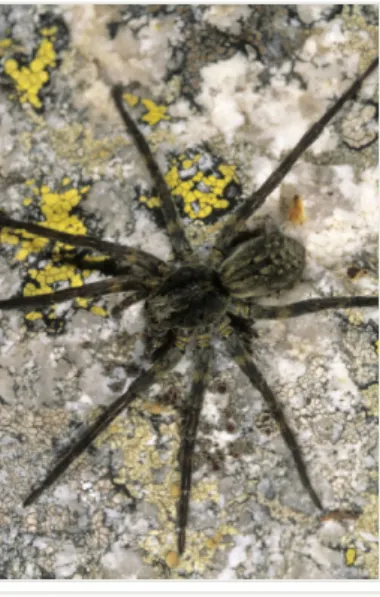
Vesubia jugorum is a large-sized spider (body length: 15–20 mm, prosoma: 7-9 mm). The prosoma is generally blackish or dark brown, marked with black streaks irradiating from the fovea. The opisthosoma is dark grey dorsally and brown reddish ventrally. Legs are dark brown dorsally and reddish-yellowish ventrally, especially on coxae (Figs 1, 2 ). See Tongiorgi (1968), Tongiorgi (1969), Maurer and Thaler (1988) and Nentwig et al. (2016) for genitalic drawings and other relevant diagnostic features.
- Global
Geographic range
Countries:
Map of records (image): - France
- Italy
Fig. 3 Figure 1.
Habitus of Vesubia jugorum — female. [Photo credit: Emanuele Biggi, 2003]
Figure 2.
Map of records (Google Earth):
Basis of EOO and AOO:
Min Elevation/Depth (m):
Max Elevation/Depth (m): Suppl. material 1
Species Distribution Model
Basis (narrative)
We based the Species Distribution Model (SDM) on literature data (Isaia et al. (2015), Isaia et al. (2007), Maurer and Thaler (1988), Simon (1881), Tongiorgi (1968), Tongiorgi (1969)) and original unpublished data gathered during recent surveys (see New occurrences).
Occurrences were used to model the current distribution of the species through a MaxEnt model in dismo R package (Hijmans et al. 2014). See Mammola et al. (2015) and Isaia et al. (2016) for details on modeling procedure. We estimated the extent of occurrence (EOO) and the area of occupancy (AOO) from the model, as implemented in the red R package (Cardoso 2016).
To estimate the potential variation of the EOO and AOO due to future climate change, the model was projected in the future (year 2028; i.e. 3 spider generations) according to two different representative concentration pathways, namely rcp 2.6 (low emission rate) and rcp 8.5 (high emission rate).
2037
2939 Figure 3.
Range description
Vesubia jugorum was originally described from an unspecified locality at high altitude in the vicinity of St. Martin-Vésubie (Haute Vésubie Valley, France). The range of this stenoendemic species is centered on the Maritime Alps (43 records). Two additional subpopulations occur at the eastern and north-western corners of the range, in Ligurian (2 records) and Cottian Alps (2 records). Most localities are situated in the Site of Community Importance and Special Area of Conservation IT1160056 “Alpi Marittime” (NW Italy).
New occurences
Materials
a. scientificName: Vesubiajugorum; family: Lycosidae; taxonRank: species;
scientificNameAuthorship: (Simon, 1881); continent: Europe; country: France;
stateProvince: Alpes-Maritimes; municipality: Uvernet Fours; locality: Col des Esbéliousses; verbatimElevation: 2500; minimumElevationInMeters: 2500;
maximumElevationInMeters: 2500; decimalLatitude: 44.28240; decimalLongitude:
6.71840; georeferenceProtocol: GPS; samplingProtocol: hand collecting; eventDate: 23 Jul 2006; habitat: Rocky areas; individualCount: 1; sex: female; lifeStage: adult;
recordedBy: Breton, Braud; identifiedBy: Herve; dateIdentified: 2006; basisOfRecord:
PreservedSpecimen
b. scientificName: Vesubiajugorum; family: Lycosidae; taxonRank: species;
scientificNameAuthorship: (Simon, 1881); continent: Europe; country: France;
stateProvince: Alpes-Maritimes; municipality: Uvernet Fours; locality: Le Trou de l'Aigle;
verbatimElevation: 2748; minimumElevationInMeters: 2748; maximumElevationInMeters:
2748; decimalLatitude: 44.26490; decimalLongitude: 6.72290; georeferenceProtocol:
GPS; samplingProtocol: hand collecting; eventDate: 20 Aug 2006; habitat: Rocky areas;
individualCount: 1; sex: female; lifeStage: adult; recordedBy: Breton; identifiedBy: Isaia (Validated); dateIdentified: 2016; basisOfRecord: Based on photographs
c. scientificName: Vesubiajugorum; family: Lycosidae; taxonRank: species;
scientificNameAuthorship: (Simon, 1881); continent: Europe; country: France;
stateProvince: Alpes-Maritimes; municipality: Meyronnes; locality: Les Courroies de David; verbatimElevation: 2405; minimumElevationInMeters: 2405;
maximumElevationInMeters: 2405; decimalLatitude: 44.43750; decimalLongitude:
6.80880; georeferenceProtocol: GPS; samplingProtocol: hand collecting; eventDate: 25 Jun 2007; habitat: Rocky areas; individualCount: 6; sex: female; lifeStage: adult;
recordedBy: Breton; identifiedBy: Isaia (Validated); dateIdentified: 2016; basisOfRecord:
Based on photographs
d. scientificName: Vesubiajugorum; family: Lycosidae; taxonRank: species;
scientificNameAuthorship: (Simon, 1881); continent: Europe; country: France;
stateProvince: Alpes-Maritimes; municipality: Allos; locality: Lac de la Petite Cayolle;
verbatimElevation: 2600; minimumElevationInMeters: 2600; maximumElevationInMeters:
2600; decimalLatitude: 44.25400; decimalLongitude: 6.72370; georeferenceProtocol:
GPS; samplingProtocol: hand collecting; eventDate: 03 Aug 2007; habitat: Rocky areas;
individualCount: 1; sex: male; lifeStage: adult; recordedBy: Breton; identifiedBy: Isaia (Validated); dateIdentified: 2016; basisOfRecord: Based on photographs
e. scientificName: Vesubiajugorum; family: Lycosidae; taxonRank: species;
Cuneo; municipality: Valdieri; locality: Passo di Préfouns; verbatimElevation: 2395;
minimumElevationInMeters: 2395; maximumElevationInMeters: 2395; decimalLatitude:
44.16970; decimalLongitude: 7.22490; georeferenceProtocol: GPS; samplingProtocol:
vidit; eventDate: 09 Aug 2011; habitat: Rocky areas; individualCount: 5; sex: female;
lifeStage: adult; recordedBy: Morando, Pala; identifiedBy: Isaia (Validated); dateIdentified:
2016; basisOfRecord: Based on photographs
f. scientificName: Vesubiajugorum; family: Lycosidae; taxonRank: species;
scientificNameAuthorship: (Simon, 1881); continent: Europe; country: Italy; stateProvince:
Cuneo; municipality: Entracque; locality: Sentiero Pagarì; verbatimElevation: 2500;
minimumElevationInMeters: 2500; maximumElevationInMeters: 2500; decimalLatitude:
44.13050; decimalLongitude: 7.41020; georeferenceProtocol: GPS; samplingProtocol:
vidit; eventDate: 17 Aug 2011; habitat: Rocky areas; individualCount: 1; sex: female;
lifeStage: adult; recordedBy: Giordano, Dalmasso; identifiedBy: Isaia (Validated);
dateIdentified: 2016; basisOfRecord: Based on photographs
g. scientificName: Vesubiajugorum; family: Lycosidae; taxonRank: species;
scientificNameAuthorship: (Simon, 1881); continent: Europe; country: France;
stateProvince: Alpes-Maritimes; municipality: Saint-Martin-Vesubie; locality: Lake Mercantour; verbatimElevation: 2600; minimumElevationInMeters: 2600;
maximumElevationInMeters: 2600; decimalLatitude: 44.14031; decimalLongitude:
7.29012; georeferenceProtocol: GPS; samplingProtocol: vidit; eventDate: 02 Aug 2011;
habitat: Rocky areas; individualCount: 1; sex: female; lifeStage: adult; recordedBy:
Piacenza; identifiedBy: Isaia (Validated); dateIdentified: 2016; basisOfRecord: Based on photographs
h. scientificName: Vesubiajugorum; family: Lycosidae; taxonRank: species;
scientificNameAuthorship: (Simon, 1881); continent: Europe; country: Italy; stateProvince:
Cuneo; municipality: Valdieri; locality: Bivio Lago Nasta; verbatimElevation: 2792;
minimumElevationInMeters: 2792; maximumElevationInMeters: 2792; decimalLatitude:
44.16750; decimalLongitude: 7.30020; georeferenceProtocol: GPS; samplingProtocol:
vidit; eventDate: 30 Aug 2011; habitat: Rocky areas; individualCount: 1; sex: female;
lifeStage: adult; recordedBy: Morando, Pala; identifiedBy: Isaia (Validated); dateIdentified:
2016; basisOfRecord: Based on photographs
i. scientificName: Vesubiajugorum; family: Lycosidae; taxonRank: species;
scientificNameAuthorship: (Simon, 1881); continent: Europe; country: Italy; stateProvince:
Cuneo; municipality: Valdieri; locality: Colle di Ciriegia; verbatimElevation: 2543;
minimumElevationInMeters: 2543; maximumElevationInMeters: 2543; decimalLatitude:
44.14183; decimalLongitude: 7.28315; georeferenceProtocol: GPS; samplingProtocol:
hand collecting; eventDate: 24 Jun 2016; habitat: Rocky areas; individualCount: 6; sex:
female; lifeStage: adult; recordedBy: Isaia, Mammola; identifiedBy: Isaia; dateIdentified:
2016; basisOfRecord: PreservedSpecimen
j. scientificName: Vesubiajugorum; family: Lycosidae; taxonRank: species;
scientificNameAuthorship: (Simon, 1881); continent: Europe; country: Italy; stateProvince:
Cuneo; municipality: Valdieri; locality: Vallone di Ciriegia; verbatimElevation: 2265;
minimumElevationInMeters: 2265; maximumElevationInMeters: 2265; decimalLatitude:
44.14887; decimalLongitude: 7.27741; georeferenceProtocol: GPS; samplingProtocol:
hand collecting; eventDate: 24 Jun 2016; habitat: Rocky areas; individualCount: 3; sex:
female; lifeStage: juvenile, adult; recordedBy: Isaia, Mammola; identifiedBy: Isaia;
dateIdentified: 2016; basisOfRecord: PreservedSpecimen
k. scientificName: Vesubiajugorum; family: Lycosidae; taxonRank: species;
scientificNameAuthorship: (Simon, 1881); continent: Europe; country: Italy; stateProvince:
minimumElevationInMeters: 2037; maximumElevationInMeters: 2037; decimalLatitude:
44.15387; decimalLongitude: 7.27433; georeferenceProtocol: GPS; samplingProtocol:
hand collecting; eventDate: 24 Jun 2016; habitat: Rocky areas; individualCount: 1; sex:
female; lifeStage: adult; recordedBy: Isaia, Mammola; identifiedBy: Isaia; dateIdentified:
2016; basisOfRecord: PreservedSpecimen
l. scientificName: Vesubiajugorum; family: Lycosidae; taxonRank: species;
scientificNameAuthorship: (Simon, 1881); continent: Europe; country: Italy; stateProvince:
Cuneo; municipality: Entracque; locality: Bivacco Moncalieri; verbatimElevation: 2710;
minimumElevationInMeters: 2710; maximumElevationInMeters: 2710; decimalLatitude:
44.13331; decimalLongitude: 7.39079; georeferenceProtocol: GPS; samplingProtocol:
vidit; eventDate: 23 Aug 2011; habitat: Rocky areas; individualCount: 1; sex: female;
lifeStage: adult; recordedBy: Morando; identifiedBy: Isaia (Validated); dateIdentified: 2016;
basisOfRecord: Based on photographs
m. scientificName: Vesubiajugorum; family: Lycosidae; taxonRank: species;
scientificNameAuthorship: (Simon, 1881); continent: Europe; country: Italy; stateProvince:
Cuneo; municipality: Vinadio; locality: Alpine scree near Colle della Lombarda;
verbatimElevation: 2342; minimumElevationInMeters: 2342; maximumElevationInMeters:
2342; decimalLatitude: 44.21163; decimalLongitude: 7.39079; georeferenceProtocol:
GPS; samplingProtocol: vidit; eventDate: 20 Jul 2016; habitat: Rocky areas;
individualCount: 1; sex: female; lifeStage: adult; recordedBy: Mammola; identifiedBy:
Mammola (Validated); dateIdentified: 2016; basisOfRecord: Based on photographs n. scientificName: Vesubiajugorum; family: Lycosidae; taxonRank: species;
scientificNameAuthorship: (Simon, 1881); continent: Europe; country: Italy; stateProvince:
Cuneo; municipality: Acceglio; locality: Passo dell'Escalon; verbatimElevation: 2939;
minimumElevationInMeters: 2939; maximumElevationInMeters: 2939; decimalLatitude:
44.42262; decimalLongitude: 6.95581; georeferenceProtocol: GPS; samplingProtocol:
hand collecting; eventDate: 25 Aug 2016; habitat: Rocky areas; individualCount: 2; sex:
female; lifeStage: adult; recordedBy: Isaia, Mammola; identifiedBy: Isaia; dateIdentified:
2016; basisOfRecord: PreservedSpecimen
o. scientificName: Vesubiajugorum; family: Lycosidae; taxonRank: species;
scientificNameAuthorship: (Simon, 1881); continent: Europe; country: Italy; stateProvince:
Cuneo; municipality: Canosio; locality: Passo della Gardetta; verbatimElevation: 2568;
minimumElevationInMeters: 2568; maximumElevationInMeters: 2568; decimalLatitude:
44.40713; decimalLongitude: 6.99455; georeferenceProtocol: GPS; samplingProtocol:
hand collecting; eventDate: 25 Aug 2016; habitat: Rocky areas; individualCount: 1; sex:
female; lifeStage: adult; recordedBy: Isaia, Mammola; identifiedBy: Isaia; dateIdentified:
2016; basisOfRecord: PreservedSpecimen
p. scientificName: Vesubiajugorum; family: Lycosidae; taxonRank: species;
scientificNameAuthorship: (Simon, 1881); continent: Europe; country: Italy; stateProvince:
Cuneo; municipality: Acceglio; locality: Oserot; verbatimElevation: 2508;
minimumElevationInMeters: 2508; maximumElevationInMeters: 2508; decimalLatitude:
44.40522; decimalLongitude: 6.97708; georeferenceProtocol: GPS; samplingProtocol:
hand collecting; eventDate: 25 Aug 2016; habitat: Rocky areas; individualCount: 1; sex:
female; lifeStage: adult; recordedBy: Isaia, Mammola; identifiedBy: Isaia; dateIdentified:
2016; basisOfRecord: PreservedSpecimen
q. scientificName: Vesubiajugorum; family: Lycosidae; taxonRank: species;
scientificNameAuthorship: (Simon, 1881); continent: Europe; country: Italy; stateProvince:
Cuneo; municipality: Argentera; locality: Rocca dei Tre Vescovi; verbatimElevation: 2628;
minimumElevationInMeters: 2628; maximumElevationInMeters: 2628; decimalLatitude:
EOO (km2):
Trend:
hand collecting; eventDate: 19 Aug 2016; habitat: Rocky areas; individualCount: 2; sex:
female; lifeStage: adult; recordedBy: Isaia, Mammola, Biggi, Galindo; identifiedBy: Isaia;
dateIdentified: 2016; basisOfRecord: PreservedSpecimen
r. scientificName: Vesubiajugorum; family: Lycosidae; taxonRank: species;
scientificNameAuthorship: (Simon, 1881); continent: Europe; country: Italy; stateProvince:
Cuneo; municipality: Entracque; locality: Vallone del Chiapous; verbatimElevation: 2324;
minimumElevationInMeters: 2324; maximumElevationInMeters: 2324; decimalLatitude:
44.17833; decimalLongitude: 7.32277; georeferenceProtocol: GPS; samplingProtocol:
hand collecting; eventDate: 06 Aug 2016; habitat: Rocky areas; individualCount: 5; sex:
male, female; lifeStage: adult; recordedBy: Milano; identifiedBy: Isaia; dateIdentified:
2016; basisOfRecord: PreservedSpecimen
s. scientificName: Vesubiajugorum; family: Lycosidae; taxonRank: species;
scientificNameAuthorship: (Simon, 1881); continent: Europe; country: Italy; stateProvince:
Cuneo; municipality: Vinadio; locality: Passo Tesina; verbatimElevation: 2450;
minimumElevationInMeters: 2450; maximumElevationInMeters: 2450; decimalLatitude:
44.23121; decimalLongitude: 7.08665; georeferenceProtocol: GPS; samplingProtocol:
hand collecting; eventDate: 20 Jul 2016; habitat: Rocky areas; individualCount: 5; sex:
male, female; lifeStage: adult; recordedBy: Isaia, Mammola, Milano; identifiedBy: Isaia;
dateIdentified: 2016; basisOfRecord: PreservedSpecimen
t. scientificName: Vesubiajugorum; family: Lycosidae; taxonRank: species;
scientificNameAuthorship: (Simon, 1881); continent: Europe; country: Italy; stateProvince:
Cuneo; municipality: Vinadio; locality: Passo di Sant'Anna; verbatimElevation: 2397;
minimumElevationInMeters: 2397; maximumElevationInMeters: 2397; decimalLatitude:
44.22240; decimalLongitude: 7.09513; georeferenceProtocol: GPS; samplingProtocol:
hand collecting; eventDate: 20 Jul 2016; habitat: Rocky areas; individualCount: 5; sex:
female; lifeStage: adult; recordedBy: Isaia, Mammola, Milano; identifiedBy: Isaia;
dateIdentified: 2016; basisOfRecord: PreservedSpecimen
u. scientificName: Vesubiajugorum; family: Lycosidae; taxonRank: species;
scientificNameAuthorship: (Simon, 1881); continent: Europe; country: Italy; stateProvince:
Cuneo; municipality: Valdieri; locality: Rifugio Bozano; verbatimElevation: 2390;
minimumElevationInMeters: 2390; maximumElevationInMeters: 2390; decimalLatitude:
44.18480; decimalLongitude: 7.29145; georeferenceProtocol: GPS; samplingProtocol:
hand collecting; eventDate: 01 Aug 2016; habitat: Rocky areas; individualCount: 4; sex:
male, female; lifeStage: adult; recordedBy: Milano; identifiedBy: Isaia; dateIdentified:
2016; basisOfRecord: PreservedSpecimen
v. scientificName: Vesubiajugorum; family: Lycosidae; taxonRank: species;
scientificNameAuthorship: (Simon, 1881); continent: Europe; country: Italy; stateProvince:
Cuneo; municipality: Chiusa Pesio; locality: Canale dei Torinesi (Monte Marguareis);
verbatimElevation: 2160; minimumElevationInMeters: 2160; maximumElevationInMeters:
2160; decimalLatitude: 44.17671; decimalLongitude: 7.69461; georeferenceProtocol:
GPS; samplingProtocol: hand collecting; eventDate: 21 Aug 2016; individualCount: 4; sex:
male, female; lifeStage: adult; recordedBy: Isaia, Galindo; identifiedBy: Isaia;
dateIdentified: 2016; basisOfRecord: PreservedSpecimen
Extent of occurrence
4412
Future decline (%):
Causes ceased?:
Causes understood?:
Causes reversible?:
Extreme fluctuations?:
AOO (km2):
Trend:
Future decline (%):
Causes ceased?:
Causes understood?:
Causes reversible?:
Extreme fluctuations?: Justification for trend
The species inhabits rocky areas of the subnival and nival zones of the Maritime Alps. The high altitude regions are particularly vulnerable to climatic variations due to climate change, with warming rates approximately doubling the global average (Böhm et al. 2001). In consequence of temperature increase, range shifts towards higher latitudes or altitudes are expected (Bellard et al. 2012), causing a decrease in the EOO. In particular, we predict a future reduction of the EOO ranging from 24% (low emission scenario) to 41% (high emission scenario).
41
No
Yes
No
Unknown
Area of occupancy
835
Decline (projected)
Justification for trend
Future forecasts based on different emission scenarios show a significant reduction in the bioclimatic range of Vesubia jugorum (details in Isaia et al. (2016)). We predict a future reduction of the AOO ranging from 12% (low emission scenario) to 32% (high emission scenario). In this perspective, it is important to take into account the connectivity of the suitable habitat, in order to provide coherent interpretations of the future trends. Suitable ecological corridors for this species would be represented by high-altitude rocky areas, which rarely occur between the Maritime Alps and the northern Alpine districts. The species is probably also limited by its low dispersal ability.
32
No
Yes
No
Number of locations:
Trend:
Number of individuals:
Trend:
Causes ceased?:
Causes understood?:
Causes reversible?:
Extreme fluctuations?:
Number of subpopulations:
Trend:
Extreme fluctuations?:
Locations
1
Justification for number of locations
The whole population is affected by the ongoing climate change.
Stable
Population
Unknow n —a census/estimation of the population has never been attempted.
Decline (inferred)
Justification for trend
Inferred from the decline in AOO.
No
Yes
No
Unknown
Subpopulations
3
Decline (projected)
Justification for trend
The main subpopulation of the species is centred in Maritime Alps. This core area includes over 90% of the known localities. Two additional subpopulations are identified at the north-western and eastern corners of the distribution range, corresponding to the Southern Cottian and Ligurian Alps, respectively. All future warming scenarios predict the extinction of the latter subpopulation.
System:
Habitat specialist:
Trend in extent, area or quality?:
Habitat importance:
Justification for fragmentation
Within the core area the suitable habitat is roughly continuous, with peaks and rocky areas ensuring connectivity between local populations. However, unsuitable habitat —namely grasslands at lower altitudes— reduces connectivity between subpopulations.
Habitat
Terrestrial
Yes
Habitat (narrative)
The species is restricted to alpine rocky areas above 2,000 m. These include rocky debris, boulder fields, and alpine screes (Figs 4, 5).
Stable
Justification for trend
The optimal habitat for the species is not expected to undergo significant variations in the future, as touristic pressure is negligible in the high mountain peaks of the Maritime Alps. Altitudinal shifts of vegetation due to climate change may hypothetically affect the extension of the subnival zone determining small variations in the extent of high altitude rocky areas.
Major Importance Figure 4.
Habitats:
Size:
Generation length (yr):
Dependency of single sp?:
Threat type:
- 6. Rocky areas (e.g. inland cliffs, mountain peaks)
Ecology
Bod y length: 15 – 20 mm, prosoma : 7–9 mm
4
No
Ecology and traits (narrative)
The species is active during the warm season, from the snow melting in late June to mid September. Males are mainly found from July to August, whereas females and immatures can be found throughout the whole season. During the day, individuals can be observed wandering on the rocks. Females with cocoons build retreats under stones (see illustration in Tongiorgi (1969)), usually of 10–15 x 3cm. Preliminary data on reared individuals and estimations based on body size suggest generation length > 3–4 years.
Threats
Threats
Future Figure 5.
Threats:
Conservation action type:
Conservation actions:
Conservation action type:
Conservation actions:
Research needed:
- 11. Climate change & severe weather
- 11.1. Climate change & severe weather - Habitat shifting & alteration - 11.3. Climate change & severe weather - Temperature extremes
Conservation
Conservation actions
In Place
- 1.1. Land/water protection - Site/area protection
Needed
- 3. Species management
- 3.3. Species management - Species re-introduction - 3.4. Species management - Ex-situ conservation - 4. Education & awareness
Justification for conservation actions
Most of the species range falls within the borders of national parks, sites of community importance and special protection areas, namely Parco Naturale Alpi Marittime (Italy), Parco Naturale del Marguareis (Italy) and Parc National du Mercantour (France).
In the light of the existing threats, it is expected that the survival of the species will depend on monitoring, conservation management and translocation programmes. Ex-situ conservation should also be considered, to ensure the preservation of healthy individuals for re-introduction in suitable habitats situated to the north from the current distribution area.
Other
- 1. Research
- 1.2. Research - Population size, distribution & trends - 1.3. Research - Life history & ecology
- 2.1. Conservation Planning - Species Action/Recovery Plan - 3. Monitoring
- 3.1. Monitoring - Population trends
Acknowledgements
We are indebted to Wolfgang Nentwig for the helpful discussion about the life history of wolf spiders. Our thanks also go to Pavel Stoev, Gergin Blagoev, Wolfgang Nentwig and Christo Deltshev for their useful comments during the review process. We are greatful to Mattia, Adriana and Guido Colombo for providing logistic support at Rifugio Garelli, and to Emanuele Biggi for the photographs of Vesubia and its habitat. We also acknowledge the help of Luca Giraudo and the staff of Parco Naturale Alpi Marittime.
References
• Bellard C, Bertelsmeier C, Leadley P, Thuiller W, Courchamp F (2012) Impacts of climate change on the future of biodiversity. Ecology Letters 15 (4): 365‑377. DOI: 10.11 11/j.1461-0248.2011.01736.x
• Böhm R, Auer I, Brunetti M, Maugeri M, Nanni T, Schöner W (2001) Regional temperature variability in the European Alps: 1760-1998 from homogenized
instrumental time series. International Journal of Climatology 21 (14): 1779‑1801. DOI:
10.1002/joc.689
• Cardoso P (2016) red: IUCN Redlisting Tools. 0.1.0.. R. URL: http://CRAN.R-project.org/package=red
• Hijmans RJ, Phillips S, Leathwick J, Elith J (2014) dismo: Species distribution modeling. 1.0-5. R. URL: http://CRAN.R-project.org/package=dismo
• Isaia M, Milano F, Mammola S (2016) Threatening the giant: the response of Vesubia jugorum (Araneae, Lycosidae) to climate change. In: Cushing P (Ed.) Program and Abstracts. 20th Congress of Arachnology, Golden, Colorado, USA, July 2-9, 2016. Denver Museum of Nature & Science Reports, 3, 230 pp. [In English]. URL: www.dmns. org
• Isaia M, Paschetta M, Chiarle A (2015) Annotated checklist of the spiders (Arachnida, Araneae) of the Site of Community Importance and Special Area of Conservation “Alpi Marittime” (NW Italy). Zoosystema 37 (1): 57‑114. DOI: 10.5252/z2015n1a4
• Isaia M, Pantini P, Beikes S, Badino G (2007) Catalogo ragionato dei ragni (Arachnida, Araneae) del Piemonte e della Lombardia. Memorie dell’Associazione Naturalistica Piemontese 9: 1‑161. [In Italian].
• Mammola S, Isaia M, Arnedo M (2015) Alpine endemic spiders shed light on the origin and evolution of subterranean species. PeerJ 3: e1384. DOI: 10.7717/peerj.1384
• Maurer R, Thaler K (1988) Über bemerkenswerte Spinnen des Parc National du Mercantour (F) und seiner Umgebung (Arachnida: Araneae). Revue Suisse de Zoologie 95: 329‑353. [In German]. DOI: 10.5962/bhl.part.79655
• Simon E (1881) Arachnides nouveaux ou rares de la faune française. Bulletin de la Société Zoologique de France 6: 82‑91. [In French].
• Tongiorgi P (1968) Su alcuni ragni italiani della famiglia Lycosidae . Memorie del Museo di Storia Naturale di Verona 16: 107‑112. [In Italian].
• Tongiorgi P (1969) Vesubia jugorum (Simon) un ragno licoside endemico delle Alpi Marittime. Atti della Società Toscana di Scienze Naturali 75(B): 255 ‑264. [In Italian].
Supplementary material
Suppl. material 1: Extent of Occurrence of Vesubia jugorum (Simon, 1881)
Authors: Stefano Mammola, Filippo Milano , Pedro Cardoso, Marco Isaia
Data type: Geographic range