Address for correspondence Khushbakht Khan
M.Phil Statistics, Department of Statistics,
Government College University, Lahore, Pakistan.
E-mail: [email protected]
Original Article
Identification of the factors associated with hirsutism
in Lahore
Introduction
Hirsutism is derived from a Latin word meaning “hairy” and defined as the thick, dark male pattern growth of hair in women. It is very disturbing condition for most of the women and affects their lives. Hirsute is a medical sign1,2, it involves the androgen dependent areas of the body such as upper lips, chin, chest, arm and
back. In severe cases, lower back, arm, lower abdomen also involved.3
Ferriman Gallwey (FG) score system is used to measure the severity of hairiness.3 Hirsute women with endocrine disorder have different etiologies as compare to IH. Around 5 to 15% women are upset by hirsute at the age of 18-45 years. In humans, androgen is the most common hormone for distribution of hair. In human body there are about 50 million hair follicles covering the body. From these hair follicles, 100,000 to 150,000 are on the facial and other parts of body. Soles of the feet, palms and lips are the only areas where there are no hair follicles.4 Khushbakht Khan, Muhammad Riaz Ahmad*, Mariam Khan**
Department of Statistics, Government College University, Lahore. * Department of Statistics, Government Postgraduate College, Jaranwala. ** Lahore Leads University, Lahore.
Abstract
Background Hirsutism is very disturbing condition for most of the women and affects their lives. Hirsute is a medical sign defined as the thick, dark male pattern growth of hair in women. The aim of this study is to explore the factors associated with hirsutism in women of Lahore, Pakistan.Methods This is a case/control study consisted of 300 subjects from whom 150 were cases and 150 controls. Researcher collected data through questionnaires from different beauty parlors, women development centers and Sanatzar institution. Descriptive and inferential analyses were used in order to explain the risk factors associated with hirsutim. To measure the association of hirsute with its risk factors Chi-square, phi and Kendall’s Tau b were used. Odd ratios and 95% confidence intervals computed with the help of logistic regression model.
Results Odd ratios and 95% confidence interval for Decrease Breast Size (OR=8.162, C.I=2.797-23.819), Family History of Hirsute (OR=6.980, C.I=3.184-15.299), Acne (OR=2.164, C.I=1.084-4.320) and Polycystic Ovary Syndrome (OR=9.060, C.I=3.492-23.507) were significant.
Conclusion There were several risk factors associated with hirsutism, out of these factors decrease breast size, family history, acne and age were most common. Family history and Polycystic Ovary Syndrome (PCOS) were highly associated with hirsute.
Key words
Operational definition of hirsutism
“Hirsutism is defined as excessive terminal hair growth in androgen-dependent areas of the body in women, which grows in a typical male distribution pattern".5
Inclusion & exclusion criteria
Women of all age groups were added to the study. Women who diagnosed as hirsute by the F-G scoring system were included and classified as cases. Tests of serum androgen and serum testosterone were not done. Most of the participant’s age was less than 45 or 50 years so risk factor, menopause were excluded from study.
Types of hirsutism
Hirsutism with normal androgen level called
primary hirsutism. Hirsutism with extra
production of androgen called Secondary Hirsutism. With either type hair became thick,
extend and dark.6 In women the face, back, arm
and chest is covered by vellus hair. In men, terminal hairs cover these parts. Both have a mixture of terminal and vellus hair on their legs, and armpit.7
Figure
Causes of hirsutism
The causes of hirsutism can be divided into:
• Related to non-androgenic factors,
• Related to androgen excess and
• Idiopathic Hirsutism (IH).
In the majority of patients hirsutism should be considered as a sign of other conditions [e.g., the Polycystic Ovary Syndrome (PCOS),
androgen-secreting tumors, Non-Classic Adrenal
Hyperplasia (NCAH), or syndromes of severe insulin resistance], rather than an isolated disorder. The exception is possibly those patients with “Idiopathic Hirsutism” (IH), also
called simple hirsutism.8,9 Non-androgenic
factors are relatively rare, while androgenic causes account for more than 80% of patients, and include Polycystic Ovary Syndrome (PCOS), which affects about 70-80% of hirsute
women.10
This study was selected because IH is common clinical problem. By identifying associated factors, hirsutism can be managed earlier. It is essential to talk about Hirsutism Status (HS) as
many hirsute women feel shame and
nervousness. They are very disturbed by this condition. Dermatologists or gynecologists may use this research. This case control study was conducted in order to investigate the factors associated with hirsutism in Lahore.
Methodology
The statistical framework of the study, data collection technique, coding scheme, study plan and statistical analysis are as follows.
Natures of the study
study was conducted to explore the risk factors of hirsute.
Sample size
The study consisted of 300 out of which 150 hirsute women as cases and 150 non-hirsute women as controls. This research conducted the disease during the period of March 2016 to September 2017. For the analysis, SPSS (Statistical Package for Social Sciences) version 20.0 was used.
Technique of data collection
For this purpose, data was collected with the
help of self-designed questionnaire.
Questionnaire was designed by the consultation with supervisor and dermatologist, merely female collected data. An F-G scoring system was also included for the assessment of hirsute whether it was light, moderate or severe.
Study area and study period
The study area consisted of different beauty shops, dermatologist department of different hospitals and different gyne clinics. This research conducted the disease during the period of March 2016 to September 2017.
Data analysis
For the Analysis, SPSS (Statistical Package for Social Sciences) version 20.0 was used. For the Descriptive and Inferential Analysis, different statistical tools including averages, percentages, Chi-square test (to check the degree of association), Phi/v-statistics, Kendall’s Tau-b, Odds Ratios, the 95% confidence intervals and Logistic Regression models were used. Logistic regression has been used to examine the relationship between independent variables and dichotomous responses variable. To represent
the relationship between dependent and
independent variable, there must be nonlinear relationship among the coefficient of both variables. If p-value is greater than 0.05 then the
results will be significant otherwise
insignificant.11
D.R Cox (1958) developed logistic regression model for the first time. The logistic regression has no assumptions of linearity, normally distributed and homogeneous variance of explanatory variables. The purpose of logistic regression was to make a best-fitted model to describe the relationship among response and
explanatory variables.12
The adequacy of the fitted model is observed by using the Cox and Snell R2 and NagelkerkeR2.
Both the measures are the same, having range
from zero to one and similar to R2 in
interpretation. Nagelkerke R2 can attain its
maximum value one but the Cox and Snell's R^2
can never attain its maximum value one.13
Results
This study consisted of 300 out of which 150 hirsute women as cases and 150 non-hirsute women as controls. This research conducted the disease during the period of March 2015 to
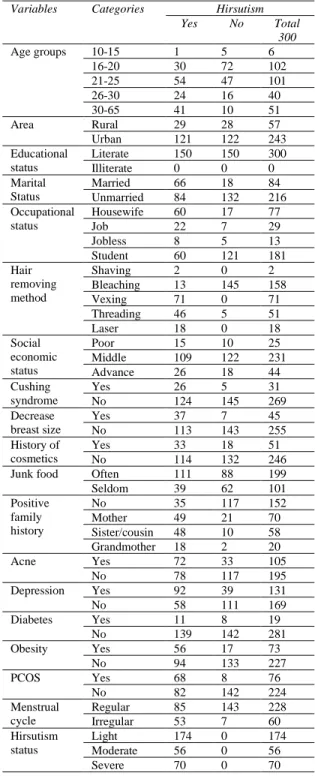
September 2016. From Table 1, age group (AG)
was divided into 5 categories such as 10-15, 16-20, 21-25, 26-30 and 30-65. The counts (percentage) of these groups are 1 (0.7%), 30 (20%), 54 (36%), 24 (16%) and 41 (27.3%) respectively. Results show that most cases of hirsute were laying in the age group of 21-25 years i.e. 36%.
Table 1 Classification of the variables of cases/ controls
Variables Categories Hirsutism Yes No Total
300
Age groups 10-15 1 5 6
16-20 30 72 102
21-25 54 47 101
26-30 24 16 40
30-65 41 10 51
Area Rural 29 28 57
Urban 121 122 243
Educational status
Literate 150 150 300
Illiterate 0 0 0
Marital Status
Married 66 18 84
Unmarried 84 132 216
Occupational status
Housewife 60 17 77
Job 22 7 29
Jobless 8 5 13
Student 60 121 181
Hair removing method
Shaving 2 0 2
Bleaching 13 145 158
Vexing 71 0 71
Threading 46 5 51
Laser 18 0 18
Social economic status
Poor 15 10 25
Middle 109 122 231
Advance 26 18 44
Cushing syndrome
Yes 26 5 31
No 124 145 269
Decrease breast size
Yes 37 7 45
No 113 143 255
History of cosmetics
Yes 33 18 51
No 114 132 246
Junk food Often 111 88 199
Seldom 39 62 101
Positive family history
No 35 117 152
Mother 49 21 70
Sister/cousin 48 10 58
Grandmother 18 2 20
Acne Yes 72 33 105
No 78 117 195
Depression Yes 92 39 131
No 58 111 169
Diabetes Yes 11 8 19
No 139 142 281
Obesity Yes 56 17 73
No 94 133 227
PCOS Yes 68 8 76
No 82 142 224
Menstrual cycle
Regular 85 143 228
Irregular 53 7 60
Hirsutism status
Light 174 0 174
Moderate 56 0 56
Severe 70 0 70
The counts (percentage) of cases who has positive family history as mother, sister/cousin and grandmother are 49 (32.7%), 48(32%) and 18(12%) respectively. Results show that mostly patient’s mothers were also hirsute. In this study, out of 150 cases 115 (76.7%) cases have positive
family history. Results show that hirsute was more likely in cases with positive family history.
Acne among cases and controls was 72 (48%) and 33 (22%) respectively. Results showed that percentage of acne among cases is very high as compare to controls. In cases the total counts (percentage) of PCOS was 68 (45.3%). In controls the total counts (percentage) of PCOS was 8 (5.3%). PCOS was most common in cases as its numbers and percentage was higher in cases.
Menstrual cycle was divided into three categories i.e. regular, irregular and absence. Among cases the count (percentage) of regular, irregular and absence menstrual cycle 85 (56.7%), 53 (35.3%) and 12 (8%) respectively. In case of controls the counts (percentage) of regular, irregular and absence 143 (95.3%), 7 (4.7%) and no control had absence periods.
It was observed that subjects who have risk factors like age (category 21-25), family history, acne, PCOS and irregular menstrual cycle were more likely to have Hirsutism status (HS). From results of nine body areas of hirsute, it was found that there were most cases of facial hirsute. This result was verified with the results.14,15
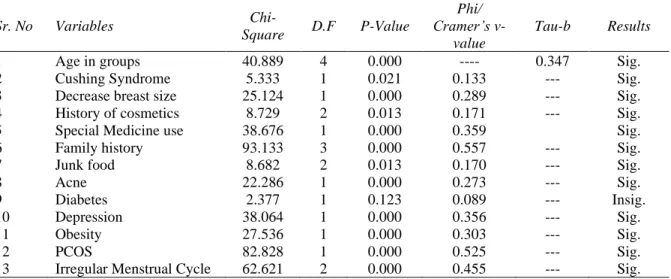
To check the association between hirsute and its associated factors chi-square, Phi/ Cramer’s v statistics and Tau-b were computed. To check the association between hirsute and risk factors that have order, Kendall’s tau b statistics was used. The factors that were nominal in nature, Phi/Cramer’s V-values were computed. Variable whose p-value was less than 0.05 were considered as significant.
Table 2 Chi-Square, Phi/ Cramer’s v and Kendall’s Tau b statistics
Sr. No Variables
Chi-Square D.F P-Value
Phi/ Cramer’s
v-value
Tau-b Results
1 Age in groups 40.889 4 0.000 ---- 0.347 Sig.
2 Cushing Syndrome 5.333 1 0.021 0.133 --- Sig.
3 Decrease breast size 25.124 1 0.000 0.289 --- Sig.
4 History of cosmetics 8.729 2 0.013 0.171 --- Sig.
5 Special Medicine use 38.676 1 0.000 0.359 Sig.
6 Family history 93.133 3 0.000 0.557 --- Sig.
7 Junk food 8.682 2 0.013 0.170 --- Sig.
8 Acne 22.286 1 0.000 0.273 --- Sig.
9 Diabetes 2.377 1 0.123 0.089 --- Insig.
10 Depression 38.064 1 0.000 0.356 --- Sig.
11 Obesity 27.536 1 0.000 0.303 --- Sig.
12 PCOS 82.828 1 0.000 0.525 --- Sig.
13 Irregular Menstrual Cycle 62.621 2 0.000 0.455 --- Sig. Table 3 Correct classification and misclassification of subjects
Table 4 Model coefficients with Odd Ratios and 95% C.I’s for Odds Ratio
Variables Β S.E(β) Wald D.F P-Value Odds
Ratio
95% (CI) for odds Lower Upper
DBS (1) 2.100 0.546 14.763 1 0.000 8.162 2.797 23.819
FHH 41.770 3 0.000
FHH (1) 1.943 0.400 23.546 1 0.000 6.980 3.184 15.299
FHH(2) 2.254 0.477 22.299 1 0.000 9.526 3.738 24.279
FHH (3) 2.981 0.842 12.535 1 0.000 19.706 3.784 102.628
Acne(1) 0.772 0.353 4.785 1 0.029 2.164 1.084 4.320
PCOS(1) 2.204 0.486 20.529 1 0.000 9.060 3.492 23.507
AG 18.076 4 0.001
AG(1) 0.258 1.195 0.047 1 0.829 1.294 0.124 13.472
AG(2) 1.510 1.180 1.638 1 0.201 4.529 0.448 45.776
AG(3) 1.360 1.246 1.190 1 0.275 3.895 0.339 44.787
AG(4) 2.367 1.232 3.693 1 0.055 10.663 0.954 119.182
Constant -2.516 0.325 60.094 1 0.000 0.081
Note: Significance of the variables has been discussed based on p-value (sig.) and the existence of p-value based on Wald test.
medicine use, family history of hirsute (FHH), acne, obesity, PCOS, irregular menstrual cycle were significant factors associated with the disease as p-value < α. Table 2 showed that diabetes was insignificant factor as p-value > α. Out of all associated factors, FHH had largest Phi/Cramer’s V value i.e. 0.557 this showed that this factor was highly associated with hirsute.
PCOS was the second most associated risk factor of the hirsute as Phi/Cramer’s v value was 0.525. All variables were positive associated which means that these fourteen factors were directly proportional to the disease.
Omnibus test was used to check overall significance of the model.16 Omnibus test Observed
Predicted
Hirsutism Percentage Correct Controls Cases
Hirsutism Controls 124 26 82.7%
Cases 28 122 81.3%
predicted that model was significant as p-value was 0.000. It also showed that at least one of category was affecting the dependent variable. In order to observe the goodness of fit, the values of Cox and Snell R2 and Negelkerke R2 were 0.456 and 0.608, respectively.
From Table 3, it was observed that the overall percentages of correctly classified and misclassified of subjects were 82.0% and 18.0% respectively. While out of total controls 82.7% were correctly predicted as controls and 17.3% were misclassified as patients. Similarly, out of total cases, 81.3% were correctly predicted as cases and 18.7% were misclassified as controls.
Table 4 indicated that the four factors including Decrease Breast Size (DBS), Family History of Hirsute (FHH), Acne and Polycystic Ovaries Syndrome (PCOS) were found to be significantly associated with the risk of Hirsute in Lahore. Results showed that all the variables were significant as there p – value was less than α except age. Table showed that P-Value of Age was greater than α so it was insignificant variable. In this table the first factor is DBS (1) “decrease breast size”; the reference category for DBS (1) “decrease breast size” was taken as “non- decrease breast size”. Its regression coefficient β was 2.100 so decrease breast size was positively associated with hirsute. Odds ratio was 8.162 its mean that patients whose breast size is decreasing have 8.162 times more chances of getting hirsute as compare to non- decrease breast size. The 95% CI was (2.797 to 23.819) as this limit not included one its means that this variable was significant with the disease. The next variable was acne; the reference category for acne (1) was taken as non-acne patients. Its regression coefficient β was 0.772, so acne was positive associated with hirsute. Odds ratio was 2.164 its mean that patients who have acne also have 2.164 times more chances of getting hirsute as compare to
non-acne patients. The 95% CI was (1.084 to 4.320) as this limit not included one its means
that this variable was significant with the disease and positively associated with the hirsute. For next variable PCOS (1) “Polycystic Ovaries Syndrome” reference category was taken as with PCOS and without PCOS patients. Its regression coefficient β was 2.204 so PCOS was positive associated with hirsute. Odds ratio was 9.060 its mean that patients whose breast size was decreasing have 9.060 times more chances of having hirsutism as compare to without PCOS. The 95% CI was (3.492 to 23.507) as this limit not included one its means that this variable was significant with the disease. The Logit Model is given below:
Ŷ= -2.516 + 2.100 * DBS + 1.943 * FHH (1) + 0.772 * Acne +
2.204 * PCOS (1) +0.258 AG (1) (i)
Let by using the above regression predict a situation for having
hirsute:
DBS (1) = 1,FHH (1) = 0, Acne (1) = 1,PCOS (1) =1, Age (1) =
1 (ii)
Therefore, by this the value of Ŷ was 2.818. Now the predicted
probability was:
f (Ŷ) = 1 (1+e−y) (iii)
= 0.943
Hence, at the presence of above situation i.e. in the presence of risk factors DBS, Acne, PCOS and Age there were 94.3% chances of getting Hirsute. It is evident from the omnibus test, percentages of the correct classification, Cox and Snell R2 and Nagelkerke R2 that the fitted model is adequate and the Odds Ratios and its 95% Confidence Intervals are valid for inferences.
Discussion
i.e., 11%. From their study, 51% hirsute had PCOS and 45% IH women were obese.17 Over 90% of women with disease had the comparatively nonthreatening conditions of IH or PCOS.18
A cross-sectional study was conducted among 790 premenopausal Iranian women. Most of the women had hirsutism at the age group of 21-25 years as compared to other groups. Family history, acne, irregular menstrual cycle, obesity, diabetes and PCOS was 56.2%, 70%, 38.6%, 6.5%, 0.6% and 62.53%. IH was found in 35.19%.19
Present study conducted to find the significant factors associated with hirsutism. As this problem is increasing day by day, so the researcher selects this topic. This is a case/control study consisted of 300 subjects from which 150 are cases and 150 controls. Researcher collected data from different beauty parlors, and Sanatzar institution. A questionnaire was developed to collect information from cases and controls. Questionnaire included risk factors related to IH. For the valuation of hirsute, F-G score system was used. Age at the start of the hirsutism, area, education, FHH, crushing syndrome, DBS and PCOS were recorded in the questionnaire. Symptoms related to PCOS as acne, diabetes, depression and irregular menstrual cycle also asked for assessment of PCOS.
Collected data from 300 subjects entered into SPSS 20.0 after coding. In descriptive analysis frequencies and percentages of factors collected. In bivariate analysis, Chi-square, phi and Kendall’s Tau b results showed that Family history and PCOS were highly associated with hirsute.17-19 From results of nine body areas of hirsute it was found that, there were most cases of facial hirsute.14,15 In analytical analysis, multinomial logistic regression was run. DBS
(OR=8.162, p=0.000), FHH (OR=6.980, P=0.000), Acne (OR=2.164, P=0.029) and PCOS (OR=9.060, P=0.000) were significant whereas Age (OR=1.294, P=0.829) was insignificant risk factor according to the results.
Conclusion
From present research, it was observed that decrease breast size, family history, acne and age were most common factors that were associated with hirsutism.
References
1. Lobo RA. Potential options for preservation of fertility in women. N Engl J Med 2005; 353(1): 64-73.
2. Yen S. Chronic anovulation caused by peripheral endocrine disorders. Reproductive Endocrinology 1991: 593-601. 3. Hatch R, Rosenfield RL, Kim MH, Tredway
D. Hirsutism: implications, etiology, and management. Am J Obstet Gynecol 1981; 140(7): 815-30.
4. Swingler R, Awala A, Gordon U. Hirsutism in young women. Obstet Gynecol 2009; 11(2):101-7.
5. Hohl A, Ronsoni MF, Oliveira MD. Hirsutism: diagnosis and treatment. Arquivos Brasileiros de Endocrinologia & Metabologia 2014; 58(2): 97-107.
6. Malik LM, Khursheed K, Haroon TS, Malik MA. An aetiological study of moderate to severe hirsutism. Pak J Med Sci 2007; 23(2): 167.
7. Swain J, Sharma S, Prakash V, Agrawal NK, Singh SK. Steroid cell tumor: a rare cause of hirsutism in a female. Endocrinology, diabetes & metabolism case reports. 2013;2013.
8. Legro RS. The genetics of polycystic ovary syndrome. Am J Med 1995; 98(1): S9-16. 9. Kashar-Miller M, Azziz R. Heritability and
the risk of developing androgen excess. J Steroid Biochem 1999; 69(1-6): 261-8. 10. Pate C. The story plot of living the
embarrassment of hirsutism. Arch Psychiat Nurs 2013; 27(3): 156-7.
12. Cox DR. The regression analysis of binary sequences. Journal of the Royal Statistical Society. Series B (Methodological). 1958 Jan 1:215-42.
13. Hosmer DW, Lemeshow S. Special topics. Applied Logistic Regression, Second Edition. 2000:260-351.
14. Ahmad QM, Shah IH, Sameem F. Hirsutism in Kashmir: an etiological study. Ind J Dermatol 2009; 54(1): 80.
15. Balaji S, Amadi C, Prasad S, BalaKasav J, Upadhyay V, Singh AK, Surapaneni KM, Joshi A. Urban rural comparisons of polycystic ovary syndrome burden among adolescent girls in a hospital setting in India. BioMed Research International 2015; 2015. 16. HosmerJr DW, Lemeshow S, Sturdivant
RX. Applied logistic regression. John Wiley & Sons; 2013.
17. Al-Ruhaily A, Malabu U, Sulimani R. Hirsutism in Saudi females of reproductive age: a hospital-based study. Annals of Saudi Medicine 2008; 28(1):28.
18. Malik LM, Ahmad TJ. A diagnostic approach towards patients with hirsutism-screening for sinister causes. J Pak Assoc Dermatol 2005; 15: 320-2.
19. Ansarin H, Aziz-Jalali MH, Rasi A, Soltani-Arabshahi R. Clinical presentation and etiologic factors of hirsutism in premenopausal Iranian women. Arch Iran Med 2007; 10(1): 7-13.