Respiratory Care Managers’ Preferences Regarding Baccalaureate
and Master’s Degree Education for Respiratory Therapists
Ellen A Becker PhD RRT-NPS AE-C
OBJECTIVE: Determine respiratory care managers’ preferences regarding baccalaureate and mas-ter’s degree education for practicing respiratory therapists (RTs). METHODS: A survey was mailed to 1,444 members of the Management Section of the American Association for Respiratory Care. Man-agers were asked about their preferences for RTs who hold or are pursuing baccalaureate degrees, the value of various courses of study (majors), and degrees earned via distance learning. Demographic data and attitudes about distance learning, content, and target audiences for master’s degree programs were also collected. RESULTS: Twenty-six percent of those polled responded. Thirty-four percent of respon-dents preferred baccalaureate degree over associate degree for entry-level RTs, 28% had no preference, and 38% no opinion. Regarding hiring of experienced RTs, 70% of respondents preferred RTs with baccalaureate degrees. Regarding baccalaureate completion degree majors, advanced respiratory care practice was most highly valued. Sixty percent thought that a degree earned via distance learning was equivalent to one earned in the traditional classroom setting; 23% thought a distance learning degree was of less value; 3% thought a distance learning degree was of greater value; and 14% were uncertain. The respondents thought graduate degrees were valuable for managers, clinical specialists, educators, and supervisors. Although 95% of managers would recommend graduate programs that have some distance learning courses, only 75% would recommend programs offered solely via distance learning. CONCLUSIONS: For RTs who plan to complete a baccalaureate degree, majoring in advanced respi-ratory care practice is potentially valuable. Managers showed preference for hiring experienced RTs with baccalaureate degrees but did not prefer entry-level therapists with baccalaureate degrees. Grad-uate degrees are supported for managers, clinical specialists, educators, and supervisors. Most managers supported some use of distance learning for graduate degrees. Key words: education, distance learning, graduate education, professional education, respiratory therapy. [Respir Care 2003;48(9):840 – 858. © 2003 Daedalus Enterprises]
Introduction
The education requirement for entry into the respiratory care profession has changed as the profession has matured.
The entry-level requirement in 1962 was a minimum 12-month curriculum. At present, the entry-level requirement is an associate degree.1,2The associate degree is also the
requirement for respiratory therapists (RTs) to earn the advanced practice Registered Respiratory Therapist (RRT) credential.2Discussions have been taking place for over 2
decades regarding increasing the required education be-yond the associate degree for advanced RTs. The Ameri-can Association for Respiratory Care (AARC) has led sev-eral initiatives for advancing RT education. In 1990, the AARC launched a baccalaureate completion program in partnership with Western Michigan University.3Next the
AARC held 2 education consensus conferences, which recommended post-associate-degree courses for RT spe-cialty practice4,5and graduate programs to prepare faculty,
clinical specialists, and researchers.4In 2001, the AARC
Ellen A Becker PhD RRT-NPS AE-C is affiliated with the Respiratory Care Division, Long Island University–Brooklyn Campus, Brooklyn, New York.
Ellen A Becker PhD RRT-NPS AE-C presented versions of this report at the Open Forum of the 46th International Respiratory Congress, October 7–10, 2000, in Cincinnati, Ohio, and at the AARC Summer Forum, June 2–4, 2000, in Vail, Colorado.
Correspondence: Ellen A Becker PhD RRT-NPS AE-C, Respiratory Care Division, Long Island University, One University Plaza, Brooklyn NY 11201. E-mail: [email protected].
established a coalition and an Internet Listserv on bacca-laureate and graduate respiratory therapy education.6
The academic literature contains several editorials and limited research on RT baccalaureate and master’s degree education. Editorials in RESPIRATORYCAREhave called on
educators to offer advanced courses to practicing RTs7and
for RTs to be lifelong learners and continue their educa-tion.7,8 Kester and Stoller believe that RTs should move
beyond learning just the basic knowledge of treatment modalities; they should also help to find the most appro-priate therapy delivery method for each patient, be sensi-tive to age-related issues, adapt clinical policies across a broad range of practice settings, conduct research and dis-seminate research findings to advance the profession, and effectively communicate with all health care team mem-bers.8
Research from the early 1990s, involving clinicians, ed-ucators, managers, and physicians, looked at the additional knowledge, skills, and attributes necessary for advanced RTs.1 That study was extended to evaluate the length of
and award for advanced-level preparation, but the partic-ipants were unable to come to a consensus. However, the participants predicted a duration of longer than 3 postsec-ondary academic years.9The majority of published studies
evaluating advanced-level respiratory therapy education involved invited participants from a cross-section of edu-cation, management, medicine, and respiratory care clini-cal subspecialty communities.1,4,5,9Using invited
partici-pants may have biased study outcomes. Also, none of these studies focused on the specific needs of the RTs who are the target population for advanced education. In prep-aration for the second AARC consensus conference, an impact study surveyed a random sample of respiratory care managers, respiratory care program directors, physi-cians, RTs, and administrators of hospitals, home care, rehabilitation, and skilled nursing facilities.10Limitations
of the impact study included that the authors did not report the response frequencies for Likert-scale items by individ-ual participant groups and that the survey response rate was only 36%. However, the responses of the various participant groups to the impact study’s open-ended ques-tions appear under separate categories. The number of written comments made by the RT group included more negative statements than positive statements toward ad-vanced degrees.
Another study that addressed RTs’ views found that 40% of practicing RTs (in a Midwestern state) who did not have baccalaureate degrees desired them. RTs questioned how their managers would value a baccalaureate degree, which degree major was most desirable, and how the de-gree would be valued if earned via distance learning (DL).11
Knowledge of respiratory care managers’ perspectives on these baccalaureate degree questions could provide RTs with valuable professional guidance. The present study
tested the following hypotheses related to advanced de-grees for practicing RTs:
1. Respiratory care managers will value baccalaureate and master’s degrees earned by practicing RTs, but will not view them as essential for all RTs.
2. Respiratory care managers will value respiratory care baccalaureate degree majors more highly than other de-gree majors for practicing RTs who complete baccalaure-ate degrees.
3. Respiratory care managers will recommend graduate degree majors related to leadership, clinical specialist, ed-ucation, and research roles for practicing RTs.
4. Respiratory care managers will value baccalaureate and master’s degrees earned via DL by practicing RTs.
Methods
A survey (see Appendix) was mailed to 1,444 members of the AARC’s Management Section. The mailing included a cover letter (with an original signature) explaining the purpose of the survey, and a self-addressed stamped en-velope. The survey asked about baccalaureate degrees, mas-ter’s degrees, and DL, and for demographic information (current job title, respiratory care credentials, type of re-spiratory care education program, employment setting, and high-school academic preparation). For each post-high-school degree program, respondents were asked whether they completed the program before or after respi-ratory care training, if most courses were taken evenings or weekends, and if any courses were taken via DL.
The respondents were asked if they would prefer hiring an RT who is working toward a baccalaureate degree, if their facilities gave financial incentives to personnel who have or are pursuing baccalaureate degrees, and the aver-age amount of the incentive. Respondents were also asked for their opinions regarding the value of various baccalau-reate degree majors (business, management, teaching, sci-ence, liberal arts, advanced respiratory care practice, and other categories) for RTs. The value ratings were made on a 3-point scale; the choices were high value, moderate value, and low value. The degree categories included in this study were the same as those in my 1995 survey (partially funded by the Wisconsin Society for Respiratory Care) regarding baccalaureate degree completion, because in that study the only “other” degree majors listed were careers unrelated to respiratory care.12The present survey
also asked the respondents if they prefer to hire an entry-level RT with a baccalaureate degree versus associate de-gree or have no opinion.
The survey included 2 open-ended questions about mas-ter’s degrees. The questions asked respondents to recom-mend desirable master’s degree majors for practicing RTs and job titles that should require a graduate degree. Re-spondents also rated (on 3-point scale of high, moderate,
and low) the value of 21 specific course topics that might appear in an RT master’s degree program. The items for this scale were generated from a convenience sample (n⫽ 4) of RT managers.
The section containing DL questions began with a def-inition of DL that included courses conveying content and dialogue between students and instructors via written ma-terial, videotapes or audiotapes, audio-teleconferencing, satellite, television, or other electronic media. One ques-tion asked respondents to compare the value of a bacca-laureate degree earned (by a practicing RT) primarily via DL to the same degree earned via traditional classroom education. The 4 response options were higher value, equal value, lower value, and uncertain. Respondents who had hired RTs whose entry-level training was via DL rated (with yes/no responses) their satisfaction with the employ-ees’ knowledge, and whether they would hire another RT whose entry-level training was via DL. Regarding gradu-ate education, respondents answered 2 yes/no questions as to whether they would recommend graduate programs that offered some or all of their courses via DL. The final DL measurement was made with the Distance Education At-titude Scale, an 11-item, 7-point semantic differential scale that has a Cronbach’s alpha of 0.86 and uses the descrip-tors interesting/boring, affordable/costly, useful/useless, appropriate/inappropriate, time-saving/time-consuming, creative/unimaginative,successful/unsuccessful,practical/ impractical, nonthreatening/threatening, active/passive, andsimple/complex.11Values were assigned to scale items
ranging from⫹3 to –3. The attitude score was generated by computing the sum of all 11 values.
To establish content validity and improve the format, the survey and cover letter were pilot-tested by a conve-nience sample of 12 respiratory care managers who had no prior exposure to the survey. They suggested revisions to improve clarity, to move from basic to complex questions, to change formatting to increase white space, and to change certain of the master’s degree program content items. These respondents also timed how long it took to complete the survey. The recommended changes were implemented and 2 graduate students proofread the final version.
Implementation
The surveys were mailed through the AARC to current members of the AARC Management Section in October 1999. Some survey recipients contacted me to ask whether they should respond to the survey, because they worked as educators or were retired; they were asked not to respond. To study the representativeness of the respondent sam-ple, a graduate student assistant telephoned 25 manag-ers who had been sent the survey but had not responded (nonresponders), asked a subset of the survey questions (including the majority of the questions about
bacca-laureate degrees and all the demographic questions), and recorded the data on a modified survey form. The sample size required for 80% power could not be cal-culated because no nonresponder data from similar stud-ies were available to estimate effect size. A sample size of 25 nonresponders were selected, because it fit within the available resources. The AARC supplied the contact information for 50 members of the Management Sec-tion, selected at even intervals from an alphabetical list, and numbered 1–50. A graduate student assistant at-tempted to contact the 25 members associated with the odd numbers on the list to determine if they received and returned the survey. The assistant thanked survey respondents and interviewed consenting nonresponders. Next the assistant attempted to reach managers associ-ated with the even numbers on the list, until data had been collected for 25 nonresponders.
Data Analysis
Data from the returned surveys, including legible zip codes from the survey’s return envelopes, were entered into statistics software (SPSS version 10.0, SPSS, Chi-cago, Illinois). Frequency data were screened for data en-try errors, errors were corrected, and final frequency re-ports were generated. A graduate student assistant and the author independently categorized the responses to the open-ended questions regarding recommopen-ended graduate degrees majors and jobs that should require a graduate degree. Disagreements about category membership were resolved with discussion.
Statistical tests assessed the representativeness of the sample and evaluated attitudes toward DL and how prior DL experience affected respondents’ opinions. Results from surveys with missing data were included in analyses when sufficient data existed for the analysis. Response catego-ries were combined whenever there was insufficient data for analysis of individual categories.
The representativeness of the study was tested via sta-tistical analyses between nonresponders and respondents, along with comparisons of respondent data and data from the AARC’s year 2000 RT Human Resources Survey (a national survey).13Comparisons were made of respondents’
and nonresponders’ valuations of various baccalaureate degree majors, practicing RTs earning baccalaureate de-grees via DL, hiring RTs with baccalaureate versus asso-ciate degrees, RTs who had entry-level RT training via DL, job titles, professional credentials, respiratory care training, employment setting, highest academic degree, and exposure to DL coursework. Comparisons were made with the chi-square test of homogeneity, and differences were considered statistically significant when p ⬍ 0.05. Data yielding expected frequencies of less than 5 in more than 2 cells were recomputed after combining appropriate data
from 2 or more categories. In analyses where the chi-square test was significant for tests involving 3 or more categories, pairwise comparisons were conducted, using the sequential Bonferroni correction method, to control for a familywise p⬍ 0.05.
The chi-square goodness of fit test was used to de-termine whether the data from the present study agreed with data from the AARC Human Resources Survey. Respondents’ regional location were categorized by com-paring legible zip codes from the survey’s return enve-lopes and the AARC Human Resources Survey’s 9 cen-sus regions. The job titles used in the present study (supervisor, assistant or associate director, director, and administrator) differed from those of the AARC Human Resources Survey (supervisor and director). The 2 choices in the AARC Human Resources Survey were intended to separate supervisors from upper level man-agers (Dubbs WH, American Association for Respira-tory Care, 2001, personal communication). Thus, re-spondents in the present study who selected “supervisor” or “associate or assistant director” were combined, and those who selected “director” or “administrator” were combined, and those combined values were compared to the AARC Human Resources Survey’s supervisor and director categories, respectively. The combined su-pervisor and director categories were compared with the AARC Human Resources Survey’s data on the frequency of holding the Registered Respiratory Therapist creden-tial, the Registered Pulmonary Function Technologist credential, the perinatal/pediatric credential, and with respiratory care educational preparation, highest aca-demic degree, and employment setting. Respiratory care education comparisons were made between this study’s categories of on-the-job training, certificate, and com-bined 1-plus-1, 2-year, 2-plus-2, and baccalaureate pro-gram and the AARC Human Resources Survey’s cate-gories of on-the-job training, technician, and RT program, respectively. This study’s employment setting categories of hospital care, extended care, and home care were compared to the AARC Human Resources Survey’s categories of acute care, combined long-term acute care/rehabilitation hospital and skilled nursing, and home care, respectively. Post-hoc power analyses and effect sizes were conducted for all tests of repre-sentativeness that were not significant.
The Pearson r correlation coefficient was calculated to test the relationships between both the DL attitude score and DL experience with questions about bacca-laureate, master’s degree, and demographic data. Dif-ferences were considered statistically significant when p ⬍ 0.05. The questions regarding baccalaureate edu-cation addressed attitudes about DL and how the re-spondent’s DL experience correlated with his or her valuation of DL baccalaureate education, satisfaction
with the knowledge of RTs who used DL for their entry-level preparation, and desire to hire additional RTs with entry-level DL preparation. Correlations for graduate program questions tested how well DL attitude and DL experience related to recommendations of graduate pro-grams with some or all DL coursework. The DL attitude score was correlated with the demographic variables of job title, highest degree held, and prior DL experience. Additional correlations compared how the 11 items of the DL attitude scale correlated with prior DL experi-ence, to determine which items were most influenced by DL experience.
Results Representativeness
Sixteen of the 1,444 mailed surveys were either unde-liverable or sent to educators or retired RTs, who were asked not to respond. With the revised sample size (1,428) there were 365 respondents (a response rate of 26%). Com-parison of respondent and nonresponder demographic data showed no significant differences in professional creden-tials, respiratory care education, employment setting, or experience using DL. The nonresponder group differed in job titles, having a greater number of “administrator” and “other” classifications, and in having more nonbaccalau-reate and fewer graduate degrees than the respondent group (Tables 1 and 2).
Regarding baccalaureate degree questions, no statis-tically significant differences were found for how re-spondents and nonresponders valued practicing RTs completing baccalaureate degrees in advanced respira-tory care practice, teaching, science, and business, and hiring baccalaureate versus associate degree candidates for entry-level positions. The nonresponders gave both the liberal arts and management degree majors more high and moderate value ratings than did the respon-dents. Also, nonresponders had less preference for hir-ing an RT who has or is workhir-ing toward a baccalaureate degree than did the respondents. There was an insuffi-cient response rate to calculate whether there was a difference between respondents and nonresponders in their ability to hire RTs who have entry-level prepara-tion via DL (Tables 3 and 4).
Comparisons for questions related to DL and baccalau-reate degrees revealed the following. Nonresponders were more likely to be uncertain or view DL as having a lower value than classroom education. The nonresponders had hired fewer RTs with DL training than had the respon-dents. Respondents and nonresponders had the same sat-isfaction with the knowledge of employees who received their entry-level training via DL and would hire RTs with DL entry-level training at the same rate (Tables 5 and 6).
Table 1. Demographics of Respondents and Nonresponders*
Response Categories (n) Chi-square
(p) Job Title
Supervisor (Associate or Assistant Director) Director† Administrator (Other)†
Respondents 36 (36) 225 23 (41) 5.090
Nonresponders 1 (2) 13 1 (8) (0.024‡)
Respiratory Care Credentials
CRT RRT Specialty
Respondents 27 327 107 4.169
Nonresponders 3 20 2 (0.124)
Respiratory Care Education
OJT/Certificate/Other 1-Plus-1 or 2-Year 2-Plus-2 or Baccalaureate
Respondents 62 177 118 1.908
Nonresponders 7 10 8 (0.385)
Employment Setting
⬍200 Beds 200–500 Beds ⬎500 Beds Extended Care Home Care
Respondents 129 130 71 32 38 3.679
Nonresponders 8 8 4 1 1 (0.451)
Highest Academic Degree
Certificate or (Associate) Baccalaureate Masters or (Doctoral)
Respondents 3 (87) 133 91 (5) 6.159
Nonresponders 3 (8) 12 2 (0) (0.046‡)
Prior Distance Learning Experience
Yes No
Respondents 102 235 3.771
Nonresponders 3 22 (0.052)
*There were 365 total respondents. Not all participants completed each category.
†The Director category was combined with the Supervisor and Assistant/Associate Director categories for this analysis because the planned analysis for the Director/Administrator pair resulted in too many cells with expected frequencies⬍5.
‡p⬍0.05 via chi-square test. CRT⫽Certified Respiratory Therapist. RRT⫽Registered Respiratory Therapist. OJT⫽on-the-job training.
Table 2. Pairwise Comparisons of Demographics of Respondents and Nonresponders*
Degree Comparison Chi-square (n) p Required p Value for
Significance† Significance (familywise␣) Non-baccalaureate vs graduate 6.381 (199) 0.012 0.0167 p⬍0.05 Baccalaureate vs graduate 4.187 (243) 0.041 0.025 NS Non-baccalaureate vs baccalaureate 0.480 (246) 0.488 0.05 NS
*Post-hoc tests using the Holm’s Sequential Bonferroni Method.
†The “Required p-value for Significance” is included to maintain a familywise␣⬍0.05, because when conducting multiple statistical tests within the same data group the total␣should not exceed 0.05.
The present study’s respondents did not differ geo-graphically from the RTs reported in the national sam-ple’s 9 census regions (Table 7).13Also the responding
supervisors and assistant/associate directors, directors, and administrators held the Registered Respiratory
Ther-apist, Registered Pulmonary Function Technologist, and perinatal-pediatric credentials at a similar rate, had sim-ilar respiratory care training, and worked in simsim-ilar em-ployment settings. With regard to the highest degree held, the supervisor and assistant/associate director
re-Table 3. Respondents and Nonresponders Answers Regarding Baccalaureate Degree*
Response Category (n) Chi-square
(p) Value of Advanced Respiratory Care Practice Major
High Moderate Low
Respondents 266 80 11 2.292
Nonresponders 22 3 0 (0.130)
Value of Management Major
High Moderate Low
Respondents 192 151 17 18.063
Nonresponders 7 11 6 (⬍0.001†)
Value of Teaching Major
High Moderate Low
Respondents 179 149 33 3.283
Nonresponders 17 7 1 (0.194)
Value of Science Major
High Moderate Low
Respondents 169 153 34 3.159
Nonresponders 12 8 5 (0.206)
Value of Business Major
High Moderate Low
Respondents 131 183 43 3.417
Nonresponders 7 11 6 (0.181)
Value of Liberal Arts Major
High Moderate Low
Respondents 22 148 186 17.356
Nonresponders 7 11 7 (⬍0.001†)
Prefer Entry-Level RT Who Has Baccalaureate vs Associate Degree
Yes No No Opinion
Respondents 120 97 132 4.813
Nonresponders 7 8 3 (0.090)
Prefer Hiring RT Who Has or Is Earning Baccalaureate Degree
Yes No
Respondents 252 106 12.732
Nonresponders 9 16 (⬍0.001†)
*There were 365 total respondents. Not all participants completed each category. RT⫽respiratory therapist.
spondents differed from the national sample in having more graduate degrees than degrees ofⱕ2 years duration, more baccalaureate degrees than degrees ofⱕ 2 years, and more
master’s degrees than baccalaureate degrees. Compared to the national sample, the present study’s respondents who were directors and administrators had more associate,
baccalaure-Table 5. Respondent and Nonresponder Answers Regarding Distance Learning vs Classroom Education*
Response Category (n) Chi-suare
(p) Hired RTs Who Have Had Distance
Learning for Entry-Level Training?
Yes No
Respondents 210 151 4.150
Nonresponders 7 13 (0.042†)
Satisfied With Distance Learning for Entry-Level Training?
Yes No
Respondents 170 32 1.905
Nonresponders 6 3 (0.167)
Would Hire More RTs Who Have Had Distance Learning for Entry-Level Training?
Yes No
Respondents 181 22 1.531
Nonresponders 6 2 (0.216)
Value of Baccalaureate Completion Degree Via Distance Learning vs Classroom Distance Learning Has
Lower Value
Distance Learning Has Equal Value (or
Higher)
Uncertain About Value of Distance Learning
Respondents 83 218 (5) 52 14.659
Nonresponders 12 5 (1) 7 (⬍0.001†)
*There were 365 total respondents. Not all participants completed each category. RT⫽respiratory therapist.
†p⬍0.05 via chi-square test.
Table 4. Pairwise Comparisons of Respondent and Nonresponder Answers Regarding Management and Liberal Arts Degrees*
Comparison Chi-square (n) p Required p Value
for Significance†
Significance (familywise␣) Management
High vs low value 19.049 (222) ⬍0.001 0.0167 p⬍0.05
Moderate vs low value 8.987 (185) 0.003 0.025 p⬍0.05
High vs moderate value 2.019 (361) 0.155 0.05 NS
Liberal Arts
High vs low value 17.951 ⬍0.001 0.0167 p⬍0.05
High vs moderate value 8.400 0.004 0.025 p⬍0.05
Moderate vs low value 1.946 0.163 0.05 NS
*Calculated with post-hoc tests with Holm’s sequential Bonferroni method.
†The “Required p-value for Significance” is included to maintain a familywise␣⬍0.05, because when conducting multiple statistical tests within the same data group the total␣should not exceed 0.05.
ate, and masters degrees than degrees ofⱕ2 years (Tables 8 and 9). The majority of effect sizes for nonsignificant tests of representativeness were 0.07– 0.09, which yielded 30 – 40% power.14
Baccalaureate Degree
The valuation of degree majors and their corresponding numbers of high value, moderate value, and low value responses (Figure 1) were:
1. Advanced respiratory care practice (high 266, mod-erate 80, low 11)
2. Management (high 192, moderate 151, low 17) 3. Teaching (high 179, moderate 149, low 33) 4. Science (high 169, moderate 153, low 34) 5. Business (high 131, moderate 183, low 43) 6. Liberal arts (high 22, moderate 148, low 186) Twenty-four respondents completed the “other” degree category; they listed (number of responses in parentheses) management (5), behavioral sciences (4), clinical special-ties (4), administration (2), communication (2), science (2), and computer technology (2).
Financial incentives were reported by 66 of 358 respon-dents (18.4%). Reported incentives came in the form of sal-ary compensation and tuition reimbursement. Reported per-centage increases in base salary (number of responses in parentheses) were: 0 –5% increase (9), 6 –10% increase (5),
11–15% increase (1), 21–25% increase (1), and 25–50% in-crease (2). Reported inin-creases in hourly wage (number of responses in parentheses) were:⬍$1.00 (4), $1.01–1.50 (1), $1.51–2.00 (1). Reported annual salary increases (number of responses in parentheses) were:⬍ $600 (1), $1,000 –2,000 (8), and $5,000 (1).
Twenty-two respondents reported an incentive of tuition reimbursement. An additional twenty-two respondents re-ported receiving tuition assistance, but did not describe the specific form of compensation provided.
Two-hundred-fifty-two respondents (70.4%, n⫽ 358) preferred to hire an RT who has or is working toward a baccalaureate degree. One-hundred-twenty respondents (34.4%) preferred to hire RTs who received entry-level training at the baccalaureate degree level, whereas 97 (27.8%) did not prefer the baccalaureate degree, and 132 (37.8%) registered no opinion.
Master’s Degree
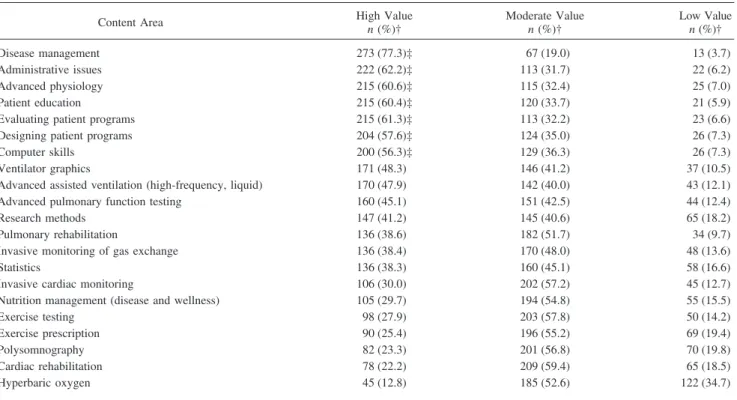
Respondents rated various master’s degree course top-ics as having high, moderate, or low value. More than 50% of respondents gave high ratings to the topics of disease management, administrative issues, evaluating patient pro-grams, advanced physiology, patient education, designing patient programs, and computer skills (Table 10).
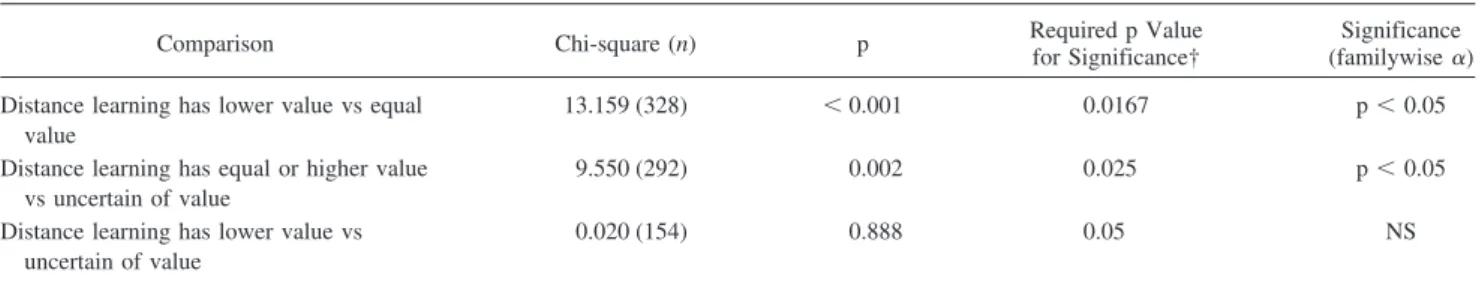
Table 6. Pairwise Comparisons of Respondent and Nonresponder Answers Regarding Baccalaureate Completion Via Distance Learning Versus Via Classroom Education*
Comparison Chi-square (n) p Required p Value
for Significance†
Significance (familywise␣) Distance learning has lower value vs equal
value
13.159 (328) ⬍0.001 0.0167 p⬍0.05
Distance learning has equal or higher value vs uncertain of value
9.550 (292) 0.002 0.025 p⬍0.05
Distance learning has lower value vs uncertain of value
0.020 (154) 0.888 0.05 NS
*Calculated with post-hoc tests with Holm’s sequential Bonferroni method.
†The “Required p-value for Significance” is included to maintain a familywise␣⬍0.05, because when conducting multiple statistical tests within the same data group the total␣should not exceed 0.05.
NS⫽not significant.
Table 7. Geographic Location of Study Sample Versus National Survey*
Number of Respiratory Therapists by Census Region Results East North Central East South Central Mid-Atlantic Mountain New England Pacific South Atlantic West North Central West South Central Chi-square (p) National Survey 1,062 512 804 335 381 920 1,130 400 956 11.941
Present Study’s Sample 67 19 46 18 17 33 54 22 38 (0.154)
Recommended graduate degree majors fell into the gen-eral categories of (number of responses in parentheses) management (208), administration (181), liberal arts and sciences (124), education (118), and health care practice (115). An additional 100 respondents selected business, but did not specify administration or management concen-trations. Similarly, 21 respondents selected public health and did not clarify an administrative or practice prefer-ence. Additionally, some respondents listed generic mas-ter’s degree titles (13), none (10), ? (2), it depends (2), uncertain (1), and not recommended. (1). Respondents listed degree titles for associate degree (4), baccalaureate degree (3), National Board for Respiratory Care creden-tials (2), or left the response area blank (26) (Table 11).
Respondents thought that for the following jobs a graduate degree would be desirable (nin parentheses): manager (356), coordinator/specialist (236), educator (162), supervisor/chief RT/ team leader (108), administrator (64), researcher/statistician (65), case manager (34), business (34), assistant or associate director (24), RT position (21), regulatory agency (4), and respiratory-related role (19). Some respondents did not enter a response (24), entered a “?” (2), or wrote “none” (3). The categories for coordinator/specialist, business, and nonrespiratory-care-specific roles contained many subgroups (Table 12).
Distance Learning
Compared to a baccalaureate degree earned in a tradi-tional classroom setting, 83 respondents (22.9%) thought a DL baccalaureate degree would have a lower value, 218
(60.2%) thought a DL degree would have equal value, 9 (2.5%) thought it would have higher value, and 52 (14.4%) were uncertain. There was no correlation between respon-dents’ DL attitude scores and how they valued RTs com-pleting a baccalaureate degree via DL (r⫽ – 0.098, p⫽ 0.066). Similarly, there was no correlation between re-spondents’ prior DL experience and how they valued an RT completing a baccalaureate degree via DL (r⫽0.039, p⫽0.48).
Of the 360 respondents who were in positions to hire or recommend hiring RTs, 210 had hired or recommended hiring an RT whose entry-level education was primarily via DL. Of that group, 202 responded and 170 (84.2%) were satisfied with the RTs’ knowledge of respiratory care and 181 of 203 (89.2%) would hire another RT whose entry-level education was primarily via DL. There were significant positive correlations between respondents’ DL attitude scores and their satisfaction with the knowledge of RTs whose entry-level RT training was via DL (r⫽0.22, p ⫽ 0.002) and their preferences for hiring additional RTs whose entry-level training was via DL (r⫽ 0.287, p⫽ ⬍0.001). There was no correlation between respon-dents’ prior DL experience and their satisfaction with the knowledge of RTs whose entry-level education was via DL (r⫽– 0.063, p⫽0.40) or their preference for hiring additional RTs whose entry-level education was via DL (r⫽ 0.067, p⫽0.37).
Regarding the use of DL for graduate programs, 344 of 361 respondents (95.3%) would recommend programs that have some DL courses. Two-hundred-sixty-two of 351 Fig. 1. Respiratory care managers value ratings of baccalaureate degree majors.
respondents (74.6%) would recommend programs offered solely via DL. There were significant moderate correla-tions between the attitude-toward-DL score and recom-mendation of graduate programs that include some DL courses (r⫽0.40, p⬍0.001) and programs consisting of
all DL courses (r ⫽ 0.48, p ⬍ 0.001). In contrast, DL experience was not correlated with recommendation for graduate programs offering some coursework via DL (r⫽ 0.070, p⫽0.20) or all coursework via DL (r⫽0.022, p⫽ 0.69).
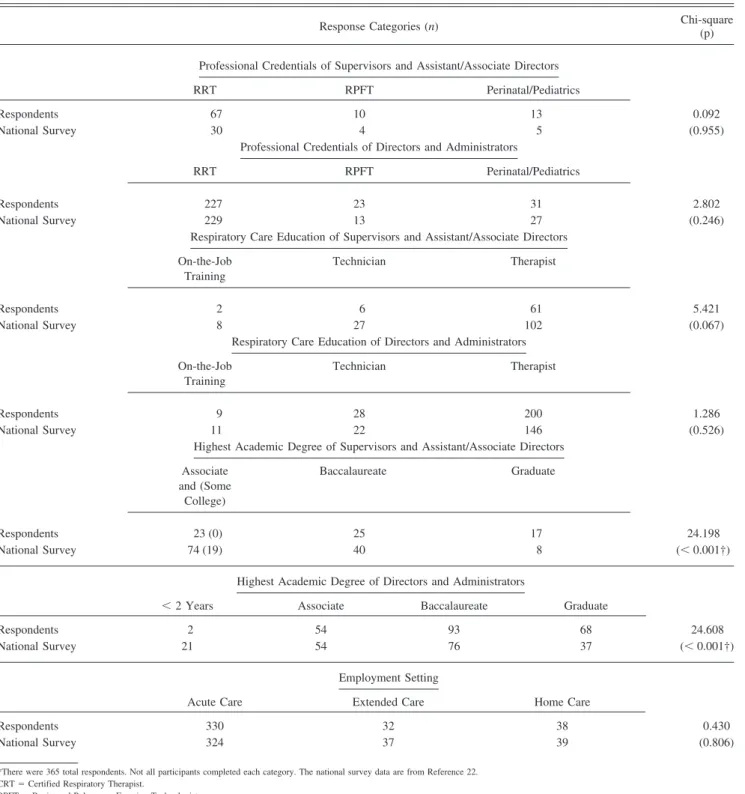
Table 8. Comparison of Demographic Data From Respondents and National Survey*
Response Categories (n) Chi-square
(p) Professional Credentials of Supervisors and Assistant/Associate Directors
RRT RPFT Perinatal/Pediatrics
Respondents 67 10 13 0.092
National Survey 30 4 5 (0.955)
Professional Credentials of Directors and Administrators
RRT RPFT Perinatal/Pediatrics
Respondents 227 23 31 2.802
National Survey 229 13 27 (0.246)
Respiratory Care Education of Supervisors and Assistant/Associate Directors On-the-Job
Training
Technician Therapist
Respondents 2 6 61 5.421
National Survey 8 27 102 (0.067)
Respiratory Care Education of Directors and Administrators On-the-Job
Training
Technician Therapist
Respondents 9 28 200 1.286
National Survey 11 22 146 (0.526)
Highest Academic Degree of Supervisors and Assistant/Associate Directors Associate and (Some College) Baccalaureate Graduate Respondents 23 (0) 25 17 24.198 National Survey 74 (19) 40 8 (⬍0.001†)
Highest Academic Degree of Directors and Administrators
⬍2 Years Associate Baccalaureate Graduate
Respondents 2 54 93 68 24.608
National Survey 21 54 76 37 (⬍0.001†)
Employment Setting
Acute Care Extended Care Home Care
Respondents 330 32 38 0.430
National Survey 324 37 39 (0.806)
*There were 365 total respondents. Not all participants completed each category. The national survey data are from Reference 22. CRT⫽Certified Respiratory Therapist.
RPFT⫽Registered Pulmonary Function Technologist. †p⬍0.05 via chi-square test.
There were no significant correlations between DL attitude score and job title (r⫽– 0.102, p⫽0.056) or highest degree held (r⫽ 0.094, p⫽0.088). Of the 337 respondents who answered the question, 30 (8.9%) had prior DL experience. There was a weak positive correlation between prior DL
experience and attitude toward DL (r ⫽ 0.12, p ⬍ 0.05). Three attitude scale items showed weak positive correlations with prior DL experience:successful-unsuccessful(r⫽0.20, p⬍ 0.001),interesting-boring(r⫽ 0.13, p⫽ 0.014), and creative-unimaginative(r⫽0.13, p⫽0.022).
Table 10. Respiratory Care Managers’ Value Ratings for Master’s Degree Content*
Content Area High Valuen(%)† Moderate Valuen(%)† Low Valuen(%)†
Disease management 273 (77.3)‡ 67 (19.0) 13 (3.7)
Administrative issues 222 (62.2)‡ 113 (31.7) 22 (6.2)
Advanced physiology 215 (60.6)‡ 115 (32.4) 25 (7.0)
Patient education 215 (60.4)‡ 120 (33.7) 21 (5.9)
Evaluating patient programs 215 (61.3)‡ 113 (32.2) 23 (6.6)
Designing patient programs 204 (57.6)‡ 124 (35.0) 26 (7.3)
Computer skills 200 (56.3)‡ 129 (36.3) 26 (7.3)
Ventilator graphics 171 (48.3) 146 (41.2) 37 (10.5)
Advanced assisted ventilation (high-frequency, liquid) 170 (47.9) 142 (40.0) 43 (12.1)
Advanced pulmonary function testing 160 (45.1) 151 (42.5) 44 (12.4)
Research methods 147 (41.2) 145 (40.6) 65 (18.2)
Pulmonary rehabilitation 136 (38.6) 182 (51.7) 34 (9.7)
Invasive monitoring of gas exchange 136 (38.4) 170 (48.0) 48 (13.6)
Statistics 136 (38.3) 160 (45.1) 58 (16.6)
Invasive cardiac monitoring 106 (30.0) 202 (57.2) 45 (12.7)
Nutrition management (disease and wellness) 105 (29.7) 194 (54.8) 55 (15.5)
Exercise testing 98 (27.9) 203 (57.8) 50 (14.2)
Exercise prescription 90 (25.4) 196 (55.2) 69 (19.4)
Polysomnography 82 (23.3) 201 (56.8) 70 (19.8)
Cardiac rehabilitation 78 (22.2) 209 (59.4) 65 (18.5)
Hyperbaric oxygen 45 (12.8) 185 (52.6) 122 (34.7)
*There were 365 total respondents. Not all participants completed each category. †Percentages based on total responses for each category.
‡Content areas where 50% or more respondents reported high value.
Table 9. Results of Pairwise Comparisons for Supervisors and Administrators Between Respondents and Nonresponders*
Comparison Chi-square (n) p Required p Value for Significance† Significance (familywise␣) Supervisor or Assistant/Associate Director
ⱕ2 years vs graduate degree 23.487 (141) ⬍0.001 0.0167 p⬍0.05
ⱕ2 years vs baccalaureate degree 7.423 (181) 0.006 0.025 p⬍0.05
Baccalaureate vs graduate 6.330 (90) 0.012 0.05 p⬍0.05
Director or Administrator
ⱕ2 years vs associate degree 13.218 (131) ⬍0.001 0.0083 p⬍0.05
ⱕ2 years vs baccalaureate degree 17.387 (192) ⬍0.001 0.010 p⬍0.05
ⱕ2 years vs graduate degree 23.933 (128) ⬍0.001 0.0125 p⬍0.05
Associate vs graduate degree 4.741 (213) 0.029 0.0167 NS
Baccalaureate vs graduate degree 2.531 (274) 0.112 0.025 NS
Associate vs baccalaureate degree 0.669 (277) 0.413 0.050 NS
*Calculated with post-hoc tests with Holm’s sequential Bonferroni method.
†The “Required p-value for Significance” is included to maintain a familywise␣⬍0.05, because when conducting multiple statistical tests within the same data group the total␣should not exceed 0.05.
Discussion Baccalaureate and Master’s Degrees
The present study found that 70.4% of respiratory care managers preferred to hire RTs who have or are working toward a baccalaureate degree, but that pref-erence was less clear when considering entry-level po-sitions. Only 34.4% of managers preferred to hire grad-uates from entry-level baccalaureate programs, compared to 27.8% who had no preference and 37.8% who had no opinion. These findings support the hypoth-esis that RT managers value baccalaureate degrees for
practicing RTs but do not view the baccalaureate degree as essential for an entry-level position.
The present study’s results also support the hypothesis that managers will value the advanced respiratory care practice degree major more highly than other degree ma-jors, for practicing RTs who complete baccalaureate de-grees. Other degree categories that received numerous high value ratings were management, teaching, science, and business. The advanced practice major, however, had the greatest percentage of high value ratings (75%, compared to 54% for the next leading category, management). Plac-ing a high value on advanced coursework within the re-spiratory care profession is consistent with the growing
Table 11. Recommended Master’s Degree Majors*
Category (number of responses) Subgroups (number of responses)
Management (208) Management (110) allied health, health care, or health services (26), human resources (16), business (12), finance (8), organizational (8), accounting (6), marketing (6), quality management (6), disease management (5), outcomes (3), case management (1), time management (1)
Administration (181) Health/hospital/medical (77), business (74), administration (generic) (19), public (11) Liberal arts and sciences (124) Liberal Arts
Psychology (4), liberal arts (3), communication (2), future studies (1), medical humanities (1), philosophy (1), sociology (1)
Sciences
Science (35), physiology (25), research (14), biology (13), exercise (9), cardiopulmonary (5), statistics (4), chemistry (2), physics (2), pathophysiology (1), math (1)
Education (118) (none)
Health care practice (115) Respiratory Care—Advanced Practice
Advanced practice (34), diagnostics/assessments (4), geriatrics (3), critical care (2), neonatal/pediatrics (2), rehabilitation (2), polysomnography (2), specialties (2)
Health-Related Professions
Health care/health sciences (14), nursing (12), allied health/health professions (8), physician assistant (7), computers/technology (5), information systems (4), legal (4), community health (3), wellness (2), anesthesia (1), biomedical engineer (1), case manager (1), speech pathology (1), medicine (1)
Nonspecific (121) Business (100), public health (21)
Other (36) Master’s of science (11), advanced learning (1), anything (1), none (10), uncertain (1), “?” (2), “it depends” (2), not recommended (1), associate degree titles (4), baccalaureate degree (3), National Board for Respiratory Care credential (2)
*There were 365 total respondents. Respondents could list more than 1 item.
Table 12. Subgroups for Coordinator/Specialist, Business, and Respiratory-Related Master’s Degree Roles*
Category Subgroups (number of responses)
Coordinator/specialist (236) Education (45), rehabilitation (25), intensive care (16), quality assurance (11), disease management (11), cardiac catheterization laboratory/cardiac testing/exercise testing (7), diagnostics (2), pulmonary function (7), sleep (6), hyperbaric oxygen (4), home care (3), equipment (2), noninvasive (1), information (1), wellness (1), protocol (1), nonspecific (99)
Business (34) Business owner/business (14), sales or marketing (14), durable medical equipment and home care (6)
Respiratory-related (19) Managed care (4), human resources (4), information systems (2), professional organizations (2), community health (2), bed coordinator (1), quality management (1), utilization review (1), compliance officer (1), hospital safety manager (1)
scope of practice,15,16 advances in technology,9,17
demo-graphic changes in population and disease,9,18and
recom-mendations for post-associate-degree training for specialty work within the profession.4,5This finding provides
guid-ance to practicing RTs who want to complete a baccalau-reate degree in a subject valued by respiratory care man-agers.
Regarding graduate degrees, the respondents recom-mended master’s degrees for leadership, clinical specialist, education, and research-related jobs. However, 12% (n⫽ 42) of respondents questioned the value of a graduate de-gree, by either not responding to this question or entering a response of none, ?, it depends,uncertain, ornot rec-ommended. The types of degree majors recommended matched the job titles in that they covered primarily man-agement, administration, education, and health or health-science degree programs. The job roles for which respira-tory care managers recommended graduate degrees are consistent with the job titles having greater proportions of graduate degrees in the 2000 AARC Human Resources Survey, which showed that RT directors, supervisors, and educators had greater numbers of graduate degrees than RTs.13
Graduate degree content areas rated as high value by
ⱖ 50% of respondents were related to program manage-ment, administrative issues, advanced physiology, and com-puter skills. The majority of clinical topics received mod-erate or low value ratings. This finding is consistent with having the primary respiratory care training occurring be-fore the graduate level. Course content areas that received high value ratings from 38 –50% of respondents were ad-vanced clinical topics and research and statistics. The re-search and statistics coursework would aid RTs in accom-plishing the previously identified needs of increasing the science of respiratory care and disseminating information via publications.
The respondents in the present study favored baccalau-reate education for experienced RTs and graduate educa-tion for RTs in leadership, clinical specialist, educaeduca-tion, and research-related roles. Managers supported, but did not mandate, advanced degrees for RTs. The AARC also supports obtaining advanced degrees, lists baccalaureate completion degree programs on its Web page,19and has
organized a committee, the Coalition for Baccalaureate and Graduate Respiratory Therapy Education, to enhance baccalaureate and graduate programs and to aid programs interested in moving toward the baccalaureate and gradu-ate levels.6Currently, there are 47 baccalaureate
respira-tory care programs, in 24 states.20
Support for RTs to complete baccalaureate and graduate degrees also comes from workplace incentives (increased salary or tuition assistance). There is some evidence that RTs with education beyond the associate degree level re-ceive financial incentives. The AARC Human Resources
Survey showed that RT salaries were higher with longer academic preparation (on-the-job training, technician, and RT programs) and higher academic degrees. The AARC Human Resources Survey did not report salary compari-sons between entry-level RTs graduating from associate degree programs versus baccalaureate degree programs.13
Recent data from the United States Census Bureau indi-cates that the average annual salary for individuals with baccalaureate degrees is $14,000/year more than individ-uals with associate degrees. The added income from the baccalaureate degree compounds to an additional $0.5 mil-lion when projected over a 40-year work life.21Graduate
education also correlates with higher salary. In the 2000 AARC Human Resources Survey, job titles such as direc-tor, educadirec-tor, and supervisor consistently received higher salaries than RTs and were associated with individuals holding more baccalaureate and graduate degrees.13
Only 18.4% of the present survey’s respondents reported financial incentive for RTs who earn or hold baccalaureate degrees. There was variability in the incentives provided, such as increased pay and tuition reimbursement. The AARC Human Resources Survey reported tuition assis-tance rates for hospital employees, durable medical equip-ment employees, and long-term-care employees that were 64%, 38%, and 55%, respectively.13In contrast, the present
study’s findings for financial incentives were much lower. A key difference between the study populations is that the present study sampled only respiratory care managers, whereas the AARC Human Resources Survey surveyed RTs across a broader range of job descriptions. The present study’s respondents’ had greater numbers of advanced ac-ademic degrees, and since the respondents were managers and administrators, they may be less aware of available tuition benefits than are nonmanager RTs.
Even without a formal mandate for baccalaureate or graduate education, the education level of RTs progressed in the past decade. The percentage of RTs holding bacca-laureate or graduate degrees rose from 16.1% in the 1992 AARC Human Resources Survey22to 29.7% in the 2000
survey.13 The percentages of RTs holding graduate
de-grees rose from 2.3% to 5.7% in that same period. It is noteworthy that these advances in RT education occurred before the profession’s entry-level academic requirement increased to associate degree in 2002. The present study’s findings that managers value baccalaureate degrees for practicing RTs and the value they place on the advanced respiratory therapy practice degree major could further prompt RTs to complete baccalaureate degrees by clarify-ing degree paths valued by employers. Similarly, more RTs desiring leadership, educational, and clinical special-ist roles might begin to pursue graduate degrees knowing that managers value graduate degrees for those roles.
Growth in the number of RTs with baccalaureate and graduate degrees may also impact how others perceive the
profession in the future. The income and prestige of a profession is associated with the profession’s median ed-ucation level.23Presently, RTs do not consistently receive
recognition as “professionals,” because the usual mini-mum education standard for professional recognition is the baccalaureate degree.23–25Comments made on the AARC
Education Section Listserv have echoed these sentiments. Parents expressed concern about their children entering a profession that does not require a baccalaureate degree. Unions for professional employees did not include RTs, because the majority of RTs lack baccalaureate degrees, and the military did not confer officer status to RTs for similar reasons. Work visas for foreign workers were more difficult to obtain for positions perceived as nonprofes-sional.26Regarding reimbursement, the Centers for
Medi-care & Medicaid Services (formerly the Health Care Fi-nancing Administration) did not initially reimburse services provided by RTs, because the profession does not require a baccalaureate degree. After a lobbying effort by the AARC that decision was reversed, and RTs are now eligible for reimbursement.25Knowledge of managers’ support for
ad-vanced degrees might influence more RTs to pursue these degrees and impact the profession’s image in the process. Distance Learning
Practitioners need to have advanced degree programs that address the needs of working adults.27,28 Programs
need to consider that most working adults want part-time programs and need to balance family responsibilities with school.28The advanced degree programs should have
mech-anisms to provide credit for prior educational coursework and life experience.29Furthermore, programs need to offer
coursework at times when practitioners are available.28DL
offers flexibility in learning time and place.30Individuals
with greater family and work responsibilities use DL courses more than individuals with fewer family and work responsibilities.31However, a prior study found that RTs
did not know how their managers viewed degrees earned via DL.11
The present study did not fully support the hypothesis that managers would value baccalaureate and master’s de-grees earned via DL. Sixty-three percent of managers thought a DL baccalaureate completion degree would have the same (or higher) value as a degree earned in a tradi-tional classroom setting, but 23% of managers thought a DL degree less valuable. An overwhelming majority of respondents who had hired RTs whose entry-level educa-tion was via DL gave positive ratings for the RTs’ knowl-edge and supported hiring additional RTs with DL entry-level education. The AARC also supports the use of DL for advanced practitioners. All 4 baccalaureate completion programs listed on the AARC Web site offer DL
cours-es.18Furthermore, the AARC offers DL programs for
con-tinuing respiratory care education units.32
Respiratory care managers viewed DL more positively for graduate degrees than for baccalaureate completion degrees. Managers supported using all DL courses for grad-uate programs but gave more support for programs that held some courses on campus. These findings align with recommendations in the DL literature that DL works best for more mature learners.33
Attitude toward DL had a slightly positive correlation with the respondents’ future decisions to hire RTs with DL entry-level education and the knowledge of prior employees with DL entry-level education. The questions asked in the present survey could not differentiate whether the experience of work-ing with DL-trained RTs influenced the respondents’ atti-tudes toward DL or if, conversely, their attiatti-tudes toward DL colored their assessments of DL-trained RTs.
There was a moderately positive correlation between attitude toward DL and the respondents’ recommendations for incorporating DL courses into graduate level degrees. However, attitude toward DL did not influence the degree to which respondents valued completing baccalaureate de-grees via DL. DL attitudes were also independent of job title and highest held academic degree.
Only 30 managers (8.9% of respondents who answered this question) reported prior DL experience. There was a slightly positive correlation between prior experience with DL and attitude toward DL. There was also a weak posi-tive correlation between prior DL experience and items on the DL attitude scale, which indicated that respondents who had prior DL experience thought DL was more suc-cessful, interesting, and creative than did respondents who did not have DL experience. None of the other compari-sons of prior DL experience and baccalaureate and grad-uate education were significant. Readers need to interpret these results cautiously, however, because of the limited number of respondents with prior DL experience. In ad-dition, the dates that the respondents took their DL courses and their DL course designs may have affected their per-spectives. DL has undergone numerous changes in the past decade. The proliferation of the Internet has enabled rel-atively easy access to rapid connections with other stu-dents and instructors.34This evolution of technology
alle-viated the slow feedback and lack of student interaction associated with correspondence courses, an earlier form of DL.30 Perspectives on DL using electronic technology
might impact future managers’ opinions. Also some peo-ple confuse DL providers with “diploma mills” (organiza-tions that confer diplomas without providing education).35
To combat that problem, individuals can search the Coun-cil for Higher Education Accreditation’s Web site to iden-tify programs that meet legitimate accreditation standards.36
Changes in the quality of teaching among DL educators might also affect how managers perceive DL. Growth of
programs to train educators how to effectively use DL occurred only recently.37Another recent shift in program
delivery is the move toward hybrid courses, which com-bine the advantages of classroom learning and DL.38These
changes in DL and the work performance of DL program graduates may also influence managers’ future opinions. Limitations
This survey’s 26% response rate may not have repre-sented the diversity of views held throughout the entire population of respiratory care managers, so the data were compared to data from the 2000 AARC Human Resources Survey to determine the sample’s representativeness of the national RT population. The comparison groups that yielded nonsignificant differences all had power levels below 40%, which prevents confirmation of similarity between the re-spondents and the broader population. However, the com-parison groups also yielded effect sizes⬍0.1, which im-plies there is little difference between the groups.14Given
the small effect sizes, I believe the present study’s sample is relatively representative of the national population.
Compared to the nonresponders, the respondents had more undergraduate and graduate degrees, fewer admin-istrative positions, fewer ratings in the high and moderate categories for recommending liberal arts and management degrees, and were more willing to hire an RT who holds or is working toward a baccalaureate degree. Respondents were also more willing to hire practitioners whose entry-level education was via DL and valued DL education more than nonresponders. Respondents and nonresponders were similar with regard to professional credentials, respiratory care education, size and type of facility, prior DL experi-ence, and values placed on the majority of baccalaureate degree majors.
Respondents in the present study were similar to those in the 2000 AARC Human Resources Survey13with
gard to geographic location, professional credentials, re-spiratory care education, and work setting. The present study’s respondents had more education than those in the AARC study, which limits interpretation of the present study’s results.
In the present study the zip code information was taken from return envelopes, and envelopes lacking a postmark were excluded from analysis, which may have biased the results.
Other limitations of the present study are that it pro-vided no comparison between respondents and nonre-sponders regarding graduate degree questions, and that other researchers might categorize and report the graduate degree majors and job titles in slightly different categories. Furthermore, this study reports descriptive data that rep-resent managers’ values of specific degrees. We cannot infer the percentage of practicing RTs who ought to hold
undergraduate or graduate degrees nor that the education standard for entry-level credentials should change. In ad-dition, the graduate education results do not indicate which recommended degree majors to select for individual job titles. Only a small percentage of respondents (8.9%) had personal experience with DL, so the strength of inferences resulting from correlations regarding DL experience is also limited.
Conclusions
Respiratory care managers value baccalaureate and mas-ter’s degrees earned by practicing RTs but do not think of those degrees as essential for all RTs. Managers prefer hiring experienced RTs with baccalaureate degrees over associate degrees, but they did not express a preference for entry-level RTs to have baccalaureate degrees. Respiratory care managers valued the advanced respiratory care prac-tice degree major for baccalaureate completion most highly, over completion of degrees in management, teaching, sci-ence, business, and liberal arts. Graduate degrees are sup-ported for RTs working as managers, educators, supervi-sors, and clinical specialists with degree majors consistent with those job titles.
Managers gave mixed support for RTs who earn calaureate and master’s degrees via DL. Regarding bac-calaureate completion degrees 62.7% of managers valued a DL baccalaureate completion degree as much as or more than a classroom degree, 22.9% valued a DL degree less, and 14.4% were uncertain. The majority of managers who hired RTs with DL entry-level preparation were satisfied with the RTs’ knowledge and skills. The respondents showed more acceptance of graduate education via DL, although they gave greater support to graduate programs that include some classroom study, rather than all course-work via DL. However, their limited personal experience with DL might not have taken into account the recent improvements in DL, and those improvements might af-fect managers’ future attitudes.
ACKNOWLEDGMENTS
The author thanks Thomas J Johnson MS RRT, Respiratory Care Pro-gram Director, Long Island University, for his support of this study, and Angela Lorenzo for help with data entry and conducting the nonre-sponder interviews.
REFERENCES
1. O’Daniel C, Cullen DL, Douce FH, Ellis GR, Mikles SP, Wiezalis CP, et al. The future educational needs of respiratory care practitio-ners: a Delphi study. Respir Care 1992;37(1):65–78.
2. National Board for Respiratory Care. New admissions policies. NBRC Horizons 2001 Sep/Oct;27(5):2–3.
3. AARC Times. Bachelor degree completion. AARC Times 1991; 15(9):40,42.
4. Cullen DL, Sullivan JM, Bartel RE, Fuson P, Galvin WF, Rinker RM, et al. A summary report. American Association for Respiratory Care. Year 2001: Delineating the educational direction for the future respiratory care practitioner. Proceedings of a national consensus conference on respiratory care education; 1992;Oct 2–4:Dallas, TX; 1993:67–75.
5. Sullivan JM, Wiezalis CP, Bartel RE, Cullen DL, Fuson P, Galvin WF, et al. A summary report. In: American Association for Respi-ratory Care. Year 2001: An action agenda. Proceedings of the second national consensus conference on respiratory care education; 1993 Oct 15–17;Bethesda MD;1994:30–35.
6. American Association for Respiratory Care. Baccalaureate education focus of new email list. AARC Report Feb 2001.
7. Czachowski RJ. Respiratory care education: quo vadis? (editorial). Respir Care 1997;42(9):844.
8. Kester L, Stoller JK. Respiratory care education: current issues and future challenges (editorial). Respir Care 1996;41(2):98–99. 9. Douce FH, Cullen DL. The length of educational preparation and
academic awards for future respiratory care practitioners: a Delphi study. Respir Care 1993;38(9):1014–1019.
10. American Association for Respiratory Care. The educational direc-tion for the future respiratory care practidirec-tioner. In: American Asso-ciation for Respiratory Care. Year 2001: An action agenda. Proceed-ings of the second national consensus conference on respiratory care education; 1993 Oct 15–17;Bethesda MD;1994:5–6.
11. Becker EA, Gibson CC. Attitudes among practicing respiratory ther-apists in a midwestern state toward completing a baccalaureate de-gree and toward distance education. Respir Care 1999;44(11):1337– 1352.
12. Becker EA. Summary report for the 1995 WSRC baccalaureate de-gree completion survey. Wisconsin Society for Respiratory Care. Jun 1995.
13. American Association for Respiratory Care. American Association for Respiratory Care Human Resources Survey –2000. Dallas: AARC; 2001.
14. Cohen J. Statistical power analysis of the behavioral sciences. Hills-dale NJ: Lawrence Erlbaum Associates; 1988.
15. The American Association for Respiratory Care. Introduction to re-spiratory care. In: Year 2001: Delineating the educational direction for the future respiratory care practitioner. Proceedings of a national consensus conference on respiratory care education; 1992 Oct 2–4; Dallas TX;1993:5–7.
16. Walton JR, Sullivan JM. Task force on professional direction. AARC Times 1985;9:22–24.
17. Paavola FG. Future trends affecting health care service and practice. In: American Association for Respiratory Care. Year 2001: Delin-eating the educational direction for the future respiratory care prac-titioner. Proceedings of a national consensus conference on respira-tory care education; 1992; Oct 2–4; Dallas TX; 1993:12–19. 18. Weiss S. Epidemiology of cardio-respiratory disease for the year
2020. In: American Association for Respiratory Care. Year 2001: Delineating the educational direction for the future respiratory care practitioner. Proceedings of a national consensus conference on re-spiratory care education; 1992; Oct 2–4; Dallas, TX; 1993:20–23.
19. American Association for Respiratory Care [Internet]. Degree com-pletion programs. http://www.aarc.org/education/degree.html (ac-cessed July 14, 2003).
20. American Association for Respiratory Care [Internet]. Accredited programs. http://www.aarc.org/education/accredited_programs/ (ac-cessed July 14, 2003).
21. United States Census Bureau. The big payoff: educational attainment and synthetic estimates of work-life earnings. Washington DC; United States Department of Commerce, Economics and Statistics Admin-istration; 2002 July Report No P23–210.
22. American Association for Respiratory Care. A study of respiratory care human resources in hospitals. Dallas: Daedalus Enterprises; 1993.
23. Cullen JB. The structure of professionalism. New York: Petrocelli Books; 1978.
24. Sullivan WM. Work and integrity. New York: Harper Collins; 1995. 25. American Association for Respiratory Care. New HCFA regulation
calls RTs “Professionals”. AARC Report Mar 2001.
26. Pilbeam SP. Notes from the chair (newsletter). Education Bulletin 2002 May/Jun 2002; American Association for Respiratory Care; Dallas: AARC:1–3.
27. Ganiere D, Larkum A, Sizemore M. Adult students report what enabled them to complete a non-traditional undergraduate program. Adult learning and social change. Proceedings of the National con-ference on alternative and external degree programs for adults; 1993 Oct 7–9; Breckenridge CO. Washington: American Council on Ed-ucation;1993:195–205.
28. Murray JW, Hall BL. A systematic approach to designing and eval-uating effective adult degree completion programs. J Contin Higher Educ 1998 Spring;46(2):19–26.
29. Green K. Nontraditional education: alternative ways to earn your credentials. OCCUP Outlook Q 1996 Summer;40(2):22–35. 30. Moore MG, Kearsley G. Distance education: a systems view.
Bel-mont CA: Wadsworth Publishing; 1996.
31. Sikora AC. A profile of participation in distance education: 1999– 2000 (NCES 2003-154). U.S. Department of Education, Washing-ton, DC: National Center for Education Statistics. Available at http:// nces.ed.gov/pubs2003/quarterly/winter/q4_3.asp (accessed August 21, 2003).
32. American Association for Respiratory Care [Internet]. CRCE On-line. http://www.aarc.org/crce_online/(accessed July 14, 2003). 33. Palloff RM, Pratt K. Building learning communities in cyberspace.
San Francisco: Jossey-Bass; 1999.
34. Palloff RM, Pratt K. Lessons from the cyberspace classroom. San Francisco: Jossey-Bass; 2001.
35. Ferreri J. Online education scams –guilt by association? Distance Education Report 2002 Jun 15;6:1,3.
36. Council for Higher Education [Internet]. Accreditation home page. http://www.chea.org/index.htm (accessed August 10, 2003). 37. Ely DP. Graduate degrees in distance education: signs of an
emerg-ing professional field. Distance Education Report 2001 Nov 1;5:1–2. 38. Young JR. ‘Hybrid’ teaching seeks to end the divide between tradi-tional and online instruction. Chron High Educ 2002 Mar 22;Sect A:33–34.