Address for correspondence Prof. Sunil Kumar Gupta, Department of Dermatology,
Dayanand Medical College and Hospital, Ludhiana, India
Email: [email protected]
Original Article
Contact sensitizers in dyshidrotic eczema
Introduction
The terminology for eruptive, symmetric, vesicular, and/or bullous dermatitis on palms and/or palmar aspects or sides of fingers includes the terms dyshidrotic eczema, dyshidrosis and pompholyx. It usually presents as a recurrent vesicular hand and foot dermatitis.1In 1873, Tilbury Fox first described
dyshidrosis as an eruption of deep seated vesicles on sides of fingers and on the palms with little or no clinical sign of inflammation. Later, in 1876, similar features were described by Hutchison who introduced the terms cheiropompholyx and podopompholyx.2,3 Today
the disease is considered a special type of eczema with a pronounced spongiosis and accumulation of edema fluid in the regions with thick epidermis.4-6 It is one of the common
medical consultations in dermatology accounting for 5-20% of all the cases of hand eczema.7 Although the etiology seems to be an
interplay of multiple factors, the role of contact allergens was studied using Contact and Occupational Dermatoses Forum of India (CODFI)-approved battery of allergens in this study.
Methods
50 patients suspected and provisionally diagnosed as having dyshidrotic eczema and attending the dermatology OPD at DMC&H, Ludhiana were randomly selected for the study. After thorough clinical history and detailed Shobhna Kajal, Sunil Kumar Gupta, Veenu Gupta*, Sukhjot Kaur, Gurpoonam Kaur, Sandeep Kaur
Department of Dermatology, Dayanand Medical College and Hospital, Ludhiana, India. * Department of Microbiology, Dayanand Medical College and Hospital, Ludhiana, India.
Abstract
Objective To study the etiological pattern of contact sensitizers in patients of dyshidrotic eczema.Methods 50 patients of suspected and provisionally diagnosed as having dyshidrotic eczema were subjected to patch test with Indian Standard Battery developed by Contact and Occupational Dermatoses Forum of India (CODFI). Results were read after 48 hours of application and second reading, if required, was taken after 72-96 hours.
Results Patch test analysis of these patients revealed that out of 50 patients 26 (52%) showed positive result with patch test. Paraphenylenediamine (20%) and nickel sulphate (10%) were the commonest allergens, followed by parthenium (8%), fragrance mix (8%) and potassium dichromate (8%).
Conclusion Careful history and examination of the patients helps to ascertain the probable relevant allergen responsible for the disease flare up. The patients of pompholyx with positive patch test results can be advised to avoid these allergens.
Key words
cutaneous examination with special reference to pattern, morphology and duration of eczema, exacerbating factors, sites involved and other suspected allergies, these patients were enrolled for this study. They were subjected to patch test with Indian Standard Battery developed by CODFI. The allergens used included the following 20 allergens: control (petrolatum), potassium dichromate 0.5%; neomycin sulphate 20%; cobalt chloride 1%; benzocaine 5%; formaldehyde 1%; paraphenylenediamine base 0.1%; parabens 15%; nickel sulphate 5%; colophony 20%; mercaptobenzothiazole 2%; nitrofurazone 1%; epoxy resin 1%; fragrance mix 8%; chlorocresol 1%; wool alcohol 30%; balsam of Peru 25%; thiuram mix 1%; black rubber mix 0.6%; Parthenium. The patch test was done by applying aluminum patch test chambers mounted on micropores according to protocol established by the International Contact Dermatitis Research group (ICDRG). Results were read after 48 hours of application and second reading, if required, was taken after 72-96 hours
Results
Out of 50 patients, the mean age of the patients was 33.88 years (standard deviation of ± 12.41) with majority between the ages of 31 to 50 years. Females (64%) outnumbered males (36%) in the series as shown in Table 1.
Out of the total, 26 (52%) tested positive to one or more allergen. Out of these, 19 (73%) were females and 7 (27%) males. Majority of the patients (42%) tested positive to a single allergen. Multiple sensitizations to two allergens were seen in 6% of the test subjects while sensitization to three or more allergens was seen in a small number of patients (4%).
The pattern of disease and sites involved in these patients are shown in Table 2. Cheiropompholyx was observed to be the most common pattern in both males and females (46%). This was followed by both cheiropompholyx and podopompholyx seen in 32% of patients. The least common pattern of presentation was podopompholyx alone seen in 22% of the patients. Seasonal variation of the disease was seen in 50% of the patients. Most of these 22 (44%) showed exacerbation of the disease in summers.
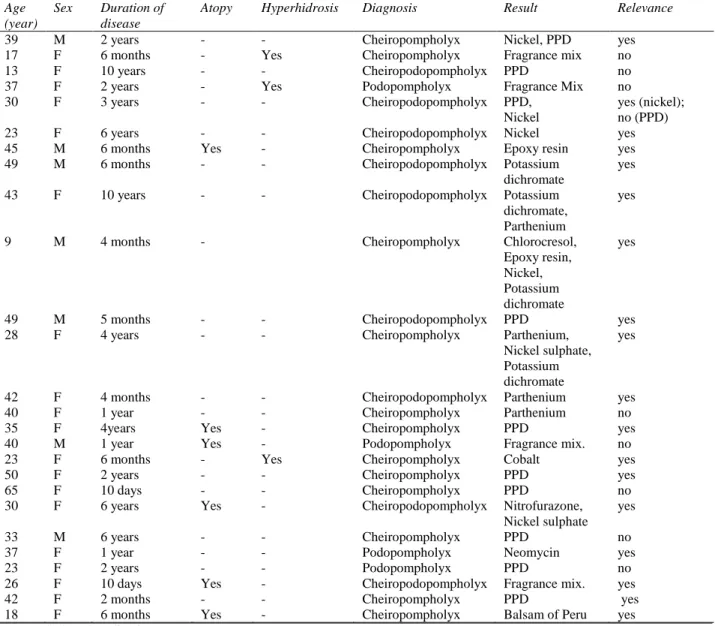
As shown in Table 3, the duration of dermatitis varied from 7 days to 12 years with a mean duration of 2.3 years. The most commonly observed period was 1-2 years. Nine (18%) and twelve (24%) patients had history of hyperhidrosis and atopy, respectively.
Regarding the occupational profile of the patients, majority of the patients (30%) were
Table 1 Age and sex distribution of pompholyx patients.
Age group (years) Female (n=32) Male (n=18) Total (n=50)
0-10 0 (0) 1 (5.6) 1 (2.0)
11-20 5 (15.6% 1 (5.6) 6 (12.0)
21-30 13 (40.6) 1 (5.6) 14 (28.0)
31-40 4 (12.5) 9 (50.0) 13 (26.0)
41-50 9 (28.1) 6 (33.3) 15 (30.0)
51-60 1 (3.1) 0 (0) 1 (2.0)
Table 2 Distribution of pompholyx pattern according to site.
Pattern of disease Female (n=32) Male (n=18) Total (n=50)
Cheiropompholyx 16 (50) 7 (38.9) 23 (46)
Cheiro- and podopompholyx 11 (34.4) 5 (27.8) 16 (32)
Table 3 Details of patients with positive results. Age
(year)
Sex Duration of
disease
Atopy Hyperhidrosis Diagnosis Result Relevance
39 M 2 years - - Cheiropompholyx Nickel, PPD yes
17 F 6 months - Yes Cheiropompholyx Fragrance mix no
13 F 10 years - - Cheiropodopompholyx PPD no
37 F 2 years - Yes Podopompholyx Fragrance Mix no
30 F 3 years - - Cheiropodopompholyx PPD,
Nickel
yes (nickel); no (PPD)
23 F 6 years - - Cheiropodopompholyx Nickel yes
45 M 6 months Yes - Cheiropompholyx Epoxy resin yes
49 M 6 months - - Cheiropodopompholyx Potassium
dichromate
yes
43 F 10 years - - Cheiropodopompholyx Potassium
dichromate, Parthenium
yes
9 M 4 months - Cheiropompholyx Chlorocresol,
Epoxy resin, Nickel, Potassium dichromate
yes
49 M 5 months - - Cheiropodopompholyx PPD yes
28 F 4 years - - Cheiropompholyx Parthenium,
Nickel sulphate, Potassium dichromate
yes
42 F 4 months - - Cheiropodopompholyx Parthenium yes
40 F 1 year - - Cheiropompholyx Parthenium no
35 F 4years Yes - Cheiropompholyx PPD yes
40 M 1 year Yes - Podopompholyx Fragrance mix. no
23 F 6 months - Yes Cheiropompholyx Cobalt yes
50 F 2 years - - Cheiropompholyx PPD yes
65 F 10 days - - Cheiropompholyx PPD no
30 F 6 years Yes - Cheiropodopompholyx Nitrofurazone,
Nickel sulphate yes
33 M 6 years - - Cheiropompholyx PPD no
37 F 1 year - - Podopompholyx Neomycin yes
23 F 2 years - - Podopompholyx PPD no
26 F 10 days Yes - Cheiropodopompholyx Fragrance mix. yes
42 F 2 months - - Cheiropompholyx PPD yes
18 F 6 months Yes - Cheiropompholyx Balsam of Peru yes
PPD = 4-phenylenediamine.
engaged in household work, followed by students (18%), businessmen/shopkeepers (10%), mechanics (8%), service/ clerical workers (8%), construction workers (6%) and fashion designers (4%).
Seventeen (34%) patients with positive patch test had at least one clinically relevant positive patch test. This was based on the correlation of the probable contactants and the allergen showing patch test positivity based on detailed history of contact with them and examination of the pattern of eczema following exposure with them. Nine (18%) patients had a positive patch
test result but clinical relevance was either uncertain or absent in them.
Discussion
Dyshidrotic eczema is a chronic and relapsing vesicobullous skin disease of hand and feet that belongs to the spectrum of eczema. Although the disease limits its extent to these areas only, its clinical course can attribute to repeated episodes of discomfort and stress among the patients.
Among the various etiological factors proposed to play a role in disease etiopathogenesis, atopy has been an important one. In our study, history of atopy (defined as presence of atopic eczema, hay fever or conjunctivitis) was present in 12 (24%) patients. This was seen to be ranging from 34% to 50% in other studies8-10while some show no correlation.
The history of hyperhidrosis was present in 9 (18%) patients in our study, similar to the findings of Lodi et al.10 (17.3%) while a higher
percentage of patients was reported to have hyperhidrosis by others.8,9 This is also favoured
by aggravation of the disease in hot and humid climate. In present study, 22 (44%) showed exacerbation of the disease in summers similar to that of Lodi et al.10
In the present study, the population of the patients with dyshidrotic eczema comprised of 32 (64%) females and 18 (36%) males (female: male ratio= 1.77) which was in agreement with the previous studies8,12 while some noted the
otherwise.9,10
Distribution of the disease showed maximum number of patients 23 (46%) with cheiropompholyx only, followed by patients with both cheiropompholyx and podopompholyx 16 (32%) and those with podopompholyx alone 11 (22%). This was similar to others studies.8,13,14
The cause of dyshidrotic eczema is unclear, however, multiple factors have been proposed to
be related like hereditary, dermatophytic infections, bacterial infections, drug intake etc.6,15,16 Although generally considered to be an
endogenous disorder, direct contact to the offending allergens cannot be neglected generating the term ‘contact pompholyx’.8
Systematic testing of these allergens has been done in a few studies in the past. In the present study, out of the 50 patients of dyshidrotic eczema, 26 (52%) patients had positive patch test results with one or more allergens. These results were similar to the other studies by Jain
et al.9 (40%), Lodi et al.10 (48.07%), and
Lehucher et al.17 (72.8%) which also showed
high percentage of such patients with patch test positivity, hence emphasizing on the role of contact allergy in disease etiopathogenesis.
The main causative allergens were paraphenylenediamine, nickel sulphate, potassium dichromate, parthenium and epoxy resin as shown in other studies.8-10,18 PPD was the
most common positive allergen (20%). The patients were evaluated for relevance of the result in view of the sources of exposure to PPD like use of hair dye by the patients, occupational exposure (associated with hair dyes, paints and rubber or exposure related to clothing/shoes). Only 50% (5 out of 10) of all the patients showed relevance to the disease in the present study.
The present study further consolidates the viewpoint of the role of the different haptens or antigens in producing pompholyx like lesions on the palms and soles in genetically predisposed individuals. Contact haptens present in various allergens illicit a specific inflammatory response after binding to the tissue receptors at these sites. Hence, patch testing with the most probable allergens in contact might help in preventing an otherwise chronic and relapsing disease in these patients.
Conclusion
Pompholyx or dyshidrotic eczema remains one of the chronic recurrent and distressing conditions in dermatology with multifactorial etiology. Patch testing remains the most important test in the diagnosis of the cases related to allergic contact dermatitis which in our case were as high as 52% of the total. Hence its usefulness in disease prevention cannot be ignored. Patch testing with the probable allergens which are frequently in contact with the patients should therefore, be carried out in routine especially in recalcitrant cases.
References
1. Smith HR, White IR, Rycroft RJ, McFadden JP. Descriptive comparison of isolated hand dermatitis and other populations at St. John's Contact Dermatitis Clinic. Contact Dermatitis. 2000;43:51-2.
2. Veien NK. Acute and recurrent vesicular hand dermatitis. Dermatol Clin. 2009;27:337-53.
3. Fox T. Clinical lecture on dyshidrosis: an undescribed eruption. Br Med J. 1873;365-6. 4. Ackerman AB, Ragaz A. A plea to expunge the word “eczema” from the lexicon of dermatology and dermatopathology. Arch Dermatol Res. 1982;272:407-20.
5. Berth JJ. Eczema, lichenification, prurigo and erythroderma. In: Burns T, Breathnach S, Cox N, Griffiths C, editors. Rook’s Textbook of Dermatology. 8th edn.
Chichester, West Sussex: Wiley-Blackwell; 2010. p. 23.1-51.
6. Altekrueger I, Ackerman AB. "Eczema" revisited. A status report based upon current textbooks of dermatology. Am J Dermatopathol. 1994;16:517-22.
7. Meding B, Swanbeck G. Epidemiology of different types of hand eczema in an industrial city. Acta Derm Venereol. 1989;69:227-33.
8. Guillet MH, Wierzbicka E, Guillet S, Dagregorio G et al. A 3-year causative study of pompholyx in 120 patients. Arch Dermatol. 2007;143:1504-8.
9. Jain VK, Aggarwal K, Passi S, Gupta S. Role of contact allergens in pompholyx. J Dermatol. 2004;31:188-93.
10. Lodi A, Betti R, Chiarelli G, Urbani CE, Crosti C. Epidemiological, clinical and allergological observations on pompholyx. Contact Dermatitis. 1992;26:17-21.
11. Bryld LE, Agner T, Menné T. Relation between vesicular eruptions on the hands and tinea pedis, atopic dermatitis and nickel allergy. Acta Derm Venereol. 2003;83 :186-8.
12. Fredricks MG, Becker FT. Vesicular eruptions of the hands and feet of dyshidrotic type: clinical and therapeutical analysis. AMA Arch Derm Syphilol. 1954;70:107-14.
13. Meding B. Epidemiology of hand eczema in an industrial city. Acta Derm Venereol Suppl (Stockh). 1990;153:1-43.
14. DeLeo VA, Suarez SM, Maso MJ. Photoallergic contact dermatitis. Results of photopatch testing in New York, 1985-1990. Arch Dermatol. 1992;128:1513-8.
15. Grauer FH, Lorincz AL. Simultaneous dyshidrosis in monozygotic twins during their separation. Arch Dermatol. 1956;74:250-2.
16. Christensen OB, Möller H. Nickel allergy and hand eczema. Contact Dermatitis. 1975;1:129-35.
17. Lehucher-Michel MP, Koeppel MC, Lanteaume A, Sayag J. Dyshidrotic eczema and occupation: a descriptive study. Contact Dermatitis. 2000;43:200-5.
18. Veien NK, Hattel T, Laurberg G. Plantar Trichophyton rubrum infections may cause dermatophytids on the hands. Acta Derm Venereol. 1994;74:403-4.