Journal Homepage: www.ijcst.org
K. Maheswari and Dr. M. Punithavalli
Department of Computer Applications, SNR SONS College, Coimbatore, India Department of Computer Applications, Sri Ramakrishna Engineering College, India
[email protected], mpuni
Abstract– Voice over Internet Protocol (VoIP) is a new fancy
and up growing technology. A major change in telecommunication industry is VoIP. The transmission of Real time voice data is not as easy as ordinary text data. The real time voice transmission faces lot of difficulties. It suffers from packet loss, delay, quality and security. These factors will affects and degrade the performance and quality of a VoIP
addresses the security and packet delivery ratio
modified secret sharing algorithm over a single path with reduced packet loss. The simulation results show that higher security is achieved in terms of route request, route reply error, delay, and packet delivery ratio.
Index Terms– Packet Loss, Quality, Communi
and VoIP
1. INTRODUCTION
ONFIDENTIALITY is very important requirement for any kind of data transmission. The data in VoIP networks are not subject to eavesdropping. Preventing data from people who do not need to know. It is a packet switched and interactive network. The traditional Public Switch Telephone Network (PSTN) is circuit switched. The circuit switched network is secure one but the packet switched internet is not. It is designed with less security features. In conventional public switched telephone networks (PSTN), entire communication paths were administered by a few authorized telephone companies. It was therefore difficult for a malicious person to wiretap conversations over telephones because persons who were allowed to access the network were carefully restricted. The recently grown internet protocol telephone or VoIP has multiple intermediates exist between the two endpoints (telephones). Therefore, the risk of man the-middle attack increases. A message is divided into shares which are sending through a single path [1]
shamir’s secret sharing algorithm [11] is implemented to provide reliable data delivery.
A. Transmission Technology Of VoIP
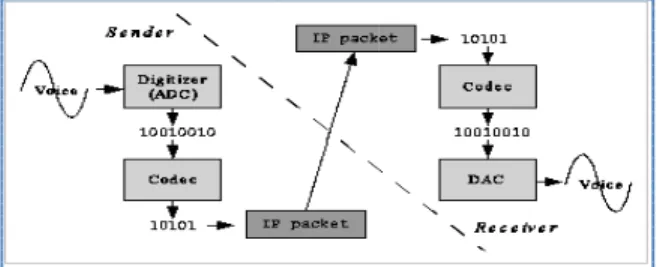
The transmission technology of VOIP must be in digital is shown in Figure 1. The caller’s voice is digitized. The
C
Secured Secret Sharing over Single Path in VoIP with
ISSN 2047-3338K. Maheswari and Dr. M. Punithavalli
of Computer Applications, SNR SONS College, Coimbatore, India of Computer Applications, Sri Ramakrishna Engineering College, India
[email protected], [email protected]
over Internet Protocol (VoIP) is a new fancy A major change in . The transmission of Real time voice data is not as easy as ordinary text data. The real time voice transmission faces lot of difficulties. It suffers from packet These factors will affects and VoIP. This paper and packet delivery ratio of a VoIP using modified secret sharing algorithm over a single path with reduced packet loss. The simulation results show that higher route request, route reply, route
ommunication, Security
is very important requirement for any kind of data transmission. The data in VoIP networks are not subject to eavesdropping. Preventing data from is a packet switched and interactive network. The traditional Public Switched Telephone Network (PSTN) is circuit switched. The circuit switched network is secure one but the packet switched internet is not. It is designed with less security features. In conventional public switched telephone networks (PSTN), paths were administered by a few authorized telephone companies. It was therefore difficult for a malicious person to wiretap conversations over telephones because persons who were allowed to access the network n internet protocol has multiple intermediates exist between the two endpoints (telephones). Therefore, the risk of
man-in-A message is divided into shares [1]. The modified is implemented to
The transmission technology of VOIP must be in digital is shown in Figure 1. The caller’s voice is digitized. The
Fig. 1: Transmission Technology of Vo
digitized voice is compressed and then separated into packets using complex algorithms [10]. These packets are addressed and sent across the network which is to be reassembled in the proper order at the destination. Again,
done by a carrier, and Internet Service Provider, or by PC. During transmission on the Internet, packets may be lost or delayed, or errors may damage the packets. Conventional error correction techniques would request the retransmiss of unusable or lost packets, but if the transmission is a real time voice communication this technique obviously would not work, so sophisticated error detection and correction systems [6] are used to create sound to fill in the gaps.
B. Secret Sharing Scheme in VoIP
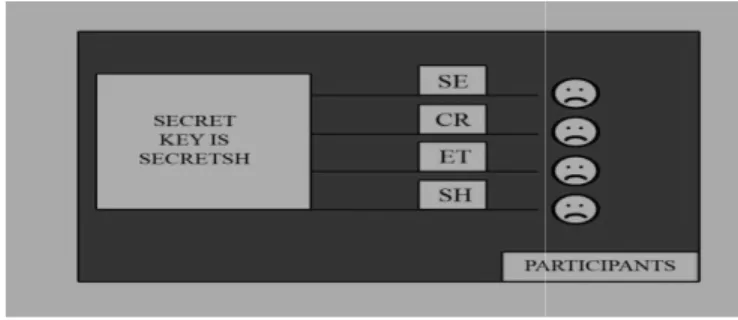
The fundamental idea of secret sharing is the secret message is sending through a single specified path
hoc On Demand distance Vector (AODV) routing [10] enemy can easily compromise the message by troubling any one of the nodes all along the path. To solve this, the message is divided into shares or pieces. The pieces are sending through the specified path [6].
A certain number of shares are used to reconstruct the original secret message. This is termed as Threshold secret sharing. Any shares less than threshold can not do anything.
• Dividing the secret message into N multiple pieces called shares [3], [7].
• The enemy has to compromise at least T shares
• Designed for cheating detection and cheater identification
• Modified Shamir’s Secret sharing scheme is implemented
Secured Secret Sharing over Single Path in VoIP with
Consistent Data Transfer
of Computer Applications, SNR SONS College, Coimbatore, India of Computer Applications, Sri Ramakrishna Engineering College, India
ansmission Technology of VoIP
digitized voice is compressed and then separated into packets These packets are addressed and sent across the network which is to be reassembled in the proper order at the destination. Again, this reassembly can be done by a carrier, and Internet Service Provider, or by PC.
During transmission on the Internet, packets may be lost or elayed, or errors may damage the packets. Conventional error correction techniques would request the retransmission of unusable or lost packets, but if the transmission is a real-time voice communication this technique obviously would not work, so sophisticated error detection and correction systems
used to create sound to fill in the gaps.
The fundamental idea of secret sharing is the secret message is sending through a single specified path using Ad-hoc On Demand distance Vector (AODV) routing [10]. The enemy can easily compromise the message by troubling any s all along the path. To solve this, the message is divided into shares or pieces. The pieces are sending A certain number of shares are used to reconstruct the original secret message. This is termed as Threshold secret ring. Any shares less than threshold can not do anything.
Dividing the secret message into N multiple pieces The enemy has to compromise at least T shares
Designed for cheating detection and cheater Secret sharing scheme is
Secured Secret Sharing over Single Path in VoIP with
Fig. 2: Secret sharing in VoIP
The subjective performance [2] of VoIP quality is predicted by E-model by an average listener combining the impairment caused by transmission parameters. The rating can be used to predict subjective user reactions, such as the Mean Opinion Score (MOS). According to ITU-T Recommendation, the E-model rating R is given by the following expression [8].
R = R0 − Is − Id − Ie + A Where R -Transmission rating factor R0 - signal to noise ratio
Is - the combination of all impairments which occur or less simultaneously with the voice signal
Id - the mouth-to-ear delay impairment factor Ie - equipment impairment factor
A - The advantage factor or expectation factor The resulting score is the transmission rating
scalar measure that ranges from 0 (poor) to100 (excellent). factor values below 60 are not recommended [4] [5]. According to [8], the R factor is related to MOS as follows:
For R < 0 MOS = 1
For 0<R<100 MOS = 1+ 0.035R + 7R(R-60) (100 For R > 100 MOS = 4.5
The E-Model not only takes in account the transmission statistics, but it also considers the voice application characteristics, like the codec quality, codec robustness against packet loss and the late packets discard. According to [2], eq. can be reduced to the following expression. where is a function of the absolute one-way delay
function of the used codec type and the packet loss rate R = 93.4 - Id- Ie.
Section 2 reviews the security threats of VoIP
This is followed by the threshold secret sharing scheme VoIP in section 3. In section 4, the results
Finally, section 5 concludes the work. II. BACKGROUND STUDY
When the use of internet grows, automatically the complexity of the security problem increases. It becomes very difficult to solve the security problem. Actually, many application services do not consider the security. User authentication, confidentiality and integrity of signaling message or media stream are required for secure communication system. The security threats are
• Eavesdropping and recording phone calls
The subjective performance [2] of VoIP quality is predicted model by an average listener combining the impairment caused by transmission parameters. The rating can be used to the Mean Opinion T Recommendation, the is given by the following expression [8].
the combination of all impairments which occur more ear delay impairment factor
The advantage factor or expectation factor
The resulting score is the transmission rating R factor, a
100 (excellent). R
factor values below 60 are not recommended [4] [5]. factor is related to MOS as follows:
60) (100-R)x10-6
Model not only takes in account the transmission statistics, but it also considers the voice application characteristics, like the codec quality, codec robustness against packet loss and the late packets discard. According to to the following expression. where Id
way delay Ie is, in short, a function of the used codec type and the packet loss rate R = threats of VoIP functions. threshold secret sharing scheme of results are analyzed. BACKGROUND STUDY
When the use of internet grows, automatically the ty problem increases. It becomes very difficult to solve the security problem. Actually, many application services do not consider the security. User authentication, confidentiality and integrity of signaling message or media stream are required for secure VoIP
The security threats are: Eavesdropping and recording phone calls
• Tracking calls
• Stealing confidential information
• Modifying phone calls
• Making free phone calls
• Pranks / Practical jokes
• Board room bugging
• Sending spam (voice or email) • Denial of service (DoS), • Alteration of voice stream, • Toll fraud,
• Redirection of call,
• Accounting data manipulation, • Caller ID impersonation, • Unwanted calls and messages
The AODV is an on demand routing protocol for unipath routing [9]. The route discovery process is initiated when a source needs a path to a destination. At the initial stage, it does not have a route in a routing table. The source floods the network with REQ packet. It specifies the destination for which the route is requested. When the node receives REQ packet, it checks whether it is the destination. The node generates REQ packet which sends back to the source along the reverse path. The reverse path sets
the node it received the REQ from. This is actual forward path from source to destination. If the node is not the destination and does not have a route to the destination, it retransmits the REQ packet. The duplicate REQ packets ma
This may be removed at intermediate nodes. When the source node receives the first REQ, it begins its sending to the destination.
III. THRESHOLD SECRET SHARING SCHEME IN VOIP This system divides a message into N pieces. Each N participant gets one share of the secret message respectively. Any shares less than threshold can not learn anything. The T (Threshold value of shares) out of N participants can rebuild the original secret message. This is called (T, N) threshold secret sharing scheme. The Shamir’s Lagrange Interpolative Polynomial scheme is used to reconstruct the original. It is designed especially for identifying cheaters.
A secret sharing scheme consists of two algorithms • Dealer
• Combiner
Dealer generates and distributes shares. The combiner collects and reconstructs the shares.
Shamir’s construction for (T, N) secret sharing scheme is
algebraic and is based on the polynomial interpolation. Assume K is the secret to be shared among N participants, S2... SN are shares, P1, P2... PNcan hold one share of the secret
respectively. The dealer obtains the by evaluating a polynomial of degree (
f( x)= K+ a1 x+…… aT-1 x
T-1mod p
Pi Si= f (i)
Where, a1, a2, a3,…..aT-1 are coefficients which are selected
randomly, part of a secret message large prime number.
Stealing confidential information
email)
Accounting data manipulation, Unwanted calls and messages
The AODV is an on demand routing protocol for unipath routing [9]. The route discovery process is initiated when a source needs a path to a destination. At the initial stage, it does not have a route in a routing table. The source floods the EQ packet. It specifies the destination for which the route is requested. When the node receives REQ packet, it checks whether it is the destination. The node generates REQ packet which sends back to the source along the reverse path. The reverse path sets up a forward pointer to the node it received the REQ from. This is actual forward path from source to destination. If the node is not the destination and does not have a route to the destination, it retransmits the REQ packet. The duplicate REQ packets may be generated. This may be removed at intermediate nodes. When the source node receives the first REQ, it begins its sending to the III. THRESHOLD SECRET SHARING SCHEME IN VOIP This system divides a message into N pieces. Each N t gets one share of the secret message respectively. Any shares less than threshold can not learn anything. The T (Threshold value of shares) out of N participants can rebuild the original secret message. This is called (T, N) threshold me. The Shamir’s Lagrange Interpolative Polynomial scheme is used to reconstruct the original. It is designed especially for identifying cheaters.
A secret sharing scheme consists of two algorithms:
Dealer generates and distributes shares. The combiner collects and reconstructs the shares.
) secret sharing scheme is algebraic and is based on the polynomial interpolation. Assume K is the secret to be shared among N participants, S1,
can hold one share of the secret respectively. The dealer obtains the ith participant Pi’s share Si
by evaluating a polynomial of degree (T-1)
at x=I (i=1,2,…,N): (1) are coefficients which are selected randomly, part of a secret message, P is randomly chosen
To indicate the security features of routes the vector P= [p1,p2,….,pM] is used.
Pi (i=1,2,…..M) is the probability that a route i is
compromised. It is assumed that P1≤ P2≤…..≤PM. The paths
are ordered based on its cost value. The distribution of shares n= [n1, n2,…..,nM]
Where, ni is thenumber of parts of a message sent through
thr route i. ni ≥0 and it is an integer.
N
n
M
i i
=
∑
=1
(2) The probability that the message is compromised equal to the probability that T or more shares are seized.
The combiner side, the knowledge of minimum number of T shares. f(i1), f(i2),….f(iT), the original polynomial f(x) can
be reconstructed by Lagrange interpolation.
Choosing the most appropriate values of (T, N) and allocating them on to the paths is very important. (T, N) threshold secret sharing algorithm is applied to the message at source. If one node compromise data, all the shares traveling through the node would be compromised.
Reactive, demand – driven algorithm is AODV (Ad hoc on demand Distance vector routing). It discovers a route to a destination only when it sends a packet for forwarding to that destination. The discovered routes are maintained by route maintenance procedures.
A link has a limited life time. The link will expire when the two end nodes are in out of transmission range. In on-demand routing protocols link status will not be updated until they are used. The broken link will cause a number of route errors and generates a packet loss. Therefore, each link is given an appropriate life time. If this value is too small, link expires too soon. If the value is very large, links break early before the timers expire. It degrades the overall performance.
A predefined static life time is assigned for T1 seconds. In static life time scheme, the two clock time attributes are used.
• Born state • Last used state
Born state indicates a new link is found in the route. The last used state indicates timestamp when the link is last used to forward a packet. There are two situations that will cause a link to be removed from the route.
• Route error is received or link is broken • Timeout
If a link is removed because of the reception of a route error, the life time is calculated as:
l=CurrentTime()- link[i,j].born If it is removed because of timeout, the life time l is calculated as
l = link[i,j].lastused – link[i,j] .born
LIFETIME is a variable indicating the estimation of the link lifetime. It is always assigned a static value. The modified algorithm is given as:
Step 1: Create set S, which includes all the possible
network security state vectors S= s1,s2,….sm. .There should be
totally2M 2 elements in set S.
Step 2: Calculate Pstate (s) for each element s according to
( )
∏
=
− −
=
M
i
p
Si Si
Pi
s
Pstate
1
) 1
( 1
(3) Where i varies from 1, 2,…. . , m.
Create set S′, which includes [1,1,…,1] only initially.
Step 3: Create set A, which include all the possible share
allocation vectors: n = n1,n2,……nm.
To reduce the size of A • N≥ n1≥n2≥……≥nm≥0
• Σ ni = N where i varies from 1, 2,…. . , m. Step 4: All the remaining elements in A are optimal share
allocations if [1,1,…,1] is the only element in set S′; or they are sub-optimal share allocations if more elements present in set S′
Step 5: Distributing the secrets in time domain basis by
sending out the shares over a certain period of time. The link is estimated by its appropriate static lifetime value [in seconds].
Step 6: If the value assigned is very small, the link will expire
too soon. At the same time if the value of lifetime is too big, there may be a route error. This will degrade the overall performance.
Step 7: Choosing the optimal value of static life time shows
the performance of this algorithm.
The algorithm is modified in the distribution part of shares in the path. Distributing the secrets based on time domain by sending out the shares over a certain period of time. The link is estimated by its appropriate static lifetime value [in seconds]. If the value assigned is very small, the link will expire too soon. At the same time if the value of lifetime is too big, there may be a route error. This will degrade the overall performance. Choosing the optimized value of link lifetime is very important.
IV. RESULTS AND DISCUSSION
The networking environment is set up with 12 nodes in a dumbbell topology structure, which consists of VoIP flow established between two end points. The network set up is shown in figure 5.8. These nodes are connected through a 2 Mb 6ms wired link with a constant 10ms propagation latency. The VoIP sender employs a G.711 codec at 12.2 kb/s with one – one exponential model. The G.711 codec used 64 kbps as a bit rate in this work. The framing interval for this codec is 20 ms and the payload is 160.The simulation run duration is 300 seconds. The probability of packet loss ratio varies from 0 to 0.1106. Both CBR traffic and VBR traffic generators are used to introduce the loss explicitly. The MOS value achieved in this work is 4.998302. This MOS value shows the quality
Fig. 3: Dumbbell Topology of VoIP over a Single Path
Fig. 4: Time versus Route Request
of the VoIP. The Fig. 3 shows the results of applying Modified Shamir’s algorithm in a network.
A. Effects on Route Request
The simulation of modified shamir’s secret sharing algorithm with AODV is implemented over a single path. The simulation of VoIP environment with 8 nodes of Dunbell topology is used as a networking environment. The simulation time is 300 sec with G.711 codec. The CBR and VBR UDP traffic sessions are used as traffic parameters. The performance of link cache AODV routing protocol with a small life time value is assigned. The static lifetime assigned in this work is 3 sec. The number of control packets transmitted by the protocol determines the routing overhead.
The Number of packets requested for a time is shown in Fig. 4. There are three types of routing packets.
• Route Request • Route Reply • Route Error
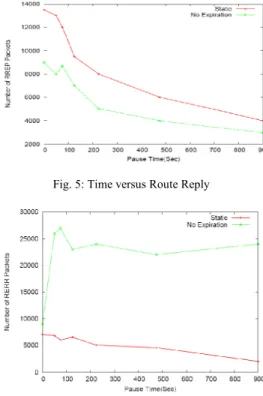
Without proper optimized life time assignment, the routing overheads are heavy. The route error makes more routing overhead. The link cache scheme provides available route information efficiently. This provides route information in advance. This scheme reduces the route discovery process. Reduced routing overhead, heavy traffic, less route error and improved performance. More route request, route reply and less rout error are achieved in the figure with static life time value.
B. Effects on Route Reply
Route reply is processed after route request is initiated. The route reply is more in static lifetime and is shown in Fig. 5.
Fig. 5: Time versus Route Reply
Fig. 6: Time versus Route Error C. Effects on Route Error
Route Error makes the transmission to end. This is the unpleasant condition for a communication network. This makes major inconvenience to the users. In this work, the route error is reported for every time seconds that is shown in Fig. 6.
Security is a dimension of routing metric to select a path based on the node security property. The maximal node disjoints paths finding algorithm finds the maximum number of paths without having any security properties of the path. The paths depend on the networking technology.
If the nodes are of equal security level, then the number of paths will also in the same security level. If nodes are of different security level, the security of each path will have more impact on the overall security of the path set. It is not true that more paths imply higher security.
D. Effects on End-to-End Delay
The important performance metric is End-to-End Delay. It is also called as Packet Latency. This is calculated by the time of packet sent at the sender and received at the receiver. This calculation is not only based on this but also the packets that are successfully delivered at the receiver without any loss of information.
When network traffic is very high, there may be a chance of packet latency at the receiver. So the success depends on the channel capacity. If the channel is more capable and error free, then there is no latency of packets. So the optimized lifetime value shows the result of low packet latency.
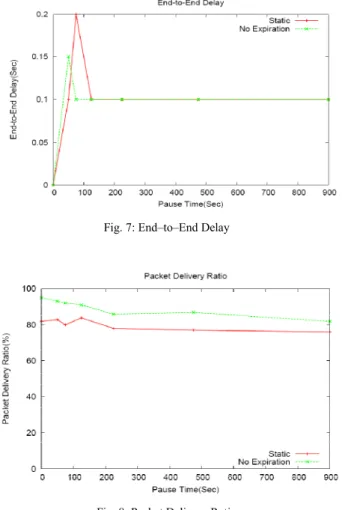
The results confirms that the small static lifetime value causes increasing number of route request and decreased number of route error. The Delay gets increased if the static lifetime is large and is shown in Fig. 7.
Fig. 7: End–to–End Delay
Fig. 8: Packet Delivery Ratio
The packet latency is calculated for packets that are successfully delivered. The transmission delay, propagation delay and queuing delay are the delay impairments that exist in IP networks. There are two types of latency.
• Protocol takes to discover a route to a destination • Latency for a sender to recover when a route used
breaks
It shows the average delay (time) in milliseconds spent to deliver each data packet.
Average End-End Delay = TimeDelay / PacketReceived
The application level performance metric is Packet Delivery Ratio (PDR). It is the ratio of packets that are received at the destination and sent at the source. It shows the ratio of total packets received at destination nodes, to total packets which are sent by source nodes.
PDR = Packets received / Packets Sent X 100
The packets may be dropped due to route error. If there is no alternate path, the packet may be dropped. It shows the number of data packets which were dropped during their journey to destination. To reduce packet loss, a small lifetime value is favored. A small life time value reduces route error and increases route requests. Therefore more data is in transmission with less route error.
The other type of packet drop is due to heavy collisions. When the traffic is very high, the packet loss caused by collision becomes more rigorous. The Time versus Packet Delivery Ratio is shown in Figure 8. The performance of packet delivery ratio in high traffic significantly affects the routing overhead.
V. CONCLUSIONS
The streaming of audio or video content over the Internet is a challenging task. This is due to the fact that the Internet is a packet switched network with a little quality of service (QoS) guarantee. The major challenge of the VoIP network is maintaining quality as well as security. This work shows the result in a better performance. In uni-path routing, only a single route is used between a source and the destination. The most commonly used protocols are Ad hoc On-Demand Distance Vector (AODV). The simulation results show that the reduction of packet loss and improvement of security. The performance is satisfied in terms of quality. But the increased Delay and security are again at a greater risk. This scheme reduces the complexity of route discovery process, Reduces routing overhead, heavy traffic, less route error and improved performance. More route request, route reply and less route error are achieved in the results with static life time value.
REFERENCES
[1] Abdur Rashid Sang, Jianwei Liu, Zhiping Liu, “performance comparison of single path and multipath routing protocol in MANET with selfish behavior”, 2010
[2] A. Baciocola, C. Cicconetti, G. Stea, “User–level performance evaluation of voip using ns2”.
[3] Berry Schoenmakers, “A simple publicly verifiable secret sharing scheme and its application to electronic voting”, CRYPTO-99, Vol. 1666 of Lecture Notes in Computer Science, Springer-Verlag, 1999, pp: 148-164.
[4] A. D. Clark. Modeling the Effects of Burst Packet Loss and Regency on Subjective Voice Quality, Columbia University IP, Telephony Workshop, 2001.
[5] R. G. Cole and J. H. Rosenbluth, “Voice over IP Performance Monitoring”, ACM SIGCOMM, 2001.
[6] Christos tachtatzis, David harle, “Performance evaluation of multipath and single path routing protocols for mobile ad-hoc networks”, 2008.
[7] Hanoch, Levy, Haim, Zlatokrilov, “The effect of packet dispersion on voice applications in IP networks”, IEEE / ACM transactions on networking, Vol.14, Issue 2, April 2006, pages: 277-288.
[8] ITU-T Rec. G.107. The E-Model, “A Computational Model for Use in Transmission Planning”, 2003.
[9] M.K. Marina, S.R. Das, “Performance of routing caching strategies in dynamic source routing, INt. Conf. on distributed computing system ICDCS, April 2001.
[10] C.E. Perkins, E.M. Belding-Royer, S.R. Das, “Ad-hoc On Demand distance Vector (AODV) routing”, Nov 2001. [11] A. Shamir, “How to Share a Secret”, Communications of the