KINETICS AND MECHANISM OF OXIDATION OF DIOLS BY
[BIS(TRIFLUOROACETOXY)IODO]BENZENE
Jayshree Banerji
[a]and Kalyan K. Banerji
[b]*Keywords: diols; hypervalent iodine; oxidation; kinetics; mechanism.
The oxidation of some vicinal and non-vicinal diols and two of their monoethers by [bis(trifluoroacetoxy)iodo]benzene (TFAIB) in aqueous acetic acid solution has been studied. The oxidation of vicinal diols leads to glycol-bond fission. The non-vicinal diols behave like monohydric alcohols and leads to the formation of hydroxy carbonyl compounds. The reaction is first order in TFAIB and a Michaelis-Menten kinetics was obtained with respect to the reductant. The reaction showed a first order dependence on hydrogen-ions. The oxidation of [1,1,2,2-2H
4]ethandiol exhibited the absence of a kinetic isotope effect. Suitable mechanisms have been proposed.
Corresponding Authors Fax: +91 291 2577530
E-Mail: [email protected]
[a] Department of Chemistry, RGP Mahavidyalaya, Kolar Road, Bhopal 462042, India
[b] Faculty of Science, National Law University, Mandore, Jodhpur 342304, India
Introduction
Oxidation of hydroxy compounds to the corresponding carbonyl compounds is an important transformation in synthetic organic chemistry. A large number of oxidants are known to bring about this transformation. However, most of these reagents are salts of toxic heavy metals. Hypervalent iodine compounds present an eco-friendly option. Bis(trifluoroacetoxy)-iodo]benzene (TFAIB) is well-known oxidant and some reports about the mechanism of oxidation reactions of TFAIB, including that of alcohols, have emanated recently from our laboratory.1-6 However several
oxidations of monohydric and polyhydric alcohols are known to follow different mechanistic pathways.7 Therefore,
we have studied the kinetics of oxidation several diols and two of their monoethers by TFAIB in 1:1 acetic acid-water (v/v), in the presence of perchloric acid. Mechanistic conclusions are discussed.
Experimental Section
Materials
TFAIB was a commercial product (Aldrich) and was used as received. The diols and the monoethers were commercial products and were distilled under reduced pressure before use. [1,1,2,2-2H
2]Ethandiol (DED) was prepared by the
reported methods.8 Its isotopic purity, as ascertained by the 1H NMR (100 MHz) spectra, is 96±3 %. Acetic acid was
refluxed for 3 h with acetic anhydride and chromic oxide and then distilled. Perchloric acid was used as a source of hydrogen ions.
Product analysis
The product analysis was performed under kinetic conditions i.e. with an excess of the diol over TFAIB. In a typical experiment, the diol (0.1 mol) and TFAIB (4.3 g, 0.01 mol) were made up 100 ml in 1:1 acetic acid-water (v/v), in the presence of perchloric acid (0.2 mol), and was allowed to stand for ca. 12 h for the completion of the oxidation. It was then treated with an excess (200 ml) of a saturated solution of 2,4-dinitrophenyl-hydrazine in 2 mol dm-3 HCl and kept overnight in a refrigerator. The
precipitated 2,4-dinitrophenylhydrazone (DNP) was filtered dried, weighed, recrystallized from ethanol and weighed again. The DNP derivatives were found to be homogenous by TLC except in the oxidation of propane-1,2- and butane-1,2-diols. In these cases the mixtures were separated by fractional crystallization. The identities of the products were confirmed by comparing the m.p. with the literature values.9
In the oxidation of ethanediol, pinacol and butane-1,4-diol, the identity of the products were confirmed by mixed m.p. with authentic samples of DNP of formaldehyde, acetone and 4-hydroxybutanal respectively. The m.p. were determined in open capillaries and are uncorrected. The results are summarized in Table 1. The yield of DNP of ethanediol was 95 % and 88 % before and after recrystallization respectively.
Kinetic measurements
The reactions were studied under pseudo-first-order conditions by keeping an excess (x 10 or greater) of the diol over TFAIB. The solvent was 1:1 acetic acid-water (v/v), unless mentioned otherwise. The reactions were studied at constant temperature (± 0.1 K) and were followed by monitoring the decrease in [TFAIB] iodometrically for up to 80% reaction extent. Pseudo-first-order rate constants, kobs,
were evaluated from linear plots (r2 > 0.995) of log [TFAIB]
Table 1. Analysis of the products in the oxidation of diols by TFAIB
Diol Product m.p. of DNP (C) Yielda
Ethanediol HCHO 166 89
Propane-1,2-diol MeCHO, HCHO 147, 165 88
Butane-2,3-diol MeCHO 148 90
Butane-1,2-diol EtCHO, HCHO 140, 165 86
Pinacol MeCOMe 127 91
Propane-1,3-diol HOCH2CH2CHO 130 86
Butane-1,3-diol MeCH(OH)CH2CHO 95 87
Butane-1,4-diol HOCH2CH2CH2CHO 118 90
Pentane-1,5-diol HOCH2(CH2)3CHO 77 85
3-Methoxybutan-1-ol MeCH(OMe)CH2CHO 106 89
2-Methoxyethanol MeOCH2CHO 119b 85
a The yield is of DNP derivative after recrystallization in percentage; b Instead of DNP, 4-nitrophenylhydrazone derivative was prepared.
Simple and multivariate regression analyses were carried out by the least-squares method. We have used standard deviation (sd), coefficient of determination (R2 or r2), and
Exner’s10 parameter, , as measures of the goodness of fit in
correlation analysis.
Results
Kinetic data were obtained for all the diols studied. Since the results are similar, only representative data are reproduced here.
Stoichiometry
The oxidation of vicinal diols by TFAIB resulted in the formation of the products arising out of glycol-bond fission. The other diols are oxidized as simple alcohols to yield hydroxy aldehydes/ketones. The overall reactions may be represented as follows.
R2C(OH)C(OH)R2 + PhI(OCOCF3)2 2R2C=O
+ PhI + 2CF3CO2H (1)
HOCH2(CH2)nCH2OH+ PhI(OCOCF3)2
HOCH2(CH2)nCHO + PhI + 2 CF3CO2H (2)
Rate laws
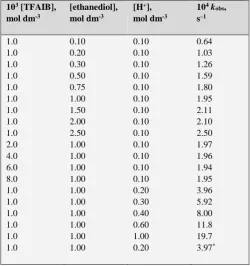
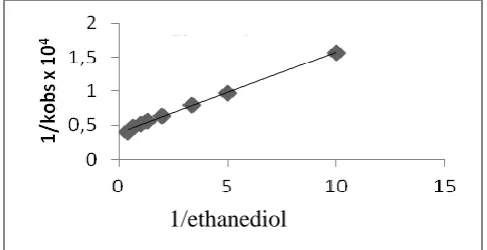
The reaction is of first order with respect to TFAIB and hydrogen ions. Michaelis-Menten type kinetics were observed with respect to diols (Table 2). A plot of 1/kobs
against 1/[diol] is linear with an intercept on the rate-ordinate (Figure 1). This indicates the following overall mechanism and the rate law (5).
(3)
(4)
(5)
The variation in diol concentration was studied at four different temperatures and the values of K and k2 were
obtained from the double reciprocal plots. The thermodynamic parameters for the formation of the intermediate and activation parameters for its disproportionation were also calculated (Tables 3 and 4).
Table 2. Rate constants of the oxidation of ethanediol by TFAIB at 298 K
103 [TFAIB],
mol dm-3
[ethanediol], mol dm-3
[H+],
mol dm-3
104 k obs,
s–1
1.0 0.10 0.10 0.64
1.0 0.20 0.10 1.03
1.0 0.30 0.10 1.26
1.0 0.50 0.10 1.59
1.0 0.75 0.10 1.80
1.0 1.00 0.10 1.95
1.0 1.50 0.10 2.11
1.0 2.00 0.10 2.10
1.0 2.50 0.10 2.50
2.0 1.00 0.10 1.97
4.0 1.00 0.10 1.96
6.0 1.00 0.10 1.94
8.0 1.00 0.10 1.95
1.0 1.00 0.20 3.96
1.0 1.00 0.30 5.92
1.0 1.00 0.40 8.00
1.0 1.00 0.60 11.8
1.0 1.00 1.00 19.7
1.0 1.00 0.20 3.97*
*contained 0.001 mol dm-3 acrylonotrile
Diol + TFAIBK Intermediate
Intermediate
k2 Product
2 diol TFAIB
Rate =
1+ diol
Kk
Table 3. Formation constants and thermodynamic parameters of diol-TFAIB intermediate
Diol K, dm-3 mol-1 H,
kJ mol-1
S,
J mol-1 K-1
G,
kJ mol-1
288 K 298 K 308 K 318 K
Ethanediol 3.77 3.43 3.11 2.83 -9.80.1 -15.2 0.3 -5.50.1
Propane-1,2-diol 4.33 4.11 3.94 3.74 -6.20.1 -11.3 0.4 -6.00.2
Butane-2,3-diol 5.35 4.84 4.40 3.92 -10.30.2 -14.1 0.8 -6.40.2
Butane-1,2-diol 4.65 4.35 4.08 3.77 -9.40.3 -14.0 0.9 -5.50.2
Pinacol 3.54 3.27 3.05 2.79 -7.80.2 -6.50.2 -6.10.2
Propane-1,3-diol 5.90 5.45 5.00 4.39 -9.90.5 -11.3 0.8 -6.70.4
Butane-1,3-diol 4.05 3.80 3.53 3.31 -7.70.1 -6.90.3 -5.80.2
Butane-1,4-diol 4.10 3.61 3.29 3.01 -10.30.2 -15.8 0.6 -5.70.3
Pentane-1,5-diol 4.41 4.08 3.72 3.41 -9.10.2 -10.9 0.6 -6.00.2
3-Methoxy-butan-1-ol 4.60 4.24 3.89 3.59 -8.00.4 -7.30.2 -6.10.3
2-Methoxy-ethanol* 4.51 4.25 3.98 3.77 -7.1±0.1 -14.5 ±0.2 -6.10.2
DED 3.87 3.53 3.20 2.92 -9.70.2 -14.5 0.3 -5.60.1
*Data from Ref.5.
Table 4. Rate constants and activation parameters for the disproportionation of the diol-TFAIB intermediate
Test for free radicals
The oxidation of ethanediol, in an atmosphere of nitrogen, failed to induce the polymerization of acrylonitrile. In blank experiments, with the diol absent, no noticeable consumption of TFAIB was observed. The addition of acrylonitrile had no effect on the rate of oxidation (Table 2).
Figure 1. Oxidation of ethanediol by TFAIB: A double reciprocal plot
To further confirm the absence of free radicals in the reaction pathway, the reaction was carried out in the presence of 0.05 mol dm-3 of 2,6-di-t-butyl-4-methylphenol
(butylated hydroxytoluene or BHT). It was observed that BHT was recovered unchanged, almost quantitatively.
Kinetic isotope effect
To ascertain the importance of the cleavage of the -C – H bond in the rate-determining step, oxidation of deuteriated ethanediol was studied. The results (Tables 3 and 4) showed that the neither the formation nor the disproportionation of the diol-TFAIB intermediate exhibit a kinetic isotope effect.
Solvent composition effect
The oxidation of ethanediol was studied in solvents containing different amounts of acetic acid and water. The rate of oxidation increases with an increase in the amount of acetic acid in the solvent (Table 5). This may be attributed to the change in the acidity of the medium with a change in the amount of acetic acid. Wiberg and Evans11 have
determined the Hammett’s acidity function, H0, for low
concentration of perchloric acid in a series of acetic acid-water mixtures. They observed that the acidity increases as the concentration of acetic acid increases. The present reaction is an acid-catalyzed one and with an increase in the acidity of the solution, the rate is expected to increase.
Diola 104 k
2, s-1 H*,
kJ mol-1
S*,
J mol-1 K-1
G*,
kJ mol-1
288 K 298 K 308 K 318 K
Ethanediol 1.32 2.51 4.80 9.10 46.5±0.7 - 157±2 93.50.5
Propane-1,2-diol 1.86 3.51 6.68 12.3 45.5±0.5 - 159±2 92.7±0.4
Butane-2,3-diol 2.62 4.93 9.09 17.0 44.8±0.6 - 158±2 91.9±0.5
Butane-1,2-diol 4.38 8.08 14.6 26.7 43.1±0.6 - 160±2 90.6±0.5
Pinacol 5.19 9.57 17.3 31.4 43.1±0.7 - 159±2 90.2±0.6
Propane-1,3-diol 4.12 9.45 21.4 47.6 59.6±0.6 - 103±2 90.2±0.5
Butane-1,3-diol 7.34 15.4 32.2 68.2 53.9±0.9 - 118±1 89.0±0.5
Butane-1,4-diol 6.85 15.0 31.3 64.9 54.4±0.4 - 117±1 89.1±0.3
Pentane-1,5-diol 7.52 15.8 33.1 69.2 53.8±0.8 - 119±2 88.9±0.6
3-Methoxy-butan-1-ol 8.03 18.0 36.3 73.5 52.1±0.6 - 124±2 88.7±0.4
2-Methoxy-ethanol* 3.43 7.85 18.7 41.2 60.8±0.7 - 120±2 96.3±0.6
DED 1.29 2.50 4.84 9.07 47.0±0.5 - 156±2 93.5±0.4
Table 5. Effect of solvent composition on the oxidation rate of ethanediol by TFAIB
[ethanediol] 1.00 mol dm-3; [TFAIB] 0.001 mol dm-3; [H+] 0.10
mol dm-3 ; T = 298 K.
Table 6. Effect of trifluoroacetic acid on the oxidation of ethanediol by TFAIB at 298 K
[ethanediol] 1.00 mol dm-3; [TFAIB] 0.001 mol dm-3; [H+] 0.10
mol dm-3.
Effect of trifluoroacetic acid
Addition of trifluoroacetic acid (TFA) reduces the rate of reaction (Table 6).
Discussion
The diverse nature of the products formed in the oxidation of vicinal diol and other diols suggests that these compounds follow different mechanistic pathways. This further confirmed by the two linear plots obtained between log k2 at
288 K and at 318 K, one for the vicinal diols and another for the rest (Figure 2). Therefore, it was considered best to treat the oxidation of vicinal and other diols separately.
Figure 2. Isokinetic relationship in the oxidation of diols by TFAIB: vicinal diols (series 1); other diols (series 2)
Oxidation of vicinal diols
There is no significant correlation between the activation enthalpies and entropies of the oxidation of five vicinal diols (r2 = 0.6373), indicating the absence of a compensation
effect.12 A correlation between the calculated values of
enthalpies and entropies is often vitiated by the experimental errors associated with them. The reaction, however, exhibited an excellent isokinetic relationship, as determined by Exner’s method.13 An Exner’s plot between log k
2 at 288
K and at 318 K was linear (r2 = 0.9989, sd = 0.02, slope =
0.9039±0.0108). The value of isokinetic temperature evaluated from the Exner’s plot is 451±11 K. The linear isokinetic correlation implies that all the diols are oxidized by the same mechanism and the change in the rate of oxidation is governed by changes in both the enthalpy and
The absence of a primary kinetic isotope effect confirms that the -C-H bond is not cleaved in the rate-determining step. In contrast, a substantial primary kinetic isotope effect was observed in the oxidation of ethanol5 by TFAIB. Thus it
is apparent that the oxidation of monohydric alcohols and vicinal diols follow different mechanisms.
A perusal of data of Table 3 showed that the formation constants of the diol-TFAIB intermediate do not exhibit much variation with the structure of the diol. However, the rate constants of the disproportionation of the intermediate vary considerably with the nature of the diol. The rate constants of the disproportionation were, therefore, subjected to correlation analysis.
The rate constants, k2, of the disproportionation failed to
yield any satisfactory correlation separately with Taft I and
Es values.
log k2 = -2.50±1.17 I - 3.48 (6)
r2 = 0.6035, sd = 0.18, = 0.70, n = 5, T = 298 K
log k2 = -1.53±0.35 Es - 3.54 (7)
r2 = 0.8615, sd = 0.11, = 0.42, n = 5, T = 298 K
The rates were, therefore, correlated in terms of Pavelich-Taft’s14 dual substituent-parameter (DSP) equation (8).
log k2 = II + Es + log k0 (8)
The correlations are excellent; the reaction constant being negative (Table 7). Though the number of compounds is rather small (five) for correlation with a DSP equation, the correlations are excellent and results can be used qualitatively.
Table 7. Temperature dependence of the reaction constants
T, K I R2 sd
288 -1.18±0.01 -1.28±0.01 0.9998 0.01 0.02 298 -1.16±0.01 -1.25±0.01 0.9999 0.01 0.02 308 -1.12±0.02 -1.18±0.01 0.9996 0.02 0.03 318 -1.09±0.02 -1.15±0.02 0.9995 0.03 0.04
The negative polar reaction constants indicate an electron-deficient carbon centre in the transition state of the rate-determining step. The negative steric reaction constant shows a steric acceleration of the reaction. This may be explained on the basis of high ground state energy of sterically crowded diols. Since the crowding is relieved in the product carbonyl compound as well as in the transition state leading to it, the transition state energies of the crowded and uncrowded diols do not differ much and steric
%AcOH, v/v 25 40 50 60 70
105 k
obs ,s-1 8.56 12.7 19.5 28.7 40.6
103 [TFA], mol dm-3 0.0 0.5 1.0 2.0
105 k
obs ,s-1 19.5 13.4 9.42 7.58
0 0.2 0.4 0.6 0.8 1 1.2 1.4 1.6 1.8 2
0 0.2 0.4 0.6 0.8 1
log k2 + 4
log
k
2
+
4
Scheme 1.
Scheme 2.
The absence of a kinetic isotope effect confirms that the
-C–H bond is not cleaved in the rate-determining step. The retardation of the reaction by the addition of TFA points to an equilibrium in which TFA is one of the products. The Michaelis-Menten kinetics also indicates the formation of an intermediate in a rapid pre-equilibrium. This may well be a ligand exchange round trivalent iodine. Similar exchanges are known in the oxidations by lead tetraaceate.15 The
observed acid-catalysis suggest that the intermediate is protonated in a fast reversible reaction, prior to the slow step.
The mechanism depicted in Scheme 1 explains all the observed data. The low negative values of the polar reaction constant support the proposed mechanism. In an oxidation reaction, the net flow of the electrons is from the reductant to the oxidant. Therefore, an electron-deficiency is created, in the transition state, in the reductant moiety.
Oxidation of other diols
The linear correlation between log k2 at 288 K and 318 K
(r2 = 0.9980, slope = 0.65550.0148) for the oxidation of
four non-vicinal diols, 3-methoxybutan-1-ol, and 2-methoxyethanol shows that all the compounds are oxidized by the same mechanism.12 The value of isokinetic
temperature is 39722 K. 3-Methoxybutan-1-ol and 2-methoxyethanol are typical monohydric alcohols and, therefore, it is highly likely that the non-vicinal diols are oxidized by a mechanism similar to that operative for monohydric alcohols. The oxidation of ethanol and 2-propanol5 exhibited a substantial primary kinetic isotope
effect confirming the cleavage of the -C-H bond in the rate-determining step. Therefore, a mechanism similar to one proposed earlier by Banerji et al,5 accounts for the
experimental results obtained in the oxidation of non-vicinal diols (Scheme 2)
Acknowledgements
Thanks are due to Dr Pradeep K. Sharma, JNV University, Jodhpur, India, for his help.
References
1Kansara, A., Sharma, P. K., Banerji, K. K. J. Chem. Res., 2004,
581.
2Kansara, A., Sharma, P. K., Banerji, K. K. J. Chem. Res., 2004,
315.
3Kansara, A., Sharma, P. K., Banerji, K. K. Indian J. Chem.,2004,
43A, 1056.
4Purohit, P., Banerji, J., Sharma, P. K., Banerji, K. K. Prog. React.
Kinet. Mech.,2009, 34, 141.
5Banerji, J., Sharma, P. K., Banerji, K. K., Indian J. Chem.,2008,
47A, 1213.
6Banerji, J., Sharma, P. K., Banerji, K. K., Prog. React. Kinet.
Mech.,2005, 30, 267;
7Banerji, J., Sharma, P. K., Banerji, K. K., Indian J. Chem., 2007,
46A, 445.
8Kemp, T. J. Waters, W. A. Proc. Roy. Soc., 1963, A274, 480.
9Coffey, S. (Ed), Rodd’s Chemistry of Carbon Compounds, Vol. I,
Elsevier, Amsterdam 1965; Rodd, E. H. (Ed), Chemistry of Carbon Compounds, Vol. I A, Elsevier, Amsterdam, 1951; Buckingham, J. (Ed), Dictionary of Organic Compounds, Vol. 3, Chapman and Hall, New York, 1982; West R C, Handbook of Chemistry and Physics, 58th edition, CRC Press,
Ohio, 1977-78.
10Exner, O., Collect. Czech. Chem. Commun., 1966, 31 3222.
11Wiberg, K. B., Evans, R. J., J. Am. Chem. Soc., 1958, 80 3019.
12Liu, L. Guo, Q.-X., Chem. Rev.,2001, 101 673.
13Exner, O.m Collect. Czech. Chem. Commun., 1964, 29 1094.
14Pavelich, W. A., Taft, R. W, J. Am. Chem. Soc.,1957, 79, 4835.
15Banerji, K. K., Banerjee, S. K., Shanker, R. Bull. Chem. Soc. Jpn.,
1978, 51, 2153.
Received: 20.03.2014. Accepted: 15.04.2014.
+ CF3COOH PhI O COCF3 O PhI O C C O H CF3 O
H (CH2)nCH2OH + H+
Ph I + CF3 COOH + H+ Slow
K Ph I (COOCF3)2 + HO-CH2-(CH2)nCH2OH
-CH2-(CH2)nCH2OH
PhI O C C O H CF3 +OH
H (CH2)nCH2OH
PhI O C C O H CF3 +OH
H (CH2)nCH2OH
+ CF3COOH PhI O COCF3 O PhI O C C O H CF3 O
H (CH2)nCH2OH + H+
Ph I + CF3 COOH + H+ Slow
Scheme 2 K Ph I (COOCF3)2 + HO-CH2-(CH2)nCH2OH
-CH2-(CH2)nCH2OH
PhI O C C O H CF3 +OH
H (CH2)nCH2OH
PhI O C C O H CF3 +OH
H (CH2)nCH2OH
+ HO-(CH2)n-CHO OH
OH
+ PhI(OCOCF3)2
O
OH
+ CF3CO2H I Ph OCOCF3 H+ O O I Ph O CF3 +OH H O
2 + PhI + H+
+ CF3CO2H