ISSN: 2501 - 1235 ISSN-L: 2501 - 1235 Available on-line at: www.oapub.org/edu
Copyright © The Author(s). All Rights Reserved.
doi: 10.5281/zenodo.3643369 Volume 6 │ Issue 1 │ 2020
REASONS FOR TENDING TOWARDS TO TENNIS
AND THE REALIZATION LEVELS OF EXPECTATIONS
OF AMATEUR TENNIS PLAYERS FROM TENNIS –
THE CASE OF DİYARBAKIR PROVINCE, TURKEY
iCanan Gülbin Eskiyecek1ii, Özlem Keskin2 1Mardin Artuklu University, School of Physical Education and Sports, Mardin, Turkey 2Kocaeli University, Faculty of Sports Sciences, Kocaeli, Turkey
Abstract:
The purpose of this research was to determine the factors encourage female and male
amateur tennis players in Diyarbakır for tennis; reasons and expectations of them about tennis. The population consisted of almost 250 tennis players in Diyarbakır Province. The
research sample was limited by entirely 121 randomly selected amateur tennis players (39 female, and 82 male) who interest in tennis at Dicle University and participated in the
Diyarbakır Kayapınar municipality tennis tournament. The survey used in the study was
developed by Sunay et al., in 2006. This Likert scaled survey consisted of 4 parts. The 1st part of the survey included demographic information; the 2nd part of the survey consisted of expectations from tennis sport; the 3rd chapter of the same survey asks the reasons for interesting in tennis in an amateur way; finally, the factors encourage for tennis sport can be seen in the 4th part. T-test and ANOVA tests were applied to determine whether the difference between the comments of participators related to gender, marital status, age, and educational background. Pearson Correlation test was applied to specify the relationship between groups and variables. For study findings,
expectations of amateur tennis players in Diyarbakır toward being a coach and popular
athlete are at a high level; the effect of physical education teachers and mass communication such as television and media organs is very few in tending towards to tennis. Also, it is revealed that thoughts about making money and leading a good life become prominent as a reason for interesting in tennis.
i This study was submitted as a poster abstract in the 13th International Sports Sciences Congress in Konya province from 7 to 9 November 2014.
Keywords: sport, tennis, tendency to tennis, expectation, encouragement
1. Introduction
For Michaud et al., (1999), sport is the physical activities including situations in which people face with themselves or others in various ways.
Since people tend to sport to reach a better health status; lose weight, gain flexibility and agility (Akça, 2012) and increase the muscle force, sport and human life have become inseparable nowadays. Accordingly, regardless of age, the sport that is consciously played on the strength of a scientific basis has a remarkable effect on being healthy, happy, well-adjusted and successful and keeping the normal power as high (Atasoy and Kuter, 2005). In addition to all these, it is emphasized that age, gender, and development characteristics are effective in participating in physical activities; socio-economic and cultural structures play a supportive role as well (Efe, 2007).
Tennis is known as an important sport in terms of health, effective physical and functional development for individuals of all ages. Regular tennis exercises cardiovascular, metabolic, as well as physical and mental benefits and improved bone health, agility, coordination, even stress and anxiety it is stated to be effective in management (Yazıcı et al., 2016).
Tennis is a funny and common recreational sport besides being a popular sport that is attracted the attention of millions of sports fans all around the world. The deep interest in tennis and increasing professionalization create a need for conducting scientific studies. Thus, tennis is not only a game but also a professional sports branch (Kermen, 2002). Tennis sport is one of the best sport branches that forces the technical, tactical and psychological abilities of the person; tennis, at the same time, is a sports branch that develops the physical, mental, emotional and social development
characteristics (Haşıl and Ataç, 1998). Reasons for the interest and expectations of people
who are interested in this branch in a professional or amateur way have become an object of curiosity by the increasing interest for tennis as an Olympic sport that is played of all ages and at every level of the society and needs both physical and mental stability has positive contributions to such psychomotor development characteristics.
The objective of this study, starting from this point of view, was to determine the reasons for individuals to start tennis and realization levels of their expectations from this sport; we also aimed to review the effect of playing tennis in an amateur way.
2. Material and Methods
2.1 Research Model
This study used a ‘descriptive survey model’ that is one of the quantitative research types
2.2 Research Sample and Population
The population consisted of almost 250 athletes playing tennis as amateurs in Diyarbakır.
The sample group of the research consisted of 121 randomly selected amateur tennis players (39 female, 82 male) who are amateur tennis players in Dicle University and
participated in Diyarbakır Kayapınar Municipality tennis tournament.
2.3 Data Collection Method
The data of this study were collected by the investigator via surveys that were filled by amateur tennis players. The related literature review was conducted before this research; previous studies on this issue were scrutinized. The surveys were applied to tennis players by the investigator in person.
The survey that was used in the research was developed by Sunay et al. The validity and reliability coefficient of the survey is 8434. This survey was used in this research after being adapted to amateur tennis players and expert opinions were
received. Data, within this scope, were obtained by the scale of ‘Reasons for starting tennis and the realization levels of expectations of amateur tennis players in Diyarbakır’. α internal consistency reliability coefficient for the 2nd part of the Five Point Likert scale was computed as 0.90; for the 3rd part was 0.86; for the 4th part was 0.87. The internal
consistency for the whole of the survey was calculated as α=0,899.
The data collection tool of this study consisted of 4 parts and 30 questions including demographic information. There are 7 questions on demographic information in the 1st part of the survey; 11 questions regarding expectations from tennis sport in the 2nd part of the survey; 9 questions about reasons for playing tennis in an amateur way in the 3rd part of the survey; finally, there are 10 questions on factors that encourage amateur tennis players to tennis sport in the 4th part of the survey. The participants were asked to give a single answer to each question.
2.4 Analysis of Data
SPSS 18.0 statistics packaged software was utilized to evaluate the data of the surveys. Information in the demographic information part of the survey was commented via frequency (f), percentage distributions (%) and arithmetic mean. T-test specified the difference between variables in data that show the normal distribution for the other parts of the survey; one-way analysis of variance (ANOVA) determined the difference between groups. Moreover, the bi-directional Pearson Correlation test was utilized to determine the relationship between demographic variables and the sum of the factors that encourage people for tennis with the sum of the reasons for interesting in tennis in an amateur way with the expectations from the tennis sport. Hypotheses are bi-directional as well as alpha value is accepted as a statistically significant result at 0.05 level.
Ranges in comments in 5 point likert graduation scale are specified by ‘4/5=0.80’
formula. 1.00 – 1.80 (Strongly disagree), 1.81 – 2.60 (Disagree), 2.61 – 3.40 (Neutral), 3.41
Since one-way variance analysis and scoring in Likert graduation scale in Tukey test are not accepted as a value while statistical analysis is performed, statistical analyses were made by adding the answers of tennis players in the 2nd, 3rd and 4th parts among themselves; then the addition was grouped as the sum of the expectations from tennis, the sum of the reasons for interesting in tennis in an amateur way and the sum of the factors that encourage people for tennis.
3. Results
This chapter presents and evaluates the findings related to research results.
Table 1: Frequency and Percentage Distribution Table of Amateur Tennis Players Participated in Research
Variables Order Subcategories Frequency (f) Percentage (%)
Gender 1 Female 39 32,2
2 Male 82 67,8
Total 121 100
Age 1 18-25 50 41,3
2 26-40 59 48,8
3 41-65 12 9,9
Total 121 100
Marital Status
1 Married 42 34,7
2 Single 79 65,3
Total 121 100
Educational Background
1 High schools and equivalents 13 10,7
2 Bachelor’s degree 89 73,6
3 Postgraduate 13 10,7
4 Doctorate 6 5,0
Total 121 100
As is seen in Table 1, 32,2% of amateur tennis players are females, 67,8% of amateur tennis players are males; 41,3% of those players are in 18-25 age range, 48,8% of related players are in 26-40 age range, 9,9% of those players are in 41-65 age range. 34,7% of related amateur tennis players are married, 65,3% of them are single. 10,7% of related amateur tennis players graduated from high schools and their equivalents; 73,6% of them are bachelors; 5% of them have PhD.
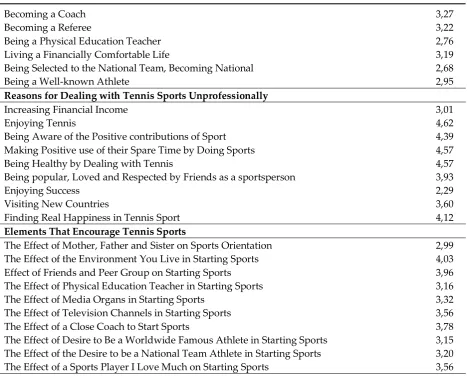
Table 2: Amateur Tennis Players’ Expectations for Tennis Sport, Reasons for Dealing with Tennis Sport Unprofessionally, and Factors That Encourage
Tennis Sport and Average Values of Elements That Encourage Tennis Sport
Expectations for Tennis Sport Mean
Being Healthy and Maintaining Health 4,55
Having a Good Physical Appearance 4,04
Becoming a Coach 3,27
Becoming a Referee 3,22
Being a Physical Education Teacher 2,76
Living a Financially Comfortable Life 3,19
Being Selected to the National Team, Becoming National 2,68
Being a Well-known Athlete 2,95
Reasons for Dealing with Tennis Sports Unprofessionally
Increasing Financial Income 3,01
Enjoying Tennis 4,62
Being Aware of the Positive contributions of Sport 4,39 Making Positive use of their Spare Time by Doing Sports 4,57
Being Healthy by Dealing with Tennis 4,57
Being popular, Loved and Respected by Friends as a sportsperson 3,93
Enjoying Success 2,29
Visiting New Countries 3,60
Finding Real Happiness in Tennis Sport 4,12
Elements That Encourage Tennis Sports
The Effect of Mother, Father and Sister on Sports Orientation 2,99 The Effect of the Environment You Live in Starting Sports 4,03 Effect of Friends and Peer Group on Starting Sports 3,96 The Effect of Physical Education Teacher in Starting Sports 3,16
The Effect of Media Organs in Starting Sports 3,32
The Effect of Television Channels in Starting Sports 3,56
The Effect of a Close Coach to Start Sports 3,78
The Effect of Desire to Be a Worldwide Famous Athlete in Starting Sports 3,15 The Effect of the Desire to be a National Team Athlete in Starting Sports 3,20 The Effect of a Sports Player I Love Much on Starting Sports 3,56
Table 3: The Relationship between Reasons for Tendency to Tennis and Realization Levels of Expectations of Amateur Tennis Players by Age Variable
Variables Correlation Age
Age r 1
p
n 121
Sum of Expectations from Tennis sport
r -,506** 1
p ,000
n 121 121
Sum of Reasons for Interesting in Tennis in an Amateur Way
r -,308** ,598** 1
p ,001 ,000
n 121 121 121
Sum of Factors Encourage to Tennis Sport
r -,332** ,487** ,446** 1
p ,000 ,000 ,000
n 121 121 121 121
** Correlation is significant at 0.01 level (2-tailed).
Table 4: The Relationship between Reasons for Tendency to Tennis and Realization Levels of Expectations of Amateur Tennis Players by Educational Background Variable
Variables Correlation Educational Background
Educational Background
r 1
p
n 121
Sum of Expectations from Tennis Sport
r -,362** 1
p ,000
n 121 121
Sum of Reasons for Interesting in Tennis in an Amateur Way
r -,219* ,598** 1
p ,016 ,000
n 121 121 121
Sum of the Factor Encourage to Tennis Sport
r -,181* ,487** ,446** 1
p ,047 ,000 ,000
n 121 121 121 121
** Correlation is significant at 0.01 level (2-tailed) * Correlation is significant at 0.05 level (2-tailed).
As is seen in Table 4, there is a negatively directed and statistically significant relationship between the educational background variable and total score level of expectations from tennis sport (r= -.362**, p= .000), reasons for interesting in tennis sport in an amateur way (r= -,219**, p= .016) and the factors that encourage for tennis sport (r= -,181**, p= .047).
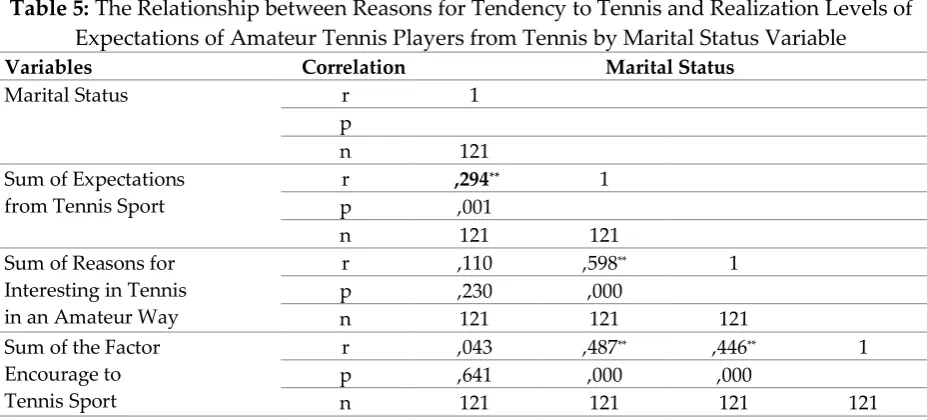
Table 5: The Relationship between Reasons for Tendency to Tennis and Realization Levels of Expectations of Amateur Tennis Players from Tennis by Marital Status Variable
Variables Correlation Marital Status
Marital Status r 1
p
n 121
Sum of Expectations from Tennis Sport
r ,294** 1
p ,001
n 121 121
Sum of Reasons for Interesting in Tennis in an Amateur Way
r ,110 ,598** 1
p ,230 ,000
n 121 121 121
Sum of the Factor Encourage to Tennis Sport
r ,043 ,487** ,446** 1
p ,641 ,000 ,000
n 121 121 121 121
** Correlation is significant at the 0.01 level (2-tailed).
Table 6: T-Test Results for Difference of Comments of Amateur Tennis Players Related to Gender Variable
Groups Gender N X SS Sd t p
Sum of Expectations from Tennis Sport
Female 39 35,38 11,16 119 -,790 ,431 Male 82 37,21 12,19
Sum of Reasons for Interesting in
Tennis in an Amateur Way
Female 39 38,08 5,85 119 ,977 ,331
Male 82 36,65 8,20
Sum of the Factor Encourage to Tennis Sport
Female 39 36 10,31 119 ,908 ,366
Male 82 34,16 10,49
p<0.05
As is seen in Table 6, the sum of expectations from tennis sport, the sum of reasons for interesting in tennis sport in an amateur way and the sum of the factors encourage for tennis sport do not make a statistically significant difference by gender at p<0.05 level. In other words, comments of tennis players related to these articles are similar to the gender variable.
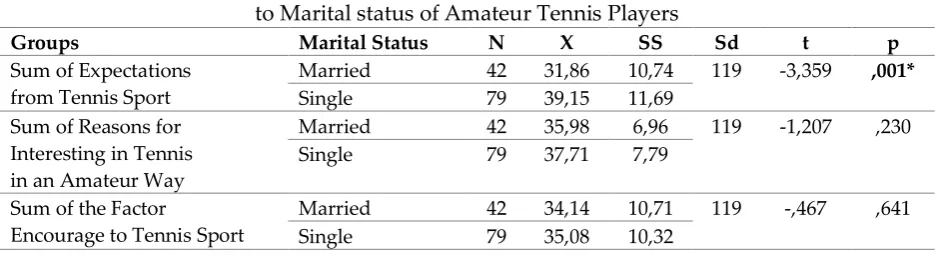
Table 7: T-Test Results for Difference of Comments Related to Marital status of Amateur Tennis Players
Groups Marital Status N X SS Sd t p
Sum of Expectations from Tennis Sport
Married 42 31,86 10,74 119 -3,359 ,001*
Single 79 39,15 11,69 Sum of Reasons for
Interesting in Tennis in an Amateur Way
Married 42 35,98 6,96 119 -1,207 ,230 Single 79 37,71 7,79
Sum of the Factor
Encourage to Tennis Sport
Married 42 34,14 10,71 119 -,467 ,641 Single 79 35,08 10,32
*p<0.05
As is seen in Table 7, the sum of expectations of amateur tennis players from tennis sport does not make a statistically significant difference by the marital status at p<0.05 level. We can say that expectations of singles are met more than the expectations of married people. Sum of the reasons for interesting in tennis sport in an amateur way and the sum of the factors encourage for tennis sport do not make a statistically significant difference by the marital status at p<0.05 level (Table 7). In other words, comments of survey participant amateur tennis players are similar when their marital status is considered.
Table 8: One-Way ANOVA Analysis (ANOVA) Results of Amateur Tennis Players Based on Age Variable
Groups Source of
Variance
Sum of Squares
Sd Mean
Squares
F p Difference
Tukey
Sum of Expectations from Tennis Sport
Intergroup 4308,51 2 2154,28
20,268 ,000* 1-2,1-3, 2-3 In-Group 12541,1 118 106,29
Sum of Reasons for Interesting in Tennis in an Amateur Way
Intergroup 651,96 2 325,98
6,255 ,003* 1-2,1-3 In-Group 6149,64 118 52,17
Total 6801,6 120
Sum of the Factor Encourage to Tennis Sport
Intergroup 1525,61 2 762,81
7,821 ,001* 1-3,2-3 In-Group 11508,95 118 97,53
Total 13034,56 120
*p<0.05
As is seen in Table 8, the sum of expectations from tennis sport makes a statistically significant difference by age at p<0.05 level. Tukey HSD multiple comparison test was performed to determine which groups this difference is between; groups were compared with each other. About the biggest difference based on Tukey HSD test results, comments of tennis players in 18-25 (X=42,98) age group related to the sum of the expectations from tennis sport realize at a more positive level than the comments of tennis players in 41-65 (X=24,42) age group.
For Table 8, the sum of the reasons for interesting in tennis in an amateur way makes a statistically significant difference by age at p<0.05 level. Tukey HSD multiple comparison test was performed to determine which groups this difference is between; groups were compared with each other. About the biggest difference based on Tukey HSD test results, comments of tennis players in 18-25 (X=39,46) age group related to the sum of the reasons for interesting in tennis sport in an amateur way realize at a more positive level than the comments of tennis players in 41-65 (X=31,92) age group.
For Table 8, the sum of factors encourage for tennis sport makes a statistically significant difference by age at p<0.05 level. Tukey HSD multiple comparison test was performed to determine which groups this difference is between; groups were compared with each other. About the biggest difference based on Tukey HSD test results, comments of tennis players in 18-25 (X=37,98) age group related to the sum of the factors encourage for tennis sport in an amateur way realize at a more positive level than the comments of tennis players in 41-65 (X=25,83) age group.
Table 9: One-Way ANOVA Analysis Results
of Amateur Tennis Players Based on Educational Background Variable
Groups Source of
Variance
Sum of Squares
Sd Mean
Squares
F p Difference
Tukey
Sum of Expectations from Tennis Sport
Intergroup 2762,32 3 920,77
7,647 ,000*
1-3,1-4,
2-3,2-4 In-Group 14088,2 117 120,41
Total 16850,51 120
Sum of Reasons for Interesting in Tennis in an Amateur Way
Intergroup 590,56 3 196,85
3,708 ,014* 2-4 In-Group 6211,05 117 53,09
Total 6801,6 120
Intergroup 565,51 3 188,5
Sum of the Factor Encourage to Tennis Sport
Total 13034,56 120
*p<0.05
It can be seen when looking at Table 9 that the sum of expectations of tennis sport makes a statistically significant difference by educational background at p<0.05 level. Tukey HSD multiple comparison test was performed to determine which groups this difference is between; groups were compared with each other. About the biggest difference based on Tukey HSD test results, comments of tennis players who graduated from high school and their equivalents (X=39,77) related to the sum of expectations from tennis sport realize at a more positive level than the comments of tennis players who are doctors (X=23,33).
As is seen in Table 9, the sum of reasons for interesting in tennis sport in an amateur way makes a statistically significant difference by the educational background at p<0.05. Tukey HSD multiple comparison test was performed to determine which groups this difference is between; groups were compared with each other. About the biggest difference based on Tukey HSD test results, comments of tennis players who are bachelors (X=38,21) related to the sum of reasons for interesting in tennis sport in an amateur way realize at a more positive level than the comments of tennis players who are doctors (X=30,33).
The sum of factors that encourage amateur tennis players for tennis sport does not make a statistically significant difference by the educational background at p<0.05 level (Table 9).
4. Discussion and Conclusion
This study determined the demographic information of amateur tennis players and reviewed the expectations of them from tennis sport, their reasons for interesting in tennis sport in an amateur way and the factors that encourage them to tennis sport. Obtained findings were discussed in consideration of the literature.
It can be observed in findings that there is no significant difference between female and male tennis players with reference to the ensemble average and differences related to gender variable based on expectations of amateur tennis players from tennis sport, their reasons for interesting in tennis sport in an amateur way and the factors encourage them to tennis sport. Their answers to survey questions are similar in terms of values. However, it is revealed that being a coach and finding real happiness in tennis sport is more important.
Regarding the expressions of Topal (2016), reasons and expectations of 414 students about starting tennis vary; this related difference is explicit especially on the gender variable.
For literature, studies of Yıldırım and Sunay (2009), Bayraktar and Sunay (2004),
Alibaz, Gündüz and Şentuna (2005), Altunok (2004) and Öztürk (2004) on the effect of
mother, father and sibling on interesting in tennis, namely the factors encourage for tennis sport show that players are significantly affected by their parents in showing a tendency to this sport. However, those research findings do not show parallelism with other studies. Being age groups different in this study than other studies may be the reason for this situation.
For this research findings, there is a statistically significant and negatively directed relationship between both age and gender variables with the total scores of expectations from tennis sport, reasons for interesting in tennis sport in an amateur way and factor encourage for tennis. Besides, there is a statistically significant and positively directed relationship between the marital status variable of amateur tennis players and the total scores of expectations from tennis sport.
It is observed when the ensemble average and differences of amateur tennis players about tennis sport by the marital status variable is analyzed that there is a significant difference between single and married tennis players. For this finding, expectations of single tennis players realize at a more positive level than the expectations of married players. There is no significant difference when looking at ensemble average and differences related to marital status based on reasons for interesting in tennis and factors encourage for tennis sport. Their answers for survey questions are parallel to each other at the same time.
For the ensemble average and differences related to age variable based on expectations from tennis sport, there is seen a significant difference between tennis players in 18-25 age group and tennis players in 41-65 age group. Expectations of amateur tennis players in 18-25 age group are more than the tennis players in both 26-40 and 41-65 age groups in terms of the items such as being a coach; being tennis referee; being chosen for national team; to receive education at the level of universities on sports; to gain scholarship from universities abroad due to tennis sport; live on the fat of the land; to maintain relations as a popular person who plays sport; being an athlete who is known by everyone. These items show us young individuals have different expectations from tennis sport in comparison to elders.
Demirkıran (2019) conducted a study to determine the reasons and expectations
about starting tennis sport of 350 tennis players in 11 provinces in the 12th region of Turkey Tennis Federation. For his findings, following items can be shown as the reasons for interesting in tennis sport: having a parent who is interested in tennis; being encouraged by parents; sports activities in the surrounding area; increasing performance; for a healthy life; to gain a footing; to generate an income.
Öztürk (2004) and Şimşek’s (2005) finding of expectations toward being a popular
athlete shows parallelism with this study.
tennis; to delight in success; to see new countries and find real happiness in tennis’’ more
than tennis players in other age groups. This shows that as the age increases, the reasons for interesting in a branch of sports change; related reasons vary in all the age groups. It is when the ensemble average and differences related to age variable based on factors encourage for tennis sport are analyzed that there is a significant difference between tennis players in 18-25 age group and 41-65 age group. Tennis players in 18-25 age group agree with the articles (factors encourage to tennis sport part) of ‘the effect of
the desire to be a worldwide known athlete in starting tennis; the effect of the desire to
be a national team athlete in starting tennis; effect of a favorite athlete in starting tennis’
more than tennis players in other age groups.
Gündoğdu (2017) conducted a study to determine the reasons and expectations of athletes who actively interest in tennis and want to be a professional in Diyarbakır. A
related study was performed with 210 (143 male and 67 female) athletes. His research results show parallelism with this study. Concerning findings, the difference is not statistically significant by gender and age variables when the reasons for interesting in tennis in an elite way and the demographic variables are compared (p>0.05). For literature, there is no statistically significant difference (p>0.05) between the gender variable and both reasons for starting tennis and expectations from tennis. However, a statistically significant difference (p<0.05) can be seen between age groups variable and both reasons for starting tennis and expectations from tennis.
For research findings of Yıldırım and Sunay (2009), Sunay and Saracaloğlu (2003) and Şimşek (2005), factors encourage for tennis towards being a national team athlete show parallelism with this study.
For the ensemble average and differences related to the educational background variable based on the expectations from tennis sport and reasons for interesting in tennis sport in an amateur way. It was found that there is a significant difference between tennis players who graduated from high schools and their equivalents and tennis players who are doctors. Tennis players who graduated from high schools and their equivalents agree with the articles (part of expectations from tennis sport) of ‘to receive education at the
level of universities on sport; to maintain the relations as a popular person who plays
sport; being a coach; live on the fat of the land’ more than the tennis players who are
doctors. Moreover, bachelors agree with the articles (the part of the reasons for interesting in tennis in an amateur way) of increasing income; to delight in success; to see new countries; to find real happiness in tennis more than tennis players who are doctors. These findings show that tennis players who graduated from high schools and their equivalents aim to be popular and make money via tennis sport. Besides, they think to receive education towards the sport.
Research findings of Sunay and Saracaloğlu (2003), Bayraktar and Sunay (2004)
and Altunok (2004) on the expectations toward ‘live on the fat of the land’ show
Another article that is parallel to our study findings is the article of ‘to receive
education at the level of universities on sport’ in theresearch of Yıldırım and Sunay (2009) and Şimşek (2005).
Again, in the research of Yıldırım and Sunay (2009), comments toward ‘to see new
countries and find real happiness in tennis’ show parallelism with our study findings.
About ensemble average and differences related to educational background variable based on factors encourage to tennis sport, there is no significant difference between tennis players who graduated from high schools and their equivalents and tennis players who are doctors and bachelors. Also, their answers to survey questions are similar to each other.
We also found that comments in Öztürk’s (2004) toward ‘factors encourage for
tennis’ show parallelism with our study. Gündoğdu (2017) emphasized that the
educational background variable of the research group has an effect on the reasons of interesting in tennis sport in an elite way (p<0.05); however, the same variable has no effect on the reasons and expectations about starting tennis (p>0.05).
In conclusion, the biggest factor for individuals after high school to choose any sports branch is economic reasons. In addition to all these, expectations toward being coach and popular are so effective, too. Again, for our research, the effect of parents and physical education teachers is less in motivation for tennis. It is thought that families need to raise awareness on sport for a more healthy society; physical education teachers should motive individuals, notably children and the young for sport. Since to delight in related sports branch helps society to lead a more quality life and see life by a positive perspective, sports activities need to be popularized in every segment of society.
References
Akça, N. Ş. (2012). The Reasons and Expectation Levels of Individuals who are Members of
Private Sports Centers. Ankara University, Department of Physical Training and
Sports, Master’s Thesis, Ankara.
Alibaz, A., Gündüz, N., Şentuna, M. (2006). Factors that Encourage Taekwondo, Karate
and Kick-Boxing Athletes to choose those branches; Reasons for Playing and Expectations for the Future. Ankara University, School of Physical Education and Sports, Spormetre Journal of Physical Education and Sports Sciences, P. 91, Ankara. Altunok, S. (2004). Factors Affecting Athletes' Choice of Racquet Sports. Gazi University,
School of Physical Education and Sports, Undergraduate Thesis, Ankara.
Atasoy, B., Kuter, F. Ö. (2005). Globalization and Sport. Uludağ University Journal of
Faculty of Education, XVIII (1), P.21.
Demirkıran, M. E. (2019). Reviewing Expectations and Reasons of 12th Region Athletes of
Turkey Tennis Federation about Starting Tennis. Fırat University, Health Sciences
Institute, Department of Physical Training and Sports, Master’s Thesis, Elazığ.
Efe, M. (2007). The Effect of Sport Studies on Social Competence Expectation and Assertiveness
in 14-16 Age Group Individuals. Uludağ University, Health Sciences Institute,
Doctoral Thesis, Bursa.
Gündoğdu, S. G. (2017). Reasons and Expectations of Performance Tennis Players in Turkey
(Diyarbakır Case). İstanbul Gelişim University, Health Sciences Institute,
Department of Coaching Training, Movement and Training Sciences, Master’s Thesis, İstanbul.
Haşıl, N., Ataç, H. (1998). Tennis Practice Examples. Akmat Akınoğlu Printing Co. Ltd.,
P.1, Bursa.
Michaud, P. A., Narring, F., Caunderay, M., Cavadini, C. (1999). Sports Activity Physical Activity and Fitness of 9-19 Year Old Teenagers in The Canton of Vaud (Switzerland).Schweizerische medizinische Wochenschrift, 129(18): 691-9.
Öztürk, T. (2004). Socio-Economic Levels and Reasons of Athletes in 6-12 Age Group to Choose
Tennis. Gazi University, School of Physical Education and Sports, Department of
Coaching Training, Undergraduate Thesis, Ankara.
Şimşek, D. (2005). Reasons and Expectations of Athletic Students Who Perform Athletics in
Secondary Education. Gazi University, Institute of Education Sciences, Department
of Physical Education and Sports Teaching, Master’s Thesis, Ankara.
Sunay, H., Saracaloğlu, A. S. (2003). Expectations of Turkish Athlete from Sports and Factors to Direct him to Sports. Ankara University, School of Physical Education and Sports, Spormetre Journal of Physical Education and Sports Sciences, P.43, Ankara. Topal, D. (2016). Reasons and Expectations of University Students to Start Tennis. Mehmet Akif Ersoy University, Institute of Educational Sciences, Department of Physical Education and Sports Teaching, Master’s Thesis, Burdur.
Yazıcı, A. B., Gül, M., Yazıcı, E., Gül, G. K. (2016). Tennis Enhances Well-Being in University Students. Mental Illness, 8: 6510, 21-25. Doi: 10.4081/mi.2016.6510
Yıldırım, Y., Sunay, H. (2009). Reasons and Expectations of Performance Tennis Players
in Turkey to Start Tennis. Spormetre Journal of Physical Education and Sports Sciences, VII (3), 103-109.
Yıldız, G. H. (2006). Ortaöğretim Kurumları Spor Alanında Okuyan Öğrencilerin Spora
Başlama ve Alanı Seçme Nedenleri İle Beklentileri. Gazi University, Institute of Educational Sciences, Department of Physical Education and Sports Teaching, Master’s Thesis, Ankara.
Creative Commons licensing terms