Research Article
a
August
2018
Computer Science and Software Engineering
ISSN: 2277-128X (Volume-8, Issue-8)
Influence of Emotional Perception in Artificial Intelligence
1
Arvind Kumar, 2Rajiv Singh 1
Research Scholar, Monad University, Hapur, Uttar Pradesh, India
2
Monad University, Hapur, Uttar Pradesh, India
Abstract- Emotions are an integral part of the human beings as a biological component and therefore, they cannot be turned on an off on a whim. However, this could be possible for the artificial agent. Thus, a model of emotionally influenced perception in an affective agent could be developed. We have followed a multidimensional representation of emotion and a mechanism is used to emotionally filter sensed stimuli in the agent’s environment. This filtering process allows different emotional states in the agent to create dissimilar emotional reactions when the agent is exposed to the same stimuli.
Emotions in humans could not be a mechanism for enhancing intelligence and then isolating from other psychological and physiological functions. In this paper, we have analysed pleasantness of three class of students (ITI, BCA and MA) and have observed their emotional aspects. This will be useful in emotionally motivated artificial intelligence.
Keywords-EMAI (Emotionally Motivated Artificial Intelligence)
I. INTRODUCTION
The word agent is used within the AI (Artificial Intelligence) domain to refer to a number of different applications. The most popular use of the term pertains to an autonomous artificial being that has the ability to interact intelligently within a temporally dynamic environment. Just how the agent achieves its intelligent interaction has become a popular research topic during last so many years.
Presently, deep learning modules of Al based systems lacks the emotional aspects of human intelligence. However, to fix the subjective issues like relationship, depression, anxiety and emotional issues future artificial intelligence based systems like cyborgs require deep emotional intelligence modules. AI is expanding and evolving itself in many technological fronts. It is not only limited by Deep learning algorithms, but expanding its horizons in deeper levels of human consciousness. Modern AI is tremendously successful for pattern recognition, voice recognition, face identification and machine learning. Self-driven cars are already on road in testing phone. But, in todays would AI is more needed in dealing with emotions like anger, impatience, disappointment, frustration, surprise, happiness, and gratitude. This article covers the scope, issues and challenges of AI for building emotional intelligence[1].
In the mid 1990s a small group of researchers became convinced that true human-like intelligence could not be modelled successfully in artificial beings without the inclusion of emotion-like mechanisms. Humans sense their environment with five (possibly more) senses for detecting external stimuli and others for tracking their internal states (e.g. hunger). Artificial agents must also implement a number of mechanisms that track not only their external environment but also their internal states in order to interact intelligently with their environment and other agents.
Brunswik [2] proposed that perception (in humans) emerges as that relatively primitive, partly autonomous, institutionalized subsystem of cognition which achieves prompt and richly detailed orientation.These characteristics of human perception are the exact abilities that Affective Computing researchers are attempting to achieve in artificial agents in order to increase information-processing efficiencies. These facilities emulate the human thought processes of flexible and rational decision making, reasoning with limited memory, limited information and relatively slow processing speed, social interaction and creativity.
There are several kinds of agents as elaborated below: Agents that can sense human emotional states [3]
Agents that can produce outward emotional behaviour [4-5] Agents that are motivated by their emotions [6-7]
ISSN(E): 2277-128X, ISSN(P): 2277-6451, pp. 69-74 This paper has attempted to strengthen the Emotionally Motivated Artificial Intelligence (EMAI) model whose sensory input is emotionally filtered before processing. The starting point is by examining the effect of emotion on perception in humans. An overview of the agent architecture includes details about the calculations used by an agent to determine emotional states. The factors of human perception are examined with respect to their emulation in the artificial agent.
II. EMOTION AND PERCEPTION
It has been established that the neuropeptide receptors observed as responsible for emotional states. This has included the backside of the spinal cord, the nervous system’s first synapse where bodily sensations and feelings are processed. Therefore, all sensory information passing between synapses via the emotion producing neuropeptides undergoes an emotional filtering process [10]. This operation assists in the brain’s ability to deal with the deluge of sensory input that it receives.
The nervous system also carries signals, not only from the body to the brain, but also from the brain to the body. Emotional states or moods occur when emotion- carrying peptides are produced in the body’s neurons. The presence of different emotional neuropeptides can create dissimilar reaction in an individual when exposed to the same stimuli.
Worthington, as reported by Malim [11], found that subjects consistently perceived dim spots of light containing consciously unreadable words with a higher emotional rating as dimmer than other words. In another experiment by Lazarus and McClearly [12], subjects were presented with a series of nonsense syllables. Electric shocks were administered to the subjects when particular syllables were shown and the anxiety level measured. Later, the subjects were exposed to the syllables at a rate faster than consciously perceivable. It was found that the syllables associated with the electric shocks raised the anxiety of the subjects.
There are several research articles to confirm that human perception is filtered by emotions [10,13]. If perception is affected by emotion in humans, then surely artificial agents that attempt to model the emotional intelligence of humans must also represent the emotional filtering process of perception. However, as the emotional filtering process occurs in humans biologically, it is not an inherent process within a machine or piece of software. In affective agent architectures emotions have been modelled at the cognitive level based on a number of appraisal models of emotion [14-16].
Therefore, the agent presented in this paper, implements the cognitive nature of perception.
III. THE EMAI ARCHITECTURE
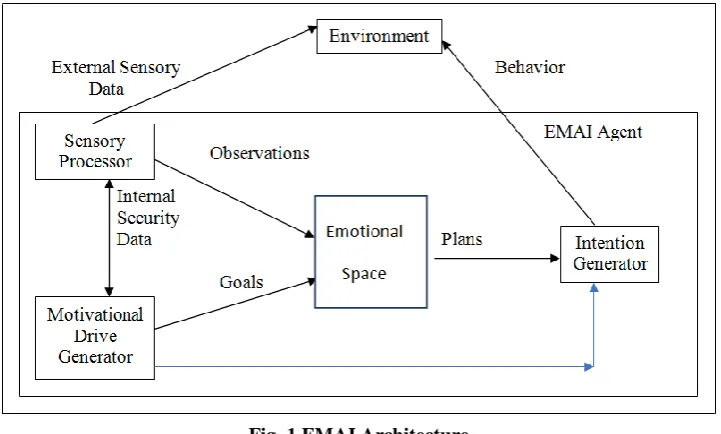
The Emotionally Motivated Artificial Intelligence (EMAI) architecture is a complex set of mechanisms that process emotional concepts for their use in affective decision-making and reasoning [9]. As the purpose of this paper is to examine the influence that emotion have on the perception of such an agent, the discussion will be limited to the parts the architecture that achieve this. A condensed overview of the parts of the EMAI architecture is shown in Fig.1.
Fig. 1 EMAI Architecture
There are two types of emotion mechanisms integrated in the EMAI architecture.
ISSN(E): 2277-128X, ISSN(P): 2277-6451, pp. 69-74 initiate behaviour in the agent. They can include concepts such as hunger, fatigue or arousal. The strength of the drives is temporally dynamic and at particular threshold levels the agent will set goals, that when successfully achieved, will pacify the drives.
The agent's goals are generated by a motivational drive generator which consists of drive mechanisms and a set of internal state registers representing the primary emotions. Each register is represented by a single gauge and stores the value for a particular drive. The number of internal state registers implemented depends on the application for which the EMAI agent is being used.
(2) The second type of emotion implemented in the EMAI architecture is secondary emotion. This category of emotion refers to the resultant mental (and in turn physical) states generated by attempts to satisfy the goals. These emotions include feelings such as happiness, anger, sorrow, guilt and boredom. Secondary emotions are represented in the EMAI architecture as values in the affective space.
The affective space is a six-dimensional space defined by six appraisal dimensions. The affective space, based on the psychological model of Smith and Ellsworth [15], defines 15 emotions (happiness, sadness, anger, boredom, challenge, hope, fear, interest, contempt, disgust, frustration, surprise, pride, shame and guilt) with respect to the dimensions of pleasantness (P), responsibility(R), effort (E), certainty (C), attention (A) and control (O). We will discuss these emotions with pleasantness only.
IV. ASSESSING THE APPRAISAL DIMENSIONS
The six appraisal dimensions are orthogonal, and no single emotion can be identified without taking into account each of these six appraisal dimensions. However, in this paper, we will consider the pleasantness only.
This dimension relates to an individual’s expression of liking or disliking towards a stimulus be it an event, object or another agent. An EMAI agent assesses and updates the pleasantness dimension as an assessment of the effect of the stimulus on the agent's goals during an encounter. Pleasantness P is the average summation of the rating of pleasantness the agent has given to a stimulus each time the agent has come into contact with it:
V. EXPERIMENTS AND RESULTS
We conducted following experiments with 30 students (10 perusing ITI, 10 perusing BCA and 10 perusing MA). The interests of these three class of students are different and therefore the experiments were chosen accordingly.
(1) We played popular music (2) We screened popular movie
(3) We gave a coupon authorising them to eat anything in the institute canteen (4) We gave a book to read in the institute library
(5) We provided internet in the IT lab to do whatever they want
Each of them was asked to rate their emotions on a 10-point scale (10 highest, 1 lowest). The pleasantness was then computed by using the following formula:
𝑃 = [ 𝑝𝑠𝑖
𝑚
𝑖=1
]/𝑚
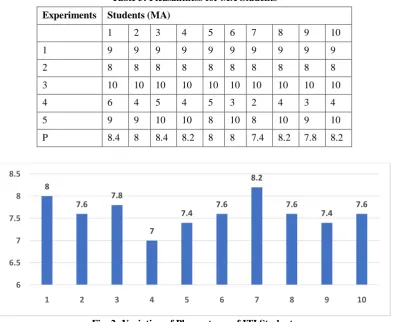
where m is the number of times the agent has come in contact with the stimulus, s, and ps is the pleasantness rating of s. The results are given in Tables 1 to 3 and graphically shown in Figs 2-4 for ITI, BCA and MA students respectively. The following conclusions can be drawn from these results:
The pleasantness for ITI students varies from 7 to 8.2 The pleasantness for BCA students varies from 7.6 to 8.4 The pleasantness for MA students varies from 7.4 to 8.4
The pleasantness is not uniform across the stream of students and hence human being. This is a challenge for AI in sensing the human emotions.
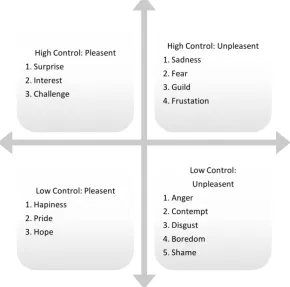
Each appraisal dimension is used to produce a six-coordinate point that defines an agent's emotional state. Fig. 5 shows the emotions with respect to the dimensions of pleasantness and control. This almost remains the same for the three class of students considered in this study.
ISSN(E): 2277-128X, ISSN(P): 2277-6451, pp. 69-74 Stimuli can be any tangible element in the agent’s environment including the actions being performed, smells, objects, other agents, the time of day or even the weather.
Table 1: Pleasantness for ITI Students
Experiments Students (ITI)
1 2 3 4 5 6 7 8 9 10
1 8 9 9 8 9 9 9 9 9 9
2 8 8 8 8 8 8 8 8 8 8
3 9 8 9 7 8 8 9 9 8 9
4 5 4 3 4 2 4 5 3 3 2
5 10 9 10 8 10 9 10 9 9 10
P 8 7.6 7.8 7 7.4 7.6 8.2 7.6 7.4 7.6
Table 2: Pleasantness for BCA Students
Experiments Students (BCA)
1 2 3 4 5 6 7 8 9 10
1 9 9 9 9 9 9 9 9 9 9
2 7 8 9 6 7 6 7 8 9 7
3 10 10 10 10 10 10 10 10 10 10
4 3 2 4 5 4 3 2 2 4 4
5 10 10 10 10 10 10 10 10 10 10
P 7.8 7.8 8.4 8 8 7.6 7.6 7.8 8.4 8
Table 3: Pleasantness for MA Students
Experiments Students (MA)
1 2 3 4 5 6 7 8 9 10
1 9 9 9 9 9 9 9 9 9 9
2 8 8 8 8 8 8 8 8 8 8
3 10 10 10 10 10 10 10 10 10 10
4 6 4 5 4 5 3 2 4 3 4
5 9 9 10 10 8 10 8 10 9 10
P 8.4 8 8.4 8.2 8 8 7.4 8.2 7.8 8.2
Fig. 2: Variation of Pleasantness of ITI Students
8
7.6 7.8
7
7.4 7.6
8.2
7.6
7.4 7.6
6 6.5 7 7.5 8 8.5
ISSN(E): 2277-128X, ISSN(P): 2277-6451, pp. 69-74
Fig. 3: Variation of Pleasantness of BCA Students
Fig. 4: Variation of Pleasantness of MA Students
The sensory processor of the agent is where high level observation takes place. This information is filtered through the affective space before it is used by the agent to generate outward behaviour (determined by the intention generator). It is at this point that the information has been perceived. Therefore, all information perceived by the agent is influenced by the agent's emotional state.
Fig. 5: Emotional States with Respect to the Pleasantness and Control Dimensions
7.8 7.8
8.4
8 8
7.6 7.6
7.8
8.4
8
7.2 7.4 7.6 7.8 8 8.2 8.4 8.6
1 2 3 4 5 6 7 8 9 10
8.4
8
8.4
8.2
8 8
7.4
8.2
7.8
8.2
6.8 7 7.2 7.4 7.6 7.8 8 8.2 8.4 8.6
1 2 3 4 5 6 7 8 9 10
High Control: Pleasent 1. Surprise
2. Interest 3. Challenge
High Control: Unpleasent 1. Sadness
2. Fear 3. Guild 4. Frustation
Low Control: Pleasent 1. Hapiness
2. Pride 3. Hope
Low Control: Unpleasent 1. Anger
ISSN(E): 2277-128X, ISSN(P): 2277-6451, pp. 69-74 Before a stimulus or event can be perceived by the agent, the agent must calculate an associated emotion for each. The emotion associated with a stimulus is determined by examining each of the appraisal dimensions with respect to the agent's last encounter with the stimulus.
VI. CONCLUSIONS
We have analysed pleasantness of three class of students (ITI, BCA and MA) and have observed their emotional aspects. The pleasantness for ITI students varies from 7 to 8.2; for BCA students varies from 7.6 to 8.4 and for MA students varies from 7.4 to 8.4. This indicates that the pleasantness is not uniform across the stream of students and hence human being. This is a challenge for AI in sensing the human emotions.
REFERENCES
[1] Amit Ray (2018), Compassionate Artificial Super intelligence, Inner Light Publishers.
[2] Brunswik, E. (1956), Perception and the Representative Design of Psychological Experiments. 2d ed., rev. & enl. Berkeley: Univ. of Calif. Press.
[3] Picard, R. W. (2000), Toward Computers that Recognize and Respond to User Emotion? IBM Systems Journal, Volume 39, No. 3 & 4, 2000.
[4] El-Nasr, M. S. (1998),Modelling Emotion Dynamics in Intelligent Agents, M.Sc. Dissertation, American University in Cairo.
[5] Reilly, W. S. N. (1996), Believable Social and Emotional Agents. Ph.D. Dissertation, Carnegie Mellon University.
[6] Canamero, D. (1997),Modelling Motivations and Emotions as a Basis for Intelligent Behaviour, in Proceedings of the First International Conference on Autonomous Agents, New York, 1997, ACM Press, New York, pp.148-155.
[7] Padgham, L. & Taylor, G. (1997), A System for Modelling Agents having Emotion and Personality, Lecture Notes in Artificial Intelligence, Springer- Verlag. vol.12, no. 9, pp. 59-71.
[8] Baillie, P. Lukose, D & Toleman, M. (2002) ‘Engineering Emotionally Intelligent Agents’, in Intelligent Agent Software Engineering, eds. V. Plekhanova & S. Wermter, Idea Publishing Group, Hershey.
[9] Baillie, P. (2002), The Synthesis of Emotions in Artificial Intelligences. Ph.D. Dissertation, University of Southern Queensland.
[10] Pert, C. B. (1997), Molecules of Emotion, Simon and Schuster, New York.
[11] Malim, T. (1994), Cognitive processes. Attention, perception, memory, thinking and language. London: MacMillan.
[12] Lazarus, R. S., & McCleary, R. (1951), Autonomic discrimination without awareness: A study of subception. Psychological Review, 58, 113-122.
[13] Leuba & Lucas (1945), The effects of attitudes on descriptions of pictures’, Journal of Experimental Psychology, American Psychological Association, Washington, vol. 35, pp. 517-524.
[14] Ortony, A., Clore, G.L. & Collins, A., (1988), The Cognitive Structure of Emotions. Cambridge University Press, Cambridge.
[15] Smith, C. A. & Ellsworth, P.C. (1985), Attitudes and Social Cognition, in Journal of Personality and Social Psychology, American Psychologists Association, Washington, vol. 48, no. 4, pp. 813- 838.