Original Research Article
A study of the factors influencing the utilization of family planning
methods in urban slums of Allahabad district, Uttar Pradesh, India
Yachna Setu*, Shiv Prakash, Khurshid Parveen, Richa Singh
INTRODUCTION
WHO has defined family planning as “a way of thinking and living that is adopted voluntarily, upon the basis of knowledge, attitudes and responsible decisions by individuals and couples, in order to promote the health and welfare of the family group and thus contribute effectively to the social development of a country”. Earlier family planning methods were not so common and instead abortions were done for avoiding unwanted child births. Later in 1564, an Italian physician “Fallopio” had first described about condom, after that other family planning methods had gained popularity.1 In worldwide at present, 57.4% of eligible couples were using any of
the family planning methodand 12% of eligible couples have unmet need for family planning.2,3 As far as India is concerned, India is the first country in the world to launch National Family Planning program in 1952 later it was reorganized in 1963.4The current use of family planning methods in our country is 53.5% (NFHS 4) which is a reduction from 56.3% (NFHS 3).5
In urban areas of country it is 57.2% and in rural areas 51.7% and in urban slums of India it is much lesser that is 21.4%.6
As Uttar Pradesh is the most populous state of our country, and 45.5% of eligible couples were using any of the family planning methods.7 Fifty six percentage of
ABSTRACT
Background: India was the first country to launch National Family Planning Program in 1952, but still the country’s desired total fertility rate and contraceptive prevalence rate have not achieved. The use of family planning methods is better in urban areas as compared to rural areas and it is worse in urban slums. Objective of the stud was to find out the utilization pattern of family planning methods and identifying the factors influencing it.
Methods: A community based cross sectional study was carried out on eligible couples selected from urban slums of Allahabad district by multistage random sampling and were interviewed by using pre-tested schedule. Data analysis was done by using SPSS version 21.
Results: A total of 356 eligible couples (age 15-49 years) were surveyed for a period of one year. It was observed that 45.78% (163/356) of eligible couples were using any of the family planning method and most commonly used method was female sterilization (53.98%), followed by condom (18.40%), then IUCDs (13.49%), injectables, OCPs and Natural methods (approx 4%) use. The use of family planning methods was found to be associated with women’s age, duration of marriage, caste categories, men’s education status, number of living children.
Conclusions: The use of family planning methods is low in slums areas and to improve the condition awareness should be created.
Keywords: Family planning, Urban slums, Utilization pattern, Eligible couples
Department ofCommunity Medicine, Moti Lal Nehru Medical College, Allahabad, Uttar Pradesh, India
Received: 20 January 2018
Accepted: 10 February 2018
*Correspondence:
Dr. Yachna Setu,
E-mail: [email protected]
Copyright: © the author(s), publisher and licensee Medip Academy. This is an open-access article distributed under the terms of the Creative Commons Attribution Non-Commercial License, which permits unrestricted non-commercial use, distribution, and reproduction in any medium, provided the original work is properly cited.
eligible couples were using family planning methods in urban UP areas, 42.1% use in rural areas and only 35.7% of eligible couples were using in slums of UP.8,9
So, it is important to study the barriers that affect the Family Planning Services including Socio demographic, financial, environmental, religious factors.
Also since NRHM came into being in 2005, rural areas have been served well, but marginalized poor of urban areas had been neglected NUHM started later in 2013 but at many of the places many of its components have not been implemented yet. So, the indicators are still poor in urban areas. Based on these facts the present study was planned out in order to study socio-demographic profile of eligible couples and the utilization pattern of family planning methods among eligible couples in slum areas of Allahabad district.
METHODS
It was a cross-sectional study carried out among eligible couples (age 15-49 years) selected from urban slums of Allahabad district. The duration of the study was of one year from October 2016 to September 2017.
A sample size of 356 eligible couples was calculated from the prevalence of unmet need of family planning practices in UP according to NFHS III (29.3%). With 95% of confidence interval and 5% margin of error. Later, the sample size was adjusted to compensate for non response rate of 10%.
The participants were selected by multistage random sampling. In the first stage, slums were selected. For this, Allahabad city was divided into four quadrants.
From each quadrant, one slum was selected randomly. In the second stage, eligible couples were selected from within the selected slums and then moving in the fixed direction, consecutive households were selected and eligible couples after taking the informed consent and explaining the objective of the study, were interviewed. In case a total of 89 eligible couples could not be interviewed in one slum (because of no-cooperation, non response or total population <1000) in a selected slum, another nearby slum was selected to complete the sample size.
Pre-designed, pretested, semi structured questionnaire was used for collection of information. The socio-demographic profile, their utilization pattern of family planning methods and factors influencing it.
The eligible couples in which women had attained early menopause, women with complaints of infertility, women who were pregnant and newly married women before the gauna were excluded from the study (Gauna is a eastern India custom of child marriage. The ceremony takes
place several years after marriage. Before the ceremony the bride stays at her natal home).
The data was analyzed using statistical software, SPSS Version 21. Chi-square test was used to test the associations between different variables. P value less than 0.05 was considered as significant
RESULTS
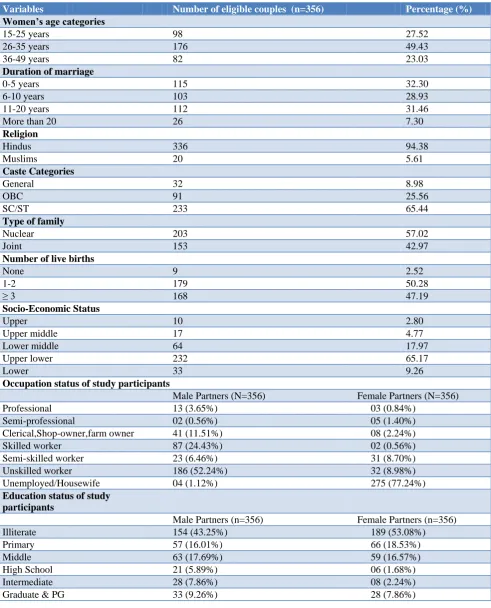
A total of 356 eligible couples were selected from urban slums of Allahabad district. Table 1 shows socio-demographic details of the selected eligible couples. It was observed that among couples, majority 49.43% (176/356) of the women belonged to 26-35 years group, and 32.30% (115/356) of eligible couples has duration of marriage less than 5 years.
Majority of couples were belonged to SC/ST category i.e 65.44% (233/356) followed by OBC category i.e 25.26% (91/356).
Majority of eligible couples were having 1-2 living children i.e. 50.28% (179/356).
The socioeconomic classification was based on Kuppuswamy’s socioeconomic status scale, 2014, which shows majority of the eligible couples 65.17% (232/356) were in upper lower SES, followed by 17.97% (64/356) in lower middle class, 9.26% (33/356) in lower middle class and very few belonged to 4.77% (17/356) upper middle class and 2.80% (10/356) in upper class.
It was observed that out of the 356 selected eligible 45.78% (163/356) were using any of the family planning method and 54.21% (193/356) of eligible couples were not using any of the family planning method (Table 2).
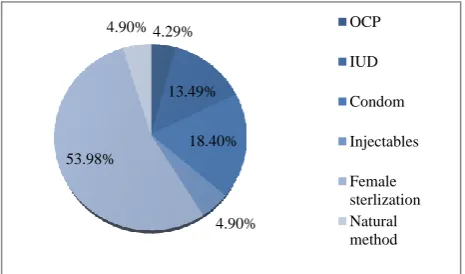
Figure 1: Distribution of eligible couples according to use of different types of family planning method.
Out of 163 eligible couples those were using any of the family planning method, the most common method used was female sterilization (tubectomy/ tubal ligation) 53.98% (88/163) and least common use was of OCPs 4.29% (07/163). None of the male have undergone Vasectomy (Figure 1).
4.29%
13.49%
18.40%
4.90% 53.98%
4.90% OCP
IUD
Condom
Injectables
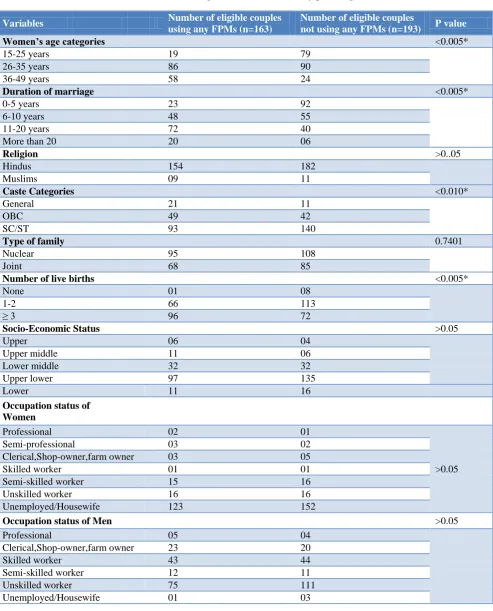
Among selected eligible couples, the use of any of the family planning method was found to be associated with woman’s age, duration of marriage, caste categories,
men’s education status and number of living children. These associations were found to be statistically significant (p<0.05) (Table 3).
Table 1: Socio-demographic profile of eligible couples in the study area.
Variables Number of eligible couples (n=356) Percentage (%)
Women’s age categories
15-25 years 98 27.52
26-35 years 176 49.43
36-49 years 82 23.03
Duration of marriage
0-5 years 115 32.30
6-10 years 103 28.93
11-20 years 112 31.46
More than 20 26 7.30
Religion
Hindus 336 94.38
Muslims 20 5.61
Caste Categories
General 32 8.98
OBC 91 25.56
SC/ST 233 65.44
Type of family
Nuclear 203 57.02
Joint 153 42.97
Number of live births
None 9 2.52
1-2 179 50.28
≥ 3 168 47.19
Socio-Economic Status
Upper 10 2.80
Upper middle 17 4.77
Lower middle 64 17.97
Upper lower 232 65.17
Lower 33 9.26
Occupation status of study participants
Male Partners (N=356) Female Partners (N=356)
Professional 13 (3.65%) 03 (0.84%)
Semi-professional 02 (0.56%) 05 (1.40%)
Clerical,Shop-owner,farm owner 41 (11.51%) 08 (2.24%)
Skilled worker 87 (24.43%) 02 (0.56%)
Semi-skilled worker 23 (6.46%) 31 (8.70%)
Unskilled worker 186 (52.24%) 32 (8.98%)
Unemployed/Housewife 04 (1.12%) 275 (77.24%)
Education status of study participants
Male Partners (n=356) Female Partners (n=356)
Illiterate 154 (43.25%) 189 (53.08%)
Primary 57 (16.01%) 66 (18.53%)
Middle 63 (17.69%) 59 (16.57%)
High School 21 (5.89%) 06 (1.68%)
Intermediate 28 (7.86%) 08 (2.24%)
Table 2: Distribution of eligible couples according to use of any of the family planning method.
Use of family planning methods Number of eligible couples (n=356) Percentage (%)
Yes 163 45.78
No 193 54.21
Table 3: Factors influencing the utilization of family planning methods.
Variables Number of eligible couples
using any FPMs (n=163)
Number of eligible couples
not using any FPMs (n=193) P value
Women’s age categories <0.005*
15-25 years 19 79
26-35 years 86 90
36-49 years 58 24
Duration of marriage <0.005*
0-5 years 23 92
6-10 years 48 55
11-20 years 72 40
More than 20 20 06
Religion >0..05
Hindus 154 182
Muslims 09 11
Caste Categories <0.010*
General 21 11
OBC 49 42
SC/ST 93 140
Type of family 0.7401
Nuclear 95 108
Joint 68 85
Number of live births <0.005*
None 01 08
1-2 66 113
≥ 3 96 72
Socio-Economic Status >0.05
Upper 06 04
Upper middle 11 06
Lower middle 32 32
Upper lower 97 135
Lower 11 16
Occupation status of Women
Professional 02 01
>0.05
Semi-professional 03 02
Clerical,Shop-owner,farm owner 03 05
Skilled worker 01 01
Semi-skilled worker 15 16
Unskilled worker 16 16
Unemployed/Housewife 123 152
Occupation status of Men >0.05
Professional 05 04
Clerical,Shop-owner,farm owner 23 20
Skilled worker 43 44
Semi-skilled worker 12 11
Unskilled worker 75 111
Variables Number of eligible couples using any FPMs (n=163)
Number of eligible couples
not using any FPMs (n=193) P value
Education status of Women
Illiterate 79 110
>0.05
Primary 33 33
Middle 25 34
High School 03 03
Intermediate 05 03
Graduate & PG 18 10
Education status of Men <0.005*
Illiterate 72 82
Primary 20 37
Middle 26 37
High School 12 09
Intermediate 15 13
Graduate & PG 18 15
*Significant
No association was seen between use any of the family planning methods and with religion, type of family, occupation status of both men and women, education of women and socioeconomic status (Table 3).
DISCUSSION
In the present study it can be observed that, 45.78% of the eligible couples were using any of the family planning method and most commonly used method was female sterilization (53.98%) and least commonly used methods was injectables and OCPs (approx 4%). No case of male sterilization was found. Similar results were seen in NFHS 4 (2015-2016) data of Uttar Pradesh with 45.5% of eligible couples using any of the family planning method and most commonly used method being female sterilization (17.3%), least commonly method used being OCPs (4.1%) and male sterilization (0.1%).
Similarly according to NFHS 4 data of India, 53% of eligible couples were using any of the family planning and the most commonly used method was female sterilization, male sterilization (0.3%). As according to the present study and also in other data it was seen that the male sterilization is very low. So, the man power training, equipment, and research in this field won’t improve the condition as it is clear that this method is not acceptable to men. Rather diverting these resources to other more acceptable methods will be beneficial. Saba et al in their study conducted in Bangalore among 300 married couples had found the similar findings with 58.6% of eligible couples using any of the family planning methods and most common method being female sterilization (71.59%), least common method was OCPs (6.26%).10 No case of male sterilization was found. In the present study it was found that the association between women’s age (p<0.005), duration of marriage of eligible couples (p<0.005), categories (p<0.010), men’s
education status (p<0.005), number of living children (p<0.005) and these association were found to be statistically significant. Similarly in the studies conducted by Shrivastava et al in Bhopal, Saba et al in Bangalore the use of any of the family planning method was found to be associated with women’s age and number of living children.11,10 In the study conducted by Prateek et al in Kancheepuram, the use of any of the family planning method was found to be associated with women’s age and men’s education.12
CONCLUSION
As it was observed in the present study that the family planning methods use was very low and the unmet need is very high in slums as compared to urban and rural areas. NUHM is already there to cater the marginalized population of urban areas, but as of today, many components have not been implemented properly in all such area. So to improve the conditions in these areas, first components of NUHM should be implemented and then regular sensitization and direct supervision of health workers should be done.
Relevance of the study
The strength of the study lies in the fact that very few studies were conducted in slum areas of Northern India, which will further help to find out the prevalence of contraceptives use and unmet need in this special population as the population of these areas were always been neglected, the prevalence is good among urban population and there is NRHM to cater the rural population of our country
ACKNOWLEDGEMENTS
thanks all my study participants for giving consent for the study.
Funding: No funding sources Conflict of interest: None declared
Ethical approval: The study was approved by the Institutional Ethics Committee
REFERENCES
1. Potts M, Diggory P, Peel J. Textbook of contraceptive practice. Cambridge University Press; 1983: 52.
2. Available at: http://www.who.int/mediacentre/ factsheet/fs 351/en. Accessed 7 November 2017. 3. United Nations, Department of Economic and
Social Affairs, Population Division (2015). Trends in Contraceptive Use Worldwide 2015 (ST/ESA/SER.A/349).
4. Kishore J. National Health Programs of India, 12th ed. Century Publishers, New Delhi; 2017: 739. 5. National Family Health Survey. (2017). Available
at: http://rchiips.org/NFHS/factsheet_NFHS-4.shtml. Accessed on 7 November 2017.
6. National Family Health Survey. (2017). Available at: http://rchiips.org/NFHS/factsheet_NFHS-4.shtml. Accessed on 7 November 2017.
7. Shaikh S, Dwivedi S. Predictors to use of Family Planning Methods among women of Allahabad
District, Uttar Pradesh. Health And Population, 2014;37(3&4):118-27.
8. National Family Health Survey. Retrieved from http://rchiips.org/NFHS/factsheet_NFHS-4.shtml. Accessed 7 November 2017.
9. Rizvi A, Mohan U, Singh S, Singh V. (2015). Assessment of Unmet Needs of Contraceptive Practices among Married Women in Urban Slums of Lucknow District. Indian J Pub Health Res Development. 2015;6(1):301.
10. Saba ID, Kishore D A Study to evaluate the factors influencing on Family planning practices among urban married women in Bangalore. IOSR J Dental Med Sci, 2015;13(11):25-33.
11. Shrivastava S, Shrivastava P, Sharma A. Study of Pattern of Contraceptive use among young sexually active women residing in a Slum of Bhopal. National J Comm Med. 2016;7(2):130-2.
12. Prateek S, Saurabh R. Contraceptive practices adopted by women attending an urban health centre. African Health Sci. 2013;12(4):416-21.