ISSN-L: 2501 - 1235 Available on-line at: www.oapub.org/edu
doi: 10.5281/zenodo.1598556 Volume 5 │ Issue 1 │ 2018
AUTOGENIC TRAINING AND
PROGRESSIVE MUSCLE RELAXATION INTERVENTIONS:
EFFECTS ON MENTAL SKILLS OF FEMALES
Amandeep Singh1,
Tarsem Singh2,
Harmandeep Singh3i
1Dr. Assistant Professor Guru Nanak Dev University,
Amritsar, India 2Dr. Associate Professor Lyallpur Khalsa College,
Jalandhar, India 3Assistant Professor Apeejay College of Fine Arts,
Jalandhar, India
Abstract:
The purpose of the present study was to investigate the effects of Autogenic training and Progressive muscle relaxation technique on the mental skills of female subjects. We recruited 60 female subjects and assigned them into three groups i.e. AT group, PMR group and control group. The first and second groups were provided with 8-week Autogenic training and PMR interventions respectively, whereas the control group continued their general routine. All three groups were tested pre and post interventions for their mental skills by using Hardy and Nelson mental skills questionnaire. Hypotheses were tested by applying ANCOVA to the collected data at 0.05 significance level. Results revealed that only concentration ability was significantly improved with Autogenic training and PMR, whereas no significant differences were observed for other variables.
Keywords: autogenic training, PMR, mental skills, concentration ability
1. Introduction
Autogenic training is a technique that enables one to slow down the mind and body which decrease one’s heart rate, slow down the respiratory system, allow the blood to flow more easily through the body and promotes the function of the immune system. If
done properly. It would help tap into the healing power of the body. The geneses of Autogenic training (AT) lie in the rest and entrancing examination in the late nineteenth century at the Berlin Institute by Oskar Vogt, a prestigious cerebrum physiologist (Kanji, 1997). Vogt saw that wise and fundamentally disapproved of people who had experienced a progression of trancelike sessions under his direction could put themselves, for a self-decided timeframe, into a state which seemed like a mesmerizing state. Moreover, these people detailed that the 'auto-sleep inducing' practices had an exceptional recuperative and inspiring impact. Vogt additionally saw that these transient mental activities, when honed a couple of times amid the day, lessened stressor impacts, for example, weakness and strain. Animated by Vogt's work: Johannes Heinrich Schultz, a German therapist and nervous system specialist, began in 1905 to ponder certain psycho physiologic instruments and possibilities of various procedures of entrancing and auto-suggestion (Schultz and Luthe. 1959). Like Vogt, he saw that the auto-suggestive methodology could be utilized for the enlistment of mental states which, like trance, open up psycho physiologic potential outcomes of clinical esteem. Schultz saw that his mesmerized patients consistently revealed two unmistakable sensations' sentiment of weight in the furthest points, frequently including the entire body' and 'a sentiment of pleasing warmth'. Schultz likewise saw that his patients moved into a trophotropic or recuperating state when they honed guidelines coordinated at the autonomic sensory system as referred to in (Wright et al., 2002). The fundamental stage is made out of six standard activities for creating vibes of weight and warmth in the furthest points, warmth in the epigastric area. Progressive muscle relaxation and its cradles have gained a great deal of attention in scientific research. Following the theoretical basement of Jacobsen (1938), the central aim of a relaxation technique is the deliberate and continuous reduction of tension in specific muscle groups of the locomotor system. The original method in which the emphasis is laid on the training of self-perception of muscular sensations has greater effects on somatic issues while the revised versions in which producing a subjective experience of relaxation are the key approach, have a grander effect on cognitive symptoms (Dolbier & Rush, 2012). The present experiment is designed to find out the effects of Autogenic training and Progressive Muscle Relaxation techniques on the various mental skill such as imagery ability, mental preparation, self-confidence, anxiety and worry management, concentration ability and relaxation ability. On the basis literature review, it is assumed that both Autogenic training and PMR will significantly affect the mental skills of the subject under study.
2.Methodology
group (N=20) and Control Group (N=20). The two experimental groups were subjected to 8-week of Autogenic training and PMR technique whereas control group continued its routine programme.
2.1 Interventions
2.1.1 Autogenic training (AT) Protocol
The subjects were instructed to lay on their back with arm and sides, palms in supine position, heels lying evenly on surface. In case of seated position on a chair, the subjects were instructed to rest their arms on laps. The subjects were tutored to scan the body and start self-instructing with the following commands:
“My right arm is heavy.”
“My arms and legs are heavy and warm <Repeated 3 or more time>.” “My heart beat is calm and regular “<Repeated 3 time>
“My solar plexus is warm”. <Repeated 3 time> “My forehead is cool.”
“I am at Peace.”<Repeated 3 time>
Few tips and suggestions were given to the subjects viz. to not to eat full meal before training session; to sit or lie down in a comfortable position and to have believe in autogenic training in order for it to work.
2.1.2 Progressive Muscle Relaxation Technique (PMR)
The modified version of Jacobson’s Progressive Muscular Relaxation Technique was used as an intervention. The subjects were instructed and provided training sessions of 15 to 20 minutes, four days a week for six weeks period.
Protocol
In the first phase, the subjects laid down in supine position. Then, they were instructed to contract a specific muscle group in voluntary manner and hold the contraction for ten seconds subsequently relaxing the muscle. This process was done in the following steps: right foot, right lower leg and foot, entire right leg, left foot, left lower leg and foot, entire left foot, right hand, right forearm and hand, entire right arm, abdomen, chest, neck and shoulder and face. In the second phase, subjects relaxed the various
muscles without any contraction of any muscle group. In the third phase, the instructor
under such situations. The subject took two weeks to master the above phases on an average. The training was carried out for a period of six weeks duration.
2.1.3 Mental Skills Questionnaire
The mental skills were assessed by applying Hardy and Nelson mental skills questionnaire (Hardy and Nelson, 1996). It consists of twenty four questions that measure six dimensions of mental skills, allocating four questions to each dimension at a 6-point likert scale. The six factors of questionnaire are: Imagery ability, Mental Preparation ability, Self-Confidence level, Anxiety and worry Management, Concentration ability and Relaxation ability.
2.2 Statistical Analyses
An Analysis of Covariance was used to determine significant differences for dependent variables within the three groups. When a significant difference among the groups was observed, a pair-wise comparison of the groups was done by using the Bonferroni Post-hoc test to identify direction and significant differences between the groups. The level of significance was set at 0.05 in order to test the differences to be considered significant.
3. Results
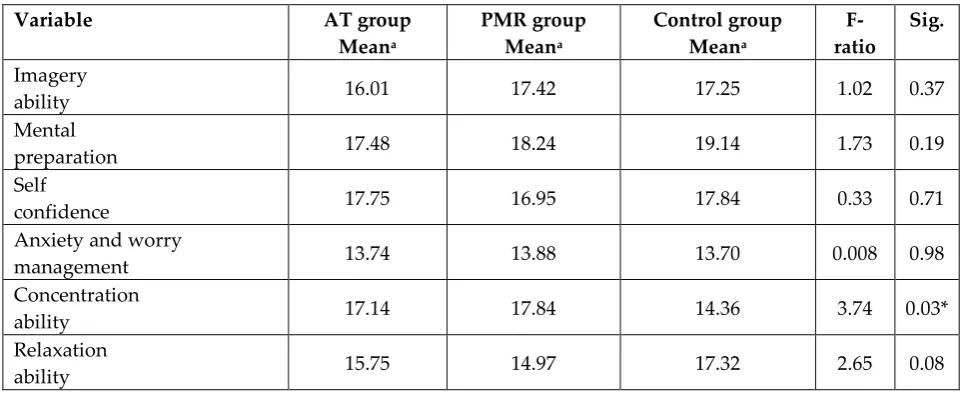
Table 1: ANCOVA results of interventions on the variables of mental skills
Variable AT group
Meana
PMR group
Meana
Control group
Meana
F-ratio
Sig.
Imagery
ability 16.01 17.42 17.25 1.02 0.37
Mental
preparation 17.48 18.24 19.14 1.73 0.19
Self
confidence 17.75 16.95 17.84 0.33 0.71
Anxiety and worry
management 13.74 13.88 13.70 0.008 0.98
Concentration
ability 17.14 17.84 14.36 3.74 0.03*
Relaxation
ability 15.75 14.97 17.32 2.65 0.08
Meana = Adjusted mean of post intervention test * Significant at 0.05 level
AT = Autogenic training
PMR = Progressive Muscle Relaxation
3.1 Imagery ability
existed at 0.05 alpha level. Since the differences were insignificant, hence, the post hoc test was not applied.
3.2 Mental preparation
As shown in table 1, the adjusted mean values of AT group, PMR training group, and control group were 17.48, 18.24 and 19.14 respectively. The results of ANCOVA show that no significant differences were found among the AT group, PMR training group and control group (p>0.05). Since the differences were insignificant, therefore, no post hoc test was employed.
3.3 Self-confidence
The adjusted mean of AT group, PMR training group and control group were 17.75, 16.95 and 17.84 respectively. ANCOVA results revealed that the differences among the intervention groups were insignificant (p>0.05). As the differences were significant, therefore, post hoc analyses were not performed.
3.4 Anxiety and worry management
The adjusted mean of AT group was 13.74, PMR training group was 13.88 and the control group was 13.70. The comparisons among the intervention groups revealed that there existed no significant difference on the variable anxiety and worry management (p>0.05). Since the differences were insignificant, therefore, no post hoc test was employed.
3.5 Concentration ability
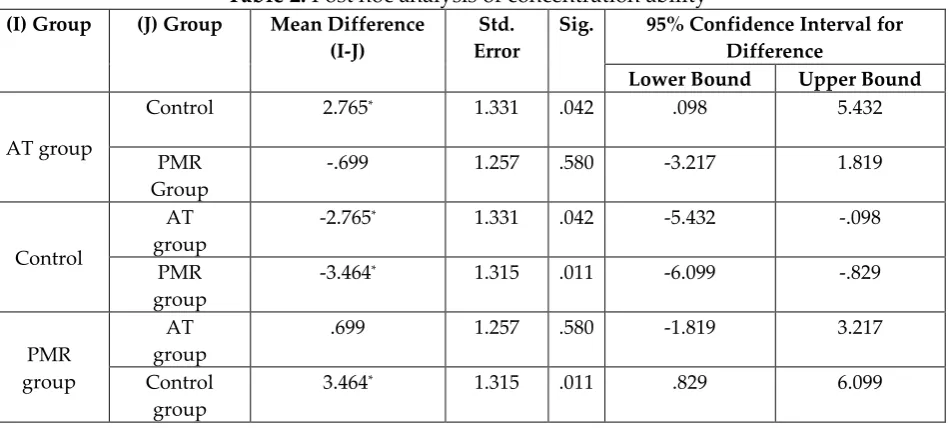
As evident in table 1, the adjusted mean scores of AT group was 17.14, PMR training group was 14.36 and control group was 17.84. The comparisons at 0.05 alpha level revealed that the differences among the AT group, PMR training group and control group were significant (p<0.05). Since the differences among independent variables were significant, multiple comparisons were made by using Bonferroni post hoc analysis. Evidently, from table 2, a significant difference was found between AT group and control group (p<0.05). The mean difference between AT and control group was 2.765 which shows that AT group demonstrated better concentration ability than the control group. Further, a comparison between PMR training group and control group revealed a significant difference that indicates better concentration ability in those who undergone PMR training intervention than the control group who did not perform any training. However, no significant difference was found between AT group and PMR training group (p>0.05).
3.6 Relaxation ability
existed at 0.05 alpha level. Since the differences were insignificant, hence, the post hoc test was not applied.
Table 2: Post hoc analysis of concentration ability
(I) Group (J) Group Mean Difference
(I-J)
Std. Error
Sig. 95% Confidence Interval for
Difference
Lower Bound Upper Bound
AT group
Control 2.765* 1.331 .042 .098 5.432
PMR Group
-.699 1.257 .580 -3.217 1.819
Control
AT group
-2.765* 1.331 .042 -5.432 -.098
PMR group
-3.464* 1.315 .011 -6.099 -.829
PMR group
AT group
.699 1.257 .580 -1.819 3.217
Control group
3.464* 1.315 .011 .829 6.099
*The mean difference is significant at the 0.05 level.
4. Discussion
autonomic nervous system. The study concluded that both techniques are effective in enhancing concentration ability.
References
Fukuyama, Y., Goso. K. Aoki. S., Kitajima, M., Sueyoshi. M. & Nakajima. S. (2000). Efficacy of the autogenic training for reducing exhaustion of caregivers in home care. Japanese Journal of Autogenic Therapy, 18(2), 56-63.
Gavin, A. W., Trine, M. R. & Morgan, W. P. (2001). Affective and metabolic responses to hypnosis, autogenic relaxation and quiet rest in the supine and seated positions. International Journal of Clinical and Experimental Hypnosis, 49(1): 5-18.
Gillani, N. B., & Smith, J. C. (2001). Zen meditation and ABC relaxation theory: an exploration of relaxation states, beliefs, dispositions, and motivations. Journal of Clinical Psychology, 57(6), 839-846.
Hardy L. and Nelson K., Mental Skills Questionnaire (1996).
Hidderley, M. & Holt, M. (2004). A pilot randomized trial assessing the effects of autogenic training in early stage cancer patients in relation to psychological status and immune system responses. European Journal of Oncology Nursing, 8, 61-65.
Jacobson, E., Progressive Relaxation. Chicago, University of Chicago Press, 1938.
Dolbier, C. L., & Rush, T. E. (2012). Efficacy of abbreviated progressive muscle relaxation in a high-stress college sample. International Journal of Stress Management, 19(1), 48–68. doi:10.1037/a0027326.
Kanji, N. (1997). Autogenic training. Complementary Therapies in Medicine. 5,162-167. Kanji, N. & Erost, E. (2000). Autogenic training for stress and anxiety: a systematic
review. Complementary Therapies in Medicine. 8(2),06-110.
Lohaus A, Hebling-Klein J, Vogele C, Kuhn-Hennighausen C. Psychophyiological effects of relaxation training in children. Brit J Health Psych. 2001;6: 197–206. Maxwell SE, Delaney HD. Designing experiments and analyzing data: A model of
comparison perspective. Belmont CA: Wadsworth; 1990. Introduction to Model Comparisons: One-Way Between-Subjects Designs; p. 67.
Schultz, J. H. & Luthe, W. (1959). Autogenic Training.' a psychophysiologic approach in psychotherapy. New York: Gnme & Strarron.
Creative Commons licensing terms