GREEN SYNTHESIS OF QUINOXALINE DERIVATIVES AT
ROOM TEMPERATURE IN ETHYLENE GLYCOL WITH
H2SO4/S
i
O2 CATALYST
Mozhgan Bashirzadeh
[a]and Farahnaz K. Behbahani
[a]*Keywords: Quinoxalines, sulfuric acid/SiO2 catalyst, diketones, phenylene diamine, green synthesis
In this study, the preparation of quinoxaline derivatives using α-diketones, 1,2-phenylene diamines in the presence of H2SO4/SiO2 catalyst
in ethylene glycol and at room temperature is reported. The advantages of this method are high yields of the products, utilizing of reusable catalyst, easy separation and mild reaction conditions. Also, reusability of the catalyst was investigated and found that catalytic activity of the catalyst did not decreased after 4th times.
* Corresponding Authors
E-Mail: [email protected]
[a] Department of Chemistry, Karaj Branch, Islamic Azad University, Karaj, Iran. P.O.Box: 314/85313
INTRODUCTION
Quinoxaline derivatives are well known in the pharmaceutical industry and have been shown to have a broad spectrum of biological activities including antibacterial, antiviral, anti- inflammatory, anticancer, and kinase inhibitory activities. 1,2 In addition, quinoxaline derivatives have been evaluated as semiconductors, dyes, and biocides.3 In this regards, a very procedures have respectively been developed for the preparation of substituted quinoxalines.4,5
In these methods the condensation reaction between an aryl 1,2-diamine with a 1,2-dicarbonyl compound have been reported4. The others synthetic routes towards quinoxalines, including oxidative coupling of epoxides with ene-1,2-diamines using Bi-catalyst, heteroannulation of nitroketene and N,S-aryliminoacetals with POCl3, cyclization of
a-arylimino oximes of α-dicarbonyl compounds and from α -hydroxy ketones via a tandem oxidation process using Pd(OAc)2 or RuCl2-(PPh3)3-TEMPO as well as MnO2.5
Most of the existing methodologies suffer from disadvantages such as the use of volatile organic solvents, unsatisfactory product yields, critical product isolation procedures, expensive and detrimental metal precursors and harsh reaction conditions, which limit their use under the aspect of environmentally benign processes. Also silica-supported reagent, H2SO4 / SiO2 for its ease of preparation, low cost, high efficiency and environmental benignness,6 has already been used in cylcoadditions,7 Beckmann rearrangements,8 glycosylations,9 condensations,10 esterification,11 acetylation of (+)cedrol compound,12 synthesis of 2,4,5-triaryl-1H-imidazoles,13 and as catalyst in organic transformations: a comprehensive review.14
On the other hand, during our continuing efforts to develop convenient approaches to synthesize heterocycle compounds,15 we revealed that H
2SO4/SiO2 was a
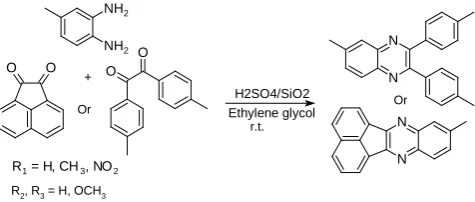
high-efficient and recyclable catalyst for preparing the quinoxaline derivatives in a synthetically practical procedure (stoichiometric ratios of starting materials and short reaction times) with relatively widely functional group compatibility in ethylene glycol at ambient temperature (Scheme 1).
Scheme 1 Synthesis of quinoxaline derivatives in the presence of H2SO4 /SiO2
RESULTS AND DISCUSSION
To achieve efficient amount of catalyst, the author set up a model reaction using benzil (2.0 mmol), and 1,2-phenylene diamine (2.0 mmol) in ethylene glycol (3.0 ml) without catalyst at room temperature. In this case, the product was obtained in low yield (30%). As shown in table 1, the yield of reaction was increased in the presence of the catalyst (0.1 - 0.3 g) and raising catalyst amount toward 0.4 g did not affect to reaction yield.
Table 1. Optimizing of the catalyst amount for the synthesis of quinoxaline derivatives
Yield%a Catalyst g
30 Free
50 0.1
55 0.2
92 0.3
92 0.4
aReaction condition: Benzyl (2.0 mmol), 1,2-phenylenediamine
(2.0 mmol) and catalyst in ethylene glycol (3.0 ml) at room temperature
H2SO4/SiO2 Ethylene glycol
r.t.
Or Or
R2, R3 = H, OCH3 NH2
NH2
O
O N
N
O O
N N
When we examined model reaction (entry1, table 2) in the presence of SiO2, the desired product was obtained in very low yield (< 10 %), but the product was resulted in 90% using H2SO4 in similar condition as well as sulfuric acid/SiO2 combination. Therefore, we decided to use sulfuric acid/SiO2 combination due to its safe, to be solid and its reusability than H2SO4 alone that is dangers and corrosive.
To evaluate the efficiency of this methodology, a number of 1,2-dicarbonyl compounds and 1,2-diamines were further subjected to condensation using very low amount of H2SO4 / SiO2 (Table 2). When the electron-donating substituents present in diamine part, decreased reaction time, whereas the effect is reverse with the electron withdrawing substituents.
Table 2. Synthesis of quinoxaline derivatives in the presence of H2SO4/SiO2 in ethylene glycol
1,2-Diketone Amine Product Time, h Yield, % m.p., °C
O
O Ph
Ph NH2
NH2 N
N Ph
Ph
3.0 92 124-12616
O
O Ph
Ph NH2
NH2 H3C
N
N Ph
Ph
2.5 88 110-11416
O
O Ph
Ph NH2
NH2 O2N
N
N Ph
Ph
O2N 4.0 85 168-17216
O O
O O
NH2
NH2 N
N
O
O
3.5 88 145-14817
O O
O O
NH2
NH2 H3C
N N
O
O
3.0 90 132-13417
O O
O O
NH2
NH2 O2N
N N
O
O O2N
4.0 85 193-19518
O O NH2
NH2
N
N 2.5 92 240-243
19
O O NH2
NH2 H3C
N
N CH3
On the other hand, electron-donating substituents with aromatic 1,2-diketone increased reaction time and the effect is reverse with electron withdrawing groups.
Proposed mechanism for the preparation of quinoxaline derivatives in the presence of H2SO4/SiO2 has been shown in Scheme 2.
Scheme 2. Suggested mechanism for the synthesis of quinoxaline derivatives using H2SO4/SiO2
EXPERIMENTAL
Melting points were measured by using the capillary tube method with an electro thermal 9200 apparatus. IR spectra were recorded on Perkin Elmer FT-IR spectrometer did scanning between 4000–400 cm–1. 1H NMR spectra were obtained on Bruker DRX-300MHz NMR instrument in CDC13. Analytical TLC of all reactions was performed on Merck precoated plates (silica gel 60F-254 on aluminum). All compounds are known and spectra and physical data were compared with those of authentic samples.16-19 The catalyst was prepared according to the reported procedure in the literature.20
Preparation of quinoxaline derivatives using H2SO4/SiO2: general procedure:
To a mixture of an appropriate o-phenylenediamine (1 mmol, 0.108 g ) and a 1,2-dicarbonyl compound (1 mmol) in ethylene glycol (3 ml), a catalytic amount of H2SO4/SiO2 (0.3 g) was added and the mixture was stirred at room
temperature. The progress of the reaction was monitored by TLC (ethyl acetate:n-hexane, 1:3). After completion of the reaction, chloroform (10 ml) was added to the solidified mixture in order to separation of catalyst from the mixture since the catalyst is not soluble in organic solvent. The residue was then diluted with H2O (15 mL) and the product was extracted with chloroform (2 × 10 mL). The combined organic layers was dried over Na2SO4. The solvent was evaporated under reduced pressure and the pure product was obtained without any further purification.
A variety of substituted o-phenylenediamines were condensed with different 1,2-dicarbonyl compounds. The results are shown in Table 2.
2,3-Diphenylquinoxaline
White solid, IR (KBr, cm-1): 3055, 1541, 1495, 1477, 1441, 1346, 1315. 1 H NMR (CDCl
3, 300 MHz): 8.16-8.20 (m, 2H), 7.76 -7.79 (m, 2H), 7.56-7.50 (m, 4H), 7.25-7.29 (m, 6H).
-2H2O
SiO2
O O O Si
OH
S O O
O H
OH
O O O
Si O
O O
NH2
NH2
SiO2
O O O Si
OH
S O O
OH OH
O O O
Si O OH
O N
H2
N H
SiO2
O O O Si
OH
S O O
OH OH
O O O
Si O N H
N H OH O H
SiO2
O O O Si
OH
S O O
OH OH
O O O
Si O N
6-Methyl-2,3-diphenylquinoxaline
Light yellow solid, IR (KBr, cm-1): 3055, 2941, 1619, 1554, 1485, 1444, 1393, 1344. 1H NMR (CDCl
3, 300 MHz): 2.63 (s, 3H), 7.25-7.35 (m, 5H), 7.45-7.55 (m, 5H), 7.89-8.08 (m, 3H).
6-Nitro-2,3-diphenylquinoxaline
Light brown solid, IR (KBr, cm-1): 3433, 3328, 3055, 1658, 1521, 1434, 1398, 1337. 1H NMR (CDCl
3, 300 MHz): 7.30-7.45 (m, 6H), 7.95 (d, 4H), 8.25 (d, 1H), 8.54 (d, 1H), 9.08 (s, 1H).
2,3-Bis(4-methoxyphenyl)quinoxaline
White solid, IR (KBr, cm-1): 3054, 2926, 2871, 2349, 1743, 1441. 1H NMR (CDCl
3, 300 MHz): 3.85 (s, 6H), 6.89 (d, 4H), 7.5 (d, 4H), 7.74 (q, 2H), 8.14 (q, 2H).
2,3-Bis(4-methoxyphenyl)-6-methylquinoxaline
Light yellow solid, IR (KBr, cm-1): 3054, 2922, 1955, 1810, 1735, 1614. 1H NMR (CDCl
3, 300 MHz): 2.61 (s, 3H), 3.84 (s, 6H), 6.88 (d, 4H), 7.48 (d, 4H), 7.56 (d, 1H), 7.91 (s, 1H), 8.03-8.0 (d, 1H).
2,3-Bis(4-methoxyphenyl)-6-nitroquinoxaline
Yellowish brown solid, IR (KBr¸ cm-1): 3055, 3027, 1950, 1659, 1540, 1477. 1H NMR (CDCl
3, 300 MHz): 3.73 (s, 6H), 6.98 (m, 4H), 7.56 (m, 4H), 8.24 (d, 1H), 8.49 (d, 1H), 9.1 (d, 1H).
Acenaphtho[1,2-b]quinoxaline
Yellow solid, IR (KBr, cm-1): 3051, 2926, 1613, 1588, 1528, 1497, 1418, 1343. 1H NMR (CDCl
3, 300 MHz): 8.37-8.40 (m, 2H), 8.18-8.21 (m, 2H), 8.05-8.08 (m, 2H), 7.78-7.83 (m, 2H), 7.73-7.76 (m, 2H).
9-Methylacenaphtho[1,2-b]quinoxaline
Light Brown solid, IR (KBr, cm-1): 3051, 2909, 2861, 1719, 1613, 1585, 1483, 1419. 1H NMR (CDCl
3, 300 MHz): 2.56 (s, 3H), 7.49 (d, 1H, Ar-H), 7.70 (t, 2H, Ar-H), 7.88 (s, 1H, Ar-H), 7.94 (d, 2H, Ar-H), 7.99 (d, 1H, Ar-H), 8.27 (t, 2H, Ar-H).
Reusability of the catalyst
At the end of the reaction, the catalyst could be successfully recovered by a simple filtration. The removed catalyst was washed with chloroform, dried at 80 ºC for 1 h and reused up to four times in the others reactions without appreciable reduction in the catalytic activity.
CONCLUSIONS
In conclusion, an efficient catalytic method for the synthesis of quinoxaline derivatives using sulfuric acid adsorbed on silica gel as catalyst in ethylene glycol at room temperature is reported. The catalyst can be reused after a simple work-up, with a gradual decline of its activity being observed.
REFERENCES
1Jaso, A., Zarranz, B., Aldana, I., Monge, A. Synthesis of new
quinoxaline-2-carboxylate 1, 4-dioxide derivatives as anti-mycobacterium t uberculosis agents. J. Med. Chem., 2005, 48, 2019-2025. https://doi.org/10.1021/jm049952w
2Toshima, K., Ozawa, T., Kimura, T., Matsumara, S. The
significant effect of the carbohydrate structures on the DNA photocleavage of the quinoxaline–carbohydrate hybrids. Bioorg. Med. Chem. Lett., 2004, 14, 2777-2779.
https://doi.org/10.1016/j.bmcl.2004.03.065
3Sarges, R., Howard, H. R., Browne, R. G., Lebel, L. A., Seymour,
P. A. Sarges, R., Howard, H. R., Browne, R. G., Lebel, L. A., Seymour, P. A., & Koe, B. K. (1990). 4-Amino [1,2,4] triazolo[4,3-a]quinoxalines. A novel class of potent adenosine receptor antagonists and potential rapid-onset antidepressants. J. Med. Chem., 1990, 33, 2240-2254.
https://doi.org/10.1021/jm00170a031
4Darabi H. R., Tahoori, F., Aghapoor, K., Taala, F., Mohsenzadeh,
F. NH4Cl-CH3OH: an efficient, acid-and metal-free catalyst system for the synthesis of quinoxalines. J. Braz. Chem. Soc. 2008, 19, 1646-1652. http://dx.doi.org/10.1590/S0103-50532008000800028
5Antoniotti, S., Dunach E. Direct and catalytic synthesis of
quinoxaline derivatives from epoxides and ene-1, 2-diamines. Tetrahedron Lett., 2002, 43, 3971-3973.
https://doi.org/10.1016/S0040-4039(02)00715-3.
6Marziano N. C., Ronchinl L., Tortato C., Ronchin S., Vavasori A.
Selective oxidations by nitrosating agents: Part 2: Oxidations of alcohols and ketones over solid acid catalysts. J. Mol. Catal. A-Chem., 2005, 235, 26-34.
https://doi.org/10.1016/j.molcata.2005.03.008
7Du Z., Si C., Li Y., Wang Y., Lu J. Improved synthesis of
5-substituted 1H-tetrazoles via the [3+2] cycloaddition of nitriles and sodium azide catalyzed by silica sulfuric acid. Int. J. Mol. Sci., 2012, 13, 4696-4703. https://doi.org/10.3390/ijms13044696
8Marziano N. C., Ronchin L., Tortato C., Vavasori A., Badetti C.
Catalyzed Beckmann rearrangement of cyclohexanone oxime in heterogeneous liquid/solid system: Part 1: Batch and continuous operation with supported acid catalysts. J. Mol. Catal. A-Chem., 2007, 277, 221-232.
https://doi.org/10.1016/j.molcata.2007.07.046
9Zhou J. F., Chen X. A., Wang Q. B., Zhang B., Zhang L. Y.,
Yusulf A., Wang Z. F., Zhang J. B., Tang J. H2SO4-SiO2: Highly efficient and novel catalyst for the Ferrier-type glycosylation. Chin. Chem. Lett., 2010, 21, 922-926.
https://doi.org/10.1016/j.cclet.2010.03.013
10 Zhang Y., Liangv, Shang Z. Fast and Eco‐friendly Synthesis of
Dipyrromethanes by H2SO4· SiO2 Catalysis under
Solvent‐free Conditions. Chin. J. Chem., 2010, 28, 259-262.
https://doi.org/10.1002/cjoc.201090063
11Chakraborti A. K., Singh B., Chankeshwara S. V., Patel A. R.
Protic acid immobilized on solid support as an extremely efficient recyclable catalyst system for a direct and atom economical esterification of carboxylic acids with alcohols. J. Org. Chem., 2009, 74, 5967-5974.
12Elvia R., Cahyana A. H., Wibowo W. Catalytic acetylation of
(+)-cedrol with heterogeneous catalyst H2SO4/SiO2 under solvent free conditions. Chem. Inter., 2015, 1, 196-201.
13Maleki, B., Shirvan, H. K., Taimazi, F., & Akbarzadeh, E. (2012).
Sulfuric acid immobilized on silica gel as highly efficient and heterogeneous catalyst for the one-pot synthesis of 2,4,5-triaryl-1H-imidazoles. Int. J. Org. Chem., 2012, 2, 93-99. http://dx.doi.org/10.4236/ijoc.2012.21015
14Kaur M., Sharma S., Bedi P. M. S. Silica supported Brönsted
acids as catalyst in organic transformations: A comprehensive review.Chin. J. Catal., 2015, 36, 520-549.
https://doi.org/10.1016/S1872-2067(14)60299-0
15Behbahani, F. K., Naeini, S., Suzangarzadeh, S. FePO
4-catalyzed
synthesis of ß-amido carbonyl compounds, Eur. Chem. Bull.,
2013, 2(11), 832-835; http://dx.doi.org/10.17628/ ecb.2013.2.832-835; Behbahani, F. K., Mohammadlo, M. L-Proline-catalyzed synthesis of fused dihydropyridines through Hantzsch. Eur. Chem. Bull., 2013, 2(11), 916-919; http://dx.doi.org/10.17628/ecb.2013.2.916-919; Behbahani, F. K., Mohammadi Ziarani, L. One pot three-component Mannich reaction Promoted by iron (III) phosphate. Eur. Chem. Bull., 2013, 2(10), 782-784; http://dx.doi.org/10.17628/ecb.2013.2.782-784. Behbahani, F. K., Lotfi, A. Catalytic performance of SiO2-supported Fe(ClO4)3.6H2O in synthesis of 2-substituted benzimidazoles.
Eur. Chem. Bull., 2013, 2(9), 694-697. http://dx.doi.org/10.17628/ecb.2013.2.694-697.
16Cai J. J., Zou J. P., Pan X. Q., Zhang W. Gallium (III)
triflate-catalyzed synthesis of quinoxaline derivatives. Tetrahedron Lett., 2008, 49, 7386-7390. https://doi.org/10.1016/ j.tetlet.2008.10.058
17Hasaninejad A., Zare A., Mohammadizadeh M. R., Shekouhy M.
Oxalic acid as an efficient, cheap, and reusable catalyst for the preparation of quinoxalines via condensation of 1,
2-diamines with α-diketones at room temperature. ARKIVOC,
2008, 13, 28-35. https://doi.org/10.3998/ ark.5550190.0009.d04
18Mohammadi Ziarani G., Badiei A., Haddadpour M. Application
of sulfonic acid functionalized nanoporous silica (SBA-Pr-SO3H) for one-pot synthesis of quinoxaline derivatives. Inter. J. Chem., 2011, 3, 87.
https://doi.org/10.5539/ijc.v3n1p87
19Niknam K., Saberi D., Mohagheghnejad M. Silica bonded
S-sulfonic acid: a recyclable catalyst for the synthesis of quinoxalines at room temperature. Molecules, 2009, 14, 1915-1926. https://doi.org/10.3390/molecules14051915.
20Montazeri N. Sulfuric Acid Impregnated on Silica Gel
(H2SO4/SiO2): A Versatile and eusable Catalyst for the
Synthesis of 1, 2, 4-Triazolo [5, 1-b][1, 3] thiazin-7-ones. Asian J. Chem., 2010, 22, 7432-7434.