International Colloquium on Graph and Model
Transformation On the occasion of the 65th birthday of
Hartmut Ehrig
(GraMoT 2010)
Second-Order Value Numbering
Tiziana Margaria, Bernhard Steffen and Christian Topnik
15 pages
Guest Editors: Claudia Ermel, Hartmut Ehrig, Fernando Orejas, Gabriele Taentzer Managing Editors: Tiziana Margaria, Julia Padberg, Gabriele Taentzer
Second-Order Value Numbering
Tiziana Margaria1, Bernhard Steffen2and Christian Topnik2
Chair Service and Software Engineering, University of Potsdam
Chair Programming Systems, TU Dortmund
Abstract: We present second-order value numbering, a new optimization method for suppressing redundancy, in a version tailored to the application for optimizing the decision procedure of jMosel, a verification tool set for monadic second-order logic on strings (M2L(Str)). The method extends the well-known concept of value numbering to consider not merely values, but semantics transformers that can be efficiently pre-computed and help to avoid redundancy at the 2nd-order level. Since decision procedures for M2L are non-elementary, an optimization method like this can have a great impact on the execution time, even though our decision procedure comprises the analysis and optimization time for second-order value numbering. This is illustrated considering a parametric family of hardware circuits, where we observed a performance gain by a factor of 3. This result is surprising, as the design of these circuits exploits already structural similarity.
Keywords: Program Analysis and Optimization, Monadic Second-Order Logic, (second-order) Value Numbering
1
Introduction
Value numbering is a well-known compiler optimization technique used to efficiently detect and eliminate redundant code by identifying equality of values [CS70, AWZ88]. Considering this (first order) concept there is a natural generalization to second-order (or even higher-order in general): rather than considering just values, one could lift the analysis to second-order by considering semantics transformers, which may then be efficiently pre-computed and help to avoid redundancy at the second-order level.
This paper is organized as follows: Section2 provides an introduction to the jMosel toolset including the definition of its syntax and semantics. First-order value numbering in the jMosel context is explained in Section 3, while Section 4 introduces second-order value numbering together with a detailed discussion of a minimal example. Subsequently, Section5illustrates our new method along a realistic case study, before we conclude with Section6.
2
jMosel
jMosel is a toolset for M2L(Str) that computes the semantics of a formula in terms of a finite state automaton. In this sense, it can be seen as a compiler from this logic into automata models. A detailed presentation of the tool can be found e.g. in [TWMS06]. Its underlying concepts and the predecessor MoSeL have been presented in [Mar96,KMMG97]. The following subsections summarize the required background about jMosel and M2L.
2.1 Syntax
jMosel’s several user-level logics are built on top of the followingMinimal Logic, which already provides the full expressive power of M2L(Str):
T ::= Id
A ::= subseteq(T,T) | shifteq(T,T)
F ::= A | ˜ F | F & F | ex Id: F | (F)
In this BNF, the non-terminalTdenotes 2nd-order terms in form of (2nd-order) variables Id. Atomic predicatesAallow comparisons in terms of subset relation and equality after bit-shifting. jMosel’s minimal logic formulas, denoted by the non-terminal and start symbolF, may be con-structed using the standard operators of (a minimal) first-order logic. For convenience, we will later also use the usual derived operators like disjunction (here written|), implication and logical equivalence.
2.2 Semantics
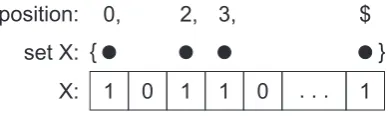
In M2L(Str) formulas are interpreted as sets of (ordered) positions in a string of arbitrary, but finite length, which can be conveniently described as finite bitvectors, i.e. a finite word over the alphabet {0,1}. One often refers to the interpretation of these bitvectors as characteristic functions that describe subsets of a given ordered set. Typical is their interpretation as finite set of natural numbers, illustrated in Figure1.
1
0 1 0 . . . 1
0, 2, 3, $
X: set X: position:
{ }
1
The bit vector corresponding to a string variable X has value 1 at positionn iff n∈N0 is
included inX, and value 0 otherwise. The figure shows a setX containing the positions 0, 2, 3 and $, its representation as a characteristic set, and its corresponding bit vector. Here, the symbol $ stands for the last position in the parametric string, and therefore marks the last bit in the bit vector; a special symbol for this last position is necessary since M2L(Str) allows reasoning about strings of finite butarbitrarylength, a convenient model for parametric hardware components.
The following development will entirely foot on the bit vector interpretation of M2L(Str), which we formally define below.
Semantics of jMosel formulas
jMosel translates formulas into complete and deterministic finite automata (DFA) in such a way that the language recognized by one such automaton corresponds to the formula’s interpretation as a bit vector. Accordingly, the semantics of a formula is defined via the functionJ K:φ−→α, whereφis the set of all jMosel formulas andα is the set of all complete DFAs.
Definition 1(Boolean Automaton)
A Boolean AutomatonAofα is defined asA= (Σ,S,s0,F,δ), where
• Σis the set of all edge labels, which themselves denote subsets of the set of free variable
V in the considered formula. They are represented as bitvectors of length|V|.
• Sis the set of all states.
• s0is the initial state,s0∈S.
• Fis the set of accepting statesF⊆S.
• δ is the transition function defined asδ:S×Σ−→S.
The edge labels determine for every string variable the Boolean value at positionn, whenever this label is taken asnth step of an accepting run. The number of edge labels is exponential in the size of the formula’s free variables, since the value of every variablev∈V has to be checked for equality with 0 or 1. Therefore, each label consists of a bit vector of length|V|.
Boolean Automata typically have very many edges between two nodes. We therefore con-struct the following equivalent Symbolic AutomatonAs, whose edges are labelled with Boolean functions and therefore compactly represent a set of edges of the original automaton.
Definition 2(Symbolic Automaton)
A symbolic automatonAsis defined asAs= (L,S,s0,F,δ), where
• L is the set of all possible edge labels, consisting of Boolean functions.
• S is the set of all states.
• s0is the initial state,s0∈S.
T
t
0 1 2 . . . $−1 $
X x0 x1 x2 . . . x$−1 x$
Y y0 y1 y2 . . . y$−1 y$
..
. ... ... ... . .. ... ...
Z z0 z1 z2 . . . z$−1 z$
Figure 2: Values for 2nd-order variables
T
t
. . . i . . .
W . . . 0 . . . X . . . 1 . . . Y . . . 0 . . . Z . . . 1 . . .
Figure 3: Representation of edge label ˜w&x&˜y&z
• δ is the transition function defined asδ:S×L −→S.
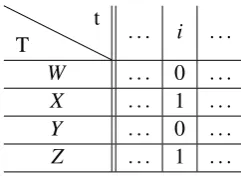
To describe the transformation fromAtoAs, we observe that values for a jMosel formula’s 2nd-order variables can be represented in table form, where a variableXis expressed as bit vector with position literalsx0,x1, ...,x$−1,x$. The ordering of variables is arbitrary but fixed.
Arowfor a variableX in Fig.2represents a word of the languageJXK. Every column of the table specifies one input symbol ofAand must therefore match an appropriate edge label. The position jin this label corresponds to the variable at position jin the ordering of variables. To convertAinto an AutomatonAs with Boolean formulas as edge labels, the labels ofAare first transformed as shown in Fig.3. Subsequently, edges sharing the same source and target state are merged; the resulting edge is labelled with the disjunction of the merged edges’ labels.
The formulas for the edge labels resulting from this transformation may be large, but their BDD representations are canonical and typically nice and concise [Bry86]. The jMosel toolset supports various BDD libraries to optimally exploit this observation.
Semantic Completeness:
Note that a symbolic automatonAs composed this way is typically not complete: its input al-phabet consists of all Boolean functions, but not every state considers the input of every possible Boolean function. However, the automaton is completeat a semantical level: the automatonA
with bit vector labels it represents is always complete. It is this semantic notion of completeness and determinism which we will refer to in the sequel of the paper.
Convention:
following applies: an arrow marks the initial state, accepting states are denoted as double circles, non-accepting states as plain circles.
In the following, we first present the classical (first-order) value numbering for this application domain, before we lift to second order in Section .
3
First-Order Value Numbering
First-order value numbering is an analysis method that allows the detection and removal of re-dundant computations from a program [CS70]. This goal is achieved by assigning abstract identi-fication values to computations that imply equality: as soon as an identiidenti-fication value reappears, it is certain that the corresponding computation has been already performed before, thus the previously computed result may be reused instead of performing the computation again. This ‘classical’ optimization is called DAGification in [KMS02].
3.1 Characterization of 1st-order Value Numbering
Given a syntax treeT of a jMosel formula in terms of
• L is the set of all labels for predicates, operators, and variables, L ={subseteq,shifteq,˜,&,ex} ∪ {X,Y,Z, ...}
• N is the set of nodes of the syntax treeT under consideration
• l:N −→L maps every syntax node to its label.
the assignment of abstract identification values can be given by any functionv1st:N −→Nthat satisfies the following two characteristics:
For all nodesn1,n2∈N of the syntax tree,
• v1st(n1) =v1st(n2)impliesl(n1) =l(n2),
i.e. the coincidence of their syntactic labels. In addition we require
• ifn1andn2are internal nodes with childrenc11, ...,ci1∈N andc21, ...,c2j∈N, respectively i= j ∧ ∀k∈ {1, ...,i}.v1st(c1k) =v1st(c2k)
3.2 Example
As an example for the process of first-order value numbering, we consider the following jMosel formula:
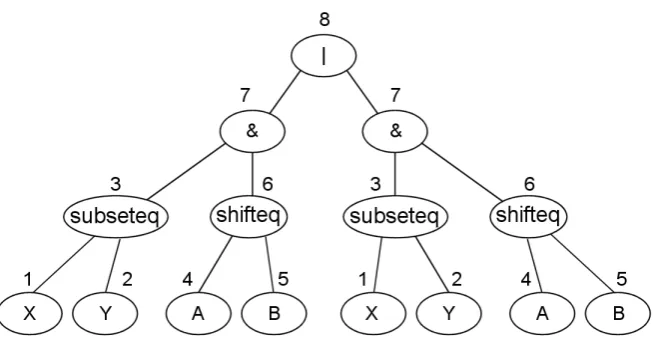
F=(subseteq(X,Y)&shifteq(A,B))|(subseteq(X,Y)&shifteq(A,B))
Fig.4shows its syntax tree after computation of the value numbers.
Figure 4: 1st order value numbering applied to the jMosel formulaF.
4
Second-Order Value Numbering
While first-order value numbering is used to identify redundant computations and replacing them by previously computed results, the goal of second-order value numbering is to identify redun-danttransformations- the reason for the use of second-order here. As will be clear below, this analysis and its corresponding optimizations is only a bit more involved than in the first-order case, but has a far bigger impact, see Section5.
4.1 Characterization of 2nd-order Value Numbering
The only difference in the characterization of the labelling function v1st :N −→Nconcerns the treatment of atomic predicates, i.e., ofA ={subseteq,shifteq}. Their labelling does no longer require the second clause for internal nodes. This results in the following slightly modified characterization:
For all nodesn1,n2∈N of the syntax tree,
• v1st(n1) =v1st(n2)impliesl(n1) =l(n2),
i.e. the coincidence of their syntactic labels. In addition we require
• ifn1andn2are internal nodes with childrenc11, ...,ci1∈N andc21, ...,c2j∈N, respectively i = j ∧ ∀k ∈ {1, ...,i}.v1st(c1k) = v1st(c2k) unless they are labelled with A ={subseteq,shifteq}
4.2 Semantics Transformers
When implementing second-order value numbering for jMosel, the semantics transformers can be implemented in terms of custom predicates similar to the atomic formulassubseteqand shifteq. This means that every identification of redundancy results in the automatic definition of a custom predicate. This process can be seen as an “on-the-fly enhancement” of the logic with newly identified predicates with multiple occurrences.
For the definition of semantics transformers and calls to these transformers, the syntax of jMosel is enhanced by thelet-construct
let <predicatename>(<argumentlist>) = <de f inition> in < f ormula>
that allows one to formulate formulas like:
let pred(X,Y) =subseteq(X,Y) & shifteq(Y,X) in pred(A,B) <-> pred(S,T).
where a new predicatepredwith argumentsXandYis defined by the formulasubseteq(X,Y) & shifteq(Y,X)and instantiated twice in the formulapred(A,B) <-> pred(S,T).
Definition 3(Semantics of thelet-Construct)
For formulas f1,f2∈F and a predicate Pred(A1,...,An) ∈P, the semantics of the let
-construct is defined as follows:
Jlet Pred(arg1,...,argn) = f1in f2K =d f Jf2[f1/Pred(x1,...,xn)]K
where·[·/·]:F × ID × ID −→ F denotes the usual syntactic substitution.
We use thelet-construct to implement second-order value numbering for jMosel. There, the definitions of and calls to semantics transformers are automatically inserted into the considered formula according to the value numbers assigned to the individual computations.
In the following we first illustrate on a very simple example how a semantics transformer is identified and inserted into the formula, then we consider a more complex case study in Section5.
4.3 Example
As a short example for the process of second-order value numbering, we consider the following jMosel formula:
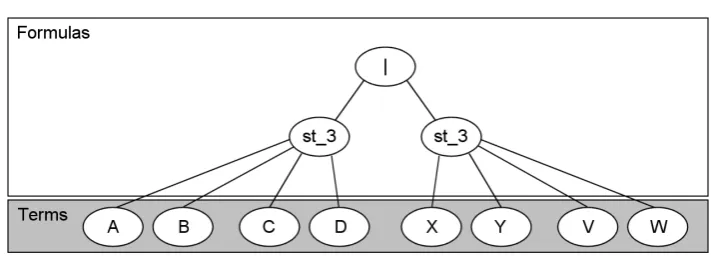
(subseteq(A,B) & shifteq(C,D)) | (subseteq(X,Y) & shifteq(V,W))
Figure 5: 2nd-order value numbering applied to a jMosel formula.
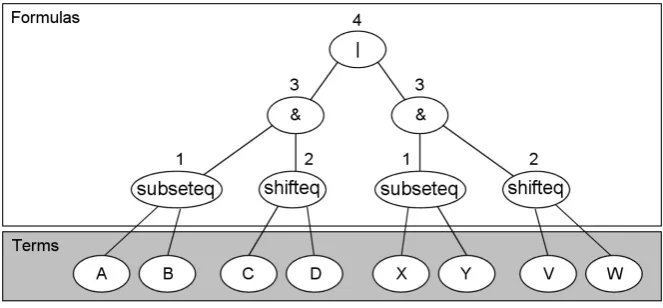
The formula’s syntax tree after computation of second-order value numbers is shown in Fig. 5. The nodes of the tree have been divided into two sets,formulasandterms; nodes representing terms have not been numbered by the 2nd-order value-numbering procedure.
The two nodes labeled with “&” share the value number 3; this means they both perform the same set of computations and can therefore be replaced by calls to a same semantics transformer st 3. The nodes with the value numbers 1 and 2 are not taken into account, since they are labeled with atomic predicates.
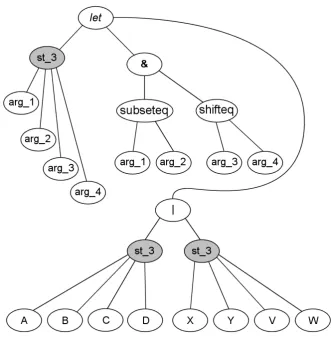
The definition of thest 3transformer is isomorphic to the subtrees labeled with value num-ber 3, but all occurring variables are replaced by fresh variables “arg n”. This transformer is inserted via let-construct into the formula, and the subtrees labelled with 3 are replaced by calls tost 3(see the corresponding syntax tree in Fig. 7), resulting in the formula:
let st 3(arg 1,arg 2,arg 3,arg 4) =
subseteq(arg 1,arg 2) & shifteq(arg 3,arg 4) in st 3(A,B,C,D) | st 3(X,Y,V,W)
When compiling this formula, the conjunction of the predicatessubseteqandshifteq is only computed once and stored as a semantics transformer, opposed to the original formula, where the conjunction is computed twice. The detailed course of the optimization and compila-tion is described in the next seccompila-tion.
4.4 The Optimizing Transformation
The optimization of the syntax tree for the formula
(subseteq(A,B) & shifteq(C,D)) | (subseteq(X,Y) & shifteq(V,W))
is performed in the following steps:
• Perform the numbering of the syntax tree, resulting in the labelling shown in Fig.5.
Figure 6: Syntax tree with calls to the semantics transformer.
• Create a semantics transformerst 3for the nodes labelled with 3 by duplicating one of the syntax trees of the corresponding subfunction.
• Replace the two occurrences of syntax nodes labelled with 3 by calls to the newly created semantics transformerst 3(Fig.6).
• Add the definition ofst 3to the top of the syntax tree (Fig.7).
The compiler operates on the modified syntax tree as follows:
• At the “let” construct it compiles the semantics transformer’s definition, identified by the subtree of the second child node of “let”.
• At the nodes representing the atomic predicates
• At the node representing the formula
subseteq(arg 1,arg 2) & shifteq(arg 3,arg 4)
it constructs the product automatona1∧2representing the conjunction ofa1anda2.
• It stores the resulting automaton as a semantics transformer namedst 3with arguments arg 1,...,arg 4.
• The compilation continues with the subtree of the third child node of “let”.
• At the node representing the call of a semantics transformerst 3(X,Y,V,W)the pre-computed definition ofst 3is copied again, this time the argumentsarg 1,..., arg 4in the edge labels are replaced with the termsX,Y,V,Wto form the result automa-tona4.
• At the node representing the formula
st 3(A,B,C,D) | st 3(X,Y,V,W)
it constructs the product automatonarepresenting the disjunction ofa3anda4and returns
full_adder
full_adder
full_adder
full_adder
@cin
X
Y
Result
@cout
add
$ $
1 1 1 1 1 1 1 1
1 1 1 1
$
Figure 8: Structure of the parametric adder
5
Application and Performance Measuring
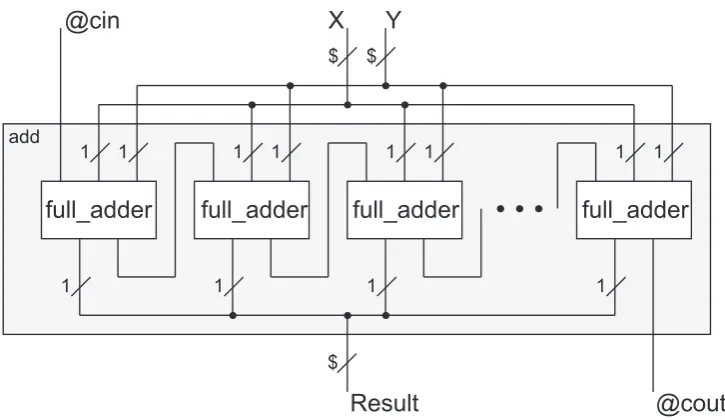
One of jMosel’s main application areas is the specification and verification of parametric hard-ware systems. We tested the presented optimization with a “real-world” example, applying it to the structural description of a parametric adder that describes the family of adder circuits for bit vectors of lengthn.
Structural Description of a Parametric Adder
Fig.8shows the structure for this adder based onninterconnected full adders. The circuit adds two bit vectorsX andY and stores the result as the new vectorResult. The Boolean variables @cinand @coutare the carry-in and carry-out bits.
The size of input formula and of the resulting automaton are too large for a detailed discussion in this paper, so we only present the results in terms of key data at this point. The compilation times have been measured on an Intel Centrino Duo System (2 x 2.16 GHz) with 1 GB of RAM:
Optimization none 1st-ord. VN 2nd-ord. VN Nodes in synt. tree 472 469 452
Depth of synt. tree 26 27 32
overall run time 11.50 sec 10.49 sec 3.47 sec
Sem. transformers - 1 6
The increased depth of the modified syntax tree is due to the fact that all definitions of se-mantics transformers are added to the top of the tree. By identifying 6 sese-mantics transformers, the size of the tree could be reduced by 20 nodes. This does not seem too exciting at first sight; however, it has quite some impact: the overall run time of the decision process is accelerated by a factor of three.
The enormous speedup is quite surprising, since the adder’s structural description already included user-defined predicates for frequently occurring constructs like the full adder and logical gates. This shows that even a carefully written formula and well structured circuits might still contain significant potential of redundancy, and therefore could benefit greatly from second-order value numbering.
6
Conclusion
We have presented second-order value numbering, a new optimization technique for suppress-ing redundancy, in a version tailored to the application for improvsuppress-ing the decision procedure of jMosel, a verification tool set for monadic 2nd-order logic on strings. Our technique extends the well-known concept of value numbering to consider not merely values, butsemantics transform-ersthat can be efficiently pre-computed and help to avoid redundancy at a second-order level. We have illustrated the effect of this optimization for a parametric family of hardware circuits, where we observed a performance gain by a factor of 3. This result is surprising, as the design of these circuits exploits already structural similarity.
Currently we are working on a careful experimental analysis of the impact of our technique in practice using standard benchmarks and libraries. We conjecture that we will observe a growth of the improvement factor with the size of the system, i.e. a ‘felt’ superlinear speedup.
In a more general perspective, second-order value numbering can be regarded as a means for a specific semantic form of procedural abstraction [SHKN76, DWF+07] in a similar way as value numbering (or its generalization to Value Flow graphs) is a semantic support for code motion [SKR90]. Thus besides looking for further application domains for second-order value numbering, it would also be interesting to investigate how the structural generalization of value numbering presented in [SKR90] can be raised to second-order in order to achieve a truly se-mantic notion of procedure abstraction for imperative programs.
Bibliography
[AWZ88] B. Alpern, M. N. Wegman, F. K. Zadeck. Detecting equality of variables in pro-grams. InPOPL ’88: Proceedings of the 15th ACM SIGPLAN-SIGACT symposium on Principles of programming languages. Pp. 1–11. ACM Press, New York, NY, USA, 1988.
[Bry86] R. E. Bryant. Graph-Based Algorithms for Boolean Function Manipulation.IEEE Transactions on Computers35(8):677–691, 1986.
[CS70] J. Cocke, J. T. Schwartz. Programming Languages and their Compilers. Courant Institute of Mathematical Sciences, New York University, 1970.
[DWF+07] A. Dreweke, M. W¨orlein, I. Fischer, D. Schell, T. Meinl, M. Philippsen. Graph-Based Procedural Abstraction. In Society (ed.), Proc. of the 2007 CGO. Pp. 259– 270. IEEE Computer Society, Los Alamitos, CA, USA, 2007.
[KMMG97] P. Kelb, T. Margaria, M. Mendler, C. Gsottberger. MOSEL: A Flexible Toolset for Monadic Second-Order Logic. InProc. TACAS’97. Lecture Notes in Computer Science 1217, pp. 183–202. Springer Verlag, 1997.
[KMS02] N. Klarlund, A. Møller, M. Schwartzbach. MONA Implementation Secrets. Inter-national Journal of Foundations of Computer Science, 2002.
[Mar96] T. Margaria. Fully Automatic Verification and Error Detection for Parameterized Iterative Sequential Circuits. InProc. TACAS ’96. Lecture Notes in Computer Sci-ence 1055, pp. 258–277. Springer Verlag, 1996.
[SHKN76] T. Standish, D. Harriman, D. Kibler, J. Neighbors. The Irvine Program Transfor-mation Catalogue. University of California, Irvine, 1976.
[SKR90] B. Steffen, J. Knoop, O. R¨uthing. The Value Flow Graph: A Program Representa-tion for Optimal Program TransformaRepresenta-tions. InEuropean Symposium on Program-ming. Pp. 389–405. 1990.