ARTIGO ORIGINAL
Assessment of Hepatitis C Virus Diversity in
Addition to the Frequency of Genotypes in
Samples Analyzed Between 2009 and 2014 at
the Reference Laboratory of National Health
Institute Dr. Ricardo Jorge
Conhecer a Diversidade do Vírus da Hepatite C para Além da Frequência
dos Genótipos em Amostras Analisadas entre 2009 e 2014 no Laboratório de
Referência do Instituto Nacional de Saúde Dr. Ricardo Jorge
1. Laboratório Nacional de Referência de Infeções Sexualmente Transmissíveis - VIH e vírus da hepatite B e C. Departamento de Doenças Infeciosas. Instituto Nacional de Saúde Dr. Ricardo Jorge. Lisboa. Portugal.
Autor correspondente: Elizabeth Pádua. [email protected]
Recebido: 29 de Janeiro de 2015 - Aceite: 29 de Junho de 2015 | Copyright © Ordem dos Médicos 2015
Elizabeth PÁDUA1, Ana Patrícia AVÓ1, Catarina ALMEIDA1, Ivone ÁGUA DOCE1, Helena CORTES MARTINS1
Acta Med Port 2015 Nov-Dec;28(6):695-701
RESUMO
Introdução: A identificação dos genótipos do vírus da hepatite C foi essencial para o prognóstico e tratamento dos doentes crónicos durante os últimos anos. Foram objetivos deste estudo conhecer a frequência de genótipos do vírus da hepatite C nos últimos seis
anos, e revelar o contributo de um ensaio in-house para caracterização molecular do vírus.
Material e Métodos: A genotipagem do vírus da hepatite C por LiPA foi realizada em 923 amostras, maioritariamente provenientes de
indivíduos do sexo masculino. A subtipagem do vírus da hepatite C pelo ensaio in-house com alvo nas regiões Core/E1 e/ou NS5B foi
efetuada em 112 amostras.
Resultados: Observámos elevada prevalência do genótipo 1 (56,6%), sendo a frequência do subtipo 1a quatro vezes superior ao subtipo 1b. Todos os casos de genótipo 3 (27,5%) foram classificados em subtipo 3a. Nas infeções pelo genótipo 4 (12,9%), identifi-caram-se os subtipos 4a (65,5%), 4d (31%), 4b (1,7%) e 4c (1,7%). Foram identificadas a RF1_2k/1b, recombinantes intragenótipo 2 e potenciais infeções mistas na população analisada.
Discussão: Os subtipos mais prevalentes, 1a e 3a, estão descritos como comuns em utilizadores de drogas injetáveis. Apesar da maioria das amostras analisadas corresponder a reclusos (78,4%), não podemos excluir eventuais comportamentos de risco associa-dos ao consumo de drogas ilícitas.
Conclusões: A prevalência elevada do subtipo 1a, a frequência e diversidade do genótipo 4 e a identificação de vírus geneticamente
recombinados, sugerem alteração do padrão molecular vírus da hepatite C descrito no passado. O ensaio in-house implementado
revelou ser útil para a correta classificação do vírus da hepatite C e melhoria do conhecimento sobre a diversidade do vírus em circu-lação no país.
Palavra-chave: Diversidade Genética; Genótipos; Subtipos; Vírus da Hepatite C.
ABSTRACT
Introduction: The identification of genotypes was essential for the prognosis and treatment of hepatitis C virus chronic patients in recent years. The aims of the study were to know the frequency of genotypes diagnosed in the last six years at the laboratory, and reveal the contribution of an in-house assay for molecular characterization of viruses.
Material and Methods: The genotyping of hepatitis C virus by LiPA was performed in 923 samples, mostly from male individuals. The subtyping of hepatitis C virus by an in-house assay to target regions in the Core/E1 and/or NS5B was performed in 112 samples. Results: We observed a high prevalence of genotype 1 (56.6%), with a frequency of subtype 1a four times higher compared to 1b. All cases of genotype 3 (27.5%) were subtype 3a. For the cases of genotype 4 (12.9%), it were identified subtypes 4a (65.5%), 4d (31%), 4b (1.7%) and 4c (1.7%). Recombinants intragenotype 2, the RF1_2k/1b, and mixed infections, were also identified.
Discussion: The most prevalent subtypes (1a and 3a) obtained are usually described in injecting drug users. Although most of the samples analysed match to inmates (78.4%), we cannot exclude any possible risk behaviors associated with illicit drug use.
Conclusions: The high prevalence of subtype 1a, the frequency and diversity of genotype 4, and the identification of recombined virus suggest modification of the molecular pattern of hepatitis C virus infection described in the past. The in-house assay proved to be useful for the correct classification of hepatitis C virus and improving knowledge about the diversity of virus circulating in the country. Keywords: Genetic Diversity; Genotypes; Hepatitis C Virus; Subtypes.
INTRODUCTION
Hepatitis C has global public health relevance, affecting both developed and developing countries. Its aetiological agent – hepatitis C virus (HCV) – is endemic worldwide and there is a wide range of prevalence rates in different regions of the world, influenced both by the major transmission routes of the virus and by health policies carried out by the
different countries aimed to prevent and treat the infection.1,2
The World Health Organization estimates that between 150 and 170 million people are infected with the virus.3 Although
ARTIGO ORIGINAL infected patients.
2,4
There are few studies in Portugal on HCV infection and a 1 to 1.5% prevalence is estimated in the Portuguese population; the virus is associated to 45% of patients with hepatitis notified in Portugal.5,6 It is however known that not every patient is notified and many are not diagnosed. Among the European countries, Portugal has the highest prevalence rates of this infection (varying between 60 and 80%) in Intravenous Drug Users (or injection drug users - IDUs).6-8
HCV is characterised by a great genetic diversity, giving rise to a high number of virus in circulation, ranked into seven different genotypes and around 67 viral subtypes.9 Different patterns of epidemiological distribution of the virus exist worldwide as well as a fast progression rate and the level of variability significantly increases over time due to the evolution of HCV quasispecies with an important role in the natural history of the infection and with the ability to
evade host’s immune response to infection.10
The combined therapy with pegylated interferon alpha and ribavirin has been used as the standard approach to chronic patients over the last few years and within the study
period.11 The efficacy of combined therapy, as determined
by the Sustained Virologic Response (SVR), i.e. continued
undetectable HCV RNA at 24 weeks post-treatment,12 ranges
between 42 and 82% and is genotype-dependent. The lowest SVR rates were found in genotype 1 HCV infections (40% - 50%) and, in contrast, the highest rates were found in genotype 2 and 3 infections (80%). Intermediate SVR rates
were associated to genotype 4 HCV infections (43 - 70%).
11-13 Therefore, different HCV genotypes lead to different
patient’s response to the standard treatment and genotype identification became crucial for establishing the outcome and treatment duration. Considering the different clinical response of patients infected with different subtypes of the same HCV genotype and the fact that clinical presentation of subtypes 1a and 1b was already described in literature, the importance of viral subtype on progression to chronic
HCV infection demands further research. 14
The updated version of the commercial assay widely used for HCV genotyping, known as LiPA, available from 2007, showed a weak performance in subtype determination, particularly regarding genotype 4 infections. The Portuguese
national reference laboratory within the INSA (National
Health Institute Dr Ricardo Jorge) developed an in-house
assay in 2009 in order to improve HCV classification.15 Our
study aimed to determine the infection’s molecular pattern over the past six years based on a retrospective analysis of HCV genotyping obtained between 2009 and 2014, as well as to improve HCV molecular characterisation in order to show the contribution of an in-house assay in HCV subtype determination.
MATERIAL AND METHODS Clinical samples, 2009 - 2014
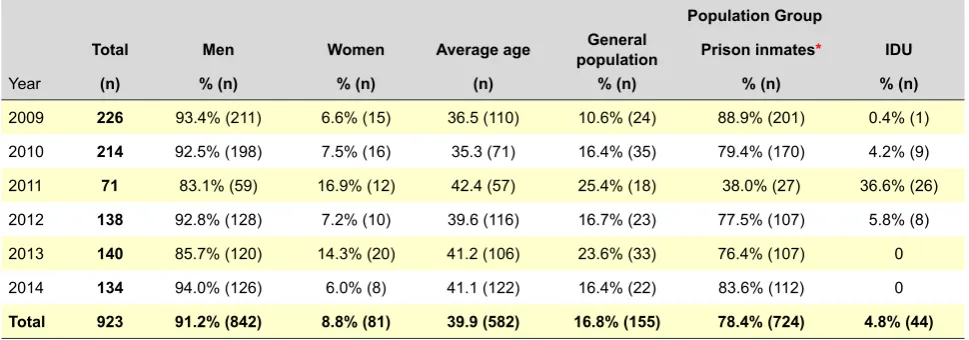
HCV genotyping using the commercial LiPA assay was applied to 923 blood samples obtained from patients presenting with HCV active infection, from which 112 were selected for viral subtype determination using a new in-house assay. According to the origin of samples, these were ranked into three population groups: 724 were included in the group of ‘prison inmates’, 155 into the group ‘general population’ (with unidentified risk behaviours) and 44 into the group of ‘IDU’. As regards gender distribution, 842 samples were obtained from male patients. The average age of our participants ranged annually between 35.3 and 42.4 (Table 1).
Methodology
Our study involved the retrospective analysis of
HCV genotyping with the commercial VERSANTTM HCV
Genotype 2.0 Assay-LiPA (Siemens Healthcare Diagnostics, NY, USA) assay and subtype determination with the in-house molecular assay obtained from the amplification and sequencing of the Core/E1 and NSSB HCV genomic regions. The assay’s reaction conditions were already
Table 1 - Characteristics of HCV patients whose blood samples were submitted for genotyping, 2009-2014
Population Group
Total Men Women Average age populationGeneral Prison inmates* IDU
Year (n) % (n) % (n) (n) % (n) % (n) % (n)
2009 226 93.4% (211) 6.6% (15) 36.5 (110) 10.6% (24) 88.9% (201) 0.4% (1)
2010 214 92.5% (198) 7.5% (16) 35.3 (71) 16.4% (35) 79.4% (170) 4.2% (9)
2011 71 83.1% (59) 16.9% (12) 42.4 (57) 25.4% (18) 38.0% (27) 36.6% (26)
2012 138 92.8% (128) 7.2% (10) 39.6 (116) 16.7% (23) 77.5% (107) 5.8% (8)
2013 140 85.7% (120) 14.3% (20) 41.2 (106) 23.6% (33) 76.4% (107) 0
2014 134 94.0% (126) 6.0% (8) 41.1 (122) 16.4% (22) 83.6% (112) 0
Total 923 91.2% (842) 8.8% (81) 39.9 (582) 16.8% (155) 78.4% (724) 4.8% (44)
ARTIGO ORIGINAL
described.15
RESULTS HCV Genotyping
The genotyping results obtained over the six-year period of the study showed a higher frequency of genotype 1 infections (56.6%, range 50.7-60.4%), followed by genotype 3 (27.5%, 21.0-35.5%) and genotype 4 (12.9%, 8.6-15.9%). Genotype 2 was the least frequent (1.4%, 0-2.3%) and no patients infected with genotypes 5, 6 or 7 were found (Table 2). In addition, 1.6% of the results were inconclusive with the LiPA method, including six patients infected with different HCV genotypes, namely genotypes 1-3, 1-4 and 3-4.
Genotype 2 HCV infection was rare and 1 and 3 were the most prevalent over the six-year period of the study, with a similar frequency, irrespective of the group (general
population, prison inmates or IDU) (Fig.1, Table 2). In addition, a 12.9% average frequency of genotype 4 HCV infection was found, showing a rising tendency between 2009 and 2013, from 11 to 14.3%, respectively (Table 2).
HCV subtyping
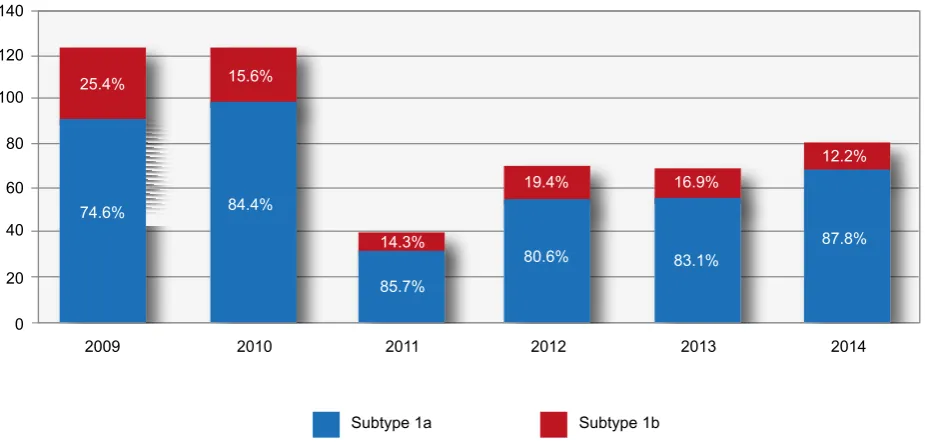
From all the patients infected with genotype 1, we found that approximately 80.8% (422/522) were infected with subtype 1a and 17.0% (89/522) with 1b. The HCV subtype was not established in 2.1% (11/522) of the patients with the LiPA commercial assay and the ratio between subtype 1a and 1b frequencies was sustained on each year and over the six-year period of the study, always showing approximately a four-fold higher frequency of patients infected with subtype 1a (Fig. 2).
Subtype 3a was the only found within the genotype 3 samples, corresponding to 27.5% of the samples (Table 2). Table 2 - Annual variation of HCV genotype percentages obtained by LiPA, 2009-2014
Genotype 1 Genotype 2 Genotype 3* Genotype 4§ Inconclusive¶
Year % (n) % (n) % (n) % (n) % (n)
2009 52.3% (134) 1.8% (4) 27.4% (62) 11.0% (25) 0.4% (1)
2010 57.9% (124) 2.3% (5) 21.0% (45) 15.9% (34) 2.8% (6)
2011 57.7% (41) 0 21.1% (15) 15.5% (11) 5.6% (4)
2012 51.4% (71) 0 35.5% (49) 12.3% (17) 0.7% (1)
2013 50.7% (71) 0.7% (1) 33.6% (47) 14.3% (20) 0.7% (1)
2014 60.4% (81) 2.2% (3) 26.9% (36) 8.6% (12) 1.5% (2)
Total 56.6% (522) 1.4% (13) 27.5% (254) 12.9% (119) 1.6% (15)
* All samples were classified as subtype 3a; § Includes non-subtyped genotype 4 infections and indistinguishable subtype 4a/4c/4d infections; ¶ Six patients with multiple infections with different HCV genotypes are included: genotypes 1 and 3, 1 and 4 and genotypes 3 and 4.
Figure 1 - Comparison of HCV genotypes determined by the commercial assay LiPA, 2009-2014 0
52.3%
57.9%
57.7%
51.4% 50.7%
60.4%
1.8% 2.3% 0% 0% 0.7% 2.2%
27.4%
21.0%
21.1%
35.5% 33.6%
26.9% 11.0%
15.9%
15.5% 12.3%
14.3%
8.6%
2009
Genotype 1 Genotype 2 Genotype 3 Genotype 4
2010 2011 2012 2013 2014
ARTIGO ORIGINAL We were unable to establish the HCV subtype in 156 (16.9%) of the 923 samples using the LiPA commercial assay: subtype was indistinguishable in 114 (73.1%) and indeterminate in 42 (26.9%).
The samples in which we were unable to reach any subtype determination and with sufficient serum remaining were submitted (n = 83) for amplification and sequencing
of Core/E1 and/or NS5B HCV genomic regions with the
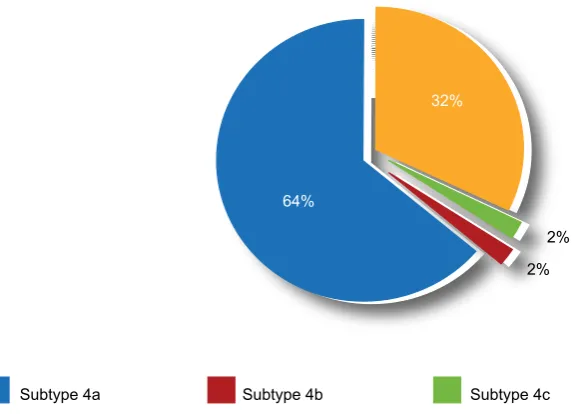
in-house assay and were successfully subtyped. Therefore, in the group of non-subtyped samples infected with genotype 4 (n = 55) with the LiPA assay, subtype 4a was the most common (65.5%), followed by subtype 4d (32.7%); one sample with subtype 4c was also found (Table 3 and Fig. 3). In addition, one sample was classified as subtype 4b with the in-house assay, whilst having been classified as indeterminate with the LiPA assay (Table 3). It should be also mentioned that the molecular assay found the inter-genotypic recombinant RF1_2k/1b and three intra-genotype 2 HCV strains (phylogenetic estimation, data not presented), not yet described in the international HCV sequence database (Table 3).
DISCUSSION
Portuguese studies on HCV molecular epidemiology are scarce and the prevalence of viral genotypes and subtypes in the infected Portuguese population is still poorly known. Therefore, our retrospective study developed at INSA’s reference laboratory, involving a HCV detailed molecular characterisation, can make a great contribution to increasing knowledge regarding the virus diversity in Portugal, particularly in the population groups where samples came from, including temporal changes in molecular patterns of infections.
Genotype 1, 2 and 3 HCV infections have been described
as the most prevalent worldwide, namely in the European and American continents.16,17 A clinical trial carried out by
Portuguese researchers around 15 years ago18 already
showed a high prevalence of genotype 1 (mostly associated to subtype 1b) and a significant frequency of subtype 3a. A low frequency of genotype 2 infection and no patient infected with genotype 4 were described. More recent retrospective studies on HCV molecular characterisation developed in IDU population groups and in prison inmates15,16 found a predominance of subtypes 1a and 4a in genotype 1 and 4 infections, respectively. A low frequency of genotype 2 was found in all studies. Our study has confirmed a high prevalence of genotype 1 (subtype 1a) and 3 (subtype 3a) and also showed that genotype 2 infection is still sporadic. A possible increase in genotype 4 infections, observed between 2009 and 2013, was also suggested.
Epidemiological studies showed that subtype 1b is highly prevalent worldwide and widely spread in Europe and in some African countries, as well as in some Southeast Asian countries, associated to elderly patients having contracted the disease through blood transfusions in the past.6,16,17 Despite the selection bias, we have found in our
study that subtype 1b showed a four-fold lower frequency when compared to subtype 1a, mainly related to young inmate patients.
Subtype 3a was the second more frequent in our population and, as subtype 1a, was described as frequently
found in IDUs from different European countries.16,17,19
Nevertheless, despite most patients in our study were prison inmates, the possible risk behaviours associated to the use of illicit drugs cannot be excluded in the IDU population group.
Genotype 4 is prevalent in the Middle East and in Africa and is associated to 62 and 90% of the infections observed
Figure 2 - Comparison of subtypes 1a and 1b in HCV-infected patients, 2009-2014 0
25.4% 15.6%
19.4% 16.9%
12.2%
14.3%
74.6% 84.4%
80.6% 83.1% 87.8%
85.7%
2009
Subtype 1a Subtype 1b
2010 2011 2012 2013 2014
ARTIGO ORIGINAL
Figure 3 - Comparison of subtypes 4a, 4b, 4c and 4d in HCV-infected patients, 2009, 2014 32%
64%
2% 2%
Subtype 4a Subtype 4b Subtype 4c Subtype 4d
in Saudi Arabia and in Egypt, respectively. Studies showed that genotype 4 remained endemic for a long period of time in Central and Western Africa, supported by continuing traditional practices including circumcision and scarification or by sexual transmission. Spreading to other African regions has coincided with the massive vaccination
campaign carried out between 1920 and 1940.13,20 HCV’s
high genetic diversity observed in Sub-Saharan Africa led to the hypothesis that genotype 4 was originated in Central and Western Africa and subsequently spread across the continent.13,17,20,21 A homogeneous molecular pattern was
found in Egypt, with the predominance of subtype 4a, unlike
the heterogeneity of genotype 4 variants in circulation in Sub-Saharan Africa; blood transfusion was described as the most frequent route of transmission until a few years ago. In addition, the predominant subtypes in Saudi Arabia were 4c/4d, followed by 4h, 4e and 4a, suggesting the presence of potential differences regarding viral origin or transmission routes in this country. An increased prevalence of subtypes 4d and 4a was described in European countries, namely in Spain, France, Italy and in Greece, associated to the movement of IDUs and to migrants arriving in Europe from endemic countries.20,21 Our study found a relatively high
prevalence of subtype 4a, followed by subtype 4d and only
Table 3 - HCV classification with the commercial assay LiPA and the new in-house assay
LiPA vs 2.0 Sequencing of Core + E1 and/or NS5B HCV regions Total
(5’UTR + core) 1a 1b 2k/1b* 2§ 2a 2b 3a 4a 4b 4c 4d n
1 7 4 11
1a 10 10
1b 12 12
2 1 1 2 4
2a/2c 1 2 2 5
2b 1 1
3a 6 6
4 4 3 7
4a/4c/4d 32 1 15 48
Inconclusivo 1 2 2 2 1 8
Total (n) 18 18 1 3 3 3 8 38 1 1 18 112
ARTIGO ORIGINAL observed with the in-house assay. In addition, subtype 4b was also found, which was already described in Portugal,22
as well as subtype 4c. These results showed the presence of a high genetic diversity of genotype 4 in Portugal. The first HCV recombinant strain was identified in 2002
in S. Petersburg - RF1_2k/1b;23 subsequent studies showed
its spreading in IDUs from different European countries.24
The in-house assay used in our study allowed the detection of one patient infected with the RF1_2k/1b and three patients with the intra-genotype 2 variant (data not presented). In fact, several patients infected with a particular recombinant
HCV strain were found in some Portuguese studies,15,16
explaining for the monitoring of the molecular epidemiology of the infection as well as its dynamics and the study of the possible clinical impact of these viral variants, even though a low HCV recombination frequency has been described in literature.
CONCLUSIONS
Despite our selection biased population, we found in our retrospective analysis that subtype 1a was the most frequent over the last six years, four times more frequent than subtype 1b. In addition, genotype 2 was sporadic and subtypes 2a and 2b were identified. Genotype 3 was exclusively classified into subtype 3a, whilst genotype 4 infection was relatively frequent and characterised by a high viral diversity and subtypes 4a, 4b, 4c and 4d were found. Patients infected with HCV recombinant strains were also found.
The HCV pathogen-associated molecular pattern obtained in our study is consistent with an epidemics associated illicit drug use risk behaviours, which has been frequently described in Portuguese IDU population groups. The high performance shown by the in-house assay allowed for an adequate classification of viruses circulating in the Portuguese population. This methodology can make an important contribution to increasing the knowledge on the role of genetic diversity in natural history and progression to chronic disease, regardless of the new era of treatment of hepatitis C that lies ahead.
HUMAN AND ANIMAL PROTECTION
The authors declare that the followed procedures were according to the regulations established by the responsible body of the Ethics and Clinical Research Committee and according to the Helsinki Declaration of the World Medical Association.
DATA CONFIDENTIALITY
The authors declare that they have followed the protocols of their work centre on the publication of patient data.
CONFLICTS OF INTEREST
The authors declare that there were no conflicts of interest in writing this manuscript.
FINANCIAL SUPPORT
The authors declare that there was no financial support in writing this manuscript.
REFERENCES
1. Lavanchy D. The global burden of hepatitis C. Liver Int. 2009;29:74–81. 2. Jafari N, Farajzadegan Z, Ataei B. Surveillance system for hepatitis C
infection: a practical approach. Int J Prev Med. 2012;3:S48–57. 3. Hepatitis C – global prevalence (uptade). Wkly Epidemiol Rec.
2000;75:18-9.
4. Lavanchy D. Evolving epidemiology of hepatitis C virus. Clin Microbiol Infect.2011;17:107–15.
5. Marinho R, Moura M, Giria J, Ferrinho P. Epidemiological aspects of hepatitis C in Portugal. J Gastroenterol Hepatol.2001;16:1076-7. 6. Marinho RT, Lavanchy D. Viral hepatitis. Meeting News. 2011;19:1–24. 7. Vieira AM, Freire R, Mangualde J, Pinho C, Fernandes V, Alves AL, et
al. Hepatite C - casuística da consulta de hepatologia de um hospital distrital. J Port Gastroenterol. 2007;14:134–40.
8. Calado RA, Rocha MR, Parreira R, Piedade J, Venenno T, Esteves A. Hepatitis C virus subtypes circulating among intravenous drug users in Lisbon, Portugal. J Med Virol. 2011;83:608-15.
9. Smith DB, Bukh J, Kuiken C, Muerhoff AS, Rice CM, Stapleton JT, et al. Expanded classification of hepatitis C virus into 7 genotypes and 67 subtypes: update criteria and genotype assignment web resource. Hepatology. 2014;59:318-27.
10. Bukh J, Miller R, Purcell R. Biology and genetic heterogeneity of hepati-tis C virus. Clin Exp Rheumatol.1995;13:S3-7.
11. Feld J, Hoofnagle J. Mechanism of action of interferon and ribavirin in treatment of hepatitis C. Nature.2005;436:967-72.
12. EASL Clinical Practice Guidelines: Management of hepatitis C virus in-fection. J Hepatol. 2014;60:392-420.
13. Antaki N, Craxi A, Kamal S, Moucari R, Van der Merwe S, Haffar S, et al.
The neglected hepatitis C virus genotypes 4, 5 and 6: an international consensus report. Liver Int. 2010;30:342–55.
14. Zein NN, Poterucha JJ, Gross JB Jr, Wiesner RH, Therneau TM, Gos-sard AA, et al. Increased risk of hepatocellularcarcinoma in patients in-fected with hepatitis C genotype1b. Am J Gastroenterol.1996;91:2560– 2.
15. Avó AP, Água-Doce I, Andrade A, Pádua E. Hepatitis C virus subtyp-ing based on sequencsubtyp-ing of the C / E1 and NS5B genomic regions in comparison to a commercially available line probe assay.J Med Virol. 2013;85:815–22.
16. Esteban J, Sauleda S, Quer J. The changing epidemiology of hepatitis C virus infection in Europe. J Hepatol. 2008;48:148-62.
17. Simmonds P. Genetic diversity and evolution of hepatitis C virus-15 years on. J Gen Virol. 2004;85:3173-88.
18. De Carvalho A, Martinho A, Leitão J, Cipriano MA, Coimbra H, Porto A. HGenotipos do VHC. Histopatologia hepática e perfil imunológico em quatro grupos de doentes. Acta Med Port. 2000;13:67-75.
19. Van Asten L, Verhaest I, Lamzira S, Hernandez-Aguado I, Zangerle R, Boufassa F, et al. Spread of hepatitis C virus among European injec-tion drug users infected with HIV: a phylogenetic analysis. J Infect Dis. 2004;189:292–302.
20. Kamal SM, Nasser IA. Hepatitis C genotype 4: what we know and what we don’t yet know. Hepatology. 2008;47:1371-83.
ARTIGO ORIGINAL
22. Koletzki D, Dumont S, Vermeiren H, Peixe P, Nina J, Camacho RJ, et al. Full genome sequence of three isolates of hepatitis C virus subtype 4b from Portugal. Arch Virol. 2009;154:127–32.
23. Kalinina O, Norder H, Mukomolov S, Magnius LO. A natural intergeno-typic recombinant of hepatitis C virus identified in St. Petersburg. J Virol. 2002;76:4034-43.