ISSN: 2501 - 1235 ISSN-L: 2501 - 1235 Available on-line at: www.oapub.org/edu
Copyright © The Author(s). All Rights Reserved.
doi: 10.5281/zenodo.3368572 Volume 5 │ Issue 11 │ 2019
ANTHROPOMETRY AND PHYSICAL FITNESS OF
FIRST AND SECOND YEAR PHYSIOTHERAPY STUDENTS
iChapelle L.ii, Guettard E., Vanroelen A., Zinzen E.
Department of Movement and Sports Sciences, Faculty of Physical Education and Physiotherapy, Free University of Brussels, Belgium
Abstract:
Objectives: To objectively examine changes in anthropometric measurements (i.e.
stature, body weight, BMI and fat percentage) and physical fitness (using the Eurofit test battery) of Physiotherapy students during their first and second university year.
Equipment and methods: Anthropometric measurements and physical fitness, in
accordance with the Eurofit test battery protocol, of 431 Physiotherapy students were determined over 6 years and compared separately for male and female students using paired samples t-tests. Results: The anthropometric measures significantly increased for both the male and female students. Both the male and the female students performed significantly worse in their second year of university on the Sit And Reach whilst performing significantly better on Handgrip Strength. The male students performed significantly better on the Flamingo Balance Test whilst performing significantly worse on the Bent Arm Hang in their second university year. Conclusion: The anthropometric measures of the Physiotherapy students got significantly worse after one year of university despite having mandatory sports classes. The physical fitness examination generated mixed results. Recommendations should be made to increase the number of hours of physical education in all university courses to improve the anthropometric measures as well as the physical fitness of these students.
Keywords: Eurofit test battery; physiotherapy students; anthropometry; physical fitness
i ANTHROPOMETRIE ET APTITUDE PHYSIQUE DE ÉTUDIANTS EN PHYSIOTHÉRAPIE DE
PREMIÈRE ET DEUXIÈME ANNÉE
European Journal of Physical Education and Sport Science - Volume 5 │ Issue 11 │ 2019 24
Objectif : Examiner de manière objective les modifications des mesures
anthropométriques (taille, poids corporel, IMC et pourcentage de graisse) et de la forme physique des étudiants en physiothérapie au cours de leurs première et deuxième années universitaires (à l’aide de la batterie de test Eurofit). Matériels et méthodes : Les mesures anthropométriques et la forme physique, conformément au protocole de la batterie de tests Eurofit, de 431 étudiants en physiothérapie ont été effectuées sur une période de 6 ans et comparées séparément pour les hommes et les femmes en utilisant des tests t sur échantillons appariés. Résultats : Les mesures anthropométriques ont clairement augmenté aussi bien pour les étudiants que pour les étudiantes. Les étudiants et les étudiantes ont obtenu des résultats bien moins bons lors de leur deuxième année d'université durant le Sit and Reach, tout en obtenant de meilleurs résultats avec la force de préhension. Les étudiants ont obtenus de meilleurs résultats durant les exercices de Flamingo Balance tandis qu'ils obtenaient de moins bons résultats durant les exercices de Bent Arm Hang durant leur seconde année d'université. Conclusion : Les mesures anthropométriques des étudiants en physiothérapie se sont considérablement dégradées après une année d'université, malgré l'obligation de suivre des cours de sport. L'examen de la condition physique a donné des résultats mitigés. Des recommandations devraient être faites pour augmenter le nombre d'heures d'éducation physique dans tous les cours universitaires afin d'améliorer les mesures anthropométriques ainsi que la forme physique de ces étudiants.
Mots clés : batterie de test Eurofit ; étudiants en physiothérapie ; mesures
anthropométriques ; forme physique
1. Introduction
The physical fitness and physical activity levels of the global population are declining as less than 60% of adults meet the minimum recommendation of 30 minutes of physical activity (at moderate intensity) a day [1]. Correspondingly, the Eurobarometer of 2017 found alarming rates of physical inactivity among Europeans since almost two-thirds (58%) of the Europeans never exercised or practiced sports at all and 48% never performed any kind of physical activity (such as for example cycling, gardening or active commuting) [2]. This physical inactivity, together with unhealthy eating, drinking and lifestyle habits, is known to be related to an increase in overweight and obesity which are, in turn, related to heart and other chronic diseases [3-10].
that precisely these unhealthy habits lead to an increased body weight, BMI and fat percentage (fat %) in Belgian university students [5].
Despite the abundancy of research, it is unclear if Physiotherapy students display similar anthropometric changes observed in previous studies. It could be hypothesized that Physiotherapy students will display a different pattern since they have mandatory sports classes throughout their education. Furthermore, one of the competences of a Physiotherapist is giving advice regarding a healthy and active lifestyle and it is thus important to be physically fit themselves to serve as a good example for others. Additionally, it is also unclear how the transition from secondary school to college or university affects the physical fitness of Physiotherapy students.
Therefore, the aim of this study was to objectively examine changes in anthropometric measurements (i.e. stature, body weight, BMI and fat %) and physical fitness (using the Eurofit test battery) of Physiotherapy students during their first and second university year. We hypothesize that, based on previous research; the anthropometric measurements will increase whilst the physical fitness will decrease.
2.Methods
2.2 Participants
All Physiotherapy students who enrolled in the program “Rehabilitation Sciences and Physiotherapy” at the free university of Brussels (VUB) between 2012 and 2017 were measured in both their first and second year of university, creating a one-year follow-up. Only first and second year Physiotherapy students, between the age of 18 and 24, were eligible to participate and students who were pregnant, ill, had severe injuries or students who dropped out of the program were excluded. Subsequently, a total of 431 students (195 males and 236 females) were measured on both occasions. The students’ informed consent was given prior to data collection.
2.3 Procedure
Anthropometric and physical fitness measures of the participants were collected on the first day of each academic year (i.e. end of September) during a mandatory sports class. Firstly, the anthropometric measures (i.e. stature, body weight, BMI and fat %) of the participants were measured in minimal clothing before the participants performed any physical activity. Stature was determined to the nearest 0.1 cm using a stadiometer (Seca 217, Seca, Hamburg, Germany), body weight was measured the nearest 0.1 kg using an electronic scale (Seca 803, Seca, Hamburg, Germany) whilst fat % was determined to the nearest 0.1% using Bioelectrical Impendance Analysis (Tanita BC-418 MA, Tanita, Tokyo, Japan). BMI of the students was subsequently calculated by dividing stature by body weight squared.
European Journal of Physical Education and Sport Science - Volume 5 │ Issue 11 │ 2019 26
with the protocol of the Eurofit battery [14]. Furthermore, the students performed the Eurofit test battery in the same order each year.
2.4 Statistical analysis
The statistical analysis was conducted using SPSS statistics version 25.0 (IBM Corporation, Armonk, New York, USA). Firstly, data were tested for normality of distribution using the Shapiro-Wilk test. Secondly, to analyze differences in the anthropometric (i.e. stature, weight, BMI and fat %) and physical fitness measures (i.e. FLA, PLT, SAR, SBJ, HGR, SUP, BAH, SHR) between the first and second year of university, paired samples t-tests were performed for males and females separately. Data is presented as mean ± standard deviation and the level of significance (α) was set at0.05.
2.5Results
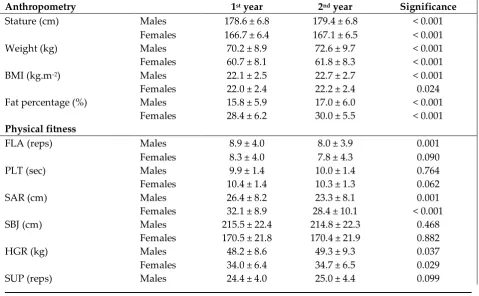
The anthropometric and physical fitness measures are displayed in Table 1 for the male and female students separately. All the anthropometric measures (i.e. stature, weight, BMI and fat %) significantly increased for both the male and female students. Regarding the physical fitness measures, both the male and the female students performed significantly worse in their second year of university on the SAR whilst performing significantly better on the HGR. Lastly, the male students performed significantly better on the FLA whilst performing significantly worse on the BAH in their second university year.
Table 1: Anthropometric and physical fitness measures of
the first and second year Physiotherapy students (n = 431; 195 males and 236 females) determined using the Eurofit protocol
Anthropometry 1st year 2nd year Significance
Stature (cm) Males 178.6 ± 6.8 179.4 ± 6.8 < 0.001 Females 166.7 ± 6.4 167.1 ± 6.5 < 0.001
Weight (kg) Males 70.2 ± 8.9 72.6 ± 9.7 < 0.001
Females 60.7 ± 8.1 61.8 ± 8.3 < 0.001 BMI (kg.m-2) Males 22.1 ± 2.5 22.7 ± 2.7 < 0.001
Females 22.0 ± 2.4 22.2 ± 2.4 0.024 Fat percentage (%) Males 15.8 ± 5.9 17.0 ± 6.0 < 0.001
Females 28.4 ± 6.2 30.0 ± 5.5 < 0.001
Physical fitness
FLA (reps) Males 8.9 ± 4.0 8.0 ± 3.9 0.001
Females 8.3 ± 4.0 7.8 ± 4.3 0.090
PLT (sec) Males 9.9 ± 1.4 10.0 ± 1.4 0.764
Females 10.4 ± 1.4 10.3 ± 1.3 0.062
SAR (cm) Males 26.4 ± 8.2 23.3 ± 8.1 0.001
Females 32.1 ± 8.9 28.4 ± 10.1 < 0.001
SBJ (cm) Males 215.5 ± 22.4 214.8 ± 22.3 0.468
Females 170.5 ± 21.8 170.4 ± 21.9 0.882
HGR (kg) Males 48.2 ± 8.6 49.3 ± 9.3 0.037
Females 34.0 ± 6.4 34.7 ± 6.5 0.029
Females 20.5 ± 4.1 20.9 ± 4.2 0.104
BAH (sec) Males 43.4 ± 15.7 38.6 ± 17.6 < 0.001
Females 14.5 ± 12.6 13.7 ± 12.4 0.076
SHR (sec) Males 19.7 ± 1.5 19.7 ± 1.5 0.808
Females 21.5 ± 1.2 21.4 ± 1.2 0.086
Note: n: number of participants; BMI: body mass index; FLA: flamingo; PLT: plate tapping; SAR: sit and reach; SBJ: standing broad jump; HGR: hand grip; SUP: sit ups; BAH: bent arm hang; SHR: shuttle run. All data is presented as mean ± standard deviation.
3.Discussion
The aim of this study was to objectively examine changes in anthropometric measurements and physical fitness of Physiotherapy students between their first and second university year. It was hypothesized that, based on previous research, Physiotherapy students will display an increase in anthropometric measurements and a decrease in physical fitness in their second university year compared to the first.
The results of this study indicated that, after one year of university, both male and female Physiotherapy students display a significant increase in stature, weight, BMI and fat %. For instance, the male Physiotherapy student gained on average 0,8 cm, 2.4 kg of body weight, 0.6 kg/m² BMI and 1.2 % fat %. Similarly, the female Physiotherapy students gained on average 0,4 cm, 1.1 kg of body weight, 0.2 kg/m² BMI and 1.6 % fat %. These increases in weight, BMI and fat % are in accordance with the findings of Deliens et al. (2015) who reported that 66,9 % of students gained weight and 61 % had a higher BMI after attending university one and a half years. Interestingly, weight and BMI of the female students did not significantly increase whilst the male students, on the contrary, gained 2,7 kg of body weight leading to a significant 0,7 kg/m² increase of their BMI [5]. The significant increase in weight, BMI and fat % of the Physiotherapy students included in this study is likely the result of an increase in sedentarism and unhealthy habits such as an increased alcohol consumption, smoking and irregular or unhealthy eating [3,5]. These results subsequently confirm that the transition period from secondary school to university is a vulnerable period for weight and fat % gain [9, 10, 11, 15].
European Journal of Physical Education and Sport Science - Volume 5 │ Issue 11 │ 2019 28
[5]. These results are confirmed by Wijndaele et al. (2006) who showed that HGR in Belgian (young) adults continues to increase till the age of 34 years [3].
3.1 Strengths and limitations
To our knowledge, this is the first study that objectively investigated the physical fitness of (Belgian) Physiotherapy students using the Eurofit test battery over a six-year period. Other strengths of this study are the large sample size and the Eurofit test battery itself. The Eurofit test battery is a reliable, accepted and widely used test battery in Europe to examine physical fitness [16, 17]. Future research will consequently be able to compare their results with the findings reported in this study.
There are, however, some limitations to this study as well. Firstly, environmental conditions could have distracted the subjects. For example, during the execution of the FLA test, there would be a lot of movement and background noises around the students, creating a possible distraction. Secondly, eating, drinking and lifestyle habits such as fatigue, alcohol consumption and smoking could influence the results of this study, but these parameters were not examined in the context of this study. Additionally, 431 second year Physiotherapy students completed the study, compared to the 717 first year Physiotherapy students that initially enrolled in the program, creating a huge drop-out. Therefore, results should be interpreted with caution as a selection among the students took place. Lastly, due to the elaborate test battery, large sample size and long measuring period (i.e. six years) of this study several test leaders were replaced over the years. Nevertheless, the different tests were always performed in accordance with the Eurofit test battery protocol [14].
3.2 Practical implications
McDaniel et al. (2013) reports that late adolescence is a unique period to perform interventions in the academic setting to promote a healthy lifestyle [20]. Health promotion and interventions are critical in the first year of university [11]. But also, in primary and secondary school this utters an important role. Ranasinghe et al. (2016) evaluated the physical activity levels in Physiotherapy students presuming these students would be conscious of the benefits of physical activity. Yet the results showed that a large portion of these students were inactive [21]. This could be explained by a lack of support and motivation to exercise sports in primary and secondary school which in its turn grows a negative attitude. Which despite their choice of study course doesn’t change when they get to university [21]. Therefore, more attention must also be given to the implementation of physical activities during primary and secondary school and adjustments can be made to the academic curriculum.
Future studies should implement a longer follow-up period to examine how the anthropometric and physical fitness measures of master Physiotherapy students evolve as they do not have mandatory physical education classes in their curriculum anymore. In addition, future studies should take into account eating, drinking and lifestyle habits of university students.
4.Conclusion
It can be concluded that the anthropometric measures of the Physiotherapy students got significantly worse after one year of university despite having mandatory sports classes. Regarding the physical fitness, the Eurofit test battery generated mixed results as the Physiotherapy students performed significantly worse on the SAR and significantly better on the HGR. In addition, the male Physiotherapy students performed significantly worse on the BAH but significantly better on the FLA. Consequently, recommendations should be made to increase the number of hours of physical education in all university courses to improve the anthropometric measures as well as the physical fitness of the students.
Acknowledgments
We thank all Physiotherapy students participating in this study and VUB staff for contributing in the data collection.
Disclosure of Interest
The authors declare that they have no competing interest.
References
European Journal of Physical Education and Sport Science - Volume 5 │ Issue 11 │ 2019 30
2019Mar14]. Available from: https://www.who.int/dietphysicalactivity/Indicators English.pdfOrganization WH.
[2] TO & Social. Special Eurobarometer 412 - European Commission [Internet]; 2014
[cited 2019Mar14]. Available from:
http://ec.europa.eu/commfrontoffice/publicopinion/archives/ebs/ebs_412_en.pdfTO&So cial. Sport and Physical Activity: Report.; 2014. doi:10.2766/73002.
[3] Wijndaele K., Duvigneaud N., Matton L., Duquet W., Lefevre J. Fysieke activiteit, fitheid en gezondheid in Vlaanderen. In: Steens G, editor. Moet er nog sport zijn? Sport,beweging en gezondheid in Vlaanderen 2002-2006. Antwerpen: F&G Partners; 2006. p. 55-70.
[4] Butler S. M., Black D. R., Blue C. L., Gretebeck R. J. Change in Diet, Physical Activity, and Body Weight in Female College Freshman. American Journal of Health Behavior. 2004;28(1):24–32.
[5] Deliens T., Deforche B., Bourdeaudhuij I. D., Clarys P. Changes in weight, body composition and physical fitness after 1.5 years at university. European Journal of Clinical Nutrition. 2015;69(12):1318–22.
[6] Crombie A. P., Ilich J. Z., Dutton G. R., Panton L. B., Abood D. A. The freshman weight gain phenomenon revisited. Nutrition Reviews. 2009;67(2):83–94.
[7] Vella-Zarb R. A., Elgar F. J. The ‘Freshman 5’: A Meta-Analysis of Weight Gain in the Freshman Year of College. Journal of American College Health. 2009;58(2):161–6.
[8] Delinsky S. S., Wilson G. T. Weight gain, dietary restraint, and disordered eating in the freshman year of college. Eating Behaviors. 2008;9(1):82–90.
[9] Anderson D. A., Shapiro J. R., Lundgren J. D. The freshman year of college as a critical period for weight gain: An initial evaluation. Eating Behaviors. 2003;4(4):363–7. [10] Lloyd-Richardson E. E., Bailey S., Fava J. L., Wing R. A prospective study of weight gain during the college freshman and sophomore years. Preventive Medicine. 2009;48(3):256–61.
[11] Vadeboncoeur C., Townsend N., Foster C. A meta-analysis of weight gain in first year university students: is freshman 15 a myth? BMC Obesity. 2015;2(1).
[12] Deliens T., Clarys P., Hecke L. V., Bourdeaudhuij I. D., Deforche B. Changes in weight and body composition during the first semester at university. A prospective explanatory study. Appetite. 2013;65:111–6.
[13] Strong K. A., Parks S. L., Anderson E., Winett R., Davy B. M. Weight Gain Prevention: Identifying Theory-Based Targets for Health Behavior Change in Young Adults. Journal of the American Dietetic Association. 2008;108(10).
[14] Lefevre J. Eurofit testbatterij: leidraad bij de testafneming en referentiewaarden. Brussel: Bloso; 1993.
[15] Schmidt S. C. E., Tittlbach S., Bös K., Woll A. Different Types of Physical Activity and Fitness and Health in Adults: An 18-Year Longitudinal Study. BioMed Research International. 2017;2017:1–10.
[17] Tsigilis N., Douda H., Tokmakidis S. P. Test-Retest Reliability of the Eurofit Test Battery Administered to University Students. Perceptual and Motor Skills. 2002;95(3_suppl):1295–300.
[18] Kaj M., Tékus É., Juhász I., Stomp K., Wilhelm M. Changes in physical fitness of Hungarian college students in the last fifteen years. Acta Biologica Hungarica. 2015;66(3):270–81.
[19] Hardman K. An Up-Date On the Status of Physical Education in Schools Worldwide: Technical Report for the World Health Organization. Geneva, Zwitserland; 2004.
[20] Mcdaniel T., Melton B. F., Langdon J. Promoting physical activity through student life and academics. Health Education Journal. 2013;73(2):237–44.
European Journal of Physical Education and Sport Science - Volume 5 │ Issue 11 │ 2019 32
Creative Commons licensing terms