119
Original article
Comparison of different extraction methods and
HPLC
method
development for the quantification of andrographolide from
Andrographis paniculata (Burm.f.) Wall. ex Nees
Se ema Sharma and Yash Pal Shar ma
Department of Forest Products, University of Horticulture and Forestry, Solan-173230, Himachal Pradesh, India
Received April 3, 2018: Revised May 18, 2018: Accepted May 25, 2018: Published online June 30, 2018
Copyright @ 2018 Ukaaz Publications. All rights reserved. Email: [email protected]; Website: www.ukaazpublications.com Aut hor f or cor respo ndenc e: Dr. Seema Sharma
Department of Forest Products, University of Horticulture and Forestry, Solan-173230, Himachal Pradesh, India
E-mail: [email protected] Tel.: +91-9418044799
1. Introduction
Andrographis paniculata (AP) (Burm.f.) Wall. ex Nees (Family:
Acanthaceae), commonly known as kalmegh (in Trade), ‘kirayat’ (Hindi), ‘kalamegha’ (Sanskrit) and ‘Indian Echinacea’ in English (Kumar et al., 2012) is an annual herb, native of South India and Srilanka (Raina et al., 2013a) and grows in abundance in Asian countries like India, Pakistan, Java, Malaysia and Indonesia (Joseph, 2014). In India, found wild throughout the plains mainly in states of Madhya Pradesh, Chhattisgarh, Orissa, Maharashtra, Assam, West Bengal, Uttar Pradesh, Uttrakhand, Tamil Nadu, Karnataka and Kerala (Prajapati et al., 2003). Plant is erect, up to 30 cm - 1m high, stem acutely quadrangular with profuse branching. Leaves are simple, opposite, lanceolate with acute apex and short petiole. Inflorescence is terminal, axillary and panicle. Flower violet to white in colour and fruit capsule with numerous seeds (Anonymous, 1999; Sareer et al., 2014). Kalmegh is a reputed herb, which is commonly used in Ayurveda, Siddha, Unani and Homoeopathy systems of medicine as well as tribal medicines. Ayurvedic properties such as Rasa-Tikta, Guna-Laghu, Ruksha, Veerya-Ushna, Vipaka-Katu, Doshaghnata-Kaphapittashamaka, etc., are found in plant
Annals of Phytomedicine 7(1): 119-130, 2018
DOI: 10.21276/ap.2018.7.1.15; Print ISSN : 2278-9839 and Online ISSN : 2393-9885 7(1): 119-130 (2018) Ann. Phytomed.,
Abstract
Androg raphis panic ulata (AP) (Burm.f.) Wall. ex Nees is a very well known plant for its medicinal value like cough, cold, fever jaundice, etc., which is attributed due to the presence of bioactive compounds. Wide use of bioactive compounds in different commercial sectors needs the most appropriate method to extract these compounds from the plant material. Keeping this in view, in present study, five different extraction methods were employed to recover extracts from whole plants of AP. The methods include Soxhlet, Reflux, Cold extraction, Ultrasound-Assisted extraction (UAE) and Microwave-Assisted extraction (MAE). Extractions were carried out by using two solvents, i.e., methanol and chloroform for each sample at different durations which vary with the method used. The extracts obtained by different extraction methods were further analyzed by high performance liquid chromatography (HPLC) to identify and quantify major bioactive compound, i.e., andrographolide. Thus, the best extraction method with best extracting solvent and extraction duration was standardized. The results showed that the extraction techniqu es significa ntly a ffect the both extract ( %) as well a s a ndr ogr apholide (%) . T he andrographolide (%) in the samples ranged from 0.587% to 1.998%. Also, analytical method development and validation parameters, including linearity, accuracy, precision, LOD and LOQ were determined to ensure the validity of extraction method for estimation of major compound andrographolide.
Keywords: Extraction, andrographolide, HPLC, method validation
In the present work, we evaluate the effectiveness of different extraction methods for the determination of andrographolide. Extraction of APwas done with five different methods as Soxhlet, Reflux, Cold extraction, Ultrasound-Assisted extraction (UAE) and Microwave-Assisted extraction (MAE). The effect of different extraction methods on total extract (%) and andrographolide (%) from whole plants of AP were observed. Extractions were carried out by using two solvents, i.e., methanol and chloroform for each sample at different durations which vary with the method used. The extracts, thus obtained as above were further analysed by high performance liquid chromatography (HPLC). Thus, the best extracting solvent and extraction duration was standardized. The present research would be helpful for further exploration and full use of the renewable resource of AP.
2. Materials and Methods
2.1 Materials and reagents
All chemicals/solvents used for extraction process were of analytical grade and for HPLC analysis were of HPLC grade. The plants of AP were procured from field of Department of Forest Products, UHF, Nauni, Solan, India. The identification of the plant sample was done in the Herbarium section of the above said Department with reference number 9520. These plants were used for isolation of standard compou nd, i.e., an drograph olide an d also for standardization of extraction method.
2.2 E xtra ction , sepa ra tion an d pu rif ication of ma jor phytoconstituent andrographolide
Field grown plants of APwere harvested during flowering stage, dried under shade for 7-8 days and then coarsely powdered and further dried in the oven for 24 h. at 35-40°C. The air dried powdered material (450 gm) was then extracted with methanol in a Soxhlet apparatus for 12 h. on a boiling water bath. After extraction, solvent was distilled off from the extract and sticky greenish mass was dried under vaccum. The dried extract was then thoroughly decanted with petroleum ether (60-80°C) for 2-3 times. Decantation discarded and residue was refluxed with hexane 2-3 times, each for half an hour. The filtrate again discarded and residue dried. The residue pre-extracted with hexane was then dissolved in methanol and filtered. The methanol from the filtrate was distilled off for removal of methanol and the residue obtained was dried under vacuum. This dried residue was then repeatedly decanted with benzene for the removal of coloured substances and thereafter, the residue was dissolved in ethyl alcohol : water mixture (1:1). The ethyl alcohol was the evaporated by heating and the aqueous part containing bitter compounds was repeatedly partitioned with ethyl acetate, each time ethyl acetate fraction was collected and aqueous layer was discarded. From ethyl acetate fraction, solvent was completely removed by distillation, resulting in creamish to light green coloured mass, andrographolide was further purified by crystallization in chloroform and adding methanol into it dropwise. The dissolved mixture was allowed to stand overnight and white crystals of andrographolide were obtained. Repeated crystallization was done to obtain purified andrographolide. Purity of the obtained crystals was ascertained by TLC and HPLC.
2.3 Sample preparation
The collected plant material was properly cleaned for desired (aerial) parts, dried for 3-5 days in open under shade and then dried in oven (35-40°C) for 30 min. The dried material was grinded with pestle
and mortar and sieved by mesh size 600 microns sieve to form uniform particle size of powdered material. This powdered material was used for standardization of extraction technique. All these extraction methods were first individually standardized for solvent and extraction duration and then these individually standardized methods were compared so as to find out the best extraction methodology.
2.4 HPLC analysis of samples
The well dried extracted samples were diluted with mobile phase (methanol : water :: 65 : 35, v/v) up to 250 times, then filtered
through 0.2 µm membrane prior to injection in the HPLC system. This well prepared sample was then analyzed by HPLC method. The details of the HPLC method are given in method development section.
2.4.1 Soxhlet extraction
Accurately weighed (1 gm) ground plant material was packed in thimble made of qualitative Whatman filter paper and then subjected to extraction in soxhlet apparatus (40 ml capacity) over water bath with methanol (100 ml) and chloroform (100 ml) solvents separately. The extraction of samples under soxhlet extraction method was done with two different solvents, i.e., methanol and chloroform separately for 0.5, 1, 1.5, 2, 4, 6 and 8 h. After extraction and filtration of the extract, solvent from each sample was distilled off and the residue was air dried to a constant weight, total extract recorded and further analysed by using HPLC developed method.
2.4.2 Reflux extraction
Accurately weighed (1 gm) plant material was extracted by refluxing with different solvents, i.e., methanol (100 ml) and chloroform (100 ml) separately. The extraction of samples under Soxhlet extraction method was done with two different solvents, i.e., methanol and chloroform separately for 0.5, 1, 1.5, 2, 4, 6 and 8 h. After extraction, the samples were processed in the same manner as for soxhlet extraction method.
2.4.3 Cold extraction
Accurately weighed (1 gm) plant material was cold extracted at room temperature by percolating by continous shaking on shaker (SPINIX Reciprocating Shaker) with 100 rpm with different solvents i.e. methanol (100 ml) and chloroform (100 ml) separately. The extraction of samples under cold extraction method was done with two different solvents (methanol and chloroform) separately for 2, 4, 6, 8, 10, 12, 14 and 16 h extraction. After extraction, the samples were processed in the same manner as for soxhlet extraction method.
2.4.4 Sonication-assisted extraction
Accurately weighed (1gm) plant material was extracted by sonication with different solvents, i.e., methanol (100 ml) and chloroform (100 ml) separately for eight different durations (4, 8, 12, 16, 20, 24, 28 and 32 min.). The extraction was done at sonication power 120 MHz. and temperature was maintained at 40°C ± 1°C. After extraction, the samples were processed in the same manner as for soxhlet extraction method.
2.4.5 Microwave-assisted extraction
30 min.). Domestic microwave oven of IFB brand model 30SC3 was used for microwave assisted extraction. Microwave output power was maintained 90 watt (10% out of 900 watt). After extraction, the samples were processed in the same manner as for soxhlet extraction method.
2.4.6 Comparison of different extraction method
Different extraction methods standardized, were compared in order to find out the best extraction method for AP in terms of total extract (%) and andrographolide content (%).
2.4.7 Development and validation of HPLC method for the quantification of andrographolide in AP
The HPLC method development and validation was done on Waters binary HPLC unit with Waters HPLC pump 515, dual absorbance detector 2487 and Empower II software and detection was done at 223 nm. The andrographolide pure compound isolated in the laboratory was used as standard.
i. Method development
The chromatographic conditions were optimized by using different columns, i.e., Spherisorb ODS-2 (4.6 × 150 mm, 3 µm), Symmetry
C18 (4.6 × 25 0mm, 5 µm) and Sunfire C18 (4.6 × 250 mm, 5 µm).
Different combinations of water and methanol (60:40 to 40:60), water and acetonitrile (60:40 to 40:60) in isocratic mode at flow rate ranging from 0.6 ml/min. to 1.3 ml/min. were tried to obtain clear, well resolved peak of andrographolide in the standard compound as well as in the sample.
ii. Method validation
The developed HPLC method was validated for seven parameters as mentioned in ICH guidelines and procedure followed for testing these parameters was also as per ICH guidelines (ICH Q2(R1), (2005)).Different parameters used for validation were Linearity and range, Accuracy, Precision, Limit of detection, Limit of quantitation and Robustness.
(a) Linearity and range: Standard stock solution containing
andrographolide (237.500 µg/ml) was prepared with mobile
phase (methanol:water::65:35, v/v) and further appropriately diluted with mobile phase to obtain the solutions of six different
concentrations (3.710 µg/ml, 7.421 µg/ml, 14.843 µg/ml, 29.687 µg/ml, 59.375 µg/ml and 118.500 µg/ml) of andrographolide. In
total seven concentrations of the analyte solutions were used in triplicate for obtaining calibration curve of andrographolide. The calibration curve was constructed by plotting the mean peak area versus the concen tration of an alyte. Th e concentrations range of the method was derived from interval between upper and lower values (including these values) of linearity.
(b) Accuracy : The accuracy of the method was studied by recovery studies. The accuracy of the method was determined by percentage recovery of andrographolide in the spiked sample at three concentration levels: (i) sample with known quantity
of andrographolide (7.421 µg/ml) + andrographolide (14.843 µg/ml); (ii) sample with known quantity of andrographolide
(7.421 µg/ml) + andrographolide (29.687 µg/ml); iii. sample with known quantity of andrographolide (7.421 µg/ml) + andrographolide (59.375 µg/ml)). The resultant samples were
then analyzed (replicated three times) and the average percentage recoveries were calculated as:
Recovery (%) =
g/ml) µ ( compound of
amount Actual
g/ml) µ ( compound of
amount Observed
× 100
(c) Precision : To study the precision of the method, inter-day and intra-day precisions were determined as:
i. Intra-day precision: The intra-day precision was measured by injecting same concentration of standard mixture (59.37
µg/ml of andrographolide) for six times in a day and
measuring their response. The relative standard deviation (% R.S.D.) of response was taken as measurement of intra-day precision.
ii. Inter-day precision: The inter-day precision was measured by injecting same concentration of standard mixture (59.37
µg/ml of andrographolide) for six consecutive days and
measuring their response. The relative standard deviation (%R.S.D.) of the response was taken as measurement of interday precision.
(d) Limit of detection (LOD) : The lowest concentration of working solution of the analyte was further diluted with mobile phase (methanol : water :: 65:35, v/v) to yield a series of appropriate concentrations. Limit of detection (LOD) of the developed method was determined by injecting progressively low concentrations of the standard solutions and S/N ratio for each concentration was observed. The concentration having signal to noise ratio nearly 3 has been found as LOD.
(e) Limits of quantitation (LOQ) : The lowest concentration of working solution of the analyte was further diluted with mobile phase (methanol : water :: 65:35, v/v) to yield a series of appropriate concentrations. Limit of quantitation (LOQ) of the developed meth od was determined by in jectin g progressively low concentrations of the standard solutions and observed S/N ratio of each concentration. The LOQ for investigated compound was established at signal to noise ratio approaching nearly to 10.
(f) Robustness: Robustness of the developed method was investigated by testing the influence of small changes in HPLC conditions as change in flow rate (± 0.05%) and change in mobile ph ase composition (± 2 %). A fixed standard
concentration of andrographolide was (118.5 µg/ml) selected
for robustness study. The selected concentration was injected in triplicate, with standard HPLC conditions, with change in flow rate from standard 1ml / min to 0.95 ml / min and 1.05 ml/ min. and with change in mobile phase composition from standard methanol : water (65:35, v/v) to methanol : water (63:37, v/v) and methanol : water (67:33, v/v). The % RSD of the retention time was calculated for mean value of each factor.
iii. Testing of the developed method
iv. Statistical analysis
The data regarding the standardization of extraction technique for five species under study was subjected to statistical analysis using OP-STAT software. Analysis of variance was worked out and critical difference at 5 percent level of significance was calculated. The data regarding the HPLC method development and validation for five species under study was subjected to statistical analysis through Empower-II software.
3. Results
The results obtained by Soxhlet extraction method were found statistically significant and are presented in Tables 1 and 2. The mean total extract was higher in methanol extraction (16.302%) than the chloroform extraction (4.192%). The mean total extract was minimum for half hour extraction (8.037%) which increased to maximum (11.898%) at eight hours extraction, which was however, found statistically at par with six hours (11.693%) extraction (Table 1).
Table 1:Effect of extraction duration and solvent on total extract (%) of AP by using Soxhlet extraction
11.898 (3.327) 5.842(2.417)
17.954(4.237) 8 Hours
4.192(2.019) 16.302(4.033)
MEAN
11.693(3.294) 5.644(2.376)
17.743(4.212) 6 Hours
11.178 (3.224) 5.503(2.346)
16.853(4.103) 4 Hours
10.332(3.037) 3.949(1.986)
16.715(4.088) 2 Hours
9.509 (2.893) 3.334(1.825)
15.684(3.960) 1.5 Hour
9.084(2.797) 2.799(1.673)
15.370(3.921) 1 Hour
8.037(2.611) 2.277(1.509)
13.798(3.714) 0.5 Hour
Mean Chloroform
Methanol Solvent
Extraction Duration
11.898 (3.327) 5.842(2.417)
17.954(4.237) 8 Hours
4.192(2.019) 16.302(4.033)
MEAN
11.693(3.294) 5.644(2.376)
17.743(4.212) 6 Hours
11.178 (3.224) 5.503(2.346)
16.853(4.103) 4 Hours
10.332(3.037) 3.949(1.986)
16.715(4.088) 2 Hours
9.509 (2.893) 3.334(1.825)
15.684(3.960) 1.5 Hour
9.084(2.797) 2.799(1.673)
15.370(3.921) 1 Hour
8.037(2.611) 2.277(1.509)
13.798(3.714) 0.5 Hour
Mean Chloroform
Methanol Solvent
Extraction Duration
CD0. 05
Solvent = 0.034
Duration = 0.064
Solvent × Duration = 0.091
Values in the parentheses are transformed values using square root tr ansfor ma tion
Among different solvents used for extraction, in methanol extraction, the total extract was minimum at half hour extraction (13.798%) which kept increasing with increase in extraction duration and reached maximum (17.954%) under eight hours extraction which was however, found statistically at par with six hours (17.743%) extraction. Under chloroform extraction, the minimum total extract (2.277%) was obtained in half hour which kept increasing with increase in extraction duration and reached maximum (5.842%) at eight hours extraction. The values of total extract obtained at four hours (5.503%), six hours (5.644%) and eight hours (5.842%) extraction with chloroform were statistically at par (Table 1).
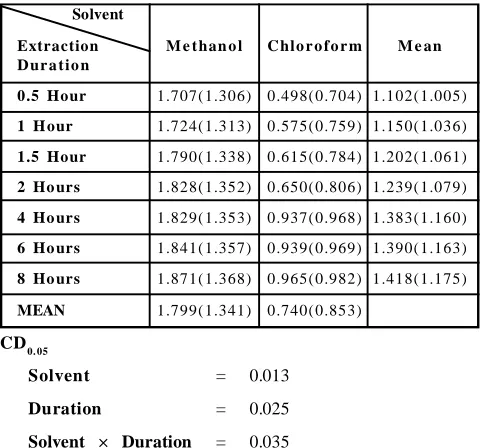
The mean content of andrographolide was found higher (1.799%) under methanol extraction than the chloroform (0.740%) extraction. Under different extraction durations, the mean andrographolide content was minimum (1.102%) under half hour extraction and maximum (1.418%) at eight hours extraction. The values of
andrographolide content obtained at four hours (1.383%), six hours (1.390%) and eight hours (1.418%) extraction were statistically at par with each other (Table 2).
Table 2: Effect of extra ction dur ation and solvent on a ndr ogr a-pholide content (%) of AP by using Soxhlet extraction
Solvent
Extraction M e t han o l C hlo r o f o r m M e an D ur a t io n
0.5 Hour 1.707( 1.306) 0.498( 0.704) 1.102( 1.005) 1 H our 1.724( 1.313) 0.575( 0.759) 1.150( 1.036) 1.5 Hour 1.790( 1.338) 0.615( 0.784) 1.202( 1.061) 2 Ho urs 1.828( 1.352) 0.650( 0.806) 1.239( 1.079) 4 Ho urs 1.829( 1.353) 0.937( 0.968) 1.383( 1.160) 6 Ho urs 1.841( 1.357) 0.939( 0.969) 1.390( 1.163) 8 Ho urs 1.871( 1.368) 0.965( 0.982) 1.418( 1.175)
MEAN 1.799( 1.341) 0.740( 0.853)
CD0. 05
Solvent = 0.013
Duration = 0.025
Solvent × Duration = 0.035
Values in the parentheses are transformed values using square root transformation
Under methanol solvent, the andrographolide content was minimum (1.707%) under half hour extraction and maximum (1.871%) under eight hours extraction. The values of andrographolide content obtained at one and a half hour (1.790%), two hours (1.828%), four hours (1.829%), six hours (1.841%) and eight hours (1.871%) extraction with methanol were statistically at par. Under chloroform solvent, the andrographolide content was minimum (0.498%) under half hour extraction which kept increasing with increase in extraction duration and reached maximum (0.965%) under eight hours extraction and which was however, found statistically at par with four hours (0.937%), six hours (0.939%) and eight hours (0.965%) extraction (Table 2).
3.1 Reflux extraction method
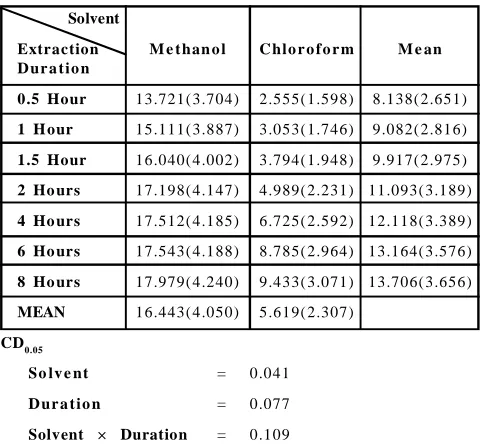
The results obtained were found statistically significant and are presented in Tables 3 and 4. The mean total extract was higher in methanol extraction (16.443%) than the chloroform extraction (5.619%). The extraction durations had positive effect on mean total extract and minimum was obtained for half hour extraction (8.138%) which increased to maximum (13.706%) at eight hours extraction duration (Table 3).
in extraction duration and reached maximum (9.433%) at eight hours extraction which was however, statistically at par with six hours (8.785%) extraction (Table 3).
Table 3:Effect of extraction duration and solvent on total extract (%) of APby using Reflux extraction
Solvent
Extraction M e t han o l C hlo r o f o r m M e an D ur a t io n
0.5 Hour 13.721( 3.704) 2.555( 1.598) 8.138( 2.651) 1 H our 15.111( 3.887) 3.053( 1.746) 9.082( 2.816) 1.5 Hour 16.040( 4.002) 3.794( 1.948) 9.917( 2.975) 2 Ho urs 17.198( 4.147) 4.989( 2.231) 11.093( 3.189) 4 Ho urs 17.512( 4.185) 6.725( 2.592) 12.118( 3.389) 6 Ho urs 17.543( 4.188) 8.785( 2.964) 13.164( 3.576) 8 Ho urs 17.979( 4.240) 9.433( 3.071) 13.706( 3.656) MEAN 16.443( 4.050) 5.619( 2.307)
CD0.05
So lv e nt = 0.041
D ur a t io n = 0.077
Solvent × Duration = 0.109
Values in the parentheses are transformed values using square root tr ansfor ma tion
The mean content of andrographolide was found higher (1.998%), under methanol extraction than chloroform (0.970%). Under extraction duration, the mean andrographolide content was minimum (1.213%) under half hour extraction and maximum (1.640%) at eight hours extraction (Table 4).
Table 4:Effect of extra ction dur ation and solvent on a ndr ogr a-pholide content (%) of AP by using Reflux extraction
Solvent M e t han o l C hlo r o f o r m M e an Extraction
D ur a t io n
0.5 Hour 1.701( 1.304) 0.725( 0.851) 1.213( 1.078) 1 H our 2.040( 1.428) 0.848( 0.921) 1.444( 1.175) 1.5 Hour 2.056( 1.434) 0.913( 0.956) 1.484( 1.195) 2 Ho urs 2.060( 1.435) 0.926( 0.962) 1.493( 1.199) 4 Ho urs 2.064( 1.436) 1.012( 1.006) 1.538( 1.221) 6 Ho urs 2.038( 1.427) 1.119( 1.057) 1.578( 1.242) 8 Ho urs 2.028( 1.424) 1.251( 1.118) 1.640( 1.271) MEAN 1.998 (1.413) 0.970( 0.982)
CD0.05
So lv e nt = 0.010
D ur a t io n = 0.019
Solvent × Duration = 0.027
Values in the parentheses are transformed values using square root tr ansfor ma tion
Among individu al solven ts, un der methanol solvent, th e andrographolide content was minimum (1.701%) under half hour extraction and maximum (2.064%) under four hours extraction. However, the values of andrographolide content obtained at one hour (2.040%), one and a half hour (2.056%), two hours (2.060%), four hours (2.064%), six hours (2.038%) and eight hours (2.028%) extraction with methanol were found statistically at par. Under chloroform solvent, the andrographolide content was minimum (0.725%) under half hour extraction which kept increasing with increase in extraction duration and reached maximum (1.251%) under eight hours extraction (Table 4).
3.2 Cold extraction method
The results obtained were found statistically significant and are presented in Tables 5 and 6. The mean total extract was higher in methanol extraction (14.634%) than the chloroform extraction (5.040%). Under different extraction durations, mean total extract was found minimum under two hours extraction (7.813%) which increased to maximum (10.379%) at eight hours and ten hours extraction. The values of mean total extract obtained at six hours (10.331%), eight hours (10.379%), ten hours (10.379%), twelve hours (10.360%), fourteen hours (10.364%) and sixteen hours (10.360%) extraction durations were statistically at par (Table 5).
Table 5:Effect of extraction duration and solvent on total extract (%) of AP by using Cold extraction
Solvent M e t han o l C hlo r o f o r m M e an Extraction
D ur a t io n
2 Ho urs 11.250 (3.354) 4.375 (2.092) 7.813 (2.723) 4 Ho urs 12.803 (3.577) 4.618( 2.149) 8.710 (2.863) 6 Ho urs 15.578 (3.946) 5.084 (2.253) 10.331 (3.100) 8 Ho urs 15.481 (3.935) 5.278 (2.297) 10.379 (3.116) 10 H ours 15.481 (3.934) 5.278 (2.297) 10.379 (3.116) 12 H ours 15.486 (3.935) 5.234 (2.288) 10.360( 3.111) 14 H ours 15.499 (3.937) 5.229 (2.284) 10.364( 3.110) 16 H ours 15.492 (3.936) 5.229 (2.286) 10.360( 3.111) MEAN 14.634 (3.819) 5.040 (2.243)
CD0.05
So lv e nt = 0.033
D ur a t io n = 0.061
Solvent × Duration = 0.086
Values in the parentheses are transformed values using square root tr ansfor ma tion
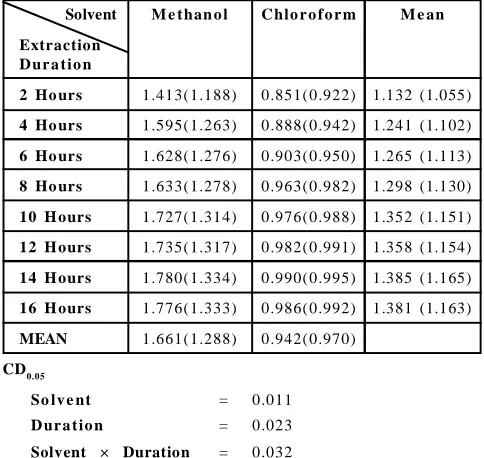
The mean content of andrographolide was found higher (1.661%) under methanol extraction than chloroform (0.942%). In different extraction durations, the mean andrographolide content was minimum (1.132%) under two hours extraction and maximum (1.385%) at twelve hours extraction. The values of mean extraction durations at ten (1.352%), twelve hours (1.358%), fourteen hours (1.385%) and sixteen hours (1.381%) were statistically at par with each other (Table 6).
Table 6:Effect of extra ction dur ation and solvent on a ndr ogr a-pholide content (%) of AP by using Cold extraction
Solvent M e t han o l C hlo r o f o r m M e an Extraction
D ur a t io n
2 Ho urs 1.413( 1.188) 0.851( 0.922) 1.132 (1.055) 4 Ho urs 1.595( 1.263) 0.888( 0.942) 1.241 (1.102) 6 Ho urs 1.628( 1.276) 0.903( 0.950) 1.265 (1.113) 8 Ho urs 1.633( 1.278) 0.963( 0.982) 1.298 (1.130) 10 H ours 1.727( 1.314) 0.976( 0.988) 1.352 (1.151) 12 H ours 1.735( 1.317) 0.982( 0.991) 1.358 (1.154) 14 H ours 1.780( 1.334) 0.990( 0.995) 1.385 (1.165) 16 H ours 1.776( 1.333) 0.986( 0.992) 1.381 (1.163) MEAN 1.661( 1.288) 0.942( 0.970)
CD0.05
So lv e nt = 0.011
D ur a t io n = 0.023
Solvent × Duration = 0.032
Values in the parentheses are transformed values using square root transformation
Among extracting solvents, in methanol solvent, the andrographolide content was minimum (1.413%) under two hours extraction which increased to maximum (1.780%) under fourteen hours extraction. The values of andrographolide content obtained at ten hours (1.727%), twelve hours (1.735%), fourteen hours (1.780%) and sixteen hours (1.776%) extraction with methanol were statistically at par. Under chloroform solvent, the andrographolide content was minimum (0.851%) under two hours extraction which kept increasing with increase in extraction duration and reached maximum (0.99 0%) u nder fou rteen h ou rs extraction. T he valu es of andrographolide content obtained at eight hours (0.963%), ten hours (0.976%), twelve hours (0.982%), fourteen hours (0.990%) and sixteen hours (0.986%) extraction with methanol were statistically at par (Table 6).
3.3 Sonication assisted extraction
The results obtained were found statistically significant and are presented in Tables 7 and 8. The mean total extract was higher in methanol extraction (11.6 94%) than chloroform extraction (3.917%). The extraction durations had positive effect on mean total extract and minimum (5.456%) was obtained under four minutes extraction and maximum (9.359%) at twenty eight minutes extraction which was however, found statistically at par with twenty four minutes (9.208%) and thirty two minutes (9.218%) extraction (Table 7).
Table 7: Effect of extraction duration and solvent on total extract (%) of AP by using Sonication assisted extraction
Solvent Extraction
D ur a t io n M e t han o l C hlo r o f o r m M e an 4 Minut es 8.258 (2.874) 2.655( 1.624) 5.456( 2.249) 8 Minut es 9.050( 3.009) 3.415( 1.848) 6.233( 2.428) 12 Minut es 11.068( 3.325) 3.651( 1.911) 7.359( 2.618) 16 Minut es 11.130( 3.336) 3.664( 1.913) 7.397( 2.624) 20 Minut es 12.620( 3.553) 3.808( 1.951) 8.214( 2.752) 24 Minut es 13.882( 3.725) 4.535( 2.129) 9.208( 2.927) 28 Minut es 13.916( 3.730) 4.803( 2.192) 9.359( 2.961) 32 Minut es 13.628( 3.690) 4.808( 2.193) 9.218( 2.941) MEAN 11.694( 3.405) 3.917 (1.970)
CD0.05
So lv e nt = 0.038
D ur a t io n = 0.075
Solvent × Duration = 0.107
Values in the parentheses are transformed values using square root tr ansfor ma tion
Under methanol extraction, the total extract was minimum (8.258%) at four minutes extraction which kept increasing with increase in extraction duration to maximum (13.916%) under twenty eight minutes extraction, which was, however, found statistically at par with twenty four minutes (13.882%) and thirty two minutes (13.628%) extraction. In chloroform extraction, the minimum total extract (2.655%) was obtained in four minutes extraction, which kept increasing with the increase in extraction duration and reached maximum (4.808%) at thirty two minutes extraction. The values of total extract obtained at twenty four minutes (4.535%), twenty eight minutes (4.803%) and thirty two minutes (4.808%) extraction with chloroform were statistically at par (Table 7).
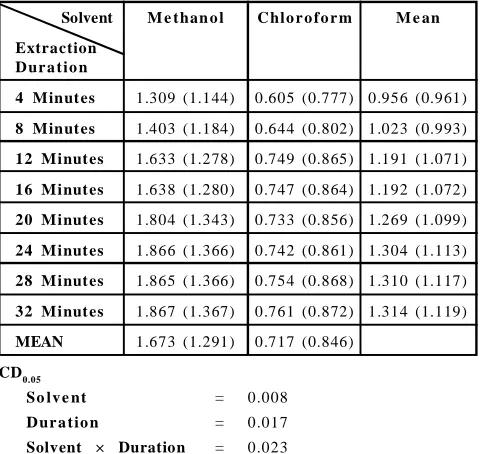
The mean content of andrographolide was found higher (1.673%), under methanol extraction than chloroform (0.717%). Under extraction durations, the mean andrographolide content was minimum (0.956%) under four minutes extraction and maximum (1.314%) at thirty two minutes extraction which was however, found statistically at par with twenty eight minutes (1.304%) and twenty four minutes (1.310%) extraction (Table 8).
Table 8:Effect of extra ction dur ation and solvent on andr ogra -pholide content (%) of AP by using Sonication a ssisted extr a ction
Solvent M e t han o l C hlo r o f o r m M e an Extraction
D ur a t io n
4 Minut es 1.309 (1.144) 0.605 (0.777) 0.956 (0.961) 8 Minut es 1.403 (1.184) 0.644 (0.802) 1.023 (0.993) 12 Minut es 1.633 (1.278) 0.749 (0.865) 1.191 (1.071) 16 Minut es 1.638 (1.280) 0.747 (0.864) 1.192 (1.072) 20 Minut es 1.804 (1.343) 0.733 (0.856) 1.269 (1.099) 24 Minut es 1.866 (1.366) 0.742 (0.861) 1.304 (1.113) 28 Minut es 1.865 (1.366) 0.754 (0.868) 1.310 (1.117) 32 Minut es 1.867 (1.367) 0.761 (0.872) 1.314 (1.119) MEAN 1.673 (1.291) 0.717 (0.846)
CD0.05
So lv e nt = 0.008
D ur a t io n = 0.017
Solvent × Duration = 0.023
Values in the parentheses are transformed values using square root tr ansfor ma tion
3.4 Microwave assisted extraction
The results obtained were found statistically significant and are presented in Tables 9 and 10. The mean total extract was higher in methanol extraction (11.327%) than the chloroform extraction (2.429%). The extraction duration had positive effect on mean total extract and minimum (4.880%) was obtained under five minutes extraction and maximum (8.230%) at twenty five minutes extraction, which was however, found statistically at par with thirty minutes (8.136%) extraction (Table 9).
Table 9:Effect of extraction duration and solvent on total extract (%) of AP by using Microwave assisted extraction
Solvent M e t han o l C hlo r o f o r m M e an Extraction
D ur a t io n
5 Minut es 8.614 (2.935) 1.146 (1.070) 4.880 (2.003) 10 Minut es 9.737 (3.120) 1.675 (1.294) 5.706 (2.207) 15 Minut es 11.667 (3.416) 1.714 (1.309) 6.690 (2.362) 20 Minut es 12.555 (3.543) 2.700 (1.643) 7.628 (2.593) 25 Minut es 12.790 (3.576) 3.671 (1.915) 8.230 (2.745) 30 Minut es 12.601 (3.550) 3.671 (1.916) 8.136 (2.733) MEAN 11.327 (3.356) 2.429 (1.524)
CD0.05
So lv e nt = 0.027
D ur a t io n = 0.046
Solvent × Duration = 0.065
Values in the parentheses are transformed values using square root tr ansfor ma tion
Under methanol extraction, the total extract was minimum (8.614%) at five minutes extraction which increased to maximum (12.790%) at twenty five minutes extraction and thereafter stabilized. In chloroform extraction, the minimum total extract (1.146%) was obtained in five minutes extraction, which kept increasing with the increase in extraction duration and reached maximum (3.671%) at thirty minutes extraction. The values of total extract obtained at twenty five minutes (3.671%) and thirty minutes (3.671%) extraction with chloroform were statistically at par (Table 9).
The mean content of andrographolide was found higher (1.606%) under methanol extraction than chloroform (0.587%). Under different extraction durations, the mean andrographolide content was minimum (0.900%) under five minutes extraction and maximum (1.266%) at thirty minutes extraction, which was however found statistically at par with twenty five minutes (1.209%) extraction (Table 10).
Table 10:Effect of extra ction dur ation and solvent on a ndr ogr a-pholide content (%) of APby using Microwave assisted extr action
Solvent M e t han o l C hlo r o f o r m M e an Extraction
D ur a t io n
5 Minut es 1.470 (1.213) 0.329 (0.573) 0.900 (0.893) 10 Minut es 1.573 (1.254) 0.489 (0.699) 1.031 (0.976) 15 Minut es 1.574 (1.254) 0.529 (0.718) 1.051 (0.986) 20 Minut es 1.625 (1.275) 0.620 (0.787) 1.123 (1.031) 25 Minut es 1.678 (1.296) 0.740 (0.860) 1.209 (1.078) 30 Minut es 1.717 (1.310) 0.815 (0.903) 1.266 (1.106) MEAN 1.606 (1.267) 0.587 (0.756)
CD0.05
So lv e nt = 0.028
D ur a t io n = 0.049
Solvent × Duration = 0.069
Values in the parentheses are transformed values using square root transformation
Under methanol solvent, the andrographolide content was minimum (1.470%) under five minutes extraction and maximum (1.717%) under thirty minutes extraction. The values of andrographolide content obtained at ten minutes (1.573%), fifteen minutes (1.574%), twenty minutes (1.625%), twenty five minutes (1.678%) and thirty minutes (1.717%) extraction with methanol were statistically at par. Under chloroform solvent, the andrographolide content was minimum (0.329%) under five minutes extraction and maximum (0.815%) under thirty minutes extraction which was however, found statistically at par with twenty five minutes (0.740%) extraction (Table 10).
3.5 Comparison of different extraction methods in AP
The total extract was recorded maximum (15.684%) under soxhlet method when extraction was done with methanol for one and a half hour which was found statistically at par with reflux extraction (15.111%) with methanol for one hour and cold extraction method
(15.481%) with methanol for ten hours. The minimum total extract (12.601%) was recorded when the extraction was done microwave assisted extraction for thirty minutes with methanol solvent (Table 11).
Table 11: Comparison of different extraction methods in AP
Ext ractio n met hod Extracting Extraction Total extract Andrographolide (% ) s o lv e nt dur a t io n (%)
Soxhlet extraction Metha nol 1.5 Hour 15.684 (3.960) 1.790 (1.338)
Reflux extraction Metha nol 1 Hour 15.111( 3.887) 2.040 (1.428)
Cold extraction Metha nol 10 Hours 15.481( 3.934) 1.727 (1.314)
Sonication assisted extraction Metha nol 32 Minutes 13.628 (3.690) 1.867 (1.367)
Microwave assisted extraction Metha nol 30 Minutes 12.601 (3.550) 1.717 (1.310) CD
0.05
0.099 0.031
SE(m) 0.032 0.010
SE(d) 0.046 0.014
C.V. 1.708 1.494
Values in the parentheses are transformed values using square roottransformation
The andrographolide content was maximum (2.040%) under reflux method when extraction was done with methanol for one hour. The andrographolide content was found almost same in sonication assisted method with methanol for thirty two minutes and soxhlet extraction method with methanol for one and a half hour extraction. The andrographolide content was recorded minimum in cold extraction method (1.727%) with methanol for ten hours extraction which was, however found statistically at par with microwave assisted method with thirty minutes (1.717%) extraction duration.
3.6 Development and validation of HPLC method for the quantification of andrographolide in AP
3.6.1 Method development
Method development was done on waters binary HPLC unit with HPLC pumps-515 and detection was done at 223 nm on dual
detector 2487. Three different columns Spherisorb ODS-2 (4.6 ×
150 mm, 3 µm), Symmetry C18 (4.6 × 250 mm, 5 µm) and Sunfire
C18 (4.6 × 250 mm, 5 µm) were tried. Standard of pure compound andrographolide (118.500 µg/ml) was repeatedly injected in different
columns by varying mobile phase, solvents and concentrations (i. methanol : water :: 70:30 to 40:60; ii. acetonitrile : water :: 70:30 to 40:60) at fixed mobile phase flow rate 1ml/min. in isocratic mode. Chromotograms were observed for clear separation of peak for andrographolide. The clearly separated, well resolved peak of andrographolide were observed only on Sunfire C18(4.6 × 250 mm,
5 µm) column with methanol : water as mobile phase. The peak of
andrographolide was not clearly resolved in acetonitrile : water as mobile phase. After selecting the column of Sunfire C18(4.6 × 250
mm, 5 µm), mobile phase concentration, i.e., methanol : water was varied for between 70:30 to 40 :60 at flow rate of 1ml/min. afforded clearly separated, well resolved peak of andrographolide. After deciding the column (Sunfire C18(4.6 × 250 mm, 5 µm)), mobile
phase (methanol : water:: 65 :35, v/v) which afforded good separation of andrographolide peak in the standard; the plant sample was injected and chromatogram was observed. The mobile phase flow was altered between 0.6 ml/min. to 1.3 ml/min. but the clear, well defined peak of andrographolide was observed only at flow rate of 1ml/min. The optimized chromatographic conditions which clearly
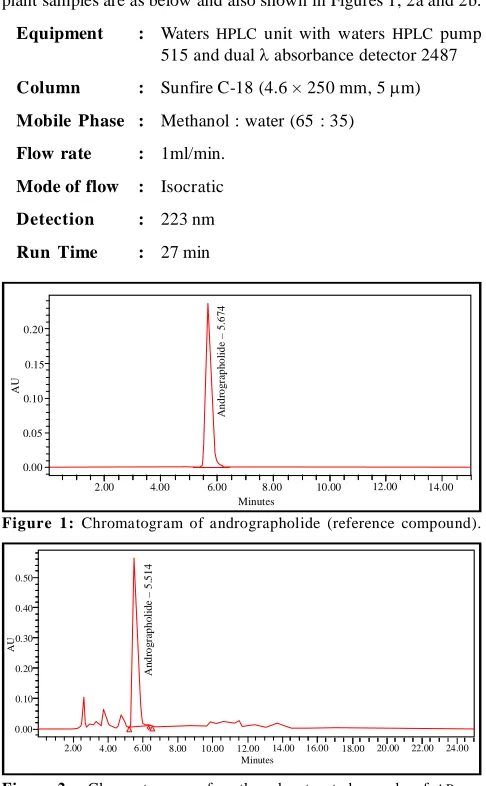
separate the compound of our interest, i.e., andrographolide in plant samples are as below and also shown in Figures 1, 2a and 2b:
Equipment : Waters HPLC unit with waters HPLC pump 515 and dual absorbance detector 2487
Column : Sunfire C-18 (4.6 × 250 mm, 5 m)
Mobile Phase : Methanol : water (65 : 35)
Flow rate : 1ml/min.
Mode of flow : Isocratic
Detection : 223 nm
Run Time : 27 min
2.00 4.00 6.00 8.00 10.00 12.00 14.00 Minutes
A
U
0.00 0.05 0.10 0.15 0.20
A
n
d
ro
g
ra
p
h
o
li
d
e
–
5
.6
7
4
Figure 1: Chromatogram of andrographolide (reference compound).
2.00 4.00 6.00 8.00 10.00 12.00 14.00 16.00 18.00 20.00 22.00 24.00 Minutes
0.00 0.10 0.20 0.30 0.40 0.50
A
U
A
n
d
ro
g
ra
p
h
o
li
d
e
–
5
.5
1
4
0.00 0.02 0.04 0.06 0.08 0.10 A U
2.00 4.00 6.00 8.00 10.00 12.00 14.00 16.00 18.00 20.00 22.00 24.00 Minutes A n d ro g ra p h o li d e – 5 .3 9 8
Figure 2b: Chromatogram of chloroform extracted sample of AP. 3.6.2 Method validation
Above developed meth od was validated for th e followin g parameters:
i. Linearity and range
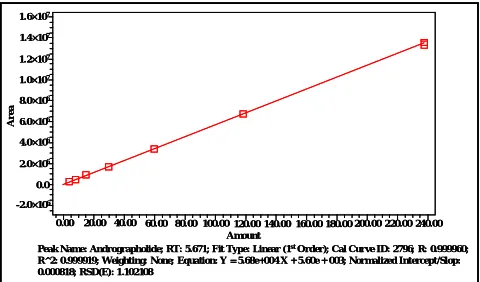
The results obtained for linearity and range for andrographolide are presented in Table 12. Linearity of andrographolide was established
for seven concentrations ranging from 3.710 µg/ml – 237.500 µg/
ml. Regression equation obtained was linear with correlation coefficient (R) value 0.999. Regression equation derived from the linear data was Y = 5.68e + 004 X + 5.60e + 003. The retention time of andrographolide was 5.671 ± 0.018. The calibration curve was constructed by plotting the mean peak area versus the concentration of each analyte (Figure 3).
0.00 20.00 40.00 60.00 80.00 100.00 120.00 140.00 160.00 180.00 200.00 220.00 240.00 -2.0×10⁶ 0.0 2.0×10⁶ 4.0×10⁶ 6.0×10⁶ 8.0×10⁶ 1.0×10⁷ 1.2×10⁷ 1.4×10⁷ 1.6×10⁷ A re a Amount
Peak Name: Andrographolide; RT: 5.671; Fit Type: Linear (1stOrder); Cal Curve ID: 2796; R: 0.999960;
R^2: 0.999919; Weighting: None; Equation: Y = 5.68e+004 X + 5.60e + 003; Normalized Intercept/Slop: 0.000818; RSD(E): 1.102108
0.00 20.00 40.00 60.00 80.00 100.00 120.00 140.00 160.00 180.00 200.00 220.00 240.00 -2.0×10⁶ 0.0 2.0×10⁶ 4.0×10⁶ 6.0×10⁶ 8.0×10⁶ 1.0×10⁷ 1.2×10⁷ 1.4×10⁷ 1.6×10⁷ A re a Amount
Peak Name: Andrographolide; RT: 5.671; Fit Type: Linear (1stOrder); Cal Curve ID: 2796; R: 0.999960;
R^2: 0.999919; Weighting: None; Equation: Y = 5.68e+004 X + 5.60e + 003; Normalized Intercept/Slop: 0.000818; RSD(E): 1.102108
Figure 3: Calibration curve of andrographolide (Reference compound).
Table 12: Linearity data of andrographolide
0.320
5.671
±
0.018
0.999
Y = 5.68e+004
X + 5.60e+003
3.710
-237.500
Andrographolide
%RSD
Mean
aRetention Time
(minutes)
Correlation
coefficient
(R)
Regression
equation
Linearity
(
µ
g/ml)
Phyto-constituent
0.320
5.671
±
0.018
0.999
Y = 5.68e+004
X + 5.60e+003
3.710
-237.500
Andrographolide
%RSD
Mean
aRetention Time
(minutes)
Correlation
coefficient
(R)
Regression
equation
Linearity
(
µ
g/ml)
Phyto-constituent
aMean±S.D.(n=21)
Table 13: Recovery studies of andrographolide
0.348 102.528 ±0.357
68.485 ±0.238 66.796
59.375 7.421
0.435 105.212 ±0.457
39.044 ±0.170 37.109
29.687
7.421 103.436 ±0.512
0.513 102.569 ±0.527
22.838 ±0.117 22.265 14.843 7.421 Andrographolide %RSD Mean recovery (%) Mean recovery
a(µg/ml)
Overall recoveryb (%) Recovery Total quantity
(µg/ml) Added
quantity (µg/ml) Initial
quantity (µg/ml) Phytoconstituent
0.348 102.528 ±0.357
68.485 ±0.238 66.796
59.375 7.421
0.435 105.212 ±0.457
39.044 ±0.170 37.109
29.687
7.421 103.436 ±0.512
0.513 102.569 ±0.527
22.838 ±0.117 22.265 14.843 7.421 Andrographolide %RSD Mean recovery (%) Mean recovery
a(µg/ml)
Overall recoveryb (%) Recovery Total quantity
(µg/ml) Added
quantity (µg/ml) Initial
quantity (µg/ml) Phytoconstituent
aMean ± SD (n=3)
bMean ± SD (n=9)
Table 14: Precision, limit of detection (LOD) and limit of quantitation (LOQ) data of andrographolide
0.092 0.037 0.76 0.90 Andrographolide b) Inter-day (% RSD) a) Intra-day (% RSD) LOQ (µg/ml) LOD
(µg/ml) Precision Phytoconstituent 0.092 0.037 0.76 0.90 Andrographolide b) Inter-day (% RSD) a) Intra-day (% RSD) LOQ (µg/ml) LOD
(µg/ml) Precision
Phytoconstituent
aIntra-day precision : data expressed as mean (n = 6)
ii. Accuracy
The results showed that recovery percentage for andrographolide ranged from 102.528 ± 0.357% to 105.212 ± 0.457% with % RSD ranged from 0.348% to 0.513%. The overall recovery percentage for andrographolide was found 103.436 ± 0.512%. The results presented in Table 13 showed that the method has good recovery as the % RSD was less than 1 (Table 13).
iii. Precision
The intra-day precision was studied by analyzing same sample six times during the day and evaluated on the basis of % RSD (coefficient of variation). The % RSD for intra-day precision of andrographolide was 0.90%. The inter-day precision was evaluated by analyzing same sample for consecutive six days. The % RSD for inter-day precision for andrographolide was found 0.76% (Table 14).
iv. Limit of detection (LOD)
The limit of detection for andrographolide was found 0.037 µg/ml
which has an average S/N ratio of 3 (Table 14).
v. Limit of quantititation (LOQ)
The limit of quantitation for andrographolide was found 0.092µg/
ml which has an average S/N ratio of 10 (Table 14).
vi. Robustness
The developed method had flow rate of 1ml/min. and with this flow rate andrographolide elutes at 5.667 min. When the flow rate of mobile phase was slightly decreased to 0.95 ml/min., the elution time of andrographolide increased to 6.000 min. With the increase in flow rate to 1.05 ml/min. the elution time of andrographolide decreased to 5.4 59 min . Th e % RSD for retention time of andrographolide was 1.593% (Table 15).
Table 15: Robustness studies of andrographolide
3.080 % RSD
0.176 S.D.b
5.721 Mean
5.222±0.004 67:33
5.667±0.012 65:35
6.275±0.005 63:37
Factor II - Mobile Phase (Methanol:Water, v/v);
(Flow rate 1 ml/min)
1.593 % RSD
0.091 S.D.b
5.709 Mean
5.459±0.006 1.05
5.667±0.012 1.0
6.000±0.010 0.95
Andrographolide (Retention time,
minutes)a Factor I - Flow rate (ml/min)
(Methanol:Water::65:35, v/v)
3.080 % RSD
0.176 S.D.b
5.721 Mean
5.222±0.004 67:33
5.667±0.012 65:35
6.275±0.005 63:37
Factor II - Mobile Phase (Methanol:Water, v/v);
(Flow rate 1 ml/min)
1.593 % RSD
0.091 S.D.b
5.709 Mean
5.459±0.006 1.05
5.667±0.012 1.0
6.000±0.010 0.95
Andrographolide (Retention time,
minutes)a Factor I - Flow rate (ml/min)
(Methanol:Water::65:35, v/v)
The developed method had mobile phase of (methanol : water :: 65 : 35, v/v) and with this mobile phase andrographolide elutes at 5.667 minutes. When the mobile phase ratio changed to methanol : water :: 63 : 37 the elution time of andrographolide increased to 6.275 minutes. With the change in mobile phase ratio as methanol : water :: 67 : 33 the elution time of andrographolide decreased to 5.222 minutes. The %RSD for retention time of andrographolide was 3.080% (Table 15).
4. Discussion
In the present study, uniformly powdered material was used for standardization of extraction technique for extraction of major phytochemical, i.e., andrographolide. Keeping in view the nature of targeted compound (lactone), polar solvent, viz., methanol and intermediate polarity solvent, viz., chloroform was used for extraction by five different methods, viz., soxhlet, reflux, cold (percolation), sonication assisted extraction and microwave assisted extraction.
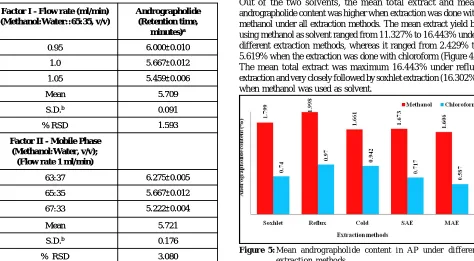
Figure 4:Mean total extract from AP under differ ent extra ction methods.
Ou t of the two solvents, the mean total extract and mean andrographolide content was higher when extraction was done with methanol under all extraction methods. The mean extract yield by using methanol as solvent ranged from 11.327% to 16.443% under different extraction methods, whereas it ranged from 2.429% to 5.619% when the extraction was done with chloroform (Figure 4). The mean total extract was maximum 16.443% under reflux extraction and very closely followed by soxhlet extraction (16.302%) when methanol was used as solvent.
The mean andrographolide content ranged from 1.606% to 1.998% when extraction was done with methanol in different extraction methods. In comparison to methanol, the mean andrographolide content was lower when extraction was done with intermediate polarity solvent, viz., ch loroform an d the values for mean andrographolide content ranged from 0.587% to 0.970% under different extraction meth ods used (Figure 5 ). T he mean andrographolide content was obtained maximum (1.998%) under reflux extraction with methanol as solvent.
The results presented for individual extraction methods showed that in soxhlet extraction, one and a half hour extraction with methanol is the best for extraction of andrographolide (1.790%) with the higher (15.684%) total extract. Under reflux extraction with methanol, the extraction with methanol for one hour has been found best in terms of andrographolide content (2.040%) with total extract as 15.111%. In cold extraction, for extraction of andrographolide content from the raw material, extraction with methanol for ten hours has been found best for extraction of andrographolide (1.727%) with total extract as 15.481%. In sonication assisted extraction, thirty two minutes extraction with methanol extracted maximum andrographolide (1.867%) with extract yield as 13.628%. In microwave assisted extraction, thirty minutes extraction with methanol gives better results for andrographolide content (1.717%) with total extract as 12.601%. On comparing the best extraction condition obtained under individual methods with each other, it is concluded that for extraction of andrographolide from the raw samples, reflux extraction with methanol for one hour is the best condition for extraction of maximum andrographolide and total extract.
High andrographolide content and high total extract under reflux extraction with methanol solvent may be due to the impact of extraction temperature as sample remains at the boiling point of extraction solvent. The reflux extraction method is common method still widely used by various researchers for extraction of different phytochemicals from AP (Rao et al., 2004; Mishra et al., 2010; Sharma et al., 2012; Raina et al., 2013b).
The method has been developed and validated for different parameters as linearity and range, accuracy, precision, LOD, LOQ and robustness.
5. Conclusion
In the present study, it is concluded that the use of Reflux method for one hour with methanol as solvent gives higher analytical values of andrographolide as compared to those obtained from other methods. In addtion to this also, a precise, easy to handle, simple and accurate HPLC method has been developed and validated for quantification of andrographolide in raw material of AP. Developed method show good linearity for andrographolide content over the range from 0.054% to 4.686% with correlation coefficient value as 0.999. The method has LOD and LOQ as 0.037 g/ml and 0.092 g/ ml for andrographolide respectively. The method has shown good precision and accuracy assessed on the basis of inter-day, intraday and recovery studies.
Conflict of interest
We declare that we have no conflict of interest.
References
Abu-Ghefreh, A. A.; Canatan, H. and Ezeamuzie, C. I. (2009). In vitro and in viv o a nti-infla mma tor y effects of andrographolide. I nt. J Immunopharmacol., 9:313-318.
Akowouah, G. A.; Zhari, I.; Norhayati, I. and Mariam, A. (2006). HPLC and HPT LC densitometr ic determination of androgra pholides and antioxidant potential of An dro gra phis pan icu lata. J. Food Compost. Anal., 19:118-126.
Anonymous. (1982). Wealth of India. Vol. I- X. Raw materials, Publication and Information Directorate CSIR, New Delhi, pp:78-81.
Anonymous. (1999). Indian Herbal Pharmacopoeia. Vol. II. Mumbai: Ebenezer Printing House. pp:110-113.
Basak, A.; Copper, S.; Roberge, A. G.; Banik, U. K.; Chreten, M. and Seidh, N. G. (199 9). I nhibition of pr otein convertases-1 , -7 a nd fur in by diterpenes of And rogr aphis panicula ta and su ccinoyl esters. Biochem. J., 338:107-113.
Calabrese, C.; Berman, S. H.; Babish, J. G.; Ma, X.; Shinto, L.; Dorr, M.; Wells, K.; Wenner, G. A. an d Standish , L. J. (2 000). A phase-I tria l of andrographolide in HIV positive patients and normal volunteers. Phytother. Res., 14:333-338.
Coon, J. T. and Ernst, E. (2004). Andrographis paniculata in the treatment of upper respiratory tract infections: A systematic review of safety and efficacy. Planta Med., 70:293-298.
Dey, Y. N.; Kumari, S.; Ota, S. and Srikanth, N. (2013). Phytopharmacological review of Andrographis paniculata (Burm.f) Wall. ex Nees. Int. J. Nutr. Pharmacol. Neurol. Dis., 3:3-10.
Fahim, M.; Srivastava, B.; Srivastava, A.K.; Ibrahim, M.; Praveen R. and Ahmad, S. (20 17). R eview on extra ction methods, antioxidant a nd antimicrobial properties of volatile oils. Ann. Phytomed., 6(2):5-46 .
Handa, S. S. and Sharm a, A. (19 90). H epa toprotective activity of androgra pholide a gainst galactosa mine a nd par acetamol intoxication in rats. Indian J. Med. Res., 92:284-292.
Hemadri, K. and Rao, S. S. (1984). Jaundice: Tribal medicine. Anc. Sci. Life,4:209-212.
Huang, K.C. (1993). The pharmacology of Chinese herbs. Boca Raton. CRC Press.
ICH Q2 (R1). 2005. Validation of Analytical Procedures: Text and Methodology. I nterna tional Conference on Har moniza tion, IFPMA, Geneva.
Joseph , S. M . (2 014). Scientfic aspects of the thera peutic u se of Andrographis paniculata (kalmegh): A review.Int. J. Pharm. Sci. Rev. Res., 27:10-16.
Kumar, A.; Dora, J.; Singh, A. and Tripathi, R. (2012). A review on king of bitter (kalmegh). Int. J. Res. Pharm. Chem.,2:116-124.
Madav, S.; Tripathi, H. C. and Mishra, S. K. (1995). Analgesic, antipyretic and antiulcerogenic effects of andrographolide. Indian J. Pharm. Sci., 57:121-125.
Melchior, J.; Spasov, A. A.; Ostrovskij, O. V.; Bulanov, A. E. and Wikman, G. (2000). Double-blind, placebo-controlled pilot and phase III study of activity of standardized Andrographis paniculata Herba Nees extra ct fixed combination (Kan Ja ng) in the trea tment of uncomplicated upper-respiratory tract infection. Phytomedicine, 7:34 1-35 0.
Mishra, S.; Tiwari, S. K.; Kakkar, A. and Pandey, A. K. (2010). Chemoprofiling of Andrographis paniculata (kalmegh) for its andrographolide content in Madhya Pradesh, India. Int. J. Pharma. Bio Sci., 1:1-5.
Neogy, S.; Das, S.; Mahapatra, S. K.; Mandal, N. and Roy, S. (2008). Amelioratory effect of Andrographis paniculata Nees on liver, kidney, heart, lung and spleen during nicotine induced oxidative stress. Environ. Toxicol. Pharmacol., 25:321-328.
Prajjal, K.; Singha, S.; Roy, S. and Dey, S. (2003). Antimicrobial activity of Andrographis paniculata. Fitoterapia, 74:692-694.
Puri, A.; Saxena, R.; Saxena, R. P.; Saxena, K. C.; Srivastava, V. and Tandon, J. S. (1993). Immunostimulant agents from Andrographis paniculata. J. Nat. Prod., 56:995-999.
Purl, A.; Saxena, R.; Saxena, R. P.; Saxena, K. C.; Srivastava, V. and Tandon, J. S. (1993). Immuno-stimulant agents from Andrographis paniculata. J. Nat. Prod., 56:995-999.
Raina, A. P.; Gupta, V.; Sivaraj, N. and Dutta, M. (2013b). Andrographis paniculata (Burm. f.) Wall ex Nees (kalmegh) , a traditional hepatopr otective drug fr om India. Genet. Resou r. Crop Ev., 60:1181-1189.
Raina, A. P.; Kumar, A.; Pareek, S. K. and Sharma, S. K. (2013b). Evaluation studies on Kalmegh (Andrographis paniculata Nees). Acta Hortic., 972:117-120.
Rais-ur-Rahman (2017). Need of standardization and quality control of herbal drugs in this Era. Ann. Phytomed., 6(2):1-4.
Rao, Y. K.; Vimalamma, G.; Rao, C. V. and Tzeng, Y. (2004). Flavonoids and androgra pholides from An dro gra phis pan icu lata. Phyto-chemistry, 65:2317-2321.
Salleh, M .S. (1991). The use of Andrographis paniculata extract for treatment of diabetes mellitus (Kegunaan ekstrak hempedu bumi (An drog raph is p anic ulata) u ntuk rawa tan diabetes mellitus) Bachelor of Science Pr oject R eport, Depar tment of Biology, UPM, Malaysia
Sareer, O.; Ahmad, S. and Umar, S. (2014). Andrographis paniculata: a critical appraisal of extraction, isolation and quantification of andrographolide and other active constituents. Nat. Prod. Res., 28: 2081-2101.
Sharma, M .; Sharma, A. and Tyagi, S. (2012). Quantitative analysis of andrographolide in Andrographis paniculata at two different stages of life cycle of plant. Acta Chim. Pharm. Indica, 2:1-7.
Sheeja, K. and Kuttan, G. (2007). Activation of cytotoxic T lymphocyte responses a nd attenu ation of tumor growth in viv o by An dro gra phis pan icu lata extr act and androgra pholide. Immunopharmacol. Immuno-toxicol., 29:81-93.
Tripathi, G. S. and Tripathi, Y. B. (1991). Chloretic action of andrographolide obtained from Andrographic paniculata from rats. Phytother. Res., 5:176-178.
Trivedi, N. P.; Rawal, U. M. and Patel, B. P. (2007). Hepatoprotective effect of androgra pholide a gainst hexachlor ocyclohexane-induced oxidative injury. Interagr. Cancer Ther., 6:271-280.
Yoopan, N.; Thisoda, P.; Rangkadilok, N.; Sahasitiwat, S.; Pholphana, N.; Ruchirawat, S. and Satayavivad, J. (2007). Cardiovascular effects of 14-deoxy-11, 12-didehydroandrographolide and Andrographis paniculata extracts. Planta Med., 73:503-511.