J o u r n a l o f A p p l i e d F o o d T e c h n o l o g y
H o m e p a g e : h t t p : / / a p p l i e d f o o d t e c h n o l o g y . o r g /
(Review)
Potential Food Safety Hazard of Acrylamide in Deep Fried Fritter Sold as
Street Food in Indonesia
Yoga Pratama
Department of Food Technology, Faculty of Animal and Agricultural Sciences, Diponegoro University, Semarang, Indonesia *Corresponding author ([email protected])
Abstract
Article information: Received 15 November 2016 Accepted 27 December 2016 Available online 31 December 2016 Keywords: acrylamide deep frying fritter street food Indonesia © 2016 Indonesian Food Technologists All rights reserved This is an open access article under the CC BY-NC-ND license
doi: 10.17728/jaft.2 Food safety studies in Indonesian street food are mainly focused on
microbiological risks. Therefore, this paper aims to review the food safety risk of acrylamide, a process contaminant, in Indonesian street food’s deep fried fritter. Acrylamide is a carcinogenic and neurotoxic compound formed when carbohydrate-rich material is heated above 120°C. Prevalence data was reviewed from selected papers on both laboratory simulation and monitoring studies while online survey was conducted to obtain the consumption data. It has been shown that deep fried fritter products meet the prerequisites for acrylamide formation. Considerable amount of asparagine and reducing sugars, the acrylamide precursors, were found in banana and sweet potato as the fritter’s material. The acrylamide content in deep fried fritter was found to be comparable with that of French fries with the highest value of 1789.5 and 1060 ng/g for banana fritter and sweet potato fritter, respectively. Using the worst/highest consumption-prevalence scenario, acrylamide intake from deep fried fritter in Indonesia may reach 895 µg of acrylamide per day which is equivalent to >5 times tolerable daily intake (TDI). Hence, it needs further and more robust risk assessment study.
Introduction
Street food has been characterized by ready to eat, low priced, and sold at public places. Food can be freshly prepared or premade and sold for immediate consumption. Street vendors normally use push cart, open air stall, truck or tent which become the main reason why it costs lower than food served by restaurant. Meanwhile, it is located in the public places such as on the street or where it can be easily reached from the street (Mamun and Turin 2016). Street food has become economically important as it provides income opportunity for people with limited education and capital. Furthermore in some countries, the majority of street vendors are women (Roever 2014). Due to its low price, it is also affordable by many people, particularly those who have low income such as in developing countries. Thus, 2.5 billion people have been estimated to consume street food daily (Kraig and Sen 2013). On contrary to its advantage, street food has been source of several food safety problems. The reported cases include harmful microbiological infestation, prohibited additives, and also environmental contamination due to its open air and near street characteristic (Mamun and Turin 2016).
Indonesia, as a developing country, has a large number of street vendors and consumers depending on it every day. Consequently, many foodborne illnesses
are observed from the consumption of street food. Gasem et al. (2001) have reported that more typhoid fever cases have been found in people who consume street food. Whereas street food has been associated with poor food hygiene (Farida et al. 2013). Various pathogen contaminations have been reported in street food such as Vibrio cholera in edible ice (Waturangi et al. 2013), Klebsiella pneumonia carriage in people who have access to street food and poor water hygiene (Farida et al. 2013), Staphylococcus aureus in foods sold in the vicinity of elementary schools (Adolf and Azis 2012), and Salmonella sp. in various street food vendors (Vollaard et al. 2004; Adolf and Azis 2012). Prohibited additive such as formalin has been reported to be used as preservative for several street foods in Surakarta, Indonesia (Proietti et al., 2014). Many other cases of unpermitted additive including textile colorant and boric acid are reported in regular basis by the media and indexed journal.
health in long term (chronic). Therefore, some potential hazards arising from non-microorganism may be overlooked. One of the examples is deep fried fritter, which becomes this review paper’s focus. The product is processed by frying at high temperature resulting in a very unlikely microbiological contamination. However, another food safety hazard may come from contamination during process which is called as process contaminant.
Compared to microbiological hazards, process contaminant related food safety issue has not been widely discussed in Indonesia. One process contaminant associated with frying process, namely acrylamide, has been a concern recently since it is considered as potential human carcinogen (Krishnakumar and Visvanathan 2014). The objective of this work is to assess the prevalence and the potential risk of acrylamide in deep fried fritter snack in Indonesia. Critical review was made from selected research articles, whereas the consumption data was collected through online survey from 263 respondents.
Figure 1. (A) pushed cart for fritter selling; (B) banana fritter; (C) cassava fritter; (D) sweet potato fritter; (E) vegetable fritter; (F) tofu fritter; (G) tempeh fritter
Hazard Identification
Fried food has become popular choice in Indonesian diet. It is supported by the abundant supply of palm oil in the country. The liquid part of palm oil, i.e. palm olein, has been widely recognized as good frying medium as it has good oxidative stability and preferred organoleptic attributes due to less greasy mouth feel compared to palm oil (Matthäus, 2007). Most importantly, the palm olein product is considerably cheaper than other frying oil products available in Indonesia such as coconut oil and the imported olive oil. Due to the popularity, a large numbers of fried street food can be easily found in Indonesia. Some popular dishes include fried rice, fried chicken, fried cat fish, fried duck and a particular form of deep fried fritter, locally called as “gorengan”, where “goring” literally means fry.
The fritter snack is normally sold during afternoon to night in a pushed cart (Figure 1). Several types of most common fritters are made from banana, cassava, sweet potato, tempeh, tofu, and vegetables (mix of cabbage, carrot and bean sprout) which are called “pisang goreng”, “singkong goreng”, “ubi goreng”, “tempe goreng”, “tahu goreng” and “bakwan”, respectively (Figure 1). Typical preparation of the fritters can be seen in the Table 1.
Figure 2. Preference of Indonesian People towards Street Food Fritter (n=263)
Table 1. Typical Preparation for Fritter in Indonesia
Step Banana Cassava Potato Sweet Tem-peh Tofu Vegetable
Peeling √ √ √ - - √
Cutting √ √ √ √ - √
Approx. Dimension (in cm)
15x5 x5
10x10 x10
15x5 x1
15x15 x1
8x8 x8 (alrea
dy in piece s)
Shred ding to small piece
s
Boiling - √ - - - -
Flour addition
√
batte-ring
-
√
batte- ring
√
batte-ring
√
batte-ring
√
mix ing
Frying √ √ √ √ √ √
Except for cassava and vegetables, the fritters are typically prepared by cutting the material in a specific dimension and then battered (mainly combination of water, wheat flour, rice flour, sugar, salt and spices). Subsequently, the battered product is deep fried using palm olein until golden brown colored product is reached and in most cases, having a crunchy crust. Time and temperature combination for deep frying are approximately 5-10 minutes at 150-180 degree Celsius (Ilmi et al., 2015). Traditional gas stove and wide frying pan are commonly used instead of temperature-controlled deep fryer, hence the reason of temperature variability. Cassava fritter is normally prepared by cutting and boiling (with garlic, and salt) prior to deep frying so that the inside texture of cassava fritter becomes soft while having crunchy crust. Vegetable fritter is prepared from a mix of vegetables, which include but not limited to cabbage, carrot and bean sprout. Shredded vegetables are mixed with diluted wheat & rice flour and selected spices before it is made into an irregularly shaped lump and fried.
fungus’ hypha creates matrix which covers and binds the soybean resulting in solid and sliceable product (Nassar et al., 2008). It has been considered as healthy food due to its high protein content and also low priced, which might be the reason of its popularity.
Figure 3. Fritter consumption frequency and the amount consumed in each occasion (n=263)
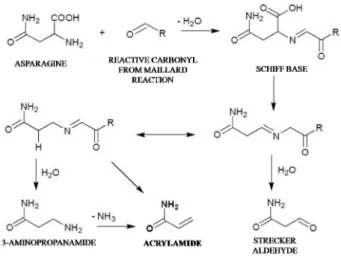
Figure 4. Proposed mechanism of acrylamide formation from asparagine and reducing sugars (Krishnakumar and
Visvanathan 2014)
Figure 3 shows the frequency and the amount of fritter consumed in each occasion. While majority of Indonesian (34.2%) consume fritter 2-3 times/week, it was surprising to have 16.3% of respondents who consume fritter in daily basis. This shows that fritter has become inseparable diet for some Indonesian people. In each occasion, more than 65% of respondents consume 2-3 pieces of fritter whereas 11.8% of respondent consume at least 5 pieces fritter. One piece of fritter is approximately 100 gram. Consumption of 2-3 pieces can be regarded as moderate while 5 pieces or more is regarded high level considering the fact that it is a snack. This consumption data will be very important in order to formulate a risk assessment related to food safety of street food fritter.
Overview of acrylamide
International Agency for Research on Cancer (IARC) in 1994 has classified acrylamide as group 2A carcinogen (probably carcinogenic to humans) while it is also found to be toxic to the nervous system, causes gene mutation and DNA damage (Krishnakumar and Visvanathan 2014). Acrylamide carcinogenicity has been well documented in numerous study using animal (rat/mouse) models while a number of researches on its potential as human carcinogen have been carried out since the first discovery of acrylamide in food in 2002 (Virk-Baker et al. 2014). Exon (2006) has reviewed the
toxicology of acrylamide while Tardiff et al. (2010) has estimated the safe dietary intake level of acrylamide for humans. Tolerable daily intake (TDI) in terms of neurotoxicity was estimated to be 40 µg/kg-day and as low as 2.6 µg/kg-day was estimated for cancer. Even though the TDI has not been adopted by regulatory bodies, in Europe for instance (European Food Safety Authority [EFSA] 2015), we can use the estimated 2.6 µg/kg-day limit to avoid any ill effect from acrylamide.
The origin and the formation mechanism of acrylamide in food have been studied in numerous publications. Evidence showed that acrylamide is formed naturally when carbohydrate-rich food is processed at high temperatures such as during frying, baking or roasting. However, it is not found in raw foods or when the carbohydrate-rich food is boiled. Similarly, acrylamide is not found in protein-rich foods such as fish, meat or chicken (Arvanitoyannis and Dionisopoulou 2014). As the presence is undesirable and related to process applied to food, acrylamide has been considered as a process contaminant. Among other foods, potato fries and cereal products become the most studied object for its acrylamide content.
Several mechanisms of acrylamide formation have been proposed. Study showed that acrylamide is formed during Maillard reaction, a non-enzymatic browning reaction, which influences the development of desirable color, flavor and aroma. It has been demonstrated that the presence of free asparagine and reducing sugar is the main cause of acrylamide formation during Maillard reaction at high temperature (Figure 4) (Das and Srivastav 2012). In addition to major pathway via Maillard reaction, several minor reaction routes have been proposed such as a pathway for lipid-rich product which includes ammonia and acrolein while asparagine is absent. Another proposed mechanism is protein pyrolisis in cereals product. Nevertheless, acrylamide formation from asparagines and reducing sugars remains the major mechanism which is generally accepted (Medeiros Vinci et al., 2012).
In accordance with the increasing interest towards acrylamide, researchers are trying to improve the efficiency and accuracy of its analytical method. Determination of acrylamide in food is normally carried out by chromatographic method such as gas chromatography (GC)-mass spectrometry (MS) where derivatization of acrylamide is needed, liquid chromatography (LC)-MS, and LC-MS-MS. Food sample is typically prepared by solid-phase extraction prior to these analyses. Due to its accuracy, LC-MS-MS is the most preferred method (Tekkeli et al., 2012).
regulation exists, Indonesia may face difficulties to implement it as the current analytical method is deemed to be sophisticated for Indonesian laboratories.
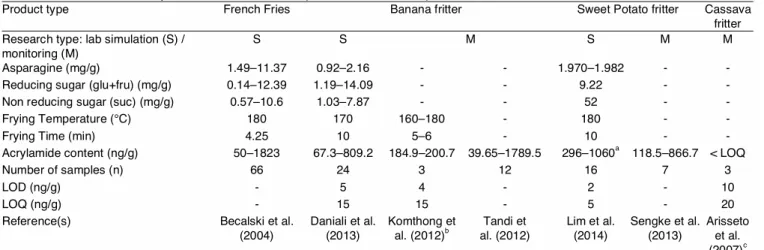
Acrylamide prevalence in deep fried fritter of Indonesia The nature of Indonesian deep fried fritter which is prepared from carbohydrate-rich materials and processed using high temperature fits the prerequisite conditions for acrylamide formation. Hence, it is reasonable to expect that the fritters may contain a considerable amount of acrylamide. As can be seen in Table 2, several authors have reported the acrylamide level in fritter products, as the result of laboratory simulation or the analysis result from samples taken from the market. However, there is data scarcity in terms of the fritter’s type. Out of 6 most common fritters found in Indonesia, only banana fritter, sweet potato fritter and cassava fritter’s data are available. Acrylamide level on the most preferred tempeh fritter’s data was not found.
Daniali et al. (2013) studied the effect of two varieties of banana in Malaysia namely Abu and Awak, and its maturity towards the acrylamide content of the banana fritter produced. It was found that the simulated banana fritter product contain acrylamide as much as 67.3 - 809.2 ng/g. Meanwhile, Komthong et al. (2012) took banana fritter samples from the traditional market in Chonburi, Thailand and reported that it has acrylamide level of 184.9 - 200.7 ng/g. Another monitoring study conducted in Manado, Indonesia showed that banana fritter sample’s acrylamide range from 39.65 to as high as 1789.5 ng/g (Tandi et al., 2012). Findings on simulated product have been confirmed by market sample analysis. This shows that considerable amount of acrylamide is present in banana fritter product.
Sweet potato fritter has also been simulated by Lim et al. (2014) to see the effect of frying oil type and the number of frying towards its acrylamide content. The products of the first frying (chosen as to provide comparable data) were reported to have acrylamide content range from 296 to 1060 ng/g. It is noteworthy to mention that the lowest result was obtained from lower degree of unsaturation oil, i.e. palm olein, while the highest value was fried using soya bean oil which has higher degree of unsaturation. Sengke et al. (2013) has
collected sweet potato fritter from 7 locations in Manado, Indonesia and found that the product contain acrylamide from 118.5 to 866.7 ng/g. Similar to banana fritter, these findings have shown that sweet potato fritter also contain a considerable amount of acrylamide.
The information of acrylamide level in cassava fritter in Indonesia is lacking. However, one monitoring study conducted in Brazil found only traces amount of acrylamide in the cassava fritter sample (Arisseto et al. 2007). As only one data present, more monitoring study and laboratory simulation should be carried out if we want to draw firmer conclusion about the presence of acrylamide in cassava fritter. The same need applies to tempeh fritter, tofu fritter and vegetable fritter, as currently there is no data available for those products.
Since the finding of acrylamide in food product, French fries has been the focus of many studies which attempt to analyze and to reduce its acrylamide content. Therefore, it can be used as a good reference for the similar study in different type of products. Based on a study by Becalski et al. (2004), acrylamide content of French fries range from 50 to 1823 ng/g. Compared to this, banana fritter has the similar range with the maximum level of 1789.5 ng/g whereas sweet potato fritter has somewhat lower acrylamide content with maximum level of 1060 ng/g. The comparison shows that deep fried fritter has comparable amount of acrylamide content with French fries. Furthermore, part of Indonesian consume fritter products in daily basis. Therefore, it would be logical if Indonesian need to put attention on this product’s acrylamide as the Western people do with French fries.
Risk factors: process condition and material
The content of acrylamide in the food products is mainly influenced by two main factors, i.e. the raw material and the process condition. Acrylamide formation is believed to happen at above 120 °C (Krishnakumar and Visvanathan 2014). It has been well acknowledged that more severe the heating process, the higher the acrylamide content. In street deep fried fritter vendors, a stabile frying temperature is hard to achieve as they are using manual gas stove. In addition, frying time also varies. Some vendors want to make crispier products
Table 2. Prevalence of Acrylamide in Selected Deep Fried Fritters Compared to French Fries
Product type French Fries Banana fritter Sweet Potato fritter Cassava
fritter Research type: lab simulation (S) /
monitoring (M)
S S M S M M
Asparagine (mg/g) 1.49–11.37 0.92–2.16 - - 1.970–1.982 - -
Reducing sugar (glu+fru) (mg/g) 0.14–12.39 1.19–14.09 - - 9.22 - -
Non reducing sugar (suc) (mg/g) 0.57–10.6 1.03–7.87 - - 52 - -
Frying Temperature (°C) 180 170 160–180 - 180 - -
Frying Time (min) 4.25 10 5–6 - 10 - -
Acrylamide content (ng/g) 50–1823 67.3–809.2 184.9–200.7 39.65–1789.5 296–1060a 118.5–866.7 < LOQ
Number of samples (n) 66 24 3 12 16 7 3
LOD (ng/g) - 5 4 - 2 - 10
LOQ (ng/g) - 15 15 - 5 - 20
Reference(s) Becalski et al. (2004)
Daniali et al. (2013)
Komthong et al. (2012)b
Tandi et al. (2012)
Lim et al. (2014)
Sengke et al. (2013)
Arisseto et al. (2007)c
a
which involve longer frying time. However, one aspect that may limit the temperature of frying is the frying stability of the oil used, palm olein. Although it has better stability than many other oils such as olive oil, soybean oil, corn oil, etc., it has lower stability than the palm oil (shortening) which normally used in fast food restaurant. Furthermore, it is a common practice for street vendors to use the oil repeatedly. By doing so, the oil quality will degrade. The degradation of the oil itself will not affect the acrylamide formation (Mestdagh et al., 2007), however it will affect the frying stability such as the smoke point due to the increasing free fatty acid content. If the smoke point lowers, it will prompt the vendor to lower the frying temperature.
From the material aspect, it has been mentioned previously that asparagine and reducing sugars are major precursors for acrylamide. Table 2 shows that both banana and sweet potato have considerable amount of asparagine, although it is lower than that of potato (assumption using the highest value of the range). Sweet potato also has lower reducing sugars than potato, whilst in contrast, banana has higher range. It is understandable considering the banana’s sweet taste. Those conditions might be the reason why sweet potato fritter has lower acrylamide content than French fries while banana fritter has a similar level. The lower asparagine value in banana is compensated by higher reducing sugars content. Daniali et al. (2013) has shown that maturity of banana significantly correlates to the concentration of reducing sugars, and thus higher acrylamide content in banana fritter.
How significant is potential safety hazard from consuming deep fried fritter?
As has been mentioned in the previous section, estimated TDI for acrylamide intake is 2.6 µg/kg-day which equals to 156 µg per day for the average 60 kg human. Using the consumption data and the prevalence data, we can estimate the acrylamide intake from fritter in Indonesia. Assumption being used is worst scenario where consumption-prevalence combination is highest. Consumption data of deep fried fritter shows that Indonesian might consume as much as 5 pieces or more of fritter in daily basis. Approximate weight of each pieces of fritter is 100 gram, thus make the estimated highest daily fritter intake is 500 gram of fritter. Multiplying this value with the highest acrylamide level in banana fritter (1789.5 ng/g) gives the approximation of worst scenario where 894750 ng (≈ 895 µg) of acrylamide is ingested daily from deep fried fritter.
Worst scenario is an exaggeration of the problem, yet it can be used as a quick check if the issue needs for further examination or not. When the value of the worst scenario is still under the safe limit, then the issue does not need to be further examined. In the deep fried fritter’s acrylamide context, the worst scenario gives approximation of 895 µg daily intake which is more than 5 times TDI. This demonstrates the potential safety hazard to Indonesian consumers, thus the need to do a more detailed risk assessment exercise. One of widely accepted risk assessment methods is by using Margin of Exposure (MOE) approach (EFSA, 2005).
Considering the potential hazard posed by deep fried fritter consumption, consumer must do moderation so that their daily intake will not exceed the TDI. Therefore, consumption of one piece of fritter per day can be considered safe in terms of acrylamide intake.
Conclusion
Acrylamide is a known carcinogenic and neurotoxic compound. The deep fried fritter product has the prerequisites for acrylamide formation as it contains considerable asparagine and reducing sugars while also processed using high frying temperature. The acrylamide content is comparable with that of French fries, especially for banana fritter. However, there is a data scarcity for several fritter types which urge the need for study. Working with the worst/highest consumption-prevalence scenario, it has been demonstrated that deep fried fritter consumption in Indonesia might lead to ingestion of 895 µg of acrylamide per day. This value exceeded the TDI and shows that potential food safety hazard might come from this. As the assumption is an over exaggeration, it needs a further and more robust risk assessment study to evaluate the actual risk level for Indonesian consumers. Currently, there is no regulation for acrylamide residue, in Indonesia and the world.
Acknowledgement
This paper was made in part of International Training Program in Food Safety, Quality Assurance and Risk Analysis held in Ghent University, Belgium 2016 (http://www.itpfoodsafety.ugent.be/) under VLIR-UOS Scholarship. Author thanks Prof. Liesbeth Jacxsens (Department of Food Safety and Food Quality, Ghent University) and all contributed members of Faculty of Bioscience Engineering, Ghent University for valuable inputs which greatly improved the manuscript.
References
Adolf, J.N.P., Azis, B.S., 2012. Microbiological status of various foods served in elementary school based on social economic status differences in karawaci region, tangerang district - Indonesia. International Food Research Journal 19(1), 65–70.
Arisseto, A.P., Toledo, M.C., Govaert, Y., Loco, J.V., Fraselle, S., Weverbergh, E., and Degroodt, J.M., 2007. Determination of acrylamide levels in selected foods in Brazil. Food Additives and Contaminants 24 (3), 236–41. DOI:10.1080/ 02652030601053170. Arvanitoyannis, I.S., Dionisopoulou, N., 2014. Acrylamide:
formation, occurrence in food products, detection methods, and legislation. Critical Reviews in Food Science and Nutrition 54 (6), 708–33. DOI:10.1080/10408398.2011. 606378.
Becalski, A., Lau, B.P.Y., Lewis, D., Seaman, S.W., Hayward, S., Sahagian, M., Ramesh, M., Leclerc, Y., 2004. Acrylamide in french fries: influence of free amino acids and sugars. Journal of Agricultural and Food Chemistry 52 (12), 3801–3806. DOI:10.1021/jf0349376.
Das, Amit Baran., Srivastav, P.P., 2012. Acrylamide in Snack Foods. Toxicology Mechanism and Methods 22 (3), 163–69. DOI:10.3109/15376516. 2011.623329.
EFSA [European Food Safety Authority]. 2005. Opinion of the scientific committee on a request from EFSA related to a harmonised approach for risk assessment of substances which are both genotoxic and carcinogenic. The EFSA Journal 282, 1–31. DOI:10.1021/bk-2010-1048.
———. 2015. Scientific Opinion on Acrylamide in Food. EFSA Journal 13 (6), 4104. DOI:10.2903/ j.efsa.2015.4104.
Exon, J H. 2006. A Review of the toxicology of acrylamide. Journal of Toxicology and Environmental Health. Part B, Critical Reviews 9 (5), 397–412. DOI:10.1080/1093740060068 1430.
Farida, Helmia, Juliëtte, A., Severin, M., Gasem, H., Keuter, M., Broek, P.V.D., Hermans, P.W.N., Wahyono, H., Verbrugh, H.A., 2013. Nasopharyngeal carriage of
Klebsiella pneumoniae and other gram-negative bacilli in pneumonia-prone age groups in Semarang, Indonesia. Journal of Clinical
Microbiology 51 (5), 1614–16.
DOI:10.1128/JCM.00589-13.
Gasem, M.H., Dolmans, W.M.V., Keuter, M., Djokomoeljanto, R., 2001. Poor food hand housing as Risk Factors for Typhoid Fever in Semarang, Indonesia. Tropical Medicine and International Health 6 (6), 484–90. DOI:10.1046/ j.1365-3156.2001.00734.x.
Ilmi, Bakhrul, I.M., Khomsan, A., Marliyati, S.A., 2015. Frying oil and fritter’s quality in Indonesian household. Jurnal Aplikasi Teknologi Pangan. 04 (02), 61–65 [In Bahasa Indonesia]. DOI:10.17728/jatp.2015.12.
Komthong, P., Suriyaphan, O., Charoenpanich, J., 2012. Determination of acrylamide in Thai-Conventional snacks from nong mon market, chonburi using GC-MS technique. Food Additives and Contaminants: Part B 5 (1), 20–28. DOI:10.1080/19393210. 2012.656145.
Kraig, Bruce, Sen, C.T., eds. 2013. Street food around the world: An encyclopedia of food and culture. Santa Barbara, California: ABC-CLIO.
Krishnakumar, T., Visvanathan, R., 2014. Acrylamide in food products: A Review. Food Process and Technology 5 (7), 344. DOI:10.4172/2157-7110.1000344.
Lim, P. K., Jinap, S., Sanny, M., Tan, C.P., Khatib, A., 2014. The influence of deep frying using various vegetable oils on acrylamide formation in sweet potato (Ipomoea Batatas L . Lam) chips. Journal of Food Science 79 (1), 115–21. DOI:10.1111/ 1750-3841.12250.
Mamun, Mohammad, A.l., Turin, T.C., 2016. Chapter 2. safety of street foods. In Food Hygiene and Toxicology in Ready to Eat Foods, edited by P Kotzekidou, 15–30. Elsevier Inc. DOI:10.1016/ B978-0-12-801916-0.00002-9.
Matthäus, Bertrand, 2007. Use of palm oil for frying in comparison with other high-stability oils. European Journal of Lipid Science and Technology 109 (4), 400–409. DOI:10.1002/ ejlt.200600294.
Mestdagh, Frédéric, Meulenaer, B.D., Peteghem, C.V.,
2007. Influence of oil degradation on the amounts of acrylamide generated in a model system and in french fries. Food Chemistry 100 (3), 1153–59. DOI:10.1016/j.foodchem. 2005. 11.025.
Nassar, Ahmad, G., Mubarak, A.E., El-beltagy, A.E., 2008. Nutritional potential and functional properties of tempe produced from mixture of different legumes. 1: chemical composition and nitrogenous constituent. International Journal of Food Science and Technology 43, 1754–58. DOI:10.1111/j.1365-2621.2007.01683.x.
Proietti, Ilaria, Frazzoli, C., Mantovani, A., 2014. Identification and management of toxicological hazards of street foods in developing countries. Food and Chemical Toxicology 63. Elsevier Ltd: 143–52. DOI:10.1016/j.fct.2013.10.047.
Roever, Sally., 2014. Informal economy monitoring study sector report: street vendors. Cambridge, MA, USA.
Sengke, C.l.A., Citraningtyas, G., F Wehantouw, F., 2013. Acrylamide analysis of sweet potato fritter sold in Manado City using HPLC. Pharmacon 2 (03), 91– 95. [In Bahasa Indonesia].
Tandi, Debora, Fatimawali, Wehantouw, F., 2012. Acrylamide analysis of banana fritter sold in Manado City using HPLC. Pharmacon 1 (02), 79– 85. [In Bahasa Indonesia].
Tardiff, Robert, G., Michael, L., Gargas, Christopher, R., Kirman, M., Carson L., Lisa M., Sweeney., 2010. Estimation of safe dietary intake levels of acrylamide for humans. Food and Chemical Toxicology 48 (2). Elsevier Ltd: 658–67. DOI:10.1016/j.fct.2009.11.048.
Tekkeli, Kepekci, S.E., Önal, C., Önal, A., 2012. A review of current methods for the determination of acrylamide in food products. Food Analytical Methods 5 (1), 29–39. DOI:10.1007/s12161-011-9277-2.
USFDA [United States Food and Drug Adminstration]., 2016. Guidance for industry acrylamide in foods table of contents. FDA Food Guidances. http://www.fda.gov/FoodGuidances.
Vinci, M., Raquel, Mestdagh, F., Meulenaer, B.D., 2012. Acrylamide formation in fried potato products - present and future, a critical review on mitigation strategies. Food Chemistry 133 (4). Elsevier Ltd: 1138–54. DOI:10.1016/j.foodchem.2011.08.001. Virk-Baker, Mandeep, K., Nagy, T.R., Barnes, S.,
Groopman, J., 2014. Dietary acrylamide and human cancer: A systematic review of literature. Nutrition and Cancer 66 (5), 774–90. DOI:10.1080/01635581.2014.916323.
Vollaard, A.M, Ali, S., van Asten, H.A.G., Ismid, I.S., Widjaja, S., Visser, L.G., Surjadi, Ch., van Dissel, J.T., 2004. Risk factors for transmission of foodborne illness in restaurants and street vendors in Jakarta, Indonesia. Epidemiology and Infection 132 (5), 863–72. DOI:10.1017/S095026880400 2742.