Vol. 8, No. 3, 2015, 375-388
ISSN 1307-5543 – www.ejpam.com
Analyzing Group Theoretical Properties of Groups with Order
24 by GAP
Ahmet Faruk Aslan, Alper Odaba¸s
∗Department of Mathematics - Computer, Science and Art Faculty, Eski¸sehir Osmangazi University, Eski¸sehir, Turkey
Abstract. We will present our implementationfgroup.giand present subgroup lattice of some groups of order 24. We also will construct tables containing those groups basic properties and generators ele-ments of Frattini and Fitting subgroups.
2010 Mathematics Subject Classifications: 20D05, 20D25, 20D30
Key Words and Phrases: Subgroup lattice, frattini subgroup, fitting subgroup.
1. Introduction
The link between group theory and GAP is constructed by Cayley’s theorem which states that every group is isomorphic to a subgroup of a permutation group. If G is a group with order n, then we can define an isomorphism fromG into the symmetric groupSn by Cayley’s theorem. GAP generates all finite order groups using the symmetric group operations, and gives concrete examples to the abstract notions of algebra, in other words, it visualizes these abstract notions. Some applications of GAP to abstract algebra can be found in[1, 3].
Since most of the cohomological invariants are (directly) related to nilpotency. It is well known that the Frattini and Fitting subgroups are related to nilpotency. In the sense of this relation we compute the generator elements of these special subgroups. It is one of the fun-damental property of algebraic structures such as groups, algebras, algebraic models etc.
The goals of this paper are:
* Presenting our implementation
fgroup.gi
* Constructing tables consisting of some basic properties and generator elements of Fitting, Frattini subgroups of a group of order 24.
* Constructing the subgroup lattices of these groups.
∗Corresponding author.
Email addresses:[email protected](A. Aslan),[email protected](A. Odaba¸s)
2. Preliminaries
In GAP programming, the following functions are frequently used for constructing groups and obtain some of their properties.
Group
GeneratorsOfGroup ConjugateGroup IsGroup
IsCyclic IsAbelian Elements
Example 1. The cyclic group C4 and its properties can be obtained by the following GAP com-mands,
gap> G:=Group((1,2,3,4)); Group([ (1,2,3,4) ]) gap> Size(G);
4
gap> IsCyclic(G); true
gap> IsAbelian(G); true
The function
Subgroup()
is used for obtain subgroups. Below we give the useful GAP commands related with subgroups and cosets.Subgroup Index IsSubgroup IsNormal
ConjugateSubgroup RightCoset
IsRightCoset ConjugacyClasses
Example 2. The following coding can be used for constructing subgroups.
gap> G:=Group((1,2,3,4),(1,2,3)); Group([ (1,2,3,4), (1,2,3) ]) gap> Subgroup(G,[(1,2,3,4)]); Group([ (1,2,3,4) ])
Also the conjugacy classes obtained by the function
ConjugacyClasses()
and the func-tionNrConjugacyClasses()
is used for finding the number of conjugacy classes of the group.gap> G:=Group((1,2,3,4,5)); Group([ (1,2,3,4,5) ]) gap> ConjugacyClasses(G);
[()^G,(1,2,3,4,5)^G,(1,3,5,2,4)^G,(1,4,2,5,3)^G, (1,5,4,3,2)^G ]
gap> NrConjugacyClasses(G); 5
The functions
FactorGroup()
andFactorGroupNC()
are used for constructing quotient groups and their enumerations. Here we will construct all quotient groups of a group by using second author’s implementation in[3]which we called asfgroup.gi
.gap> Read("fgroup.gi");
gap> G:=Group((1,2,3),(1,3)); Group([ (1,2,3), (1,3) ]) gap> IsAbelian(G);
false
gap> IsCyclic(G); false
gap> Fgroup(G);
Group( [ (1,2,3), (1,3) ] ) has 3 factor groups. These :
[Group([ ]), Group([ f1 ]), Group([ (1,2,3), (1,3) ])]
Finally, in GAP, a homomorphism between groups is defined as follows
gap> G:=Group((1,2,3)(4,5)); Group([ (1,2,3)(4,5) ])
gap> genG:=GeneratorsOfGroup(G); [ (1,2,3)(4,5) ]
gap> H:=Group((1,2)(3,4)); Group([ (1,2)(3,4) ])
gap> hom:=GroupHomomorphismByImages(G,H,genG,[(1,2)]); [ (1,2,3)(4,5) ] -> [ (1,2) ]
gap> IsGroupHomomorphism(hom); true
It is well known that for a given group G and its normal subgroup H, we haveG/H is abelian if and only if[G,G]⊆H, where[G,G]is the commutator subgroup ofG. So,[G,G]is the smallest normal subgroup which makes the quotient abelian. Consequently, we have the following example.
gap> G:=SymmetricGroup(8); Sym( [ 1 .. 8 ] )
gap> Size(G); 40320
gap> K:=DerivedSubgroup(G);
Group([ (1,3,2), (1,4,3), (1,4,5), (1,5,6), (1,4,3,6,7), (1,6,8)(3,4)(5,7) ])
gap> IsNormal(G,K); true
gap> F:=FactorGroup(G,K); Group([ f1 ])
gap> IsAbelian(F); true
gap> Fgroup(G);
SymmetricGroup( [ 1 .. 8 ] ) has 3 factor groups. These :
[ Sym( [ 1 .. 8 ] ), Group([ f1 ]), Group([ ]) ]
Definition 1. The largest nilpotent normal subgroup of a group G, is called the Fitting subgroup, denotedF(G). The Frattini subgroup of a group G, denotedΦ(G), is the intersection of all maximal subgroups of G. Of course,Φ(G)is characteristic, and hence normal in G, and it is nilpotent. It follows that for any finite group G, we haveΦ(G)≤F(G).
We refer[4]and[2]for details about the Fitting and Frattini subgroups.
Theorem 1 (Frattini Argument). Let NG(P)is normaliser of P in G, N Ã G and suppose that P∈S y lp(N). Then G=NG(P)N .
Theorem 2. LetΦ(G)≤NÃG and suppose that N/Φ(G)is nilpotent. Then N is nilpotent. Proof. To show that N is nilpotent, we prove that each of its Sylow subgroups is normal. For this purpose, we let P∈S y lp(N)and we note that PΦ(G)/Φ(G)is a Sylowp-sugroup of
N/Φ(G). ButN/Φ(G)is assumed to be nilpotent, and thus its Sylow subgroups are normal and we have PΦ(G)/Φ(G)ÃN/Φ(G). Thus, in fact, PΦ(G)/Φ(G)is actually characteristic in
N/Φ(G)and since N/Φ(G) Ã G/Φ(G), we deduce that PΦ(G)/Φ(G) Ã G/Φ(G). This gives
PΦ(G)ÃG.
Since P is Sylow in N, it is also Sylow in PΦ(G). Since the latter subgroup is normal in
G, we can apply the Frattini argument to deduce thatNG(P)PΦ(G) =G. Since P ≤ NG(P), however, this yieldsNG(P)Φ(G) =G. It follows from this thatNG(P) =G (Otherwise,NG(P) would be contained in some maximal subgroup ofG, which also containsΦ(G), and this would contradict the fact that NG(P)Φ(G) = G). We now have NG(P) = G, and thus P Ã G. In particular,PÃN as desired.
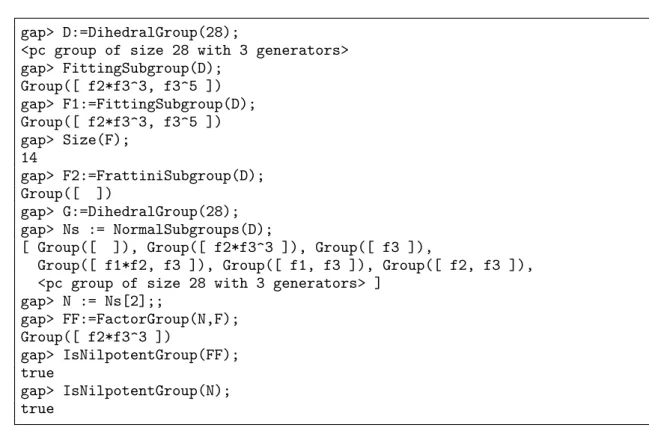
gap> D:=DihedralGroup(28);
<pc group of size 28 with 3 generators> gap> FittingSubgroup(D);
Group([ f2*f3^3, f3^5 ]) gap> F1:=FittingSubgroup(D); Group([ f2*f3^3, f3^5 ]) gap> Size(F);
14
gap> F2:=FrattiniSubgroup(D); Group([ ])
gap> G:=DihedralGroup(28); gap> Ns := NormalSubgroups(D);
[ Group([ ]), Group([ f2*f3^3 ]), Group([ f3 ]),
Group([ f1*f2, f3 ]), Group([ f1, f3 ]), Group([ f2, f3 ]), <pc group of size 28 with 3 generators> ]
gap> N := Ns[2];;
gap> FF:=FactorGroup(N,F); Group([ f2*f3^3 ])
gap> IsNilpotentGroup(FF); true
gap> IsNilpotentGroup(N); true
2.1. Constructing Subgroup Lattices by GAP
Finding subgroups and classification of group properties of a group has significant impor-tance for analyzing its relations to compare with other groups.
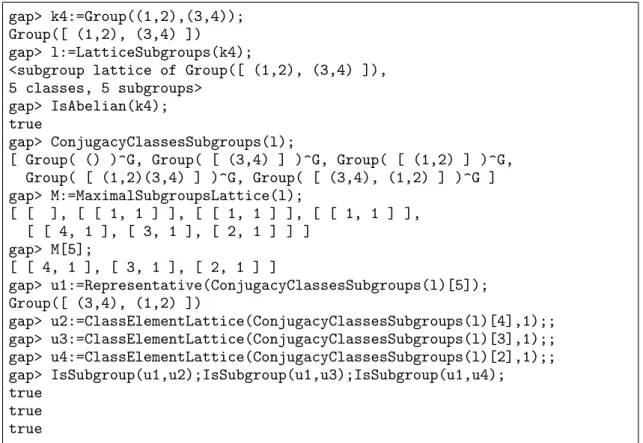
In this section we will look how GAP is used for classifying subgroups. For example sub-group lattice of Klein 4-sub-group is as shown in Figure 1[5].
This means that the group has five subgroups where three of them are trivial and others are 2/1 type, i.e., cyclic group of order 2. These subgroups can be find by using GAP as follows:
gap> k4:=Group((1,2),(3,4)); Group([ (1,2), (3,4) ])
gap> l:=LatticeSubgroups(k4);
<subgroup lattice of Group([ (1,2), (3,4) ]), 5 classes, 5 subgroups>
gap> IsAbelian(k4); true
gap> ConjugacyClassesSubgroups(l);
[ Group( () )^G, Group( [ (3,4) ] )^G, Group( [ (1,2) ] )^G, Group( [ (1,2)(3,4) ] )^G, Group( [ (3,4), (1,2) ] )^G ] gap> M:=MaximalSubgroupsLattice(l);
[ [ ], [ [ 1, 1 ] ], [ [ 1, 1 ] ], [ [ 1, 1 ] ], [ [ 4, 1 ], [ 3, 1 ], [ 2, 1 ] ] ]
gap> M[5];
[ [ 4, 1 ], [ 3, 1 ], [ 2, 1 ] ]
gap> u1:=Representative(ConjugacyClassesSubgroups(l)[5]); Group([ (3,4), (1,2) ])
gap> u2:=ClassElementLattice(ConjugacyClassesSubgroups(l)[4],1);; gap> u3:=ClassElementLattice(ConjugacyClassesSubgroups(l)[3],1);; gap> u4:=ClassElementLattice(ConjugacyClassesSubgroups(l)[2],1);; gap> IsSubgroup(u1,u2);IsSubgroup(u1,u3);IsSubgroup(u1,u4); true
true true
2.2. Examples
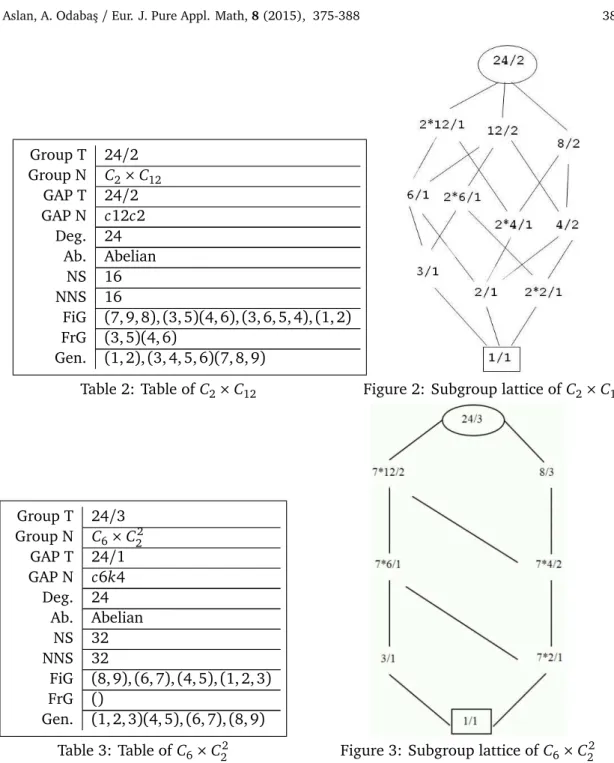
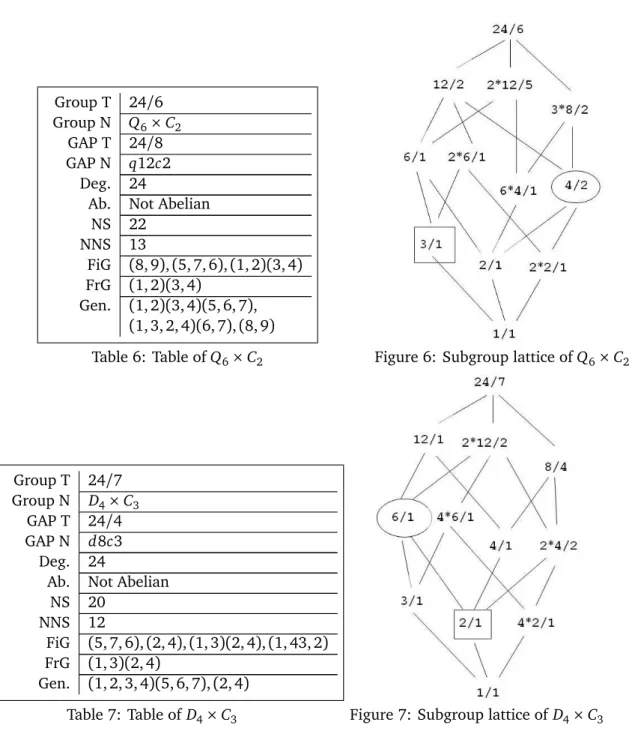
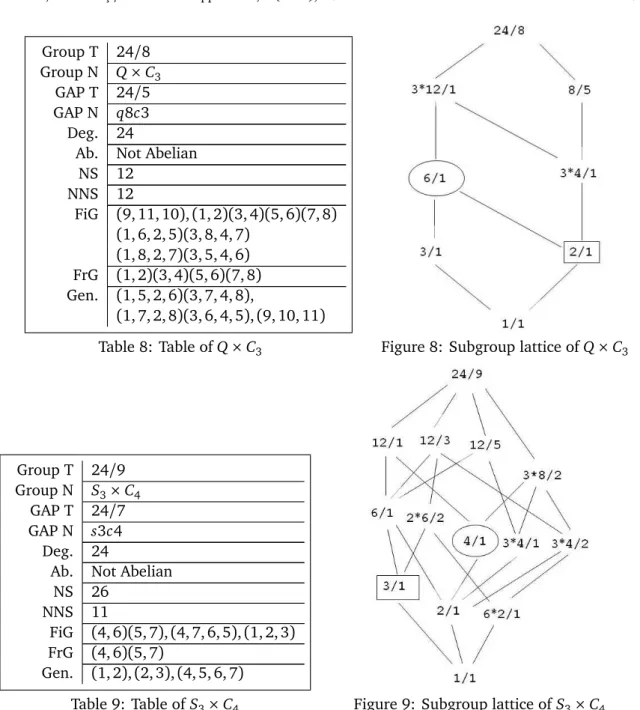
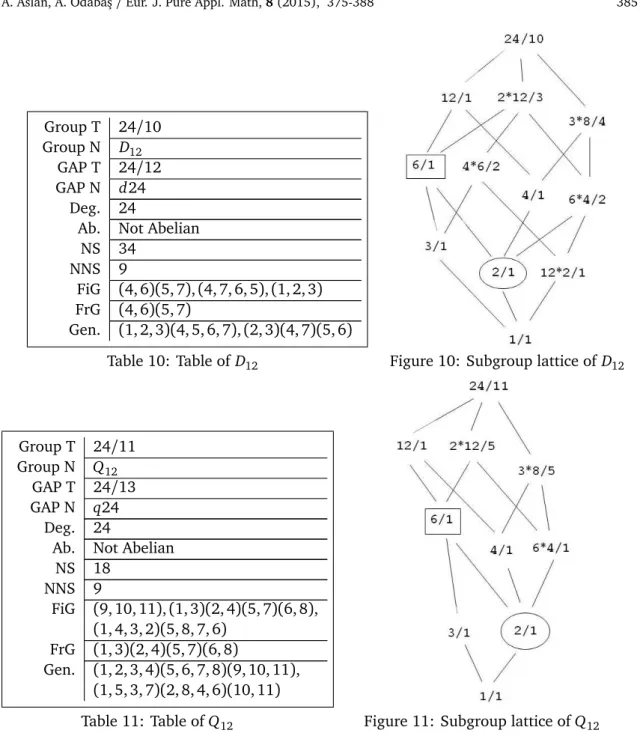
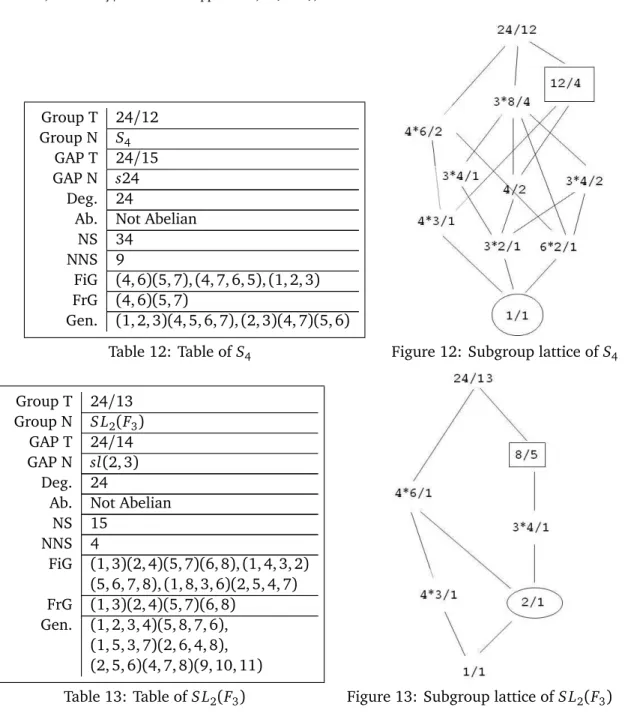
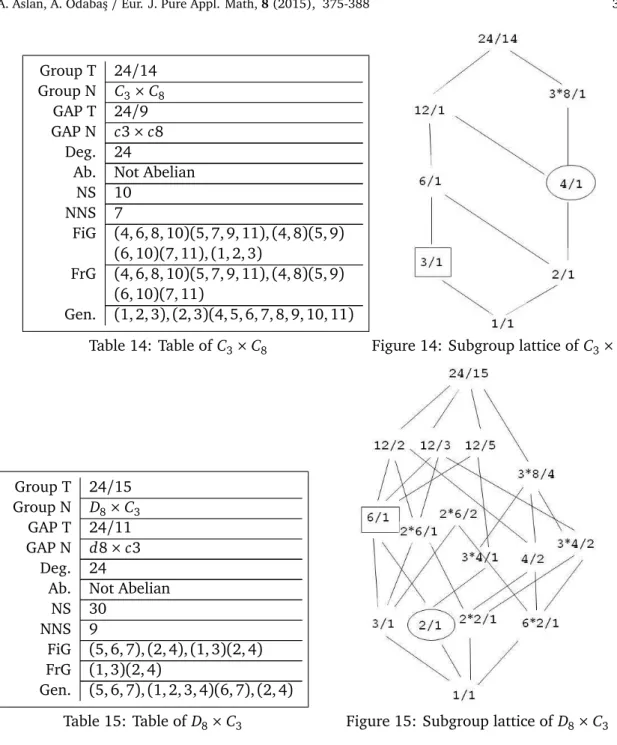
In this section, up to GAP order, we will give tables containing generators of (Frattini, Fitting) subgroups, abelianess property of 14 different groups of order 24. In all cases, the table headings are as defined in Table 1. Also, we give the subgroup lattices near the tables.
Table 1: Group & Generator Properties
Group T Type of Group NS Number of Subgroups
Group N Name of Group NNS Number of Normal Subgroups GAP T Type of GAP FiG Generators of Fitting Subgroup GAP N GAP Name of Group FrG Generators of Frattini Subgroup
Group T 24/2 Group N C2×C12
GAP T 24/2 GAP N c12c2
Deg. 24 Ab. Abelian
NS 16 NNS 16
FiG (7, 9, 8),(3, 5)(4, 6),(3, 6, 5, 4),(1, 2)
FrG (3, 5)(4, 6)
Gen. (1, 2),(3, 4, 5, 6)(7, 8, 9)
Table 2: Table ofC2×C12 Figure 2: Subgroup lattice ofC2×C12
Group T 24/3 Group N C6×C22
GAP T 24/1 GAP N c6k4
Deg. 24 Ab. Abelian
NS 32 NNS 32
FiG (8, 9),(6, 7),(4, 5),(1, 2, 3)
FrG ()
Gen. (1, 2, 3)(4, 5),(6, 7),(8, 9)
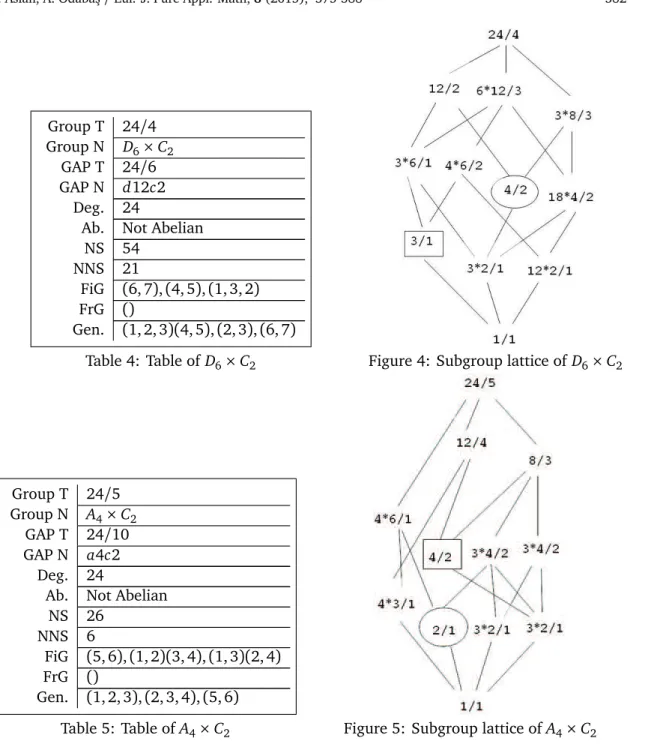
Group T 24/4 Group N D6×C2
GAP T 24/6 GAP N d12c2
Deg. 24
Ab. Not Abelian NS 54
NNS 21
FiG (6, 7),(4, 5),(1, 3, 2)
FrG ()
Gen. (1, 2, 3)(4, 5),(2, 3),(6, 7)
Table 4: Table ofD6×C2 Figure 4: Subgroup lattice ofD6×C2
Group T 24/5 Group N A4×C2
GAP T 24/10 GAP N a4c2
Deg. 24
Ab. Not Abelian NS 26
NNS 6
FiG (5, 6),(1, 2)(3, 4),(1, 3)(2, 4)
FrG ()
Gen. (1, 2, 3),(2, 3, 4),(5, 6)
Group T 24/6 Group N Q6×C2
GAP T 24/8 GAP N q12c2
Deg. 24
Ab. Not Abelian NS 22
NNS 13
FiG (8, 9),(5, 7, 6),(1, 2)(3, 4)
FrG (1, 2)(3, 4)
Gen. (1, 2)(3, 4)(5, 6, 7),
(1, 3, 2, 4)(6, 7),(8, 9)
Table 6: Table ofQ6×C2 Figure 6: Subgroup lattice ofQ6×C2
Group T 24/7 Group N D4×C3
GAP T 24/4 GAP N d8c3
Deg. 24
Ab. Not Abelian NS 20
NNS 12
FiG (5, 7, 6),(2, 4),(1, 3)(2, 4),(1, 43, 2)
FrG (1, 3)(2, 4)
Gen. (1, 2, 3, 4)(5, 6, 7),(2, 4)
Group T 24/8 Group N Q×C3
GAP T 24/5 GAP N q8c3
Deg. 24
Ab. Not Abelian NS 12
NNS 12
FiG (9, 11, 10),(1, 2)(3, 4)(5, 6)(7, 8) (1, 6, 2, 5)(3, 8, 4, 7)
(1, 8, 2, 7)(3, 5, 4, 6)
FrG (1, 2)(3, 4)(5, 6)(7, 8)
Gen. (1, 5, 2, 6)(3, 7, 4, 8),
(1, 7, 2, 8)(3, 6, 4, 5),(9, 10, 11)
Table 8: Table ofQ×C3 Figure 8: Subgroup lattice ofQ×C3
Group T 24/9 Group N S3×C4
GAP T 24/7 GAP N s3c4
Deg. 24
Ab. Not Abelian NS 26
NNS 11
FiG (4, 6)(5, 7),(4, 7, 6, 5),(1, 2, 3)
FrG (4, 6)(5, 7)
Gen. (1, 2),(2, 3),(4, 5, 6, 7)
Group T 24/10 Group N D12
GAP T 24/12 GAP N d24
Deg. 24
Ab. Not Abelian NS 34
NNS 9
FiG (4, 6)(5, 7),(4, 7, 6, 5),(1, 2, 3)
FrG (4, 6)(5, 7)
Gen. (1, 2, 3)(4, 5, 6, 7),(2, 3)(4, 7)(5, 6)
Table 10: Table ofD12 Figure 10: Subgroup lattice ofD12
Group T 24/11 Group N Q12
GAP T 24/13 GAP N q24
Deg. 24
Ab. Not Abelian NS 18
NNS 9
FiG (9, 10, 11),(1, 3)(2, 4)(5, 7)(6, 8),
(1, 4, 3, 2)(5, 8, 7, 6)
FrG (1, 3)(2, 4)(5, 7)(6, 8)
Gen. (1, 2, 3, 4)(5, 6, 7, 8)(9, 10, 11),
(1, 5, 3, 7)(2, 8, 4, 6)(10, 11)
Group T 24/12 Group N S4
GAP T 24/15 GAP N s24
Deg. 24
Ab. Not Abelian NS 34
NNS 9
FiG (4, 6)(5, 7),(4, 7, 6, 5),(1, 2, 3)
FrG (4, 6)(5, 7)
Gen. (1, 2, 3)(4, 5, 6, 7),(2, 3)(4, 7)(5, 6)
Table 12: Table ofS4 Figure 12: Subgroup lattice ofS4
Group T 24/13 Group N S L2(F3)
GAP T 24/14 GAP N sl(2, 3)
Deg. 24
Ab. Not Abelian NS 15
NNS 4
FiG (1, 3)(2, 4)(5, 7)(6, 8),(1, 4, 3, 2) (5, 6, 7, 8),(1, 8, 3, 6)(2, 5, 4, 7)
FrG (1, 3)(2, 4)(5, 7)(6, 8)
Gen. (1, 2, 3, 4)(5, 8, 7, 6),
(1, 5, 3, 7)(2, 6, 4, 8),
(2, 5, 6)(4, 7, 8)(9, 10, 11)
Group T 24/14 Group N C3×C8
GAP T 24/9 GAP N c3×c8
Deg. 24
Ab. Not Abelian NS 10
NNS 7
FiG (4, 6, 8, 10)(5, 7, 9, 11),(4, 8)(5, 9) (6, 10)(7, 11),(1, 2, 3)
FrG (4, 6, 8, 10)(5, 7, 9, 11),(4, 8)(5, 9) (6, 10)(7, 11)
Gen. (1, 2, 3),(2, 3)(4, 5, 6, 7, 8, 9, 10, 11)
Table 14: Table ofC3×C8 Figure 14: Subgroup lattice ofC3×C8
Group T 24/15 Group N D8×C3
GAP T 24/11 GAP N d8×c3
Deg. 24
Ab. Not Abelian NS 30
NNS 9
FiG (5, 6, 7),(2, 4),(1, 3)(2, 4)
FrG (1, 3)(2, 4)
Gen. (5, 6, 7),(1, 2, 3, 4)(6, 7),(2, 4)
References
[1] The Gap Group. Groups, Algorithms, and Programming.U. St. Andrews, Scotland. (1997).
[2] I. M. Isaacs. Group Theory Notes.University of Wisconsin - Madison. (2002).
[3] A. Odabas. Abstract Algebra and Numbers Theory with GAP.Masters Thesis, Dumlupinar University. p. 254. (2004).
[4] H. E. Rose. A Course on Finite Groups.Springer, (2000).