247
Study Regarding Seasons Influence on the Drinking
Behaviour in Lactating Dairy Cows
Dinu Gavojdian, Ludovic Toma Cziszter, Stelian Acatinc
ă
i, Gavril Stanciu, Iulian Tripon,
Simona Baul, Silvia Erina, Atila Bognar
Faculty of Animal Sciences and Biotechnologies, Timişoara, 300645, Calea Aradului, nr. 119, Romania
Abstract
The aim of the paper was to evaluate the influence that season has on the water consumption behaviour in lactating dairy cows. Researches were carried out on twenty multiparous Romanian Black and White cows, during summer and winter seasons. Cows were housed in a tied stanchion barn 24 h, and had free access to a water source. Environmental parameters, quantity of consumed forages and milk yield were measured each day of the experiments. Studied traits were: number of drinking bouts and duration of the drinking periods, frequency of the drinking periods, time length between consumption of the forages and first drinking period and time length between milking and first drinking period. Average number of drinking bouts on 24 h registered during winter season was 8.15, and 16.10 during summer season. Differences registered between the two seasons for this trait were significantly statistic (p<0.001). Duration of a drinking period was of 0.82 minutes in the winter and of 0.84 minutes during summer season.
Keywords: drinking behaviour, dairy cows, season influence.
1. Introduction
Water is considered the most important nutrient for the lactating dairy cows, however little research has focused on drinking behavior [1]. Drinking is synchronized in lactating cows with feeding and milking, this is a learnt response to an impending osmotic demand [2]. In intensive rearing systems cows drink more frequently compared to free-ranged cattle, although there is considerable variation between animals.
Frequency of drinking bouts is positively correlated with the number of meals per day and the volume of consumed water [3].
In dairy cattle, water consumption is influenced by a great number of factors, from which DMI intake, milk yield, temperature, body weight, levels of salt and protein from forages, effort made by the
* Corresponding author: Dinu Gavojdian, [email protected], 0040-356456400
animal and quality and quantity of water are most important [3, 4].
The aim of the paper was to evaluate the influence that season has on the water consumption behaviour in lactating dairy cows.
2. Materials and methods
In the current study twenty multiparous Romanian Black and White cows were used. The cows were housed in a tied stanchion barn at the Didactical Farm of the Banat’s University of Agricultural Sciences and Veterinary Medicine Timisoara. The experiments were carried out during winter and summer season, each experimental group consisted in 10 cows.
248 During the first experimental period, cows were fed a diet consisted in 20 kg of corn silage, 8 kg of pasture hay, 3 kg of concentrates and 4 kg of brower yeast. In summer season, cows received a diet of 30 kg alfalfa fresh feed, 3 kg of concentrates and 4kg of brower yeast. The forages were offered to the animals in two equal portions each day, at approximately 6:30 and 16:30.
The cows were milked twice a day, at approximately 5:00 and 17:00 h. Data regarding environmental temperature was recorded three times per day, at 7:00, 14:00 and 23:00 h. The average air temperature registered inside the barn was 8.1°C during winter and 28.4°C in summer. Cows had free access to a water source 24 h. Drinking behavior was monitored 24 h, using 4 video cameras (CC9622BIR) connected to a video capture device of 125 frames per second with four
channels. Video recordings were analyzed by continuous observation for each cow and each period. For a better interpretation of the results, the 24 h interval was divided in three segments. In our research we have registered and studied some specific drinking behavior patterns, such as number of drinking bouts, frequency of drinking periods, time length between forage consumption and first drinking period, time length between milking and first drinking period and duration of a drinking period.
3. Results and discussion
Averages, dispersion indices, differences and their significance for the number of drinking bouts during winter and summer seasons are presented in table 1.
Table 1. Number of drinking bouts during winter and summer seasons (minutes)
Interval/Season Winter Summer
Segment I h 7-14°°
X±Sx 3.85±0.26 5.75±0.30
SD 1.18 1.37
Segment II h 14-21°
X±Sx 3.15±0.26 4.80±0.42
SD 1.18 1.88
Segment III h 21-7°°
X±Sx 1.15±0.16 5.55±0.51
SD 0.74 2.28
On 24 h X±Sx 8.15±0.43 16.10±0.72
SD 1.92 3.24
Winter-Summer
Segment I - 1.9 **
Segment II - 1.65 **
Segment III - 4.4 ***
24 h - 7.95 ***
During winter season per 24 h interval, average drinking bouts registered was of 8.1. On the day’s segments, means have been of 3.8 during first segment, 3.1 during the afternoon segment and of only 1.1 during the night segment.
In the summer season, average value registered was of 16.1 per 24 h. On the daily segments averages registered were 5.7 during morning segment, 4.8 during second one and of 5.5 during night.
Between the two seasons, average differences registered were of 7.9 drinking periods, value that is statistically significant (p0.001).
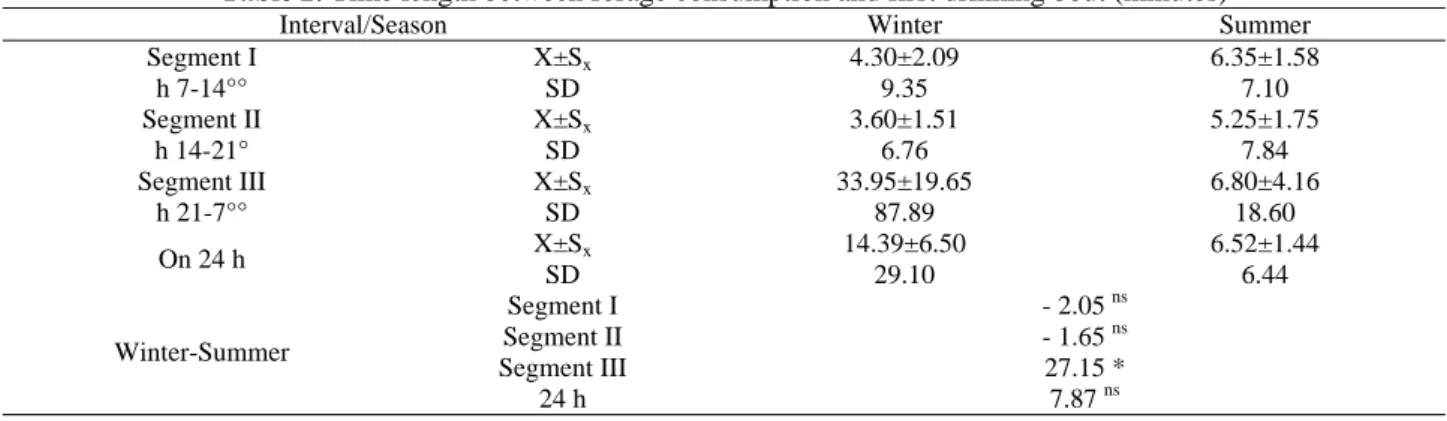
Averages, dispersion indices, differences and their significance for the time length between consumption of the feed and first drinking bout during winter and summer seasons are presented in table 2.
Table 2. Time length between forage consumption and first drinking bout (minutes)
Interval/Season Winter Summer
Segment I h 7-14°°
X±Sx 4.30±2.09 6.35±1.58
SD 9.35 7.10 Segment II
h 14-21°
X±Sx 3.60±1.51 5.25±1.75
SD 6.76 7.84 Segment III
h 21-7°°
X±Sx 33.95±19.65 6.80±4.16
SD 87.89 18.60
On 24 h X±Sx 14.39±6.50 6.52±1.44
SD 29.10 6.44
Winter-Summer
Segment I - 2.05 ns
Segment II - 1.65 ns
Segment III 27.15 *
249 On 24 h, during winter season, average time length between the end of foraging and first drinking period was of 14.3 minutes. On the day’s segments, the situation was slightly different because during the first two segments the averages registered were of 4.3 minutes, respectively 3.6 minutes for the first two segments and of 33.9 minutes during the night segment, last value could be explained because of the very low number of watering periods registered during night time. For the summer season, average per 24 h registered was of 6.5 minutes. During days segments, values were relatively equally
distributed. Respectively 6.3 minutes in the first segment, 5.2 during second segment and 6.8 during night segment.
Between the two segments, differences registered per 24 h interval were of 7.8 minutes, in favor of the winter season, the value is insignificant statistic (p0.05).
Averages, dispersion indices, differences and their significance for the time length between milking and first water consumption during winter and summer seasons are presented in table 3.
Table 3. Time length between milking and first water consumption (minutes)
Interval/Season Winter Summer
Segment I h 7-14°°
X±Sx 121.55±17.71 63.40±7.89
SD 79.22 35.30 Segment II
h 14-21°
X±Sx 66.10±7.16 33.40±7.99
SD 32.03 35.77
On 24 h X±Sx 93.82±9.27 47.74±4.74
SD 41.47 21.19
Winter-Summer
Segment I 58.15 ***
Segment II 32.70 **
24 h 46.08 ***
During winter season, average time length between milking and first water consumption was 93.8 minutes per 24 h. During morning milking, the time length registered was of 121.5 minutes and during afternoon milking of 66.1 minutes, difference of 55.4 minutes could have been registered because during first milking the fed was also offered to the cows, and cows preferred to eat than drink.
During summer season, on 24 h the averages registered were of 47.7 minutes. Average for time
length between milking until first consume of water was of 63.4 minutes during morning and of 33.4 minutes during second milking.
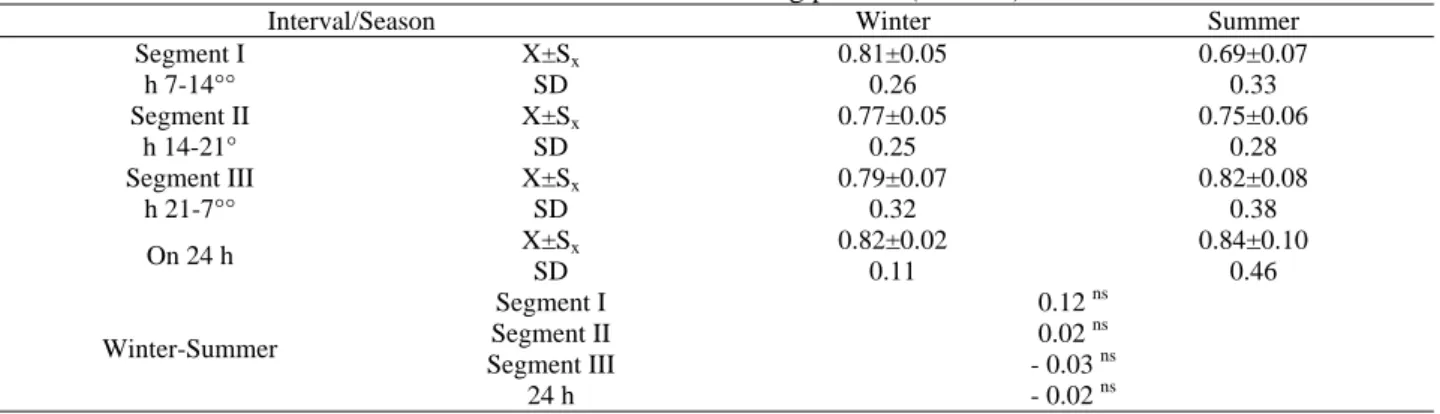
Between the two seasons on 24 h, difference registered was of 46 minutes in favor of winter season, value statistic significant (p0.001). Averages, dispersion indices, differences and their significance for the duration of the drinking periods during winter and summer seasons are presented in table 4.
Table 4. Duration of the drinking periods (minutes)
Interval/Season Winter Summer
Segment I h 7-14°°
X±Sx 0.81±0.05 0.69±0.07
SD 0.26 0.33 Segment II
h 14-21°
X±Sx 0.77±0.05 0.75±0.06
SD 0.25 0.28 Segment III
h 21-7°°
X±Sx 0.79±0.07 0.82±0.08
SD 0.32 0.38
On 24 h X±Sx 0.82±0.02 0.84±0.10
SD 0.11 0.46
Winter-Summer
Segment I 0.12 ns
Segment II 0.02 ns
Segment III - 0.03 ns
250 During cold season, average value registered was of 0.82 minutes and of 0.84 minutes during
summer season. Differences registered between the two seasons were insignificant (p0.05).
0 2 4 6 8 10 12 14
1 2 3 4 5 6 7 8 9 10 11 12 13 14 15 16 17 18 19 20 21 22 23 24
Figure 1. Frequency of drinking periods during winter season
0 2 4 6 8 10 12 14 16
1 2 3 4 5 6 7 8 9 10 11 12 13 14 15 16 17 18 19 20 21 22 23 24
Figure 2. Frequency of drinking periods during summer season
Frequency of drinking periods during winter and summer seasons are presented in figures 1 and 2. In both seasons, as observed from the figures below, two peaks for the drinking periods could be observed. The two higher frequencies occurred in both cases right after the cows finished consuming their portions.
During winter season water consume was relatively low, especially during the night segment. Most drinking occurred during the intervals 9 - 10°° and 18 - 19°°.
In summer season, drinking bouts were much frequent and distributed more equally, compared to winter season. Also, during night time, water consume registered as well. Highest frequency was registered during the 9 to 10°° and 21 to 22°° intervals.
4. Conclusions
Drinking frequency registered two daily peaks in both seasons, periods that correspond to the finishing of the forages consume, during morning and evening time,
In summer season, unlike the winter, drinking bouts have been registered also during night segments,
Time length between forage consume and first drinking bout was of 14.3 minutes during winter and of 6.5 minutes during summer season, difference between the two seasons was of 7.8 minutes (p>0.005).
251 Results suggest that the season bears some influence on this parameter, but the milking process does not influences the drinking period debut,
Average duration of the drinking bouts was of 0.82 minutes during winter and 0.84 minutes during summer season. Thus, multiplying average number of drinking periods with the average duration of the drinking bouts, we could approximate that entire watering process per 24 h was of 7-8 minutes during winter season and of 14-15 minutes during summer season.
References
1. Grant, R. J., Albright, J. L., Feeding behavior and management factors during the transition period in dairy cattle, J. Anim. Sci., 1995, 73, 2791-2803,
2. Huzzey, J. M., von Keyserlingk, M. A. G., Weary, D. M., Changes in Feeding, Drinking and Standing Behavior of dairy cows during transition period, J. Dairy Sci., 2005, 88, 2454-2461,
3. Stanciu, G., Tehnologia cresterii bovinelor, Brumar, Timisoara, 1999, pp. 105-122,