
8
Validation of the 3-steps Complete in vitro Method for
Ruminant Feedstuffs Intestinal Digestibility
Ana Elena Cişmileanu
1, Catalin Dragomir
1, Smaranda Toma
11
National Research Development Institute for Animal Biology and Nutrition–IBNA Balotesti, 077015-Balotesti, 1 Calea Bucuresti, Ilfov County, Romania
Abstract
The ruminants partially use the dietary protein in the rumen step of digestion. The undegraded part of this protein and also, its digestion in the stomach and small intestine vary depending on the type of feedstuff. The intestinal digestibility of the rumen undegraded protein RUP can be evaluated by the 3-steps in vitro method. In this study it was validated this method using the Ankom technology for two feeds: soybean meal and alfalfa hay.
Keywords: intestinal digestibility, protein, ruminant.
1. Introduction
Modern feed nutrition systems have described the required dietary protein for dairy cows, sheep and goats. The part of the feed protein after ingestion and rumen degradation, which is available for absorption in the small intestine is the metabolizable protein, dependent on the flow, the digestibility of microbial crude protein and dietary ruminal undegraded protein (RUP) [1]. The amino acids profile of RUP and also, their intestinal digestibility can vary widely among and within feedstuffs [2]. Using the small intestinal digestibility of RUP as a constant factor will lead to errors in prediction of nutrient needs [3]. Therefore, intestinal digestibility of RUP has been determined by the in vitro reliable method of Calsamiglia (1995) [4] and consequently, the diet formulation were not generally based on mean table values for the content and digestibility of the amino acids of the individual feedstuffs.
* Corresponding author: Ana Elena Cişmileanu Tel: 0040 21 351 20 81, Fax: 0040 21 351 20 80 Email: [email protected]
The three-step in vitro procedure for estimating intestinal digestion of proteins in ruminants [4] closely simulates physiological conditions of ruminants, including potential effects of ruminal fermentation, which is the first step; the next two steps are enzymatic ones. The technique consists of incubation of Dacron bags containing feedstuff sample in rumen for 16 h, then the dried post-ruminal residue is incubated consequently for 1 h in pepsin solution and for 24 h in pancreatin solution. Finally, the soluble nitrogen N is precipitated. The technique assumes that microbial contamination of post-rumen residue is negligible. It is rapid, reliable, inexpensive and can be applicable on a wide variety of feeds. It has reasonable correlation with the mobile-bag method of Hvelplund (1985) [5] which are also for intestinal digestibility estimation. Briefly, in this method the 16 h-rumen incubation residue is weighed in small polyester bags (2.5 x 4 cm), incubated for 1 h in pepsin solution and then incubated in fistulizated cows in ileum/duodenum. After 20 h the bags are collected from faeces and the N content is dosed.
9 residues sample were introduced in nylon bags (5 x 5 cm) and incubated in a Daisy Incubator for the enzyme steps. The N content of the enzymatic residue was used for calculating the intestinal digestibility of undegraded rumen protein, IDP. Our study is not a new approach. It is an adapted Gargallo and Calsamiglia’s method and all the steps are in vitro and, the results are compared with the initial version of the method [4]. Our objective was to validate this complete in vitro
method in order to be easier applied.
2. Materials and methods
Two feeds, soybean meal (SBM) and alfalfa hay (AH), have been used for comparing the next presented 2 versions of the intestinal digestibility
in vitro method. Their chemical composition was: dry matter (DM) 88.12% and crude protein (CP) 43.62% for SBM as native feed, and DM 90.76% and CP 19.20% for AH as native feed.
Presentation of the 3-steps in vitro enzymatic method [4]
We applied the classic version of the method in four repeated trials. Each feed was grounded through a 2-mm screen, and then approx. 3 g were weighed into 5-cm x 10-cm polyamide bags and suspended in the rumen of cannulated cows for 16 h. We used eight bags for SBM and four bags for AH in one trial.
After the rumen incubation period, the bags were rinsed with tap water, dried at a 55oC for 48 h. The pooled samples from bags for each feed represent the post-rumen residue or RUP. It was used for the next two steps, but an aliquot was kept for determination of N content.
0.5 g of rumen residue for each trial was weighed into a 50-mL centrifugation tube and incubated in pepsin and pancreatin solutions as Calsamiglia (1995) [4] mentioned. After these enzymes steps and precipitating with TCA (trichloracetic acid), the result of the intestinal residue is calculated after dosing the soluble CP in TCA. IDP is calculated as TCA-soluble CP, divided by amount of rumen residue CP used in the assay.
Presentation of the 3-steps complete in vitro adapted method (adaptation after Gargallo and Calsamiglia, 2006) [6].
The first step is incubation of approximately 3 g of feedstuff sample (grounded through a 1-mm screen) introduced in one nylon bag (5x10-cm, Ankom R510, pore size 50 μm), in the filtered rumen buffered mixture (rumen liquid: McDougall buffer 1:4) for 24 h at 39oC in the digestion jar of the DaisyIncubator (Ankom). We used 2 jars, and in each jar four SBM bags and two AH bags were added. After wetting the nylon bags, carbon dioxide gas was purged into the jar for thirty seconds and the lid fixed.
At completion of incubation, jars were removed and the fluid eliminated. The bags were thoroughly rinsed with cold tap water until water was clear. The nylon bags were oven-dried at 55°C for 48 h. The pooled rumen residues from the bags for each feed were used for further testing of the intestinal digestion. We obtained rumen residues from three repeated trials by collecting ruminal liquid at 14 days interval. An aliquot of the rumen residue (at least 1 g) was kept for the N analysis.
The rumen residues samples were grounded to pass through 1-mm screen and approximately 0.5 g of sample was directly weighed into filter bag F57 (Ankom), and the exact weight was recorded. For each of the three trials we allocated 10 filter bags for SBM and 4 bags for AH. The filter bags were incubated for 1 hour at 39°C in the Daisy Incubator jar containing 2 L of a 0.1 N HCl pre-warmed solution adjusted to pH 1.9 with 1 g/L of pepsin (Merck 1.07190.1000).
After completion of incubation, fluid drainage and rinsing with cold tap water, the filter bags were introduced again into the Daisy digestion jar containing pre-warmed 2 L of a pancreatin solution (0.5 M KH2PO4 buffer adjusted to pH 7.75 and containing 50 mg/L of thymol and 1.68 g/L of pancreatin P-7545, Sigma). Incubation was for 24 h with constant rotation at 39°C.
10
Calculation of IDP
IDP (% of RUP)=intestinal digestibility of undegraded rumen crude protein. It is calculated as the CP in the rumen residue sample minus the CP remaining after pepsin-pancreatin incubation divided by the CP in the rumen residue sample, and multiplied by 100.
RUP [g/100 g CP]=rumen undegradable protein=(Rumen Residue CP/Initial CP) x 100
where: Rumen Residue CP=CP content [g] of the 100 g residue after rumen step/ incubation
Initial CP=CP content [g] of the 100 g feed sample before the start of the method
3. Results and discussion
The initial CP content of the two feeds is presented in Table 1.
Table 1. Chemical composition of the experimental feeds
feed DM CP (% of DM)
SBM 88.12 48.22
AH 90.76 21.15
SBM=soybean meal; AH=alfalfa hay
The evaluation of the complete in vitro method was realized by just two parameters of validation: the reproducibility and the correlation with the initial version of the method.
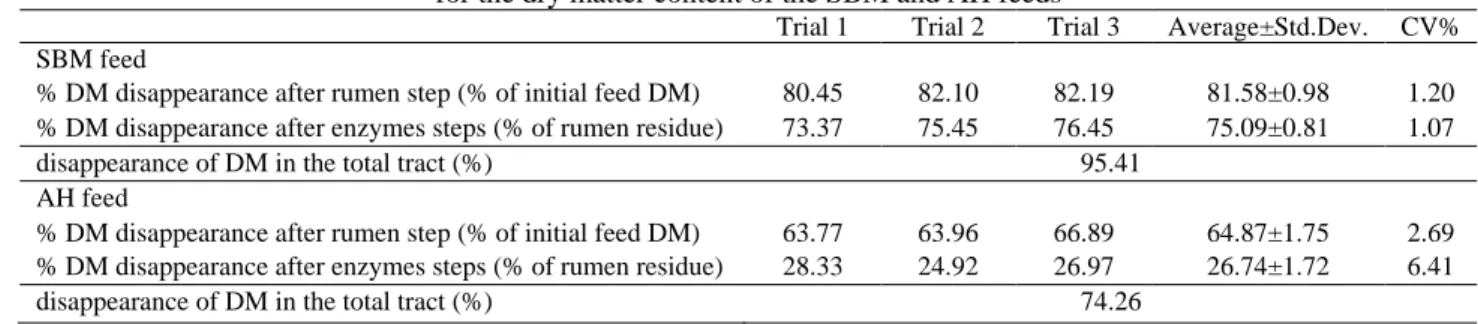
The reproducibility for CP and DM for both feeds is presented in Tables 2, 3 and 4. It can be observed that this parameter is attended in each case by proper value of the coefficient of variability (CV).
Table 2. Reproducibility of the 3-steps complete in vitro method – for the protein content of SBM feed SBM feed Trial 1 Trial 2 Trial 3 Average±Std. Dev. CV% CP content of rumen step residue (%) 39.79 38.15 37.73 38.55±1.09 2.82
RUP [g/100g CP] 82.52 79.12 78.25 79.96±2.26 2.82
CP content of enzymes steps residue (%) 12.57 10.98 11.54 11.69±0.80 6.89
IDP (% of RUP) 68.41 71.22 69.41 69.68±1.42 2.04
Table 3. Reproducibility of the 3-steps complete in vitro method - for the protein content of AH feed AH feed Trial 1 Trial 2 Trial 3 Average±Std. Dev. CV% CP content of rumen step residue (%) 12.85 13.48 12.54 12.96±0.47 3.69
RUP [g/100 g CP] 60.76 63.74 59.29 61.26±2.26 3.69
CP content of enzymes steps residue (%) 5.25 5.54 5.30 5.36±0.16 2.89
IDP (% of RUP) 59.14 58.90 57.74 58.59±0.75 1.29
Table 4. Reproducibility of the 3-steps complete in vitro method for the dry matter content of the SBM and AH feeds
Trial 1 Trial 2 Trial 3 Average±Std.Dev. CV% SBM feed
% DM disappearance after rumen step (% of initial feed DM) 80.45 82.10 82.19 81.58±0.98 1.20 % DM disappearance after enzymes steps (% of rumen residue) 73.37 75.45 76.45 75.09±0.81 1.07
disappearance of DM in the total tract (%) 95.41
AH feed
% DM disappearance after rumen step (% of initial feed DM) 63.77 63.96 66.89 64.87±1.75 2.69 % DM disappearance after enzymes steps (% of rumen residue) 28.33 24.92 26.97 26.74±1.72 6.41
disappearance of DM in the total tract (%) 74.26
In Table 5 are presented the average values of the IDP for classic version method. The comparison of IDP between variants of the method is as presented: for AH, the new value is 58.59% versus 63.30%, and for SBM the new IDP value of
69.68% is compared with 77.04% in classic version.
11 of the feedstuffs had retention times longer than 16 h (Boucher, 2009) [7]. Another reason for difference could be from interferences in the N results for enzyme steps residues: in classic
version the supernatant is analyzed, and in the new version, the sediment (the remained part, undigested) is used for N dosing.
Table 5. Results for the protein digestibility in the 3-steps method – classic version
SBM feed AH feed
disappearance of CP after rumen step (% of content in feed) 15.61 41.03
RUP [g/100 g CP] 100-15.61=84.39 100-41.03=58.97
IDP (% of RUP) or disappearance of CP after enzymes steps (% of rumen residue)
77.04 63.30
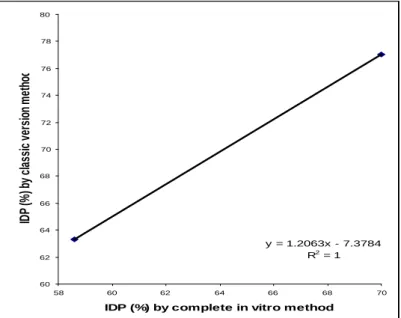
But, as can be observed in Fig. 1 the relationship between IDP values suggests that IDP of classic version could be calculated using the IDP obtained by complete in vitro version. Also, this
relationship could be more profound evaluated by applying the new version of the method on more feedstuffs.
y = 1.2063x - 7.3784 R2 = 1
60 62 64 66 68 70 72 74 76 78 80
58 60 62 64 66 68 70
IDP (%) by complete in vitro method
ID
P (
%
) b
y cl
assi
c ver
si
on
m
et
ho
d
Figure 1. Relationship between intestinal digestion IDP (%) of SBM and AH estimated by the 2 version of 3-steps method
4. Conclusions
The complete in vitro 3-steps method is reproducible, and can be used for determination of the intestinal digestion of proteins for ruminants reducing the time and labor for working.
References
1. National Research Council (NRC), Nutrient Requirements of Dairy Cattle: Seventh Revised Edition, 2001. Washington, DC: The National Academies Press, USA.
2. Prestlokken, E., Rise, O., Protein and amino acid digestibility in dairy cows measured with mobile nylon
bags recovered in ileum or in faeces, Acta Agric. Scand Sect A Anim. Sci., 2003, 53, 11-20.
3. Maskalova, Y., Vajda, V., Krempasky, M., Bujnak L., Rumen degradability and ileal digestibility of proteins and amino acids of feedstuffs for cows, Acta Vet. Brno, 2014, 83, 225-231.
4. Calsamiglia, S., Stern, M. D., A three-step in vitro procedure for estimating intestinal digestion of protein in ruminants, Journal of Animal Science, 1995, 73:1459-1465.
5. Hvelplund, T., Digestibility of rumen microbial protein and undegraded dietary protein estimated in the small intestine of sheep and by in sacco procedure, Acta Agric. Scand. Suppl., 1985, 25:132-138.
12
determine intestinal digestion of proteins, J. Anim. Sci., 2006, 84, 2163-2167.
7. Boucher, S. E., Calsamiglia, S., Parsons, C. M., Stern, M. D., Ruiz Moreno, M., Vázquez-Añón, M., Schwab, C. G., In vitro digestibility of individual
![Hexakis(μ3 1 methylthiourea κ3S:S:S)hexakis[iodidocopper(I)]](data:image/gif;base64,R0lGODlhAQABAIAAAP///wAAACH5BAEAAAAALAAAAAABAAEAAAICRAEAOw==)