A Hybird Image Retrieval System with User’s Relevance Feedback Using
Neurocomputing
Dianhui Wang and Xiaohang Ma
Department of Computer Science and Computer Engineering La Trobe University, Melbourne, VIC 3086, Australia E-mail: [email protected]
Keywords:Image retrieval, intelligent systems, neurcomputing, relevance feedback
Received:May 17, 2004
This paper aims at developing a hybrid scheme for intelligent image retrieval using neural nets. Each item in an image database is indexed by a visual feature vector, which is extracted using color moments and discrete cosine transform coefficients. Query is characterized by a set of semantic labels, which are predefined by system designers and associated with domain concerns. The proposed hybrid image retrieval (HIR) system utilizes the image content features as the system input, and the semantic labels as its output. To compensate the deficiency of semantics modelling, an on-line user’s relevance feedback is applied to improve the retrieval performance of the HIR system. The neural net acts like a pattern association memory bank that maps the low-level feature vectors to their corresponding semantic labels. During the retrieval process, the weights of the neural net are updated by an interactive user’s relevance feedback technique, where the feedback signal comprise the neural net actual output, semantic labels provided by users and the given query. A prototype HIR system is implemented and evaluated using an artificial image database. Experimental results demonstrate that our proposed techniques are promising.
Povzetek: Hibridni algoritem z nevronsko mrežo je uporabljen za iskanje slik.
1 Introduction
With the development of the Internet and database tech-niques, information retrieval (IR) becomes very popular [1]. As a powerful form of delivering information, mul-timedia data are frequently used in many domain appli-cations. Techniques for effectively dealing with multime-dia databases management are useful and in demand. In the past, a lot of efforts on content-based image retrieval (CBIR) have been devoted to achieving this goal [2, 3]. A direct motivation for developing CBIR systems is to release the workload of manually annotating image data using text-based keywords. The existing CBIR systems can be catego-rized into two classes [4, 5]. The first scheme extracts low-level visual features from images, then uses a similarity measure to calculate the distance between a query and im-ages from the database using the feature vectors for items rank. The second scheme is a semantic content-based ap-proach, where semantics are automatically extracted from raw images, and then a construction key is made from these semantic items. The query is characterized using some combinations of the semantics extracted from the images, and the retrieval is achieved by counting the semantic items occurrence frequency. Currently, most CBIR systems fall into the first class, where semantic information of the im-age is not utilized during retrieval.
There exists a big gap between image semantic con-tent and its corresponding representation using low-level
niques, readers may refer to [8]. At present, the adjustment of system parameters mainly takes place in similarity mea-sure. Due to the capabilities of neural nets for pattern mem-ory, generalization and adaptation, some promising results on learning similarity metrics using neural nets for CBIR systems have been developed [9, 10, 11, 12]. Indeed, the concept of learning similarity is closely related to visual feature classification [13]. Recently, it has been reformu-lated as a problem of pseudo metric approximation using neural nets [14]. In some existing neural nets based CBIR systems, the weights of neural nets are obtained through two phases: off-line training followed by on-line updat-ing. These two steps correspond to the processes of pat-tern memory and neural similarity metric adaptation. Al-though some problems in this scheme still remain open, for example, the impact of the subjective RF on retrieval per-formance, the reported results indicate the usefulness of the RF techniques.
Neural nets, as a powerful modeling tool, have demon-strated its good potential for image retrieval tasks. It has been successfully applied in intelligent image retrieval sys-tems, especially for semantics recognition and learning similarity measure. To further explore the power of neural nets based intelligent image retrieval systems, we present a hybrid scheme for image retrieval in this paper. Our pro-posed hybrid image retrieval (HIR) system takes low-level visual features as the system input and the semantic labels as its output. Off-line learning takes place before perform-ing retrieval tasks. A modified cost function for “error back-propagation” training algorithm is presented to im-plement the RF, where feedback signal comprises the neu-ral net actual output, semantic labels provided by users and the query. The remainder of this paper is organized as fol-lows. Section 2 describes our hybrid intelligent image re-trieval system in details. Section 3 evaluates the proposed techniques and reports our experimental results. Section 4 concludes this paper with some remarks on further work.
2 System Description
2.1 System Architecture
An intelligent image retrieval system may be viewed as a computing platform with a friendly user interface that
al-2. Database Module - All images and corresponding fea-tures data are stored here. Usually, it contains the fol-lowing repositories:
– Image Repository - consists of raw image data. – Feature Repository - holds the features that are
extracted from image repository.
– Links Repository - The connections between im-ages and features are recorded in this repository. – Other Repository - saves the other accessorial data. For example, some parameters involved in learning and similarity measure, and the data used to accelerate the retrieval process.
3. Matching and Ranking Module - measures the sim-ilarity between the query image and images in the database and ranks the query results.
4. User Module - provides an interactive user interface to let users input the query and view the result. Although the user is generally thought of as a human agent, it is also possible that the module is an interface to another information system.
5. Interactive Feedback Module - The system can pro-vide a mechanism to adjust the matching and ranking module. So, using the user feedback, the system can refine the retrieval results.
2.2 Features Extraction
Visual features, denoted byF = [f1, f2, . . . , fn], used in
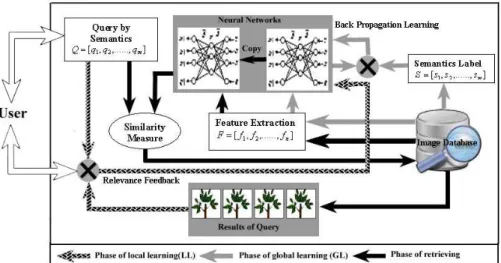
Figure 1: The proposed intelligent HIR system using neural nets
frequencies. Considering a tradeoff between the dimen-sionality curse and fidelity of information, we apply a par-tition technique as shown by an example in Figure 2 where the coefficients are grouped into 7 categories based on loca-tion attribute, for computing the local statistics of the DCT coefficients.
Semantics within an image can be extracted manually, and we use a semantic label vector,S = [s1, s2, . . . , sm],
to represent the presence or absence of semantics within the image, wheremis the number of semantics concerned and predefined by domain experts, andsitakes binary values.
For example, S = [1,0,1]can be interpreted as that the image contains semantics 1 and 3, but it does not contain semantics 2.
Figure 2: DCT transformation
2.3 Off-line Semantics Modelling
The purpose of off-line semantics modeling is to associate the low-level visual features with the semantic concepts contained in images. A feedforward neural net is employed to implement this task because of its power of learning, generalization and adaption [15].
LetG = {(F, S)} be a collection of feature-semantic-label pairs. The neural net used in this study is with three layer architecture, i.e., input layer, hidden layer and out-put layer. Sigmoid activation function, σ(x) = [1 + exp(−x)]−1, is used at both the hidden layer and the out-put layer. In order to improve the generalization capability
of the neural net, a regularized hybrid training algorithm is adopted [16]. The objective function in this algorithm is given by
E1= P
Gkσ(σ(F wN)wL)−Sk2
+λT r(wT
NwN+wLwTL),
(1)
wherewN is the hidden layer weights; wL is the output
layer weights; λis a regularizing parameter; andT r(M)
represents the trace of a matrixM.
2.4 Query Representation and Similarity
Measurement
Distinguishing from other neural net based image retrieval systems, the query in our proposed system is specified by an indicator vector Q = [q1, q2, . . . qm], where qk takes
binary values with 1(0) representing the presence (don’t care) of a semantic concept contained in the target images. During the retrieval process, the low-level features are fed into the well-trained neural net, and it gives real number outputs in [0,1], denoted byO = [o1, o2, . . . , om]. We
de-fine a similarity measureD(Q, O)by a weighted dot prod-uct (DP), that is,
D(Q, O) =
m
X
k=1
αkqkok, (2)
whereαk ≥ 0, subjected to
P
αk = 1, is a weighting
factor which reflects the emphases on different semantics related to a specific query. In our simulations, we take these factors equally.
2.5 On-line Memory Bank Updating with
User’s Relevance Feedback
1. Asqk =uk = 0, the user “do not care” this semantic
item. The retrieved image does not contain the cor-responding semantic item or it contains this item but the user does not mark it. For this case, the updat-ing of the weights associated to thek-th output of the neural net is irrelevant to further improve the retrieval performance.
2. Asqk= 0, uk= 1, the user “do not care” this
seman-tic item, but the retrieved image contains this item and the user also marks it in the feedback vector. It is like a byproduct to supervise the neural net to refine its memory.
3. As qk = 1, uk = 0, this semantic item is what the
user expects. Unfortunately, the retrieved image does not contain it.
4. As qk = 1, uk = 1, this semantic item is what
the user expects and the retrieved image satisfies the user’s requirement.
Summarizing the above four cases, the on-line learning will take place only for the weights associated to the out-puts withqk∨uk= 1, where “∨” represents the logic “OR”
operator. In such a way, the objective function (1) for on-line learning is modified as:
E2= X
G0
ZΘZT +λT r(wT
NwN +wLwLT), (3)
whereZ =σ(σ(F0w
N)wL)−U;G0 ={(F0, U)}
repre-sents a collection of feature-semantic-lable pairs from the retrieved images;Θ =diag{q1∨u1, q2∨u2, . . . , qm∨um}.
3 Performance Evaluation
3.1 Experimental Setup
The proposed HIR system has been implemented using C++ and evaluated by an artificial image database with 355 nature scene images containing following semantic con-cepts: Rock, Water, Tree, Sky and Human. Table 1 and Table 2 show some basic statistics of the database. For ex-ample, in Table 1 , there are 165 images containing rocks;
3 Semantics 99
4 Semantics 50
5 Semantics 11
in Table 2 , there are 125 images containing 2 semantic concepts.
For evaluation purpose, each image was transformed into 9 different images. The transformation detail is given in Table 3. So totally there are 3,550 images in the testing database. Because a single train-and-test experiment may generate misleading performance estimates when the sam-ple size is relatively small, a 5-fold cross validation scheme was used to evaluate the performance of the retrieval sys-tem. For each fold, we partition the database into training dataset (1,775 images) and test dataset (1,775 images) ran-domly.
Table 3: Transformation Methods
Method Parameters
1 Resize 0.8
2 Resize 1.2
3 Rotation (Clockwise) 90◦ 4 Rotation (Clockwise) 180◦ 5 Rotation (Clockwise) 270◦ 6 Salt-Pepper Noise 0.03 7 Gaussian Noise µ= 0,σ= 0.06
8 Vertical Mirror 9 Horizontal Mirror
The visual features used in our system are comprised of 9 color moments and 42 local statistics of the DCT coeffi-cients for three-color channels, i.e., the mean and the vari-ance of the DCT coefficients in the 7 sub-regions for three color channels. A neural net with an architecture 51-30-5 is employed in the HIR system. The training program runs 10,000 epochs without the momentum term and with a learning rate as 0.1 for the off-line learning.
in the database. A higher value ofprecisiontherefore indi-cates that the top-ranked hits more target images. Because of the database used in this study, the standardrecalland precisioncalculation formulas cannot be directly applied to characterize the system performance. Therefore, we used a modifiedrecallcalculation formula where a variable win-dow size is used for each group of images. The winwin-dow size takes the number of images having the same semantics as the query. Another measure adopted in this evaluation is the so-called mean rankµ, which is defined by
µ= N(N+ 1)
2PNi=1rank(i) (4)
whererank(i)is the rank of the relevant imagei(i.e., po-sition of retrieved relevant imageiin the retrieved images), which is an integer between 1 and 1,775 in this case study, andN is the number of total relevant images in the test database.
3.2 Results and Analysis
Figure 3: Performance without any RF
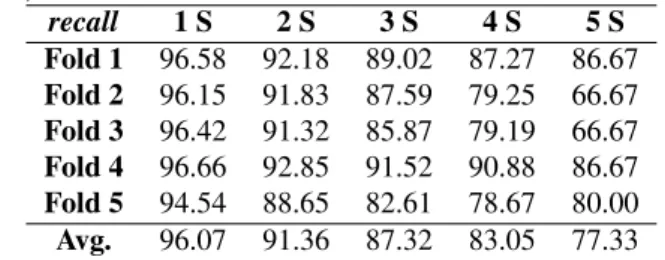
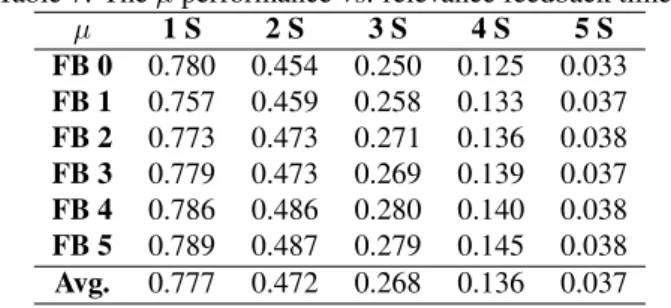
The results shown in this section for a certain number of semantic concepts are the average rates for all possible combination, for example, 2 S (2 semantic concepts) is the average performance for all 2 semantic concepts combina-tion, including< Rock, T ree >,< Rock, W ater >and etc. During the retrieval process, 5 times of RF were ap-plied using the variable windows for each group images, and the neural net was trained for 300 epochs without the momentum term and with a learning rate as 0.1 for on-line updating. Figures 3 and 4 show the system perfor-mance for a specific query utilizing two semantic concepts: “Rock” and “Cloud”. Tables 4 and 5 show recall andµ performances of the proposed HIR system for the training datasets. It indicates the semantics modelling power of the neural net. Tables 6 and 7 showrecallandµperformances for the test datasets with various times of RF. It can be seen that the recall performance has been gradually enhanced through the use of the RFs. It is observed that the average
Figure 4: Performance after 5 times of RF
recallrates for queries with different semantics monoton-ically decrease with the increased number of semantics in the images. This sounds logical and reasonable because adding complexity will result in some loss of system per-formance. Forµ, there is little improvement as the RF is applied. The main reason for this is of the lack of positive examples from the retrieved items for the RF. The feedback activity only happens for the firstNretrieved images. The relevant images located in the rear of retrieval queue is the “dead zone” and can not be activated for the RF. Therefore, it is a significant technique to inspire some relevant images from the rear of retrieval queue in the database for on-line learning.
Table 4: TheRecallperformance for the training datasets (%)
recall 1 S 2 S 3 S 4 S 5 S Fold 1 96.58 92.18 89.02 87.27 86.67 Fold 2 96.15 91.83 87.59 79.25 66.67 Fold 3 96.42 91.32 85.87 79.19 66.67 Fold 4 96.66 92.85 91.52 90.88 86.67 Fold 5 94.54 88.65 82.61 78.67 80.00 Avg. 96.07 91.36 87.32 83.05 77.33
Table 5: Theµperformance for the training datasets
µ 1 S 2 S 3 S 4 S 5 S
Fold 1 0.931 0.764 0.635 0.414 0.113 Fold 2 0.923 0.735 0.568 0.368 0.084 Fold 3 0.935 0.759 0.588 0.366 0.086 Fold 4 0.943 0.787 0.697 0.633 0.388 Fold 5 0.912 0.732 0.577 0.464 0.342 Avg. 0.929 0.755 0.613 0.449 0.203
Table 7: Theµperformance vs. relevance feedback times
µ 1 S 2 S 3 S 4 S 5 S
FB 0 0.780 0.454 0.250 0.125 0.033 FB 1 0.757 0.459 0.258 0.133 0.037 FB 2 0.773 0.473 0.271 0.136 0.038 FB 3 0.779 0.473 0.269 0.139 0.037 FB 4 0.786 0.486 0.280 0.140 0.038 FB 5 0.789 0.487 0.279 0.145 0.038 Avg. 0.777 0.472 0.268 0.136 0.037
*FBm- m times of relevance feedback
1 to 5 times of RF, which are believed as being objective. Therecallandµperformance increase obviously when the feedback window size varies from 1 to 2. However, when the window size keeps increasing, the system performances tend to be flat. We also observed that the feedback window size has no obvious impact on 5 semantic concepts. This could be related to the limited number of images to be re-trieved in the database.
Table 8: Average Recallperformance vs. the number of feedback images (%)
Recall 1 S 2 S 3 S 4 S 5 S
WSR 1 81.65 69.20 61.08 55.23 48.22 WSR 2 88.10 77.54 67.42 59.13 48.22 WSR 3 87.95 78.07 68.64 58.93 48.22 WSR 4 87.74 78.36 69.66 59.77 47.33 WSR 5 87.81 78.51 69.12 61.21 48.22
3.3 A Comparative Study
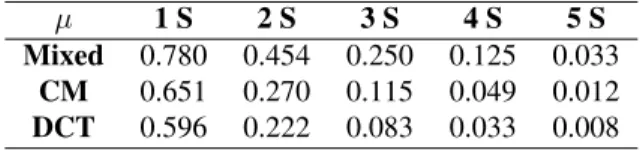
In this comparative study, we investigated the effect of the features and similarity metrics used in the HIR system. Three different feature sets, that is, the colour moment (CM) features, DCT features and the mixed features, are examined under the HIR system framework, respectively. The same datasets are used and the performance results are obtained by averaging a 5-fold runs. Uisng the colour
Table 10:Recallperformance comparison for different fea-tures using the training datasets (%)
recall 1 S 2 S 3 S 4 S 5 S Mixed 96.07 91.36 87.32 83.05 77.33
CM 67.39 30.53 17.47 8.29 4.00 DCT 66.47 21.12 8.73 4.53 0.00
moment features, a 9-dimension feature vector is extracted from each image. Correspondingly, a neural net with an architecture of 9-20-5 is employed. For the DCT features, a neural net with an architecture of 42-30-5 is employed, since 42 local statistics are extracted from the coefficients of the DCT in the 7 sub-regions. The neural nets were trained off-line for 10,000 epochs with learning rate as 0.1. Tables 10 and 11 show the system performances for the training datasets with the different features. Tables 12 and 13 show the system performances for the test datasets with the different features. It is remarkable that the system per-formance using the mixed features is much better than that obtained by the separated ones.
The system performances produced by the DP similar-ity measure and theLp(p= 1,2,∞)norms are compared.
Notice that the “0” elements in a query do not means “ab-sence” but “do’not care”, therefore a non-standardLpnorm
is applied, that is,
DLp(Q, O) = (
m
X
k=1
qk|qk−ok|p)1/p, (5)
where Q =< q1, q2, . . . , qm > and O =< o1, o2, . . . , om > are the query indicator vector and the
neural net’s output, respectively.
Table 11:µperformance comparison for different features using the training datasets
µ 1 S 2 S 3 S 4 S 5 S
Table 12:Recallperformance comparison for different fea-tures using the test datasets (%)
recall 1 S 2 S 3 S 4 S 5 S Mixed 80.79 64.69 53.10 45.11 34.67
CM 67.21 30.65 18.80 8.61 1.33 DCT 63.70 19.93 7.16 3.13 0.00
Table 13:µperformance comparison for different features using the test datasets
µ 1 S 2 S 3 S 4 S 5 S
Mixed 0.780 0.454 0.250 0.125 0.033 CM 0.651 0.270 0.115 0.049 0.012 DCT 0.596 0.222 0.083 0.033 0.008
Tables 14 and 15 show the retrieval performances for the training datasets with the different similarity metrics. Ta-bles 16 and 17 report the results for the test datasets. It can be seen that the system performances obtained by the Dot product,L2andL∞norms are comparable, whereas the results from theL1norm is poor compared with others.
3.4 Robustness Analysis
Model reliability or robustness with respect to the model parameters shift is meaningful. A higher reliability implies a relaxed requirement to the solution constraints. Con-versely, if the model reliability is weak, then the variation scope of the parameters becomes limited. This makes the process of achieving a feasible solution more complicated or difficult. For neural nets, the model parameters are the weights, the solution refers to a set of specified weights obtained through learning, and the constraints may be the learning rate and/or the terminal conditions. To investigate the HIR system reliability, we generate a random matrix, namely,Mnoise, whose size equals the weight matrix and
its elements are uniformly distributed in (−1,1). Then, perturbed weight matrices can be obtained byWnoise =
(I+δMnoise).∗W at 10 different levels, i.e., theδvaries
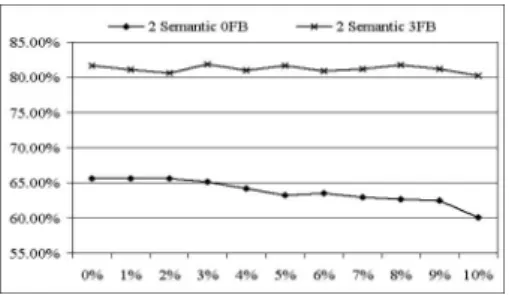
from 1% to 10%. Figures 5 and 6 show the effects of the model noise to the memory bank for the training datasets. A comparative study on the functionality of the RF to dif-ferent levels of noise was investigated. Three times of RF
Table 14: Recallperformance comparison for the training datasets (%)
recall 1 S 2 S 3 S 4 S 5 S
DP 96.07 91.36 87.32 83.05 77.33 L1 61.17 40.61 43.37 61.00 77.33
L2 96.07 91.38 87.38 83.31 77.33
L∞ 96.07 91.39 87.39 83.31 77.33
Table 15: µ performance comparison for the training datasets
µ 1 S 2 S 3 S 4 S 5 S
DP 0.929 0.755 0.613 0.449 0.203 L1 0.598 0.341 0.283 0.332 0.203
L2 0.929 0.758 0.618 0.4455 0.192
L∞ 0.929 0.722 0.495 0.253 0.046
Table 16: Recall performance comparison for the test datasets (%)
recall 1 S 2 S 3 S 4 S 5 S
DP 80.79 64.69 53.10 45.11 34.67 L1 56.93 34.42 30.04 36.61 34.67
L2 80.79 64.70 52.99 44.85 34.67
L∞ 80.79 64.68 52.95 44.93 34.67
were applied for the queries with different number of se-mantic concpets. Figures 7 and 8 depict the performances for 2 semantic concepts. They show that the HIR system is more robust to the model noise as the RF technique is employed.
4 Concluding Remarks
A hybrid scheme for content-based intelligent image re-trieval is proposed in this paper. Our main technical contri-butions are (i) the framework of a new intelligent image retrieval scheme using neural nets; (ii) the modified ob-jective function for on-line memory bank updating using user’s relevance feedback and query information; and (iii) the robustness analysis and comparative studies. Simula-tion results demonstrate that the interactive relevance feed-back with on-line learning strategy could enhance the re-call performance in the HIR system. However, it is quite limited for improving the µ performance. This may be largely caused by the lack of suitable teacher signals (im-ages) during the feedback learning process, and/or the scale constraint of our image database used in this study. It is be-lieved that the µ performance of the HIR system will be increased by using some typical images from “dead zone”, i.e., the set of images in the database whose elements have no chance to be retrieved for some specific queries.
It is interesting to see the effects of false relevance
feed-Table 17:µperformance comparison for the test datasets
µ 1 S 2 S 3 S 4 S 5 S
DP 0.780 0.454 0.250 0.125 0.033 L1 0.544 0.266 0.161 0.116 0.033
L2 0.780 0.462 0.257 0.128 0.033
Figure 6:µperformance vs. 10 noise levels for the training datasets
Figure 7: recallperformance vs. 10 noise levels for the test datasets with 2 semantics
Figure 8: µ performance vs. 10 noise levels for the test datasets with 2 semantics
[2] J. Wu (1997) Content-based indexing of multimedia databases,IEEE Trans. On Knowledge and Data En-gineering, vol. 6, pp. 978–989.
[3] Y. Rui, T. S. Huang, and S. F. Chang (1999) Image re-trieval: Current techniques and promising directions and open issues, Journal of Visual Communication and Image Representation, vol. 10, pp. 39–62.
[4] F. Crestani and G. Pasi (2000) Soft Computing in Information Retrieval: techniques and applications, Physica Verlag (Springer Verlag).
[5] A. Yoshitaka and T. Ichikawa (1999) A survey on content-based retrieval for multimedia databases, IEEE Trans. On Knowledge and Data Engineering, vol. 11, pp. 81-93.
[6] S. Santin, and R. Jain (1999) Similarity measures, IEEE Trans. On Pattern Analysis and Machine Intel-ligence, vol. 21, pp. 871–883.
[7] Y. Riu, T. Hunag, M. Ortega, and S. Mehrotra (1998) Relevance feedback: A power tool for interactive content-based image retrieval, IEEE Trans. On Cir-cuit and Systems. for Video Technology, vol. 5, pp. 644–656.
[8] X. S. Zhou and T. S. Huang (2002) Relevance feed-back in content-based image retrieval: some recent advances, Information Sciences-Applications-An In-ternational Journal, vol. 148, pp.129–137.
[9] H. Lee and S. Yoo (2001) Intelligent image retrieval using neural network, IEICE Trans. on Information and Systems, vol. 12, pp. 1810–1819.
[10] T. Ikeda and M. Hagiwara (2000) Content-based im-age retrieval system using neural networks, Interna-tional Journal of Neural Systems, vol. 5, pp. 417–424.
[12] G. D. Guo, A. K. Jain, W. Y. Ma, and H. J. Zhang (2002) Learning similarity measure for natural im-age retrieval with relevance feedback, IEEE Trans. On Neural Networks, vol. 13, pp. 811–820.
[13] V. Aditya, A. T. Mario,K. J. Anil, and H. J. Zhang (2001) Image classification for content-based index-ing,IEEE Trans. On Image Processing, vol. 10, pp. 117–130.
[14] D. Wang and X. Ma (2004) Learning pseudo metric for multimedia data classification and retrieval,Proc. Knowledge-Based Intelligent Information & Engi-neering Systems, LNAI 3213, vol. 1, pp. 1051–1057.
[15] D. E. Rumelhart, G. E. Hinton and R. J. Willianms (1986) Learning representations of back-propagation errors,Nature, vol. 323, pp. 533–536.