MuTUAL: A Controlled Authoring Support System
Enabling Contextual Machine Translation
Rei Miyata The University of Tokyo [email protected]
C´ecile Paris Data61, CSIRO
Anthony Hartley Rikkyo University
Masao Utiyama NICT
Kyo Kageura The University of Tokyo
Eiichiro Sumita NICT
Abstract
The paper introduces a web-based authoring support system, MuTUAL, which aims to help writers create multilingual texts. The highlighted feature of the system is that it enables machine translation (MT) to generate outputs appropriate to their functional context within the target doc-ument. Our system is operational online, implementing core mechanisms for document structur-ing and controlled writstructur-ing. These include a topic template and a controlled language authorstructur-ing assistant, linked to our statistical MT system.
1 Introduction
For improved machine translatability, a wide variety of controlled language (CL) rule sets have been proposed (Kittredge, 2003; Kuhn, 2014). Evidence of reduced post-editing costs when a CL is employed is provided (Bernth and Gdaniec, 2001; O’Brien and Roturier, 2007), and several controlled authoring support tools, such as Acrolinx1and MAXIT2, have been developed. The fundamental limitation of the CLs proposed hitherto is, however, that they are defined at the level of the sentence rather than at the level of the document (Hartley and Paris, 2001). In fact, the notion of functional document element (see Section 2.1) does figure in some CL rule sets. ASD Simplified Technical English (ASD, 2013), for ex-ample, specifies writing patterns linked to functional roles of the document elements; the recommended maximum length of sentence is 20 words for ‘procedural’ writing and 25 words for ‘descriptive’ writing. Yet, the granularity of the elements is not high enough to enable detailed definitions of linguistic pat-terns within the elements. Thus it is necessary to formalise a document-level framework which enables context-dependent CL specification.
In this paper, we introduce an integrated web-based system,MuTUAL, which implements a suite of controlled authoring support modules, combined with our statistical machine translation (SMT) system. At the document level, document structuring modules help authors create well-organised documents. At the sentence level, controlled writing modules help them write source texts (ST) consistent with source-language CL rules. The principal innovation in the system is to contextualise the CL rules in the document structure to enable MT to generate outputs consistent with the target-side CL for a given functional element. While the current system supports the creation of municipal procedural documents in Japanese and their translation into English, it is extensible to other language pairs and text domains. 2 Contextual Translation
MuTUAL starts from the observation that the same source sentence should be translated as different tar-get sentences depending on its location within the functional elements of the document. Let us consider this example Japanese sentence from a procedural technical manual: ‘文書を印刷する/bunsho o insatsu
suru’. This sentence can appear as a task title in a section heading or as a step description in an itemi-sation, and should be translated, respectively, as ‘To print a document’ or ‘Print the document’. That is, the translation depends on the item’s functional role within the document.
This work is licensed under a Creative Commons Attribution 4.0 International Licence. Licence details: http:// creativecommons.org/licenses/by/4.0/
1http://www.acrolinx.com/
2http://www.smartny.com/maxit.html/
DITA element inBody(default) Specified functional element
Prereq information the user needs to know before
starting Personal conditionEvent condition Item condition
Context background information Explanation (Summary, Purpose, Expiration of validity, Penalty, Related concept)
Steps main content: a series of steps Necessary items to bring Place to go
Form(s) to complete
[image:2.595.80.525.60.213.2]Result expected outcome Result (Period for procedure, Items to be is-sued, Contact from local government) Postreq steps to do after completion of current task Guidance to other procedures
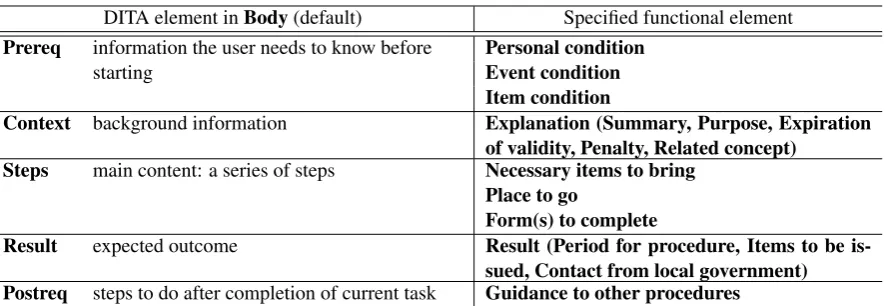
Table 1: Instantiation of the DITA Task topic
To realise contextual translation using MT, we (1) formulated a document structure for municipal procedures based on the Darwin Information Typing Architecture (DITA) framework (OASIS, 2010), and (2) defined context-dependent CL rules in both source and target languages according to the functional document elements, in combination with ST transformation rules.
2.1 Functional Task Elements
DITA is an XML architecture for authoring and publishing technical information which supports struc-tured authoring to help writers compose a modularised chunk of information, calledtopic(Bellamy et al., 2012). A topic has a hierarchical structure of functional elements, i.e., elements which play certain com-municative roles within the documents, and, at the highest level, is composed of the common elements: Title,Short description,Prologue,BodyandRelated-links.
According to topic types, DITA further defines more specific elements under theBodyelement. DITA provides by default several topic types such asConcept topic,Reference topicandTask topic. We focus here on the Task topic, which is designed for describing technical procedures, because what we are concerned is mainly municipal procedures. The left column in Table 1 shows the functional elements under theBodyof Task topic (OASIS, 2010).
Note that the functional elements of the Task topic as defined in DITA are still too coarse-grained to properly organise municipal procedures and specify detailed linguistic patterns for each element. How-ever, DITA allows for ‘specialisation’, so we undertook a genre analysis of actual municipal documents and assigned fine-grained sub-elements (the right column of Table 1).
2.2 Context-dependent CL with Pre-translation Processing
At this stage, the DITA structure provides a language-independent functional framework, which helps authors identify what information should be included. It is, however, still unclear how to write and translate each element. In order to instantiate the elements as texts, we defined context-dependent CL rules, i.e., desired linguistic patterns, for each element on both source and target sides.
For example, Event conditionrequires a conditional clause such as ‘日本に来たとき/nihon ni kita
toki’ (when you arrive in Japan). We also assigned a rather strict pattern forStepselement, polite speech style with declarative form ‘します/shimasu’ in Japanese and imperative form ‘do’ in English, such as ‘以下の書類を持参します/ika no shorui o jizan shimasu’ (Bring the following documents), while the constraint is relaxed inContext,ResultandPostreq.
* To bring the following documents. Bring the following documents. Transform ‘shimasu’ into ‘shiro’
Pre-translation processing
MT MT
以下の書類を持参します。
(ika no shorui o jisan-shimasu)
* 以下の書類を持参しろ。 (ika no shorui o jisan-shiro) S T 1
MT 1 MT 2
[image:3.595.86.509.62.125.2]S T 2
Figure 1: Pre-translation processing forSteps(* undesirable sentence)
CL authoring assistant ‒ CL rules ‒ Terminology
Similar text
search databaseTopic
Document database
Terminology
database Municipalweb sites Multilingual parallel term extraction translat ion back t rans lation M T dic tion ar y check search search alert
archive editreuse
MT (+TM) Pre-translation processing Topic template Map organiser
Controlled
Writing
Document
Structuring
Multilingualisation
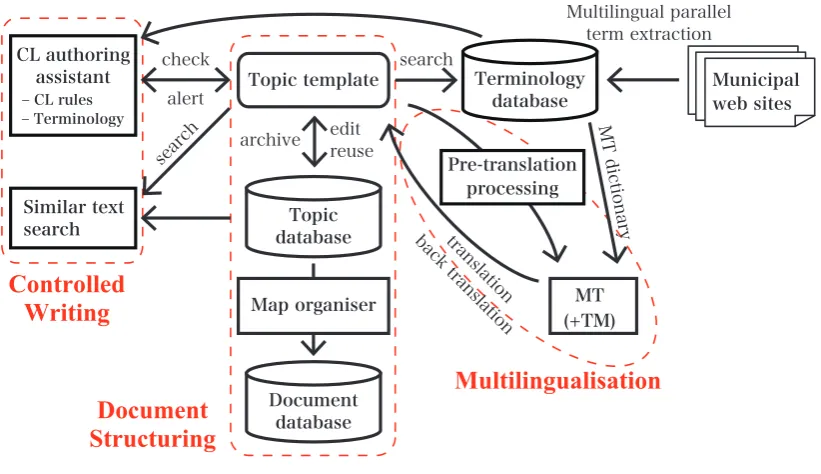
Figure 2: Modules of MuTUAL
MT2, which complies with the target side CL rule, with the use of the imperative form ‘do’. ST1is served to Japanese readers andMT2to English readers. This process can be fully automated by defining simple transformation rules based on the morphological analysis of ST,3on condition that the linguistic patterns of the ST are sufficiently controlled in conjunction with functional elements.
3 The MuTUAL System
The MuTUAL system comprises modules for document structuring, controlled writing, and multilin-gualisation (see Figure 2). The following modules realise the contextual translation we have outlined:
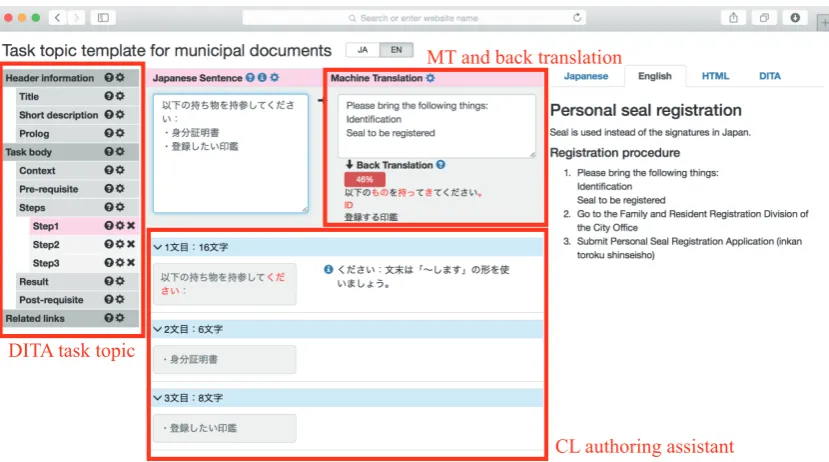
• Topic template is the core interface for authoring self-contained topics in a structured manner. The left pane in Figure 3 provides the basic DITA Task topic structure for composing municipal procedural documents.
• CL authoring assistantanalyses each sentence in the text box and highlights any segment that vio-lates a local CL rule or controlled terminology, together with diagnostic comments and suggestions for rewriting (shown at bottom centre in Figure 3) (Miyata et al., 2016). In addition, we have imple-mented a preliminary rewriting support function with several of the features advocated by Mitamura et al. (2003). For a particular CL-noncompliant segment, the function offers alternative expressions; clicking one of the suggestions automatically replaces the offending segment in the text box above.
• Pre-translation processingautomatically modifies source segments in the background following transformation rules defined for each functional element, and thenMTproduces the translation and back-translation at the same time.
[image:3.595.89.500.166.403.2]DITA task topic
[image:4.595.91.506.60.291.2]CL authoring assistant MT and back translation
Figure 3: Task topic template for authoring municipal procedures
The key mechanism for enhancing authoring and translation is to invoke the CL authoring assistant tuned to the current functional element. For example, only for theSteps elements of the template, it implements the rule ‘use declarative formshimasuat the end of the sentence’. Then the pre-translation processing forStepstransforms the declarative ‘shimasu’ into an imperative ‘shiro’ for our MT system to produce the desired imperative form ‘do’ on the target side.
The modules above are implemented in PHP and JavaScript, and can be accessed through the usual web browsers. The topic template seamlessly connects with our SMT system, TexTra,4the dictionary of which is customised by municipal terminology we maintain. We plan to publish an open-source version of the system through our project website.5
4 Conclusions and Future Work
We have presented a web-based support system for authoring municipal procedural documents. The prin-cipal novel feature of the system is that it makes use of document structuring based on the DITA frame-work, which affords a basis for fine-grained context-dependent CL rules coupled with pre-translation processing. It consequently enables MT to generate outputs appropriate to their functional context with-out degrading the quality of the source.
MuTUAL is currently operational online, focusing on the Task topic for creating municipal procedural documents in Japanese and English. The implemented CL rules were shown to be effective in triggering more appropriate outputs from our SMT system (Miyata et al., 2015). Also, a preliminary user evaluation revealed that the controlled authoring assistant module helped reduce time correcting CL-violations by more than 30%. As a future evaluation plan, while previous work has tended to focus on sentence-level text quality, we intend to evaluate the document-sentence-level quality of the system products by adopting task-based methods (Colineau et al., 2002). We will eventually make the system available to municipal departments and assess its usability in actual work scenarios.
4TexTra is a state-of-the-art SMT system particularly intended for Japanese as source language, and provides free API.
https://mt-auto-minhon-mlt.ucri.jgn-x.jp
Acknowledgements
This work was supported by JSPS KAKENHI Grant Number 16J11185 and by the Research Grant Program of KDDI Foundation, Japan.
References
ASD. 2013. ASD Simplified Technical English. Specification ASD-STE100, Issue 6. http://www.asd-ste100.org. Laura Bellamy, Michelle Carey, and Jenifer Schlotfeldt. 2012. DITA Best Practices: A Roadmap for Writing,
Editing, and Architecting in DITA. IBM Press.
Arendse Bernth and Claudia Gdaniec. 2001. MTranslatability.Machine Translation, 16(3):175–218.
Nathalie Colineau, C´ecile Paris, and Keith Vander Linden. 2002. An evaluation of procedural instructional text. InProceedings of the International Natural Language Generation Conference, pages 128–135, New York. Anthony Hartley and C´ecile Paris. 2001. Translation, controlled languages, generation. In Erich Steiner and Colin
Yallop, editors,Exploring Translation and Multilingual Text production, pages 307–325. Mouton, Berlin. Richard Kittredge. 2003. Sublanguages and controlled languages. In Ruslan Mitkov, editor,Oxford Handbook of
Computational Linguistics, pages 430–437. Oxford University Press, Oxford.
Tobias Kuhn. 2014. A survey and classification of controlled natural languages. Computational Linguistics, 40(1):121–170.
Teruko Mitamura, Kathryn Baker, Eric Nyberg, and David Svoboda. 2003. Diagnostics for interactive controlled language checking. InProceedings of the 4th Workshop on Controlled Language Applications (CLAW 2003), pages 237–244, Dublin, Ireland.
Rei Miyata, Anthony Hartley, C´ecile Paris, Midori Tatsumi, and Kyo Kageura. 2015. Japanese controlled language rules to improve machine translatability of municipal documents. InProceedings of the Machine Translation Summit XV, pages 90–103, Miami, USA.
Rei Miyata, Anthony Hartley, C´ecile Paris, and Kyo Kageura. 2016. Evaluating and implementing a controlled language checker. In Proceedings of the 6th International Workshop on Controlled Language Applications (CLAW 2016), pages 30–35, Portoro˘z, Slovenia.
OASIS. 2010. Darwin Information Typing Architecture (DITA) Version 1.2. http://docs.oasis-open.org/dita/v1.2/os/spec/DITA1.2-spec.html.