Volume 2008, Article ID 579416,17pages doi:10.1155/2008/579416
Review Article
Biometric Template Security
Anil K. Jain, Karthik Nandakumar, and Abhishek Nagar
Department of Computer Science and Engineering, Michigan State University, 3115 Engineering Building, East Lansing, MI 48824, USA
Correspondence should be addressed to Karthik Nandakumar,[email protected] Received 2 July 2007; Revised 28 September 2007; Accepted 4 December 2007
Recommended by Arun Ross
Biometric recognition offers a reliable solution to the problem of user authentication in identity management systems. With the widespread deployment of biometric systems in various applications, there are increasing concerns about the security and privacy of biometric technology. Public acceptance of biometrics technology will depend on the ability of system designers to demonstrate that these systems are robust, have low error rates, and are tamper proof. We present a high-level categorization of the various vulnerabilities of a biometric system and discuss countermeasures that have been proposed to address these vulnerabilities. In par-ticular, we focus on biometric template security which is an important issue because, unlike passwords and tokens, compromised biometric templates cannot be revoked and reissued. Protecting the template is a challenging task due to intrauser variability in the acquired biometric traits. We present an overview of various biometric template protection schemes and discuss their advantages and limitations in terms of security, revocability, and impact on matching accuracy. A template protection scheme with provable security and acceptable recognition performance has thus far remained elusive. Development of such a scheme is crucial as bio-metric systems are beginning to proliferate into the core physical and information infrastructure of our society.
Copyright © 2008 Anil K. Jain et al. This is an open access article distributed under the Creative Commons Attribution License, which permits unrestricted use, distribution, and reproduction in any medium, provided the original work is properly cited.
1. INTRODUCTION
A reliable identity management system is urgently needed in order to combat the epidemic growth in identity theft and to meet the increased security requirements in a variety of ap-plications ranging from international border crossings to se-curing information in databases. Establishing the identity of a person is a critical task in any identity management system. Surrogate representations of identity such as passwords and ID cards are not sufficient for reliable identity determination because they can be easily misplaced, shared, or stolen. Bio-metric recognition is the science of establishing the identity of a person using his/her anatomical and behavioral traits. Commonly used biometric traits include fingerprint, face, iris, hand geometry, voice, palmprint, handwritten signa-tures, and gait (seeFigure 1). Biometric traits have a number of desirable properties with respect to their use as an authen-tication token, namely, reliability, convenience, universality, and so forth. These characteristics have led to the widespread deployment of biometric authentication systems. But there are still some issues concerning the security of biometric recognition systems that need to be addressed in order to en-sure the integrity and public acceptance of these systems.
There are five major components in a generic biomet-ric authentication system, namely, sensor, feature extrac-tor, template database, matcher, and decision module (see Figure 2). Sensor is the interface between the user and the authentication system and its function is to scan the bio-metric trait of the user. Feature extraction module processes the scanned biometric data to extract the salient information (feature set) that is useful in distinguishing between diff er-ent users. In some cases, the feature extractor is preceded by a quality assessment module which determines whether the scanned biometric trait is of sufficient quality for fur-ther processing. During enrollment, the extracted feature set is stored in a database as a template (XT) indexed by the user’s identity information. Since the template database could be geographically distributed and contain millions of records (e.g., in a national identification system), maintain-ing its security is not a trivial task. The matcher module is usually an executable program, which accepts two biomet-ric feature setsXT andXQ (from template and query, resp.) as inputs, and outputs a match score (S) indicating the sim-ilarity between the two sets. Finally, the decision module makes the identity decision and initiates a response to the query.
Face Fingerprint Iris Hand geometry
Palmprint Signature Voice Gait
Figure 1: Examples of body traits that can be used for biometric
recognition. Anatomical traits include face, fingerprint, iris, palm-print, hand geometry, and ear shape; while gait, signature, and keystroke dynamics are some of the behavioral characteristics. Voice can be considered either as an anatomical or as a behavioral charac-teristic.
Due to the rapid growth in sensing and computing tech-nologies, biometric systems have become affordable and are easily embedded in a variety of consumer devices (e.g., mo-bile phones, key fobs, etc.), making this technology vulner-able to the malicious designs of terrorists and criminals. To avert any potential security crisis, vulnerabilities of the bio-metric system must be identified and addressed systemati-cally. A number of studies have analyzed potential security breaches in a biometric system and proposed methods to counter those breaches [1–5]. Formal methods of vulnera-bility analysis such as attack trees [6] have also been used to study how biometric system security can be compromised.
In this paper, we first summarize the various aspects of biometric system security in a holistic and systematic man-ner using the fish-bone model [7]. Our goal here is to broadly categorize the various factors that cause biometric system failure and identify the effects of such failures. This paper is not necessarily complete in terms of all the security threats that have been identified, but it provides a high-level classi-fication of the possible security threats. We believe that tem-plate security is one of the most crucial issues in designing a secure biometric system and it demands timely and rigorous attention. Towards this end, we present a detailed overview of different template protection approaches that have been proposed in the literature and provide example implemen-tations of specific schemes on a public domain fingerprint database to illustrate the issues involved in securing biomet-ric templates.
2. BIOMETRIC SYSTEM VULNERABILITY
A fish-bone model (seeFigure 3) can be used to summarize the various causes of biometric system vulnerability [1]. At the highest level, the failure modes of a biometric system can be categorized into two classes: intrinsic failure and
fail-ure due to an adversary attack. Intrinsic failfail-ures occur due
to inherent limitations in the sensing, feature extraction, or matching technologies as well as the limited
discriminabil-ity of the specific biometric trait. In adversary attacks, a re-sourceful hacker (or possibly an organized group) attempts to circumvent the biometric system for personal gains. We further classify the adversary attacks into three types based on factors that enable an adversary to compromise the system security. These factors include system administration, nonse-cure infrastructure, and biometric overtness.
2.1. Intrinsic failure
Intrinsic failure is the security lapse due to an incorrect de-cision made by the biometric system. A biometric verifica-tion system can make two types of errors in decision making, namely, false accept and false reject. A genuine (legitimate) user may be falsely rejected by the biometric system due to the large differences in the user’s stored template and query biometric feature sets (seeFigure 4). These intrauser varia-tions may be due to incorrect interaction by the user with the biometric system (e.g., changes in pose and expression in a face image) or due to the noise introduced at the sen-sor (e.g., residual prints left on a fingerprint sensen-sor). False accepts are usually caused by lack of individuality or unique-ness in the biometric trait which can lead to large similar-ity between feature sets of different users (e.g., similarity in the face images of twins or siblings). Both intrauser varia-tions and interuser similarity may also be caused by the use of nonsalient features and nonrobust matchers. Sometimes, a sensor may fail to acquire the biometric trait of a user due to limits of the sensing technology or adverse environmental conditions. For example, a fingerprint sensor may not be able to capture a good quality fingerprint of dry/wet fingers. This leads to failure-to-enroll (FTE) or failure-to-acquire (FTA) errors.
Intrinsic failures can occur even when there is no explicit effort by an adversary to circumvent the system. So this type of failure is also known as zero-effort attack. It poses a serious
threat if the false accept and false reject probabilities are high (see Table 1). Ongoing research is directed at reducing the probability of intrinsic failure, mainly through the design of new sensors that can acquire the biometric traits of an indi-vidual in a more reliable, convenient, and secure manner, the development of invariant representation schemes and robust and efficient matching algorithms, and use of multibiometric systems [8].
2.2. Adversary attacks
Here, an adversary intentionally stages an attack on the bio-metric system whose success depends on the loopholes in the system design and the availability of adequate computational and other resources to the adversary. We categorize the ad-versary attacks into three main classes: administration attack, nonsecure infrastructure, and biometric overtness.
(i) Administration attack
This attack, also known as the insider attack, refers to all vulnerabilities introduced due to improper administration of the biometric system. These include the integrity of the
User Enrollment User identity,I Biometric sensor T Quality assessment module Feature extractor XT System database User Authentication Claimed identity,I Biometric sensor Q Quality assessment module Feature extractor XQ Matcher XT System database Decision module S Match/nonmatch
Figure 2: Enrollment and recognition stages in a biometric system. Here,Trepresents the biometric sample obtained during enrollment,Q
is the query biometric sample obtained during recognition,XTandXQare the template and query feature sets, respectively, andSrepresents
the match score.
Table 1: False reject and false accept rates associated with state-of-the-art fingerprint, face, voice, and iris verification systems. Note that the
accuracy estimates of biometric systems are dependent on a number of test conditions and target population.
Biometric trait Test Test conditions False reject rate False accept rate
Fingerprint FVC 2006 [9]
Heterogeneous population including manual
workers and elderly people 2.2% 2.2%
FpVTE 2003 [10] US government operational data 0.1% 1%
Face FRVT 2006 [11] Controlled illumination, high resolution 0.8%–1.6% 0.1%
Voice NIST 2004 [12] Text independent, multi-lingual 5–10% 2–5%
Iris ICE 2006 [11] Controlled illumination, broad-quality range 1.1%–1.4% 0.1%
enrollment process (e.g., validity of credentials presented during enrollment), collusion (or coercion) between the ad-versary and the system administrator or a legitimate user, and abuse of exception processing procedures.
(ii) Nonsecure infrastructure
The infrastructure of a biometric system consists of hard-ware, softhard-ware, and the communication channels between the various modules. There are a number of ways in which an adversary can manipulate the biometric infrastructure that can lead to security breaches. A detailed discussion on these types of attacks is presented inSection 2.4.
(iii) Biometric overtness
It is possible for an adversary to covertly acquire the biomet-ric characteristics of a genuine user (e.g., fingerprint impres-sions lifted from a surface) and use them to create physical artifacts (gummy fingers) of the biometric trait. Hence, if the biometric system is not capable of distinguishing between a
live biometric presentation and an artificial spoof, an adver-sary can circumvent the system by presenting spoofed traits.
2.3. Effects of biometric system failure
When a biometric system is compromised, it can lead to two main effects: (i) denial-of-service and (ii) intrusion.
Denial-of-service refers to the scenario where a legitimate
user is prevented from obtaining the service that he is en-titled to. An adversary can sabotage the infrastructure (e.g., physically damage a fingerprint sensor) thereby preventing users from accessing the system. Intrinsic failures like false reject, failure-to-capture, and failure-to-acquire also lead to denial-of-service. Administrative abuse such as modification of templates or the operating parameters (e.g., matching threshold) of the biometric system may also result in denial-of-service.
Intrusion refers to an impostor gaining illegitimate access
to the system, resulting in loss of privacy (e.g., unauthorized access to personal information) and security threats (e.g., terrorists crossing borders). All the four factors that cause biometric system vulnerability, namely, intrinsic failure,
Intrinsic failure Individuality of biometric trait Sensor/representation/ matcher limitations Exception processing Administration Insider attack Enrollment fraud Biometric system failure Hill climbing Replay Steal/modify templates Function creep Trojan horse Nonsecure infrastructure Spoofing Biometric overtness
Figure 3: Fish-bone model for categorizing biometric system vulnerabilities (adapted from [1]).
Figure 4: Illustration of biometric intraclass variability. Two di
ffer-ent impressions of the same finger obtained on differffer-ent days are shown with minutia points marked on them. Due to translation, rotation, and distortion, the number and location of minutiae in the two images are different. The number of minutiae in the left and right images is 33 and 26, respectively. The number of common minutiae in the two images is 16 and few of these correspondences have been indicated in the figure.
administrative abuse, nonsecure infrastructure, and biomet-ric overtness, can result in intrusion.
2.4. Countering adversary attacks
Adversary attacks generally exploit the system vulnerabil-ities at one or more modules or interfaces. Ratha et al. [13] identified eight points of attack in a biometric system (see Figure 5). We group these attacks into four categories,
namely, (i) attacks at the user interface (input level), (ii) at-tacks at the interfaces between modules, (iii) atat-tacks on the modules, and (iv) attacks on the template database.
2.5. Attacks at the user interface
Attack at user interface is mostly due to the presentation of a spoof biometric trait [14–17]. If the sensor is unable to dis-tinguish between fake and genuine biometric traits, the ad-versary easily intrudes the system under a false identity. A number of efforts have been made in developing hardware as well as software solutions that are capable of performing liveness detection [18–26].
2.6. Attacks at the interface between modules
An adversary can either sabotage or intrude on the commu-nication interfaces between different modules. For instance, he can place an interfering source near the communication channel (e.g., a jammer to obstruct a wireless interface). If the channel is not secured physically or cryptographically, an adversary may also intercept and/or modify the data being transferred. For example, Juels et al. [27] outlined the secu-rity and privacy issues introduced by insecure communica-tion channels in an e-passport applicacommunica-tion that uses biomet-ric authentication. Insecure communication channels also al-low an adversary to launch replay [28] or hill-climbing at-tacks [29].
Stored templates
Sensor extractorFeature Matcher (e.g., cash dispenser)Application device Yes/no 1. Fake biometric 2. Replay old data 3. Override feature extractor 4. Synthesized feature vector 5. Override matcher 6. Modify template 7. Intercept the channel
8. Override final decision
Figure 5: Points of attack in a generic biometric system (adapted from [13]).
A common way to secure a channel is by cryptographi-cally encoding all the data sent through the interface, say us-ing public key infrastructure. But even then, an adversary can stage a replay attack by first intercepting the encrypted data passing through the interface when a genuine user is inter-acting with the system and then sending this captured data to the desired module whenever he wants to break into the sys-tem. A countermeasure for this attack is to use time-stamps [30,31] or a challenge/response mechanism [32].
2.7. Attacks on the software modules
The executable program at a module can be modified such that it always outputs the values desired by the adversary. Such attacks are known as Trojan-horse attacks. Secure code execution practices [33] or specialized hardware which can enforce secure execution of software should be used. An-other component of software integrity relates to algorith-mic integrity. Algorithalgorith-mic integrity implies that the software should be able to handle any input in a desirable manner. As an example of algorithmic loophole, consider a matching module in which a specific input value, sayX0, is not handled
properly and wheneverX0is input to the matcher, it always
outputs a match (accept) decision. This vulnerability might not affect the normal functioning of the system because the probability ofX0being generated from a real-biometric
data may be negligible. However, an adversary can exploit this loophole to easily breach the security without being noticed.
2.8. Attacks on the template database
One of the most potentially damaging attack on a biometric system is against the biometric templates stored in the system database. Attacks on the template can lead to the following three vulnerabilities. (i) A template can be replaced by an im-postor’s template to gain unauthorized access. (ii) A physical spoof can be created from the template (see [34–36]) to gain unauthorized access to the system (as well as other systems which use the same biometric trait). (iii) The stolen template can be replayed to the matcher to gain unauthorized access. A potential abuse of biometric identifiers is cross-matching or
function creep [37] where the biometric identifiers are used
for purposes other than the intended purpose. As an exam-ple, a fingerprint template stolen from a bank’s database may be used to search a criminal fingerprint database or cross-link to person’s health records.
The most straightforward way to secure the biometric system, including the template, is to put all the system mod-ules and the interfaces between them on a smart card (or more generally a secure processor). In such systems, known as match-on-card or system-on-card technology, sensor, fea-ture extractor, matcher, and template reside on the card [38]. The advantage of this technology is that the biometric infor-mation never leaves the card. However, system-on-card so-lutions are not appropriate for most large-scale applications; they are expensive and users must carry the card with them all the time. Further, it is possible that the template can be gleaned from a stolen card. So it is important to protect the template even in match-on-card applications. Passwords and PIN have the property that if they are compromised, the sys-tem administrator can issue a new one to the user. It is desir-able to have the same property of revocability or cancelabil-ity with biometric templates. The following section provides a detailed description of the approaches that have been pro-posed for securing biometric templates.
3. TEMPLATE PROTECTION SCHEMES
An ideal biometric template protection scheme should pos-sess the following four properties [39].
(1) Diversity: the secure template must not allow cross-matching across databases, thereby ensuring the user’s privacy.
(2) Revocability: it should be straightforward to revoke a compromised template and reissue a new one based on the same biometric data.
(3) Security: it must be computationally hard to obtain the original biometric template from the secure template. This property prevents an adversary from creating a physical spoof of the biometric trait from a stolen tem-plate.
(4) Performance: the biometric template protection scheme should not degrade the recognition perfor-mance (FAR and FRR) of the biometric system.
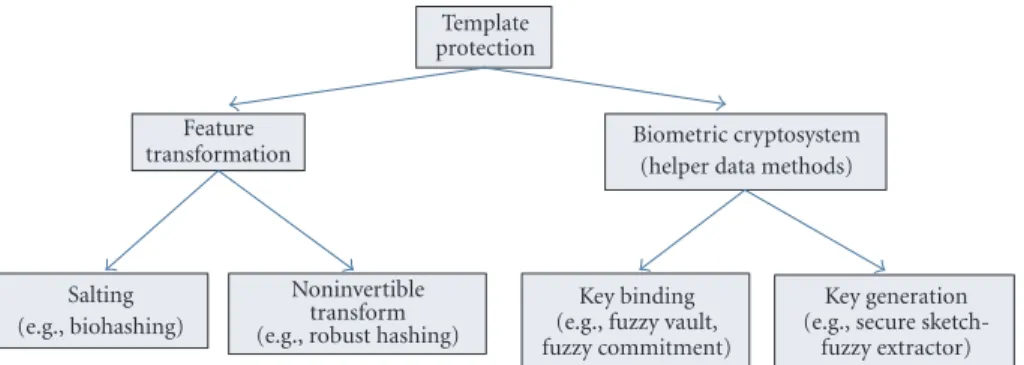
Template protection
Feature
transformation Biometric cryptosystem(helper data methods)
Salting (e.g., biohashing)
Noninvertible transform (e.g., robust hashing)
Key binding (e.g., fuzzy vault, fuzzy commitment)
Key generation (e.g., secure
sketch-fuzzy extractor)
Figure 6: Categorization of template protection schemes.
Enrollment Authentication Biometric template (T) Transform F Key (K) Transformed template F(T,K) Matching F(Q,K) Match/ nonmatch Transform F Key (K) Biometric query (Q)
Figure 7: Authentication mechanism when the biometric template is protected using a feature transformation approach.
The major challenge in designing a biometric template protection scheme that satisfies all the above requirements is the need to handle intrauser variability in the acquired biometric identifiers. Recall that multiple acquisitions of the same biometric trait do not result in the same feature set (see Figure 4). Due to this reason, one cannot store a bio-metric template in an encrypted form (using standard en-cryption techniques like RSA, AES, etc.) and then perform matching in the encrypted domain. Note that encryption is not a smooth function and a small difference in the values of the feature sets extracted from the raw biometric data would lead to very large difference in the resulting encrypted fea-tures. While it is possible to decrypt the template and per-form matching between the query and decrypted template, such an approach is not secure because it leaves the template exposed during every authentication attempt. Hence, stan-dard encryption techniques are not useful for securing bio-metric templates.
The template protection schemes proposed in the lit-erature can be broadly classified into two categories (see Figure 6), namely, feature transformation approach and
bio-metric cryptosystem. In the feature transform approach, a
transformation function (F) is applied to the biometric tem-plate (T) and only the transformed temtem-plate (F(T;K)) is stored in the database (seeFigure 7). The parameters of the transformation function are typically derived from a ran-dom key (K) or password. The same transformation func-tion is applied to query features (Q) and the transformed query (F(Q;K)) is directly matched against the transformed template (F(T;K)). Depending on the characteristics of the
transformation functionF, the feature transform schemes can be further categorized as salting and noninvertible
trans-forms. In salting,F is invertible, that is, if an adversary gains access to the key and the transformed template, she can re-cover the original biometric template (or a close approxima-tion of it). Hence, the security of the salting scheme is based on the secrecy of the key or password. On the other hand, noninvertible transformation schemes typically apply a one-way function on the template and it is computationally hard to invert a transformed template even if the key is known.
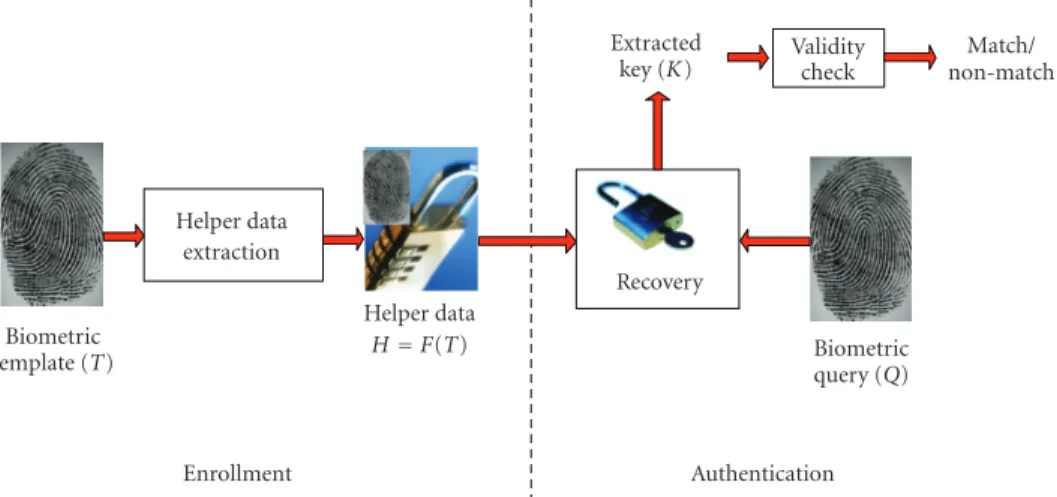
Biometric cryptosystems [40,41] were originally devel-oped for the purpose of either securing a cryptographic key using biometric features or directly generating a crypto-graphic key from biometric features. However, they can also be used as a template protection mechanism. In a biometric cryptosystem, some public information about the biometric template is stored. This public information is usually referred to as helper data, and hence biometric cryptosystems are also known as helper data-based methods [42]. While the helper data does not (is not supposed to) reveal any significant in-formation about the original biometric template, it is needed during matching to extract a cryptographic key from the query biometric features. Matching is performed indirectly by verifying the validity of the extracted key (seeFigure 8). Error correction coding techniques are typically used to han-dle intrauser variations.
Biometric cryptosystems can be further classified as
key-binding and key generation systems depending on how the
helper data is obtained. When the helper data is obtained by binding a key (that is independent of the biometric features)
Biometric template (T) Helper data extraction Helper data H=F(T) Enrollment Authentication Recovery Biometric query (Q) Extracted key (K) Validity check Match/ non-match
Figure 8: Authentication mechanism when the biometric template is secured using a key generation biometric cryptosystem. Authentication
in a key-binding biometric cryptosystem is similar except that the helper data is a function of both the template and the keyK, that is, H=F(T;K).
Table 2: Summary of different template protection schemes. Here,Trepresents the biometric template,Qrepresents the query, andKis the
key used to protect the template. In salting and noninvertible feature transform,F represents the transformation function, andMrepresents the matcher that operates in the transformed domain. In biometric cryptosystems,F is the helper data extraction scheme andMis the error correction scheme that allows reconstruction of the keyK.
Approach What imparts security to the
template? What entities are stored?
How are intrauser variations handled?
Salting Secrecy of keyK
Public domain: transformed templateF(T;K)
Secret: KeyK
Quantization and matching in transformed domain
M(F(T;K),F(Q;K)) Noninvertible transform Noninvertibility of the
transformation functionF
Public domain: transformed templateF(T;K), keyK
Matching in transformed domain
M(F(T;K),F(Q;K)) Key-binding biometric
cryptosystem
Level of security depends on the amount of information revealed by the helper dataH
Public domain: helper data H=F(T;K)
Error correction and user specific quantization
K=M(F(T;K),Q) Key-generating biometric
cryptosystem
Level of security depends on the amount of information revealed by the helper dataH
Public domain: helper data H=F(T)
Error correction and user specific quantization
K=M(F(T),Q)
with the biometric template, we refer to it as a key-binding
biometric cryptosystem. Note that given only the helper data,
it is computationally hard to recover either the key or the original template. Matching in a key-binding system involves recovery of the key from the helper data using the query bio-metric features. If the helper data is derived only from the biometric template and the cryptographic key is directly gen-erated from the helper data and the query biometric features, it leads to a key generation biometric cryptosystem.
Some template protection techniques make use of more than one basic approach (e.g., salting followed by key-binding). We refer to such techniques as hybrid schemes. Template protection schemes proposed in [43–46] are exam-ples of the hybrid approach. A brief summary of the various template protection approaches is presented inTable 2. Apart from salting, none of the other template protection schemes requires any secret information (such as a key) that must be
securely stored or presented during matching. We will now discuss these four approaches in detail with one illustrative method for each approach.
3.1. Salting
Salting or Biohashing is a template protection approach in
which the biometric features are transformed using a func-tion defined by a user-specific key or password. Since the transformation is invertible to a large extent, the key needs to be securely stored or remembered by the user and pre-sented during authentication. This need for additional infor-mation in the form of a key increases the entropy of the bio-metric template and hence makes it difficult for the adversary to guess the template. (Entropy of a biometric template can be understood as a measure of the number of different iden-tities that are distinguishable by a biometric system.)
Advantages
(1) Introduction of key results in low false accept rates. (2) Since the key is user-specific, multiple templates for
the same user biometric can be generated by using dif-ferent keys (allowing diversity). Also in case a template is compromised, it is easy to revoke the compromised template and replace it with a new one generated by us-ing a different user-specific key (allowing revocability). Limitations
(1) If the user-specific key is compromised, the template is no longer secure, because the transformation is usually invertible, that is, if an adversary gains access to the key and the transformed template, she can recover the original biometric template.
(2) Since matching takes place in the transformed domain, the salting mechanism needs to be designed in such a way that the recognition performance does not de-grade, especially in the presence of large intrauser vari-ations.
An example of salting approach is the random multi-space quantization technique proposed by Teoh et al. [47]. In this technique, the authors first extract the most native projections of the face template using Fisher discrimi-nant analysis [48] and then project the obtained vectors on a randomly selected set of orthogonal directions. This random projection defines the salting mechanism for the scheme. To account for intrauser variations, the feature vector obtained after random projection is binarized. The threshold for bi-narization is selected based on the criteria that the expected number of zeros in the template is equal to the expected number of ones so as to maximize the entropy of the tem-plate. Note that the security in this scheme is provided by the user-specific random projection matrix. If an adversary gains access to this matrix, she can obtain a coarse (some in-formation is lost due to binarization) estimate of the biomet-ric template. Similar biohashing schemes have been proposed for iris [49] and palmprint [50] modalities. Another example of salting is the cancelable face-filter approach proposed in [51] where user-specific random kernels are convolved with the face images during enrollment and authentication.
3.2. Noninvertible transform
In this approach, the biometric template is secured by ap-plying a noninvertible transformation function to it. Non-invertible transform refers to a one-way function,F, that is “easy to compute” (in polynomial time) but “hard to invert” (givenF(x), the probability of findingxin polynomial time is small). The parameters of the transformation function are defined by a key which must be available at the time of au-thentication to transform the query feature set. The main characteristic of this approach is that even if the key and/or the transformed template are known, it is computationally hard (in terms of brute force complexity) for an adversary to recover the original biometric template.
Advantages
(1) Since it is hard to recover the original biometric tem-plate even when the key is compromised, this scheme provides better security than the salting approach. (2) Diversity and revocability can be achieved by using
application-specific and user-specific transformation functions, respectively.
Limitations
(1) The main drawback of this approach is the tradeoff between discriminability and noninvertibility of the transformation function. The transformation function should preserve the discriminability (similarity struc-ture) of the feature set, that is, just like in the origi-nal feature space, features from the same user should have high similarity in the transformed space, and fea-tures from different users should be quite dissimilar after transformation. On the other hand, the transfor-mation should also be noninvertible, that is, given a transformed feature set, it should be hard for an ad-versary to obtain the original feature set (or a close approximation of it). It is difficult to design transfor-mation functions that satisfy both the discriminability and noninvertibility conditions simultaneously. More-over, the transformation function also depends on the biometric features to be used in a specific application. Intrauser variations can be handled either by using trans-formation functions that are tolerant to input variations (e.g., robust hashing [53]) or by using noninvertible trans-formation functions that leave the biometric template in the original (feature) space even after the transformation (e.g., fingerprint minutiae can be transformed into another set of minutiae in a noninvertible manner). In the latter scenario, intrauser variations can be handled by applying the same biometric matcher on the transformed features as on the original feature set. Templates that lie in the same space after the application of a noninvertible transform have been re-ferred to as cancelable templates in [32]. Noninvertible trans-formation functions have been proposed for fingerprint [52] and face [54] modalities in the literature.
Ratha et al. [52] proposed and analyzed three noninvert-ible transforms for generating cancelable fingerprint tem-plates. The three transformation functions are cartesian, po-lar, and functional. These functions were used to transform fingerprint minutiae data such that a minutiae matcher can still be applied to the transformed minutiae. In cartesian transformation, the minutiae space (fingerprint image) is tessellated into a rectangular grid and each cell (possibly con-taining some minutiae) is shifted to a new position in the grid corresponding to the translations set by the key. The po-lar transformation is simipo-lar to cartesian transformation with the difference that the image is now tessellated into a number of shells and each shell is divided into sectors. Since the size of sectors can be different (sectors near the center are smaller than the ones far from the center), restrictions are placed on the translation vector generated from the key so that the ra-dial distance of the transformed sector is not very different
(a) (b)
(c) (d)
Figure 9: Illustration of Cartesian and polar transformation functions used in [52] for generating cancelable biometrics. (a) Original
minu-tiae on radial grid; (b) transformed minuminu-tiae after polar transformation; (c) original minuminu-tiae on rectangular grid; and (d) transformed minutiae after Cartesian transformation.
than the radial distance of the original position. Examples of minutiae prior to and after polar and cartesian transforma-tions are shown inFigure 9.
For the functional transformation, Ratha et al. [52] used a mixture of 2D Gaussians and electric potential field in a 2D random charge distribution as a means to translate the minu-tiae points. The magnitude of these functions at the point corresponding to a minutia is used as a measure of the mag-nitude of the translation and the gradient of a function is used to estimate the direction of translation of the minutiae.
In all the three transforms, two or more minutiae can possi-bly map to the same point in the transformed domain. For example, in the cartesian transformation, two or more cells can be mapped onto a single cell so that even if an adver-sary knows the key and hence the transformation between cells, he cannot determine the original cell to which a minu-tia belongs because each minuminu-tiae can independently belong to one of the possible cells. This provides a limited amount of noninvertibility to the transform. Also since the transforma-tions used are locally smooth, the error rates are not affected
significantly and the discriminability of minutiae is preserved to a large extent.
3.3. Key-binding biometric cryptosystem
In a key-binding cryptosystem, the biometric template is se-cured by monolithically binding it with a key within a cryp-tographic framework. A single entity that embeds both the key and the template is stored in the database as helper data. This helper data does not reveal much information about the key or the biometric template, that is, it is computationally hard to decode the key or the template without any knowl-edge of the user’s biometric data. Usually the helper data is an association of an error correcting code (selected using the key) and the biometric template. When a biometric query differs from the template within certain error tolerance, the associated codeword with similar amount of error can be re-covered, which can be decoded to obtain the exact codeword, and hence recover the embedded key. Recovery of the correct key implies a successful match.
Advantages
(1) This approach is tolerant to intrauser variations in bio-metric data and this tolerance is determined by the er-ror correcting capability of the associated codeword. Limitations
(1) Matching has to be done using error correction schemes and this precludes the use of sophisticated matchers developed specifically for matching the orig-inal biometric template. This can possibly lead to a re-duction in the matching accuracy.
(2) In general, biometric cryptosystems are not designed to provide diversity and revocability. However, at-tempts are being made to introduce these two prop-erties into biometric cryptosystems mainly by using them in conjunction with other approaches such as salting [43,45,55].
(3) The helper data needs to be carefully designed; it is based on the specific biometric features to be used and the nature of associated intrauser variations.
Fuzzy commitment scheme [56] proposed by Juels and Wattenberg is a well-known example of the key binding ap-proach. During enrollment, we commit (bind) a codewordw of an error-correcting codeCusing a fixed-lengthbiometric feature vectorxas the witness. Given a biometric templatex, the fuzzy commitment (or the helper data) consists ofh(w) andx−w, wherehis a hash function [57]. During verifi-cation, the user presents a biometric vectorx. The system subtracts x −w stored in the database from x to obtain w=w+δ, whereδ=x−x. Ifxis close tox,wis close to wsincex−x=w−w. Therefore,wcan now be decoded to obtain the nearest codeword which would bewprovided that the distance betweenwandwis less than the error cor-recting capacity of the codeC. Reconstruction ofwindicates a successful match.
A number of other template protection techniques like fuzzy vault [58], shielding functions [59], and distributed source coding [60] can be considered as key binding bio-metric cryptosystems. Other schemes for securing biobio-metric templates such as the ones proposed in [61–65] also fall un-der this category. The fuzzy vault scheme proposed by Juels and Sudan [58] has become one of the most popular ap-proaches for biometric template protection and its imple-mentations for fingerprint [66–70], face [71], iris [72], and signature [73] modalities have been proposed.
3.4. Key generating biometric cryptosystem
Direct cryptographic key generation from biometrics is an attractive proposition but it is a difficult problem because of the intrauser variability. Early biometric key generation schemes such as those by Chang et al. [74] and Veilhauer et al. [75] employed user-specific quantization schemes. In-formation on quantization boundaries is stored as helper data which is used during authentication to account for intrauser variations. Dodis et al. [76, 77] introduced the concepts of secure sketch and fuzzy extractor in the con-text of key generation from biometrics. The secure sketch can be considered as helper data that leaks only limited in-formation about the template (measured in terms of en-tropy loss), but facilitates exact reconstruction of the tem-plate when presented with a query that is close to the template. The fuzzy extractor is a cryptographic primi-tive that generates a cryptographic key from the biometric features.
Dodis et al. [76,77] proposed secure sketches for three different distance metrics, namely, Hamming distance, set difference, and edit distance. Li and Chang [78] introduced a two-level quantization-based approach for obtaining secure sketches. Sutcu et al. [79] discussed the practical issues in se-cure sketch construction and proposed a sese-cure sketch based on quantization for face biometric. The problem of generat-ing fuzzy extractors from continuous distributions was ad-dressed by Buhan et al. [80]. Secure sketch construction for other modalities such as fingerprints [81,82], 3D face [83], and multimodal systems (face and fingerprint) [84] has also been proposed. Protocols for secure authentication in remote applications [85,86] have also been proposed based on the fuzzy extractor scheme.
Key generating biometric cryptosystems usually suffer from low discriminability which can be assessed in terms of
key stability and key entropy. Key stability refers to the extent
to which the key generated from the biometric data is repeat-able. Key entropy relates to the number of possible keys that can be generated. Note that if a scheme generates the same key irrespective of the input template, it has high key stabil-ity but zero entropy leading to high false accept rate. On the other hand, if the scheme generates different keys for diff er-ent templates of the same user, the scheme has high er-entropy but no stability and this leads to high false reject rate. While it is possible to derive a key directly from biometric features, it is difficult to simultaneously achieve high key entropy and high key stability.
(a) (b)
10010. . .01110 (80 bits)
(c)
(d) (e) (f)
Figure 10: Template protection schemes implemented on a fingerprint template. (a) Fingerprint image, (b) fingercode template (texture
features) corresponding to the image in (a), (c) fingercode template after salting, (d) minutiae template corresponding to the image in (a), (e) minutiae template after noninvertible functional transformation, and (f) minutiae template hidden among chaffpoints in a fuzzy vault. Advantages
(1) Direct key generation from biometrics is an appealing template protection approach which can also be very useful in cryptographic applications.
Limitations
(1) It is difficult to generate key with high stability and en-tropy.
4. IMPLEMENTATION OF TEMPLATE SECURITY APPROACHES
While good implementations of salting [47], noninvertible transform [52], and key binding biometric cryptosystem [45] are available in the literature, key generation biometric cryptosystems with high key entropy and stability have been more difficult to implement in practice [79,81,82]. For il-lustration purposes, we provide implementations of the first three template protection schemes for fingerprint templates
(seeFigure 10). Biometric vendors typically have their own template formats that may contain some proprietary features in order to improve the matching accuracy. For example, a fingerprint minutiae template can consist of attributes such as ridges counts, minutia type, quality of the minutia in ad-dition to standard attributes, namely,xcoordinate,y coor-dinate, and minutiae angle. In our implementation, we con-sider only the commonly used fingerprint features such as texture features andx,yand angle attributes of the minutiae. To evaluate the performance of the three implementa-tions, we used a public-domain fingerprint database, namely, the FVC2002-DB2. This database [87] consists of 800 images of 100 fingers with 8 impressions per finger obtained using an optical sensor. The size of the images in this database is 560×296, the resolution of the sensor is 569 dpi and the im-ages are generally of good quality. Our goal here is not to de-termine the superiority of one template protection method over the other but to simply highlight the various issues that need to be considered in implementing a template protec-tion scheme. Of course, performance varies depending on
the choice of the biometric modality, database, and the values of the parameters used in each scheme.
4.1. Salting
We chose the random multispace quantization (RMQ) tech-nique proposed by Teoh et al. [47] to secure the texture (fin-gercode) features described in [88]. The fingercode features were selected for this implementation, because the RMQ technique works only on fixed-length feature vectors. In this implementation, we considered the first four impressions from each finger in the FVC2002-DB2. Since the algorithm requires alignment of fingerprint images prior to the appli-cation of Fisher discriminant analysis, we align the different impressions of a finger with respect to the first impression us-ing minutiae and find the common (overlappus-ing) fus-ingerprint region in all the four impressions. Texture features were ex-tracted only for the common region, and the remaining im-age region was masked out.
Since our implementation inherently uses information from all the impressions of a finger (by extracting a common region from all the impressions and by doing FDA based on all the finger impressions) and then using the same images for testing (resubstitution method of error estimation), it has excellent performance (0% EER). In our implementation, we used 80 bits to represent the final feature vector. The corre-sponding ROC curves are shown inFigure 11. It can be in-ferred from the results that in case the key is secure, the im-postor and genuine distributions have little overlap leading to near 0% EER. In cases where the impostor does know (or guesses) the true key, the performance of the system is close to the case when no RMQ technique is applied. Further, if the adversary knows the key, original biometric template can be recovered by him.
4.2. Noninvertible transform
We implemented two noninvertible transforms, namely, po-lar and functional (with a mixture of Gaussian as the trans-formation function) defined in [52]. For the polar transform, the central region of the image was tesselated into n = 6 sectors of equal angular width and 30-pixel-wide concentric shells. The transformation here is constrained such that it only shifts the sector number of the minutiae without chang-ing the shell. There aren! ways in which thensectors in each shell can be reassigned. Given k shells in the image (con-strained by the width of the image and ignoring the central region of radius 15 pixels), the number of different ways a transformation can be constructed is (n!)kwhich is equiva-lent to log2(n!)kbits of security.
For the functional transformation, we used a mixture of 24 Gaussians with the same isotropic standard deviation of 30 pixels (where the peaks can correspond to +1 or−1 as used in [52]) for calculating the displacement and used the direction of gradient of the mixture of Gaussian function as the direction of minutiae displacement. Since the mean vec-tor of the Gaussians can fall anywhere in the image, there are 296×560 possible different values of means of each Gaussian component. As there are 24 Gaussian components and each
10 20 30 40 50 60 70 80 90 100 Gen u ine ac ce pt ra te (%) 10−2 10−1 100 101 102
False accept rate (%) Original
RMQ (insecure key) RMQ (secure key)
Figure 11: ROC curves of random multispace quantization (RMQ)
[47] using the texture features proposed in [88]. The “Original” curve corresponds to the matcher using the Euclidean distance be-tween texture features of query and template; “Insecure Key” curve corresponds to the case when the impostor knows the key (used to generate the random feature space); “Secure Key” curve corre-sponds to the case when the impostor does not know the key.
one can peak at +1 or−1, there are (296∗560∗2)24possible transformations. However, two transformations with slightly shifted component means will produce two similar templates such that one template can be used to verify the other.
To analyze the security of the functional transformation, Ratha et al. [52] assumed that for each minutiae in the fin-gerprint, its transformed counterpart could be present in a shell of width d pixels at a distance of K pixels from the minutiae. Further, assuming that the matcher cannot distin-guish minutiae that are within δr pixels and their orienta-tions are withinδθdegrees, each transformed minutiae en-codesIm=log2(π(((K+d)2−K2)/(δr)2)∗π/δθ) bits of in-formation. Assuming that there areNminutiae in template fingerprint and one needs to match at leastmminutiae to get accepted, the adversary needs to make 2Im∗m−log2((Nm))
at-tempts. Note that this analysis is based on the simplifying as-sumption that each minutia is transformed independently. This overestimates the number of attempts needed by an ad-versary to guess the biometric template.
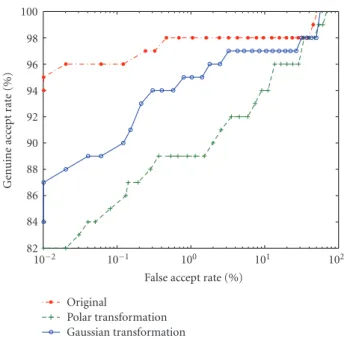
Among the eight impressions available for each of the 100 fingers in FVC2002-DB2, we use only the first two impres-sions in this experiment because they have the best image quality. The results, based on the minutiae matcher in [89], are shown in Figure 12which indicates a decrease in GAR for a fixed FAR. In terms of security, noninvertible transfor-mation is one of the better approaches since it is compu-tationally hard (in terms of brute force complexity) to in-vert the stored template and obtain the true template. The true template is never revealed especially in case when the
82 84 86 88 90 92 94 96 98 100 Gen u ine ac ce pt ra te (%) 10−2 10−1 100 101 102
False accept rate (%) Original
Polar transformation Gaussian transformation
Figure 12: ROC curves corresponding to two noninvertible
trans-forms (Gaussian and polar) on FVC2002-DB2. The “Original” curve represents the case where no transformation is applied to the template, “Gaussian” curve corresponds to the functional transfor-mation of the template, and “Polar” corresponds to the polar trans-formation of the template.
Table 3: Performance summary of the fuzzy vault implementation
for FVC2002-DB2 database. Here,ndenotes the degree of the en-coding polynomial used in vault construction. The maximum key size that can be bound to the minutiae template is 16nbits.
FTCR n=7 n=8 n=10
GAR FAR GAR FAR GAR FAR
2% 91% 0.13% 91% 0.01% 86 0%
transformation of the biometric template is done on a sep-arate module (possibly a handheld device [38]) which does not save the original template in memory and is not accessi-ble to an adversary.
4.3. Key-binding biometric cryptosystem
A fuzzy vault was chosen for implementation because con-crete implementations on real fingerprint data sets are not yet available for many of the other key-binding biometric cryp-tosystems. We implemented the fuzzy vault as proposed in [90] using the first two impressions of each of the 100 fin-gers in the FVC2002-DB2.Table 3shows the error rates cor-responding to different key sizes used in binding. Compared to the “original” ROC curve inFigure 12, we observe that the fuzzy vault scheme has a lower genuine accept rate by about 4%. Further, this scheme also has failure to capture errors if the number of minutiae in the fingerprint image is not suffi -cient for vault construction (minimum number of minutiae required in our implementation is 18).
Dodis et al. [76,77] defined the security of biometric cryptosystems in terms of the min-entropy of the helper data. In particular, they provided the bounds on min-entropy for the fuzzy vault construction in [58]. The security of the fuzzy vault scheme has also been studied by Chang et al. [91]. An advantage of the fuzzy vault (key binding) scheme is that instead of providing a “Match/Non-match” decision, the vault decoding outputs a key that is embedded in the vault. This key can be used in a variety of ways to authen-ticate a person (e.g., digital signature, document encryp-tion/decryption, etc.).
There are some specific attacks that can be staged against a fuzzy vault, that is, attacks via record multiplicity, stolen key
inversion attack, and blended substitution attack [92]. If an ad-versary has access to two different vaults (say from two dif-ferent applications) obtained from the same biometric data, he can easily identify the genuine points in the two vaults and decode the vault. Thus, the fuzzy vault scheme does not provide diversity and revocability. In a stolen key inver-sion attack, if an adversary somehow recovers the key em-bedded in the vault, he can decode the vault to obtain the biometric template. Since the vault contains a large num-ber of chaffpoints, it is possible for an adversary to substi-tute a few points in the vault using his own biometric fea-tures. This allows both the genuine user and the adversary to be successfully authenticated using the same identity and such an attack is known as blended substitution. To counter these attacks, Nandakumar et al. [45] proposed a hybrid ap-proach where (i) biometric features are first “salted” based on a user password, (ii) vault is constructed using the salted tem-plate, and (iii) the vault is encrypted using a key derived from the password. While salting prevents attacks via record mul-tiplicity and provides diversity and revocability, encryption provides resistance against blended substitution and stolen key inversion attacks.
4.4. Discussion
We believe that as yet there is no “best” approach for template protection. The application scenario and requirements play a major role in the selection of a template protection scheme. For instance, in a biometric verification application such as a bank ATM, a simple salting scheme based on the user’s PIN may be sufficient to secure the biometric template if we as-sume that both the transformed template and the user’s PIN will not be compromised simultaneously. On the other hand, in an airport watch-list application, noninvertible transform is a more suitable approach because it provides both template security and revocability without relying on any other input from the user. Biometric cryptosystems are more appropri-ate in match-on-card applications because such systems typ-ically release a key to the associated application in order to indicate a successful match.
The other major factors that influence the choice of a template protection scheme are the selected biometric trait, its feature representation, and the extent of intrauser vari-ations. Design of a template protection scheme depends on the specific type of biometric features used. While good noninvertible transforms have been proposed for fingerprint
minutiae features [52], it may be difficult to design a suitable noninvertible transformfor IrisCode representation [25]. In contrast, it may be easier to design a biometric cryptosys-tem for IrisCode because it is represented as a fixed-length binary string where standard error-correction coding tech-niques can be readily applied. Moreover, if the intrauser variations are quite large, it may not be possible to apply a noninvertible transform or create a biometric cryptosystem. Therefore, even in a specific application scenario and for a fixed biometric feature representation, more than one tem-plate protection scheme may be admissible, and the choice of the suitable approach may be based on a number of fac-tors such as recognition performance, computational com-plexity, memory requirements, and user acceptance and co-operation.
5. SUMMARY AND RESEARCH DIRECTIONS
Given the dramatic increase in incidents involving identity thefts and various security threats, it is imperative to have reliable identity management systems. Biometric systems are being widely used to achieve reliable user authentication, a critical component in identity management. But, biometric systems themselves are vulnerable to a number of attacks. In this paper, we have summarized various aspects of bio-metric system security and discussed techniques to counter these threats. Among these vulnerabilities, an attack against stored biometric templates is a major concern due to the strong linkage between a user’s template and his identity and the irrevocable nature of biometric templates. We have de-scribed various template protection mechanisms proposed in the literature and highlighted their strengths and limita-tions. Finally, specific implementations of these approaches on a common fingerprint database were presented to illus-trate the issues involved in implementing template security.
The available template protection schemes are not yet sufficiently mature for large scale deployment; they do not meet the requirements of diversity, revocability, security, and high-recognition performance. Further, the security analy-sis of existing schemes is mostly based on the complexity of brute force attacks which assumes that the distribution of biometric features is uniform. In practice, an adversary may be able to exploit the nonuniform nature of biometric fea-tures to launch an attack that may require significantly fewer attempts to compromise the system security. While we have pointed out some of the vulnerabilities in specific schemes such as fuzzy vault, a rigorous analysis of the cryptographic strength of the template security schemes similar to those available in the cryptanalysis literature has not been carried out till date. Such an analysis must be performed before the template security schemes are deployed in critical real-world applications.
A single template protection approach may not be suffi -cient to meet all the application requirements. Hence, hybrid schemes that make use of the advantages of the different tem-plate protection approaches must be developed. For instance, a scheme that secures a “salted” template using a biometric cryptosystem (e.g., [44–46]) may have the advantages of both salting (which provides high diversity and revocability) and
biometric cryptosystem (which provides high security) ap-proaches. Finally, with the growing interest in multibiomet-ric and multifactor authentication systems, schemes that si-multaneously secure multibiometric templates and multiple authentication factors (biometrics, passwords, etc.) need to be developed.
ACKNOWLEDGMENTS
This research was supported by Army Research Office con-tract W911NF-06-1-0418 and the Center for Identification Technology Research (CITeR), and NSF/IUCRC program. The authors would like to thank Salil Prabhakar, Sharath Pankanti, Andrew Teoh, and the anonymous reviewers for their feedback and useful suggestions.
REFERENCES
[1] A. K. Jain, A. Ross, and S. Pankanti, “Biometrics: a tool for in-formation security,” IEEE Transactions on Inin-formation Foren-sics and Security, vol. 1, no. 2, pp. 125–143, 2006.
[2] C. Roberts, “Biometric attack vectors and defences,” Comput-ers and Security, vol. 26, no. 1, pp. 14–25, 2007.
[3] M1.4 Ad Hoc Group on Biometric in E-Authentication, “Study report on biometrics in E-authentication,” Tech. Rep. INCITS M1/07-0185rev, International Committee for In-formation Technology Standards (INCITS), Washington, DC, USA, August 2007.
[4] I. Buhan and P. Hartel, “The state of the art in abuse of biomet-rics,” Tech. Rep. TR-CTIT-05-41, Centre for Telematics and Information Technology, University of Twente, Twente, The Netherlands, December 2005.
[5] A. K. Jain, A. Ross, and U. Uludag, “Biometric template secu-rity: challenges and solutions,” in Proceedings of the European Signal Processing Conference (EUSIPCO ’05), Antalya, Turkey, September 2005.
[6] B. Cukic and N. Bartlow, “Biometric system threats and coun-termeasures: a risk based approach,” in Proceedings of the Bio-metric Consortium Conference (BCC ’05), Crystal City, Va, USA, September 2005.
[7] K. Ishikawa, Guide to Quality Control, Nordica International, Tokyo, Japan.
[8] A. Ross, K. Nandakumar, and A. K. Jain, Handbook of Multi-biometrics, Springer, Berlin, Germany, 2006.
[9] Biometric System Laboratory - University of Bologna, “FVC2006: the 4th international fingerprint verification com-petition,” 2006,http://bias.csr.unibo.it/fvc2006/default.asp. [10] C. Wilson, A. R. Hicklin, M. Bone, et al., “Fingerprint vendor
technology evaluation 2003: summary of results and analysis report,” Tech. Rep. NISTIR 7123, National Institute of Stan-dards and Technology, Gaithersburg, Md, USA, June 2004. [11] P. J. Phillips, W. T. Scruggs, A. J. ´O Toole, et al., “FRVT 2006
and ICE 2006 large-scale results,” Tech. Rep. NISTIR 7408, Na-tional Institute of Standards and Technology, 2007.
[12] M. Przybocki and A. Martin, “NIST speaker recognition eval-uation chronicles,” in Proceedings of Odyssey: The Speaker and Language Recognition Workshop, pp. 12–22, Toledo, Spain, May 2004.
[13] N. K. Ratha, J. H. Connell, and R. M. Bolle, “An analysis of minutiae matching strength,” in Proceedings of the 3rd
Interna-tional Conference on Audio- and Video-Based Biometric Person Authentication (AVBPA ’01), pp. 223–228, Halmstad, Sweden, June 2001.
[14] T. Matsumoto, H. Matsumoto, K. Yamada, and S. Hoshino, “Impact of artificial “gummy” fingers on fingerprint systems,” in Optical Security and Counterfeit Deterrence Techniques IV, vol. 4677 of Proceedings of SPIE, pp. 275–289, San Jose, Calif, USA, January 2002.
[15] T. Matsumoto, M. Hirabayashi, and K. Sato, “A vulnerability evaluation of iris matching (part 3),” in Proceedings of the Sym-posium on Cryptography and Information Security (SCIS ’04), pp. 701–706, Iwate, Japan, January 2004.
[16] W. R. Harrison, Suspect Documents, Their Scientific Examina-tion, Nelson-Hall, Chicago, Ill, USA, 1981.
[17] A. Eriksson and P. Wretling, “How flexible is the human voice? A case study of mimicry,” in Proceedings of the European Con-ference on Speech Technology (Eurospeech ’97), pp. 1043–1046, Rhodes, Greece, September 1997.
[18] S. T. V. Parthasaradhi, R. Derakhshani, L. A. Hornak, and S. A. C. Schuckers, “Time-series detection of perspiration as a live-ness test in fingerprint devices,” IEEE Transactions on Systems, Man and Cybernetics Part C, vol. 35, no. 3, pp. 335–343, 2005. [19] A. Antonelli, R. Cappelli, D. Maio, and D. Maltoni, “Fake fin-ger detection by skin distortion analysis,” IEEE Transactions on Information Forensics and Security, vol. 1, no. 3, pp. 360–373, 2006.
[20] D. R. Setlak, “Fingerprint sensor having spoof reduction fea-tures and related methods,” US patent no. 5953441, 1999. [21] K. A. Nixon and R. K. Rowe, “Multispectral fingerprint
imag-ing for spoof detection,” in Biometric Technology for Human Identification II, vol. 5779 of Proceedings of SPIE, pp. 214–225, Orlando, Fla, USA, March 2005.
[22] J. Li, Y. Wang, T. Tan, and A. K. Jain, “Live face detection based on the analysis of fourier spectra,” in Biometric Technol-ogy for Human Identification, vol. 5404 of Proceedings of SPIE, pp. 296–303, Orlando, Fla, USA, April 2004.
[23] K. Kollreider, H. Fronthaler, and J. Bigun, “Evaluating liveness by face images and the structure tensor,” in Proceedings of the 4th IEEE Workshop on Automatic Identification Advanced Tech-nologies (AUTO ID ’05), pp. 75–80, Buffalo, NY, USA, October 2005.
[24] H.-K. Jee, S.-U. Jung, and J.-H. Yoo, “Liveness detection for embedded face recognition system,” International Journal of Biomedical Sciences, vol. 1, no. 4, pp. 235–238, 2006.
[25] J. Daugman, “Recognizing persons by their iris patterns,” in Biometrics: Personal Identification in Networked Society, A. K. Jain, R. Bolle, and S. Pankanti, Eds., pp. 103–122, Kluwer Aca-demic Publishers, London, UK, 1999.
[26] E. C. Lee, K. R. Park, and J. Kim, “Fake iris detection by using purkinje image,” in Proceedings of International Conference on Advances in Biometrics (ICB ’06), vol. 3832 of Lecture Notes in Computer Science, pp. 397–403, Hong Kong, 2006.
[27] A. Juels, D. Molnar, and D. Wagner, “Security and privacy issues in E-passports,” in Proceedings of the 1st International Conference on Security and Privacy for Emerging Areas in Com-munications Networks, (SecureComm ’05), pp. 74–88, Athens, Greece, September 2005.
[28] P. Syverson, “A taxonomy of replay attacks,” in Proceedings of the Computer Security Foundations Workshop (CSFW ’97), pp. 187–191, Franconia, NH, USA, June 1994.
[29] A. Adler, “Vulnerabilities in biometric encryption systems,” in Proceedings of the 5th International Conference on Audio-and Video-Based Biometric Person Authentication (AVBPA ’05),
vol. 3546 of Lecture Notes in Computer Science, pp. 1100–1109, Hilton Rye Town, NY, USA, July 2005.
[30] K. Lam and D. Gollmann, “Freshness assurance of authenti-cation protocols,” in Proceedings of the European Symposium on Research in Computer Security (ESORICS ’92), pp. 261–272, Toulouse, France, 1992.
[31] K. Lam and T. Beth, “Timely authentication in distributed sys-tems,” in Proceedings of the European Symposium on Research in Computer Security (ESORICS ’92), vol. 648, pp. 293–303, Toulouse, France, 1992.
[32] R. M. Bolle, J. H. Connell, and N. K. Ratha, “Biometric perils and patches,” Pattern Recognition, vol. 35, no. 12, pp. 2727– 2738, 2002.
[33] R. Seacord, Secure Coding in C and C++, Addison-Wesley, Reading, Mass, USA, 2005.
[34] A. Ross, J. Shah, and A. K. Jain, “From template to image: re-constructing fingerprints from minutiae points,” IEEE Trans-actions on Pattern Analysis and Machine Intelligence, vol. 29, no. 4, pp. 544–560, 2007.
[35] R. Cappelli, A. Lumini, D. Maio, and D. Maltoni, “Fingerprint image reconstruction from standard templates,” IEEE Trans-actions on Pattern Analysis and Machine Intelligence, vol. 29, no. 9, pp. 1489–1503, 2007.
[36] A. Adler, “Images can be regenerated from quantized biomet-ric match score data,” in Proceedings of the Canadian Confer-ence on Electrical and Computer Engineering, vol. 1, pp. 469– 472, Niagara Falls, Ontario, Canada, May 2004.
[37] A. K. Jain, R. Bolle, and S. Pankanti, Eds., Biometrics: Personal Identification in Networked Society, Kluwer Academic Publish-ers, Dordrecht, The Netherlands, 1999.
[38] A. K. Jain and S. Pankanti, “A touch of money,” IEEE Spectrum, vol. 43, no. 7, pp. 22–27, 2006.
[39] D. Maltoni, D. Maio, A. K. Jain, and S. Prabhakar, Handbook of Fingerprint Recognition, Springer, Berlin, Germany, 2003. [40] U. Uludag, S. Pankanti, S. Prabhakar, and A. K. Jain,
“Bio-metric cryptosystems: issues and challenges,” Proceedings of the IEEE, vol. 92, no. 6, pp. 948–960, 2004.
[41] A. Cavoukian and A. Stoianov, “Biometric encryption: a positive-sum technology that achieves strong authentication, security and privacy,” Tech. Rep., Office of the Information and Privacy Commissioner of Ontario, Toronto, Ontario, Canada, March 2007.
[42] A. Vetro and N. Memon, “Biometric system security,” in Pro-ceedings of the 2nd International Conference on Biometrics, Seoul, South Korea, August 2007.
[43] T. E. Boult, W. J. Scheirer, and R. Woodwork, “Revocable fin-gerprint biotokens: accuracy and security analysis,” in Proceed-ings of the IEEE Computer Society Conference on Computer Vi-sion and Pattern Recognition (CVPR ’97), pp. 1–8, Minneapo-lis, Minn, USA, June 2007.
[44] C. Soutar, D. Roberge, A. Stoianov, R. Gilroy, and B. V. K. V. Kumar, “Biometric Encrpytion,” in ICSA Guide to Cryptogra-phy, R. K. Nichols, Ed., McGraw Hill, New York, NY, USA, 1999.
[45] K. Nandakumar, A. Nagar, and A. K. Jain, “Hardening finger-print fuzzy vault using password,” in Proceedings of 2nd Inter-national Conference on Biometrics, pp. 927–937, Seoul, South Korea, August 2007.
[46] O. T. Song, A. B. J. Teoh, and D. C. L. Ngo, “Application-specific key release scheme from biometrics,” International Journal of Network Security, vol. 6, no. 2, pp. 127–133, 2008. [47] A. B. J. Teoh, A. Goh, and D. C. L. Ngo, “Random
multi-space quantization as an analytic mechanism for BioHashing of biometric and random identity inputs,” IEEE Transactions


![Figure 3: Fish-bone model for categorizing biometric system vulnerabilities (adapted from [1]).](https://thumb-us.123doks.com/thumbv2/123dok_us/8737407.2367812/4.900.208.686.120.543/figure-fish-bone-model-categorizing-biometric-vulnerabilities-adapted.webp)
![Figure 5: Points of attack in a generic biometric system (adapted from [13]).](https://thumb-us.123doks.com/thumbv2/123dok_us/8737407.2367812/5.900.233.672.112.312/figure-points-attack-generic-biometric-adapted.webp)
![Figure 9: Illustration of Cartesian and polar transformation functions used in [52] for generating cancelable biometrics](https://thumb-us.123doks.com/thumbv2/123dok_us/8737407.2367812/9.900.208.688.109.851/figure-illustration-cartesian-transformation-functions-generating-cancelable-biometrics.webp)

![Figure 11: ROC curves of random multispace quantization (RMQ) [47] using the texture features proposed in [88]](https://thumb-us.123doks.com/thumbv2/123dok_us/8737407.2367812/12.900.469.814.103.441/figure-curves-random-multispace-quantization-texture-features-proposed.webp)