Lecture 1
Subject, purpose and tasks of the course. Mathematical
methods in telecommunication engineers practice.
Plan of the lecture:
1. Introduction. Subject, aim and tasks of the course. 2. Set theory elements.
2.1 Definitions of set and cardinal number. 2.2 Sets and subsets.
2.3 Describing sets (representation of sets). Universal set. 2.4 Basic operations.
2.4.1 Union. 2.4.2 Intersection.
2.4.3 Complement and set difference. 2.4.4 Symmetric difference.
2.4.5 Cartesian product.
1 Introduction. Subject, purpose and tasks of the course “Special branches of mathematics”.
Aim and tasks of the course: forming of basic mathematical knowledge for professional activity within telecommunications; acquisition of habits on scientific literature analysis without assistance, defining mathematical problems skills, analytical thinking formation.
Subject of the course: investigation of systems and its elements mathematical models. Quantitative and qualitative analytical research of telecommunication objects.
Content of the course: mathematical apparatus (tool) of applied theory of random processes and fields which includes statements of the set theory, probability theory and mathematical statistics, Markovian processes and telecommunication systems mathematical models in the state space.
2 Set theory elements
2.1 Definitions of set and cardinal number
Set theory is the branch of mathematics that studies sets, which are collections of objects. Although any type of object can be collected into a set, set theory is applied most often to objects that are relevant to mathematics.
In philosophy, sets are ordinarily considered to be abstract objects physically represented by groups of objects. For instance, three cups on a table when spoken of together as “the cups” form a set with three elements.
A set is just a collection of objects. The objects of the collection that form the set are called the elements of the set.
An element of a set is sometimes called a member of the set.
Commonly sets are denoted by Latin characters 𝐴, 𝐵, 𝐶, … , 𝑁 …. Statement that set 𝐴 consists of different elements (and only of this elements) conditionally noted in this way: 𝐴 = 𝑎1, 𝑎2, 𝑎3, … , 𝑎𝑛 . A set is exactly determined by its elements. Set membership of element (membership relation) is denoted by symbol ∈ (app. Table of mathematical symbols).
If 𝑋 is a set, to express the fact that 𝑥 is an element of 𝑋, we write 𝑥 ∈ 𝑋. If 𝑥 is not an element of the set 𝑋, we write 𝑥 ∉ 𝑋.
Conversely, given a finite number of 𝑛 sets 𝑥1, … , 𝑥𝑛, we can form the set 𝑥1, … , 𝑥𝑛 . The sets 𝑥1, … , 𝑥𝑛 are elements of the set 𝑥1, … , 𝑥𝑛 .
In particular, if 𝑥 is a set, we can form the set 𝑥 whose only element is 𝑥. We have 𝑥 ∈ 𝑥 . A set with only one element is called a singleton.
Two sets are called equal if they contain the same elements (and not if they have the same number of elements as some would say). For example 0 ≠ 2 because these two sets have different elements.
Two sets are identical if and only if they have exactly the same members. So 𝐴 = 𝐵 if and only if forevery 𝑥, 𝑥 ∈ 𝐴 ⇔ 𝑥 ∈ 𝐵.
For example, {0,2,4} = {𝑥| 𝑥 𝑖𝑠 𝑎𝑛 𝑒𝑣𝑒𝑛 𝑛𝑎𝑡𝑢𝑟𝑎𝑙 𝑛𝑢𝑚𝑏𝑒𝑟 𝑙𝑒𝑠𝑠 𝑡𝑎𝑛 5}.
A set is called finite if it has finitely many elements. Otherwise we say that the set is infinite. A finite set cannot be equal to an infinite set. Also two finite sets that have different number of elements cannot be equal.
The set 0, 1, 2, 3, … is infinite.
In general, we have 𝑥 ≠ 𝑥 because the set 𝑥 has only one element, whereas the set 𝑥
could have more than one element.
For example: number of service customers is a finite set, but a set of noise spectral components is infinite.
Cardinal number, power of set, cardinality
In mathematics, cardinal numbers, or cardinals for short, are a generalization of the natural numbers used to measure the cardinality (size) of sets. The cardinality of a finite set is a natural number, the number of elements in the set. The transfinite cardinal numbers describe the sizes of infinite sets.
The cardinality 𝑆 of a set 𝑆 is “the number of members of 𝑆”. For example, a set {45, 6,
7, 768} has a cardinality value of 4.
The empty set is the unique set having no members; its size is zero. Many possible properties of sets are trivially true for the empty set.
Empty set with no members and zero cardinality (or the null set) is denoted by the symbol ∅. For example, the set 𝐴 of all three-sided squares has zero members and thus 𝐴 = ∅.
Some sets have infinite cardinality. The set ℕ of natural numbers, for instance, is infinite. Some infinite cardinalities are greater than others. For instance, the set of real numbers has greater cardinality than the set of natural numbers.
If the axiom of choice holds, the law of trichotomy holds for cardinality. Thus we can make the following definitions:
1. Any set 𝑋 with cardinality less than that of the natural numbers, or 𝑋 < ℕ , is said to be a finite set.
2. Any set 𝑋 that has the same cardinality as the set of the natural numbers, or 𝑋 = ℕ = ℵ0, is said to be a countably infinite set.
3. Any set 𝑋 with cardinality greater than that of the natural numbers, or 𝑋 > ℕ , for example ℝ = 𝐜 > ℕ , is said to be uncountable.
Cardinality of the continuum
The cardinality of the continuum, sometimes also called the power of the continuum, is the size (cardinality) of the set of real numbers (sometimes called the continuum). The set of real numbers 0, 1 is uncountable and its cardinality is called the continuum. Sets like that are called
continuum sets.
2.2 Sets and subsets
A set 𝐴 is a subset of a set 𝐵 if 𝐴 is "contained" inside 𝐵. Notice that 𝐴 and 𝐵 may coincide. The relationship of one set being a subset of another is called inclusion.
If every member of set 𝐴 is also a member of set 𝐵, then 𝐴 is said to be a subset of 𝐵, written 𝐴 ⊆ 𝐵 (also pronounced 𝐴 is contained in 𝐵). Equivalently, we can write 𝐵 ⊇ 𝐴, read as 𝐵 is a superset of 𝐴, 𝐵 includes 𝐴, or 𝐵 contains 𝐴. The relationship between sets established by ⊆ is called inclusion or containment.
Fig. 1 Euler diagram showing 𝐴 is a subset of 𝐵 and conversely 𝐵 is a superset of 𝐴
Euler diagrams or Euler circles are a diagrammatic means of representing sets and
their relationships. A Venn diagram is constructed with a collection of simple closed curves
drawn in the plane. Venn diagrams normally comprise overlapping circles. The interior of the
circle symbolically represents the elements of the set, while the exterior represents elements
If 𝐴 is a subset of, but not equal to, 𝐵, then 𝐴 is called a proper subset of 𝐵, written 𝐴 ⊊ 𝐵 (𝐴 is a proper subset of 𝐵) or 𝐵 ⊋ 𝐴 (𝐵 is proper superset of 𝐴).
An obvious but very handy identity, which can often be used to show that two seemingly different sets are equal: 𝐴 = 𝐵 if and only if 𝐴 ⊆ 𝐵 and 𝐵 ⊆ 𝐴.
If 𝐴 and 𝐵 are sets and every element of 𝐴 is also an element of 𝐵, then: – 𝐴 is a subset of (or is included in) 𝐵, denoted by 𝐴 ⊆ 𝐵,
or equivalently
– 𝐵 is a superset of (or includes) 𝐴, denoted by 𝐵 ⊇ 𝐴.
If 𝐴 is a subset of 𝐵, but 𝐴 is not equal to 𝐵 (i.e. there exists at least one element of 𝐵 not contained in 𝐴), then:
– 𝐴 is also a proper (or strict) subset of 𝐵; this is written as 𝐴 ⊊ 𝐵,
or equivalently
𝐵 is a proper superset of 𝐴; this is written as 𝐵 ⊋ 𝐴.
Examples:
– The set of all men is a proper subset of the set of all people. – {1, 3} ⊊ {1, 2, 3, 4}.
– {1, 2, 3, 4} ⊆ {1, 2, 3, 4}.
– The empty set is a subset of every set and every set is a subset of itself: ∅ ⊆ 𝐴; 𝐴 ⊆ 𝐴. – The set {1, 2} is a proper subset of {1, 2, 3}.
– Any set is a subset of itself, but not a proper subset.
– The empty set ∅ is also a subset of any given set 𝑋. (This statement is vacuously true.)
The empty set is always a proper subset, except of itself.
– The set {𝑥: 𝑥 𝑖𝑠 𝑎 𝑝𝑟𝑖𝑚𝑒 𝑛𝑢𝑚𝑏𝑒𝑟 𝑔𝑟𝑒𝑎𝑡𝑒𝑟 𝑡𝑎𝑛 2000} is a proper subset of {𝑥: 𝑥 𝑖𝑠 𝑎𝑛 𝑜𝑑𝑑 𝑛𝑢𝑚𝑏𝑒𝑟 𝑔𝑟𝑒𝑎𝑡𝑒𝑟 𝑡𝑎𝑛 1000}.
The power set (or powerset) of 𝑆, written 𝒫 𝑆 , 𝑃(𝑆), ℘(𝑆) or 2𝑆, is the set of all subsets of 𝑆. Any subset 𝐹 of 𝒫 𝑆 is called a family of sets over 𝑆.
If 𝑆 is the set {𝑥, 𝑦, 𝑧}, then the complete list of subsets of 𝑆 is as follows: { } (also denoted ∅, the empty set); {𝑥}; 𝑦 ; {𝑧}; {𝑥, 𝑦}; {𝑥, 𝑧}; 𝑦, 𝑧 ; {𝑥, 𝑦, 𝑧}; and hence the power set of 𝑆 is
𝒫 𝑆 = ∅, 𝑥 , 𝑦 , 𝑧 , 𝑥, 𝑦 , 𝑥, 𝑧 , 𝑦, 𝑧 , 𝑥, 𝑦, 𝑧 .
2.3 Describing sets (representation of sets). Universal set.
There are several ways of describing, or specifying the members of, a set.
One way is by intensional definition, using a rule or semantic description. See this example:
𝐴 is the set whose members are the first four positive integers. 𝐵 is the set of colors of the French flag.
The second way is by extension, that is, listing each member of the set. An extensional definition is notated by enclosing the list of members in braces:
𝐶 = {4, 2, 1, 3};
𝐷 = {𝑏𝑙𝑢𝑒, 𝑤𝑖𝑡𝑒, 𝑟𝑒𝑑}.
But by this method we can describe only finite sets (𝐴 = 𝑎, 𝑏, 𝑐, 𝑑 ) and it is not
aplicable for all cases.
The order in which the elements of a set are listed in an extensional definition is irrelevant, as are any repetitions in the list. For example, {6,11} = {11,6} = {11,11,6,11} are equivalent, because the extensional specification means merely that each of the elements listed is a member of the set.
For sets with many elements, the enumeration of members can be abbreviated. For instance, the set of the first thousand positive integers may be specified extensionally as: {1, 2, 3, . . . , 1000}, where the ellipsis (“...”) indicates that the list continues in the obvious way.
Ellipsis may also be used where sets have infinitely many members. Thus the set of positive even numbers can be written as {2, 4, 6, 8, . . . }.
The notation with braces may also be used in an intensional specification of a set. In this usage, the braces have the meaning “the set of all ...”. So, 𝐸 = {𝑝𝑙𝑎𝑦𝑖𝑛𝑔 𝑐𝑎𝑟𝑑 𝑠𝑢𝑖𝑡𝑠} is the set whose four members are ♠, ♦, ♥, and ♣. A more general form of this is set-builder notation, through which, for instance, the set 𝐹 of the twenty smallest integers that are four less than perfect squares can be denoted:
𝐹 = {𝑛2− 4 ∶ 𝑛 𝑖𝑠 𝑎𝑛 𝑖𝑛𝑡𝑒𝑔𝑒𝑟; 𝑎𝑛𝑑 0 ≤ 𝑛 ≤ 19}.
In this notation, the colon (“:”) means “such that”, and the description can be interpreted as “𝐹 is the set of all numbers of the form 𝑛2− 4, such that 𝑛 is a whole number in the range from 0 to 19 inclusive”. Sometimes the vertical bar (“|”) or the semicolon (“;”) is used instead of
One often has the choice of specifying a set intensionally or extensionally. In the examples above, for instance, 𝐴 = 𝐶 and 𝐵 = 𝐷.
A universal set 𝐔 is a set which contains all objects, including itself. In mathematics, and particularly in set theory and the foundations of mathematics, a universe is a class that contains (as elements) all the entities one wishes to consider in a given situation.
Examples: in arithmetics – numbers, in linguistics – words, in communication theory – signals etc.
If the object of study is formed by the real numbers, then the real line ℝ, which is the real
number set, could be the universe under consideration.
2.4 Basic operations
2.4.1 Union
The union (denoted as ∪) of a collection of sets is the set of all distinct elements in the collection. The union of a collection of sets 𝑆1, 𝑆2, 𝑆3, … , 𝑆𝑛 gives a set 𝑆1∪ 𝑆2∪ 𝑆3∪ … ∪ 𝑆𝑛.
Fig. 3 A Venn diagram representing the union of sets 𝐴 and 𝐵. If one circle represents 𝐴, and the other 𝐵, then the red area represents the union of 𝐴 and 𝐵. The area where the circles join, also
shown in red, is the intersection of the two sets.
A simple example: we have sets 𝐴 = {1, 2, 3, 4} and 𝐵 = {5, 6, 7, 8}, and the union of sets 𝐴 and 𝐵 𝐴 ∪ 𝐵 = 1, 2, 3, 4, 5, 6, 7, 8 .
Symbolically it can be denoted as 𝐴 ∪ 𝐵 = 𝑥 ∈ 𝐴 ∨ 𝑥 ∈ 𝐵 ,
where ∨ – logical disjunction.
In some cases, we will have to consider the union of several, even infinitely many sets, defined in the obvious way. For example, if for every positive integer 𝑛, we are given a set 𝑆𝑛,
then
𝑆𝑛 ∞
𝑛=1 = 𝑆1∪ 𝑆2∪···= {𝑥 | 𝑥 ∈ 𝑆𝑛 𝑓𝑜𝑟 𝑠𝑜𝑚𝑒 𝑛}.
Sets cannot have duplicate elements, so the union of the sets {1, 2, 3} and {2, 3, 4} is {1, 2, 3, 4}. Multiple occurrences of identical elements have no effect on the cardinality of a set
or its contents.
Union (binary union) is an associative operation; that is, 𝐴 ∪ (𝐵 ∪ 𝐶) = (𝐴 ∪ 𝐵) ∪ 𝐶.
The operations can be performed in any order, and the parentheses may be omitted without ambiguity (i.e. either of the above can be expressed equivalently as 𝐴 ∪ 𝐵 ∪ 𝐶). Similarly, union is commutative, so the sets can be written in any order. The empty set is an identity element for the operation of union. That is, {} ∪ 𝐴 = 𝐴, for any set 𝐴. Thus one can think of the empty set as the union of zero sets. In terms of the definitions, these facts follow from analogous facts about logical disjunction (OR “∨”).
2.4.2 Intersection
The intersection of two sets 𝐴 and 𝐵 is the set that contains all elements of 𝐴 that also belong to 𝐵 (or equivalently, all elements of 𝐵 that also belong to 𝐴), but no other elements.
The intersection of 𝐴 and 𝐵 is written “A ∩ B”. Formally: 𝑥 ∈ 𝐴 ∩ 𝐵 if and only if 𝑥 ∈ 𝐴 and 𝑥 ∈ 𝐵.
Symbolically it can be denoted as 𝐴 ∩ 𝐵 = 𝑥 ∈ 𝐴 ∧ 𝑥 ∈ 𝐵 ,
where ∧ – logical conjunction.
For example:
– The intersection of the sets {1, 2, 3} and {2, 3, 4} is {2, 3}.
– The number 9 is not in the intersection of the set of prime numbers {2, 3, 5, 7, 11, … } and the set of odd numbers {1, 3, 5, 7, 9, 11, … }.
If the intersection of two sets 𝐴 and 𝐵 is empty, that is they have no elements in common,
More generally, one can take the intersection of several sets at once. The intersection of 𝐴, 𝐵, 𝐶, and 𝐷, for example, is 𝐴 ∩ 𝐵 ∩ 𝐶 ∩ 𝐷 = 𝐴 ∩ (𝐵 ∩ (𝐶 ∩ 𝐷)). Intersection is an associative operation; thus, 𝐴 ∩ (𝐵 ∩ 𝐶) = (𝐴 ∩ 𝐵) ∩ 𝐶.
Fig. 4 The intersection of 𝐴 and 𝐵, or 𝐴 ∩ 𝐵
Fig. 5 An intersection of sets 𝐴, 𝐵, 𝐶
The most general notion is the intersection of an arbitrary nonempty collection of sets. If 𝑴 is a nonempty set whose elements are themselves sets, then 𝑥 is an element of the
intersection of 𝑴 if and only if for every element 𝐴 of 𝑴, 𝑥 is an element of 𝐴. In symbols: 𝑥 ∈ ⋂𝑴 ↔ ∀𝐴 ∈ 𝑴, 𝑥 ∈ 𝐴 .
The notation for this last concept can vary considerably. Set theorists will sometimes write “∩ 𝑴”, while others will instead write “∩𝐴∈𝑴𝐴”.
In the case that the index set 𝐼 is the set of natural numbers, notation analogous to that of
an infinite series may be seen: ⋂∞𝑖=1𝐴𝑖.
When formatting is difficult, this can also be written “𝐴1∩ 𝐴2 ∩ 𝐴3∩ …”, even though strictly speaking, 𝐴1∩ (𝐴2 ∩ (𝐴3∩ … makes no sense.
Finally, let us note that whenever the symbol “∩” is placed before other symbols instead
of between them, it should be of a larger size (⋂).
⋂∞𝑛=1𝑆𝑛 = 𝑆1∩ 𝑆2∩···= {𝑥 | 𝑥 ∈ 𝑆𝑛 𝑓𝑜𝑟 𝑎𝑙𝑙 𝑛}.
A partition of a set 𝑋 is a division of 𝑋 into non-overlapping “parts” or “blocks” or “cells” that cover all of 𝑋. More formally, these “cells” are both collectively exhaustive and
mutually exclusive with respect to the set being partitioned.
A partition of a set 𝑋 is a set of nonempty subsets of 𝑋 such that every element 𝑥 in 𝑋 is
in exactly one of these subsets.
Equivalently, a set 𝑃 of nonempty sets is a partition of 𝑋 if
1. The union of the elements of 𝑃 is equal to 𝑋. (The elements of 𝑃 are said to cover 𝑋.) 2. The intersection of any two distinct elements of 𝑃 is empty. (We say the elements of 𝑃
are pairwise disjoint.)
In mathematical notation, these two conditions can be written as 1. 𝑃 = 𝑋;
2. 𝐴 ∩ 𝐵 = ∅ 𝑖𝑓 𝐴 ∈ 𝑃, 𝐵 ∈ 𝑃, 𝐴 ≠ 𝐵.
The elements of 𝑃 are sometimes called the blocks or parts of the partition.
Fig. 6 A partition of a set into 6 parts
2.4.3 Complement and set difference
A complement is a concept used in comparisons of sets to refer to the unique values of one set in relation to another.
Absolute complement
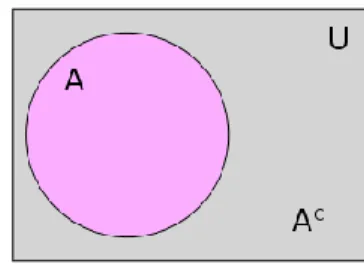
Fig. 7 In this image, the universal set is represented by the border of the image, and the set 𝐴 as a disc. This image illustrates the complement of 𝐴 in 𝑈, the additional complement, 𝐴𝑐 which
If a universe 𝐔 is defined, then the relative complement of 𝐴 in 𝐔 is called the absolute complement (or simply complement) of 𝐴, and is denoted by 𝐴𝑐 or sometimes 𝐴′, also the same set often is denoted by ∁𝐔𝐴 or ∁𝐴 if 𝐔 is fixed, that is:
𝐴𝑐 = 𝐔\𝐴.
For example, if the universe is the set of integers, then the complement of the set of odd numbers is the set of even numbers.
The following proposition lists some important properties of absolute complements in relation to the set-theoretic operations of union and intersection.
PROPOSITION 1: If 𝐴 and 𝐵 are subsets of a universe 𝐔, then the following identities hold:
De Morgan's laws: – (𝐴 ∪ 𝐵)𝑐 = 𝐴𝑐 ∩ 𝐵𝑐; – (𝐴 ∩ 𝐵)𝑐 = 𝐴𝑐 ∪ 𝐵𝑐.
Complement laws: – 𝐴 ∪ 𝐴𝑐 = 𝐔;
– 𝐴 ∩ 𝐴𝑐 = Ø; – Ø𝑐 = 𝐔; – 𝐔𝐜= Ø;
– If 𝐴 ⊆ 𝐵, then 𝐵𝑐 ⊆ 𝐴𝑐 (this follows from the equivalence of a conditional with its
contrapositive).
Involution or double complement law: 𝐴𝑐𝑐 = 𝐴.
Relationships between relative and absolute complements: 𝐴\𝐵 = 𝐴 ∩ 𝐵𝑐;
(𝐴\𝐵)𝑐 = 𝐴𝑐∪ 𝐵.
The first two complement laws above shows that if 𝐴 is a non-empty subset of 𝐔, then {𝐴, 𝐴𝑐} is a partition of 𝐔.
Fig. 8 The relative complement of 𝐴 in 𝐵
If 𝐴 and 𝐵 are sets, then the relative complement of 𝐴 in 𝐵, also known as the set-theoretic difference of 𝐵 and 𝐴, is the set of elements in 𝐵, but not in 𝐴.
The relative complement of 𝐴 in 𝐵 is denoted 𝐵\𝐴 (sometimes written 𝐵 − 𝐴, but this notation is ambiguous, as in some contexts it can be interpreted as the set of all 𝑏 − 𝑎, where 𝑏 is taken from 𝐵 and 𝑎 from 𝐴).
Formally:
𝐵\𝐴 = 𝑥 ∈ 𝐵|𝑥 ∉ 𝐴 .
Examples:
– {1,2,3} ∖ {2,3,4} = {1}; – {2,3,4} ∖ {1,2,3} = {4}.
– If ℝ is the set of real numbers and ℚ is the set of rational numbers, then ℝ\ℚ is the set of
irrational numbers.
The following proposition lists some notable properties of relative complements in relation to the set-theoretic operations of union and intersection.
PROPOSITION 2: If 𝐴, 𝐵, and 𝐶 are sets, then the following identities hold: 𝐶 ∖ (𝐴 ∩ 𝐵) = (𝐶 ∖ 𝐴) ∪ (𝐶 ∖ 𝐵);
𝐶 ∖ (𝐴 ∪ 𝐵) = (𝐶 ∖ 𝐴) ∩ (𝐶 ∖ 𝐵); 𝐶 ∖ (𝐵 ∖ 𝐴) = (𝐴 ∩ 𝐶) ∪ (𝐶 ∖ 𝐵);
(𝐵 ∖ 𝐴) ∩ 𝐶 = (𝐵 ∩ 𝐶) ∖ 𝐴 = 𝐵 ∩ (𝐶 ∖ 𝐴); (𝐵 ∖ 𝐴) ∪ 𝐶 = (𝐵 ∪ 𝐶) ∖ (𝐴 ∖ 𝐶);
𝐴 ∖ 𝐴 = Ø; Ø ∖ 𝐴 = Ø; 𝐴 ∖ Ø = 𝐴.
2.4.4 Symmetric difference
The symmetric difference of two sets is the set of elements which are in one of the sets, but not in both. This operation is the set-theoretic kin of the exclusive disjunction (XOR operation) in Boolean logic. The symmetric difference of the sets 𝐴 and 𝐵 is commonly denoted by 𝐴∆𝐵.
For example, the symmetric difference of the sets {1,2,3} and {3,4} is {1,2,4}. The symmetric difference of the set of all students and the set of all females consists of all male students together with all female non-students.
The symmetric difference is equivalent to the union of both relative complements, that is: 𝐴∆𝐵 = 𝐴\𝐵 ∪ 𝐵\𝐴 ,
and it can also be expressed as the union of the two sets, minus their intersection: 𝐴∆𝐵 = 𝐴 ∪ 𝐵 \ 𝐴 ∩ 𝐵 ,
or with the XOR operation:
𝐴∆𝐵 = 𝑥: 𝑥 ∈ 𝐴 ⊕ 𝑥 ∈ 𝐵 .
The symmetric difference is commutative and associative: 𝐴∆𝐵 = 𝐵∆𝐴,
𝐴∆𝐵 ∆𝐶 = 𝐴∆ 𝐵∆𝐶 .
Thus, the repeated symmetric difference is an operation on a multiset of sets giving the set of elements which are in an odd number of sets.
The symmetric difference of two repeated symmetric differences is the repeated symmetric difference of the join of the two multisets, where for each double set both can be removed. In particular:
𝐴∆𝐵 ∆ 𝐵∆𝐶 = 𝐴∆𝐶.
This implies a kind of triangle inequality: the symmetric difference of 𝐴 and 𝐶 is contained in the union of the symmetric difference of 𝐴 and 𝐵 and that of 𝐵 and 𝐶. (But note that
for the diameter of the symmetric difference the triangle inequality does not hold.) The empty set is neutral, and every set is its own inverse:
𝐴∆∅ = 𝐴, 𝐴∆𝐴 = ∅.
Intersection distributes over symmetric difference: 𝐴 ∩ 𝐵∆𝐶 = 𝐴 ∩ 𝐵 ∆ 𝐴 ∩ 𝐶 .
n-ary symmetric difference
As above, the symmetric difference of a collection of sets contains just elements which are in an odd number of the sets in the collection:
Evidently, this is well-defined only when each element of the union 𝑀 is contributed by a finite number of elements of 𝑀.
2.4.5 Cartesian product
A Cartesian product (or product set) is the direct product of two sets. Specifically, the Cartesian product of two sets 𝑋 (for example the points on an 𝑥-axis) and 𝑌 (for example the points on a 𝑦-axis), denoted 𝑋 × 𝑌, is the set of all possible ordered pairs whose first component
is a member of 𝑋 and whose second component is a member of 𝑌 (e.g. the whole of the 𝑥-𝑦 plane):
𝑋 × 𝑌 = 𝑥, 𝑦 |𝑥 ∈ 𝑋 𝑎𝑛𝑑 𝑦 ∈ 𝑌 .
For example, the Cartesian product of the 13-element set of standard playing card ranks {𝐴𝑐𝑒, 𝐾𝑖𝑛𝑔, 𝑄𝑢𝑒𝑒𝑛, 𝐽𝑎𝑐𝑘, 10, 9, 8, 7, 6, 5, 4, 3, 2} and the four-element set of card suits {♠, ♥, ♦, ♣} is the 52-element set of all possible playing cards
{(𝐴𝑐𝑒, ♠), (𝐾𝑖𝑛𝑔, ♠), . . . , (2, ♠), (𝐴𝑐𝑒,♥), . . . , (3,♣), (2,♣)}. The corresponding Cartesian product has 52 = 13 × 4 elements.
A Cartesian product of two finite sets can be represented by a table, with one set as the rows and the other as the columns, and forming the ordered pairs, the cells of the table, by choosing the element of the set from the row and the column.
Basic properties
Let 𝐴, 𝐵, 𝐶 and 𝐷 be sets. In cases where the two input sets are not the same, the Cartesian product is not commutative because the ordered pairs are reversed.
Although the elements of each of the ordered pairs in the sets will be the same, the pairing will differ: 𝐴 × 𝐵 ≠ 𝐵 × 𝐴.
For example:
{1,2} × {3,4} = {(1,3), (1,4), (2,3), (2,4)}; {3,4} × {1,2} = {(3,1), (3,2), (4,1), (4,2)}.
One exception is with the empty set, which acts as a “zero” and for equal sets: 𝐴 × ∅ = ∅ × 𝐴 = ∅,
and, supposing 𝐺, 𝑇 are sets and 𝐺 = 𝑇: 𝐺 × 𝑇 = 𝑇 × 𝐺 .
Strictly speaking, the Cartesian Product is not associative. 𝐴 × 𝐵 × 𝐶 ≠ 𝐴 × 𝐵 × 𝐶 .
Notice that in most cases the above statement is not true if we replace intersection with union.
𝐴 ∪ 𝐵 × 𝐶 ∪ 𝐷 ≠ 𝐴 × 𝐶 ∪ 𝐵 × 𝐷 .
However, for intersection and union it holds for: 𝐴 × 𝐵 ∩ 𝐶 = 𝐴 × 𝐵 ∩ 𝐴 × 𝐶 ,
and,
𝐴 × 𝐵 ∪ 𝐶 = 𝐴 × 𝐵 ∪ 𝐴 × 𝐶 .
n-ary product
The Cartesian product can be generalized to the 𝑛-ary Cartesian product over 𝑛 sets 𝑋1, ..., 𝑋𝑛:
𝑋1× … × 𝑋𝑛 = 𝑥1, … , 𝑥𝑛 : 𝑥𝑖 ∈ 𝑋𝑖 .
Indeed, it can be identified to (𝑋1×. . .× 𝑋𝑛−1) × 𝑋𝑛. It is a set of 𝑛-tuples.
Operations over sets basic properties
1. Commutative law:
𝐴 ∪ 𝐵 = 𝐵 ∪ 𝐴; 𝐴 ∩ 𝐵 = 𝐵 ∩ 𝐴.
2. Associative law:
𝐴 ∪ 𝐵 ∪ 𝐶 = 𝐴 ∪ 𝐵 ∪ 𝐶 ; 𝐴 ∩ 𝐵 ∩ 𝐶 = 𝐴 ∩ 𝐵 ∩ 𝐶 .
3. Distributive law:
𝐴 ∩ 𝐵 ∪ 𝐶 = 𝐴 ∩ 𝐵 ∪ 𝐵 ∩ 𝐶.
4. Basic operations: 𝐴 ∪ 𝐴 = 𝐴; 𝐴 ∩ 𝐴 = 𝐴.
5. Law of absorption: 𝐴 ∪ 𝐴 ∩ 𝐵 = 𝐴; 𝐴 ∩ 𝐴 ∪ 𝐵 = 𝐴.
6. De Morgan`s law: (𝐴 ∪ 𝐵)𝑐 = 𝐴𝑐 ∩ 𝐵𝑐; (𝐴 ∩ 𝐵)𝑐 = 𝐴𝑐 ∪ 𝐵𝑐.
7. Complement law: 𝐴 ∪ 𝐴𝑐 = 𝐔;
𝐔𝐜 =Ø.
Involution or double complement law: 𝐴𝑐𝑐 = 𝐴.
Relationships between relative and absolute complements: 𝐴\𝐵 = 𝐴 ∩ 𝐵𝑐;
(𝐴\𝐵)𝑐 = 𝐴𝑐∪ 𝐵.
If 𝑨, 𝑩, and 𝑪 are sets, then the following identities hold: 𝐶 ∖ (𝐴 ∩ 𝐵) = (𝐶 ∖ 𝐴) ∪ (𝐶 ∖ 𝐵);
𝐶 ∖ (𝐴 ∪ 𝐵) = (𝐶 ∖ 𝐴) ∩ (𝐶 ∖ 𝐵); 𝐶 ∖ (𝐵 ∖ 𝐴) = (𝐴 ∩ 𝐶) ∪ (𝐶 ∖ 𝐵);
(𝐵 ∖ 𝐴) ∩ 𝐶 = (𝐵 ∩ 𝐶) ∖ 𝐴 = 𝐵 ∩ (𝐶 ∖ 𝐴); (𝐵 ∖ 𝐴) ∪ 𝐶 = (𝐵 ∪ 𝐶) ∖ (𝐴 ∖ 𝐶);