Logical Methods in Computer Science Vol. 10(4:5)2014, pp. 1–29
www.lmcs-online.org
Submitted Jun. 28, 2013 Published Dec. 4, 2014
DECIDABILITY PROBLEMS FOR ACTOR SYSTEMS∗
FRANK S. DE BOERa, MOHAMMAD MAHDI JAGHOORIb, COSIMO LANEVEc, AND GIANLUIGI ZAVATTAROd
a CWI/LIACS, The Netherlands
e-mail address: [email protected]
b Leiden University, The Netherlands e-mail address: [email protected]
c,d Department of Computer Science and Engineering, University of Bologna, INRIA Focus, Italy e-mail address: {cosimo.laneve,gianluigi.zavattaro}@unibo.it
Abstract. We introduce a nominal actor-based language and study its expressive power. We have identified the presence/absence of fields as a crucial feature: the dynamic creation of names in combination with fields gives rise to Turing completeness. On the other hand, restricting to stateless actors gives rise to systems for which properties such as termination are decidable. This decidability result still holds for actors with states when the number of actors is bounded and the state is read-only.
1. Introduction
Since their introduction in [20], actor languages have evolved as a powerful computational model for defining distributed and concurrent systems [2, 3]. Languages based on actors have been also designed for modelling embedded systems [23, 24], wireless sensor networks [11, 31], multi-core programming [22], and web services [9, 10]. The underlying concurrent model of actor languages also forms the basis of the programming languages Erlang [4] and Scala [19] that have recently gained in popularity, in part due to their support for scalable concurrency.
2012 ACM CCS: [Software and its engineering]: Software notations and tools—General programming languages—Language types—Concurrent programming languages; [Theory of computation]: Semantics and reasoning—Program reasoning—Program verification.
Key words and phrases: Actors, RESTful services, decidability problems, 2-Counter Machines, well-structured transition systems, embedding relation.
∗This paper is a full version of an extended abstract that appears in [13]. With respect to the conference paper, this one contains examples and discussions, see Section 2.1, and complete proofs of statements. a−dThis work has been has been supported by the HATS Project No. FP7-231620 (Highly Adaptable and
Trustworthy Software using Formal Models) and by the ENVISAGE Project No. FP7-610582 (Engineering Virtualized Services) of the EC.
LOGICAL METHODS
lIN COMPUTER SCIENCE DOI:10.2168/LMCS-10(4:5)2014
c
F. S. de Boer, M. M. Jaghoori, C. Laneve, and G. Zavattaro CC
In actor languages [2, 20, 32], actors use a queue for storing the invocations to their methods in a FIFO manner. The queued invocations are processed sequentially by executing the corresponding method bodies. The encapsulated memory of an actor is represented by a
finite number offields that can be read and set by its methods and as such exist throughout
its life time.
In this paper we introduce a nominal actor-based language and study its expressive power. This language, besides dynamic creation of actors, also supports the dynamic cre-ation of variable names that can be stored in fields and communicated in method calls. As such our nominal actor-based language gives rise to unboundedness in (1) internal queues of the actors, (2) dynamic actor creation/activation and (3) dynamic creation of variable names.
Statelessness has recently been adopted as a basic principle of service oriented com-puting, in particular by RESTful services. Such services are designed to be stateless, and contextual information should be added to messages, so a service can customize replies sim-ply by looking at the received request messages. In service oriented computing read-only fields (which are initialized upon activation) are used to provide configuration/deployment information that distinguishes the distinct instances of the same service. We have identified the presence/absence of fields as a crucial feature of our language: (1) and (3) in combina-tion with fields gives rise to a Turing complete calculus. On the other hand, restricting to stateless actors gives rise to systems for which properties such as termination and process reachability are decidable. In order to preserve this decidability result to actors with states we have to restrict the number of actors to be finite and the state to be read-only.
More specifically, we model a system consisting of finitely many actors with read-only fields as a well-structured transition system [16] – henceforth termination and process reach-ability are decidable. Further, we show that an abstraction of systems of unboundedly many stateless actors (i.e., actors without fields) which preserves termination and process reach-ability is also an instance of well-structured transition system. It turns out that, in the context of unbounded actor creation, this restriction to stateless actors is necessary by a reduction to the halting problem for 2 Counter Machines.
To the best of our knowledge, the technique we use to establish the decidability results
for the above languages is original since (i) these systems respectively admit the creation of
unboundedly many variables and actor names; (ii) actors in general are sensitive to the
iden-tity of names because of the presence of a name-match operator. In particular, in the case of finitely many actors with read-only fields, we define an equivalence on process instances
in terms of renamings of the variables that generate the same partition. This equivalence
allows us to compute an upper bound to the instances of method bodies, which is the basic argument for the model being a well-structured transition system. In case of systems with unboundedly many stateless actors, the reasonable extensions of this equivalence on process instances have been unsuccessful because of the required abstraction of the identity of actor names. Therefore we decided to apply our arguments to an abstract operational model where messages may be enqueued in every actor of the same class. The above equivalence can be successfully used in this model, thus yielding again the upper bounds for the number of method body instances. Further, the abstract model still provides enough information to derive decidable properties of the language.
pure asynchronous mechanism of queued and dequeued method calls in actor-based lan-guages has not been addressed. It is interesting to observe that the most expressive known fragment of the pi-calculus for which interesting verification problems are still decidable is the depth-bounded fragment [26]. In [33] the theory of well-structured transition systems is applied to prove the decidability of coverability problems for bounded depth pi-calculus. Our nominal actor language also features the creation and communication of new names. In our decidable fragments however, differently from the depth-bounded pi-calculus fragment, we do not restrict the creation and communication of names. For instance, in the queue of an actor we might have unboundedly many messages (representing process continuations) where each message shares one name with the previous message in the queue. Decidability of asynchronous communication via a shared data space, read operation and non-blocking test operators on the shared space of the coordination language Linda has been studied in [8]. In [5] the authors introduce an algorithm for reachability analysis of multithreaded object-oriented programs. This algorithm requires both a bound on the number of context switches (between the threads) and the visible heap. Further their approach is specific to object-oriented programs and is not applicable to actor-based languages, which are based on a different concurrency model. As another final example, a system composed of finitely many actors can be easily modeled as a communicating finite state machine [6], a formalism that is known to be Turing complete [6, 25]. However, this modelling does not scale to infi-nite actors and does not display the execution model of actors. Recent work on actor-based language focusses on deadlock analysis: In [18], a technique for the deadlock analysis has been introduced for a version of Featherweight Java which features asynchronous method invocations and a synchronization mechanism based on futures variables. The approach fol-lowed in [15] for detecting deadlock in an actor-like subset of Creol [7] is based on suitable over-approximations.
2. The language Actor
Four disjoint infinite sets of names are used: actor classes, ranged over byC,D,· · ·,method
names, ranged over bym,m′,n,n′,· · ·,field names, ranged over byf,g,· · ·, andvariables,
ranged over byx,y,z,· · ·. For notational convenience, we use exwhen we refer to a list of
variablesx1, . . . , xn(and similarly for other kinds of terms).
The syntax of the language Actor uses expressions E and processes P defined by the
rules
E ::= f | x | new C(Ee)
P ::= 0 | (f←[ E).P | letx=EinP | x!m(Ee).P |
[E=E]P;P | P+P
An expression E either denotes a value stored in a field f, or a variable x, or a new actor
of class Cwith fields initialized to the values of Ee. A process may be either the terminated
one, denoted by 0, or a field update (f ←[ E).P, or the assignment let x = E in P
of a value to a variable, or an invocation x!m(Ee).P of a method m of the actor x with
arguments Ee, or a check [E = E′]P;P′ of the identity of expressions with positive and
negative continuations, or, finally a nondeterministic process P +P′. We never write the
tailing 0in processes; for example (f←[ x).0will be always shortened into (f←[ x). We
CCS [27], we model sequences of actions by exploiting the so-called prefix notation (like,
e.g., in (f←[ E).P).
The operation letx =E in P is a binder of the occurrences of the variablex in the
process P that are not already bound by a nested let operation of x; the occurrences of
x in E are free. Let free(P) be the set of variables of P that are not bound. As usual,
we identify processes P and P′ that are equal up-to alpha-conversion of bound names,
written P =α P′. The substitution operationP[y/x] returns the process P where the free
occurrences ofxare replaced byy. The substitution operationP[ye/
e
x] returns the processP
where the free occurrences ofxearesimultaneously replaced byey. In case, alpha-renaming is
required for avoiding name clashes. For example letz=x in new C(y, z)[z, u/x, y] returns
letz′=zin new C(u, z′).
In the following examples and encodings we shorten let x = f in x!m(Ee).P into
f!m(Ee).P (we have preferred the simpler syntax to ease the descriptions).
Aprogramis amain process P and a finite set ofactor class definitions C.m(ex) =PC,m,
where PC,m may contain the special variable this (which can be seen as an implicit formal
parameter of each method). In the following we restrict to programs that are (1) unambiguous, namely, every pair C,m has at most one definition;
(2) correct, namely, let fields(·) be a map that associates a tuple of field names to every
actor class. Then, (i) in every expression new C(Ee), the length of the tuples Ee and
fields(C) are the same; (ii) in every definitionC.m(ex) =PC,m, the field names occurring
in PC,m are in the tuple fields(C).
In this paper, we abstract from types and type-correctness because we are only interested in expressive power issues. However, it is straightforward to equip the above language with a type discipline.
2.1. Examples. To illustrate the features of the actor language we discuss four examples.
Example 2.1. The merger service is an application that forwards to a back office server
the values carried by two invocations of clients to methods first and second. The merger
freezes the forward as long as there is no invocation of eitherfirst or second – in the process
calculi community, themerger is modelled by a join pattern [17]. In our actor language the
merger is modelled by a class actor Mergerwith six fields: t andfstoring the values true andfalse, respectively;fstand sndstoringtrue or false according to the methodfirst and second have been invoked or not, respectively; g storing the argument of the invocation;
srvstoring the actor name of the back office server.
The class actor Mergerincludes the following three methods:
Merger.init(x) = (t←[ tt).(f←[ ff).(fst←[ ff).(snd←[ ff).(srv←[ x)
Merger.first(a) = [snd=t]srv!m(a,g).(snd←[ f);
[fst=f] (fst←[ t).(g←[ a);this!first(a)
Merger.second(a) = [fst=t]srv!m(g, a).(fst←[ f);
[snd=f] (snd←[ t).(g←[ a);this!second(a)
The method init manifests a basic feature of our actor language: the creation of new
variables. In particular,tt and ff are free variables in the method definition of init. When
init will be invoked, they will be replaced by two different fresh variables (said in pi-calculus
These variables are stored in the fieldstandf, respectively and they will be used to update
the fields fst and snd appropriately . The merger forwards two messages to the server,
which is stored in the field srv. These messages have been received through invocations of
first and second. No forward occurs if one of the two methods has not been invoked. In
particular,first(the methodsecondbehaves in a similar way) performs the forward ifsecond
has been evaluated and its message has not been already forwarded (fieldsndequal to tt);
in this case the parameter of the invocation of second has been stored into g. Otherwise,
if there is no previous invocation tofirst, still to be forwarded, (field fstequal to ff) then
fstis set tott and the parameter stored intog. There is a possibility thatfirstis evaluated
and a previous evaluation of first has still to be forwarded (field fst equal to tt). In this
case, the invocation is bounced back (it is enqueued in the actor queue – see the operational semantics).
Example 2.2. As a second example we model the OpenID authentication protocol [30].
Three actors are considered: a client, a server, and an authProvider. The client sends
a login request to the server. The server generates two secure tokens clientToken and authToken, used for secure communication with theclientand theauthProvider, respectively,
and then sends the two tokens to the corresponding actors. Subsequently, theclient sends
an authentication message to the authProvider that (after checking the correctness of the
username and password) communicates to the server whether the authentication succeeds
or fails. In the following, we abstract from the management of username and password and
we simply assume that they are stored in the fields uand pof the clientwhen it sends the
authenticate message to theauthServer.
The class Cof the clientincludes the following two definitions:
C.init(server) = server!login(this)
C.token(authServer,clientToken) = authServer!authenticate(u,p,clientToken)
The class Sof the serverincludes the following four definitions:
S.init(authServer) = (auth←[ authServer)
S.login(client) = auth!open(this,clientToken,authToken).
client!token(auth,authToken) S.succeeds(authToken) = . . .
S.fails(authToken) = . . .
The classAof theauthServerincludes the following two definitions (we leave unspecified
the check of the correctness of username and password):
A.open(server,cToken,aToken) = (server←[ server).(ctoken←[ cToken).
(atoken←[ aToken)
A.authenticate(u, p,cToken) = [ctoken=cT oken]server!succeeds(atoken);
server!fails(atoken)
The main program that instantiates the client, the server and the authProvider is as
follows:
letclient =new C in letserver =new S in
letauthProvider =new A in
Example 2.3. We illustrate the modeling of a register that stores natural numbers and supports the operations of increment and decrement, when its value is positive. In the absence of data-types in our nominal actor language, we model a register by an actor
and implement the value of the register by the number of invocations of the methoditem
stored in its queue. Below we describe the corresponding class R, assuming a class Ctrl
which encodes the control of the register machine. When an operation is performed, the
register replies with an invocation run(pc,tt,ff), wherepc is a suitable continuation. The
continuation is unique when the increment is invoked; the decrement has two possible continuations: a positive one, in case of success, and a negative one (the register was 0, no decrement is performed).
// R has a field called dec, Ctrl is an actor in the context
R.inc(pc,tt,ff) =R!item(tt,ff).Ctrl!run(pc,tt,ff) R.dec(pc,pc′,tt,ff) = (dec←[ tt).R!checkzero(pc,pc′,tt,ff)
R.checkzero(pc,pc′,tt,ff) = [dec=tt]Ctrl!run(pc′,tt,ff).(dec←[ ff);Ctrl!run(pc,tt,ff)
R.init(tt,ff) = (dec←[ ff)
R.item(tt,ff) = [dec=ff]R!item(tt,ff);(dec←[ ff)
Method inc simply gives rise to the storage of a new message item and a trigger of the
continuation. Executing a message item, amounts to bouncing the invocation back if the
value of the fielddecis false. In this case the invocation is enqueued again. Otherwise the
invocations is “consumed” because there was a pending decrement to perform (see below)
anddecis set to true (indicating that there is no pending decrement anymore). Methoddec
is the tricky one: it setsdec to true and add an invocation of checkzero (we are assuming
that the register queue always contains at most one invocation of dec). That is, we are
postponing the triggering of the continuation to the evaluation ofcheckzero that will occur
after the evaluation of any other method in the queue of the register. When checkzero will
be evaluated either (i) the decfield is true, this means that the register did not contained
any item message – its value was 0 – and the continuationpc′ is triggered; or (ii) thedec
field is false, that is the register has been decremented and the continuation pc is triggered.
A refinement of the above register is used in Theorem 3.2 to demonstrate the Turing
completeness of a sublanguage of Actor.
Example 2.4. In Sections 4 and 5 we will respectively prove decidability results for two fragments of our actor language: in the first fragment only the main program can create new actors (so boundedly many actors can be created) and fields are read-only, while in the second fragment actors have an empty state. To illustrate these two fragments we show
how they can be used to model a system in which nworkers are used to execute ndistinct
tasks indicated by a client.
In the fragment with bounded actors and read-only fields the model can be described
by considering a classC for the client with aninitmethod responsible for invoking the task
manager, passing him the description of thentasks to be executed:
// C has no fields
C.init(TManager) =TManager!tasksExec(t1,· · ·, tn)
The task manager is an instance of a class providing a method called tasksExecable to
// T M has n fields called W1,· · ·,Wn,
T M.tasksExec(p1,· · ·, pn) =W1!exec(p1).· · ·.Wn!exec(pn)
Finally, a worker is an instance of a classW with one method execable to execute the
passed task (we leave this method unspecified):
// W has no fields and one method exec(p)
The main program first instantiates the workers, then the task manager by storing in
its state the reference to the workers, and finally the client; after the init method of the
client is invoked passing him a reference to the task manager:
letw1 =new W in · · · letwn =new W in
lettaskManager =new TMs(w1,· · ·,wn)in
letclient =new C inclient!init(taskManager)
In the fragment with stateless actors we present an alternative specification of the system in which the classes for the client and the workers are as above, while the task manager is defined as follows:
// T M has no fields
T M.tasksExec(p1,· · · , pn) =this!nextTask(p1,· · · , pn, x1, x2,· · ·, xn, x1)
T M.nextTask(p1,· · ·, pn, v1,· · ·, vn+1) = [v1=v2]0;letw =new W inw!exec(p1).
this!nextTask(p2,· · · , pn, p1, v2,· · · , vn+1, v1)
Upon reception of thentasks to be executed, the task manager passes the task descriptions
to the method nextTask. This method instantiates one new worker, passes to it the
corre-sponding task, and then recursively invokes itself to continue with worker instantiations. In
order to execute exactly n recursive calls, n+ 1 additional parameters are considered: in
the first call all such parameters are distinct excluding the first and the last one, at every call the parameters are circularly shifted, and when the first two parameters coincide the chain of calls is terminated.
2.2. The operational semantics. The operational semantics of the language Actor will
use an infinite set of actor names, ranged over A, B, · · ·. This set is partitioned by the
actor classes in such a way that every partition retains infinitely many actor names. We
write A ∈ C to say that A belongs to the partition of C. In the following, the (run-time)
expressions will also include actor names and, with an abuse of notation, this extended set
of expressions will be ranged over byE. The set of terms that are variables or actor names,
calledvalues, will be addressed byU,V,· · ·. Similarly for processes that, at run-time, may
also have actor names. The extended set will be addressed by P. We notice that free(P),
when P belongs to this extended set, may returns variables and actor names. We will also
apply free(·) to tuples of (extended) expressions: free(Ee) returns the set of variables and
actor names inEe.
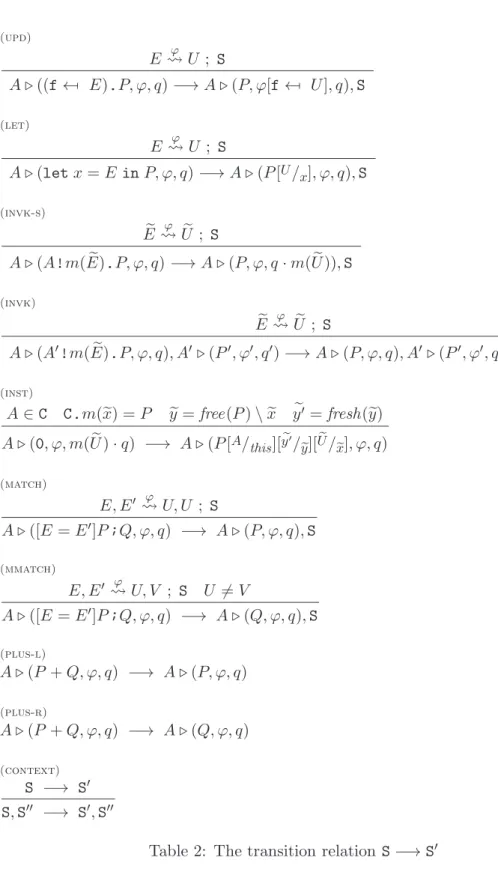
The semantics is defined in terms of a transition relation S−→S′, whereS, S′, called
configurations, are sets of terms A ⊲(P, ϕ, q) with A being an actor name, ϕ, the state of
A, being a map from fields(C) to values, whereA∈C, and q being a queue of terms m(Ue).
The empty queue will be denoted with ε. Configurations contain at most one A ⊲(P, ϕ, q)
for each actor name A. As usual, let −→∗ be the transitive closure of −→ and −→+ be
U ϕ U ; ∅ f ϕ ϕ(f) ; ∅
e
E ϕ Ue ; S ef=fields(C) A=fresh(C)
new C(Ee) ϕ A; A ⊲(0,[ef7→Ue], ε),S
Ei ϕ Ui ; Si, for i∈1..n
E1,· · ·, En
ϕ
U1,· · · , Un; S1,· · ·,Sn
Table 1: The evaluation relation E ϕ U ; S
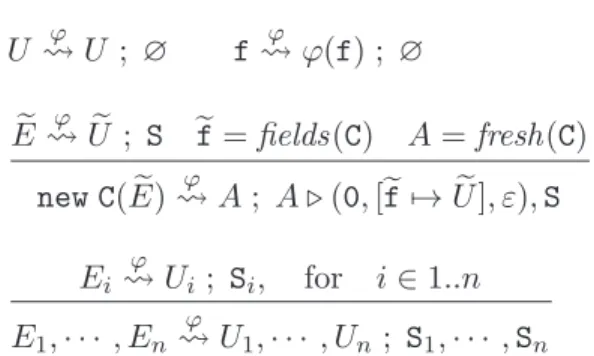
The operational semantics ofActoris defined in Table 2, where theevaluation function
E ϕ U ; S is used (defined in Table 1). This function takes an expression E and a store
ϕand returns a value U and a possibly empty configuration Sof termsA ⊲(0, ϕ, ε). These
terms represent actors created during the evaluation – the namesAarefresh– andϕrecords
the initial values of the fields of A. The auxiliary function fresh(·) used in the evaluation
function takes a class actor and returns an actor name of that class that is fresh. In order to have a finitely branching transition system (see the remark at the end of this section),
we assume actor names in classes are totally ordered and fresh(C) always returns the first
unused name of the classC. In this way, fresh names are selected in a deterministic manner.
The same auxiliary function is used in rule (inst)on a tuple of variables. In this case it
returns a tuple of the same length of variables that are fresh. Also in this case, we assume
a total order of variables and fresh(ex), where xe has length n, returns the least n unused
variables. For notational convenience, we always omit the standard curly brackets in the
set notation and we use “,” both to separate elements inside sequences and for set union
(the actual meaning is made clear by the context).
The initial configuration of a program with main process P is ℵ ⊲ (P,∅, ε), where
ℵ is a name of the root, an actor of a class without fields and methods. We assume that
the class of ℵ does not belong to the classes of the program. Note that the root actor is
guaranteed to terminate because its queue remains empty (no method invocation may be enqueued) and the main process (as any other one) terminates.
We finally remark that transition systems of the languageActor arefinitely branching
(every state has a finite number of successor states) because the choices of fresh actor
names (in the evaluation ofnew C) and of fresh variables (in the instantiation of the bodies
of methods) are deterministic.
2.3. Relevant sublanguages. We will consider the following fragments of Actor whose relevance has been already discussed in the Introduction:
Actorba is the sublanguage where thenewexpression only occurs in the main process (the
number of actor names that it is possible to create is bounded).
Actorro is the sublanguage without the field update operation (f←[ E) (fields are read-only
as they cannot be modified after the initialization).
Actorroba is the intersection ofActorba and Actorro.
(upd)
E ϕ U ; S
A ⊲((f←[ E).P, ϕ, q)−→A ⊲(P, ϕ[f←[ U], q),S
(let)
E ϕ U ; S
A ⊲(letx=E inP, ϕ, q)−→A ⊲(P[U/x], ϕ, q),S
(invk-s)
e
E ϕ Ue ; S
A ⊲(A!m(Ee).P, ϕ, q)−→A ⊲(P, ϕ, q·m(Ue)),S
(invk)
e
E ϕ Ue ; S
A ⊲(A′!m(Ee).P, ϕ, q), A′⊲(P′, ϕ′, q′)−→A ⊲(P, ϕ, q), A′ ⊲(P′, ϕ′, q′·m(Ue)),S
(inst)
A∈C C.m(ex) =P ye=free(P)\xe ye′=fresh(ey)
A ⊲(0, ϕ, m(Ue)·q) −→ A ⊲(P[A/this][ye′ /ye][Ue/
e
x], ϕ, q)
(match)
E, E′ ϕ U, U ; S
A ⊲([E =E′]P;Q, ϕ, q) −→ A ⊲(P, ϕ, q),S
(mmatch)
E, E′ ϕ U, V ; S U 6=V
A ⊲([E =E′]P;Q, ϕ, q) −→ A ⊲(Q, ϕ, q),S
(plus-l)
A ⊲(P+Q, ϕ, q) −→ A ⊲(P, ϕ, q)
(plus-r)
A ⊲(P+Q, ϕ, q) −→ A ⊲(Q, ϕ, q)
(context)
S −→ S′
S,S′′ −→ S′,S′′
3. Undecidability results for Actorba and Actorro
In this section we establish the main undecidability results for the actor language in Section 2.
In particular, we will prove the undecidability of termination and process reachability.
Definition 3.1. Consider an actor program. Thetermination problem is to decide whether
it has no infinite computation; theprocess reachability problem is to decide, given a process
P, whether there exists a computation of the program traversing a configuration having a
termA ⊲(P′, ϕ, q) withP′ being equal toP up-to renaming of variables and actor names.
We will use a reduction technique from a Turing-complete model to our actor model. In particular, the Turing-complete models we consider are the 2 Counter Machines (2CMs) [29]
and a faulty variation of them. A 2CM is a machine with two registers R1 and R2 holding
arbitrary large natural numbers and aprogram P consisting of a finite sequence of numbered
instructions of the following type:
• j:Inc(Ri): increments Ri and goes to the instruction j+ 1;
• j:DecJump(Ri, l): if the content of Ri is not zero, then decreases it by 1 and goes to the
instructionj+ 1, otherwise jumps to the instructionl;
• j:Halt: stops the computation and returns the value in the register R1.
A state of the machine is given by a tuple (i, v1, v2) where iindicates the next instruction
to execute (the program counter) andv1 and v2 are the contents of the two registers. The
user has to provide the initial state of the machine. The transition relation of the 2CM will
be denoted by Z=⇒.
The faulty variation of the 2CM we use are the “two Faulty Towers Machine” (2FTM,
for short) [12]. These machines havetwo faulty registers R1 andR2 holding either arbitrary
large natural numbers or thefaulty value ⊥. The program of a 2FTM is a finite sequence of
numbered instructions that are the same of those in 2CMs. However, in contrast with 2CMs,
2FTMs from a state (i, v1, v2) maynondeterministically evolve into a faulty state (i,⊥, v2)
or (i, v1,⊥) or (i,⊥,⊥). If an instruction i is an Inc/DecJump that refers to the register
R1 (respectively, R2) then (i,⊥, v) (respectively, (i, v,⊥)) evolves to (0,⊥, v) (respectively,
(0, v,⊥)). In 2FTMs, the instruction numbered 0 is always assumed to be Halt. Let Z=⇒F
be the transition relation of the 2FTMs.
By definition, every 2CM program with a 0-numbered instruction Halt is a 2FTM
program and conversely. If we restrict to 2CM with a 0-numbered instruction Halt, it is
easy to verify that every such machine has an infinite computation with a 2CM-semantics if and only if it has an infinite computation with a 2FTM-semantics. Similarly for instruction reachability, if we consider any non 0-numbered instruction.
In the sequel, we consider 2FTMs and 2CMs whose initial state is (1,0,0).
3.1. The languageActorba. We encode the value nstored in a register asnmessages (of
the same type) that are enqueued in an actor – see Figure 1. Namely, letR1 and R2 be two
actors of classRand let the number of messages item inR1 and R2 be their value.
The instruction Inc is implemented by inserting one item message in the queue of
the corresponding register. In our formalism, this is done by invoking the method item
whose execution has two possible outcomes: (i) the invocation is enqueued again; (ii) the
invocation is discarded because we are in the presence of a residual of aDecJumpoperation,
R // R has fields dec, ctr, loop and stop
R.item(tt,ff) = [stop=ff] [dec=ff]this!item(tt,ff);(dec←[ ff)
R.inc(pc,tt,ff) = [stop=ff](loop←[ ff).this!item(tt,ff).ctr!run(pc,tt,ff)
R.decjump(pc,pc′,tt,ff) = [stop=ff](loop←[ ff).(dec←[ tt).this!checkzero(pc,pc′,tt,ff)
R.checkzero(pc,pc′,tt,ff) = [stop=ff](loop←[ ff).
[dec=tt]ctr!run(pc′,tt,ff).(dec←[ ff);ctr!run(pc,tt,ff)
R.init(tt,ff,Ctrl) = (dec←[ ff).(ctr←[ Ctrl).(loop←[ ff).(stop←[ ff).
this!bottom(tt,ff)
R.bottom(tt,ff) = [loop=ff](loop←[ tt).this!bottom(tt,ff); (stop←[ tt)
Ctrl // Ctrl has fields stm1, · · ·, stmn and r1 and r2
Ctrl.run(pc,tt,ff) = [pc =stm1][[Instruction 1]]1,tt,ff
· · ·
[pc =stmn][[Instruction n]]n,tt,ff
Ctrl.init() =r1!init(tt,ff,this).r2!init(tt,ff,this).this!run(stm1,tt,ff)
Ctrl.halt() =0
where [[Instruction i]]i,tt,ff is equal to
– rj!inc(stmi+1,tt,ff) if Instruction i =Inc(Rj);
– rj!decjump(stmi+1,stmk,tt,ff) if Instruction i =DecJump(Rj, k);
– this!halt if Instruction i =Halt.
The main process is
letx=new Ctrl(x1,· · ·, xn,new R( , , , ),new R( , , , ))inx!init().
Figure 1: Encoding a 2FTM inActorba(“ ” denotes an irrelevant initialization parameter)
In case (i), to avoid an infinite sequence of item dequeues and enqueues, we introduce
fields stop and loop which are initialized to false and set to true by the bottom method
in case the queue contains only item messages. This has as effect that the stored item
messages are subsequently purged from the queue of the register. Note that differently from the example in Section 2 we have encoded the boolean values as fields (so that we do not need to pass them around).
In case (ii), registers have a field decthat is set to tt by a decjump method execution.
This field means that the actual decrement of the register is delayed to the next execution of checkzero. Since in (ii) item is not enqueued, then the register is actually decremented
and the field dec is set to ff. When checkzero will be executed, since dec = ff then the
next instruction of the 2CM is simulated. On the contrary, whencheckzero is executed with
dec=tt then the decrement has not been performed (the register is 0) and the simulation
The Haltinstruction is simulated by invoking a method halt that does nothing.
As in the examples of Section 2, booleans are implemented by two variables – see the
method Ctrl.init – that are distributed during the invocations. With a similar machinery,
in the actor class Ctrl, the labels of the instructions are represented by the variables
x1,· · ·, xn, which are stored in the fields stm1, . . . ,stmn ofCtrl.
Theorem 3.2. Termination and process reachability are undecidable inActorba.
The undecidability of termination in Actorba follows by the property that a 2FTM
diverges if and only if the corresponding actor program has an infinite computation. As regards process reachability, we need a smooth refinement of the encoding in Figure 1 where
theHalt instruction is simulated by a specific process.
Proof. Let us assume to have a fixed 2FTM and let [[Instruction i]]i,tt,ff be defined in Figure 1.
Let also
[[(i, v1, v2)]]tt,ff def
= ℵ ⊲ (0,∅, ε), (v16=⊥andv26=⊥)
C ⊲([[Instruction i]]i,tt,ff, ϕctrl, ε),
R1⊲(0, ϕreg,bottom(tt,ff)·item(tt,ff)v1),
R2⊲(0, ϕreg,bottom(tt,ff)·item(tt,ff)v2)
[[(i,⊥, v)]]tt,ff def
= ℵ ⊲ (0,∅, ε), (v6=⊥)
C ⊲([[Instruction i]]i,tt,ff, ϕctrl, ε),
R1⊲(0, ϕ⊥reg, ε),
R2⊲(0, ϕreg,bottom(tt,ff)·item(tt,ff)v)
[[(0,⊥, v)]]tt,ff def
= ℵ ⊲ (0,∅, ε), (v6=⊥)
C ⊲(0, ϕctrl, ε),
R1⊲(0, ϕ⊥reg, ε),
R2⊲(0, ϕreg,bottom(tt,ff)·item(tt,ff)v)
where
– ϕctrl
def
= [stmi7→xii∈1..n,r1 7→R1,r2 7→R2];
– ϕreg
def
= [stop7→ff,loop7→ff,dec7→ff,ctr7→C];
– ϕ⊥
reg
def
= [stop7→tt,loop7→tt,dec7→ff,ctr7→C];
– item(tt,ff)v def= item(tt,ff)· · ·item(tt,ff)
| {z }
vtimes
.
(the definitions of [[(i, v,⊥)]]tt,ff and [[(0, v,⊥)]]tt,ff and [[(0,⊥,⊥)]]tt,ff follow the same patterns).
We first observe that ℵ⊲(P,∅, ε) −→∗ [[(1,0,0)]]tt,ff, where P is the main process in
Figure 1. Then we demonstrate the following properties: (1) if (i, v1, v2)Z=⇒F (j, v′
1, v2′) then [[(i, v1, v2)]]tt,ff −→+ [[(j, v1′, v2′)]]tt,ff;
(2) if [[(i, v1, v2)]]tt,ff has an infinite computation then the computation has infinitely many
configurations like
(3) if
ℵ ⊲ (0,∅, ε), C ⊲([[Instruction i]]i,tt,ff, ϕctrl, ε), R1⊲(P1, ϕ1, q1), R2⊲(P2, ϕ2, q2)
−→∗
ℵ ⊲ (0,∅, ε), C ⊲([[Instruction j]]j,tt,ff, ϕctrl, ε), R1⊲(P′
1, ϕ′1, q′1), R2⊲(P2′, ϕ′2, q′2)
is a computation with every intermediate configuration having the process of the actor
C equal to0then there are two computations
ℵ ⊲ (0,∅, ε), C ⊲([[Instruction i]]i,tt,ff, ϕctrl, ε), R1⊲(P1, ϕ1, q1), R2⊲(P2, ϕ2, q2)
−→∗ [[(i, v
1, v2)]]tt,ff
and
ℵ ⊲ (0,∅, ε), C ⊲([[Instruction j]]j,tt,ff, ϕctrl, ε), R1⊲(P′
1, ϕ′1, q′1), R2⊲(P2′, ϕ′2, q′2)
−→∗ [[(j, v′
1, v2′)]]tt,ff
where the actorC never moves such that
(i, v1, v2)Z=⇒F(j, v1′, v′2).
The proof of (1) is a straightforward case analysis on the type of instruction i.
The proof of (2) uses an argument by contradiction. Assume that there are finitely many configurations like 3.1. Then, there is an infinite suffix of this computation in which
the actor C does not perform actions. This means that at least one actor Ri performs
infinitely many actions by executing the methodsitem andbottom. But this is not possible
because bottom blocks the actor if it is invoked twice without executing update actions on
the register in between.
The proof of (3) simply considers two possible cases: either some fieldsstopis set to
tt during the computation or not. In the first case the corresponding register of the 2FTM
enters a faulty state⊥. In the second case the instruction has been correctly executed.
The property (1) guarantees that if a 2FTM has an infinite computation then also the corresponding encoding has an infinite computation. The opposite follows from (1) and (2): if the encoding has an infinite computation, it traverses infinitely many configurations repre-senting configurations of the corresponding 2FTM, thus it also has an infinite computation. The undecidability result can be easily extended to the process reachability problem. It
suf-fices to modify the process modeling anHalt(not numbered with 0) by replacingthis!halt()
with a process Q different from all the other processes in Figure 1. We have that Q is
reachable if and only if the 2CM with the same program of the given 2FTM terminates.
3.2. The language Actorro. We show that Actorro is Turing-complete by means of an encoding of a 2CM – see Figure 2. In this encoding the two registers are represented by two
disjoint stacks of actors linked by the next field. The top elements of the two stacks are
passed as parameters r1 and r2 of the run method of the controller. As before, this actor
encodes the control of the 2CM.
The instructionIncis implemented by pushing an element on top of the corresponding
stack. This element is an actor of classRstoring in its field the old pointer of the stack. The
new pointer, i.e. the new actor name, is passed to the next invocation of the runmethod.
The instruction DecJump is implemented by popping the corresponding stack. In
particular, the method run of the controller is invoked with the field next of the register
being decreased. This pop operation is performed provided the register that is argument
the stack rj (i6=j) and the next instruction to be executed are simply passed around and therefore they do not need to be stored in updatable fields.
Theorem 3.3. Termination and process reachability are undecidable inActorro.
Proof. It is easy to verify that if a 2CM has a computation (1,0,0) Z=⇒(i1, v1, v′
1)Z=⇒ · · ·Z=⇒(in, vn, v′n) then there is a computation
ℵ⊲(P,∅, ε)−→∗ ℵ⊲(0,∅, ε), C ⊲([[Instruction
1]]nil,nil, ϕ, ε)
−→∗ ℵ⊲(0,∅, ε), C ⊲([[Instruction i1]]r1,r1′, ϕ, ε),Rr1,Rr′1,G1
−→∗ ℵ⊲(0,∅, ε), C ⊲([[Instruction i
n]]rn,r′n, ϕ, ε),Rrn,Rrn′,Gn
where P is the main process of Figure 2, [[Instruction ij]]rj,r′j are defined in Figure 2, ϕ=
[stm1 7→ x1,· · · ,stmn 7→ xn,nil 7→ nil], Rri and Rri′ are stacks of register actors whose
length isvi and v′i, respectively. For instance, Rr1 of lengthk is
r1⊲(0,[next7→r2], ε), r2⊲(0,[next7→r3], ε),· · · , rk⊲(0,[next7→nil], ε) .
The configurationsGionly contain register termsr⊲(0,[next7→r′], ε) and representgarbage
(they are inactive).
In contrast with Theorem 3.2, the converse implication (every computation of the
Actorro program in Figure 2 may be split in subcomputations of finite lengths that
corre-spond to 2CM transitions) is not difficult because the program of Figure 2 is deterministic. The above correspondence guarantees that the computation of the actor system
termi-nates if and only if aHaltinstruction is reached. The undecidability of process reachability
is proved by using the same arguments of Theorem 3.2.
4. Decidability results for Actorroba
We demonstrate that programs in Actorroba are well-structured transition systems [1, 16].
This will allow us to decide a number of properties, such as termination. We begin with some background on well-structured transition systems.
A reflective and transitive relation is called quasi-ordering. A well-quasi-ordering is a
quasi-ordering (X,≤) such that, for every infinite sequence x1, x2, x3, · · ·, there exist i, j
with i < j and xi ≤xj.
Definition 4.1. Awell-structured transition system is a finitely branching transition system (S,−→,) where is a quasi-ordering relation on states such that
(1) is a well-quasi-ordering
(2) is upward compatible with −→, i.e., for every S1 S′1 and S1 −→ S2, there exists
S′1 −→∗ S′2 such thatS2S′2.
Given a statesof a well-structured transition system,Pred(s) denotes the set of immediate
predecessors of s(i.e., Pred(s) ={s′ |s′ −→s}) while ↑sdenotes the set of states greater
than s(i.e., ↑ s={s′ |ss′}). With abuse of notation we will denote with Pred( ) also
its natural extension to sets of states.
R // R has a field next
R.dec1(ctrl, r,stm) =ctrl!run(next, r,stm)
R.dec2(ctrl, r,stm) =ctrl!run(r,next,stm)
Ctrl // Ctrl has fields stm1, · · ·, stmn and nil
Ctrl.run(r1, r2,pc) = [pc =stm1][[Instruction 1]]r1,r2;
· · ·
[pc =stmn][[Instruction n]]r1,r2
where [[Instruction i]]r1,r2 is equal to
– this!run(new R(r1), r2,stmi+1) if Instruction i =Inc(R1);
– this!run(r1,new R(r2),stmi+1) if Instruction i =Inc(R2);
– [r1=nil]this!run(r1, r2,stmk);r1!dec1(this, r2,stmi+1)
if Instruction i =DecJump(R1, k);
– [r2=nil]this!run(r1, r2,stmk);r2!dec2(this, r1,stmi+1)
if Instruction i =DecJump(R2, k);
– 0 if Instruction i =Halt.
The main process isletx=new Ctrl(x1,· · · , xn,nil)inx!run(nil,nil, x1).
Figure 2: Encoding a 2CM inActorro
Definition 4.2. Consider a well-structured transition system (S,−→,). GivenS∈ S the termination problem is to decide whether S has an infinite computation; thecontrol-state reachability problem is to decide, given T∈ S, whether there isT′ Tsuch that S−→∗ T′. In well-structured transition systems termination is decidable when the transition
re-lation −→ and the ordering are effectively computable. When it is also possible to
effectively compute a finite-basis for the set of states Pred(↑ s) we have that control-state
reachability is decidable as well.
In the following we assume given an actor program with its main process and its set
of actor class definitions. The first relation we convey is = that relates renamings, ranged•
over byρ,ρ′,. . .that are functions mapping variables that are not free in the main process
into either actor names or variables. Let
ρ=• ρ′ def= for everyx, y : (i) ρ(x) =ρ(y) if and only if ρ′(x) =ρ′(y)
(ii) ρ(x) =ρ′(x) ifρ(x) orρ′(x) is an actor name or
a free variable of the main process
Namely, two renamings are in the relation= if they identify the same variables, regardless•
the value they associate when such a value is a variable. For example, [x 7→ y, y 7→ z]=•
[x 7→ x, y 7→ z] and [x 7→ y, y 7→ y, z 7→ A] = [• x 7→ x′, y 7→ x′, z 7→ A]. However
[x 7→ y, y 7→ z] 6= [• x 7→ x, y 7→ x] and [x 7→ A] 6= [• x 7→ B]. In general, if ρ and ρ′ are
injective renamings that always return variables then ρ =• ρ′. The requirements of = are•
renamings in relation according to= never apply to free variables of the main process. This• because these variables are possibly stored in fields of actors and their renaming might change the behaviours of actors in a way that breaks the upward compatibility of the
following relation and −→ (c.f. proof of Theorem 4.4, part (2)). From this also follows
that the above renamingsdo not change the main process (because they do not apply to its
free variables).
Letdom(ρ) be the domain of the renamingρ. We denote byP ρ the result ofP[ρ(xe)/
e
x],
where xe = x1,· · · , xn is a tuple containing the variables in dom(ρ) (without repetitions)
and ρ(ex) =ρ(x1),· · · , ρ(xn).
Next, let≃be the least relation on termsm(U1,· · ·, Un) and on processes such that
ρ=• ρ′
m(ρ(x1),· · ·, ρ(xk))≃m(ρ′(x1),· · · , ρ′(xk))
ρ=• ρ′
P ρ≃P ρ′
For example, it is easy to verify thatm(x, y) ≃m(x′, y′) and that [x=A]y!m(x, A, y)≃
[z=A]y′!m(z, A, y′). On the contrary [x=A]B!m(x, A, B)6≃[z =A]y′!m(z, A, y′). The
rationale behind≃is that it identifies processes that “behave in similar ways”, namely they
enqueue “similar invocations” in the same actor queue. Method invocations m(U1,· · · , Un)
of a given actor are identified if the processes they trigger “behave in similar ways”.
Lemma 4.3. Let T be either a method invocation m(U1,· · · , Un)or a process of a program
in Actorba (and therefore in Actorroba). Let T = {T ρ1, T ρ2, T ρ3,· · · } be such that i 6= j
implies T ρi 6≃T ρj. Then T is finite.
Proof. We demonstrate the lemma for processes, the argument is similar for method
invoca-tions. So, let P be a process. It is possible to count the number of renamingsρ on free(P)
that are different according to =. In fact, the values of renamings on variables that are•
different fromfree(P) do not play any role in the definition ofT.
The basic remark is that a renaming ρ generates a partition of the set free(P): two
variables x and y are in the same partition if and only if ρ(x) = ρ(y). If we restrict to
renamings that map variables to variables (and not actor names), then they are different
according to = if they yield different partitions. The number of such renaming is the• Bell
number of the cardinality offree(P), let it beBell(κ), whereκis the cardinality offree(P). In addition, in our case, renamings may map a variable to an actor name into a finite set {A1,· · ·, Aℓ}. In this case the identity of the actor name is relevant. If κ ≥ ℓ then
(( κ
ℓ )×ℓ! + 1)×Bell(κ) is an upper bound to the different renamings according
•
=. If
κ < ℓ then the upper bound is (ℓ!/κ! + 1)×Bell(κ). In any case the number of different
renamings according to = is finite.•
Henceforth the setT is finite as well.
The well-quasi-ordering relation on configurations relies on an (almost standard)
em-bedding relation ≤on queues (except the part about≃, it is the one in [16]):
there existi1< i2<· · ·< ik≤hsuch that, for j∈1..k, mj(Ufj)≃nij(Veij)
Then, let
Pi≃Pi′ and qi≤q′i fori∈1..ℓ
A1⊲(P1, ϕ1, q1),· · ·, Aℓ⊲(Pℓ, ϕℓ, qℓ) A1⊲(P1′, ϕ1, q1′),· · · , Aℓ⊲(Pℓ′, ϕℓ, qℓ′)
It is worth noticing that the relationconstraints corresponding elementsA ⊲(P, ϕ, q) and
A ⊲(P′, ϕ, q′) to have the same states. In fact these states are defined by the main process using either its free variables or the actor names that it has created. For this reason there
are finitely many of them and the relation is parametric with respect to them.
Theorem 4.4. Let (S,−→) be a transition system of a program of Actorroba. Then (S,−→ ,) is a well-structured transition system.
Proof. (1) is a well-quasi-ordering. To prove that is a well-quasi-ordering, we reason
by contradiction. Let S1,S2,S3,· · · be an infinite sequence of states in S such that, for
everyi < j,Si 6Sj. Let y1,· · ·,ym be a sequence of variables not free in the main process.
Consider:
subterms(C) = {P | there exists a methodm s.t. P is a subterm ofC.m(xe)} ∪
{m(y1,· · · , yg) | there exists a methodm s.t. C.m(xe) with |xe|=g}
The set subterms(C) is finite, but all the –possibly infinitely many– processes that can be
executed (or the messages that can be received) by an actor of class C are renamings P ρ
(orm(ey)ρ) of these terms. Notice that by Lemma 4.3, the number of termsP ρ(andm(ye)ρ)
which are different according to≃is finite as well. It is thus possible to extract a subsequence
Si1,Si2,Si3,· · · fromS1,S2,S3,· · · such that, for everyA, in the elementsA ⊲(P A ijρij, ϕ
A ij, q
A ij)
andA⊲(PA
ikρik, ϕ
A ik, q
A
ik) ofSijandSik, respectively, we have thatP
A
ijρij ≃P
A
ikρik. Moreover,
as we are consideringActorroba the actor state cannot be modified, hence ϕA
ij =ϕ
A ik.
As we are consideringActorroba, the set of actor is bound. LetA1,· · · , Aℓ be such actor
names. Due to the above arguments, the sequence Si1,Si2,Si3,· · · may be represented as a
sequence of tuples of queues:
(qA1 i1 ,· · · , q
Aℓ
i1 ), (q A1 i2 ,· · ·, q
Aℓ
i2 ), (q A1 i3 ,· · · , q
Aℓ
i3 ), · · ·
such that Sij Sik if and only if (q
A1 ij ,· · · , q
Aℓ
ij ) ⊑
ℓ (qA1 ik ,· · · , q
Aℓ
ik ), where ⊑
ℓ is the
coordi-natewise order defined by
(q1,· · ·, qℓ)⊑ℓ(q′1,· · · , qℓ′)
def
= for every h : qh ≤qh′
(≤ is the above embedding relation).
We are finally reduced to an infinite sequence of tuples of queues such that every tuple
cannot be in relation according to⊑ℓ with any of the subsequent ones. This fact contradicts
the
Higman’s Lemma [21]: if (X,≤) is a well-quasi-ordering and (X∗,≤∗) is the set of finite X-sequences ordered by the embedding relation ≤∗ defined using ≤as pointwise ordering,
then (X∗,≤∗) is a well-quasi-ordering.
More precisely, the contradictions follows from the following consequence of the Higman’s Lemma:
• ifX is a finite set and (X∗,≤) is the set of finiteX-sequences ordered by the embedding
relation, then (X∗,≤) is a well-quasi-ordering.
• if (X,≤) is a well-quasi-ordering then (Xℓ,≤ℓ) is a well-quasi-ordering.
(2) is upward compatible with −→. A state ϕ is normed, if, for every field f, ϕ(f)
is either a free variable in the main process or an actor name. A configuration is normed
if the states of the actors are normed. We observe that the initial configuration is normed.
We also let (Ee)ρ ≃(Ee)ρ′ whenever ρ=• ρ′.
We first demonstrate that, if Ee ϕ Ue ; Swith ϕnormed, then
(exp-i) ifEe≃fE′ and S=∅thenEf′ ϕ fU′; ∅and Ue ≃fU′;
(exp-ii) if Ee (respectively P) only contain free variables in the main process and actor
names thenEe≃Ee′ (respectivelyP ≃P′) impliesEe=Ee′ (respectivelyP =α P′)
and Ee ∅ Ue ; S implies that Ue contain free variables in the main process and
actor names and Sis normed.
(exp-i) is proved by induction on the hight of the proof-tree of Ee ϕ Ue ; ∅. There are
two basic cases: (1) E = U and (2) E = f. As regards (1), E′ = U′ and the property
is immediate by the hypothesis that E ≃ E′. As regards (2), E′ = f because E ≃ E′;
henceforth the property (because E′ is evaluated in the state ϕ as well). There is one
inductive case (because the case of new is not possible, otherwise S cannot be empty),
which is immediate.
(exp-ii) is an immediate consequence of the definition of= and• ∅.
LetS1−→S2. We demonstrate that
(i) if S1 is normed then S2 is normed as well (this means that the transition system
(S,−→) of a program of Actorroba has normed configurations because the initial state is normed);
(ii) ifS1 S′1 then there existsS′1 −→∗ S′2 such thatS2S′2.
As regards(i), it follows by remarking that in programs of Actorroba, there is no field update
and the unique process that may create states is the one ofℵ(the main process). Then (i)
derives from the property(exp-ii).
As regards (ii), its proof is a case analysis on the proof-tree of S1 −→ S2 where
the cases correspond to the unique rule appearing in the tree that is not an instance of (context). Let S1 = A1 ⊲(P1ρ1, ϕ1, q1),· · · , Aℓ ⊲(Pℓρℓ, ϕℓ, qℓ). Since S1 S′1 then
S′1=A1⊲(P1ρ′1, ϕ1, q1′),· · ·, Aℓ⊲(Pℓρℓ′, ϕℓ, q′ℓ) such that, for everyi,Piρi
•
=Piρ′i andqi≤q′i. The cases are discussed in order.
(1) S1 −→S2 contains an instance of(let), namely
A ⊲(letx=E inP, ϕ, q), −→ A ⊲(P[U/x], ϕ, q),S3 .
whereE ϕ U;S. By S1 S′1, S1′ must contain A ⊲(letx=E′ inP′,∅, ε) such that
let x =E in P ≃let x= E′ in P′ (without loss of generality, we are assuming the
two bound variables are the same) andq ≤q′. There are two subcases: (1.1)A=ℵand
(1.2) A6=ℵ. In (1.1), By (exp-ii), this is possible provided E =E′ and P =α P′. It is
easy to verify that S′1 −→ S′2 and S2 S′2 because their unique difference with S1 and
S′1 is due to the two processesP and P′. In (1.2), S3=∅because nonewcan occur in
E. Additionally, by definition of ≃,E ≃E′ and P ≃P′. Let E′ ϕ U′,∅. By (exp-i)
we haveU ≃U′ and it is easy to verify that P[U/x]≃P′[U′
/x]. Henceforth S′1 −→S′2
and S2S′2 because their unique difference withS1 and S′1 is due to the two processes
(2) S1 −→S2 contains an instance of(invk-s), namely
A ⊲(A!m(Ee).P, ϕ, q), −→ A ⊲(P, ϕ, q·m(Ue)).
Since S1 S′1 then S1′ contains A ⊲(A!m(fE′).P′, ϕ, q′) with Ee ≃ fE′, P ≃ P′, and
q ≤ q′. We observe that A 6= ℵ and if Ee ϕ U ,e ∅ and fE′ ϕ fU′,∅ then Ue ≃ fU′
by (exp-i). Therefore q ·m(Ue) ≤ q′ ·m(fU′) and S′
1 −→ S′2 with S2 S′2 because
their unique difference with S1 and S′1 is due to the two terms A ⊲(P, ϕ, q·m(Ue)) and
A ⊲(P′, ϕ, q′·m(Uf′)).
(3) S1 −→S2 contains an instance of(invk), namely
A ⊲(B!m(Ee).P, ϕ, q), B ⊲(Q, ψ, p) −→ A ⊲(P, ϕ, q), B ⊲(Q, ψ, p·m(Ue)), S3 .
There are two subcases: either A =ℵ or A 6=ℵ. When A = ℵ the proof is similar to
the above case (1.1); when A6=ℵthe proof is similar to case (2).
(4) S1 −→S2 contains an instance of(inst), namely
A ⊲(0, ϕ, m(Ue)·q)−→A ⊲(P[A/this][ye′ /ye][Ue/
e
x], ϕ, q),
whereC.m(ex) =P,Cbeing the class ofA,ey=free(P)\xeand ye′ =fresh(ey). Therefore
S1 = A ⊲(0, m(Ue)·q),T1 and S2 = A ⊲(P[A/this][ye′/ey][Ue/xe], q),T1. Since S1 S′1
then S′1 =A ⊲(0, ϕ, n1(fV1)· · ·nh(fVh)·m(Ve)·q′),T′1 and m(Ue)≃m(Ve) and q≤q′ and
T1T′1. By the operational semantics rules, we getS′1 −→∗ A⊲(0, ϕ, m(Ve)·q′·q′′),T′′1 by
performing transitions of the actorA, withT′1 T1′′and, by definition,q≤q′·q′′. At this
stage, we notice thatA ⊲(0, ϕ, m(Ve)·q′·q′′),T′′1 −→A ⊲(P[A/this][ez/ye][Ve/xe], ϕ, q′·q′′),T′′ 1.
We notice thatP[A/this][ye′ /ey][Ue/
e
x] =P[A/this][ye7→ye′,xe7→Ue] andP[A/this][ze/ye][Ve/xe] = P[A/this][ye7→z,e ex7→Ve] and [ye7→ye′,xe7→Ue]= [• ey7→ez,xe7→Ve]. Therefore
P[A/this][ez/
e
y][Ve/ex]≃P[A/this][ze/ey][Ve/xe]
which implies that S′1 −→∗−→S′2 and S2 S′2 because their unique difference with S1
and S′1 is due to the two above processes.
(5) S1 −→S2 contains an instance of(match), namely
A ⊲([E =E′]P;Q, ϕ, q) −→ A ⊲(P, ϕ, q),S3 .
We discuss the case A 6=ℵ because the other one is similar to (1.1). There are three
subcases (5.1) both E and E′ are variables; (5.2) E is a variable and E′ is a field; (5.3)
E and E′ are both fields. In case (5.1), let E =x =E′. Since S1 S′1, then S′1 must
containA ⊲([z=z]P′;Q′, ϕ, q′) with [x=x]P;Q≃[z=z]P′;Q′ andq≤q′. Therefore
we may use (match) to derive S′1 −→ S′2 with S2 S′2. In case (5.2), let E = U
and E′ = f. There are two subcases: (5.2.1) U is a variable or (5.2.2) U is an actor
name. In (5.2.1), U has to be a free variable in the main process because we are using
(match) (f may contain either such variables or actor names, additionally, renamings
never return free variables in the main process). Therefore, byS1 S′1, we have thatS′1
contains A ⊲([U =f]P′;Q′, ϕ, q′) with [U =f]P;Q≃ [U = f]P′;Q′ and q ≤q′. The
consequence is that S′1 −→S′2 withS2 S′2 because their unique difference withS1 and
S′1 is due to the two either the pair of processes P, P′ or Q, Q′. Similarly for (5.2.2).
The case (5.3) is obvious.
(6) S1 −→S2 contains an instance of(mmatch). Similar to (5).
We notice that the well-structured transition system (S,−→,) has decidable
algo-rithms for computingand for computing the next states. Then decidability of termination
directly follows from the above mentioned results of the theory of well-structured transition systems that we have previously recalled.
Theorem 4.5. In programs ofActorroba the termination problem is decidable.
We now move to the definition of an appropriate algorithm for the computation of a finite basis for the predecessors of a given configuration, so to conclude also the decidability of control-state reachability.
Lemma 4.6. Let(S,−→,)be a well-structured transition system of a program inActorroba, and let S∈ S. Then there is a finite set X ⊆ Pred(S) such that, for every S′ ∈ Pred(S), there isT∈ X withTS′. X can be effectively computed.
Proof. We show how to computeX. Let S=A ⊲(P, ϕ, q),S′. Thepredecessor processes of
P are the following ones: (i) letx=E inP′, withP =P′[Ue/xe], for some Ue and somexe;
(ii) x!m(E1,· · · , En).P; (iii) [U = U]P;Q; (iv) [U = V]Q;P; (v) P +Q; (vi) Q+P;
(vii)P is an instance of a method body of the actor class ofA. IfAis of actor classCthen
we take all the method bodies of C with a suffix matching one of the cases (i)–(vi) above
(in this case, the expressions in (ii) are either variables or actor names). If A=ℵ then we
look for a matching suffix of the main process. The above six cases are demonstrated in the presence of such suffixes.
We only discuss case (i), the other ones are similar. In case (i), if A is of actor class
C, thenE =y, for some y. If x∈free(P′) thenX contains the configuration A ⊲(letx=
y in P′, ϕ, q),S′ with P =P′[y/
x]. Otherwise X contains the configuration A ⊲(let x =
z inP′, ϕ, q),S′, for z∈free(P′) and for a unique z /∈free(P′). When A=ℵ then E may
be newC (orherwise the argument is as before). If x ∈free(P′) and S′ =A′⊲(0, ϕ, ε),S′′
with A′ ∈ C then X contains the configuration A ⊲(let x =newC in P′, q),S′′ (and this
for every possible A′ ∈Csuch that A′⊲(0, ε) is in S′).
Lemma 4.6 and the above mentioned results on well-structured transition systems allow
us to decide thecontrol-state reachability problem.
Theorem 4.7. In programs ofActorroba the control-state reachability problem is decidable.
Proof. Let ↑ S = {S′ ∈ S |S S′}. Let also Pred(↑ S) = {T| T −→ S′ and S′ S}. By
definition of ,Pred(↑S) ⊆Pred(S). Therefore ↑Pred(↑S)⊆ ↑Pred(S)⊆ ↑ X, where X is
the finite set of Lemma 4.6 that is effectively computable.
Next we discuss the process reachability problem – see Definition 3.1 – inActorroba. To
this aim, we use a simpler version of the (classical) diamond property.
Proposition 4.8. Let (S,−→) be a transition system of a program of Actorroba and let ℵ ⊲ (P,∅, ε),S −→ ℵ ⊲ (P,∅, ε),S′ (ℵ does not move) and ℵ ⊲ (P,∅, ε),S′ −→ ℵ ⊲
(P′,∅, ε),S′′ with P′ 6= P (ℵ moves). Then there exists S′′′ such that ℵ ⊲ (P,∅, ε),S −→
ℵ ⊲ (P′,∅, ε),S′′′ −→ ℵ ⊲ (P′,∅, ε),S′′.
It is worth noticing that the language Actor also owns the more classical diamond
property: if in a configuration there are two transitions inferred by two distinct actors, then
it is possible to perform them in any order reaching the same configurationsup-to bijective
Corollary 4.9. The process reachability problem is decidable inActorroba.
Proof. In order to verify whether a configurationA ⊲(P′, ϕ, q),Sis reachable withP′ equal
to P up-to renaming of variables andactor names, we proceed as follows.
First, by Proposition 4.8 it is not restrictive to consider the set of configurations T
reachable by completely executing the actor ℵ only. The cardinality of T is bounded by
2k, where k is the maximal nesting of + in the main process. If one of the processes in
the configurations reached by executing ℵ is equal to P, up-to renaming of variables and
actor names, then we are done. Otherwise, letuebe the free variables in the main process.
For each ofT=ℵ⊲(0,∅, ε), A1⊲(0, ϕ1, q1),· · · , Aℓ⊲(0, ϕℓ, qℓ) inT, we check control-state
reachability fromTto at least one of the states in the following finite set:
{ ℵ⊲(0,∅, ε), A1⊲(Q1[A1/this][z1e/y1e][U1f/fx1], ϕ1, ε),· · · , Aℓ⊲(Qℓ[Aℓ/this][zeℓ/
e
yℓ][Ufℓ/xeℓ], ϕℓ, ε)
| for every1≤i≤ℓ, Qi is a suffix of the body of mi in Ci, where Ai∈Ci, formal parameters and free variables ofmi are xei and yei
e
Ui is a tuple in {A1, . . . , Aℓ,u,e ez} (ez,ze1,· · · ,zeℓ are fresh)
there exists1≤j≤ℓsuch that Qj is equal to P up-to renaming} Then the corollary follows by Theorem 4.7.
We conclude this section by recalling that we have already proved the undecidability of termination in programs with unboundedly many actors and read-only fields. Note that
if we remove from Actorroba the constraint on bounded actor names then the relation is
no longer a well-quasi-ordering. Consider, for instance, an actor (with empty state) having a method that first creates a new instance of the same class and then invokes on this new instance the same method. Among the reachable configurations it is possible to select a
sequence S1,S2,S3,· · · such that the configuration Sn is defined as follows:
Sn
def
= A1⊲(0,∅, ε),· · · , An⊲(0,∅, ε)
It is easy to see that, for every i < j,Si6Sj.
5. Decidability results for Actorsl
We prove that in Actorsl termination and process reachability are decidable, too. As
discussed at the end of Section 4, the ordering defined for Actorroba is not appropriate for
Actorslbecause in the latter it is possible to dynamically produce unboundedly many actors.
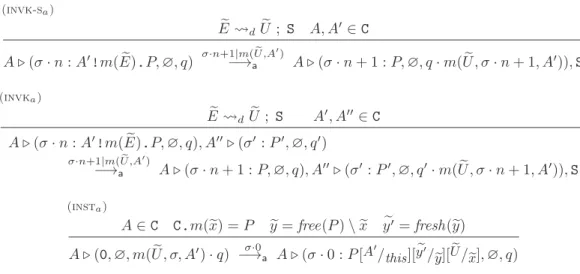
Therefore, in order to compute an upper bound to the instances of method bodies, which is the basic argument for the model of Section 4 to be a well-structured transition system, we need to abstract from the identity of these names – as we have done with variables. However, in case of actor names, the abstractions we have devised all break the delivering of messages. Therefore we decided to apply our arguments to an abstraction of the operational model where the delivery of messages is inexact: it may be enqueued in every actor of the same class. Yet, this abstract model allows us to derive decidability of termination and process reachability for the original language.
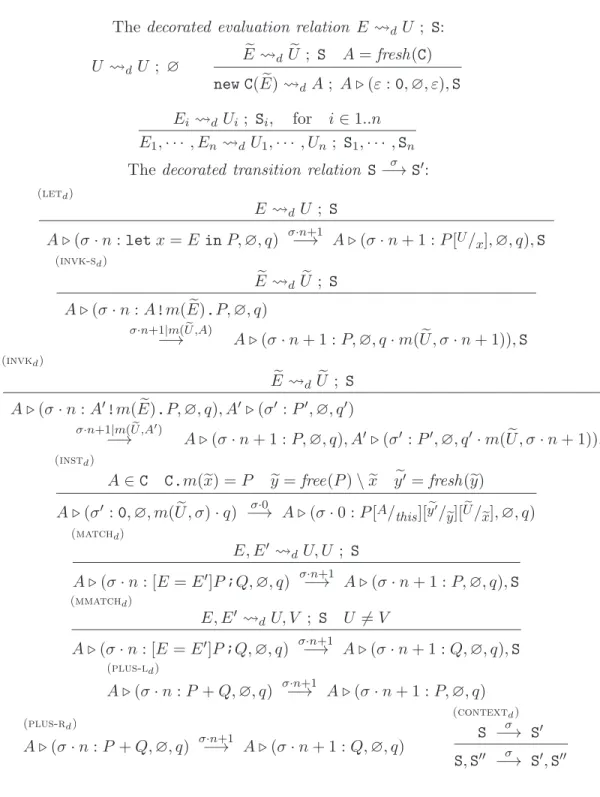
In order to formalize the correspondence between the concrete and the abstract oper-ational semantics, we need to add decorations to processes and transitions at the concrete level. Such decorations are used to keep track of the causal dependencies among processes. The decorated syntax adds a sequence of natural numbers in front of the process of an actor,
Thedecorated evaluation relation E dU ; S:
U dU ; ∅ Ee dUe ; S A=fresh(C)
new C(Ee) dA; A ⊲(ε:0,∅, ε),S
Ei dUi ; Si, for i∈1..n E1,· · ·, En dU1,· · · , Un; S1,· · · ,Sn
The decorated transition relation S−→σ S′: (letd)
E dU ; S
A ⊲(σ·n:letx=E inP,∅, q) σ−→·n+1 A ⊲(σ·n+ 1 :P[U/x],∅, q),S
(invk-sd)
e
E dUe ; S
A ⊲(σ·n:A!m(Ee).P,∅, q)
σ·n+1|m(U ,Ae )
−→ A ⊲(σ·n+ 1 :P,∅, q·m(U , σe ·n+ 1)),S
(invkd)
e
E dUe ; S
A ⊲(σ·n:A′!m(Ee).P,∅, q), A′⊲(σ′ :P′,∅, q′)
σ·n+1|m(U ,Ae ′)
−→ A ⊲(σ·n+ 1 :P,∅, q), A′⊲(σ′ :P′,∅, q′·m(U , σe ·n+ 1)),S
(instd)
A∈C C.m(xe) =P ye=free(P)\ex ye′ =fresh(ye)
A ⊲(σ′ :0,∅, m(U , σe )·q) −→σ·0 A ⊲(σ·0 :P[A/this][ye′/ye][Ue/xe],∅, q) (matchd)
E, E′ dU, U ; S
A ⊲(σ·n: [E=E′]P;Q,∅, q) σ−→·n+1 A ⊲(σ·n+ 1 :P,∅, q),S (mmatchd)
E, E′ dU, V ; S U 6=V
A ⊲(σ·n: [E =E′]P;Q,∅, q) σ−→·n+1 A ⊲(σ·n+ 1 :Q,∅, q),S
(plus-ld)
A ⊲(σ·n:P +Q,∅, q) σ−→·n+1 A ⊲(σ·n+ 1 :P,∅, q)
(plus-rd)
A ⊲(σ·n:P+Q,∅, q) σ−→·n+1 A ⊲(σ·n+ 1 :Q,∅, q)
(contextd)
S −→σ S′
S,S′′ −→σ S′,S′′
Table 3: The decorated operational semantics of the languageActorsl
identifies the action of emission of the message that caused the method instantiation from
which P was generated, and nis a counter indicating that P is actually generated by the
method instantiation afternsteps. Notice that for the main process executed by the actorℵ