End-User Systems, Reusability, and High-Level Design
Glenn S. Fowler([email protected])
John J. Snyder ([email protected])
Kiem-Phong Vo ([email protected])
AT&T Bell Laboratories 600 Mountain Avenue Murray Hill, NJ 07974, USA
During the past ten years, the number of computer users has grown by orders of magnitude. This has been brought about by dramatic increase in comput-ing power combined with equally dramatic decrease in hardware costs. Be-yond \stand-alone" user applications like word processing and spreadsheets, new classes of business applications arise where competitive advantage is created by empowering \end-users" with instant access to relevant information. In many cases, code already exists to access and process the desired information; the chal-lenge is nding a way to couple such processing capabilities to individual user requests in a timely, specic, and friendly fashion. The keys to such end-user systems lie in high-level design and software reusability. This paper describes a language tool Easel (End-User Application System Encoding Language) for building end-user systems and experiences in its development and deployment.
1. Introduction
An end-user is a user who needs to perform some computing functions but may not be well-acquainted with the underlying theories and mechanics. In this sense, even an expert computer user can be an end-user in some application domain. An end-user application is a software system designed to be used by end-users. As such, the primary characteristic of an end-user system is an interface that is easy to use, directly addresses users' needs, and hides any complexity in the solution methods. As computing techniques become more diverse and complex while the cost of computing machinery becomes cheaper, the market for end-user applications gets larger. This is particularly true in business computing where combina-tions of techniques from networking, databases, statistical analyses, equation solving, and graphics are routinely required.
Though computing techniques can be complex, there are a multitude of high quality software tools readily available to solve such problems. From a system construction point of view, it is desirable to take advantage of such tools in building a new application. Coupled with the requirement of a good user interface, the main challenges in building an end-user application are:
Designing a system architecture that maps closely to users' needs
Leveraging as much as possible from existing software tools in implementation.
As successful applications often live long and beget others, additional challenges are to ensure that a system is easily evolvable, and to grow the pool of reusable software tools as systems are built. A sign of a successful software development organization is its ability to build families of applications quickly and still provide good maintenance support. This is possible only if:
The system construction method encourages building reusable tools
Enough characteristics of an application family can be abstracted into reusable
tem-plates
A means exists to help the coding and maintenance of such templates.
Over the past 10 years, we have been working with a language and system to build end-user applications calledEasel(End-User Application System Encoding Language). Easel
applications use interactive constructs such as windows, forms, menus, and hypertexts to provide easy to use interface and build or reuse computational tools for other application-specic tasks. Within AT&T, Easel has been used to build hundreds of applications
ranging from simple educational systems to sophisticated applications used to plan and manage the telephone network. Some of these applications are used world-wide and support hundreds of international users on a daily basis. Early experience withEaselwas reported
in [Vo90]. This paper describes the current state of the Easellanguage, how its approach to system construction encourages software reuse, how language macros help build a higher abstraction levels, and relates some experience in building families of end-user applications withEasel.
2. End-user system architecture
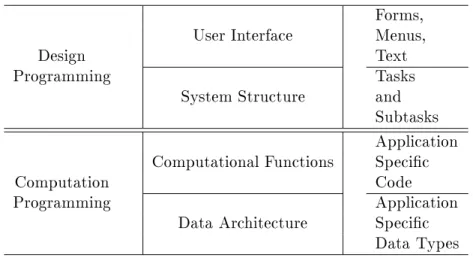
To see how Easel helps to build an end-user system, we need to understand the components that comprise such a system. The logical structure of an end-user system can be divided into four layers [Vo90] as shown in Figure 1. The top two layers represent
Design Programming, i.e., programming activities focusing on the user interface and high-level tasks as seen from the user's point of view. The lower two layers representComputation Programming, i.e., activities focusing on how the high level tasks are to be implemented and with what data structures.
TheUser Interfacelayer allows users to manipulate the systems using well-dened and easy to use steps. A major function of this layer is to hide all dierences and idiosyncrasies in the interfaces of underlying computing tools and techniques. An Easel application builds
this layer using menus, forms, and hypertexts to provide an active interface that guides users in taking appropriate computational steps.
TheSystem Structuredenes a task partition and relationships among tasks. In theEasel
Forms, User Interface Menus,
Design Text
Programming Tasks
System Structure and Subtasks Application Computational Functions Specic
Computation Code
Programming Application
Data Architecture Specic Data Types
Figure 1:
Interactive End-User Systems Architecturedialogs appropriate to the task and prescriptions for computing methods necessary to carry out that task. Dialogs can cause transitions to other frames in the frame network or induce certain low level computations. For example, a simple electronic mail application might consist of the following tasks:
Getting a list of users,
Picking addressees from the user list,
Filling out a mail form, and
Sending the mail.
Each of these tasks maps to a frame that denes:
Its own set of relevant parameters (e.g., login ids, mail headers, etc.),
Mechanisms to obtain the parameters (e.g., from the user, from login database, etc.),
and
Appropriate commands to drive lower-level computational processes (e.g., running the mailcommand).
Thus, frames focus on high level activities required to perform a given task. Actual com-putations are performed at a lower level by invoking applications code, utilities, and other packages.
there are several language mechanisms to execute application specic code that may be in C or some interpretive languages such as the UNIX shell [Bou78, BK89] orAwk[AKW88]. The Data Architecture layer denes the types of data to be manipulated along with their storage and access methods. Specic data types depend on the application and the tools used to perform the computational functions. Data types may be tuned to support, fa-cilitate, and optimize execution of algorithms and methods at the computational level. Examples include Easel variables, C and C++ data types and structures, data for
rela-tional and object-oriented databases, as well as data types required by specic packages, such as statistical or queuing packages.
The four-layer architecture points out some useful insights on reusability in some broad categories of tools. Traditional UNIX tools are often designed to do single tasks that, in many cases, embody powerful data structures and algorithms. Since their interfaces are geared toward the specic computing methods being implemented, they are not easily usable by end-users although they are immensely reusable. At the other end of the spectrum, many screen-oriented applications based on screen libraries likecurses[Arn84, Vo85] orX[Nye90] and various spreadsheets or database packages are easy to use, but oer little reuse because the computational methods are too intertwined with the implementation of other parts of the system. Easel is an attempt at bridging this reuse gap between general purpose but hard to use tools and application specic but easy to use software.
Easel's approach to system construction can be summed up as that of separating Design Programming from Computational Programming. TheEasel language focuses on
express-ing the high level design of a system includexpress-ing its user interface and task partition. Most computational details in the lower two layers are left out at this level but enough of the interface to appropriate software components can be specied. In this way, tool reuse is naturally a component of theEasel's system construction method. As we shall see later,
by bringing in a language tool for program design, Easel also makes possible the reuse of certain high level tasks in much the same way that software tools traditionally improve computational reuse.
3. The
Easellanguage
The Easel language is block structured where the block types map to certain high
level activities. Some blocks dene user interface components and tasks such as:
{frame { a high level task
{context { grouping of related activities
{menu { selections to be decided by users
{question { a group of questions is a form
{write { display text to screen
Other blocks and statements dene computations such as:
{process { runs named cooperating UNIX process and sends enclosed text to its
standard input
~Ccall { calls the named C function
~call ~goto ~overlay ~return { transition among frames
~evglobal ~evlocal { event handling
le input and output
string handling
mathematical operations and functions
Other language statements provide for managing the scope of variables, manipulating the run-time UNIX process environment and keyboard bindings and macros. Another group of statements is used to modify default display attributes, such as window locations, border styles, colors, etc.
Easelvariables need not be declared and are initialized as empty strings. Most operations
including those requiring communicating with external processes or subroutines result in string values. However, in cases where numerical values are required, the mathematical assignment statement:= can be used to do such computations.
Easelapplications are constructed in a network of frames. Each frame is dened in a frame block:
{frame FrameID ~arg1 ~arg2 ... ....
}f
Each frame has its own name or frame id, may accept arguments, may contain statements and other nested blocks, and may return values to its caller. Easel variable names (and
keywords) begin with the ~(tilde) character.
Composite blocks provide grouping of statements and nested blocks:
{context (entry):(exit) ....
}c
Control ow as exemplied above is directed via(entry)and (exit)conditions. A block or
statement is executed only if its (entry)condition is true; control loops through the block
or statement until its(exit)condition is satised. An omitted, or null, condition is taken
as true.
Rather than examining the Easel programming language in detail, we will illustrate how
3.1. An
Easelemail application
An electronic mail application serves as a small but realistic example. The main tasks of the application consist of:
Getting a list of users,
Asking the user to select addressees,
Filling out a mail form, and
Sending the mail.
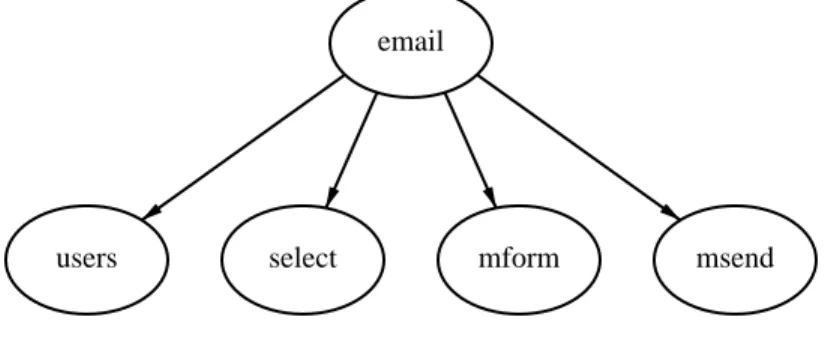
The design of the frame network for such anemailapplication might then look like Figure 2.
users select mform msend
Figure 2:
The email frame networkBelow is the Easel code for the top level email frame. Line 1 begins a frame block for
frame email. Line 2 calls frame users to get a list of users that is assigned to variable ~users. Line 3 calls frame select with argument ~users to ask user to make selections
which will be assigned to variable ~to. Line 4 calls framemform with argument ~to. This
frame will return three values to be assigned to ~to, ~subj and ~mesg. Line 5 begins with
an entry condition that is true only when both ~to and ~mesg are not null; if that is the
case, then framemsend is called to send the message to the selected people. Line 6 denotes
the end of the frame block.
1: {frame email
2: ~call users > ~users 3: ~call select ~users > ~to
4: ~call mform ~to > ~to ~subj ~mesg
5: (~to!=~null && ~mesg!=~null): ~call msend ~to ~subj ~mesg 6: }f
The rst task or frame called by email is users. Below is the code for users. Line 2
runs /bin/ksh as a cooperating process or coprocess. Values returned from the coprocess
will be assigned to variable ~logins. Line 3 species the response" and
\end-of-commands" protocol delimiters to be used betweenEaseland the coprocess. WhenEasel
is done sending data to the coprocess (the text on line 5), it sends the end-of-commands text (echo ShIsDone\n). Easelthen starts reading text returned from the coprocess until
disturbed during this execution so Easel will not refresh the screen when it gets back
control from the coprocess. Line 5 is the complete body of text to be sent to the coprocess; on Suns running NIS (formerly Yellow Pages), this shell script will generate the current list of logins. Line 6 ends the process block. Line 7 causes control to return to the calling frame and returns the value contained in the variable ~logins.
1: {frame users
2: {process "/bin/ksh" > ~logins 3: ~!"ShIsDone\n","echo ShIsDone\n"
4: ~$
5: ypcat passwd | cut -d: -f1 | sort | uniq | xargs 6: }p
7: ~return ~logins 8: }f
The next task is to ask the user to select the desired addressees from the available list of users. Below is the frame select that performs this task. Line 1 begins frame select,
which has argument~list. Lines 2{8 present the~listof logins as a menu to the end-user,
builds a ~to list adding each user selection, and loops until a null choice is entered. The .windowstatement on line 3 denes a window for the menu. If this is not denedEaselwill
construct some default window whose size and placement are designed to make good use of screen real estate. Line 5 provides the list of options to be shown, namely those stored in variable ~list. Delimiters for the list are specied as space, tab, or newline characters.
Line 6 builds a list of the logins selected by the user and stores the result in the variable
~to. This variable is used in the menu's title given in line 4 to give immediate feedback to
user on the current set of selections. Line 9 returns the value of ~toto the calling frame.
1: {frame select ~list
2: {menu :(~pers == ~null) ~pers
3: .window( x=5, xlen=50, y=0, ylen=10 ) 4: Mail To: ~to
5: {option ~list " \t\n" 6: ~to = ~to * ~pers * " "
7: }o
8: }m
9: ~return ~to 10: }f
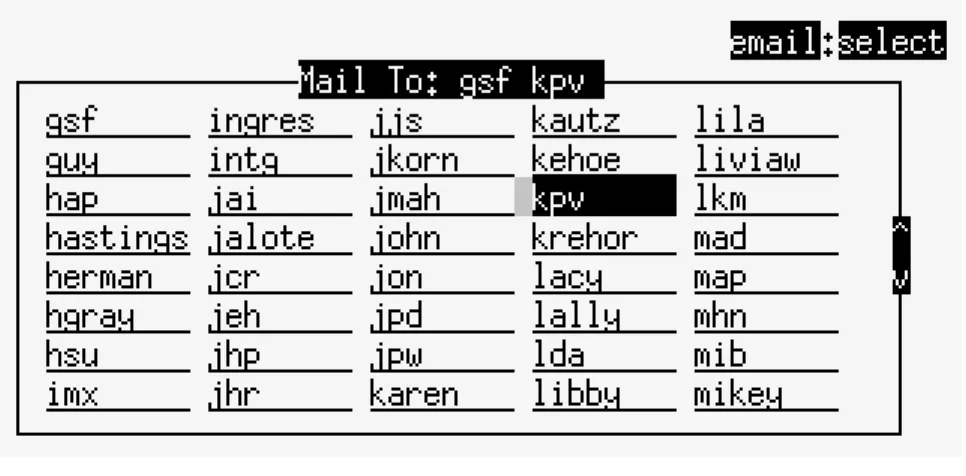
A screen snapshot ofselectis shown in Figure 3. Note that the frame stackemail:select
shows the traversal sequence in the frame network to get to the frame select. If allowed
by system designers, experienced users of anEasel application can use the commands at
the bottom of the screen to directly access any frame in the network.
The third email task is to display a mail form and let the user ll it in. Below is the
framemform. The context block beginning on line 2 is used to group the enclosed question
blocks so they will be displayed together as a unit or form. The .form statement on lines
3{8 species that answer elds should be shown in color 2 (typically underlining on black and white terminals) withattributes set toprintable characters. The .formstatement also
includes a template for the form and indicates which question variables correspond to which answer elds. For example, line 4 indicates that the answer eld is the~Tovariable, which,
Figure 3:
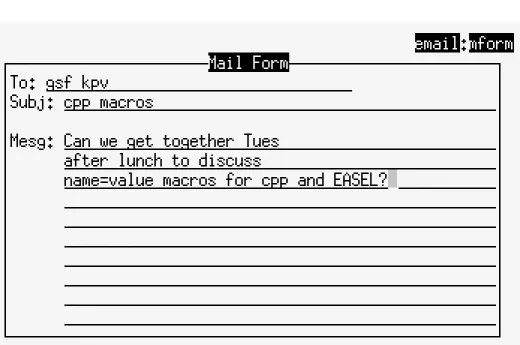
The selectscreenthe user in theselectframe will be shown on the form as soon as it is displayed. The user
can edit the answer eld on the form or move on to the next eld. Lines 10{12 provide help text for this form should the user request help. Although not shown here, help text may includeEaselvariables as well as hypertext links. Lines 13{22 are the question blocks
used to build up the form; each provides a variable to collect the user's response to that question. The .fieldstatement in line 20 overrides the suggested template and species
that the answer ~Mesg eld be repeated 10 times for a ten-line answer. If the user types
beyond the 10th line, the answer eld will scroll (unless the answer has been restricted to
the length specied). Although the syntax for specifying a form is a bit verbose with its
.form statement and group of question blocks, it saves frame designers from counting row
and column coordinates and allows entry conditions on question blocks to tailor eld access dynamically. Line 24 returns the values in~To,~Subj, and~Mesgback to the calling frame.
Figure 4 shows a screen snapshot of the form.
1: {frame mform ~To 2: {context
3: .form( c=2, a=p,
4: To: <_____________________ $ ~To
5: Subj: <___________________________ $ ~Subj 6:
7: Mesg: <___________________________ $ ~Mesg
8: )
9: Mail Form 10: {descript
11: Some HELP for the form 12: }d
13: {question ~To
14: To:
15: }q
16: {question ~Subj 17: Subj: 18: }q
19: {question ~Mesg 20: .field( r=10 ) 21: Mesg:
24: ~return ~To ~Subj ~Mesg 25: }f
Figure 4:
Themform screenThe nal task, if the user has provided non-null text for the addressees and the message, is to send the user's e-mail, as coded in framemsend below. Line 2 gets the current value of
the environment variable $LOGNAME and stores it in the Easel variable ~LOGNAME(for use
in the mail message body). Lines 3{14 communicate with the same coprocess/bin/kshas
was set up in the frame users. This time, what is being sent to the shell is a multi-line
mail command that is parameterized by several Easel variables. The variable ~efsdate
in line 8 is an Easel read-only variable containing the current date as a string, e.g., Sat May 21 01:40:10 EDT 1994.
1: {frame msend ~To ~Subj ~Mesg 2: ~getenv ~LOGNAME
3: {process "/bin/ksh"
4: ~!"ShIsDone\n","echo ShIsDone\n"
5: ~$
6: mail ~To <<!! 7: Subj: ~Subj 8: Date: ~efsdate 9:
10: ~Mesg 11:
12: Thanks! ~LOGNAME 13: !!
14: }p 15: }f
as it would be sent to the coprocess to let the command be checked without sending any unnecessary mail.
mail gsf kpv <<!! Subj: cpp macros
Date: Sat Apr 30 01:40:10 EDT 1994 Can we get together Tues
after lunch to discuss
name=value macros for cpp and Easel? Thanks! jjs
!!
That has been a quick look at Easelas a language and system to build end-user systems.
As the emailapplication shows, the application design process starts with identifying tasks from user's perspective. These tasks can be quickly prototyped in the Easel language without lower level computations. In this way, the tasks can be tested out with users to see if they are suitable. In parallel to or with user testing, computational tasks can be implemented and tested. This cycle continues until the system is complete. Figure 5 shows this system construction method.
User Interface Frames
Computations Data Requirements
Prototype
User Test Releases
Figure 5:
Easel frame system development cycle3.2. Building higher abstraction levels with macros
The availability of a language suitable for design programming enables design reuse in the traditional style of building macro templates and code libraries. It is clear how frames parallel traditional library functions and can be reused as such. In many projects where families of applications are built, higher levels of reuse can be achieved by dening macro templates. Such templates are useful because they:
Reduce programming time of repetitive tasks,
Standardize the access to lower level computational functions.
For example, consider the task of obtaining a list of logins in frame users of the email
application. The shell communication can be abstracted to the actions of:
Sending the shell a set of commands,
Reading responses from the shell, and
Assigning responses to an appropriate Easel variable.
Below is a macro denition of this task in an extended C preprocessor language [KR78, Fow88]. The macro KSH_get takes two arguments Cmd and Var that dene the command
to be sent to the shell and the variable to store any responses. The default values for Cmd
and Varare the stringecho ok and the variable nameksh_out.
1: #macdef KSH_get(Cmd="echo ok", Var=ksh_out) 2: {process "/bin/ksh" > ~Var 3: ~!"ShIsDone\n","echo ShIsDone\n"
4: ~$
5: Cmd
6: }p
7: #endmac
The instantiation below of the macro KSH_get generates the equivalent code on lines 2{6
of frame users:
KSH_get(Var=users, Cmd="ypcat passwd | cut -d: -f1 | sort -u | xargs")
The communication protocol with the shell as dened in this example is relatively simple. For other tools, it can be much more complex. By using macro templates, frame developers can focus directly on whatneeds to be performed without having to worry about how it is performed, which helps avoid inadvertent errors.
The same technique can also be applied to the menu task in the select frame. Below
is the macro template to do that. Here, macro parameters are used to describe the main components of a menu block. In this example, the menu window is constrained to always appear with the top left corner at location x=5 and y=0 and dimensions xlen=50 and ylen=10. This is somewhat contrived (by default, windows are automatically sized and
placed by a best-t rule) but it serves to show how interface constraints can be standardized using macro templates.
1: #macdef Menu_list( Title=Selections, List=list, Sel=sel, Ans=ans) 2: {menu :(~Sel == ~null) ~Sel
3: .window( x=5, xlen=50, y=0, ylen=10 ) 4: Title: ~Ans
5: {option ~List " \t\n" 6: ~Ans = ~Ans * ~Sel * " "
7: }o
For completeness, the following instantiation ofMenu_listgenerates the same code for the
menu block on lines 2{8 of frameselect:
Menu_list(Title=Mail To, Sel=pers, Ans=to)
4. Experiences with building an application family
Within AT&T, several projects have successfully used Easel to build sophisticated
network management applications. In particular, a project which we shall called Project D made extensive use of Easel to generate families of end-user applications for a variety of end-users, including:
Switch engineers { to monitor, forecast, plan, and equip switches to handle trac loads
eciently,
Operations support sta { to monitor and evaluate operator services throughout a
network, and
Service planners { to conduct trac analyses of specialized services and provide reports.
Much of the raw data for these systems is generated automatically by the switches them-selves in the telephone network. Portions of this data are periodically downloaded onto UNIX servers and stored in relational databases, for use by applications. These applications are often written in C with embedded SQL calls. The C code can be complex, sophisticated, and not easy to use by non-experts. But to better serve telephone customers, it is becoming more and more important to make such capabilities readily available to end-users.
When Project D rst started, it recognized the needs to reuse existing C code and to provide friendly user interfaces. They found lots of literature on user interfaces, e.g., [Sch87], and a variety of user interface packages inspired by the early work at Xerox PARC [Gol84], including Apple Macintoshes and PCs with Microsoft Windows. But what was needed was to wrap a friendly user interface around large existing C applications running on UNIX systems. Easel was chosen for this task.
In building applications, Project D's architects recognized that there were many tasks that are repeated again and again, such as:
Obtaining information from the database,
Formatting data for display to end-users,
Collecting end-user responses via menus and forms,
Providing hypertext help,
Storing new information into the database, and
Time-stamping and posting messages to end-users.
A library of high-level objects,
Easel frame code,
Application-specic libraries, including database access utilities (C and SQL), and
A relational database.
The high level objects currently number about 70 and are implemented as macros that expand into Easel code (using awk and cpp). Code generated by the macros reference a
library of about 90 utilities, written both in Easel and C, many of which interface with
the database. As new reusable objects or object attributes are found and dened, Easel
code and database access utilities can be expanded as needed.
To date, Project D has built nearly a dozen dierent end-user systems, each consisting of hundreds of Easel frames. During the initial phase of the project, many new objects
are discovered, implemented in macros and, as necessary, supported by new low-level C functions and/or database transactions. Application architects have said that the capability to write new macros and new code at any level avoids hitting \brick walls" and makes this approach based on Easel even more powerful than a typical 4GL. Recent applications have been built entirely out of predened macros. The expansion of common macros can be \personalized" to meet particular requirements of particular customer sets.
A typical Project D source code le written with macros averages about 100 to 200 lines long, which after macro expansion averages about 1,000 lines of Easelsource code. Thus, use of the macros reduces code size roughly by a factor of 5 if compared to straight Easel
code. It is not as easy to get a similar comparison between Easel code and equivalent
code in C but it is not hard to conclude that the code size reduction would be much larger than that. Project D developers have estimated that programming inEaselalone (without
macros) oers a 10 to 1 advantage in terms of implementation time over writing the same end-user system in C.
This high level of software reuse has allowed Project D to employ small teams to inter-act with customer focus groups, design, test, and rapidly rene prototypes using customer feedback to esh out features for production releases. The end results for Project D are customers who feel that they are getting what they really want. Finally, from an organi-zational point of view, an important aspect of having high level macro objects is that they are easily learned by developers new to the project. New Project D developers typically can begin to build screen objects within a few days of training.
5. Evolution and reuse experience
Easelhas grown and matured signicantly over the years, thanks to two
complemen-tary forces. One has been feedback from designers and developers using Easel to build
An example of users' feedback is the recent addition of an interactive frame builderefb. For
many years,Easelprovided a language and environment to program and execute end-user systems. We have discussed the benets of having a language suitable for implementing the high level design of such systems. However, an aspect of user interface design that cannot be easily addressed by a textual language is that of experimenting with dierent screen layouts. The frame builderefbaddresses this needs by allowing users to writeEasel code
and lay out the screen interactively. It is interesting to note thatefb itself is implemented
in theEasellanguage as a frame system consisting of about 150 frames and 3 coprocesses written in C.
Easel is based on a number of standard libraries; the original list included: curses, for screen manipulations, malloc for memory allocation, regex for regular expression match-ing [KP84], and stdio, the standard input/output library. In the course ofEasel's evolu-tion, we found that some of these libraries needed improvement and that new libraries were needed.
The earliest version of Easel, around early 1982, was based on the originalcurses library on the BSD4.1 UNIX System. Aside from a number of bugs, this version of curses also suered from lack of features (such as hardware scrolling) and poor performance. After much consideration, curses was rewritten to improve code quality and eciency. The new library,screen[FKV94], remains upwards compatible withcursesand includes new features such as screen editing, menu display, mouse support. It is also fully internationalized and and supports multiple international multi-byte character sets. Because of screen, Easel
is perhaps the only current application construction system that enables applications that run transparently in multiple countries using dierent character code sets across the Orient and Europe.
Easeluses the mallocpackage for dynamic memory allocations. Early in its development, it was discovered that standardmallocimplementations both on System V and BSD UNIX systems had severe deciencies, either in terms of space fragmentation or time performance or both. This prompted a study by Korn and Vo[KV85] to compare all available malloc
implementations in 1985. At that time, a newmallocpackage based on the best-t strategy was also implemented. The study found that this package provides the best trade-o in both time and space. This version of malloc is now part of the standard System V UNIX distribution. More recently, we found that certain large Easel applications may have hundreds to thousands of users running concurrently on the same server. This indicates that there is much to be gained by using shared memory for storing frames on line. Coupled with certain other needs, this prompted a generalization ofmalloctovmalloc[Vo94a, Vo94b], a new library that introduces the idea of allocation from regions each of which may employ a dierent allocation strategy and a dierent means to obtain memory.
When event handling was added to Easel, it was discovered that signals could cause the
screen to be only partially updated. The bug was tracked down to the stdiolibrary which drops data if a write system call is interrupted by a signal. This and other shortcomings
of stdioled to the writing of so, a faster, safer I/O library [KV91].
Along the way, it was found that several pieces of software in the department, including
The need to distribute low-level libraries that depend on system calls and other environmen-tal parameters for a wide range of hardware and software platforms led to the development of an installation tool to automate the process. The tool, called Iffe [FKSV94], probes
and then congures the software automatically without human intervention.
5.1. Other approaches
The rst version of Easel called Ifs [Vo90] was rst developed in the early part of
1982. At that time, there were few alternative languages for building end-user applications. Within AT&T, the best known tool for form-based applications was FE, a form-entry
system [Pri85]. AsFEfocused on forms, it could not be used for more general applications requiring menus or windows. More recently, there are a number of commercial character-based packages with comparable functionality to Easel. Most notable are the FMLI
package distributed with UNIX System V and theJAMpackage [Jya94]. FMLIis based on
thecurseslibrary and uses a syntax similar to the shell language enhanced with constructs to write forms and menus. The heavy reliance on separate scripts for forms and menus
FMLI cumbersome to use. JAM runs on both PC and UNIX systems and is based on
proprietary software for screen handling. JAMrelies more on an interactive screen builder to prototype screens than on a language to write applications. Though this makes it easy to build single applications with few screens, it can become cumbersome when families of applications must be built along the line of Project D discussed in Section 4. In fact, Project D developers investigated both JAM andEaseland decided to useEaselbecause its
open-ended architecture makes it easy to add new functionality at any number of architectural levels, e.g., high-level macros,Easel's code, processes, or C routines. On the bit-mapped graphic side, theTcl/Tk[Ous94] language and toolkit is compatible toEaselin the basic approach to tool and application design. In fact, it would be interesting to rewrite the display library of Easel based on Tcl/Tk or a similar toolkit. An advantage of doing this is that Easel-based applications could run transparently on character terminals and
graphical workstations.
6. Conclusion
We have describedEasel a language and system for building end user systems. From an application builder's point of view, the success of Easel derives directly from its phi-losophy of separatingDesign programming from Computational programming by providing a programming language suitable for design implementation. This enables a style of sys-tem development that focuses on partitioning tasks as seen from users' perspective and increases the chance of matching users' expectations. Having a high level language for design programming brings in traditional reuse techniques such as code libraries and tem-plates. In addition, by dening precisely a small number of standard interfaces to external code,Easel encourages the construction of reusable code. We described experiences with
a project where a family of end-user applications were built based on these ideas. In this case, the application builders themselves claimed at least a factor of ve reduction in code size and corresponding productivity improvement.
60,000 lines of C code. For many years, this body of code was maintained and enhanced by essentially a single person (Vo). This is not normally feasible but for the high level of reusability in the internal code. As the software evolves, we gradually abstract pieces of it into reusable libraries. The construction of such libraries have sometimes led to new and interesting theoretical problems. For example, early in the rewrite of thecurses library, it is recognized that screen scrolling is best modeled by a string matching problem in which matches have weights. This led to the development of a new heaviest common subsequence algorithm[JV92]. Recently, new algorithms and heuristics for memory allocation were de-veloped in building thevmalloclibrary. Thus, reuse permeates our way of building software and drives the interplay between theory and practice.
7. References
[AKW88] Al Aho, Brian Kernighan, and Peter Weinberger. The AWK Programming Language. Addison Wesley, 1988.
[Arn84] K. C. R. C. Arnold. Screen Updating and Cursor Movement Optimization: A Library Package, 4.2 BSD UNIX Programmer's Manual Supplementary Docu-ments. University of California, Berkeley, July 1984.
[BK89] Morris Bolsky and David G. Korn. The KornShell Command and Programming Language. Prentice-Hall Inc., 1989.
[Bou78] S. R. Bourne. The Unix Shell. AT&T Bell Laboratories Technical Journal, 57(6):1971{1990, July 1978.
[FKSV94] Glenn S. Fowler, David G. Korn, J. J. Snyder, and Kiem-Phong Vo. Feature-Based Portability. In VHLL Usenix Symposium on Very High Level Languages, October 1994.
[FKV94] Glenn S. Fowler, David G. Korn, and Kiem-Phong Vo. Principles for Writing Reusable Libraries. 1994. Available from authors.
[Fow88] Glenn S. Fowler. cpp - The C language preprocessor, 1988. UNIX Man Page. [Gol84] A. Goldberg. Smalltalk-80, The Interactive Programming Environment.
Addison-Wesley, 1984.
[JV92] Guy Jacobson and Kiem-Phong Vo. Heaviest increasing/common subsequence problems. In Combinatorial Pattern Matching: Proceedings of the Third Annual Symposium, volume 644 of Lecture Notes in Computer Science, pages 52|65, 1992.
[Jya94] Jyacc. Jam application development guide, 1994.
[KP84] Brian W. Kernighan and Rob Pike. The UNIX Programming Environment. Prentice Hall, 1984.
[KV85] David G. Korn and Kiem-Phong Vo. In Search of a Better Malloc. In USENIX 1985 Conference Proceedings, pages 489{506, 1985.
[KV91] David G. Korn and Kiem-Phong Vo. SFIO: Safe/Fast String/File IO. In Pro-ceedings of Summer USENIX Conference, pages 235{256. USENIX, 1991. [NV93] Stephen C. North and Kiem-Phong Vo. Dictionary and Graph Libraries. In
Proceeding of Winter USENIX Conference, pages 1{11. USENIX, 1993. [Nye90] Adrian Nye. Xlib Programming Manual. O'Reilly & Associates, Inc., 1990. [Ous94] John K. Ousterhout. Tcl and the Tk toolkit. Addison-Wesley, 1994.
[Pri85] Reuben M. Pritchard. FE - A Multi-Interface Form System. AT&T Technical Journal, 64(9):2009{2223, November 1985.
[Sch87] Bruce Schneiderman. Designing the User Interface. Addison Wesley, 1987. [Vo85] Kiem-Phong Vo. screen(3X) - more <curses>: the <screen> library, 1985.
UNIX Man Page.
[Vo90] Kiem-Phong Vo. IFS: A Tool to Build Application Systems. IEEE Software, 7(4):29{36, July 1990.
[Vo94a] Kiem-Phong Vo. Enhancing library usability with disciplines and methods. 1994. Available from the author.
[Vo94b] Kiem-Phong Vo. Vmalloc: A general and ecient memory allocator. 1994. Available from the author.
Biography
Glenn Fowler is a Distinguished Member of Technical Sta in the Software Engineering Research Department at AT&T Bell Laboratories in Murray Hill, New Jersey. He is cur-rently involved with research on conguration management and software portability, and is the author ofNmake, a congurable ANSI C preprocessor library, and the coshell network
execution service. Glenn has been with Bell Labs since 1979 and has a B.S.E.E., M.S.E.E., and a Ph.D. in Electrical Engineering, all from Virginia Tech, Blacksburg Virginia.