REVIEW
Polymer-based chromophore–catalyst
assemblies for solar energy conversion
Gyu Leem
1*, Benjamin D. Sherman
2and Kirk S. Schanze
1*Abstract
The synthesis of polymer-based assemblies for light harvesting has been motivated by the multi-chromophore antennas that play a role in natural photosynthesis for the potential use in solar conversion technologies. This review describes a general strategy for using polymer-based chromophore–catalyst assemblies for solar-driven water oxida-tion at a photoanode in a dye-sensitized photoelectrochemical cell (DSPEC). This report begins with a summary of the synthetic methods and fundamental photophysical studies of light harvesting polychormophores in solution which show these materials can transport excited state energy to an acceptor where charge-separation can occur. In addition, studies describing light harvesting polychromophores containing an anchoring moiety (ionic carboxylate) for covalent bounding to wide band gap mesoporous semiconductor surfaces are summarized to understand the photophysical mechanisms of directional energy flow at the interface. Finally, the performance of polychromophore/ catalyst assembly-based photoanodes capable of light-driven water splitting to oxygen and hydrogen in a DSPEC are summarized.
Keywords: Energy conversion and storage, Energy and charge transport, Ru-containing polymer system, Dye-sensitized photoelectrochemical cells, Water oxidation, Photoanode, polymeric chromophore-water oxidation
© The Author(s) 2017. This article is distributed under the terms of the Creative Commons Attribution 4.0 International License (http://creativecommons.org/licenses/by/4.0/), which permits unrestricted use, distribution, and reproduction in any medium, provided you give appropriate credit to the original author(s) and the source, provide a link to the Creative Commons license, and indicate if changes were made.
1 Introduction
Artificial photosynthesis mimics the natural process occurring in plants with specifically engineered light-har-vesting systems to carry out the direct transformation of light energy to that stored in a chemical bond (i.e. a solar
fuel) [1]. The ultimate goal in artificial photosynthesis is
to generate carbon-based fuels from water splitting and
CO2 reduction with sunlight as shown in Eq 1 [2].
Toward this goal, artificial photosynthesis as an inte-grated system requires multifunctional behavior that generally consist of three parts: collection of light across a broad portion of the solar spectrum, transportation of photo excited-energy to charge separation sites of pig-ment (or chromophore) assemblies, and utilization of
(1)
2H2O+CO2+8 hν→CH4+2O2G◦=10.3 eV.
the photoexcited carriers to drive catalytic reactions that
produce chemical fuel [3, 4]. Integration of multiple
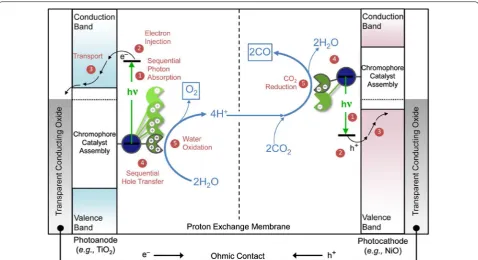
com-ponents to facilitate these photoelectrochemical events is necessary to achieve highly efficient solar-to-fuel con-version. In order to develop artificial photosynthesis, dye-sensitized photoelectrochemical cells (DSPECs) have been designed and investigated to provide an
architec-ture to drive water splitting and CO2 reduction at n- and
p-type semiconductor oxides with molecular-level light
absorption and catalysis as shown in Fig. 1 [5, 6].
Surface-bound chromophore–catalyst assemblies at the photo-anode and photocathode absorb light and perform the solar fuel half-reactions. To date DSPEC systems have integrated light harvesting assemblies utilizing a variety of architectures such as polymers, dendrimers, and
pep-tides [7–13].
In natural photosynthesis, a multi-chromophore antenna system absorbs light efficiently and transmits excited-state energy rapidly to a reaction center. Related antenna strategies can be achieved with polychromo-phoric polymers. Ruthenium(II) polypyridyl complexes
Open Access
*Correspondence: [email protected]; [email protected]
1 Department of Chemistry, University of Texas at San Antonio, San
Antonio, TX 78249, USA
have been widely used over the last decades as light har-vesting chromophores due to their high absorptivity in the visible spectrum for a strong metal-to-ligand charge
transfer (MLCT) transition [11, 14–17]. Ruthenium(II)
polypyridine complexes incorporated into a polymer scaffold offer a potential means of developing light-harvesting antenna systems for applications in dye-sen-sitized photovoltaic cells and artificial photosynthesis. According to previous studies, MLCT excitons in poly-meric chromophore systems exhibit a site-to-site
hop-ing mechanism along the polymer chains [18, 19]. In
the past several decades there have been a number of reported polymeric chromophore systems containing pendant ruthenium(II) polypyridine as light harvesting units because of beneficial properties such as remark-able photo- and thermal stability and long-distance
exci-ton and charge transport [20–25]. Recently, our research
group has carried out investigations of the photophysical and electrochemical properties of novel polychromo-phores or polychromophore–catalyst assemblies in order to understand the photodynamics of charge and exciton transport in solution and at the interface of
semiconduc-tor materials [19, 26, 27].
Constructing films of defined molecular composition has been a priority of applied material and interface sci-ence. Layer-by-layer (LbL) polyelectrolyte self-assembly offers a simple and versatile tool to allow facile control of
molecular assemblies prepared directly on substrate films
[28]. Most LbL polyelectrolyte films feature multilayers
composed of positively and negatively charged polyelec-trolytes and employ the electrostatic Coulomb interac-tion between the oppositely charged macromolecules to form stable films. LbL technology has promising
applica-tions in solid-state light-emitting devices [29], drug
deliv-ery [30], biomembrane [31], electrodialysis membranes
[32], and diagnostics [33]. Very recently, Leem et al. used
the LbL approach to construct multilayers for the use in
a DSPEC [26].
This review is focused on the synthesis, and photo-physical properties of polymeric assemblies consisting of multiple Ru(II) polypyridyl complexes as well as the poly-electrolyte LbL chromophore–catalyst assembly depos-ited onto semiconductor substrates for use in a DSPEC. The review highlights light-driven water oxidation using a polymeric chromophore–catalyst assembly immobi-lized onto a semiconductor at a DSPEC photoanode.
2 Polymer‑based metal complex assemblies 2.1 Synthesis and characterization of polymer‑based
metal complex assemblies
Table
1
Monofunc
tional polymers c
on
taining Ru(II) chr
omophoric sit
es
a Absor
ption maximum (
±
3
nm) f
or the most in
tense metal-t
o-ligand char
ge tr
ansf
er (ML
C
T) band measur
ed in ac
et
onitr
ile solution
Polymer
(1
)
(2
)
(3
)
(4
)
(5
)
(6
)
(7
)
Abs
max
a
dπ
−
π* (nm)
454 (1) 478 (2)
458
458
451
460
456
λem
(nm)
655 (1) 658 (2)
646
645
623
640
657
Re
fs
[
24
]
[
25
,
34
]
[
35
]
[
22
]
[
21
]
[
23
electrochemical properties of the chromophoric sites preserved in the polymer. As an early synthetic strat-egy, polymer assemblies containing a [tris(bipyridyl) ruthenium(II) derivatives] were considered for creating polymer assemblies that could be modified by
introduc-ing polypyridyl Ru complexes [24, 25, 34].
Polypyridyl complexes of ruthenium were attached to
styrene-p-(chloromethyl) styrene copolymers
derivat-ized via nucleophilic displacement of chloride followed
by the formation of an ether (1) or ester linkage (2) in
Table 1 [24]. Based on electronic absorption spectral data
of ether and amide-linked polymers, the photophysical properties of the metal to ligand charge-transfer transi-tions of ruthenium(II) complexes on the polymeric chain are unchanged upon binding to the polymers. For an
amide-linked polymer (3), the aminated
poly(styrene-p-(aminomethyl)styrene) (co-PS-CH2NH2) can be
cou-pled with a carboxylic acid derivative of the Ru metal
complex in the presence of a couple of reagents [25, 34].
The amide-linked polymer strategy is a preferable cou-pling chemistry because of the availability of a variety of carboxylic acid derivatives of metal chromophores and quenchers. More interestingly, intra-strand energy trans-fer in the amide-linked polymer is known to be rapid compared to energy transfer in the ether-linked polymer due to the electron withdrawing effect of the amide link relative to the ether link.
The polymer poly(4(2-[N,N-bis(trimethylsilyl)amino]
ethyl)styrene) (4) was prepared by a living anionic
polym-erization method that offers well-controlled polymer
chain lengths and narrow polydispersity (Mw/Mn < 1.2)
compared to the previous polymer (3) that was prepared
by free radical polymerization and had a PDI of 1.5 [35].
The amide coupling reaction was carried out to link a ruthenium polypyridyl complex to the amino polymer. A major drawback of this anionic polymerization is mono-mer functional group tolerance under the strongly basic reaction conditions. As a key advantage, however, that aids the investigations of the photophysical properties of the polymer, the amino polymers synthesized by this method are linear and optically transparent in the visible region.
Our group reported the synthesis of a polystyrene backbone by the reversible addition-fragmentation chain transfer (RAFT) polymerization method combined with the azide-alkyne Huisgen cycloaddition as a “click
chemistry” reaction [22]. The azide-alkyne click reaction
affords a high yield for grafting Ru(II) complexes con-taining a terminal acetylene group onto the methyl azide functionalized polystyrene backbone. This is followed by the formation of a triazole linker under mild reaction conditions at room temperature. From emission quan-tum yield and lifetime studies, the MLCT excited state
is efficiently quenched in the RAFT PS-Ru
polychromo-phores (5) relative to a model Ru complex chromophore
in the absence of a polymer backbone. Interestingly, the thiol (–SH) end-groups on the polymers from the RAFT chain transfer agent can quench the MLCT state by a charge-transfer mechanism among the chromophore, leading to considerable reduction in the lifetime of the MLCT state.
Recently, in order to eliminate the thiol polymer end-groups we developed atom transfer radical polymeriza-tion (ATRP) and nitroxide-mediated controlled radical polymerization (NMP) methods to prepare polystyrene-based polychromophores with pendant Ru(II)
polypyri-dyl complexes [18, 20, 21, 23]. The ATRP method allows
for postpolymerization modification by incorporating
–Br end group functionality [21]. The
polypyridylruthe-nium derivatized polystyrenes were achieved in two steps. The polystyrene backbone was prepared by ATRP of the
N-hydroxyscuccinimide (NHS) derivative of 4-vinyl
ben-zoate with methyl α-bromoisobutyrate as the initiator. Subsequently an amide coupling reaction of the NHS-pol-ystyrene with Ru(II) complexes derivatized with
aminome-thyl groups ([Ru(bpy)2(CH3-bpy-CH2NH2)]2+) afforded
polypyridylruthenium derivatized polystyrenes, (6).
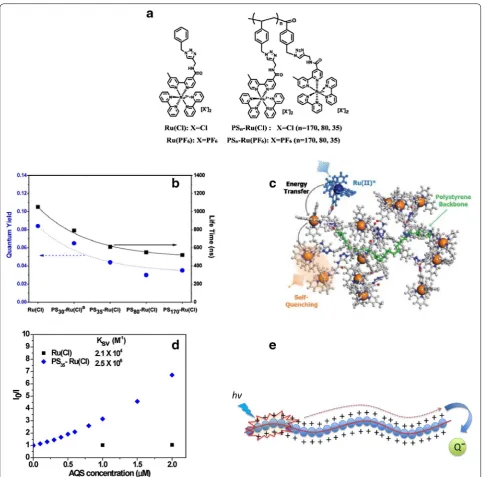
Leem et al. [23] explored systematic
structure–prop-erty relationships using a series of polystyrene backbone polymers containing Ru(II) polypyridyl pendant
chromo-phores, (7). The NMP and “click chemistry”
method-ology affords polymers with precisely defined number
average molecular weights (Mn) ranging from ~ 5500 to
24,000 g mol−1 with a high efficiency for the click
graft-ing of Ru chromophores to the polymer backbone. The emission quantum yield and lifetimes for the polymers in solution systematically decrease with increasing
molecu-lar weight as shown in Fig. 2. With an increased loading
of Ru metal chromophores on the polymer assemblies, the probability of exciton migration from the MLCT excited states to trap sites within the close-packed Ru pendants in a polymer backbone becomes more pro-nounced. Exciton-exciton annihlilation also becomes important at high light flux. Importantly, we confirmed the existence of exciton hopping along the polymer chains according to emission quenching studies of the
model compound, Ru(Cl) and polymers, PSn-Ru(Cl). The
luminescence of the cationic Ru(Cl) and PSn-Ru(Cl) is
quenched by oppositely charged sodium 9,10-anthraqui-none-2,6-disulfonate (AQS). Quenching of the polymers exhibited significant amplification (~ 100-fold) in com-parison to the quenching of the Ru(Cl).
2.2 Polymeric chromophores on metal oxide films
light harvesting assemblies by coupling polymer assemblies to mesoporous semiconductor surfaces for understanding of the structure and dynamical phenom-ena relating to solar energy conversion systems. For example, covalently or noncovalently surface-bound polychromophoric assemblies have been used that
contain anchoring group (i.e. –COOH and PO3H2) or
oppositely charged chains to bind the assembly onto a mesoporous semiconductor surface for excited state electron injection into conduction band of
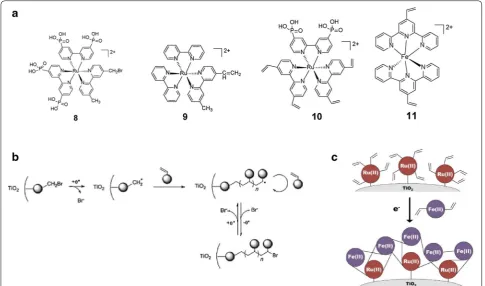
semiconduc-tor. As shown in Fig. 3, the initiator site, [Ru(4,4′-PO3H2
-2,2′-bpy)2(4-Br-4′-Mebpy)]2+ (bpy = 2,2′-bipyridine,
Mebpy = 4,4′-diphosphonic acid-2,2′-bipyridine, 8
was covalently bound to the TiO2 surface. Then, the
reductive initiation of [Ru(bpy)2(4-Me-4′-vinlybpy)]2+
(4-Me-4′-vinylbpy = 4-vinyl-4′-methyl-2,2′-bipyridine),
9 occurs at surface bound 8 onto TiO2 nanoparticles
by electrochemically controlled radical polymerization
[36]. Similarly, [Ru(5,5′-divinyl-2,2′-bipyridine)2(4,4′
-(PO3H2)2-bpy)]2+ containing a phosphonated bipyridine
Fig. 3 a Structures of [Ru(4,4′-PO3H2-2,2′-bpy)2(4-Br-4′-Mebpy)]2+ (8), [Ru(bpy)2(4-Me-4′-vinlybpy)]2+ (9), Ru(5,5′-(R)2-bpy)2Cl2 (R=CH=CH2) (10), [Fe(v-tpy)2]2+ (v-tpy = 4′-vinyl-2,2′:6′,2″-terpyridine) (11). b Mechanism of the oligomeric growth of RuII complexes from 8 in the cavities of the mesoporous TiO2 film. c Schematic diagram of the surface structure following reductive polymerization of 11 on TiO2-10 (Reproduced with permis-sion from Ref. [36, 37]. Copyright 2014, Wiley–VCH Verlag Gmbh & Co. and 2013, American Chemical Society, respectively)
ligand as anchoring group and vinyl functionalized
bipy-ridine ligands, 10 was selected as the monomer
precur-sor [37]. After the immobilization of 10 as the inner
molecular layer in mesoporous TiO2 film, [Fe(v-tpy)2]2+
(v-tpy = 4′-vinyl-2,2′:6′,2″-terpyridine), 11 was
reduc-tively electropolymerized onto the existing surface film
of 10, which resulted in enhanced photostability in
com-parison to the surface-bound Ru complex only. With the use of transient absorption spectroscopy of the
polymer-loaded TiO2, it was shown that photoexcitation of the
surface-bound Ru chromophore is followed by electron
injection and FeII to RuIII electron transfer.
Instead of electropolymerization of Ru(II)
polypyri-dyl chromophore onto a TiO2 surface, Leem et al. [19]
reported the preparation of conjugated and
non-con-jugated [18] polymer-based Ru(II) chromophores with
carboxylic acid anchoring groups followed by covalent immobilization of the polymeric chromophores to the surface of semiconductor nanoparticles. The carbox-ylic acid-derivatized ruthenium-functionalized polymer,
PS-Ru-A, was obtained by a NMP method and click
assembly via an azide-alkyne Huisgen cycloaddition reac-tion allowing the attachment of Ru(II) polypyridyl to the
polystyrene backbone as shown in Fig. 4. PS-Ru-A was
anchored to mesoporous TiO2 films (TiO2//PS-Ru-A) in
order to understand the interfacial photophysical dynam-ics of energy and charge transport among tand he pen-dant complexes along the polymer chain at the interfaces. The MLCT exciton from Ru(II) diffuses efficiently among pendant Ru complexes that are attached along the poly-mer backbone. Based on transient absorption spectra and time-resolved emission spectra measurements, an
antenna effect of the assembly occurs in TiO2//PS-Ru-A
consisting of the following photophysical events; (1)
photoexcitation of surface-bound RuII chromophores
and electron injection into TiO2 on the picosecond time
scale, (2) multiple Ru* → Ru energy hopping events after
photoexcitation of unbound RuII chromophores followed
by electron injection, (3) intra-assembly hole transfer to
pendant complexes away from the TiO2 surface, and (4)
back electron transfer between RuIII and TiO
2(e−).
3 Polymer chromophore–catalyst assemblies for solar energy conversion
Multiple strategies have been explored for assembling chromophores and catalysts onto semiconductors
includ-ing co-loadinclud-ing of chromophore and catalyst species [38,
39], forming bilayer assemblies with Zr(IV)-phosphate
bridges [40], adsorbing pre-synthesized covalently linked
chromophore–catalyst assemblies [41–44],
electro-assembly by reductive vinyl coupling [45, 46], and the
deposition of molecular overlayers [47, 48]. An example
of a pre-synthesized chromophore–catalyst assembly is
shown in Fig. 5, and this approach often requires
mul-tistep procedures with poor overall yields. The co-load-ing strategy requires less synthetic effort with the use of discrete chromophore and catalyst species but with the trade-off of less control of the orientation between the components and less special separation between catalyst and oxide surface. The use of metal cation bridged bilay-ers addresses the latter shortcoming of co-immobiliza-tion by allowing the sequential surface deposico-immobiliza-tion of the phosphate-derivatized chromophore and catalyst spe-cies, with the catalyst not in direct contact with the semi-conductor surface. While this gives a similar hierarchal surface structure with less synthetic effort as with the use pre-synthesized assemblies, the metal bridge is sus-ceptible to hydrolysis and is generally unstable over long times.
Our group has been interested in developing a differ-ent method for preparing dye-sensitized photoelectrode surfaces referred to as the ‘layer-by-layer’ (LbL) strategy
using polychromophore–catalyst assemblies. Figure 6
illustrates the stepwise sequence of preparing an LbL surface with a polystyrene-based Ru polychromophore
(PS-Ru) and the molecular water oxidation catalyst
[Ru(tpy)(Mebim-py)(OH2)]2+ (Mebim-py =
2-pyridyl-N-methylbenzimidazole) (RuC) [26]. This sequence first
involves the deposition of one to several layers of the cat-ionic polymer chromophore chain, with the deposition of an anionic polymer alternated when depositing several thicknesses of the chromophore-containing polymer. The
representative study in Fig. 6 details the use of
polysty-rene-based assemblies featuring pendant [Ru(bpy)3]2+
chromophores deposited onto mesoporous wide band gap metal oxide substrates, with alternating deposition of
poly(acrylic acid) (PAA) as an oppositely charged
poly-electrolyte via the LbL method. Following the adsorption of the PS-Ru layer, soaking the electrode in solution con-taining the RuC water oxidation catalyst introduces this species to the surface, with the catalyst layer thickness
increased with alternating soakings in a PAA solution
to build out RuC/PAA layers on the underlying PS
-Ru/PAA surface.
Photoelectrochemical investigations of PS-Ru/RuC were carried out to explore the ability of this surface to support light driven water oxidation in aqueous solu-tion at pH 7 by using a collector-generator (C–G) dual working electrode cell. The C–G electrochemical setup is specifically designed to monitor the in situ
photoelec-trochemical production of O2 by dye-sensitized
photoan-odes, with the real time response of the setup providing additional information on the photocatalytic stability of
the photoanode as shown in Fig. 7 [46, 49, 50]. In
addi-tion to the as prepared dye-sensitized photoanode under
of a transparent FTO electrode (the collector electrode) held 1 mm from the photoanode surface with the con-ductive surfaces facing. Narrow, 1 mm thick glass spac-ers are used to hold the two electrodes at the set distance, and the lateral edges are sealed with inert epoxy to cre-ate a small volume between the electrodes. When placed in solution, the volume fills with electrolyte via capillary
action and serves to spatially constrain O2 produced at
the photoanode for accurate detection and quantification
at the collector [49].
Using the C–G setup, it was shown that the PS-Ru/ RuC LbL system could carry out light driven water
oxi-dation at a SnO2/TiO2 core/shell electrode with the best
performance observed for FTO//(SnO2/TiO2)//(PAA/
PS-Ru)5/(PAA/RuC)5 [26]. The photocurrent density of
this photoanode was ca. 10 μA cm−2 after 30 s of
illu-mination (0.44 V vs. NHE bias) and the C–G analysis
showed the generation of O2 with a 22% Faradaic
effi-ciency. This performance mirrored other DSPEC studies using the same RuC catalyst with more modest over-all photocurrent densities than observed compared to
the use of [Ru(bda)(L)2]-type water oxidation catalysts
(bda = 2,2′-bipyridine-6,6′-dicarboxylate; L = neutral
donor ligand) [51–53]. The performance of the PS-Ru/
RuC LbL system did demonstrate the viability of this approach for to preparing photoelectrode interfaces and improvement will likely occur through further optimi-zation of the LbL deposition strategy and introduction of more active molecular catalysts such as [Ru(bda)
(L)2].
Recently, we elaborated on the LbL method with the use of a covalently linked Ru chromophore–catalyst
polymeric assembly [27]. In contrast with the
previ-ous LbL study which involved the surface deposition
of individual cationically charged Ru-C complexes, in
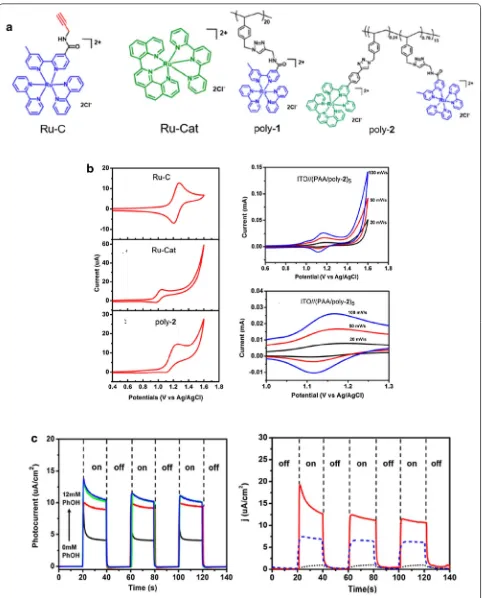
this study the catalyst [Ru(trpy)(phenq)]2+ (Ru-Cat;
troy = 2,2′:6,2″-terpyridine; phenq = 2-(quinol-8′
-yl)-1,10-phenanthroline) was incorporated onto the same polymer backbone as the chromophore, and then depos-ited onto a mesoporous substrate via the LbL method. This approach enables the control of the chromophore-to-catalyst ratio within the polymer assembly. The
chemical structure of a representative polymer,
poly-2, is shown in Fig. 8. The Ru-Cat water oxidation
cata-lyst and Ru-C chromophore moieties were attached
to a polystyrene backbone via an azide-alkyne Huis-gen cycloaddition reaction, with the relative ratio of the alkyne precursors of the chromophore and catalyst added to the click reaction feed dictating the ratio of each
in the final polymer construct. Both 1H NMR and the
comparison of the absorbance spectrum of the polymer
with simulated component spectra of the Ru-C and Ru
-Cat complexes verified the incorporation of each in the
desired ratio into the final polymer strand.
Electrochemical analysis of poly-2 showed behavior
characteristic of both the Ru-C and Ru-Cat subunits
(Fig. 8b). While the poly-2 shows an anodic wave for the
RuIII/II couple of the Ru-C component at 1.2 V vs NHE
and a catalytic wave at Eapp > 1.4 V vs NHE
characteris-tic of Ru-Cat, the oxidation of the Ru-C is irreversible in
the polymer. This was taken as evidence for hole
trans-fer from Ru-CIII to Ru-Cat within the polymer
struc-ture. FTO//nanoTiO2 photoanodes with 10 LbL layers
of PAA/poly-2 were active for the light driven oxida-tion of phenol or benzyl alcohol, with the photocurrent response increasing with an increase in concentration of
the organic substrate (Fig. 8c). Light driven water
oxida-tion was investigated with 5 LbL layer thick polyacrylic
acid (PAA)/poly-2 on FTO//(SnO2/TiO2) core/shell
elec-trodes (FTO//(SnO2/TiO2)//(PAA/poly-2)5) which gave a
twofold enhanced photocurrent response compared to
FTO//(SnO2/TiO2)//(PAA/poly-1)5 (poly-1 containing
only Ru-C with no Ru-Cat moieties present in the
pol-ymer). This was taken as likely evidence for light driven
water oxidation though the generation of O2 was not
quantified.
4 Summary
In this review, we summarize a series of polymeric assemblies consisting of multiple Ru(II) polypyridyl complexes prepared by using several polymerization methods including living anionic polymerization, RAFT, ATRP and NMP, followed by postreaction such as ami-dation reaction and click chemistry for the attachment of Ru(II) polypyridyl complexes to the polymer backbone. Fig. 7 a Collector–generator schematic and photographs of the
We describe the structure and dynamics of these poly-mer assemblies on mesoporous structure semiconductor films. Polymeric chromophore–catalyst assembly specifi-cally containing chromophore units and an oxidation cat-alyst was developed to demonstrate its use in light-driven water oxidation at a photoanode-solution interface for a DSPEC application.
Authors’ contributions
All authors have contributed to the writing of the manuscript. All authors read and approved the final manuscript.
Author details
1 Department of Chemistry, University of Texas at San Antonio, San Antonio,
TX 78249, USA. 2 Department of Chemistry & Biochemistry, Texas Christian
University, Fort Worth, TX 76129, USA.
Competing interests
The authors declare that they have no competing interests.
Ethics approval and consent to participate Not applicable.
Funding
This material is based on work supported solely as part of the UNC EFRC: Solar Fuels and Next Generation Photovoltaics, an Energy Frontier Research Center funded by the U.S. Department of Energy, Office of Science, Office of Basic Energy Sciences under Award Number DE-SC0001011.
Publisher’s Note
Springer Nature remains neutral with regard to jurisdictional claims in pub-lished maps and institutional affiliations.
Received: 8 November 2017 Accepted: 7 December 2017
References
1. J.S. High, L.G.C. Rego, E. Jakubikova, Quantum dynamics simulations of excited state energy transfer in a zinc-free-base porphyrin dyad. J. Phys. Chem. A 120, 8075–8084 (2016)
2. Y. Kim, J.H. Lee, H. Ha, S.W. Im, K.T. Nam, Material science lesson from the biological photosystem. Nano Converg. 3, 19 (2016)
3. Z.A. Morseth, L. Wang, E. Puodziukynaite, G. Leem, A.T. Gilligan, T.J. Meyer, K.S. Schanze, J.R. Reynolds, J.M. Papanikolas, Ultrafast dynamics in multi-functional Ru(II)-loaded polymers for solar energy conversion. Acc. Chem. Res. 48, 818–827 (2015)
4. C. Liu, N.P. Dasgupta, P. Yang, Semiconductor nanowires for artificial photosynthesis. Chem. Mater. 26, 415–422 (2014)
5. M.K. Brennaman, R.J. Dillon, L. Alibabaei, M.K. Gish, C.J. Dares, D.L. Ashford, R.L. House, G.J. Meyer, J.M. Papanikolas, T.J. Meyer, Finding the way to solar fuels with dye-sensitized photoelectrosynthesis cells. J. Am. Chem. Soc.
138, 13085–13102 (2016)
6. T. Meyer, J. Papanikolas, C. Heyer, Solar Fuels and next generation photo-voltaics: the UNC-CH energy frontier research center. Catal. Lett. 141, 1–7 (2011)
7. D.M. Ryan, M.K. Coggins, J.J. Concepcion, D.L. Ashford, Z. Fang, L. Aliba-baei, D. Ma, T.J. Meyer, M.L. Waters, Synthesis and electrocatalytic water oxidation by electrode-bound helical peptide chromophore–catalyst assemblies. Inorg. Chem. 53, 8120–8128 (2014)
8. S.E. Bettis, D.M. Ryan, M.K. Gish, L. Alibabaei, T.J. Meyer, M.L. Waters, J.M. Papanikolas, Photophysical characterization of a helical peptide chromophore-water oxidation catalyst assembly on a semiconductor surface using ultrafast spectroscopy. J. Phys. Chem. C 118, 6029–6037 (2014)
9. D.L. Ashford, A.M. Lapides, A.K. Vannucci, K. Hanson, D.A. Torelli, D.P. Har-rison, J.L. Templeton, T.J. Meyer, Water oxidation by an electropolymerized
catalyst on derivatized mesoporous metal oxide electrodes. J. Am. Chem. Soc. 136, 6578–6581 (2014)
10. J.H. Alstrum-Acevedo, M.K. Brennaman, T.J. Meyer, Chemical approaches to artificial photosynthesis. 2. Inorg. Chem. 44, 6802–6827 (2005) 11. D.L. Ashford, M.K. Gish, A.K. Vannucci, M.K. Brennaman, J.L. Templeton, J.M.
Papanikolas, T.J. Meyer, Molecular chromophore–catalyst assemblies for solar fuel applications. Chem. Rev. 115, 13006–13049 (2015)
12. L. Wang, E. Puodziukynaite, E.M. Grumstrup, A.C. Brown, S. Keinan, K.S. Schanze, J.R. Reynolds, J.M. Papanikolas, Ultrafast formation of a long-lived charge-separated state in a Ru-loaded poly(3-hexylthiophene) light-harvesting polymer. J. Phys. Chem. Lett. 4, 2269–2273 (2013) 13. L. Wang, E. Puodziukynaite, R.P. Vary, E.M. Grumstrup, R.M. Walczak, O.Y.
Zolotarskaya, K.S. Schanze, J.R. Reynolds, J.M. Papanikolas, Competition between ultrafast energy flow and electron transfer in a Ru(II)-loaded polyfluorene light-harvesting polymer. J. Phys. Chem. Lett. 3, 2453–2457 (2012)
14. Y.-Q. Fang, N.J. Taylor, F. Laverdière, G.S. Hanan, F. Loiseau, F. Nastasi, S. Campagna, H. Nierengarten, E. Leize-Wagner, A. Van Dorsselaer, Ruthenium(II) complexes with improved photophysical properties based on planar 4′-(2-Pyrimidinyl)-2,2′:6′,2″-terpyridine ligands. Inorg. Chem. 46, 2854–2863 (2007)
15. M.W. Cooke, G.S. Hanan, F. Loiseau, S. Campagna, M. Watanabe, Y. Tanaka, Self-assembled light-harvesting systems: Ru(II) complexes assembled about Rh–Rh cores. J. Am. Chem. Soc. 129, 10479–10488 (2007) 16. N. Tuccitto, V. Torrisi, M. Cavazzini, T. Morotti, F. Puntoriero, S. Quici, S.
Cam-pagna, A. Licciardello, Stepwise formation of ruthenium(II) complexes by direct reaction on organized assemblies of thiol-terpyridine species on gold. ChemPhysChem 8, 227–230 (2007)
17. J.Y. Kim, K. Zhu, N.R. Neale, A.J. Frank, Transparent TiO2 nanotube array
photoelectrodes prepared via two-step anodization. Nano Converg. 1, 9 (2014)
18. G. Leem, Z.A. Morseth, K.-R. Wee, J. Jiang, M.K. Brennaman, J.M. Papaniko-las, K.S. Schanze, Polymer-based ruthenium(II) polypyridyl chromophores on TiO2 for solar energy conversion. Chem. Asian J. 11, 1257–1267 (2016)
19. G. Leem, Z.A. Morseth, E. Puodziukynaite, J. Jiang, Z. Fang, A.T. Gilligan, J.R. Reynolds, J.M. Papanikolas, K.S. Schanze, Light harvesting and charge separation in a π-conjugated antenna polymer bound to TiO2. J. Phys.
Chem. C 118, 28535–28541 (2014)
20. Z. Fang, A. Ito, A.C. Stuart, H. Luo, Z. Chen, K. Vinodgopal, W. You, T.J. Meyer, D.K. Taylor, Soluble reduced graphene oxide sheets grafted with polypyridylruthenium-derivatized polystyrene brushes as light harvesting antenna for photovoltaic applications. ACS Nano 7, 7992–8002 (2013) 21. Z. Fang, A. Ito, S. Keinan, Z. Chen, Z. Watson, J. Rochette, Y. Kanai, D. Taylor,
K.S. Schanze, T.J. Meyer, Atom transfer radical polymerization prepara-tion and photophysical properties of polypyridylruthenium derivatized polystyrenes. Inorg. Chem. 52, 8511–8520 (2013)
22. Y. Sun, Z. Chen, E. Puodziukynaite, D.M. Jenkins, J.R. Reynolds, K.S. Schanze, Light harvesting arrays of polypyridine ruthenium(II) chromo-phores prepared by reversible addition-fragmentation chain transfer polymerization. Macromolecules 45, 2632–2642 (2012)
23. G. Leem, S. Keinan, J. Jiang, Z. Chen, T. Pho, Z.A. Morseth, Z. Hu, E. Puodzi-ukynaite, Z. Fang, J.M. Papanikolas, J.R. Reynolds, K.S. Schanze, Ru(bpy)32+
derivatized polystyrenes constructed by nitroxide-mediated radical polymerization. Relationship between polymer chain length, structure and photophysical properties. Polym. Chem. 6, 8184–8193 (2015) 24. J.N. Younathan, S.F. McClanahan, T.J. Meyer, Synthesis and characterization
of soluble polymers containing electron- and energy-transfer reagents. Macromolecules 22, 1048–1054 (1989)
25. L.M. Dupray, T.J. Meyer, Synthesis and characterization of amide-derivat-ized, polypyridyl-based metallopolymers. Inorg. Chem. 35, 6299–6307 (1996)
26. G. Leem, B.D. Sherman, A.J. Burnett, Z.A. Morseth, K.-R. Wee, J.M. Papaniko-las, T.J. Meyer, K.S. Schanze, Light-driven water oxidation using polyelec-trolyte layer-by-layer chromophore–catalyst assemblies. ACS Energy Lett.
1, 339–343 (2016)
27. J. Jiang, B.D. Sherman, Y. Zhao, R. He, I. Ghiviriga, L. Alibabaei, T.J. Meyer, G. Leem, K.S. Schanze, Polymer chromophore–catalyst assembly for solar fuel generation. ACS Appl. Mater. Interfaces 9, 19529–19534 (2017) 28. J.B. Schlenoff, H. Ly, M. Li, Charge and mass balance in polyelectrolyte
29. A. Wu, D. Yoo, J.K. Lee, M.F. Rubner, Solid-state light-emitting devices based on the tris-chelated ruthenium(II) Complex: 3. High efficiency devices via a layer-by-layer molecular-level blending approach. J. Am. Chem. Soc. 121, 4883–4891 (1999)
30. A.P.R. Johnston, C. Cortez, A.S. Angelatos, F. Caruso, Layer-by-layer engi-neered capsules and their applications. Curr. Opin. Colloid Interface Sci.
11, 203–209 (2006)
31. A.-M. Pilbat, Z. Szegletes, Z. Kóta, V. Ball, P. Schaaf, J.-C. Voegel, B. Szalontai, Phospholipid bilayers as biomembrane-like barriers in layer-by-layer polyelectrolyte films. Langmuir 23, 8236–8242 (2007)
32. N. White, M. Misovich, A. Yaroshchuk, M.L. Bruening, Coating of nafion membranes with polyelectrolyte multilayers to achieve high mono-valent/divalent cation electrodialysis selectivities. ACS Appl. Mater. Interfaces. 7, 6620–6628 (2015)
33. L. Toellner, M. Fischlechner, B. Ferko, R.M. Grabherr, E. Donath, Virus-coated layer-by-layer colloids as a multiplex suspension array for the detection and quantification of virus-specific antibodies. Clin. Chem. 52, 1575–1583 (2006)
34. L.M. Dupray, M. Devenney, D.R. Striplin, T.J. Meyer, An antenna polymer for visible energy transfer. J. Am. Chem. Soc. 119, 10243–10244 (1997) 35. D.A. Friesen, T. Kajita, E. Danielson, T.J. Meyer, Preparation and
photo-physical properties of amide-linked, polypyridylruthenium-derivatized polystyrene. Inorg. Chem. 37, 2756–2762 (1998)
36. Z. Fang, S. Keinan, L. Alibabaei, H. Luo, A. Ito, T.J. Meyer, Controlled electropolymerization of ruthenium(II) vinylbipyridyl complexes in mesoporous nanoparticle films of TiO2. Angew. Chem. Int. Ed. 53,
4872–4876 (2014)
37. A.M. Lapides, D.L. Ashford, K. Hanson, D.A. Torelli, J.L. Templeton, T.J. Meyer, Stabilization of a ruthenium(II) polypyridyl dye on nanocrystalline TiO2 by
an electropolymerized overlayer. J. Am. Chem. Soc. 135, 15450–15458 (2013)
38. M.V. Sheridan, B.D. Sherman, R.L. Coppo, D. Wang, S.L. Marquard, K.R. Wee, N.Y. Murakami Iha, T.J. Meyer, Evaluation of Chromophore and Assembly Design in Light-Driven Water Splitting with a Molecular Water Oxidation Catalyst. ACS Energy Letters. 1(1), 231–236 (2016)
39. Y. Gao, X. Ding, J. Liu, L. Wang, Z. Lu, L. Li, L. Sun, Visible light driven water splitting in a molecular device with unprecedentedly high photocurrent density. J. Am. Chem. Soc. 135, 4219–4222 (2013)
40. K. Hanson, D.A. Torelli, A.K. Vannucci, M.K. Brennaman, H. Luo, L. Alibabaei, W. Song, D.L. Ashford, M.R. Norris, C.R.K. Glasson, J.J. Concepcion, T.J. Meyer, Self-assembled bilayer films of ruthenium(II)/polypyridyl com-plexes through layer-by-layer deposition on nanostructured metal oxides. Angew. Chem. Int. Ed. 51, 12782–12785 (2012)
41. D.L. Ashford, W. Song, J.J. Concepcion, C.R.K. Glasson, M.K. Brennaman, M.R. Norris, Z. Fang, J.L. Templeton, T.J. Meyer, Photoinduced electron transfer in a chromophore–catalyst assembly anchored to TiO2. J. Am.
Chem. Soc. 134, 19189–19198 (2012)
42. B.D. Sherman, Y. Xie, M.V. Sheridan, D. Wang, D.W. Shaffer, T.J. Meyer, J.J. Concepcion, Light-driven water splitting by a covalently linked ruthenium-based chromophore–catalyst assembly. ACS Energy Lett. 2, 124–128 (2017)
43. G. Sahara, H. Kumagai, K. Maeda, N. Kaeffer, V. Artero, M. Higashi, R. Abe, O. Ishitani, Photoelectrochemical reduction of CO2 coupled to water
oxida-tion using a photocathode with a Ru(II)–Re(I) complex photocatalyst and a CoOx/TaON photoanode. J. Am. Chem. Soc. 138, 14152–14158 (2016) 44. M. Yamamoto, L. Wang, F. Li, T. Fukushima, K. Tanaka, L. Sun, H. Imahori,
Visible light-driven water oxidation using a covalently-linked molecular catalyst-sensitizer dyad assembled on a TiO2 electrode. Chem. Sci. 7,
1430–1439 (2016)
45. B.D. Sherman, D.L. Ashford, A.M. Lapides, M.V. Sheridan, K.-R. Wee, T.J. Meyer, Light-Driven Water Splitting with a Molecular Electroassembly-Based Core/Shell Photoanode. J. Phys. Chem. Lett. 6, 3213–3217 (2015) 46. B.D. Sherman, M.V. Sheridan, K.-R. Wee, S.L. Marquard, D. Wang, L.
Alibabaei, D.L. Ashford, T.J. Meyer, A dye-sensitized photoelectrochemi-cal tandem cell for light driven hydrogen production from water. J. Am. Chem. Soc. 138, 16745–16753 (2016)
47. K.-R. Wee, M.K. Brennaman, L. Alibabaei, B.H. Farnum, B. Sherman, A.M. Lapides, T.J. Meyer, Stabilization of ruthenium(II) polypyridyl chromo-phores on nanoparticle metal-oxide electrodes in water by hydrophobic PMMA overlayers. J. Am. Chem. Soc. 136, 13514–13517 (2014)
48. A.M. Lapides, B.D. Sherman, M.K. Brennaman, C.J. Dares, K.R. Skinner, J.L. Templeton, T.J. Meyer, Synthesis, characterization, and water oxidation by a molecular chromophore–catalyst assembly prepared by atomic layer deposition. The “mummy” strategy. Chem. Sci. 6, 6398–6406 (2015) 49. B.D. Sherman, M.V. Sheridan, C.J. Dares, T.J. Meyer, Two electrode
collector-generator method for the detection of electrochemically or photoelectrochemically produced O2. Anal. Chem. 88, 7076–7082 (2016)
50. K.-R. Wee, B.D. Sherman, M.K. Brennaman, M.V. Sheridan, A. Nayak, L. Ali-babaei, T.J. Meyer, An aqueous, organic dye derivatized SnO2/TiO2 core/
shell photoanode. J. Mater. Chem. A 4, 2969–2975 (2016)
51. R.L. Coppo, B.H. Farnum, B.D. Sherman, N.Y.M. Iha, T.J. Meyer, The role of layer-by-layer, compact TiO2 films in dye-sensitized photoelectrosynthesis
cells. Sustain. Energy Fuels 1, 112–118 (2017)
52. L. Alibabaei, M.K. Brennaman, M.R. Norris, B. Kalanyan, W. Song, M.D. Losego, J.J. Concepcion, R.A. Binstead, G.N. Parsons, T.J. Meyer, Solar water splitting in a molecular photoelectrochemical cell. Proc. Natl. Acad. Sci. USA 110, 20008–20013 (2013)

![Fig. 5permission from Ref. [, chromophore–catalyst assemblies [ ab Co-loaded assembly on TiO2 [38, 39]](https://thumb-us.123doks.com/thumbv2/123dok_us/842920.2078933/8.595.61.537.86.652/fig-permission-ref-chromophore-catalyst-assemblies-loaded-assembly.webp)