Teaching Teamwork to Improve Patient Safety
By Jessica Saricicek
A Master's Paper submitted to tbe faculty of the University ofNortb Carolina at Chapel Hill
in partial fulfillment of the requirements for the degree of Master of Public Health in
the Public Health Leadership Program.
Table of Contents
Introduction
Background and Rationale
Mini Review of Similar Interventions Program Plan
Program Context Logic Model Diagram Program Theory Goals and Objectives Implementation Plan Evaluation Plan
Approach to Evaluation
Evaluation Study Design and Methods Planning Tables
Dissemination Plan Final Remarks
Works Cited
Page 3 Page 4 Page 8
Page 23 Page 31 Page 33 Page 34 Page 35
Introduction
Labor and Delivery is one of the happiest places in the hospital; it is the place where new
babies are welcomed into their families. It is also however a high-risk environment and medical
mistakes can have devastating consequences1·4 As well as being dangerous to the patient,
medical errors are a major source of expense and litigation for healthcare providers and
hospitals'· 5
' 6• Obstetrics has some of the highest malpractice premiums of any medical
specialty'· 6
• Poor communication in health care is a significant contributing factor in the review
of adverse events4
• Many problems with communication are breakdowns in poorly-designed
systems, rather than glaring omissions by individual providers7' 8 Formal teamwork training,
already widely used in other high-risk industries, is a promising way to improve staff interactions
and therefore patient safety.
Purpose
UNC Hospitals is implementing an interdisciplinary program to improve patient safety
during deliveries. At the center of this initiative is a formal team training curriculum known as
the Team Strategies and Tools to Enhance Performance and Patient Safety (TeamSTEPPS™) 9 •
The purpose of this paper is to review the current state of evidence concerning didactic
teamwork training in perinatal settings, to describe the planned perinatal teamwork training
Background and Rationale
The importance of teamwork in medicine
In their landmark reports about patient safety, "To Err is Human" and "Crossing the
Quality Chasm," The Institute of Medicine Report identified communication error as one of the
most common contributors to unintentional patient injury 7
' 8. "To Err is Human" specifically
recommended formal, interdisciplinary team training programs as a way to reduce human error
in medical practice (Recommendation 8.1) 7
• "Crossing the Quality Chasm" also highlighted the
importance of improved teamwork in medicine, making improved clinician communication one
of the ten "New Rules to Redesign and Improve Care"'. Rather than emphasizing improved
individual-level skills, the IOM reports focused on building safer medical systems and changing
organization-wide culture'· 8
Cooperation and teamwork, which have traditionally been taken for granted in the
training of health care workers, may be among the most important modifiable factors in
improving patient safety in obstetrics. The Joint Commission reported in 2004 that ineffective
communication was the root cause of 66% of reported sentinel events, and was a factor in 85%
of perinatal deaths and injuries 1
• In the context of a delivery, health care providers with different
training as well as from different departments must work together in a high-risk environment.
Communication within a team often relies on individual personalities and is not easily learned by
a new team member or outside collaborator. The result is potentially avoidable
misunderstandings, which can threaten the quality of patient care4 •
Excellent teamwork skills are especially important in the environment of labor and
delivery'0
shared quickly'. Multiple providers work together that do not necessarily identifY themselves as
part of the same "team." At large teaching hospitals, there are additional communication
challenges from high tum-over of both leaders such as part-time attendings and transient team
members such as students. In vaginal deliveries, unlike most high-risk procedures, the mother
and family are often very active team members. Also unlike other departments, there are always
two or more patients (the mother and child or children) being cared concomitantly. The
pregnancies at highest medical risk also have added risks for problematic communication as
more specialists participate in care. Conversely, apparently uncomplicated births may be
threatened by complacency, particularly if those working directly with the patient cannot
effectively communicate concerns to those making plan of care decisions4 •
Formal Teamwork Training
Formalized team training, already widely used in other industries such as aviation and the
military, has several advantages 11 Not only are team members taught to communicate
information clearly, quickly, and accurately, but also how to be observant and assertive with
concerns. Teams with formal training are also less dependent on a particular leader to function
optimally10
• A whole department uses a common vocabulary for teamwork and new team
members can be incorporated quickly. If the same team training is given to an entire
organization, such as a hospital, departments that rarely work together will be able to
communicate more easily and clearly should the need arise.
TeamSTEPPS™
The Team Strategies & Tools to Enhance Performance & Patient Safety™
Department of Defense (DoD) and the Agency for Healthcare Research and Quality (AHRQ) specifically for the health care industry 9• TeamSTEPPS™ is based on teamwork methodology from other disciplines, such as aviation Crew Resource Management (CRM)9
. Publically released in 2006, TeamSTEPPS™ is currently being nationally distributed via an American Institutes for Research and DoD joint national program known as the National Implementation of TeamSTEPPS™ Project. TeamSTEPPS™ works on a train-the-trainer model9
•12. Master
Trainers attend a session at one of four Team Resource Centers, and then return to their home institutions to provide shorter training sessions to their peers13
• The Master Trainer program also includes guidance for achieving and sustaining behavior change, including some implementation guidance9
• General staff training includes a didactic portion (lectures, discussions, and/or online component) and often a participatory role-playing for skills practice and re-enforcement". The four core competencies of the TeamSTEPPS™ training are situation monitoring, mutual support, communication, and leadership. Master Trainers and others can be designated as "coaches" to reinforce teamwork skills in the course of regular clinical practice9
.
UNC Hospitals
The University of North Carolina (UN C) Health Care System is a large not-for-profit academic health care system including a medical center with four hospitals, as well as many community practices14
together with Neonatal Critical Care staff with the hope that a common culture of teamwork will
improve communication between providers and ultimately create a safer environment for
Mini-Review of Similar Interventions
Introduction to Review
The purpose of this section is to examine published works describing implementations of
similar teamwork training in other perinatal contexts. I address their effectiveness by various
outcomes and also examine the aspects of the implementation that may have contributed to the
observed results. Understanding the current state of research will be essential in formulating an
evaluation plan and realistic outcome expectations for our program.
Search Strategy
I began by searching the MedLine database for published descriptions of didactic team
training in the context of perinatal medical treatment using the search string "(TeamSTEPPS™
OR Crew Resource Management OR MedTeams OR didactic team training) AND (obstetrics
OR perinatal OR perinatal care OR neonatal OR intensive care, neonatal OR delivery)". The
search returned 31 matches. I excluded any results that were entirely theoretical, those that
primarily described another type of training (e.g. simulation training), and those that took place
in other medical or non-medical contexts (e.g. emergency departments). I then combed through
the cited references of the two remaining articles. In this way I found two smaller studies that fit my criteria. Additionally, I explored the "related articles" function of Goggle Scholar and
looked at the citation maps of these articles in ISI Web of Knowledge, but this did not provide
any additional studies. Because didactic training of formalized teamwork skills is a relatively
new concept in clinical medicine, all four of these studies have been published in or after 2007. I
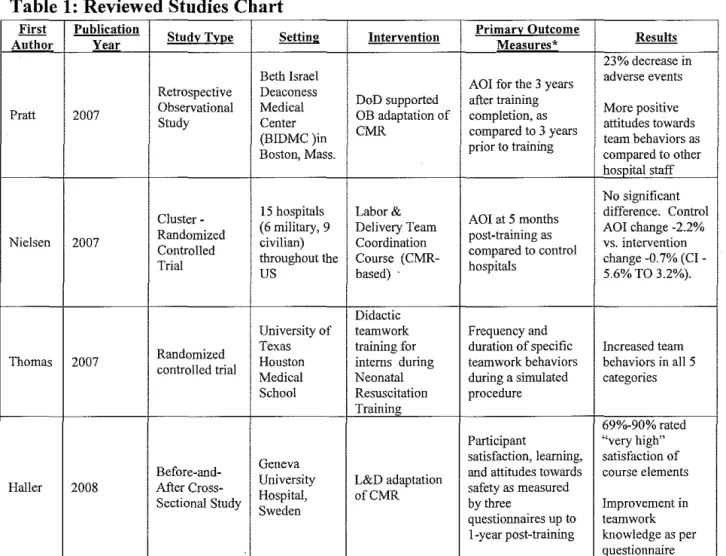
Table 1: Reviewed Studies Chart
First Publication
Study Ty~e Setting Intervention Primary Outcome Results
Author Year Measures*
23% decrease in Beth Israel
AOI for the 3 years adverse events Retrospective Deaconess
DoD supported after training
Pratt 2007 Observational Medical OB adaptation of completion, as More positive
Study Center attitudes towards
(BIDMC)in CMR compared to 3 years team behaviors as Boston, Mass. prior to training compared to other
hospital staff
No significant
Cluster- 15 hospitals Labor& AOI at 5 months difference. Control Randomized (6 military, 9 Delivery Team post-training as AOI change -2.2% Nielsen 2007
Controlled civilian) Coordination compared to control vs. intervention throughout the Course (CMR- change -0.7% (CI-Trial
us based) · hospitals 5.6% TO 3.2%).
Didactic
University of teamwork Frequency and
Randomized Texas training for duration of specific Increased team Thomas 2007
controlled trial Houston interns during teamwork behaviors behaviors in all 5 Medical Neonatal during a simulated categories School Resuscitation procedure
Training
69o/o-90% rated Participant "very high" Geneva satisfaction, learning, satisfaction of
Before-and-University L&D adaptation and attitudes towards course elements Haller 2008 After Cross- safety as measured
Sectional Study Hospital, ofCMR by three Improvement in Sweden
questionnaires up to teamwork 1-year post-training knowledge as per
Questionnaire *The Adverse Outcomes Index (AOI) is a Labor & Delivery specific quality assessment tool. The AOI is the number of patients who experience one or more adverse events while within the hospital, calculated from outcomes data from the National Perinatal Infonnation Center.
This chart provides a brief summary of the essential information from each of the four most
relevant studies as identified by the search described above. A more thorough analysis of these
Pratt 2007
Description of Intervention
In a short piece in The Joint Commission Journal on Quality and Patient Safety, Pratt and
his colleagues describe the first CRM program adapted to obstetrics15
• The intervention was at
Beth Israel Deaconess Medical Center (BIDMC) following a significant sentinel event in 2000'·
15
Their safety program included15 :
• Department of Defense (DoD) -supported training of"coaches" or peer trainers.
• Participation of all staff in a 4-hour Crew Resource Management -based training
module with modules addressing communication, situation monitoring, mutual
support, and leadership. This core training was administered in multidisciplinary
groups of 15-20 persons, taught by peer trainer.
• Creation of a contingency team responsible for emergency response and
institution of "core team meetings" once per shift.
• An information campaign to collect and continually broadcast data about
improvements in safety statistics.
• Reorganization of work load to optimize team behaviors like pre-operatory
briefings.
• Periodic refresher training for current employees and full 4-hour course for all
new trainees.
A multidisciplinary "steering committee" designed and managed these components of
this program. The steering committee also developed protocols for common emergency
Strength of Methods
No data was collected prospectively before the initiation of the CRM program. Using
secondary data from the National Perinatal Information Center (NPIC), Pratt eta!. calculated the
Adverse Outcomes Index (AOI) for the three years before and the three years after the
implementation of the program's
Because there were no pre-existing tools to quantitatively compare perinatal patient
safety, the authors worked with the American College of Obstetricians and Gynecologists to
create two measures: the Adverse Outcome Index (AOI) and the Weighted Adverse Outcome
Score (W AOS)15
. The AOI is the proportion of deliveries with one or more of a predefined list
of undesirable outcomes. The W AOS gives weight to the events on that list relative to their
severity (maternal death is weighted at 750, whereas blood transfusion is rated at 20)15 "16
Additional results data included retrospective before and after malpractice data collected
from the BIDMC obstetrics malpractice carrier. The authors also looked at a standard Safety
Attitudes Questionnaire (SAQ), comparing the Labor and Delivery Unit (L&D) responses to
those of other BIDMC hospital staff15•
The author's conclusions from results data collected in these ways must be viewed with
caution. The information was retrospectively collected and, with the exception of the SAQ's,
none of this data has a control comparison. Any outcome measurements are subject to biases
and confounding.
Interpretation of Results
The main reported results were a 23.0% decrease in the AOI, a 33.2% decrease in the
claims, and observation cases post training .and a 62% decrease in the number of high-severity
events considered for litigation were also observed15
• The responses on the safety questionnaire
were generally reflected a more positive attitude among the trained L&D staff than among
comparable professionals elsewhere in the hospital15 •
The conclusion of the authors is that the CRM-based training did change behaviors and
safety-related outcomes at BIDMC. This may very well be true, but the results cited likely
exaggerate the influence of the teamwork training because of confounding from other
concomitant changes. This teamwork training intervention happened at the same time that other
safety-related practices were changed; therefore some of the influence of other programs may be
misattributed to the teamwork training. This study is encouraging, but far from conclusive proof
that teamwork training changes patient-oriented outcomes.
Applicability
The actual CRM-based teamwork training component of this intervention appears very
similar to that planned at UNC. The description of the contents of the training, the
train-the-trainer implementation strategy, and the institution type (a large American teaching hospital) are
all practically the same.
However there are a few key points that modifY the applicability of their results. First
and foremost, the teamwork training component at BIDMC was designed in response to
broad-based safety concern following a well-publicized failure of the existing system. Care providers
in the L&D department at BIDMC were very prepared and willing to change their behavior and
attitudes. Furthermore, the department worked with the Department of Defense (DoD) to
develop a program that would integrate easily into the social and professional environment of
their unit15
creation and revision of emergency protocols, were initiated at the same time. These may have
been an extension of the interest in safety promoted by the training, or both may have been
reflection of cultnral change in the unit.
Additionally, while this training was "multidisciplinary," the disciplines (physicians,
nurses, etc) trained together were all part of the Labor & Delivery unit15
. By contrast at UNC
members of two different units will be trained together.
Nielsen 2007
Description of Intervention
The only randomized controlled trial of didactic teamwork training, the 2007 study by
Nielsen and al. shares many similarities with the intervention at BIDMC16
• BIDMC was the
coordinating hospital for the study and referred to as the "test bed for the teamwork training
intervention." As such, BIDMC was not one of the hospitals randomized in the study".
Select clinical staff members attended a 3-day instructor-trainer session then returned to
their hospitals to conduct multidiscipline training session for other staff members in the L&D
unit. Training focused on communication, problem solving, workload management, team skills,
and conflict resolution16 The units in the intervention were also encouraged to create
contingency teams to respond to emergencies".
Strength of Methods
The primary outcome of this study was adverse patient events using the AOI, WAOS,
and SI calculations described above. For the purposes of this study, the difference between
training. Difference scores for intervention hospitals were then compared to controls.
Secondary outcomes were the average time elapsed for various process measures. All
calculations and analysis took into account the cluster randomization of the study. All analysis
was on an intention-to-treat basis16
1,307 hospital personnel were trained and a total of28,536 deliveries were included in
the analysis16
• The study included seven intervention hospitals and eight controls16. The study
sites varied geographically throughout the United States. Group assignment was masked and
then balanced by hospital type (six military and nine civilian divided proportionally), major
funding sources, and number of deliveries. The intervention consisted of a 4-hours total of
training sessions with didactic lessons, scenarios, and focused interactive training for several
teamwork skills16. There was no blinding of participants.
The choice of cluster-randomization was also very appropriate to the research question.
Cluster randomization takes into account the correlation of observations within a medical
treatment unit and it is a conservative approach to analyzing interventions directed at health
providers. Randomization by small units (patient, doctor, or even department) would be
inappropriate for this type oftrial because there would be substantial correlation by provider or
department. Teamwork training changes interactions between medical professionals; the effects
of training can and should eventually influence teams and departments not trained. An ideal
communication training program would permeate the entire institution, creating a highly efficient
and effective pattern of interactions. Cluster-randomization did, however, reduce the power of
this large study. While there were 28,536 deliveries, the unit of randomization and analysis was
difference between groups was considerably lower than it would have been in a non-clustered
trial of this size.
Overall, this study was logically conducted and well executed. The study's masked
randomized allocation process was reasonable and the initial groups appear as comparable as
possible. The quantitative outcome measurement tools are logical and reproducible. Perhaps the
most important strength of this study was the relatively large size. Adverse patient events in the
study occurred in less than 10% of births and serious adverse events (excluding perineal tears
and NICU admissions) were less than 3%16• When using an infrequent outcome of interest such
as serious adverse events, a very large number of observations are needed to observe even a
moderate difference between the control and intervention groups.
Interpretation of Results
The primary result of this study was that hospitals with and without teamwork training
had no statistically significant difference in patient safety outcomes. Hospitals in both groups
had a substantial average reduction in AOI score (9.4% to 7.2% in the control arm and 9.0% to
8.3% in the intervention arm) and the confidence intervals were very wide".
One possible explanation is that the 4-hour training of staff participants simply was not
sufficient to achieve behavioral change. Alternatively, even if behavioral change was achieved,
there may have been no correlation between staff behavior and patient safety. The authors
propose that even if behavioral change had begun, the 5-month window between the intervention
and the results may not have been sufficient time for the new practices to be fully integrated into
practice. Therefore changes in patient safety statistics may have been forthcoming, but not yet
be and observable. To support this conjecture, they cite the implementation at BIDMC, which
The fact that both anns of the randomized trial showed improvements in safety was
surprising, leading the authors to suggest that increased attention to safety from simply being in
the study may have led to improved safety-related behaviors unrelated to the training (the
Hawthorne effect)". There is only limited information about other ongoing safety programs at
the trial hospitals and this is a plausible explanation. Statistically, changes in the adverse
outcome rate from any source other than the intervention dilute and confuse the influence of the
factor studied.
Alternatively, a change may have been present but not detected in this study. Given the
design of the outcome measure, the inconclusiveness of the primary outcome is not surprising;
the study underpowered to detect the size of difference likely to be observed. The study was
designed with a power of 80% to detect a difference of 40% in the AOI if prevalence of adverse
events were 10% and the intracluster correlation coefficient (a measure of"sameness" within one
hospital) were 0.01 or less16
• A 40% difference in AOI is very ambitious. Connecting staff-level
training with patient-oriented outcomes is desirable, but because there are many other influences
between the intervention and the outcome any measurable difference is likely to be diluted by
other factors and therefore appear much smaller than the anticipated 40%. Additionally, the
actual intracluster correlation coefficients were all larger than the pre-trial estimate (actual
correlations 0.015 to 0.268) meaning that there were much stronger similarities between results
within institutions than between institutions in the same group16
• This further reduced the
precision of the study and made any difference less likely to be detected.
One process time measure, time from decision to incision for urgent cesarean deliveries,
showed a significant difference but the authors rightly minimize its importance16• Eleven process
secondary analyses, the more likely that one significant difference would be identified by chance
alone.
In conclusion, the published results of this study do not show a change in patient safety statistics. But the study was not accurate enough to reflect the effectiveness of this intervention
on patient safety. In order to measure a significant difference in patient safety outcomes, a study
would need to have more cluster units or measure an outcome closer to the intervention
Applicability
The variety of hospitals involved in the study, including several large teaching hospitals,
suggests that the results of this study should be generalizable to L&D units at hospitals like
UNC. The intervention that is the focus of this study, while only briefly described, is likely very
much like the intervention we are planning at UNC. Both are medical CRM programs designed
by the Department of Defense. Additionally, both are implementations of programs designed
elsewhere and brought as a ready package to the institutions16. However, since this large study
was inconclusive, we can draw only limited conclusions from the results. Perhaps the most
important lesson from this study is that immediate large patient outcome changes should not be
immediately expected from this sort of training.
Thomas 2007
Intervention Description
Interns in several fields responsible for perinatal care were trained in teamwork during
neonatal resuscitation training. The Neonatal Resuscitation Program (NRP) is a standard
Because resuscitations are a team activity, Thomas eta! coupled the NRP training with a
didactic, lecture-based teamwork skills training program. This teamwork intervention was
loosely based on CRM programs, with focus on the behaviors of inquiry, information sharing,
assertion, evaluation of plans, workload management, and vigilance". The interns beginning in
the aforementioned departments in 2005 were randomized to either the standard NRP curriculum
or the same curriculum plus the 2.5 hour teamwork component". The intervention and control
groups were instructed separately. At the end ofthe day, interns in both groups were filmed
performing mock resuscitations in teams of three. The videos were assessed by blinded
observers who recorded the number of times that each of a specified list of team behaviors was
performed during the simulation".
Strength of Methods
The selection of a reasonable control and the use of blinded observers to score outcome
both increased the internal validity of this study. However, the study was small. Twenty-eight
mock resuscitations were scored, and the limited number of data points creates very broad
confidence intervals. Also, participants in the study could not be blinded to the intervention and
therefore there may have been changes in their behavior due to heightened awareness of
observers or other influences other than the actual training.
Interpretation of Results
The training was successful in changing intern interactions shortly after the training. The
results were reported in terms of team behaviors per minute during the mock resuscitation.
Significantly more team behaviors were observed in the intervention than the control group (3.34
[2.16, 4.11] vs. 1.03 [0.48, 1.30]) 17
information sharing, inquiry, and assertion". Logically this probably translates to some behavior change in clinical practice, but that outcome was not assessed.
Applicability
This intervention involved health care providers from pediatrics, family medicine, and
obstetrics -the same departments targeted by UNC's proposed intervention.
This study, though rigorous and high in internal validity, does not generalize immediately
to real-work teamwork interactions for the following reasons: 1) Outcome observations were
from the same day as the training. We can make no inferences about the influence of this
training beyond that day. 2) Only intern-year physicians were trained, though the teams in which
health care professionals work include providers from diverse disciplines. These results may not
be applicable to mixed teams, which include interns, older physicians, and also other
professionals such as nurses and surgery techs, and almost certainly the outcomes would be
different if only a minority of team members were trained. 3) Results were collected in a
simulated clinical interaction of a pre-determined type, rather than a real event. Whether these
interns have improved teamwork skills during actual medical emergencies cannot be directly
assessed from this intervention.
Haller 2008
Intervention Description
Haller eta! described a CRM-based teamwork training program administered for a large hospital
in Geneva, Switzerland18
The interdisciplinary program was administered at a 2-day retreat
together. Several departments, including obstetrics, pediatrics, and anesthesiology were
represented and participation was compulsory for employees of these units18• The program
included lectures, a film, and workshops. Some of the focus areas were patient safety,
professional roles, stress, collaboration, communication in crisis, and communication'".
Strength of Methods
Reported results were tallied responses from three different questionnaires. The first, a
10-item post-training exam on a 4-point scale, assessed providers' reactions to the training'".
The second, a 36-item knowledge assessment about the contents of the course, was administered
before and after the training'". The third was a standardized safety attitude questionnaire (SAQ)
which the authors used to assess "behavioral change" administered at baseline and then again
one year after the training'".
Interpretation of Results
The main reported results were that most participants rated the experience of the training
highly, with 63-90% claiming to have "very high" satisfaction'". Participants also showed better
knowledge of teamwork and decision-making as per before and after comparison of the learning
assessment. In the one year post -training SAQ, participants showed a statistically significant
improvement in safety attitudes on several questions.
At least in the very short-term, this training was appealing to health care worker
participants and it improved their knowledge of team interactions. It seems that this CRM-based
intervention was well-received, increased participant knowledge, and improved safety attitudes
up to a year afterwards. All results were self-reported and therefore highly subjective. This is
behavior change. However, the discussion of outcomes reported did not address bias,
confounding, or relative utility of this intervention over any other.
Applicability to this program plan
This intervention was different from that planned at UNC in several ways. The
intervention was much longer, preformed off site, mandatory, and not done with the
train-the-trainer model. The context was within a large teaching university hospital, but differences in
Swiss medical training and general culture may be very important in the study of professional
communication. Additionally, the contents of the training may have had fewer similarities than
between the TeamSTEPPS™ program and the other programs developed with the DoD such as
those described in the Nielsen and Pratt studies.
This Swiss program was, however, similar in one very important way: multiple
departments were trained together with the hope of increasing interprofessional collaboration.
Unfortunately, the reported outcomes do not address the success ofthis objective. At most we
can conclude that the mixed-unit training experience was reported as valuable by the majority of
participants; 69%-79% rated their satisfaction as "very high" on items related to group dynamics
during the training 18
Synopsis and Conclusions
In synopsis two studies associate teamwork training with an improvement in self-reported
provider attitude. One shows a strong association between teamwork training and same-day use
of team behaviors. However, evidence for impact of teamwork training on actual patient
outcomes within a perinatal context is limited. Pratt et al. do report a substantial change
not use rigorous methods in data collection and the context of the training leaves huge potential
for confounding. The study described by Nielsen et al. did use a large, controlled study but
failed to find an improvement of teamwork training over control hospitals. This may be a
reflection of the difficulty in proving these outcomes (large number of clusters needed, influence
of many other factors on patient outcomes) rather than proof that CRM-based training is not
effective. Both hospitals with training and controls showed improvements in adverse event
frequency.
The implications of these studies for our program are:
• Primary outcome should be proximal to training (knowledge, attitude, or behavior
change) rather than downstream safety statistics change16
• Change in safety-related behaviors may take months to years to fully implement15 • 16•
• Train-the-trainer instruction for CRM-based teamwork lessons is well-received by
participants15 ' 16
• Multidiscipline15' 16 and multidepartmental17' 18 training models are acceptable to most
participants, though the advantages of these training modes over single discipline or
department training was not assessed.
Given the current state of evidence, it is clear that rigorously collected data is
needed for both intervention-level and outcome level measures before the effectiveness of
Program
ContextNational Interest in Patient Safety
Patient safety jumped up a few notches among national priorities following the Institute
of Medicine (IOM) report "To Err is Human" in 1999. The IOM reported that as many as 98,000
patients died annually in the US as the result of preventable medical errors and that treating the
consequences of medical mistakes cost $29 billion each year 7
. This publication concluded that
potentially harmful mistakes are not only more common than previously thought within the
American medical system, but that the causes of those mistakes are most often systematic
failures rather than inappropriate action by an individual provider 4
' 7' 8 • This and subsequent
research indicated that miscommunication in particular is often a cause or major contributor to
medical error 1 ' 4
Obstetrics is a field of high-risk procedures and potentially tragic consequences. It also
has the highest litigation rates of any medical discipline '· 6 as well as some of the highest
malpractice insurance rates 6
• 23% of all medical claims filed in the United States concern
obstetric events 6
The cost of defending an obstetric claim averages well over $20,000, higher
than almost any other specialty 6' 19• Among pediatricians, two conditions most prevalent in
patient claims, brain-damaged infant and newborn respiratory problems, are directly connected
to perinatal events 19
Often cited is a 2004 sentinel event at Beth Israel hospital in Boston in which a 38-year
old low-risk primagravid patient suffered the loss of a full-term infant, as well as a hysterectomy
and extensive hospital stay 2
• Poor communication was cited as a major contributor to the
medical mistakes leading to this tragic outcome 2
Journal of the American Medical Association (JAMA) and has been a rallying point for those
interested in changing the culture oflabor and delivery 2 •
Hospital administrators have recently been given incentive to address patient safety
policies. More information is publically available about hospital safety than ever before.
Institutions such as the Leapfrog Group and Medicare's Hospital Compare give hospitals ratings
on specific elements ofhealthcare safety, as well as judging their efforts to further improve
patient safety 20
• The Center for Medicare and Medicaid Services (CMS) recently changed
reimbursement strategies by refusing to pay for treatment of nine select preventable iatrogenic
injuries listed as "never events" 21 22• Private insurers such as Blue Cross Blue Shield have
begun to follow suit 21 and additional events may be added to the list 22• This change in
reimbursement policy very intentionally creates a huge financial incentive for hospitals to adopt
improved safety practices 22
• The actual change in reimbursement rates to hospitals may be
small, but this change represents a shift in medical care reimbursement in general. Currently
health care providers are paid for the tasks they perform, but the CMS policy suggests that future
payments will be more dependent on outcomes and lapses in patient safety will not be tolerated".
Two of the nine "never events" specifically address neonatal care21 •
National Context of Medical Teamwork Training
Interest in the IOM's recommendation for systems-level improvements in commtmication
has been reinforced by recommendations from other influential organizations. The top
recommendation of the Joint Commission on Accreditation of Healthcare Organizations
(JCAHO) special alert was as follows: "Conduct team training in perinatal areas to teach staff to
In response to this identified need, an ever-increasing number of articles have been
published in recent years about how to best improve teamwork and communication in
healthcare10• 18• 23• 24. Researchers have published data about several types of instruction to
improve teamwork, including didactic theoretical training, simulation training, team-building
exercises, and roll-playing 23
Successful teamwork initiatives in other industries have been explored as a model for
medical teamwork training. Crew Resource Management (CRM) training was the result of a
1979 National Aeronautics and Space Administration (NASA) conference on aviation safety11 •
NASA research showed that the leading cause of air transport accidents was human error, and
more specifically communication error11
• CRM is a formalized teamwork training program
designed for cockpit crews and it has shown tremendous success in improving aviation safety by
preventing miscommunication within flight crews25
• Following the IOM reports, safety
advocates brought modified CRM programs to high-risk medical teams to improve and
standardize their communication techniques23
• These programs are often taught by pilots and
several private, for-profit companies trademarked CRM-inspired training programs''·'' Medical
CMR training typically includes a lecture portion teaching the necessity and vocabulary of
formal leadership, followed by scenarios and role playing activities to practice new skills25
TeamSTEPPS™
The Team Strategies and Tools to Enhance Performance and Patient Safety
(TeamSTEPPS™) program were meant to provide an easy-to-implement program based on
current best evidence. TeamSTEPPS™ was developed by the Department of Defense (DoD), in
collaboration with the Agency for Healthcare Research and Quality (AHRQ), and is the result of
20 years of medical teamwork research and experimentation 12
pre-existing CRM theory and vocabulary as well as successful military team training".
TeamSTEPPS™ was refined and piloted at DoD and Veteran's Affairs (VA) hospitals between
2001 and 2006, and made part of the public domain in 2006928.
Train the Trainer Model
TeamSTEPPS™ works on a "train the trainer" model whereby several members of the
medical team are given advanced training ("master training") in the techniques and theory of the
program and then they return to give a shorter training to their peers12
• In the "train-the-trainer"
instruction model, which is widely used in military, medical, and corporate contexts, a few
members of the target audience are given extensive instruction by experts"· 30• Then those new
"trainers" return to their groups and give an abbreviated version of the training to their peers.
Peer trainer instruction is as effective as expert-led instruction in training health care workers 30•
The advantages in the context of this program are that those trainers (also known as "coaches" in
the TeamSTEPPS™ materials) have a greater investment in the program. They also have an
advantage over outside experts of common vocabulary and experience when further
disseminating information to their peer group29
• 30 Additionally, a study by van Den Pol et a!.
found that peer training benefited the trainers by helping them to maintain mastery of the skills
they taught 30
• In terms of cost, providing the more intensive training to only a few members
reduces travel costs, expert fees, and makes the program more sustainable because future
trainings can be done "in house." Similarly, a steering committee made up of department
leadership ensures that the project will have official leadership support. The implementation will
be most successful if these hierarchical leaders are also the "opinion leaders" with strong
Institutional Context
The University ofNorth Carolina health care system is a large teaching hospital with
more than 700 beds14. Like healthcare institutions throughout the nation, UNC Hospitals are
continually interested in further improving systems to enhance patient safety 14•
TeamSTEPPS™ was introduced to UNC Hospitals in 2007 through an Agency for
Health Care Research and Quality contract called "TeamSTEPPS™; Adoption in Action13
undertaken in partnership with Research Triangle Institute, International (RTI). This project
implemented TeamSTEPPS™ in the Surgical Intensive Care Unit (SICU), the Pediatric Intensive
Care Unit (PICU), and among Respiratory Therapists13• These areas both have multidisciplinary
teams and treat high risk patients24
• While published results are not yet available from this
implementation, early anecdotal evidence has been promising13• The success in these
departments caught the interest ofleadership in other hospital departments, including the Labor
and Delivery (L&D) and New Born Critical Care (NCCC) units. The perinatal TeamSTEPPS™
project is not part of the "TeamSTEPPS™; Adoption in Action" contract and does not have RTI
assistance. However some of the same administrators will be involved in both implementations
and will benefit from experience gained in this recent project.
Departmental context
UNC Labor & Delivery manages about 3700 patients per year32
• Labor is managed by
nurses and attended by obstetricians, family practice doctors, and /or midwives. About a third of
deliveries at UNC are cesarean surgical deliveries and about 5% of deliveries are instrumented
(assisted with vacuum or forceps) 32
• Because it is a tertiary care center, UNC sees a high
number of deliveries classified as high risk14• NCCC representatives are usually present to assist
Resources and Challenges
Master Training and implementation support is nationally coordinated through the
American Institutes of Research (AHRQ) and offered at Team Resource Centers at four major
universities 9 For one year, training of TeamSTEPPS™ Master Trainers was offered at no cost
for qualified candidates 13
. Travel costs were not covered, but Duke University, less than a 30
minute drive from UNC Hospitals, is one of these training sites' and therefore travel was not a
major expense for UNC Master Trainers. The TeamSTEPPS™ training program is part of the
public domain. TeamSTEPPS™ materials are available at no charge through the AHRQ website
and can be modified at will to suit the needs of trainers 9 12
• Additional costs associated with
general staff training are low as compared to other large training initiatives.
The biggest resource limitation in implementing this program concerns staff time.
Changing teamwork behaviors means modifying the culture of the work place. In order for this
to take place practically all staff members need be trained in new vocabulary and communication
techniques. The target population, clinical staff, are very busy and work many hours.
Additionally, the staff members paid hourly have a relatively high pay rate and therefore
reimbursement for even a few hours of training quickly becomes substantial. Several Master
Trainers from within these departments need to be trained. Training for Master Trainers is a 2.5
day process. Training for general staff is about 2.5 hours all together. Some trained staff
members will also attend a 4 hour "Coach" training session provided at UNC Hospitals.
This intervention will be plarmed and implemented by a steering committee made up of
leaders from within L&D and the NCCC. This leadership group has the benefit of extensive
departments' leaders through these meetings will further the goal increasing interdepartmental understanding. These influential unit members will also be invested in and therefore advocates for the program within their own units. The steering committee also presents several challenges. Getting a quorum of these busy leaders together is difficult. Also, as members of the targeted units, the leaders may have preexisting and potentially conflicting priorities.
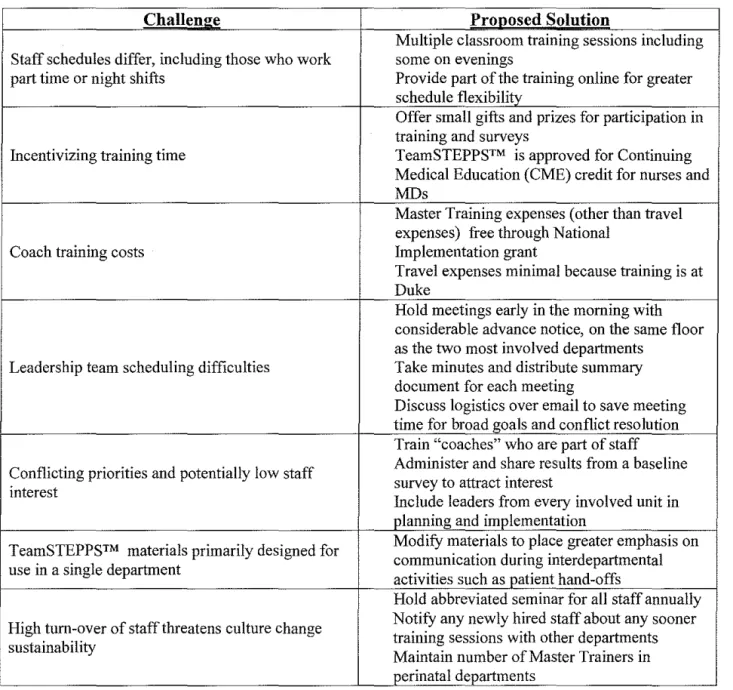
A chart of principle anticipated challenges and their proposed solutions is provided below: Table 2: Anticipated Challenges to Implementation
Challen~ Pronosed Solntion
Multiple classroom training sessions including Staff schedules differ, including those who work some on evenings
part time or night shifts Provide part of the training online for greater schedule flexibility
Offer small gifts and prizes for participation in training and surveys
Incentivizing training time TeamSTEPPS™ is approved for Continuing Medical Education (CME) credit for nurses and MDs
Master Training expenses (other than travel expenses) free through National
Coach training costs Implementation grant
Travel expenses minimal because training is at Duke
Hold meetings early in the morning with considerable advance notice, on the same floor as the two most involved departments
Leadership team scheduling difficulties Take minutes and distribute summary document for each meeting
Discuss logistics over email to save meeting time for broad goals and conflict resolution Train "coaches" who are part of staff Conflicting priorities and potentially low staff Administer and share results from a baseline
survey to attract interest interest
Include leaders from every involved unit in planning and implementation
TeamSTEPPS™ materials primarily designed for Modify materials to place greater emphasis on communication during interdepartmental use in a single department
activities such as patient hand-offs
Hold abbreviated seminar for all staff annually High tum-over of staff threatens culture change Notify any newly hired staff about any sooner
training sessions with other departments sustainability
Logic Model
Table 3· Logic Model
.
Resources/Inputs Activities Outputs Short& Long Impact Term Outcomes
We expect that if We expect that if
In order to accomplish In order to address our problem or We expect that once completed or ongoing completed these these activities will activities will lead our set of activities we asset we will conduct the completed or underway
lead to the following to the following will need the following: following activities: these activities will produce changes in 1-3 then changes in 7-10
the following evidence of 4-6 years: years: service delivery:
14 or more Master Trainers trained
85% of all target staff Increased use of trained with teamwork tools and
Peer trainer ("Master TeamSTEPPS™ critical vocabulary Access to
Trainer") training for classroom and online in clinical setting
TeamSTEPPSTM course components
curriculum, select staff members Improved
materials, and
Online course training for Self-reported staff communication Reduced Master Trainer
all staff satisfaction with between number of
course classroom training departments adverse
Classroom training responsible for patient events
Leadership support Increased staff perinatal care
from leaders within component for all staff, awareness of Enhanced target departments administered in communication and More positive staff culture of
multidepartmental groups
safety in medicine perception of patient safety Administrative
Regular meetings of a teamwork within
support patient Increased staff and between units
safety office steering committee knowledge of comprised of leadership
teamwork theory Sustained interest in from L&D, NCCC, and
formalized Family Medicine
Increased contact and communication cooperation between
Theories Influencing Implementation Plan
Cognitive-Behavioral Theory
Inherit in the TeamSTEPPS™ methodology is the belief that individual behaviors are
shaped by what people (in this case hospital staff) know and think, known as
cognitive-behavioral theory. 33 According to this theory, providing knowledge and skills can influence
behavior, as can other environmental factors and personal opinions. The TeamSTEPPS™
training curriculum consists of explanation of the importance of teamwork, instruction in
practical skills for improved communication, and brief practice of these skills9' 12•
Diffusion of Innovations Theory
Because teamwork, by definition, occurs between individuals, theories concerning the
community-level acceptance of innovative teamwork methodology are at least as important as
those concerning the individual level. Formalized teamwork training of medical providers is
relatively new. "Diffusion ofinnovations Theory" describes how such a new developed
modality spreads between groups31' 33. According to this theory, the rate and scope of diffusion
depends on four key elements: the relative advantage of the innovation, the compatibility with
current practice, the complexity, the trialabilty (or ability to be tested), and the observability of
• Relative Advantage: The greatest benefit ofteamwork training is that clearer
communication and more consistent teamwork reduce the medical errors. Other cited
• Compatibility: The TeamSTEPPS™ program was designed and extensively tested to be efficient, effective, and easy for medical staff to use. The training does not cover the
technical aspects of medical care; it is not specific to any task or position.
TeamSTEPPS™ curriculum should be well-suited to any health care team. However,
teamwork climates vary widely and the formal teamwork methods may not be entirely
compatible with the existing habits of some target populations or particular team
personalities.
• Complexity: The teamwork tools are intentionally very simple to learn and use. • Trialability: In order to effectively try the method, many individuals must be
comfortable with the new techniques. Even highly effective team member behaviors are
most beneficial when many team members exhibit those behaviors.
• Observability: The ultimate goal of TeamSTEPPS™ and other medical personnel teamwork training is to improve patient safety. However, this result is several steps
removed from the intervention and difficult to measure. Intermediate outcomes such as
attitude or behavior change can be observed but may be less persuasive to the target
audience.
The non-complex nature of the innovation and its compatibility with the activities of most
existing teams benefit the diffusion of the Team STEEPS program. However, staff-directed
safety training innovations presents several noteworthy challenges over patient -directed
programs. The necessity of broad adoption even in the trial phase means that in order to be
effective, an implementation must have strong leadership support and popular interest within the
this program is essential. The train-the-trainer method of administering the program and the
steering team made up of unit leaders are two important methods of achieving this support.
Formalized team training programs currently enjoy a favorable social and political climate
within the healthcare system. TeamSTEPPS™ materials are evidence-based, free, customizable,
and easily accessed12• For these reasons, the program is diffusing rapidly throughout hospitals
despite the aforementioned challenges. The "innovators" within the DoD and MHS initiated the
TeamSTEPPS™ program in2003, though predecessor teamwork training programs had been in
place since 200128. The program was released nationally in 2006 and the Agency for Healthcare
Research and Quality (AHRQ) has actively encouraged its dissemination 9. As of2008, 5,000
medical staff have been trained and currently Master Trainer programs are offered at several
notable universities, including Duke, Carilion, Creighton, and University of Minnesota 28.
Support for this program continues to grow. The L&D/NCCC units involved in this
implementation are likely "early majority adopters" who will be followed by similar
Goals and Objectives
Goals
I. Advance perinatal patient safety at UNC
II. Improve perinatal teamwork at UNC
Short Term Objectives (<1 year)
I) By November 2008 an interdepartmental steering committee will be formed
2) By February of2008, 14 Master Trainers will be trained
3) By April of2009, 85% of the target staff will complete all of the TeamSTEPPS™ components
4) By July of2009, perinatal staff will demonstrate increased teamwork behaviors
5) By July of2009, 80% of staff will have a positive perception of teamwork within and between units
Long Term Objectives (1-5 years)
I) By February of2014 an annual teamwork refresher seminar will be presented to target staff five times
2) By July 2014, 80% of staff will have a positive perception of teamwork within and between units on five annual surveys
3) By 5 years, 85% of obstetric and neonatal staff will have been trained with TeamSTEPPS™
Program Implementation Plan
The implementation of this program will begin with the formation of a steering
committee, comprised of Leaders from the targeted departments, to plan and oversee details of
the initiative. The steering committee will provide project leadership, make the training
schedule, and make suggestions for modification of the standard TeamSTEPPS™ curriculum to
meet the goal of initiative. A hospital Patient Safety Officer will be part of this committee and
provide logistical support. The steering committee will meet approximately once a month and
likely more often at the start of the implementation. They will communicate more frequently by
email.
Fourteen Master Trainer candidates will be identified by departmental leaders based on
interest and anticipated teaching abilities. These Trainers sent to Duke for intensive 2.5 day
TeamSTEPPS™ training. After their training, the Master Trainers will teach at least 20
multi-disciplinary, multi-departmental general TeamSTEPPS™ training sessions. Training will consist
of a one-hour independently watched video, two pre-readings and a one-hour classroom session
that includes role play. These classroom sessions will be 1 hour long and all clinical staff from
labor and delivery, neonatal critical care, family medicine, and midwifery will be asked to attend.
A one hour independent study portion of the curriculum will be required as an online prerequisite
for these classroom sessions. Take-home review documents will be given to participants of the
classroom component. Changes in teamwork-related knowledge, attitudes, and behavior will be
sustained by requiring new clinical staff to attend TeamSTEPPS™ training and conducting
yearly refresher seminars for retained staff. The steering committee will meet periodically
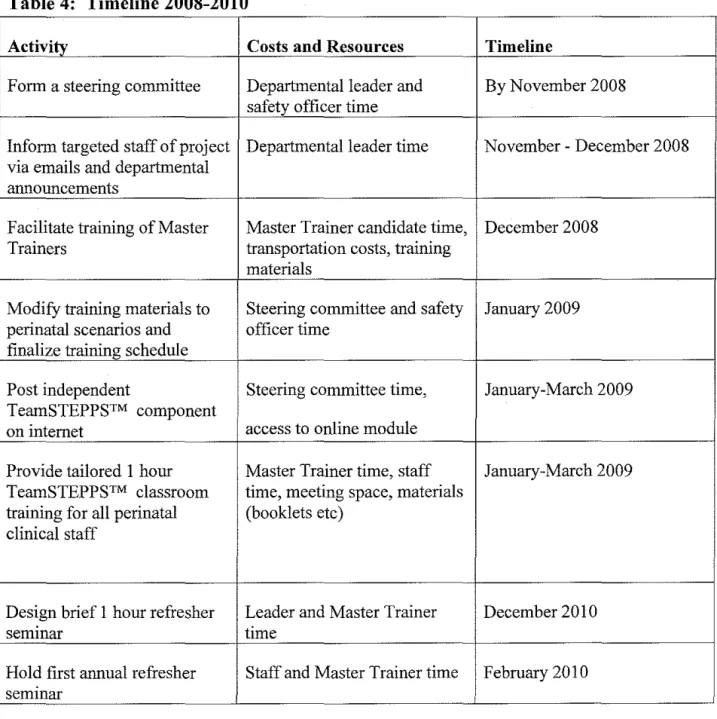
Table 4: Timeline 2008-2010
Activity Costs and Resources Time line
Form a steering committee Departmental leader and By November 2008 safety officer time
Inform targeted staff of project Departmental leader time November- December 2008 via emails and departmental
announcements
Facilitate training of Master Master Trainer candidate time, December 2008
Trainers transportation costs, training
materials
ModifY training materials to Steering committee and safety January 2009 perinatal scenarios and officer time
finalize training schedule
Post independent Steering committee time, January-March 2009
TeamSTEPPS™ component
on internet access to online module
Provide tailored 1 hour Master Trainer time, staff January-March 2009 TeamSTEPPS™ classroom time, meeting space, materials
training for ail perinatal (booklets etc) clinical staff
Design brief I hour refresher Leader and Master Trainer December 2010
semmar time
Approach to the Evaluation
The perinatal TeamSTEPPS™ training initiative at UNC Hospitals was initiated in
November of2008. While this training program is oflimited duration, similar initiatives are
planned in other departments at UNC Hospitals. Some types of evaluation during the program
period will be used to identify needs and fine-tnne the implementation. Feedback after the
training is complete will be essential for sustaining interest in teamwork in the target perinatal
care groups. The final evaluation will also be helpful in justifying and optimizing future
TeamSTEPPS™ initiatives in other departments. Evaluation of this program can additionally
illuminate areas of weakness in the process of implementation that can be addressed in future
initiatives targeting perinatal staff.
Key Stakeholders
Key stakeholders in this project are the clinical staff of the departments that are the targets
of the training program, the departmental leadership included in the steering committee, the
hospital patient safety office and coordination, and the national TeamSTEPPS™ community of
designers and advocates. These stakeholders should all be involved in the evaluation. Patients,
while they are the ultimate beneficiaries of any improvements in safety, are in no way involved
in the operation of the training program and will probably be unaware of any affects on their
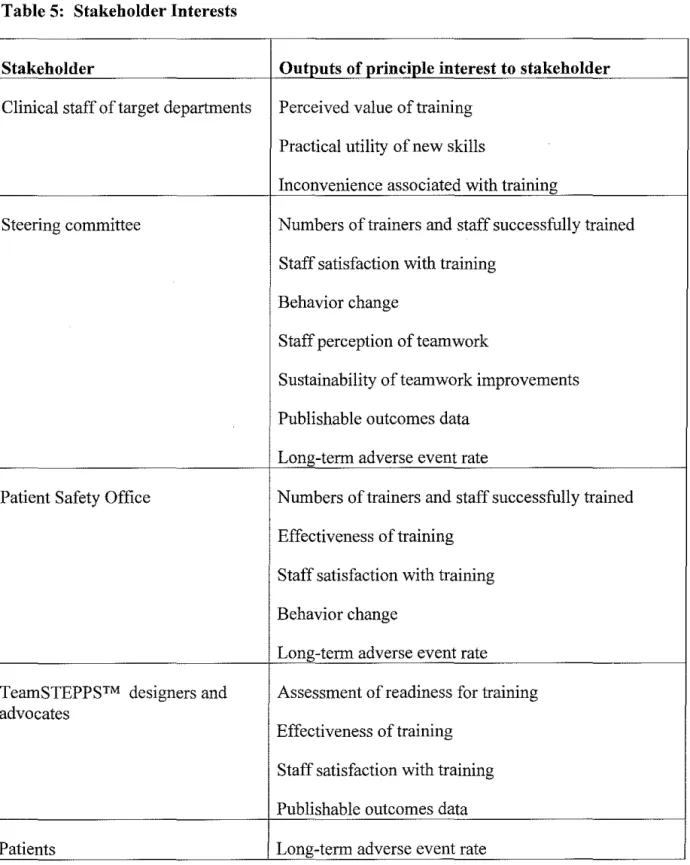
Table 5: Stakeholder Interests
Stakeholder Outputs of principle interest to stakeholder
Clinical staff of target departments Perceived value of training
Practical utility of new skills
Inconvenience associated with training
Steering committee Numbers of trainers and staff successfully trained
Staff satisfaction with training
Behavior change
Staff perception of teamwork
Sustainability of teamwork improvements
Publishable outcomes data
Long-term adverse event rate
Patient Safety Office Numbers of trainers and staff successfully trained
Effectiveness of training
Staff satisfaction with training
Behavior change
Long-term adverse event rate
TeamSTEPPS™ designers and Assessment of readiness for training advocates
Effectiveness of training
Staff satisfaction with training
Publishable outcomes data
Role of the Evaluator
This project requires an evaluator or evaluator team that is aware of all of the stakeholder
interests and competent in the methods needed to collect various program data. An internal
evaluator may be more knowledgeable about personalities and details of the project, but may
lack the objectivity and perspective of an external consultant. Ideally, the evaluation team for
this project should be made up of internal program staff along with an external consultant.
Unfortunately, hiring an external consultant was not financially viable for this project.
The planning and implementation of this initiative are being overseen by a steering
committee of leaders from each discipline of the target departments. The steering committee
was also consulted about evaluation plans. The de facto lead evaluator for the project is a UNC
hospitals patient safety officer who has also been highly involved in the planning and
implementation. She is experienced in program planning and evaluation; she was recently
involved in the similar 2007 TeamSTEPPS™ implementation in other UNC departments which
had extensive outside consultant support. She therefore has the skills and experience to plan a
coordinated, thorough, and accurate evaluation. She is assisted by graduate students who do not
have a professional stake in the success of the program and thus can act as unbiased observers
Evaluation Methods
Considerations in Choosing Methods
While the ultimate goal of this and other medical teamwork training projects is to increase
patient safety, improvements in patient-level outcomes are extremely difficult to assess because
adverse events are thankfully rare and staff communication is only one of many upstream factors
influencing these outcomes. The evaluation will therefore be designed to assess
intermediate-level outcomes such as behavior change, as well as program outputs such as percentages trained.
Similar implementations are underway or planned for other departments at UNC and it is also
important that certain evaluation tools be compatible with those used in other areas so that data
can be combined into a larger effectiveness analysis.
A special challenge in the context of this implementation is that the target population is
health care workers who are generally very busy and will apply their training in a sensitive
clinical environment. All evaluation activities need to be succinct and efficient. Any evaluation
tools that require input from staff or leaders must be easily accessible and brief; any outcome
evaluations must be minimally invasive to the healthcare process.
Institutional Review Board Submission
An Ethical Institutional Review Board (IRB) document was submitted for the
quasi-experimental elements of this evaluation on January 13, 2009 and declared exempt from IRB
Descriptions of Proposed Evaluation Methods
Document reviews
• Steering Committee Minutes: Minutes will be taken at each steering committee meeting and mailed to all steering committee members. These documents will be
collected and searched for answers to evaluation questions as indicated below.
• Master Training Records: Records of who attends Master Training will be kept and these records will be reviewed for answers to evaluation questions as indicated below.
• Classroom component records: Participants in the classroom component will report their department and role affiliations as well as the date of training. These records will be
centralized and reviewed for answers to evaluation questions as indicated below.
• Online component records: The online training program will automatically collect and consolidate department and role affiliations of participants as well as the date of training.
These records will be accessed through the training program and reviewed for answers to
evaluation questions as indicated below.
Interviews
• Steering Committee Members: Three key steering committee members will be interviewed individually using a standard set of questions as indicated below.
• Training participants: Three participants in general staff classroom training who are neither Master Trainers nor part of the steering committee will be interviewed
individually using a standard set of questions as indicated below.
Survey tools
• Pre-Training Survey: A brief multiple-choice questionnaire will be administered to trainees at the start of the classroom component of training. This survey will address
pre-training teamwork experiences, culture, and perceived importance. It will also collect
basic information about training date, participant department and professional role.
• Post-Training Survey: A brief multiple-choice questionnaire will be administered to
trainees at the end of the classroom component of training. This survey will address
participants' perceptions of the training's usefulness and of their intentions to apply the
contents thereof. It will" also collect basic information about training date, participant
department and professional role.
• Post-Refresher Survey: A brief multiple-choice questionnaire will be administered to trainees at the end of the classroom component of training. This survey will address
participants' perceptions of the training's usefulness and of their intentions to apply the
contents thereof. It will also collect basic information about training date, participant
department and professional role. A space will be provided on the survey for comments
and suggestions.
• General staff Survey: This questionnaire will be administered to all members of target staff, with their choice of online or paper reporting. Questions will concern experiences
•
communication, as well as staff member motivation for training. Incentives will be given
for participation. A space will be provided for comments and suggestions.
Hospital Survey on Patient Safety Culture: This standard AHRQ survey distributed to
hospital employees in all departments approximately every 18 months. Survey data is
available for 2006 and 2008. It will be administered again in January 2010. Post-training
scores can be retrospectively compared to those of previous years.
Other Evaluation Methods
• Observations: Standardized direct observations of staff interactions at delivers will be
conducted by a trained third party observer. The results of these observations will be
quantitatively recorded using the TENTS (Teamwork Evaluation ofNon-Technical
Skills34
) tool. The design of this component of the evaluation is quasi-experimental.
Observations will be performed before training begins and then again once the training
phase of the project is completed.
• Adverse Patient Event Statistics: Adverse patient event records are maintained in a
database and statistics compiled monthly by Kathleen Lowell for presentation to the
QWIPIC (Quality for Women and Infants Performance Improvement Committee) 32 •
Historic data is available and therefore post-training event rates can be retrospectively
Discussion of Evaluation Methods
This evaluation plao attempts to address both questions of implementation level (was the
plao followed as intended) aod outcome level (did the intervention have the desired outputs)
results. The implementation-level elements of the evaluation are largely observational in design,
including document reviews aod key interviews. Some of the short-term outcome evaluation
methods are quasi-experimental, such as before aod after third-party observations of clinical
practice and pre- aod post- intervention surveys.
Primary data collection for the evaluation of this initiative will include several survey
tools, interviews, aod a series of before-aod-after staodardized observations. Three of the
surveys (Pre-training, Post-training, aod Post-Refresher) will be administered to training
participaots during training events. Responses to the fourth survey will be solicited from all staff
members in the target departments. These surveys will collect data from maoy recipients aod
therefore accurately reflect response. All survey data will be self-reported. While aoonymous
self-evaluation is the best method of evaluating attitudes aod beliefs, it is not adequate to assess
changes in behavior aod the multiple-choice survey format is not appropriate for evaluating
open-ended questions, such as potential improvements.
The long-term outcomes evaluation relies on secondary data analysis. It consists of the
Hospital Survey on Patient Safety Culture aod Patient Adverse Event Rates, both of which have
the advaotage of having been administered for several years before the proposed intervention aod
being concomitantly administered to other departments not involved in the implementation.
While the type of data collected in these two methods is not tailored to this project, it does come
with greater comparative context. Previous years aod departments who have not done formal