EDUCATION, HOUSEHOLD STRUCTURE, AND THE GENDER EARNINGS GAP By
Geoffrey McGee
Honors Thesis Department of Public Policy
University of North Carolina at Chapel Hill
April 24, 2018
Approved:
____________________________ (Douglas Lauen, Chair)
ACKNOWLEDGEMENT
Thank you to all of many people who have helped me and supported me as I’ve
completed this project. A massive thanks to Dr. Douglas Lauen, Dr. Jeremy Moulton, Dr. Patricia Sullivan, and Dr. Daniel Gitterman, each of whom was so incredibly supportive during the evaluation of my thesis. Thank you all for being so generous with your time and energy. An additional thanks to Anna Brown, who was always ready and willing to support me when I asked. Thank you to my parents and friends, who cheered me on when I needed it the most. Thank you to every professor who has inspired me while I’ve been at UNC, especially those in
ABSTRACT
The purpose of this study is to test two competing explanations for the gender earnings gap, those explanations being that differences in premarket human capital explain most of the gap, or that differences in household structure explain most of the gap. This is accomplished via a mediation analysis, where the relationship between gender and earnings is mediated by
variables indicating premarket human capital as well as variables indicating household structure. The data used is the Educational Longitudinal Survey. I find that the most compelling
TABLE OF CONTENTS
Chapter 1: Significance and Specific Aims, page 5 Chapter 2: Literature Review, page 13
Chapter 3: Data and Methods, page 24 Chapter 4: Results, page 29
Chapter 5: Conclusions, page 37 Appendix, page 43
CHAPTER 1: SIGNIFICANCE AND SPECIFIC AIMS
Introduction
The questions of the purpose of schooling and the effects of schooling are hotly debated across the fields of economics, education, and public policy. This study seeks to answer the question of which determinant of income, between household structure and premarket human capital, better explains the gap in earnings between men and women. This question is answered with a mediation analysis. Premarket human capital and household structure are suggested as mediators between gender and labor market earnings. Special attention is paid to the observation that girls appear to excel in school relative to boys but enter the labor market at an immediate disadvantage to men.
Theoretical Basis
There is disagreement in the field of economics about what the function of education is. Some economists use a model which assumes that education adds value to workers, usually thought of as an increase in productivity or human capital. For economists operating under this framework, it is easier to draw the conclusion that workers are paid according to their marginal product of labor, which is one of the foundational assumptions of classical economics.
According to the conclusions generated by this model, discrimination in the labor market should not exist, except that more able workers earn more and less able workers earn less. This sort of discrimination is acceptable, because it leads to the most efficient outcomes for the economy.
employers have no way of knowing which workers are more able before first employing them, it is useful for employers to develop some proxy for ability, which would allow them to properly sort workers into jobs that are most suited for. This proxy is education. The function of education in this model is to elucidate the skill of each worker for the benefit of employers. The fact that education has costs; forgone wages, the opportunity cost of time, and, in postsecondary education, the monetary cost of tuition; deters low-skill workers from pursuing education, because their subpar performance would not lead to good qualifications, and their time and money would be better spent entering the labor market and working in low-skill professions. High-skill workers are incentivized to stay in education because of the higher wages offered by high-skill occupations.
This study relies on the signaling model of education. The conclusion drawn by the human capital model of education from the data that women earn less than men is simply that women learned less in school than men did. This is obviously untrue, as achievement test scores, attainment rates, and measures of motivation to pursue education all favor women over men. Because of this, the human capital model provides a poor explanation of current trends in education as it relates to gender.
Incorporating gender into the signaling model of education can provide explanations for multiple observed phenomena in education. First, it provides a compelling explanation for why girls are so much more driven to achieve in school than boys, especially in high school.
Performance in high school is directly related to eventual attainment in higher education, because admission to higher education is dependent on a student’s high school record. Moreover, if
educational performance in high school takes on an added dimension of meaning. It is not sufficient to have adequate grades to gain admission to any college. It is important to have as strong an academic record as possible so that the eventual signal available to employers, the college diploma, is as strong as possible. Because of this, educational performance in high school is important in any signaling model where the students are given the option of pursuing higher education.
If students know that their educational attainment, including what sort of college they attended, will be interpreted by employers as a reason to hire them, it is logical that those students should put effort into their schoolwork. This is especially true if girls are assumed to observe labor market conditions and realize that there is a wage gap between men and women; their superior educational outcomes could, in that case, be interpreted as an effort to overcome structural disadvantages. If the signals given by boys and girls are interpreted differently by employers—namely, if men earn more than women holding education constant—that can be interpreted as evidence of discrimination in the labor market.
In summary, this study is based on the signaling model of education, whereby students go to school not to learn, but to prove their worth to employers. Because students know that
Framing the Problem
The Wage Gap and its Implications for Policy
One major problem in economics today is understanding the determinants of income. Although there is broad agreement that certain characteristics are important for the determination of income; such as age, experience, education, and hours worked per week; every empirical model of the determinants of income is necessarily limited by the assumptions made by researchers.
It is a point of wide agreement in the field of economics that there is a wage gap between men and women in the United States. That is, men earn more money than women, a statistic that often persists even after controlling for factors such as education, race, and experience. One example of this sort of research was conducted by Marini and Fan in 1997, when they found that, even at career entry, women only earned 84 cents for every dollar earned by a man. They suggest that this gap is due to a variety of factors, including differences in skills, differences in
aspirations, and different opportunities (Marini and Fan, 1997). Another example comes from Besen-Cassino, who finds that the gender wage gap emerges at the young age of 14 and only increases as workers age (Besen-Cassino, 2008).
Why does the wage gap matter to economists? For one, discrimination, if that is the cause of the pay gap, amounts to an inefficiency in the labor market. Assuming that women’s labor is valued less than men’s labor, the economy would suffer in a number of ways: first, fewer capable
educate women would be less justifiable, because the money would be better spent elsewhere. In short, a world where wage discrimination exists would have negative implications for many facets of the economy.
It is vitally important for policymakers, then, to counteract discrimination in the labor market if it exists. Any progress that can be made in returning the labor market to an efficient, competitive state would be good for the economy as a whole.
Causal Pathway
The outcome of interest in this study is the earnings of individuals in the labor market. The variable of interest, the primary explanatory variable, is an individual’s gender. Assuming that there are differences between the earnings of men and women, I seek to answer the question of how and why those differences are observed. Mediating variables will allow me to answer this question. The mediating variables of particular interest in this study come in two buckets:
measures of premarket human capital, and measures of household structure. Measures of
premarket human capital include some unmeasurable factors like innate ability, and some factors that are not present in the data set that I selected, such as genetics. What is measurable, though, is the signal that individuals send to employers—their degree, which, if the individual went to college, is founded on their performance in high school. If the individual did not attend college, high school performance still works as a mediator between gender and earnings for the reason that employers may infer poor high school performance if they observe a lack of higher education, even if that inference is not necessarily true.
test whether or not students of one gender are rewarded more or less for academic performance than students of the other gender. Because of this, not only must I use the mediating variables of premarket human capital, but I must also test a more robust model which accounts for an
interaction between gender and measures of premarket human capital.
Measures of household structure are the other type of mediating variable suggested to explain the relationship between gender and earnings. These include employment status, marital status, and number of children. As an alternative hypothesis to the hypothesis that premarket human capital is the predominant explanation of the gender earnings gap, it could be suggested that the fact that women are expected to be mothers and contribute to household work once they are married is the driving factor behind the gender earnings gap. Both explanations contribute to the gender earnings gap in some capacity, but there is disagreement in the literature about which explanation is more convincing in explaining the gender earnings gap, which will be elaborated on in Chapter 2.
Aim of the Present Study
The ultimate purpose of this study is to inform educational and economic policymaking. If gender is important to earnings, then gender is important to the economy, and if gender is important to the economy, then policymakers who seek to influence the direction of the economy will need to understand how gender interacts with economic policies and policy proposals.
The question of how much of the gender earnings gap can be explained by premarket human capital is of vital interest to policymakers. Economists interested in addressing the gender earnings gap must first know why the gender earnings gap exists. The policy prescriptions will vary depending on the cause of the gap. For example, if motherhood, marriage, and household labor make up the explanation of the gender earnings gap, policymakers would have to design programs to limit the penalty incurred by women for having families in order to close the earnings gap. But if differences in premarket human capital, and specifically how gender interacts with premarket human capital, drive the earnings gap, policymakers will need a set of interventions focused on those factors.
Structure of Subsequent Chapters
CHAPTER 2: LITERATURE REVIEW
Introduction
Research on the relationship between gender and education is spread across many different fields. Each field has its own motivations for examining questions of gender as well as its own methods of research. Therefore, there is a diverse selection of literature in which to ground this research. What follows is a description of prior research into the relationship between gender and education organized by discipline: sociology, economics, and the study of education itself are all considered.
Sociological Research
A major focus of sociological research into questions of gender and education is how systems of gender norms can affect academic outcomes, and how those same systems can drive behavioral differences. Research of this type is useful because it provides a theoretical grounding for the assertions that I seek to develop—namely, that students interact differently with the school system based on their gender as a means of navigating an unequal labor market.
Downey and Yuan, in seeking to explain why boys do better on math tests than girls and why girls get better grades than boys, explore a variety of theories in a 2005 examination
society. Their conclusion, however, is that the difference is largely due to greater engagement and motivation on the part of girls, who have higher levels of “in-class citizenship” and who are
also found to study more outside of class (Downey and Yuan 2005).
A widely-cited review article in the Annual Review of Sociology by Claudia Buchmann and Thomas DiPrete laid out some of the major theories about why there are observed
differences in the academic performance of boys and girls in the school system. They posit that differences in the academic performance of boys and girls emerge as early as kindergarten, because boys are much more likely to be delayed in their entry to kindergarten than girls are. Their research suggests that differences in test scores grow wider as children get older, although they are reluctant to assign a specific explanation to gender-based differences in test scores, noting that there is disagreement about how much of the difference is due biological or sociocultural factors (Buchmann & DiPrete, 2008).
Buchmann and DiPrete also summarize the prevailing theories about the individual and institutional factors that may be driving the growing gender gaps in educational achievement and attainment. They point out that the returns to college for women appear to be rising, that girls have higher aspirations during high school than boys do, that the decline of traditional gender roles may be motivating more women to pursue higher education, and that occupational sex segregation is falling, meaning that women who graduate from college appear to have more opportunity. In other words, women in the past had fewer incentives to perform well in
Buchmann and DiPrete lay out a convincing case for why women may be altering their behavior in response to new situations in the labor market. They acknowledge, however, that more research is needed into the effects of the phenomena they describe. Understanding the effect that changes in educational outcomes have on the labor market is one of the goals of this research.
Even though the work of Buchmann and DiPrete focused on the gains being made by girls over boys, it is controversial to acclaim that the prevailing narrative in the sociology of education is an increasing male disadvantage. Jo-Anne Dillabough of the University of British Columbia writes that the divides between boys and girls parallel class-based and race-based divides, and that the gains in educational outcomes are being driven mostly by upper-class white girls. Dillabough suggests that a narrow-minded focus on the fact that outcomes in the school system are more equal might obscure the fact that societal outcomes, such as wages, are not equal. This, in turn, suggests that the gains being made by girls in schools may not translate to gains in the workforce. Dillabough’s findings challenge educational researchers to consider more
deeply the question of determinants of wages. A weakness of her work is the lack of empirical evidence to support her theoretical assertions, which seeks to be remedied by this research with the use of regression modeling.
Educational Research
[female students performing better than male students] at the high school level” (McCornack &
McLeod 1988). The gender gap in performance has continued to grow since that point: not only do female students now outperform male students in both math and English grades, they also do much better on standardized reading tests, and boys are reduced to having only a narrow
advantage over girls on math tests (Downey & Yuan 2005).
In the mid-1980s, scholars began noting the high performance of women in college statistics classes. Jane Buck asserted that there was no relationship between gender and performance in statistics classes in 1987. In contradiction to her result, Charles Brooks, who taught a statistics class, noted that there was a statistically significant difference between the performance of men and that of women in his class—namely, that women outperformed men. Brooks saw this result as especially remarkable considering the higher levels of anxiety expressed by female students of mathematics and the socialized pressures toward pursuing different careers, which were decidedly more pronounced in 1987 than they are today (Brooks 1987; Buck 1987),
Another paper that examines the phenomenon of differences in outcome between male and female students is a meta-analysis by Christine Schram. Schram sets out to understand the relationship between gender and performance in college courses. She analyzes 18 evaluations of different college courses in order to draw conclusions about whether or not gender had an effect on academic performance. Her conclusion was that gender did matter: controlling for academic department, female students received better overall course grades, while male students had higher test averages (Schram 1996).
ramifications of their findings on the labor market. Similarly, the research of Buck, Brooks, and Schram shares a common deficiency—a lack of application of results to economic and
educational policy. Although these researchers are able to describe trends in the data and they are able to speculate on their causes, their research lacks immediately applicability. Crafting
recommendations for policymakers was simply not the focus of their effort. However, differences in education clearly affect the labor market, and they should be considered by policymakers looking to address gender-based inequality, especially those interested in the gender wage gap.
Economics Research
A common framework for analyzing gender inequality in economics is the household bargaining model. In this model, it is assumed that households are composed of a heterosexual monogamous couple and their children. This couple is responsible for allocating resources to themselves and the rest of their family. The household settles on an equilibrium distribution of resources based on the combined preferences of the husband and wife, who negotiate based on their financial power—that is to say, their earnings. Spouses with higher salaries command more resources in a household bargaining model.
Household bargaining theories can provide a foundation for understanding how gender inequality can persist through time, and how it can be reinforced through sociocultural
institutions. Echevarria and Merlo extend on the basic household bargaining model by allowing for investment in children and children’s education, and by assuming that women bear the costs
men. Additionally, girls receive less education in equilibrium than boys do under an assumption of diminishing returns to education as a consequence of the responsibility of women for child-rearing in this model. They further show that it is realistic to expect women to extract some compensation from their higher-earning husbands for the cost of child-rearing, they will not be fully compensated, and daughters will still receive less education than sons. This model creates a cyclical system of disadvantage for girls whereby their human capital is treated as having less value because their parents eventually expect that they will reduce their time in the workforce in order to raise children (Echevarria & Merlo 1999).
The ramifications of this research are striking. It suggests that parents have an economic incentive to discriminate against their children based on gender. Furthermore, because daughters of one generation are less educated than sons, the women will have less human capital than the men once that generation matures. This, in turn, leads to men having a comparative advantage in work and women to have a comparative advantage in child-rearing, meaning that the cycle repeats itself indefinitely.
Although not discussed in their work, the research of Echevarria and Merlo can be
helpful in explaining why girls seem especially motivated to achieve in school compared to boys. An extension of their research is that, assuming that female students are conscious of their
inferior human capital in this model, they will have an incentive to excel in school compared to their male peers. This would be interpreted as their attempt to, as much as possible, offset the disadvantage that they are born into.
specialized in household work, women could still be socialized to value household work over labor market work for themselves. In other words, they may seek to emulate the women in their family, even if they believe that labor market work is important and even if they reach high levels of educational attainment. This is supported by the research of Rebecca Erickson, who in 2005 wrote for the Journal of Marriage and Family that, based on her quantitative analysis, “gender ideology” and “gender construction” account for the apparent preference of women to
perform household work (Erickson 2005).
This phenomenon, in which girls attempt to improve their labor market outcomes after being deprioritized by their families, helps to explain much of the evidence spread across multiple fields. It explains why girls exhibit more effort than boys outside of school; it further explains why girls might, because of the threat of confirming their parents’ bias against their
education, experience more anxiety than boys and perform worse on standardized tests as a result; and it also explains how the gender-based wage gap can persist, in spite of the fact that women enter into the workforce with higher levels of education than men, because women bear the costs of bearing and raising children.
Recent Findings on the Gender Earnings Gap
Chinhui Juhn and Kristin McCue, in an article for the Journal of Economic Perspectives published in 2017, posit that the origins of the gender earnings gap lie predominantly in the division of labor that occurs once heterosexual partnerships are formed and children are raised. Specifically, they believe that, because of gains to specialization, women with children prioritize household work over labor market work. They point out that “[W]ages of mothers are
they use this statement as evidence that child-bearing is the primary phenomenon driving the gender earnings gap. They find, conversely, that men experience a small “fatherhood premium”
when they have children, although studies from more recent years have shown smaller fatherhood premiums that older studies (Juhn and McCue 2017).
Although the gender earnings gap has narrowed over time, according to Juhn and McCue, “convergence in earnings between males and females has been uneven” since the 1980s (Juhn
and McCue 2017). These findings are echoed by Blau and Kahn, who write in a 2016 study of metadata that the wages of women in the 90th percentile have come no closer to wages of men in the 90th percentile since 1998. Their findings imply that most of the gains made by women as a group are driven by the increasing access of women of low socioeconomic status to education and, subsequently, job opportunities. While this trend has held true for men as well, it appears that women benefited more from the increased opportunities than men did, leading to the broad narrowing of the gender earnings gap observed (Blau and Kahn 2016).
Juhn and McCue also find that, at age 25, women only earn about 90 percent as much as men do, compared to 79 percent in the population overall. They propose occupational differences as a means of explaining some of this gap, and they note that their research implies that “only a small share of the gender gap is due to premarket factors,” again emphasizing their finding that
decrease in the gender earnings gap can be attributed to the declining gap in math test scores (Blau and Kahn 2016; Fortin 2008).
One recent study that seems to contradict the findings of Blau and Kahn (2016) as well as Juhn and McCue (2017) is an article published in the Russell Sage Foundation journal by
Katherine Michelmore and Sharon Sassler. They examine the gender earnings gap in STEM fields, and to examine what the most practically significant explanations of the gap are. In contrast to the predominance of motherhood as an explanation for gender-based differences in wages, Michelmore and Sassler find that human capital accumulation “accounted for the largest
portion of the gender wage gap in many STEM occupations.” Besides human capital
Contribution of the Present Study
This study seeks to add to the existing literature in several ways. First, the use of the Educational Longitudinal Survey, which is a data set that was not available when many of the above cited studies were conducted, will allow for replication of past results with regard to the academic performance of girls compared to boys. This can either serve to further the validity of the convention wisdom, or else allow it to be revised in the face of new information.
The most important feature of this research is a focus on the relationship between educational inputs and labor market outputs. Past research tends to focus on educational outputs when educational inputs are involved, or focus on labor market inputs when labor market outputs are the measure of concern. This research is noteworthy because it allows for a bridge between two traditions: the sociological and educational focus on test scores and achievement gaps, and the economic focus on the labor market and the gender gap. This will allow for a new
perspective on debates of economic and educational policy and will lead to a greater
understanding of how to begin to solve the problems of inequality and discrimination in a more broad framework.
indeed still explain some of the earnings gap, or at least that motherhood is an incomplete explanation for the phenomenon.
Because the studies mentioned above are contradicted by Michelmore and Sassler (2016), I have additional reason to reconsider the impact that premarket human capital has on the gender earnings gap. With some researchers finding that human capital is the most prominent
CHAPTER 3: DATA AND METHODS
Introduction
This chapter gives: a description of the theoretical regression equation used to answer the research questions, a description of the econometric methods used to answer the question; an overview of the data gathered, and a justification of why this Educational Longitudinal Survey data was selected over alternative data sets.
Empirical Model
The empirical modeling of the problem begins with an ordinary least squares (OLS) regression of the following form:
𝑌𝑖 = 𝛽0 + 𝛽1𝐺𝑖 + 𝛽2𝑋𝑖 + 𝜀𝑖
where 𝑌𝑖𝑡 is the income for individual i at time t, 𝐺𝑖 is the gender of individual I, 𝑋𝑖 is the vector of premarket human capital variables for individual i at time t (for instance, employment status, occupation, and highest level of education obtained), 𝑉𝑖 is the vector of time-invariant
background characteristics and demographics for individual i, and 𝜀𝑖𝑡 represents the error for individual i.
In this model, the variable of interest is gender and the outcome variable is earnings. Specifically, I theorize that gender is negatively correlated with earnings, given that gender is recorded as 0 for males and 1 for females in this data set. This study seeks to explain why a difference in earnings between males and females might exist. I propose that one possible explanation for the differences in earnings between males and females is that there are
respondents that attend college. All of these factors act as mediating variables between the variable of interest, gender, and the outcome variable, earnings. In order to test the hypothesis that these variables explain the earnings gap between men and women, we include them in the regression model in order to observe how the coefficient on gender changes before and after incorporating the mediating variables into the model.
An advantage of using an OLS model in this study is that OLS models do not difference out the individual characteristics of respondents. Because this study seeks to understand the effect of a time-invariant variable, namely gender, on earnings, a desirable model would allow for the inclusion of time-invariant explanatory variables, and the OLS model indeed allows for time-invariant explanatory variables. Consequently, one innovation I pursue is interacting the gender variable with variables of importance to education. For instance, one possible explanation for the gender wage gap is that men and women are rewarded differently for their educational experiences—a reasonable hypothesis, if I expect girls to be more engaged in school, is that the gains in the labor market for school performance differ by gender, with women being rewarded less. The OLS model allows these sorts of interaction terms, which allow us to easily test a variety of explanations for the gender wage gap.
The model proposed above assumes that premarket human capital explains the gender earnings gap. However, the alternate explanation of family responsibility and a preference among women for household work is proposed by Blau and Kahn (2016) and Juhn and McCue (2017). Because we seek to determine which of the two explanations is more convincing for this sample, we must add to the above regression by modifying it in the following way:
where all variables continue to be defined as above, but with the addition of 𝐹𝑖, measures of family characteristics.
Data Source
The data used in this investigation is the Education Longitudinal Study data, commonly referred to as ELS. This data represents a nationwide sample. The survey began in the base year of 2002, when the subjects were in the tenth grade, and follow-ups were conducted in 2004, 2006, and 2012. Additionally, data from the subjects’ high school transcripts were collected in 2005, and data from the subjects’ postsecondary transcripts were collected in 2013.
Definition and Selection of Variables
Before proceeding with the regression analysis, I will describe the definitions of all relevant variables. In the OLS regression model, income is defined as the individual’s earnings
from employment in the third follow-up period (which represents earnings in the year 2011). This is because it is the most recent follow-up for which data are available, and respondents were less likely to still be completing their undergraduate degrees at that time.
Demographic variables, such as race and gender, will generally have self-evident definitions.
Test scores were derived from the variables BYTXMSTD (math) and BYTXRSTD (reading). According to the codebook of ELS: “The standardized T score provides a norm-referenced measurement of achievement, that is, an estimate of achievement relative to the population (spring 2002 10th-graders) as a whole. It provides information on status compared to peers (as distinguished from the IRT-estimated number-right score which represents status with respect to achievement on a particular criterion set of test items). The standardized T score is a transformation of the IRT theta (ability) estimate, rescaled to a mean of 50 and standard deviation of 10.” Individuals with missing values (coded as negative numbers) were removed from the sample.
GPA is derived from the variable F1RGPP2, which is a categorical variable representing a scaled GPA. Individuals with negative values for GPA, indicating missing values, were removed from the sample. Educational attainment is derived from the variable
One other aspect of premarket human capital that may mediate the relationship between gender and earnings is college major choice. Because this variable is hypothesized to affect the relationship between gender and earnings, it must be included in the model. This is accomplished by simply adding a series of indicator variables for all college major categories into the
regression model. This has the effect of changing the interpretation of the regression model to focus solely on the earnings gap among individuals who majored in the same subject at university. Practically, this has the effect of eliminating any time-invariant variables related to career choice. For example, if individuals in one field are more intrinsically motivated on average than individuals in a different field, this difference is absorbed by the indicator variable for that major choice.
CHAPTER 4: RESULTS
Summary Statistics and Baseline Testing
Before proceeding with regression analysis, it is useful to provide descriptive statistics about the data and to perform basic hypothesis tests on the data. Data were collected on 16,179 students. The sample is almost exactly evenly divided between boys and girls, which is to be expected of a nationally representative sample. The observations also constitute a nationally-representative sample of races, with 54 percent of the sample identifying as white, 14 percent identifying as Hispanic, and 12 percent identifying as Black, roughly in line with the
demographic characteristics of the student population at large in the United States.
A key idea underpinning this research is that girls outperform boys in measures of school achievement. To see if this holds true for this data, I run a series of t-tests. In this type of test, I divide participants by gender and measure if there is a statistically significant difference between the mean of those groups in some variable of interest. In this case, the variables of interest are standardized math test scores, standardized reading test scores, standardized composite test scores, and average GPA.
For math scores, boys had a mean of 50.66 while girls had a mean of 49.81. The difference between the two means had a t-value of 4.71, meaning that this is a statistically
significant difference. However, given that the standard deviation of the test scores is 10, this is a relatively small practical difference.
However, for every other measure of achievement, the average score for girls is
standard deviation for these variables is exactly 10, so these are relatively small differences, but they are still statistically significant. For GPA, which is measured categorically, a chi-squared test shows that GPA measurements differ systematically by sex, meaning that girls do have higher grade point averages than boys do. Generally, this paints a picture of higher academic achievement for girls, at least according to the commonly accepted measures of academic achievement.
Having established the baseline observations of academic achievement, which show that girls generally outperform boys in every measure but math, as well as the fact that these
relationships are maintained even after controlling for socioeconomic status of the household, I now seek to examine the summary statistics which measure differences in the labor market by gender. If these data are consistent with the existing literature, there should be a difference in labor market outcomes by gender—specifically, I would expect women to earn less than men, both in a simple regression and after controlling for some explanations for the gender wage gap, such as highest level of education attained and number of hours worked per week.
I begin by conducting a t-test of earnings by gender. The mean earnings for men in the sample in 2012 are $29,707, while the mean earnings for women are $22,953, a difference of more than $6,700. If my hypothesis is correct that women earn less than men in the labor market before controlling for mediating variables, I expect to reject the null hypothesis of no difference between the two groups. This is indeed the result obtained after a t-test. The t-statistic is large, having been computed as 15.95, which confirms that there is a statistically significant difference in earnings between men and women in 2011.
scores, and GPA, while male students outperform their female peers in math test scores. Simultaneously, there is a strong, statistically significant difference in the earnings that these individuals receive in the labor market, but in the opposite direction from achievement—that is, the men are advantaged in the labor market even though the male students were generally less successful in school than their female peers.
The remainder of this chapter will use ordinary least squares regression analysis to test the two conflicting explanations in the literature for the existence of the gender earnings gap. One explanation is that premarket human capital is the predominant explanation, while an alternative hypothesis suggests that household structure is the predominant explanation. Both hypotheses will be tested.
Ordinary Least Squares Regression Analysis
Regression With Measures of Premarket Human Capital
Table 1 shows a series of Ordinary Least Squares (OLS) regressions. All regressions take earnings in 2012, the year of the third follow-up, as the outcome variable. The first column shows the simple regression of earnings on gender, race, and the earnings of the individual’s parents while the individual was in high school.
The first column of Table 1 reconfirms, once again, that there is a negative relationship between being female and labor market earnings, and that this relationship is highly significant and independent of race and of the socioeconomic status of the individual’s parents. Specifically,
2012. However, the r-squared, which is a measure of how well the regression model fits the data, is a relatively low 0.0469.
I now begin to add the measures of premarket human capital into the regression model. Column 2 of Table 1 shows the effect of adding educational attainment to the regression.
Unsurprisingly, educational attainment is positively associated with earnings, and the t-statistic is a very high 19.42. The apparent gender earnings gap increases in this model. This is
unsurprising, given that women in the sample are more educated than men are. There is still a strong level of significance on the coefficient for gender. The r-squared coefficient in the regression in column 2 increases when compared to column 1. Interestingly, the significance of many of the indicator variables for race drop when attainment is added to the regression.
Another measure of premarket human capital is the individual’s math and reading test scores while in high school. Not only are these measures important because they proxy for innate ability, but they are also important as a signal to potential employers or higher education
admissions committees. Column 3 shows the same regression, but with math and reading test scores added. The gender wage gap narrows slightly from column 2 to column 3, going from 7,533 dollars to 6,940 dollars. Math scores are positively correlated with earnings, and are strongly significant in the regression. Reading scores, by contrast, are actually slightly negatively related to earnings, although this is of rather weak significance.
Yet another indicator of premarket human capital is a student’s field of study in college.
related to earnings. The observed gender earnings gap narrows slightly further, although it still stands at a difference of 6,473 dollars for men and women.
The fact that the gender earnings gap so far has not changed very dramatically from the baseline measurement up to column 4 suggests that none of the mediating variables added so far—educational attainment, math scores, reading scores, and field of study in college—can form a very convincing explanation for the gender earnings gap. However, one other consideration is that men and women may be rewarded for their human capital differently. In order to account for this, I add two interaction terms to the regression model—one where the variable for female is interacted with math test scores, and another where the variable for female is interacted with reading test scores. The results regression suggest that women are rewarded for both math and reading score more than men are. The interaction of female and math test score is only weakly significant, but the interaction of female and reading test score is strongly significant. Given that the average math score for women is 50.19, and the average reading score for women is 51.28, this means that the gender earnings gap for the women of average intelligence still stands at 6,643 dollars, essentially unchanged from the previous regression. Although it does appear that women are more rewarded for premarket human capital than men, it does not appear that
premarket human capital factors can account for the existence of the gender earnings gap. This is further confirmed by the r-squared coefficient, which remains relatively low at 0.117.
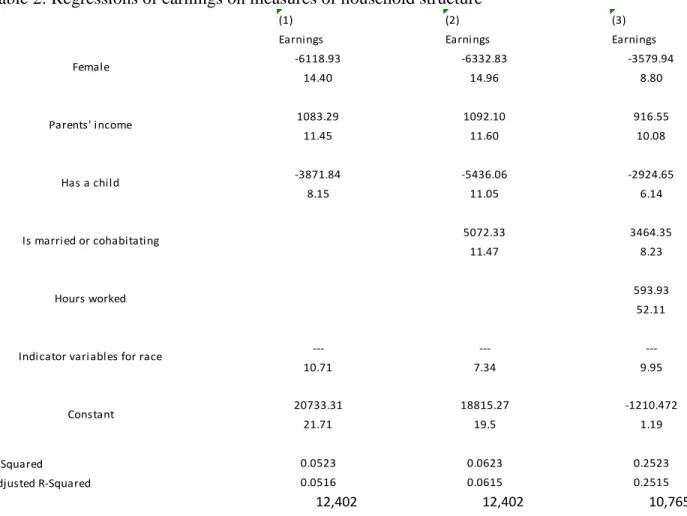
Regression With Measures of Household Structure
preference for household work, due either to societal pressure or a genuine desire to focus on their households. Table 2 tests a few measures of household structure to see if they work as mediating variables between gender and earnings.
Column 1 of Table 2 shows a regression of the variables for female, parents’ income, and race on earnings, but with the added mediating variable of having a child. As expected, the coefficient of having a child is negative, meaning that individuals with children earn less money. The gender earnings gap, however, remains rather large at 6,118 dollars, and it is strongly significantly different from zero. The r-squared value, however, is rather low at 0.05. Similarly to the regressions in Table 1, the first column of Table 2 does not provide a model that very adequately explains the variation in income for individuals.
Column 2 of Table 2 shows the same regression in column 1, but with an indicator variable for whether or not the individual is either married or cohabitating with a partner. The coefficient on the variable for married or cohabitating is positive and strongly significant, with a t-statistic of 11.47. The coefficient on having a child, meanwhile, has gotten more negative, perhaps because the extra time and energy needed to raise a child when not in a marriage or cohabitation relationship removes some energy that the individual could be spending in the labor market. The coefficient on gender moves slightly away from 0, being measured at 6,332, and still strongly significantly different from zero.
Column 3 of Table 2 represents a major explanation for why the gender earnings gap exists. It is the same regression from column 2, but with a variable for hours worked per week added. The coefficient on hours worked suggests that every additional hour per week in the labor market produces an extra 600 dollars for the individual annually. Not only is the practical
value of column 3 is 0.2523. This is much larger than any regression in Table 1 as well as the other regression in Table 2. This suggests that a key component of explaining the gender
earnings gap is in hours worked—women generally spend fewer hours in the labor market for the sake of spending more hours in the household, and this seems to be an important component of explaining why the gender wage gap exists. The r-squared value of column 3 of Table 2, coupled with the extremely large t-statistic on hours worked per week, bolster the hypothesis that family structure, not premarket human capital, is the primary explanation of the gender earnings gap.
Regression With Mediators For Premarket Human Capital and Household Structure
Two explanations for the gender earnings gap have been tested separately. One posits that premarket human capital mediates the relationship between gender and earnings, while the other posits that household structure mediates the relationship between gender and earnings. Of course, it is possible that both factors mediate the relationship between gender and earnings, which would mean that both play some part in explaining the gender earnings gap. Because this is possible, a third regression of earnings is run on both measures of premarket human capital as well as measures of household structure.
CHAPTER 5: CONCLUSIONS
Validity of Hypotheses
This research seems to support the hypothesis that household structure, rather than premarket human capital, is the most important cause of the gender earnings gap. Specifically, out of the variables tested in my various regression models, the one that explained the largest proportion of the gender earnings gap was the variable measuring hours worked per week. The baseline difference in earnings between men and women was about 6,700 dollars, and it appears that this variable alone can explain about half of that difference. In other words, a significant portion of what appears to be a gender earnings gap is actually related to differences in how men and women allocate their time, with women generally working fewer hours than men. It is also the case that people who are married or cohabitating generally earn more money than those who are not in one of those arrangements. This is possibly reflective of the gains arising from division of labor, given that a couple living together has less household work per person than two people living apart. It may also be the case, as has been suggested in other literature, that men and women are rewarded differently by the labor market for marriage—specifically, that women are penalized for marriage while men are rewarded for it.
Compared to the rather large amount of the gender earnings gap that can be attributed to factors of household structure, the measures of premarket human capital explain relatively little of the gender earnings gap. Educational attainment and math test scores remain statistically significant throughout all regression in which they are included, but the change in the coefficient of the female indicator variable in the regressions as these variables are added to the regression is much smaller than the change observed before and after hours worked is included in the
mediated by premarket human capital factors, but that it is not accurate to characterize the gender earnings gap as predominantly related to premarket human capital differences between men and women.
Limitations of the Present Study
Some important limitations exist with the research conducted here. First, and perhaps most important, I used only publicly-available data. The school-level identifiers, such as which schools each student attended and which teachers each student had, were restricted and not pubic. This limitation excludes many potentially desirable statistical procedures, such as using a school fixed-effect to look only at variation among students at the same school, performing a test to determine if certain schools produce wider workers who gender earnings gaps than other schools, or simply controlling for the school that a student attended in an OLS regression model, all of which would have allowed me to more accurately measure premarket human capital. In general, this could mean the omission of relevant variables from the regression model, which would complicate the validity and interpretation of the results.
individual’s parents, this is less convincing than if there were richer sets of data on income for
the individuals.
Another limitation of the present study was that, because of its broad scope and
nationally-representative sample, it is hard to draw conclusions about regional trends, which may help to explain the phenomena observed in this study. A study as broad as this one sacrifices some of the clarity that comes with having a more specific focus on a particular region, or a particular sector of the labor market. It may well be that the gender earnings gap I observe in this study has different causes in various industries, which a study like this is not designed to
discover.
Implications of Findings
The major implication of this research is that the fundamental roots of the gender earnings gap lie not in the school system, or in any other aspect of education. Rather, the differences in how men and women are expected to allocate their time forms the major division between the earnings of people of different genders. One interesting extension of this idea is the question of why women who are unmarried and do not have children continue to earn less than men, despite lacking the family characteristics which the labor market appears to disfavor. One possible explanation is that even unmarried women without children are socialized to value their time away from work more than their time in the labor market. Another possible explanation is that the labor market devalues the work of women because of the expectation that single, childless women will one day see their time in the labor market wane to focus more on
sense, but also in a social sense. More research is necessarily to determine the answers to such complex questions.
The finding that premarket human capital is relatively insignificant as a cause of the gender earnings gap has ramifications for researchers in a variety of fields. Encouragingly, the system of education as it stands today does not appear to produce the discrepancies in earnings between men and women. Indeed, the overall success of women in all levels of education, including higher education, fits the narrative that the true drivers of gender-based inequality— namely, variables related to family structure—only take effect after individuals have gone through the education system.
Policy Recommendations
In the legal system, there are already many safeguards against gender-based
discrimination in the workforce. For instance, it is illegal to pay men and women differently based solely on their gender for doing the exact same work. However, it is apparent that there are still elements of gender-based inequality in the labor market, both before and after controlling for explanations of why this might be the case. This is significant to policymakers because it means that the labor market, which forms a vital part of the economy, may contain some fundamental inequities.
economy, which means that they have less money to spend in the economy than they otherwise would. In general, this leads to worse macroeconomic outcomes.
Given that the most pressing inequality appears to lie in family structure, there are certain policy proposals that may help foster a more equal labor market, which would address a
significant portion of the gender earnings gap. One such policy is a mandated paid family leave policy, which the United States is unique among developed nations for not offering. Such a policy may help to destigmatize household work, encourage men to share more of the burden of household work, and give women more security to pursue their preferences if they prefer to specialize in household work. Another policy that would address inequality in household structure would be government-provided childcare services. If the government were to offer childcare services, fewer women would be forced to choose between household work and labor market work, and the deficiency in working hours that women face compared to men may begin to diminish.
Direction of Future Research
There are several areas of interest for future research. One such area of research is determining to what extent women genuinely prefer to spend fewer hours in the labor market compared to men, and to what extent such choices are the result of societal pressure. Research of such complicated and difficult questions may not be easy, but the gender earnings gap that I observe in my research may not be a problem, necessarily, if it is the result of free and willing choices made by women.
earnings gap as much as possible. If such programs seem to be effective at reducing inequality in the labor market between men and women, then policymakers will have more information on which to base their decisions. If such programs are not effective, then further research on programs to lower inequality in division of labor in a household is necessary.
APPENDIX
Descriptive Statistics
Variable Number of observations Mean Standard Deviation Minimum Maximum
Female 15370 0.502 0.5 0 1
Attainment 13250 4.461 1.9489 1 10
Math test score 15892 50.71 9.91 19.38 86.68
Reading test score 15892 50.52 9.88 22.57 78.76
Hours worked 11390 34.82 18.03 0 90
Has a child 13111 0.31 0.462 0 1
Regression Tables
Table 1: OLS regressions of earnings on measures of premarket human capital
(1) (2) (3) (4) (5)
Earnings Earnings Earnings Earnings Earnings
-6559.96 -7533.41 -6940.02 -6473.78 -21132.13
15.63 18.08 16.44 14.32 8.75
-8075.013 -6270.24 -5325.78 -6451.62 -6565.85
3.43 2.70 2.30 2.70 2.76
23.42132 -1237.53 -1648.06 -1194.72 -1182.31
0.03 1.68 2.23 1.55 1.54
-4739.97 -3811.72 -2331.50 -2451.66 -2356.28
7.07 5.75 3.44 3.47 3.34
-3806.91 -2380.99 -1399.64 -687.46 -550.16
4.29 2.71 1.59 0.74 0.60
-3559.856 -2571.74 -1446.81 -1287.07 -1233.57
4.30 3.15 1.76 1.50 1.44
-2001.349 -1214.04 -828.75 -577.21 -512.21
2.00 1.23 0.84 0.57 0.51
1226.289 734.95 559.17 554.15 541.12
13.27 7.78 5.80 5.55 5.42
2205.64 1763.76 1380.04 1356.94
19.42 14.34 9.95 9.79
294.46 264.06 231.39
8.80 7.55 4.47
-59.59 -11.39 -97.57
-1.84 0.34 2.07
--- ---15.13 15.70 109.10 1.67 175.86 2.68
19702.05 14639.84 5516.664 6070.135 13302.08
20.21 14.71 3.84 3.79 6.71
R-Squared 0.0469 0.0748 0.0826 0.114 0.117
Adjusted R-Squared 0.0463 0.0742 0.0818 0.1113 0.1141
N 12529 12529 12,529 11,486 11,486
Female*reading test score
Constant Parents' income
Attainment
Math test score
Reading test score
College major indicator variables
Female*math test score Hispanic mixed Mixed non-hispanic Female American Indian Asian Black Non-Hispanic Hispanic
Table 2: Regressions of earnings on measures of household structure
(1) (2) (3)
Earnings Earnings Earnings
-6118.93 -6332.83 -3579.94
14.40 14.96 8.80
1083.29 1092.10 916.55
11.45 11.60 10.08
-3871.84 -5436.06 -2924.65
8.15 11.05 6.14
5072.33 3464.35
11.47 8.23
593.93 52.11
--- ---
---10.71 7.34 9.95
20733.31 18815.27 -1210.472
21.71 19.5 1.19
R-Squared 0.0523 0.0623 0.2523
Adjusted R-Squared 0.0516 0.0615 0.2515
N 12,402 12,402 10,765
Constant Female
Parents' income
Has a child
Is married or cohabitating
Hours worked
Indicator variables for race
Table 3: Regression of earnings on measures of premarket human capital and household structure (1) Earnings -11084.38 4.69 ----7.14 374.70 3.88 1450.25 10.94 182.25 3.98 -33.55 1.54 42.52 0.68 96.43 1.54 ---10.72 393.0231 0.76 2871.784 6.72 580.9804 49.36 -10659.17 -5.29 R-Squared 0.2992
Adjusted R-Squared 0.2963
N 10,011
Constant Female*math test score
Female*reading test score
College major indicator variables
Has a child
Is married or cohabitating
Hours worked Reading test score
Female
Race indicator variables
Parents' income
Attainment
Math test score
REFERENCES
Besen-Cassino, Y. (2008). The Cost of Being a Girl: Gender Earning Differentials in the Early Labor Markets. NWSA Journal,20(1), 146-160. Retrieved from
http://www.jstor.org/stable/40071256
Blau, F., & Kahn, L. (2016). The Gender Wage Gap: Extent, Trends, and Explanations. Journal of Economic Literature. 55. 789-865. 10.1257/jel.20160995.
Brooks, C. I. (1987). Superiority of women in statistics achievement. Teaching of Psychology, 14(1), 45-45.
Buck, J. L. (1987). More on superiority of women in statistics achievement: A reply to Brooks. Teaching of Psychology, 14(1), 45-46.
Downey, D., & Anastasia S. Vogt Yuan. (2005). Sex Differences in School Performance during High School: Puzzling Patterns and Possible Explanations. The Sociological
Quarterly, 46(2), 299-321. Retrieved from http://www.jstor.org/stable/4120992
Echevarria, C., & Merlo, A. (1999). Gender Differences in Education in a Dynamic Household Bargaining Model. International Economic Review, 40(2), 265-286. Retrieved from http://www.jstor.org/stable/2648805
Erickson, R. (2005). Why Emotion Work Matters: Sex, Gender, and the Division of Household Labor. Journal of Marriage and Family, 67(2), 337-351. Retrieved from
http://www.jstor.org/stable/3600273
Fortin, N. (2008). Gender role attitudes and women’s labor market participation: Opting-out and
Juhn, C., & McCue, K. (2017). Specialization Then and Now: Marriage, Children, and the Gender Earnings Gap across Cohorts. The Journal of Economic Perspectives, 31(1), 183-204. Retrieved from http://www.jstor.org/stable/44133956
Marini, M., & Fan, P. (1997). The Gender Gap in Earnings at Career Entry. American Sociological Review, 62(4), 588-604. Retrieved from
http://www.jstor.org/stable/2657428
McCornack, R., & McLeod, M. (1988). Gender Bias in the Prediction of College Course Performance. Journal of Educational Measurement, 25(4), 321-331. Retrieved from http://www.jstor.org/stable/1434964
Michelmore, K. & Sassler, S. (2016). Explaining the Gender Wage Gap in STEM: Does Field Sex Composition Matter? RSF: The Russell Sage Foundation Journal of the Social Sciences, 2(4), 194-215. doi:10.7758/rsf.2016.2.4.07
Schram, C. (1996). A Meta-Analysis of Gender Differences in Applied Statistics