Exploring Nurse-Perceived Challenges and Rewards of Caring for Long-Term Ventilated Patients in an Intensive Care Unit
By
Morgan Elizabeth Barnes
Senior Honors Thesis School of Nursing
University of North Carolina at Chapel Hill April 3, 2018
Approved:
Abstract
Progress in modern medicine has enabled critically ill patients, such as those in acute respiratory distress, a chance to survive through mechanical ventilation. There is a growing population of patients who receive mechanical ventilation for extended periods of time – at least 21 days for at least six hours per day. While there is literature examining patient perception of ventilation in the critical care unit, there is a gap in the literature regarding the nurse experience of caring for this population in critical care units. The purpose of this descriptive, pilot study was to explore the nurse-perceived challenges and rewards of caring for long-term ventilated patients in a critical care unit and to identify strategies for addressing challenges in the context of a job satisfaction framework. Three nurses from a regional hospital critical care unit participated in
semi-structured interviews to yield detailed accounts of their experiences. Challenges identified stemmed from patient attributes and caregiving, with a major theme of trust. Strategies for addressing challenges uncovered team approaches that emphasized the importance of
collaboration and personal strategies related to introspection. Overcoming challenges was seen as a reward, along with praise and recognition. Recognizing challenges, finding ways to control challenges, and enhancing reward leads to job satisfaction. Therefore, awareness of these aspects has the potential to promote job satisfaction, energy, and connectedness.
Exploring Nurse-Perceived Challenges and Rewards of Caring for Long-Term Ventilated Patients in an Intensive Care Unit
Advances in the treatment of critical illnesses have enabled patients to survive conditions that previously were a death sentence. These advances have contributed to a large number of patients requiring prolonged mechanical ventilation. Mechanical ventilation is a technique
through which an external device, which is connected directly to a patient, moves gas toward and from the patient’s lungs (Muñoz Bonet, 2003). While most patients require short periods of mechanical ventilator support, a minority of mechanically ventilated patients depend on prolonged mechanical ventilation, which usually requires admittance to a critical care floor (Nelson, Cox, Hope, & Carson, 2010). Long-term, or prolonged, mechanical ventilation has been defined as greater than or equal to 21 days with six or more hours of mechanical ventilation each day (MacIntyre et al., 2005).
Riker (2011), and prolonged mechanical ventilator support is one reason for extended critical care stays.
While there are studies that explore patient perception of experiences in the critical care setting, very few, if any studies, seek to understand the nurse perception of challenges and rewards of caring for patients who are on long-term ventilator support. Literature regarding the nurse management of ventilator weaning highlights the importance of team collaboration and the critical care nurse's role in this process (Cederwall, Plos, Rose, Dübek, & Ringdal, 2014).
Additionally, while there are studies exploring nurse experiences with non-sedated, critically ill, ventilated patients (Laerkner, Egerod, & Hansen, 2015), there is a gap in the literature specific to nurse perceptions of caring for long-term ventilated patients in the critical care setting. A study exploring healthcare team members' experiences with conscious, ventilated patients found that staff experienced challenges with communication and trusting relationships (Karlsson & Bergbom, 2015).
for the patient initially, many nurses withdrew from this group. The critical care nurses who withdrew from the primary group of nurses perceived the care of this long-term, non-acute, ventilated patient as stressful, and authors hypothesized that this could relate to ‘task identity’ or assumptions around the kind of work critical care nurses should or should not be doing, such as long-term, non-acute care (Wetzig et al., 2009).
Purpose
This descriptive pilot study seeks to explore nurse perception of caring for long-term ventilated patients in a critical care setting. The aims of this study are to identify the challenges and rewards that nurses experience while caring for long-term ventilated patients. Additionally, how nurses address challenges of caring for long-term ventilated patients will be explored. Gaining an increased understanding of this nursing experience has the potential to reveal factors related to job satisfaction and coping strategies of nurses in the ICU environment as well as ultimately improve patient care outcomes.
Methods Framework
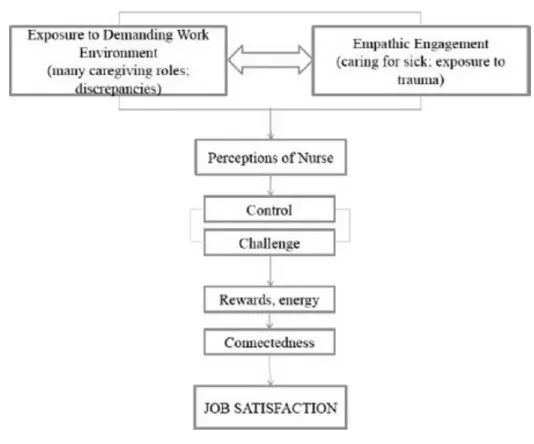
control over challenges in the workplace and further recognize accomplishments as rewarding. The rewards create energy for one’s job, and awareness or acknowledgment of the rewards contributes to feelings of connectedness and ultimately job satisfaction (Morrison & Korol, 2014).
Figure 1. Job satisfaction model (Morrison & Korol, 2014) Design
semi-structured interviews were conducted face-to-face and recorded on a digital recording device. This design allowed for detailed descriptions of nurses’ experiences.
Participants
Participants were recruited for a convenient sample from a single critical care unit at a regional hospital in North Carolina. A single critical care unit was adequate for this pilot study. Registered nurses (RNs) from this unit were recruited via a unit email listerv. An email was sent out to all RNs and included a brief description of the study and inclusion criteria: a minimum age of 18 years old, a current registered nurse license in the state of North Carolina, employment in the critical care unit for at least a year, proficient English language skills, and a work schedule of at least part-time, which is defined as two twelve-hour shifts per week.
Data Collection
Following university IRB approval, the Nursing Research Council at the hospital approved the study, as did the critical care unit manager. The author then sent a recruitment email to all of the critical care unit’s registered nurses. Registered nurses emailed the author with intent to participate and availability, and the author provided consent forms via email for
Data Analysis
The principal investigator of this study transcribed the interviews from the digital voice recorder verbatim. The transcriptions were checked against the recordings to confirm accuracy and to assess the tones of the nurses’ responses. The faculty advisor reviewed the transcriptions. Development of themes was completed based on a technique described by Vaismoradi, Jones, Turunen, and Snelgrove (2016), which includes the following four phases: initialization, construction, rectification, and finalization. In the initialization phase, transcriptions were read, recurring items of interest were highlighted, data was coded, abstractions were developed, and reflective notes were written. Next, the construction phase consisted of classifying codes, comparing, labeling, defining, and describing. The rectification phase involved immersion and distancing, relating themes to established knowledge, and stabilizing. Lastly, in the finalization phase, the principal investigator developed a story line to give a holistic view on the study phenomenon (Vaismoradi et al., 2016). The faculty advisor assisted with this analysis process.
Results
Three nurses (Nurses A, B and C) from a critical care unit in a regional hospital were interviewed face-to-face, outside of work. Registered nursing experience of participants ranged from nine years to 23 years, and critical care experience ranged from one year to 18 years. The interviews lasted from 22 minutes to 42 minutes.
Empathic Engagement
The Morrison and Korol (2014) job satisfaction model suggests that empathic engagement intertwines with the demanding work environment to influence the nurse’s
extended stay in a critical care unit while going through prolonged mechanical ventilation. The nurses, however, reported separating home and work life, therefore not allowing strong
empathetic feelings to interfere with daily life outside of work. All nurses admitted giving long-term ventilated patients privileges or extra time because of the patients’ difficult situations. One nurse described spending midnight with a long-term ventilated patient instead of with coworkers on New Year’s Eve, when the nurse knew the patient would be lonely spending yet another holiday in the hospital without family. Examples of privileges included food from outside of the hospital or highly orchestrated trips off of the unit. Additionally, nurses reported bonding with family members of long-term ventilated patients due to the patients’ extended stay in the critical care unit. Nurses also reported feeling close to patients as if they were part of a work family because of the extended stay and thus increased opportunities for relationship development. Table 1
Empathic Engagement Quotes
Nurse A “[Y]ou’re constantly reminded, when you’re there with them taking care of them, they really don’t have anybody else at that moment when you’re taking care of them, and you have to take care of them like it’s your own family member.”
“I always bring something to the patient from home that … they would like, just to change the monotony of the same food all the time. [I’d] say, ‘Hey, listen, I’m going to go to McDonald’s tomorrow morning, do you want some pancakes?’ and you bring them pancakes – of course, if they’re allowed to eat it.”
Nurse B “You start looking at the rooms and you realize that these are some small rooms that they’re confined to, and you just try to figure out ways to make it better.”
“With one patient, I was able to progress to taking him off the unit and getting him outside, and you see the outdoors – something we take for granted – like the sun, and sitting out in the hot sun … that was a huge thing in his day … and we when we went outside, we would strip away the gowns and try to limit the gloves and everything, but just get him an opportunity to be a human and to just – like, we weren’t in the
hospital room anymore, we were outside.”
Nurse C “[I]n a way, whether you try to or don’t try to, you essentially kind of adopt them as part of a work family that you have.”
that they’re at least hanging out with coworkers and not a patient at the drop of midnight, and this year I did it very differently.”
Challenges
One of the key elements in the Morrison and Korol (2014) model is the identification of challenges as perceived by the nurse. Nurses in this study identified many challenges, stemming from caregiving or patient attributes.
Caregiving challenges. A caregiving challenge nurses experienced was gaining trust from long-term ventilated patients. Nurses mentioned how long-term ventilated patients
developed preferences for nurse caregivers, thus when other nurses cared for them, gaining trust with new nurses was difficult. Nurses also reported experiencing challenges of burnout and feeling heavily relied upon by the patient after gaining trust and caring for the patient repeatedly. One nurse explained how a long-term ventilated patient wanted to know the nurse’s work
schedule and would seem to “cling” to that nurse. While settling into a routine was seen as something that made nursing practice easy, finding the right routine initially and making sure to avoid complacency in care were seen as challenges for nurses. The nurse participants placed great emphasis on the challenge of witnessing the decline of long-term ventilated patients or seeing them not make progress. Nurses reported feeling as if they had a purpose to heal, and when long-term ventilated patients became deconditioned or did not progress under their care in the critical care unit, the nurses felt frustrated.
Table 2
Caregiving Challenges Quotes
Nurse A “[I]t’s kind of sometimes hard if they’ve been on the unit and they’ve been long-term somewhere else, for example, or they’ve been on your unit for a long time, they build trust with certain nurses.”
a lot of times in these patients, there’s not a lot that changes. So, picking up those little things that change can be more difficult than someone who you’re treating [that] is a more critical care patient that you’re observing really meticulously.” “You can get burned out. For as much as I enjoyed working with one of the patients that was a long-term patient, there comes a time when you come to work and you don’t want to come to work and see every day that your name is paired up with that patient.”
Nurse C “It can be very discouraging to see them not make progress.”
“She would still try and get things out of me, and she always wanted to know when I was working and wasn’t working and she definitely seemed to cling to me for certain things.”
“All of them at some point or another, you get frustrated with. Whether it’s you get frustrated with the actual patient, whether you get frustrated with their family, whether you get frustrated with yourself, but you get frustrated with something with them one way or another because in the end, and the deep down in all of our nurses’ hearts is that if we’re not able to get someone better … then it can be very
frustrating.”
Patient attributes. Nurse participants reported that patient anxiety was a challenge in long-term ventilated patients. Additionally, communication was a major theme in responses relating to challenges of caring for this patient population. Other patient attribute challenges identified include comorbidities, labeled patient behaviors, perceived lack of patient motivation, and perceived patient neediness. One nurse mentioned how, in their view, some long-term ventilated patients would forget the nurse had other patients, which increased the nurse’s perception of patient neediness.
Table 3
Patient Attribute Challenges Quotes
Nurse A “You have a lot of comorbidities, so it’s a challenge when there are multiple things with the patient.”
“Well, they tend to – [when] they’ve been ventilated for so long – they become needy… they forget you’re taking care of other people.”
“[I]f there’s no communication with those patients, then it’s very hard to take care of them. It’s a trust thing.”
Nurse B “If they have bad behaviors, then those bad behaviors get sort of labeled and then passed down amongst the nursing staff, which isn’t a really good thing.”
Nurse C “A lot of these patients, because a machine is breathing for them or a machine is assisting breathing for them, then they have a lot of anxiety about that. So, that in itself can be a challenge.”
“They can really test your feelings. Sometimes you can get very frustrated with them because – just the reasons that they’re here. Not all of them, but some of them will give up.”
Strategies to Address Challenges
According to the Morrison and Korol (2014) model, having control over challenges leads to increased reward and job satisfaction. The nurse participants identified a variety of strategies that helped them address perceived challenges of caring for long-term ventilated patients, including team strategies and personal strategies.
Team strategies. The nurses interviewed found that collaborating with the care team and the patient were strategies that helped solve issues and ease patient frustration. Nurses
emphasized the importance of giving long-term ventilated patients choices in their care. Further, making an effort to stay consistent to a plan across all nursing staff was a strategy that helped nurses develop routines with long-term ventilated patients. Eliminating patient labels with coworkers was also seen as a strategy to address challenges of labeled patient behaviors and perceived patient neediness. Working with staff to change monotony of the patient’s stay in the critical care unit was seen as a strategy to improve patient experience and mood and thus improve nurse experience with the patient.
Table 4
Team Strategies Quotes
Nurse A “And you get a total plan of care for the patient that worked, and you know the other nurses on yours days off would do the same thing and it worked for them … just simple stuff like that, communicating with your coworkers.”
“You have to give them some kind of – some kind of choice.”
these patients a little differently that were once, you know, labeled as a ‘problem child,’ per se. I hate to say that, but in that situation, we had a new nurse come in and he single-handedly changed the perception of the nursing unit and the patient, and that patient ultimately ended up leaving here. And I think that had that nurse not come in here and changed some of those perceptions, that – I don’t know if that would have been the same outcome.”
“I still try to treat all patients how I would want to be treated. And if I see that they’re getting labeled a certain way, I still try to find the best in the patient and then sort of try to correct some of the misnomers or ways that people are talking about the patient to try to point out a positive or to point something different about why that patient might be acting out the way they are.”
Nurse C “[S]ome of our staff and leadership team have gone in to get patients birthday presents and Christmas gifts or Halloween decorations or Christmas decorations.” “I made a lot of steps, talked with leadership here, talked with physicians here, spoke with a lot of nurses, and came up with guidelines to get him off of the [telemetry] leads.”
Personal strategies. Nurses identified taking breaks from long-term ventilated patients as a strategy to prevent burnout. In these cases, nurses would ask to not be assigned to the long-term ventilated patient(s) to which they had been routinely assigned. Nurses also identified the need for personal growth in the areas of patience and communication. When set in a routine, nurses emphasized holding oneself accountable to avoid complacency in care. Additionally, the nurses interviewed identified introspection as a strategy to reflect on one’s practice and job satisfaction.
Table 5
Personal Strategies Quotes
Nurse A “You’ve got to have a little more patience.”
“You have to be patient with them to have some kind of communication with them.” “You just have to learn how to communicate better with them.”
Nurse B “[Y]ou sometimes have to hold yourself a little bit more accountable with checks and balances.”
“If you’re getting burnout over taking care of those populations, then you probably need to re-examine yourself, if you’re in the right spot to be taking care of those patients.”
know, I’ve had them the last three weeks straight or the last nine out of ten of my shifts … I just need a one or two shift break from them.’”
“You have to think that the rewards outweigh the challenges. You have to think of, you know, getting them out of here and getting them off of the ventilator.”
Rewards
The Morrison and Korol (2014) model suggests that rewards lead to energy,
connectedness, and job satisfaction. The model also suggests that control over challenges is a reward in itself (Morrison and Korl, 2014). Nurses A, B, and C mentioned multiple perceived rewards of caring for long-term ventilated patients, including that overcoming challenges is rewarding. One nurse mentioned that that overcoming challenges is rewarding because “it makes sense of where [one was].” Witnessing progress in long-term ventilated patients was also seen as a reward. One nurse explained that ultimately weaning a patient off of the ventilator is the most rewarding aspect of caring for these patients, saying that if the patient comes of the ventilator, then it does not matter what the patient put the nurse through or what the patient put his or herself through in the end. Becoming close to the patient and family was also identified as rewarding. Additionally, receiving praise or recognition was identified as a perceived reward when caring for long-term ventilated patients.
Table 6
Rewards Quotes
Nurse A “[Y]our coworkers realize it – when you kind of spearhead something.”
“I think everybody likes to build things and see it built… see things done and have some kind of satisfaction, ‘I made that’ or ‘I made that person better.’”
Nurse B “Ultimately, it’s rewarding if you see some type of success in getting them from point ‘A’ to point ‘B.’ You know, you have patients who you’ve felt weren’t going to make any progress and then they – not only do they make progress, but they exceed your expectations.”
“[I]f you start seeing patients getting better, sometimes that negates a lot of the challenges that you see because it makes sense of where you were.”
the things we do in nursing these days because we get people in and out of the hospital pretty quickly, and we don’t see them through different aspects of their lives.”
Nurse C “[H]e turned into a rewarding challenge because we all kind of got into him doing more and maximizing his potential.”
“That is probably the most rewarding, to actually get them off the ventilator, and sometimes we know in the beginning that we’re not going to be able to do that, and sometimes, you know, that is our goal. Sometimes it can be a long, hard, and
challenging goal, but that’s definitely the most – to me – the most rewarding thing is to actually see them getting off of the ventilator.”
Job Satisfaction
All of the nurses interviewed conveyed that they were satisfied in their current job in a critical care unit that often has long-term ventilated patients. The Morrison and Korol (2014) model suggests that overcoming perceived challenges and recognizing rewards leads to job satisfaction. The nurses did not indicate that caring for long-term ventilated patients increased or decreased their job satisfaction in the critical care unit while maintaining that they were satisfied in their current jobs.
Table 7
Job Satisfaction Quotes
Nurse A “[I]t’s God’s work, and if you’re not religious, it’s just a calling. It’s … satisfying to give something back to humanity.”
“It’s rare to find somebody who likes to take care of those patients for a long time, but I have no issues with it. But I think that it’s satisfying, definitely satisfying.” Nurse B “They’re a part of what we can expect to see on our unit, and I don’t mind one way
or the other working with them. I enjoy working with them, but I also enjoy taking care of just patients in general.”
“Typically, I like to see some type of progress being made, and that makes – in general – my job as a nurse more enjoyable.”
Nurse C “I don’t think [caring for long-term ventilated patients] has changed my perspective of how I like my job.”
Discussion
Although this research is limited by a small sample size of nurses in one institution, this study provided insight on nurse experiences of caring for long-term ventilated patients in a critical care unit. The principal investigator investigated challenges and rewards of caring for long-term ventilated patients in the context of the Morrison and Korol (2014) job satisfaction model. Ultimately, nurses reported feeling satisfied in their jobs in a critical care unit that cares for long-term ventilated patients. Although the nurses did not indicate that caring for this population in the critical care unit affected their perceived job satisfaction, the nurses identified challenges, how they address challenges, and the rewards they experience while working with these patients, which contribute to job satisfaction.
Each nurse conveyed empathic engagement, as they communicated ways in which they recognized the patients’ difficult situations and went “above and beyond the call of duty” to make the patients’ stays in the unit better. Additionally, the reported close relationships at work between the nurses and the patients likely influenced the nurses’ perceptions of challenges of caring for this population.
routine and following the same routine repeatedly, lack of change with these patients created challenges of preventing complacency in care. In addition to the caregiving challenges related to trust, the challenges of feeling frustrated, discouraged, or sad when patients did not progress or declined in health can be associated with the nurses’ perceptions of their purpose to heal.
Patient attribute challenges of anxiety and communication difficulties are challenges that stem from ventilator dependence. Nurses mentioned anxiety as a major problem for long-term ventilated patients, as nurses suggested that depending on a machine for breathing and needing suction created anxiety in this population. Additionally, unless patients were temporarily off of the ventilator and had a special tracheostomy attachment, patients could not talk, creating issues with communicating and lip reading. Some comorbidities, such as decubitus ulcers and muscle wasting (deconditioning), were also challenges identified that can be associated with ventilator use and lessened mobility. Patient attitudes were sometimes seen as a challenge for nurses when bad patient behaviors were discussed and labeled among nurses, when patients seemed
unmotivated, and when patients seemed excessively needy.
collaborated to change monotony of the long stays for long-term ventilated patients by working together to decorate those patients’ rooms for holidays or to purchase birthday gifts.
Personal strategies to address challenges involved introspection of feelings, needs, and weaknesses. Nurses reported taking breaks from long-term ventilated patients in order to prevent burnout. Examining oneself to know when a break is needed and thus prevent burnout is
important, as job satisfaction has been found to be a predictor of burnout levels (Kalliath & Morris, 2002). Nurses emphasized the importance of growth in the areas of patience and communication, which requires introspection to recognize personal weakness. Additionally, holding oneself accountable to avoid complacency in care when following a routine repeatedly also requires self-examination and effort.
The rewards associated with caring for long-term ventilated patients identified were all intrinsic in nature. Nurses explained that witnessing patients improve, even if the improvement is small, can negate the challenges. Seeing progress in long-term ventilated patients was identified as the biggest reward of caring for these patients. This finding emphasizes the intrinsic
between praise and job satisfaction (Sveinsdóttir, Ragnarsdóttir, & Blöndal, 2016; Tourangeau & Cranley, 2006).
Implications for Future Practice
As job satisfaction is important for retention of nurses, promoting reward and using strategies to control challenges is a way to increase job satisfaction. When looking at nurses who care for long-term ventilated patients in critical care units, this study suggests multiple facets to consider for addressing challenges and increasing perceived reward. Recognition of challenges can help critical care units and nurses explore strategies for growth and improvement. The team and personal strategies identified in this study should be further explored to examine
effectiveness. While nurses do not always have control over the path of long-term ventilated patients’ recoveries, this study suggests that recognizing improvements in the complicated and extended hospital stays of these patients promotes intrinsic reward. Praising coworkers for accomplishments in helping long-term ventilated patients during their stay is also a way to increase reward and job satisfaction according to this study, and while this finding is supported in literature, more research is needed to expand this evidence.
Conflict of Interest
The Conflict of Interest program associated with the principal investigator’s university Institutional Review Board determined a conflict of interest arising from the principal
investigator’s employment at the study site. The conflict was allowed under management with certain considerations, including privatization of results until results became publicly available, confirmation of data interpretation through a second party, disclosure of employment to
References
Bittner, E. A. & Schmidt, U. H. (2012). The ventilator liberation process: Update on technique, timing, and termination of tracheostomy. Respiratory Care, 57(10), 1626-1634. doi: 10.4187/respcare.01914
Cederwall, C., Plos, K., Rose, L., Dübek, A., & Ringdal, M. (2014). Critical care nurses management of prolonged weaning: An interview study. British Association of Critical Care Nurses, 19, 236-242. doi: 10.1111/nicc.12092
Cheung, N. H. & Napolitano, L. M. (2014). Tracheostomy: Epidemiology, indications, timing, technique, and outcomes. Respiratory Care, 59(6), 895-919. doi: 10.4197/respcare.02971 Kalliath, T. & Morris, R. (2002). Job satisfaction among nurses: A predictor of burnout levels.
Journal of Nursing Administration, 32(12), 648-654. doi:
10.1097/00005110-200212000-00010
Karlsson, V. & Bergbom, I. (2015). ICU professionals' experiences of caring for conscious patients receiving MVT. Western Journal of Nursing Research, 37, 360-375. doi: 10.1177/0193945914523143
Laerkner, E., Egerod, I., & Hansen, H. P., (2015). Nurses' experiences of caring for critically ill, non-sedated, mechanically ventilated patients in the intensive care unit: A qualitative study. Intensive and Critical Care Nursing, 31, 196-204. doi: 10.1016/i.iccn.2015.01.005 MacIntryre, N. R., Epstein, S. K., Carson, S., Scheinhorn, D., Christoper, K., & Muldoon, S.
Morrison, K. B. & Korol, S. A. (2014). Nurses’ perceived and actual caregiving roles:
Identifying factors that can contribute to job satisfaction. Journal of Clinical Nursing, 23, 3468-3477. doi: 10.1111/jocn12597
Muñoz Bonet, J. I. (2003). [Definitions in mechanical ventilation]. Anales de pediatría, 59(1), 60-66. doi: 10.1016/S1695-4033(03)78150-8
Nelson, J. E., Cox, C. E., Hope, A. A., & Carson, S. S. (2010). Chronic critical illness. American Journal of Respiratory Critical Care Medicine, 182(4), 446-454. doi:
10.1164/rccm.201002-0210CI
Vaismoradi, M., Jones, J., Turunen, H., & Snelgrove, S. (2016). Theme development in qualitative content analysis and thematic analysis. Journal of Nursing Education and Practice, 6(5), 100-110. doi: 10.5430/jnep.v6n5p100
Wetzig, S. M., Walsh, C., Prescott, C., Kruger, P. S., Griffiths, D., Jennings, F., & Aitken, L. (2009). Having a permanent resident in intensive care: The rewards and
challenges. Australian Critical Care, 22(2), 83-92. doi: 10.1016/j.aucc.2009.02.003 Sveinsdóttir, H., Ragnarsdóttir, E. D., & Blöndal, K. (2016). Praise matters: The influence of
nurse unit managers’ praise on nurses’ practice, work environment and job satisfaction: A questionnaire study. Journal of Advanced Nursing, 72(3), 558-568. doi:
10.1111/jan.12849
Appendix A Interview Guide
Thank you for your participation in this interview. Once again, my name is Morgan Barnes, and this interview is part of my honors project, entitled “Exploring Nurse-Perceived Challenges and Rewards of Caring for Long-Term Ventilated Patients in a Critical Care Unit.” I will ask you open-ended questions that will allow you to elaborate on your experiences. In order to protect patient identities, do not use patient names. Refer to individuals as “the patient.” If you are ready to begin, I will ask the first question. In this interview I will be asking you about your experiences of caring for long-term ventilated patients in the critical care unit. Patients with long-term ventilator support are defined as patients that receive mechanical ventilation support for at least 21 days for at least six hours per day.
Questions
1. First, can you tell me the number of years you have been a registered nurse? 2. How many years have you worked in a critical care setting?
3. Can you describe your nursing experience of working with long-term ventilated patients in the CCU?
4. Do you find caring for this patient population different than caring for patients who are not on long-term ventilator support?
• If not, would you tell me about the ways in which they are similar?
• If yes, would you tell me the ways in which caring for this patient population is
different?
6. What are some of the challenges you experience (physical, psychological, emotional, in the workplace, at home, etc.) associated with caring for long-term ventilated patients in the critical care unit? Please explain.
7. What are ways in which you deal with these challenges?
8. What are the ways in which you find caring for long-term ventilated patients rewarding? 9. Do you think the rewards outweigh the challenges?
10. What are the ways in which caring for long-term ventilated patients affects your shift? 11. What are the ways in which caring for long-term ventilated patients affects how much
you like your job? Please explain.
Conclusion