PROGRAM AND EVALUATION PLAN:
BERTIE COUNTY ADOLESCENT PARENT PROGRAM - REDUCING REPEAT TEEN PREGNANCY
By
Latoya Cherry Patterson
A Master’s Paper submitted to the faculty of the University of North Carolina at Chapel Hill
in partial fulfillment of the requirements for the degree of Master of Public Health in
the Public Health Leadership Program
Chapel Hill
2011
_________________________________ Advisor:
_________________________________ Date
_________________________________ Second Reader:
ABSTRACT
Adolescent mothers are at an increased risk of repeat teen pregnancy and the negative
consequences that arise with these additional pregnancies. There is even more of a risk for these
mothers in rural areas. In an effort to reduce repeat teen pregnancy in a rural low income county
in North Carolina, the Bertie County Adolescent Parent Program (BCAPP) is proposed. This
school-based program will provide various interventions including weekly peer group meetings,
collaboration with the local health department to provide long acting reversible contraception, as
well as providing mentors. An analysis of similar existing secondary teen pregnancy prevention
programs and their evaluation strategies and findings helped strengthen the design for the Bertie
County Adolescent Parent Program. This paper will describe this analysis and provide a detailed
program and evaluation plan for the Bertie County Adolescent Parent Program with the hope that
TABLE OF CONTENTS
INTRODUCTION ... 1
SYSTEMATIC REVIEW ... 4
Introduction ... 4
Methods ... 4
Summary of Programs ... 5
Analysis ... 15
Conclusion ... 17
PROGRAM PLAN ... 19
Program Overview and Rationale ... 19
Program Context ... 21
Application of Program Theory ... 25
Goals and Objectives ... 28
Program Implementation ... 29
EVALUATION PLAN ... 32
Rationale for the Evaluation ... 32
Approach to the Evaluation ... 32
Evaluation Study Design ... 34
Evaluation Methods... 35
Evaluation Planning Table ... 36
Dissemination Plan ... 40
DISCUSSION ... 42
ACKNOWLEDGEMENTS ... 44
REFERENCES ... 45
APPENDIX ... 47
Table 1 – Summary of Studies with Similarities to the Bertie County Adolescent Parent Program ... 47
Figure 1 - Logic Model ... 48
1 INTRODUCTION
The Bertie County Adolescent Parent Program (BCAPP) is a program designed to
prevent repeat teen pregnancies among adolescent mothers in Bertie County, North Carolina.
This school based program held at Bertie County High School aims to accomplish this mission
by providing education, counseling and resources to decrease risky sexual behaviors and increase
use of long acting reversible contraception among these adolescent mothers. There are many
programs that have been developed throughout the country to address repeat teen pregnancy1;
however, there are few in rural areas. Rural areas tend to have less prevention programs that
target teenagers as well as limited resources leading to the lack of repeat teen pregnancy
prevention programs.2 As a result, repeat teen pregnancy rates tend to be higher in rural areas.2
Consequently, the Bertie County Adolescent Parent Program was uniquely developed to
addresses the issue of repeat teen pregnancy in a rural county.
The rationale behind the program plan for the Bertie County Adolescent Parent Program
is based on evidence that subsequent teen pregnancies leading to negative consequences for both
mothers and their children. The consequences include poorer educational, economical, health,
and developmental outcomes as compared to teen mothers of one child.3 Furthermore, it has
been well documented that adolescents who experience a repeat pregnancy are more likely to
leave school without graduating, to be unemployed, and to be welfare dependent.4 Currently,
nearly one-quarter of all teen mothers have a second birth before turning twenty1 and these rates
tend to be higher in southern states and rural areas3. Specifically, the rate of teen pregnancies in
Bertie County is ranked 8 out of the 100 counties in the state of North Carolina.5 Based on these
negative outcomes and the priority of preventing repeat teen pregnancy national, statewide, and
2
Interventions shown to effectively address the issue of repeat teen pregnancy include
promoting long acting reversible contraception, providing group sessions to address social norms
about teen pregnancy, establishing mentorship programs, and creating policies that insure
schools provide school-based childcare and that school nurses provide some form of prenatal
care.6 Some of these interventions are included in the main activities of the Bertie County Adolescent Parent Program and other activities specific to Bertie County are included as well.
Teen mothers will participate in weekly group sessions to address knowledge on the prevention
of a second pregnancy, the use of long acting reversible contraception, the importance of
completing high school, and the importance of having a support system as well as focusing on
improving parenting skills. In addition, teen mothers will be provided with long acting
reversible contraception at a reduced rate, transportation and childcare during and after sessions,
as well as mentors when possible. Also, with the goal of preventing/reducing repeat teen
pregnancy in Bertie County, this program will serve as a pilot program that can be used to create
other programs like it in rural counties of North Carolina and beyond.
This paper will give a more in depth view of the program plan and program evaluation
through various sections. Section one includes a systematic review of the literature for programs
with similar goals and components to the Bertie County Adolescent Parent Program which will
clarify effective strategies of programs targeting teen mothers. Section two is a more detailed
description of the program plan including goals and objectives, underlying theoretical constructs,
a logic model, and an implementation plan. Section three is an evaluation plan for the Bertie
County Adolescent Parent Program which addresses gathering data on how well the program is
3
Lastly, the discussion of the significance of the program and its future directions will conclude
4 SYSTEMATIC REVIEW
Introduction
The purpose of this literature review is to identify and analyze programs similar to the
Bertie County Adolescent Parent Program with the intention of using this information to improve
the effectiveness of the Bertie County Adolescent Parent Program. Similarity of the programs
will be determined by the number of matching elements between the program and the Bertie
County Adolescent Parent Program. These elements include: (a) target population is pregnant
teens and teen mothers; (b) main focus is on prevention of subsequent teen pregnancy; (c)
school-based; (d) focuses on provision and use of long acting reversible contraception; (e)
focuses on completion of high school; (f) weekly counseling/education sessions where child-care
and transportation are provided; and (g) mentoring from local volunteers. Once similar programs
are identified, based on these elements, their approach to implementation and evaluation will be
analyzed. In addition, the strengths and weaknesses of each study will be discussed. This
literature review will conclude with an analysis of how the results can be applied to the Bertie
County Adolescent Parent Program.
Methods
Research Question
This literature review was performed with the following research question: What can be
learned from programs similar to the Bertie County Adolescent Parent Program? In order to be
considered similar enough to the Bertie County Adolescent Parent Program to be useful,
programs were only included if they targeted pregnant teens and/or teen mothers and if the main
focus was to prevent subsequent teen pregnancies.
5
A PubMed online database search was undertaken to identify articles describing possible
programs. Search terms used were ("Pregnancy in Adolescence"[Mesh] OR "pregnancy in
adolescence") AND (repeat OR subsequent OR rapid*) AND (program evaluation OR
intervention studies). The search was limited to the English language. Additional methods to
identify additional articles included searching the reference lists of included papers and searching
the reference lists of relevant systematic reviews. Titles and abstracts of resulting articles were
reviewed to determine whether or not each article met the primary inclusion criterion. The
primary inclusion criterion were programs that shared elements with the Bertie County
Adolescent Parent Program with a priority on elements (a), (b), and (c) above. Programs were
excluded if the pregnant teens and/or teen mothers were not attending a regular public school and
if the majority of the program activities were held outside of the school. Three programs which
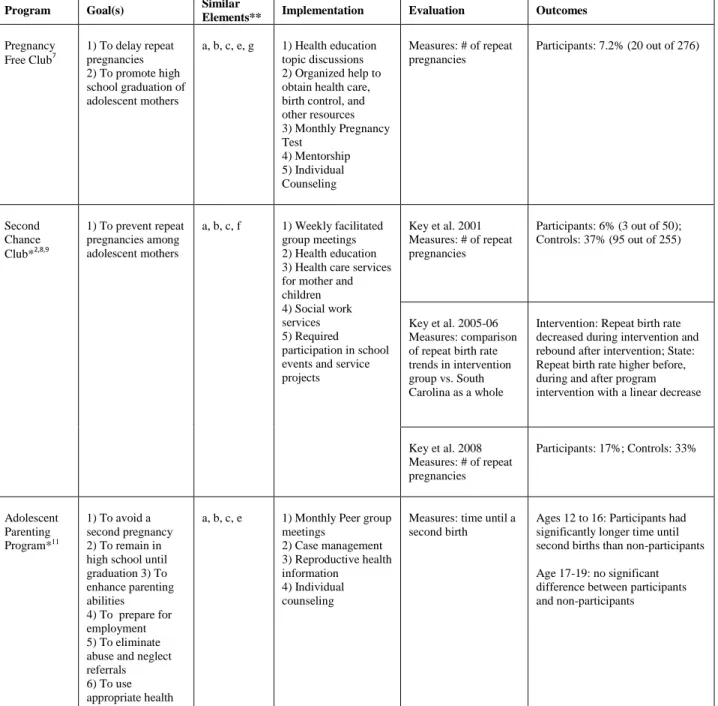
met this inclusion criterion are summarized and analyzed below (see also Table 1).
Summary of Programs
Pregnancy-Free Club
The Pregnancy-Free Club (PFC) is a program established by a public health agency in an
alternative school with similar goals and objectives to the Bertie County Adolescent Parent
Program.7 The goal of the Pregnancy-Free Club is to delay repeat pregnancies and promote high
school graduation of these adolescent mothers through various services coordinated by public
health nurses.7 All pregnant and parenting adolescents were invited to participate in the PFC
during the school year and were allowed to continue participating until they graduated or left
school. These teens were provided services monthly during the summer, seeing the public health
nurse at home or at school monthly. For an incentive, participants were given a $5 gift card each
6
The services provided to these adolescents include monthly pregnancy tests, counseling,
and interventions to help them obtain health care, birth control, and other resources.7 In addition, the public health nurses discussed health education topics with participants and provided them
with mentors for additional support. Public health nurses were allowed to be present during the
entire school day in case participants needed assistance at any time.
At each monthly pregnancy test, surveys are completed by the participants and
information is documented by the nurses to be used for program evaluation. The survey
contained questions about sexual activity, desire to be pregnant, consistency of birth control use,
reason for birth control use, what the adolescent would do if pregnant, substance use, and
number of children the adolescent would like to have over their lifetime and while they are in
high school.7 The documentation by the nurses included pregnancy test results, dates of last sexual contacts, number of sexual partners in the last 30 days, current birth control method(s),
and student history of violence, sexual abuse, homelessness, abandonment and having a
specialized education plan at school.7 Nurses also recorded nursing interventions and referrals. These methods were used to answer the main outcome evaluation question, does participating in
the PFC delay repeat pregnancy among adolescent mothers?
Additionally, process evaluation measures were collected in order to evaluate
participants’ satisfaction with their experience. The method for process evaluation included two
focus groups with adolescent participants. The focus groups were audiotaped, transcribed, and
analyzed for major themes of benefits and suggestions for improvement. Questions considered
in the focus groups were how the PFC was helpful, how nurses were helpful, what participants
did not like about the PFC, what they would like to see changed, and how the program helped
7
The evaluation showed that in the first year of the program (1998-1999) there were no
repeat pregnancies. Over a period of nine years, the rates of repeat pregnancies ranged from
1.9% to 10.3% with the overall rate being 7.2% (20 pregnancies among 276 participants).7 This
is noted to be well below the repeat pregnancy rate of 25% prior to the beginning of PFC.7
Focus group evaluation showed that participants thought monthly pregnancy test, survey
questions about pregnancy planning, the gift card incentive, daily nurse availability and open
nurse-participant relationships were helpful.7 The focus group identified areas of improvement include wanting more sensitivity from nurses when addressing positive pregnancy test, wanting
more assurance of confidentiality and wanting reminders about monthly pregnancy test so they
would not forget.7
The results of evaluation seem promising; however one weakness with the outcome
evaluation is the lack of comparison group data. Since there are typically a limited number of
pregnant and parenting teens in a specific area, it is hard to find pregnant and parenting teens not
participating in the program for comparison. The article was able to compare the rates of repeat
pregnancy before and after the program to give some sense of how effective the program was at
delaying repeat pregnancy. Despite this limitation with outcome evaluation, the process
evaluation was a strength of this program. Using focus groups to collect process evaluation data
was great for determining program satisfaction. More importantly, Schaffer et al. noted that
feedback from participants in the focus group was used to improve the program for subsequent
years.7
Strengths of the program components included monthly pregnancy test which added
objective accountability, incentives which increased participation, trusting relationships between
8
summer provided continuity. Overall the program and evaluation for the PFC was effective and
there are many things that can be learned from this program to improve the Bertie County
Adolescent Parent Program.
Second Chance Club
The Second Chance Club is another program similar to the Bertie County Adolescent
Parent Program with the same goal of preventing repeat pregnancies among adolescent mothers.
The Second Chance Club is a peer-education, school based program developed by researchers at
the University of South Carolina for an urban high school in Charleston, South Carolina.8
Initiated in August of 1994, all pregnant and parenting adolescents in this high school were asked
to participant in the program.8 Participants remained in the program until graduation, formal
withdrawal from school, or transfer to another school. Participants in the program were low
income African Americans ages 15-17.
The Second Chance Club consisted of several components: peer support provided by
project participants through weekly facilitated group meetings (held during lunch); health
education on issues concerning adolescence, parenting and careers, health care for both the
mothers and their children (including contraception) at a local clinic; social work services such
as individual case management, home visits, and counseling. Participant were also required to
participate in school events and service projects.8 The project coordinator was a social worker,
who was racially and culturally matched with the participants and who followed up with
participants even when they did not attend group meetings or school.8
The main source of evaluation described for the Second Chance Club consisted of an
outcome evaluation focused on determining if there was a reduced rate of repeat births among
9
matched controls from birth certificates and another using an ecological evaluation which
compared the repeat community birth rates before, during and after implementation of the
program.8, 9 In 2001, Key, Barbosa, and Owens described the study for the first preliminary
evaluation as a retrospective case-controlled cohort study.9 Controls were selected for the
participants randomly and anonymously from the South Carolina Birth Certificate Data Registry
matched by race, age at delivery, year of delivery, parity, Kessner Index of prenatal care, and
mother’s educational level.9
Controls were excluded if they were residents in the intervention
high school attendance zone. There were no significant differences in initial demographic
variables between control subjects and participants. The reappearance of a participant or control
subject’s name and social security number on a birth certificate in the South Carolina Birth
Certificate Data Registry between the years 1994 to 1997 was used to determine if a repeat birth
occurred.9
The results of this evaluation showed that only 6% (3 out of 50) of the participants had
repeat births compared to 37% (95 out of 255) of the control subjects who had repeat births.9
Each of the three participants who had a repeat birth had only one.9 Among the control subjects
29% had one repeat birth, 7% had two repeat births, and 1% had three repeat births.9 The number of multiple repeat births between the participants and control subjects was statistically
significant. Repeat births among active participants (participants attending 4 meetings or more)
and inactive participants was not statistically significant.9
The main limitation of this evaluation was selection bias. The authors noted that there
were no significant differences in the initial demographic variables between currently pregnant
control subjects and participants; however, 24% of the control subjects had inadequate prenatal
10
even though it was not statistically significant. The controls could have possible gotten less
prenatal care due to increased shame and reluctance to acknowledging their pregnancies due to
lack of support therefore putting them more at risk for a repeat pregnancy. This possible initial
difference in support could have affected the differences in repeat pregnancies among controls
and participants.10 This is just one example of how selection bias could have affected the results. One strength of the evaluation was the use of power analysis to determine the number of
participant and controls needed to detect a 50% reduction of the expected repeat adolescent birth
rate.9 These numbers were met which is important when the sample size is limited. Overall, the evaluation methodology of this study was objective and was an effective way to evaluate the
rates of repeat teen pregnancy.
The second preliminary evaluation of the Second Chance Club was described by Key et
al. in a 2005-2006 article.8 This ecological evaluation compared the rate of repeat births in the two zip codes served by the high school with the Second Chance Club with selected community
data from South Carolina as a whole. Repeat birth rates were calculated using data from the
South Carolina Birth Certificate Data Registry and the United States Census for 15-17 year old
African-American girls before (1990-1993), during (1994-1997) and after (1998-2001) the
program was implemented.8 The results of this evaluation showed that the repeat birth rate for
15-17 year old African American girls in the program catchment area decreased during the
intervention period with a rebound after the intervention period but to a lower rate than before
program implementation.8 This change in repeat birth rates was statistically significant. The
repeat birth rates in the state were higher than in the catchment area before, during, and after
11
The main limitation of this evaluation is that one cannot conclude that the outcome is
directly attributable to the program because all population data was used. For example, the
catchment area was not mutually exclusive; data collected in the catchment area was from
participants in the Second Chance Club. If pregnant or parenting adolescents did not attend high
school, they could not participate in the program. Other community influences have had positive
or negative impact on the role in the catchment area and the state which is not detectable in this
type of evaluation. The combined results from both preliminary evaluations have promising
results. A final more detailed evaluation was described by Key et al. in a 2008 article which also
showed lower rates of subsequent pregnancies in the Second Chance participants as compared to
non-participants.2 The methodology was similar to the initial preliminary study except it was
prospective instead of retrospective. As in the prior evaluations, the rate of subsequent births
was statistically significantly lower in participants (17%) than in the comparison group (33%).2
In order to address the issue of the catchment area not being mutually exclusive, intention to treat
analysis was used. The strengths and weakness of this analysis mirrors the first preliminary
evaluation. The results of these three evaluations indicate effectiveness of the intervention on
reduction of subsequent adolescent pregnancies. One possible confounder so all these results are
rates of abortion since birth certificates were used to determine the number of repeat teen
pregnancies. Birth certificates would not include numbers of repeat teen pregnancies that were
aborted. However, the combination of outcome evaluation methodologies is a major strength of
the Second Chance Club evaluation and their a few studies that consider abortion rates.
There was no described or evaluation protocol for process evaluation to determine
component effectiveness in the preliminary evaluations; however, it was described in the final
12
groups of participants, and interviews of parents and school personnel.2 The qualitative analysis
showed overall positive attitudes towards the program. Participants noted that being able to
learn and receive support from others in the program that already had children was beneficial,
while parents noted improved motivation to achieve and hopefulness in their daughters.2 School
personnel noted the educational benefit and the importance of the peer approach.2 It was not
stated in the article that this feedback was used to modify the program overtime. Some strengths
of the program overall include weekly peer group meetings, emphasis of community/school
involvement, and having a coordinator who is racially and culturally matched to the participants
in the program. As with the Pregnancy Free Club, many aspects of the Second Chance Club
could be incorporated in the Bertie County Adolescent Parent Program.
Adolescent Parenting Program
The Adolescent Parenting Program (APP) is another secondary pregnancy prevention
program for first-time pregnant or parenting teenagers in North Carolina that is managed by the
North Carolina Department of Health and Human Services.11 APP is located in 30 of the 100
counties in North Carolina; however Bertie County is not one of the participating counties.11 The
program is housed in many settings including public school systems. Each program is tailored to
fit the needs of its county, keeping in mind the program objectives which include avoiding a
second pregnancy during program participation, using appropriate health care services for
mother and child, remaining in high school or equivalent program until graduation, enhancing
parenting abilities, preparing for employment, and eliminating substantiated referrals of abuse
and neglect.11
To participate in the program, first-time pregnant or parenting adolescents must be age 18
13
coordinator is responsible for providing direct casework services to program participants, as well
as planning and managing the program. APP coordinators interact with their approximately
12-20 participants on average 3-4 times a month through a combination of individual contacts and
group meetings. Components of the program include: (a) case management to create
connections within the community to facilitate school continuation, access to health care and
parenting/employment education; (b) reproductive health information containing abstinence and
birth control resources to prevent a second pregnancy; (c) individual counseling; and (d) peer
group meetings.11
The outcome evaluation methods for APP are similar to the methodology used in the
preliminary evaluations of the Second Chance Club. A retrospective study using North Carolina
birth certificate records was used to compare APP participants (n = 1260) to adolescent mothers
not participating in APP (n = 1260).11 Teenage mothers not participating in the program were
randomly selected from birth records, matching the APP group on county and maternal age at
first birth. Even after matching, there were differences between the APP group and the non-APP
group. The differences were in race, marital status, and tobacco use during pregnancy; however
these factors were controlled through the use of statistical analysis.11 The outcomes examined
were prenatal care utilization, birthweight, gestational age and time until second birth. Since
time until second birth is a main focus of the Bertie County Adolescent Parent Program, those
results will be the focus of this analysis. Time until a second birth was measured as the number
of days between the births of the first and second child.
The results of this evaluation from time until second birth were similar to the other
programs; however, these results were different based on the age of the adolescent mother at the
14
was similar for both the APP group and the non-APP group.11 APP participants age 12 to 16 had
significantly longer time until second births as compared to the 12 to 16 year olds in the
non-APP group.11 For example, two years after their first births, 88% of the young mothers ages 12 to 16 in the APP group still did not have a second birth, compared to 85% of the 12 to 16 year olds
in the non-APP group mothers in this age group (p=0.006).11 On the contrary, in the age group
17 to 19 there was no significant difference between the APP participants and the non-APP
group.11 This lack of significant difference could be due to the fact that 17 to 19 year olds were
not in APP as long as the younger mothers to gain all the benefits of the program because
support after graduation from high school is withheld.
As with all the other evaluations, there were some limitations to this evaluation design.
First, it was a non-experimental design; therefore, causal interpretations require caution.
Secondly, as with the other programs, participation is voluntary. This causes some selection bias,
since the APP group is self-selected and adolescent mothers who choose to participate in APP
could be intrinsically different than other adolescent mothers. Statistical analysis was used to
reduce the selection bias but only a limited number of variables were considered.11 Due to the
use of birth certificates only this evaluation is possibly confounded by abortion rates like the
Second Chance Club evaluation.
Unlike the Second Chance Club, one weakness of this evaluation was the lack of
description of process evaluation for APP. It would be helpful to know the participants’
perspective on the implementation of the program and what was most beneficial. One major
strength of the program was how APP coordinators collaborated with other agencies to
coordinate, locate, and refer services to assist adolescent mothers with their needs, including
15
However, since not all Adolescent Parenting Programs are held at public schools further analysis
should be done to determine specific effectiveness of only the school based programs. Overall,
many things can be learned from this program.
Analysis
By examining these three programs and their evaluation strategies much can be learned to
improve the Bertie County Adolescent Parent Program.2, 7-9, 11 As far as program element similarities, all three programs targeted pregnant teens and teen mothers, focused on preventing
subsequent pregnancy, were school based and focused on completion of high school. Delivery
and use of contraception was addressed by all programs; however, none of the programs
specifically stated a focus on long acting reversible contraception use like the Bertie County
Adolescent Parent Program. The Second Chance Club, like the Bertie County Adolescent Parent
Program, has weekly group meetings with participants. The other programs had group meetings,
but they were only held once a month.8 Individual consulting was provided in all programs;
however, mentoring was only mentioned in the Pregnancy Free Club.7, 8, 11
Elements of the other programs that were shown to be beneficial and that could add the
effectiveness of the Bertie County Adolescent Parent Program include monthly pregnancy
testing, program participation incentives, using a racially and culturally matched program
coordinator and collaboration with other agencies. Monthly pregnancy testing could increase the
accountability of the participants in the program; however, since there are limited resources in
Bertie County it would need to be provided by the Bertie County Health Department instead of
being done at the school. Since Bertie County is a rural low income county in North Carolina,
many of the participants could benefit from a small monetary incentive to be used for their
children for participation in the program since many activities will be held afterschool. If
16
could be more effective. Bertie County Adolescent Parent Program participants may feel more
comfortable with a coordinator that is racially and culturally matched to them, like in the Second
Chance Club.2 The Bertie County Adolescent Parent Program is already collaborating with the
public school system and the health department; however, participants may need other services,
such as social work or employment services, that could be organized through the program. All
these elements will be considered in the final design for the Bertie County Adolescent Parent
Program based on the available resources.
As far as evaluation methodologies, some elements of effective process and outcome
evaluations could be useful in evaluating the Bertie County Adolescent Parent Program. The
Pregnancy Free Club and the Second Chance Club described effective process evaluation
techniques through the use of focus groups and interviews.2, 7 Using qualitative methods, these programs were able to use this feedback throughout the programs to make necessary adjustment
to further benefit the participants. In addition, gaining the opinions of parents could add to the
effectiveness of the program because Bertie County is a very close-knit county in which family
support is very important.12
There are limited outcome evaluation methods for secondary pregnancy prevention due
the nature of the programs and the limited number of adolescent mothers for comparison.
Several thorough analyses were done for the Second Chance Club. The use of a prospective
and/or a retrospective case-control cohort based on birth certificates is an objective way to track
individuals in the program and not in the program to get repeat pregnancy data. Since the
population of Bertie County is so small and rural, using birth certificates only from rural
countries matched for key demographics to collect repeat pregnancy data would be useful. In
17
from birth certificates. Yet, initially with limited resources, an evaluation without a comparison
group like the one for the Pregnancy Free Club may be less time consuming and more effective
for the Bertie County Adolescent Parent Program, which has limited staff. Over time the use of
cohort studies may be more reasonable. After the completion of the Bertie County Adolescent
Parent Program, an ecological evaluation would be useful to determine if the program was
effective and if this program design could be used in high schools in other rural counties. The
positive results from all three existing programs on delaying repeat teen pregnancy further
demonstrate that Bertie County Adolescent Parent Program could be as effective since many
elements are shared.
Conclusion
This literature review revealed three programs which share important elements with the
Bertie County Adolescent Parent Program, such as foci on preventing subsequent pregnancy, on
completion of high school, and the use of peer group meetings. The programs slightly varied in
program components, program objectives, and the methods used to evaluate them. In general,
there are several important lessons to take from this review. First, there appear to be benefits to
using incentives, administering pregnancy tests, collaborating with several agencies, and using a
program coordinator who is racially and culturally matched with the participants. Also, how
active a participant is in the program and the age at which participant start the program may alter
the effectiveness of the program for these individuals. This should be kept in mind when
applying evaluation results to the program. Finally, thorough evaluations are necessary to learn
from a program. Therefore, there needs to be thorough ongoing process and outcome evaluation,
possibly via various methodologies and various time frames. Applying some of these lessons to
18
address repeat teen pregnancy among pregnant and parenting teens in Bertie County, North
19 PROGRAM PLAN
Program Overview and Rationale
Even though teen pregnancy rates have been gradually declining in the United States
since 1990, teen pregnancy and repeat teen pregnancy continue to be a growing problem in North
Carolina, specifically among teens in Bertie County, a rural county in eastern North Carolina. In
an effort to reduce repeat teen pregnancy in the female adolescent population, I have created
Bertie County Adolescent Parent Program (BCAPP). The program is designed to reduce repeat
teen pregnancy among adolescentsin Bertie County who have already had one teen pregnancy,
by decreasing risky sexual behavior and increasing long acting reversible contraception use
through a school based program providing education, counseling and resources to these teen
mothers.
The program will be initiated in Bertie County High School, the only high school in the
county, to provide these services to teenage mothers. This will be a pilot program that can
possibly be implemented in other rural eastern North Carolina counties in the future. The overall
goal is to target current teen mothers, in order to prevent subsequent pregnancies in these
individuals.
Location: Bertie County, North Carolina
In 2005, the teen pregnancy rate in the United States was 69.5/1000 which is a record low
and down 41% since the peak in 1990 of 116.9/1000.13 In 2006, the teen pregnancy rate increased by 3%, the first time in more than a decade. Despite this slight increase in teen
pregnancy rate, the overall rate is still lower now than it has been in the past in the United
20
pregnancies--not their first teen pregnancy. Of all the teen pregnancy births in 2002,
approximately 89,000 (21%) were among teens who already had a child. Nearly one-quarter of
all teen mothers have a second birth before turning 20.1 Repeat teen pregnancy is a larger
problem in southern states and for African American teenagers.3 In addition, teens in rural areas
have an increased rate of repeat teenage pregnancies.3 Being rural, Bertie County, North Carolina
is a high risk location placing its teen mothers at an increased risk of repeat teen pregnancies.
Bertie County is located in northeastern NC with an estimated permanent population of
19,434 in 2010; however, unlike NC as a whole, its population has decreased over time.12 The population is predominately non-white minorities who comprised 63.7% of the populations in
2000, 62.3% were black. 100% of the population is considered to be in rural areas based on the
demographics of the county.12 The largest number of residents in Bertie County are between the
ages of 5-19 making up 22.3% of the population.12 The pregnancy rate for girls ages 15-17
between 2005 and 2009 was 48.0/1000 (n = 95) overall, with rates of 20.7/1000 (n = 12) in
whites and 59.3/1000 (n = 83) in all minorities.5 This is a significantly higher pregnancy rate for
girls ages 15-17 than the overall state rate of 33.6/1000.5 In fact, Bertie is ranked 8 out of 100 counties in NC for pregnancy rates for girls ages 15-17 between 2005-2009, only behind
Richmond, Scotland, Robeson, Hertford, Tyrrell, Edgecombe, and Lee Counties.5 There is
limited data on the number of births per year that are repeat adolescent pregnancies. However,
based on data showing that about 20% of these pregnancies were repeat pregnancies it is a
significant problem.
Targeted Risk Factors
The primary risk factors for repeat teen pregnancy are continued risky sexual behaviors
21
pregnancy among current adolescent mothers.6 Other risk factors include lower educational
achievement and a non-supportive family environment. It is important to address these risk
factors because data has shown that having one child as a teenager leads to negative implications
for both the mothers and their children, such as having poorer long term educational, economic,
health, and developmental outcomes.3 Having a second child compounds these problems which
lead to even more problems.3 Adolescents who experience a repeat pregnancy are more likely to
leave school without graduating, to be unemployed, and to be welfare dependent.4
To combat these risk factors and prevent repeat adolescent pregnancy, the CDC
publication of evidence-based practices for improving health, The Community Guide, suggests
comprehensive risk reduction programs and interventions associated with community service and
social, emotional, and cognitive competence training to reduce sexual risk behaviors.14 The
proposed school based program in Bertie County will be based on elements of these
evidence-based intervention models.
Program Context
As the Bertie County explored options for program design, the following contextual
factors were identified that could influence implementation of an effective repeat teen pregnancy
prevention intervention in Bertie County school.
National, State, and Local Priorities
Currently, there is a focus on rates of teen pregnancy and possible interventions at local,
state, and national levels, providing a timely context for the implementation of a repeat
22
Based on the Bertie County Community Health Assessment, the priority areas include
chronic disease management, child and maternal health, and fitness and wellness.12 Within the priority of child and maternal health, the focuses are HIV/STDs, low birth weight/very low birth
weight babies and infant mortality with lack of prenatal care, poor preconceptional health and
unprotected sex as key behaviors noted.12 Many of these issues are very salient in first time and
repeat teen pregnancy because many of these factors contribute to unwanted teen pregnancies
and the negative consequences of teen pregnancies.
In North Carolina, one of the 13 focus areas for the Healthy NC 2020 project is risky
sexual behavior.15 Within this focus area, sexually transmitted diseases and unintended
pregnancy are major objectives. One of the main proposed targets is to reduce the percent of all
pregnancies that are unintended. The current percentage of unintended pregnancies as of 2007 is
39.8%; the goal is to reduce it to 30.9% by 2020.16
Along these same lines, there has been a national emphasis on adolescent health
including teen pregnancy based on the national Healthy People 2020 campaign. One main
proposed objective is to increase the prevention and management of unintended pregnancies in
adolescents.17 The focus is on the role and responsibilities of primary care clinicians who treat
adolescents. The objective states that prevention strategies at the primary, secondary, and
tertiary levels should be integrated into adolescent-focused clinical settings in which primary
care clinicians provide care.17 Examples of these prevention strategies include contraception
counseling, dispensing and prescribing contraception and education regarding sexual health,
promoting positive health behaviors that improve pregnancy outcomes, and pregnancy options
counseling. Other objectives include increasing the number of adolescents who delay onset of
23
sexually active adolescents.17 The overall goal is to reduce unintended pregnancies in adolescent
girls.
Political Environment
Current, there is a highly supportive political environment for programs aimed to reduce
teen pregnancy. In September of 2010, the U.S. Department of Health and Human Services
announced that $155 million in teen pregnancy prevention grants were going to be awarded to
states, non-profit organizations, school districts, and universities.17 The grants are designed to
support the duplication of teen pregnancy prevention programs that have been shown to be
effective through research as well as the testing of new innovative approaches to combating teen
pregnancy. Teen pregnancy is considered a serious national problem that needs to be addressed
to promote health and success of young people throughout the country. Therefore, creating a
program designed to reduce repeat teen pregnancy during this political time is in line with
national goals. In addition, it is consistent with local, state, and national priorities described in
the goals within the Bertie County Health Assessment, Healthy NC 2020, and Health People
2020 as discussed above.
Acceptability to Recipients
Interventions within a rural community can be very difficult and expensive. However,
implementing the program within Bertie County High School allows us to reach adolescent
mothers at risk of repeat teen pregnancy. Since North Carolina law requires students to remain
in school until 16 years of age, there is an increased likelihood that we can target most adolescent
mothers before they are at risk of dropping out of school. Even more encouraging is that the
24
With this low dropout rate, the program is likely reach 16-19 year olds as well. Engaging the
community and earning support for these adolescent mothers is very important for repeat teen
pregnancy prevention because Bertie County consist of several close knit communities, such as
churches, families, and longtime friendships.12 Working within these communities and earning
the trust and support of their members will allow for greater acceptability in the target
population. By gaining trust and support from family members, church members, and friends
that teen mothers value will hopefully help encourage acceptability from teen mothers. In
addition, providing incentives, ensuring privacy, and listening to the concerns of these mothers
will aid in gaining acceptability from perspective participants.
Possible Financial Resources, Technical Feasibility and Stakeholders
Possible financial resources include national, state, and local funds that are used for
promotion of adolescent health. Being able to access this funding in Bertie County could be a
challenge because it is such a small rural county. There is definitely a need, but organizations
providing the funds may look at the population and absolute number of teen pregnancies and see
this as likely to yield a poor return on investment. In order to address this problem, it is
necessary to provide these agencies and organizations with data to show the impact repeat teen
pregnancies have on the people in Bertie County. Despite small numbers in the county, repeat
teen pregnancies are important to address because they have long term consequences on both
mother and child. The financial impact of these long term educational, economic, and health
consequences is quite significant for a low income county like this one. In larger rural counties
the impact is also great; however, creating a program in a county that is often overlooked is
25
Eastern North Carolina and other rural areas in the future to provide a greater overall reduction in
the state of North Carolina could be useful.
Since teen pregnancy, especial repeat teen pregnancy, is a major health problem, a
program of this nature seems quite feasible. Other major problems such as STIs, HIV, and
obesity do not always affect more than one person’s life like teen pregnancy. Therefore helping
both mothers and child through preventing repeat teen pregnancy is acceptable. For example,
healthcare providers and the school system will likely be accepting of a program aimed to
prevent/reduce repeat teen pregnancy. Primary care providers, including pediatricians and
obstetrician gynecologist, will probably be most receptive to this kind of program because much
of their patient base is affected by this health problem. In order to provide optimal care and have
healthy teens, it is necessary to reduce the number of teens having multiple children at a young
age. Since, repeat teen pregnancy has direct education consequences for these teen mothers, the
school system will be willing to help with this intervention. Overall, the atmosphere is
conducive for a program to prevent/reduce repeat teen pregnancy in Bertie County. Possible
stakeholders for this program include Bertie County Public Schools, Bertie County Health
Department, Adolescent Pregnancy Prevention Campaign of NC, and parents of teenage
mothers.
Application of Program Theory
A social ecological perspective can be used to approach health problems, such as the
problem of rapid repeat teen pregnancy described above. Rapid repeat teen pregnancy is defined
as one occurring within 24 months of the previous birth.6 According to McLeroy et al., the social ecological model focuses on both individual and social environmental factors in order to develop
26
individual, interpersonal, community and population factors that support and maintain healthy
behaviors. Utilizing this model to approach health problems means considering all the factors
that lead to unhealthy behaviors and then developing interventions that address these factors in
order to reduce unhealthy behaviors in individuals 18. This model assumes that changes in the
social environment will lead to changes in individuals and having support from individuals
within a population is necessary for overall environmental change.18 This approach can be used to further analyze the risk factors and determinants of rapid repeat teen pregnancy and the
creation of the Bertie County Adolescent Parent Program as an intervention to reduce this health
problem.
Individual Level
Individual factors focus on beliefs, knowledge, and skills possessed by individual people.
For rapid repeat teen pregnancy, believing that one must stay in an unhealthy relationship is an
individual risk factor. For example, teen mothers who are experiencing intimate partner violence
may believe they are helpless and have no ability to refuse sexual activity or negotiate
contraceptive use, even though they know by not doing so they are at increased risk of getting
pregnant again.6 Based on the health belief model, this increase in unhealthy behavior is a result
of decreased self-efficacy among these teen mothers. Interventions that screen for abuse early
during the postpartum period can both prevent intimate partner violence and promote long-acting
contraceptives. Since many of the long term contraceptives (injectable DMPA) can be used
without a partner’s knowledge, it can increase individual’s self-efficacy even if they choose to
stay in unhealthy relationships.6 For the Bertie County Adolescent Parent Program, activities
which relate to this level include education, individual counseling and increase knowledge of and
27
Interpersonal Level
Interpersonal factors focus on interactions and feelings between people that are connected
socially. Teens who have friends and family who were adolescent parents are at increased risk
for repeat pregnancy.6 This can be addressed by interventions that enhance existing network ties
or develop new social network linkages. For example, developing an intervention in which teen
mothers and their friends can attend group session to address/change these social norms can
create increased social support and affirmation that not rapidly getting pregnant again is
acceptable within their social circle. In addition, mentorship programs can provide social
support between these teens and their mentors, which can lead to a decrease in risk taking. For
the Bertie County Adolescent Parent Program, activities which relate to this level include group
sessions to create a support system and change social norms about repeat teen pregnancy in
addition to promoting completion of primary and secondary education in order to create support
for their children.
Community and Population Level
Community and Population factors focus on the ways in which power and resources are
differentially distributed between groups of people on the basis of income, race, neighborhood or
social capital. Teens who are forced to drop out of school due to the lack of school resources for
pregnant teens are less likely to go back to school once they have their first birth, putting them at
increased risk for rapid repeat teen pregnancies.6 Interventions that create policies that insure all
school nurses can provide some form of prenatal care and insure schools will provide some form
of school-based child care in areas where teen pregnancy is highest, which can lead to a decrease
in the number of teens that drop out of school as a result of pregnancy. For the Bertie County
28
transportation for teen mothers as well as partnering with the Health Department to provide long
acting reversible contraception.
Goals and Objectives
The goal of the Bertie County Adolescent Parent Program is to reduce subsequent
pregnancies in teenage mothers in Bertie County.
The following are the identified short term objectives to be achieved by the activities of
the Bertie County Adolescent Parent Program.
By July 2012, 95% of program staff will have participated in training on the program
model used in the Bertie County Adolescence Parent Program.
By July 2012, program staff will have access to contact information for teenage mothers
and recruit 75% of these mothers to the program based on referrals from Bertie County
High School.
By August 2012, at least 50% of teenage mothers recruited will be participating in the
Bertie County Adolescent Parent Program through Bertie County High School.
By August 2012, 95% of teenage mother participating will attend weekly sessions after
school.
Long-term objectives are as follows:
By August 2014, 98% of teenage mothers attending Bertie County High School will be
referred to the program.
By August 2014, 90% of teenage mothers attending Bertie County High School will
29
By August 2014, 95% of the teenage mothers participated in the Bertie County
Adolescent Parent Program will not have had a subsequent pregnancy.
By August 2014, at least 50% of teenage mothers participating in the program will be
using long acting reversible contraception.
By August 2014, at least 50% of teenage mothers participating in the program and
eligible for graduation will have graduated from high school.
Program Implementation
The Bertie County Adolescent Parent Program will begin in August 2011 at Bertie
County High School. This program is designed for approximately 10-15 adolescent girls who
are pregnant with their first child or who already have at least one child and attend Bertie County
High School. The overall goals of the program are to reduce subsequent pregnancies in these
teenage mothers by increasing knowledge and use of long acting reversible contraception and
increasing the rate of these teen mothers graduating for high school. In order to accomplish
these goals, the Program Coordinator, who will be racially and culturally matched to prospective
participants, will work closely with the public school system and the health departments in Bertie
County.
The Program Coordinator will recruit staff members and volunteers who will facilitate
weekly sessions with these teen mothers after school. The framework for the weekly sessions
will be dynamic, based on suggestion from the Community Guide, but can be changed based on
input from the staff and needs of the participants of the program. The staff members will consist
of at least one health educator, one counselor, and one healthcare provider. These staff members
will conduct sessions that will address the detrimental effects of two or more births before the
Depo-30
Provera), encourage teen mothers to return to school after a birth, encourage graduation from
high school, encourage post-graduation opportunities, address parenting skills, and stress the
importance of surrounding oneself with a good support system through various group activities.
In addition to group activities, each teen mother will have an allotted amount of time for
individual counseling sessions. For increased support, teen mothers will be paired with
volunteers from the community who agree to serve as mentors. Once selected and trained, staff
members will work with the program coordinator to develop lesson plans for group sessions,
which can change based on suggestions by the teen mothers.
The Program Coordinator will partner with Bertie County High School in order to
identify possible teen mothers for the program, recruit health educators from the school, and gain
access to a location on campus for the weekly activities to be held. In order to make
participation more feasible for these teen mothers, the use of an activity bus to transport teen
mothers home after program activities would be necessary and could be organized through the
school. The Program Coordinator will organize childcare for the children of teen mothers who
may need it in order to participate in the program. In addition, a small monetary incentive will
be given monthly for continued participation in the program. To encourage completion of high
school the program coordinator will gain access to the grades of teen mothers participating in the
program and encourage academic assistance when necessary. The Program Coordinator will
also work with the Bertie County Health Department in order to provide teen mothers with
contraception. At least three weekly meetings per semester will be dedicated to going to the
Health Department for individual contraception counseling and refills.
Overall, the Project Coordinator will be responsible for continuing coordination with the
31
make sure the goals and objectives of the program are being met. These relationships as well as
relationships created within the community with this program will increase sustainability.
Logic Model
See Figure 1 (Appendix) for the Bertie County Adolescent Parent Program Logic Model.
Timeline
See Figure 2 (Appendix) for a detailed timeline for the implementation for the Bertie
32 EVALUATION PLAN
Rationale for the Evaluation
The Bertie County Adolescent Parent Program is a program in a small rural area in NC
with limited resources; consequently, evaluation of the program is very important for
sustainability. The primary reasons for evaluating this program include monitoring progress
toward program goals and objectives, determining if components of the program are producing
the necessary outcomes, justifying the need for further funding, and making sure resources are
not being wasted. Overall, it is necessary to make sure the program is running smoothly and is
producing results in order to continue funding in this area with limited resources.
Approach to the Evaluation
Evaluator Role
The evaluator has the role of examining the operations of the program to determine the
success of implementation and effectiveness. This information will be used to identify program
strengths, weaknesses and areas for improvement. All the data collected will be used
demonstrate accountability with hopes to ensure continued resources and maintenance of the
Bertie County Adolescent Parent Program. In order to accomplish effective evaluation, both an
internal and external evaluator is recommended. The internal evaluator will have a better
understanding of the program and will be better able to determine what are good evaluation
questions and measures. They have firsthand experience with the strengths and weakness of the
program and the areas for improvement. In addition, an internal evaluator tends to be less costly
than hiring an external evaluator. However, an external evaluator will have a more objective
perspective on the program, which will be necessary for funder and political purposes.
33
external evaluator for a thorough evaluation. The skills and characteristics most important for
these evaluators to have are experience with evaluations, knowledge of qualitative and
quantitative data sources and analysis, respectful interactions with program staff, strong
organization skills, understanding of the limitations in rural counties, and ability to deliver final
reports in a timely manner.
Stakeholder Input
Stakeholders that need to be involved in the evaluation of the Bertie County Adolescent
Parent Program include the Bertie County Public Schools, Bertie County Health Department,
Adolescent Pregnancy Prevention Campaign of NC, adolescent mothers, their significant others,
government officials, and medical providers. These stakeholders are most concerned with how
the program is being implemented and if it leads to a reduction in repeat teen pregnancy. Bertie
County Public Schools are also concerned about the number of students in the program that
graduate from high school and how the resources that they providing are being used, such as a
location for meetings and transportation. The Bertie County Health Department is concerned
with the number of participants taking advantage of the reduced rates on contraception and how
many participants are using long-term methods. There are many ways in which the stakeholders
can be involved in the evaluation process. Stakeholders will be consulted to make sure all key
questions relevant to them are being included. Stakeholders’ insight on effective and appropriate
ways to collect data from adolescent mothers will be considered when deciding on a final
evaluation plan. Overall stakeholders can help with question development and data collection
and analysis, since there will be open lines of communication.
34
Lack of resources for proper evaluation is a potential challenge. In a rural county like
Bertie County, there are not many programs being created and there is a lack of tools already in
place for evaluation. Getting an external evaluator could also be a challenge since there are
limited resources for compensation.
Evaluation Study Design
Assessment for the implementation of the Bertie County Adolescent Parent Program will
be completed using an observational study design. Both quantitative and qualitative measures
will be collected. The opinions of the program coordinator, program staff, Bertie County High
School Personnel and teenage mother participants will be requested by interviews and surveys at
various points during the implementation of the program. In addition, quantitative data
regarding number of staff members trained, number of teen mothers contacted/recruited, number
of referrals from Bertie County High School, number of teen mothers at Bertie County High
School, number of teen mother participants, and number of teen mother participants using
transportation/child care services will be collected. This information will be collected twice per
school semester.
Assessment for the outcomes evaluation will be completed using a quasi-experimental
study design. The primary outcomes of Bertie County Adolescent Parent Program relate to the
teen mother participants. The primary outcomes are the rate of subsequent teen pregnancy, rate
of long acting reversible contraception use, and rate of high school graduation. The comparison
group will consist of teen mothers attending Bertie County High School but not enrolled in the
Bertie County Adolescent Parent Program based on 10 to 15 girls enrolled in the program. The
program will use a post-test only prospective cohort evaluation design. This type of design will
better demonstrate changes in outcomes that are due to the intervention compared to a design
35
among both participants and teen mothers who chose not to do the program. One disadvantage is
the difficulty of following teen mothers not participating in the program, but with the help of
Bertie County High School this is quite achievable.
Evaluation Methods
The primary methods used in the evaluation will be surveys, face-to-face open-ended
interviews, focus groups, and document review. Open-ended interviews will be used to assess if
implementation of the program staff training sessions, access to teen mothers’ contact
information, recruitment and referral methods, and weekly program sessions went according to
plan. It will also address what strengths, barriers and improvement should be addressed. These
interviews will be focused on the Program Coordinator. In addition, program staff, Bertie
County High School personnel, local health department staff, and participants will be given
surveys to determine what went well or poorly from their perspectives and what can be
improved. Surveys will also be used to assess program staff and teen mothers’ opinions of the
program training and the components of program itself. To further access the opinions of teen
mothers, one focus group per school semester will be held. Surveys will also be used to
determine the primary outcomes for the participants. These outcomes will be verified by
document review.
Document review will play a role in the assessment of the program’s implementation and
outcomes. The program coordinator must maintain records of the number of staff attending
training, number of contacts gained for teen mothers, number of referrals from Bertie County
High School, number of teen mothers recruited and the number of teen mothers participating in
the program. There also will be records of the number of sessions teen mothers attend, number
of uses of transportation and childcare services by teen mothers. At the Bertie County Health
36
acting reversible contraception use and information on subsequent pregnancies. At the Bertie
County High School, there will be a review of the graduation records. All document review on
the participants will be used verify the participants’ answers on the survey for their outcomes.
Evaluation Planning Table
Short Term Objective 1: By July 2012, 95% of program staff will have participated in training on the program model used in the Bertie County Adolescence Parent Program. (Process
Objective)
Evaluation Question Participant Evaluation Method
Has the 95% of the program staff attended the program training by July 2012? If no,
why not? Program Coordinator Program Staff Document Review (coordinator records) Survey
Was the program staff satisfied with the content and
delivery of the training?
Program Coordinator Program Staff
Open-ended interview Survey
Did the program staff consider the training relevant to their
job?
Program Coordinator Program Staff
Open-ended interview Survey
Did the program staff learn what was intended to be
taught at training?
Program Coordinator Program Staff
Open-ended interview Survey
Was there noticeable and measurable change in the activity and performance in
the program staff after training?
Program Coordinator Open-ended interview
Was the program staff who received training more likely to continuing working with the
program as compared to staff who did not attend training?
Program Coordinator Open-ended interview
Did anything unexpected happen?
Program Coordinator Program Staff
Open-ended interview Survey
Short Term Objective 2: By July 2012, program staff will have access to contact information for teenage mothers and recruit 75% of these mothers to the program based on referrals from Bertie County High School. (Process Objective)
Evaluation Question Participant Evaluation Method
Has program staff gained access to contact information
for teen mothers in Bertie County by July 2012?
Program Coordinator Document review (coordinator
37
How did the program staff gain access to contact information for the teen
mothers?
Program Coordinator Open-ended interview
What were the barriers to gaining access to the teen mother contact information?
And how could this access have been improved?
Program Coordinator Open-ended interview
Were referrals for teenage mothers received from Bertie
County High School by July 2012?
Program Coordinator
Document review (coordinator records)
How were the referrals selected?
Bertie County High School personnel
Document review (personnel records)
How were the referrals received from Bertie County
High School?
Program Coordinator, Program Staff
Document review (coordinator records)
What were the barriers to the referral process? And how
could this process been improved?
Program Coordinator Open-ended interview
How many teen mothers whom program staff had contact information were recruited for the program by July 2012? Were at least 75%
recruited?
Program Coordinator Program Staff
Document review (coordinator records and
contact/recruitment logs)
What were the barriers to the recruitment process? And how
could this process been improved?
Program Coordinator Program Staff
Open-ended interview Survey
Short Term Objective 3: By August 2012, at least 50% of teenage mothers recruited will be participating in the Bertie County Adolescent Parent Program through Bertie County High School. (Participant Objective)
Evaluation Question Participant Evaluation Method
How many teen mothers recruited were participating in
the Bertie County Adolescent Parent Program by August
2012? Were at least 50% participating?
Program Coordinator Program Staff
Document review (coordinator records and
recruitment/participant logs)
What were the reasons that some recruited teen mothers chose not to participate in the
Program Coordinator Program Staff