ORIGINAL RESEARCH ARTICLE
The Proximate Determinants of Fertility in Eswatini
DOI: 10.29063/ajrh2019/v23i2.7
Garikayi B. Chemhaka
1,2* and Clifford O. Odimegwu
1Demography and Population Studies Programme, Schools of Social Sciences and Public Health, University of the Witwatersrand, Private Bag 3, Wits 2050, South Africa1; Department of Statistics and Demography, University of Eswatini, Private Bag 4, Kwaluseni, Eswatini (formerly Swaziland)2
*For Correspondence: Email: Email: [email protected]; Phone: +26825170000
Abstract
Accelerating downwards the fertility rate remains a priority issue for developmental planning of any country. Fertility transition for most African countries has been slow since attaining their independence. In a period of almost four decades Eswatini experienced high fertility above replacement level fertility of 2.1; total fertility rate has declined from 6 to 4 children per woman from 1968 to 2007. This paper examines the impact of each proximate factor (contraception, postpartum infecundability, abortion and sexual activity) on fertility. Using the cross-sectional data from the 2006-7 Eswatini Demographic and Health Survey (DHS), the revised Bongaarts proximate determinants model of fertility was applied at national level and the analysis was extended to observe educational variation among women aged 15-49. The analysis showed that contraception had the greatest impact of fertility reduction, then sexual activity, postpartum infecundability and induced abortion. Women‘s educational level had huge negative influence on fertility and positive implication on reproductive choice of using contraception, delaying sexual activity/marriage and childbearing. The results guide on selection of potential social variables amenable to policy aimed at improving women‘s reproductive behaviour in Eswatini through better educational attainment. (Afr J Reprod Health 2019; 23[2]:65-75).
Keywords: Abortion, contraception, postpartum infecundability, sexual activity, education
Résumé
Accélérer à la baisse le taux de fécondité reste une question prioritaire pour la planification du développement de tout pays. La transition de la fécondité a été lente pour la plupart des pays africains depuis leur indépendance. Au cours d'une période de près de quatre décennies, Eswatini a connu une fécondité élevée supérieure à 2, 1; le taux de fécondité total est passé de 6 à 4 enfants par femme de 1968 à 2007. Cet article examine l‘impact de chaque facteur immédiat (contraception, non fécondabilité post-partum, avortement et activité sexuelle) sur la fertilité. En utilisant les données transversales de l'Enquête démographique et de santé (EDS) 2006-2007 d'Eswatini, le modèle révisé de déterminants immédiats de Bongaarts de la fécondité a été appliqué au niveau national et l'analyse a été étendue pour observer les variations de l'éducation chez les femmes âgées de 15 à 49 ans. L‘analyse a montré que la contraception avait le plus grand impact sur la réduction de la fécondité, puis sur l‘activité sexuelle, sur la non-fécondabilité post-partum et sur l‘avortement provoqué. Le niveau d‘éducation des femmes avait une influence négative considérable sur la fécondité et une incidence positive sur le choix en matière de procréation de recourir à la contraception, de retarder les activités sexuelles / le mariage et la maternité. Les résultats donnent des indications sur la sélection des variables sociales potentielles susceptibles de faire l‘objet d‘une politique visant à améliorer le comportement des femmes en matière de procréation à Eswatini grâce à un meilleur niveau d‘instruction. (Afr J Reprod Health 2019; 23[2]: 65-75).
Mots-clés: Avortement, contraception, non fécondabilité post-partum, activité sexuelle, éducation
Introduction
Since the 1960s, fertility has been declining for most countries in sub-Saharan Africa (SSA) attributable to several socioeconomic, ecological and proximate factors1,2. The latter factors were first expounded as a set of eleven factors by Davis
and Blake3 and further compressed into four;
marriage, contraception, postpartum
factors are of keen interest among population researchers including policy makers for monitoring women‘s reproductive behaviour5,6
. The reproductive health and rights enshrined in the International Conference on Population and Development (ICPD) Programme of Action adopted in 19946 often are compromised in high fertility regimes for women and thereby limiting their socioeconomic progress in employment and educational opportunities, to mention a few. In SSA, women are regarded as minors and their reproductive choices, including determining family size, often are subjugated by their partners/husbands and/or through kinship ties7. Evidence indicates that the desire of limiting, spacing or stopping childbearing among women in SSA is poised with challenges. One multicountry study, for example, indicates in overall that 30 per cent of women exceeded their desired number of children 8. The magnitude of women exceeding their ideal parities was much higher in Swaziland (now Eswatini) and Rwanda estimated at 52 and 54 per cent, respectively8. Eswatini has had relatively high fertility (above replacement-level fertility of 2.1 births per woman) estimated at 4.0 in 20079 and declining to 3.3 in 201410.
The ICPD reproductive behaviour framework sets out key principles on women‘s empowerment including control of family size, when to marry, get pregnant and equity in health6, which are typified by the four proximate determinants of fertility proposed by Bongaarts4. Rather than statements of action of theoretical importance espoused in the ICPD framework, the Bongaarts framework has stimulated fertility behaviour research based on a widely applied simple quantifiable model used in this study. Since empowered women, notably through education, tend to achieve their desired fertility1,11,12, both ICPD and Bongaarts frameworks provide a basis of assessing women‘s fertility experience in attempt to improve their fertility control or behaviour in an environment free from abuse or coercion.
Education, an important and amenable policy variable in SSA, has rather a complex and ultimate negative relationship with fertility modifiable through a set of proximate determinants of fertility13. The benefits of
education on fertility reduction are well articulated including exposing women to ideas of, and means to birth control or family planning12,14,15. However, accelerating fertility transition for SSA countries remains a challenge due to a significant proportion of illiterate women14,16. This is exacerbated in pro-natalist contexts where traditional cultural values sanction childbearing and the timing of fertility change12,17.
This paper seeks to assess the impact of proximate determinants of fertility (marriage, abortion, contraception and postpartum infecundability) on fertility level among women in Eswatini (formerly Swaziland) in relation to their educational status based on the Bongaarts model. The latter framework was applied in a prior study by Warren et al18 to the 1988 Family Health Survey (FHS), and therefore expanded in this study to the 2006-7 Demographic and Health Survey (DHS) data for Eswatini. Thus this study using an international comparable DHS data set, extends the measurement and conceptualisation of proximate variables in the original Bongaarts model as espoused by Stover19 and Johnston and Westoff20 on concepts such as sexual activity and abortion. In the earlier study, Warren et al18 found that breastfeeding/abstinence was most influential in suppressing fertility. Induced abortion was not estimated but rather involuntary infertility which has a negligible fertility inhibiting effect5.
Methods
Data
required as inputs to the Bongaarts framework on proximate determinants of fertility were extracted using StatCompiler21. The DHS survey collected demographic, socioeconomic and health data for women but not limited to age, sexual activity, pregnancy, childbearing, postpartum abstinence and amenorrhoea, contraceptive use and methods, marital status, place of residence, region of residence, wealth quintile and educational attainment.
Methodology
The Bongaarts framework explains why fertility cannot reach its potential full maximum through four principal proximate factors namely; contraception, marriage, induced abortion and postpartum infecundability4,5. These combined factors were used to determine the proximate factors with huge effect on total fertility rate (TFR) and explain 96 per cent of the variation in fertility levels5. The original formulation of the Bongaarts model4,5, which expresses TFR as a multiplicative function of proximate variables, has been used extensively for more than two decades and recently fine-tuned to accommodate for new data and evidence22. The revisions are explained in subsequent sections and the revised equations are expressed for the aggregate proximate determinants model as follows22:
)
(
)
(
)
(
)
(
)
(
* * * * *a
f
a
C
a
C
a
C
a
C
TFR
m
c
i
a
f(1) * * * * * TF C C C C
TFR m c i a (2)
Where
f
f*(
a
)
represents the revised fecundity rate at age (a) andTF
*the revised total fecundity rate. Thus, the asterisk * symbolises that the revisions were made on the original formulation of the Bongaarts model. On indices; Cm* is the index of sexual exposure, Cc*is the index of contraception use and effectiveness, Ca* is the index of abortion,and Ci* is the index of postpartum infecundability (due to amenorrhoea/breastfeeding or abstinence). The indices values range between 0 and 1. A zero represents the determinant is completely effective in inhibiting or reducing fertility and a value of 1
indicates no influence on fertility. The four indices were estimated as follows:
Index of marriage or sexual union (sexual
exposure)
The risk of conceiving for women occurs in marriage or sexual unions and thus timing or duration in unions is a function of proportion of women sexually exposed and their age pattern: The index of sexual exposure is given as follows:
)
(
)
(
* *a
w
a
C
C
m
m
m (3))
(
)
(
)
(
a
f
*a
f
*a
w
m
m
m (4))
(
)
(
)
(
)
(
)
(
* * * * *a
f
a
C
a
C
a
C
a
f
m
c
i
a
f (5)Where fm*(a)refers to the fertility rate among sexually exposed women and
w
m(
a
)
represents weighted age-specific fertility rates. The intended use of this index was to measure sexual exposure, but due to restrictive data, the index was limited to marital/cohabitation unions measurable using the original Bongaarts model5,19. In Eswatini, conception often precedes marriage-a rather fluid concept defined as customary, civil or as a non-single event. Early sexual activity before marriage is high and often is coupled with high teenage fertility9 which is not atypical in the society as this proves women‘s marriageability or fecundity. According to Bongaarts22 apart from marriage or cohabitating, sexual activity and childbearing occurs also among unmarried (both never and formerly married) women who had conceived (currently pregnant), had sex in past month, abstained postpartum and currently using contraceptives.Index of contraceptive use
This index is a function of prevalence of contraception use and the effectiveness of methods used. The index of contraception is expressed using the following formulae:
)
(
)
(
* *a
w
a
C
)
(
)
(
)
(
a
f
*a
f
*a
w
c
n
n
f
f*(
a
)
f
f*(
a
)
(7))
(
)
(
)
(
)
(
a
C
*a
C
*a
f
*a
f
n
i
a
f (8)Where fn*(a) refers to naturally exposed fertility. The aggregate formula of contraception index is further expanded by Bongaarts22 as follows:
) ( )] ( ) ( )[ ( 1 ) ( * * * * a e a o a u a r a
Cc (9)
Where
u
*(
a
)
represents contraceptive prevalence for sexually exposed women, o(a)refers to theoverlap with postpartum infecundability,
e
*(
a
)
is the average contraceptive effectiveness, and)
(
*
a
r
is the fecundity adjustment. The estimatefigures of the fecundity adjustment factor
r
*(
a
)
and
(
)
_
a
f
f which represent the average of fecundity rates *( )a
fn have been estimated for a number of countries by Bongaarts22.
The index of contraception according to Bongaarts22 has been revised to exclude the overlap of contraceptive use with postpartum infecundability. The contraceptive use effectiveness rates applied in the study were taken from Trussell23 as follows: female and male sterilisation (0.99), pill (0.91), intrauterine device (0.99), injectables (0.94), implants (0.99), male condom (0.82), female condom (0.79), rhythm/periodic abstinence (0.76), and withdrawal (0.78) and from Bongaarts5 others- lactational amenorrhoea and folk method (0.70).
Index of postpartum infecundability
The index represents the ratio of average birth interval when postpartum abstinence and lactational amenorrhoea are not practiced to average birth interval in the presence of postpartum abstinence and lactational amenorrhoea. In the absence of postpartum abstinence and lactation the average of 20 months is estimated as a sum of four components: 1.5 months infecundable period after birth, 7.5 months waiting time to conception, 2 months added due to
spontaneous intrauterine mortality and 9 months full term gestation4. The revised postpartum index by Bongaarts22 in equation 10 is given as equivalent to the original formulation of the index in equation 11 as follows:
i i
i
i
C
a
w
a
C
C
*
*(
)
(
)
(10)
i
C
i
20
18
.
5
(11)Where i refers to the average number of months of postpartum infecundability (due to postpartum amenorrhoea or abstinence). In this study, i was estimated as the median duration of postpartum infecundability compiled from StatCompiler for 2006-7 Esw
atini DHS data
21.
Index of induced abortion
The index of abortion can be estimated as equation 12 further simplified to equation 13.
)
(
)
(
* *a
w
a
C
C
a
a
a (12)
TFR b TAR
TFR
Ca* *
(13)
18
.
5
(
)
14
*
a
i
b
(14)Where TAR represents the total abortion rate and *
b is the averted births per induced abortion. The value of 14 is the average reproductive time associated with an abortion, 18.5i(a)is the average reproductive time associated with a live birth, and i(a)represents the average postpartum infecundability interval22. Data on abortion rates are incomplete and difficult to get and therefore Johnston and Westoff20 developed a model used in this study for computing TAR as expressed below:
MOD
TRAD
TFR
TAR3.630.33 0.009 0.333 (15)
sensitive to the variations in the direct measures such as contraceptive prevalence rate and TFR24. The TAR can be expressed as a rate per 1,000 women which is as an average abortion rate (AR) computed as20:
35
1000
TAR
AR
(16)Thus, in this study the abortion index,Ca*, and abortion rates were estimated for Eswatini. Alternative estimates of TARat country level have been done by Bongaarts22 using the formula:
1000
30
AR
TAR
(17)In equation 17 abortion rates were assumed estimates for world sub-region by Sedgh et al.25. For Southern Africa region, in which Eswatini belongs, the abortion rate for 2008 was estimated at 15 abortions per 1,000 women25. This approach was not used for this study due to the rigidity of the estimate when variation at subpopulation is required. Thus, the regression approach equation 15 was preferred to equation 17 for the study.
Results
Respondents’ characteristics
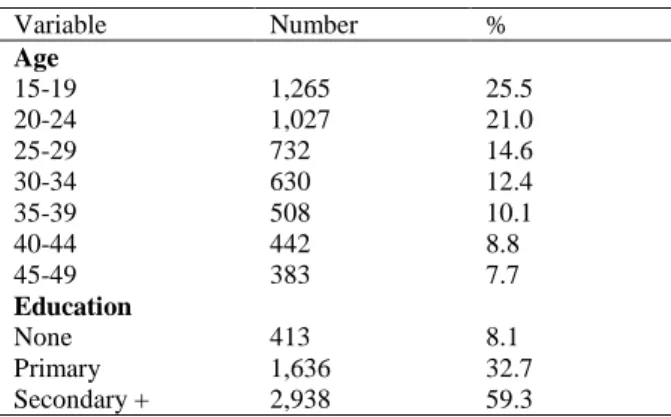
The characteristics of women respondents by their age and educational level are shown in Table 1. The results suggest that the distribution of women decreased with age. The proportion of younger women (less than 30 years) was 61.1%. The proportion of literate respondents with primary or higher education (32.7% and 59.3%, respectively) was substantially high (91.9%). This reflects low illiteracy among women in Eswatini.
Fertility levels by educational level
The estimates of observed total fertility rate (TFR) and predicted TFR are presented in Table 2 by educational level. Also shown are the total abortion rate (TAR) and abortion rate (AR) which are explained in later section. Fertility differences by educational level were observed. As expected, fertility decreased with increase in the level of education. The difference between observed TFR
and predicted TFR from the Bongaarts model signifies little fertility variation that is accounted for by other variables (such as, sterility, coital frequency) beside the key four proximate variables.
The role of proximate determinants on
fertility in Eswatini
The average ages at first marriage and first sex as well as various estimates of reproductive behaviour derived from data required as inputs to the Bongaarts model: contraceptive use (
u
), contraceptive effectiveness (e
), and median postpartum infecundability (i) are presented in Table 3. The impacts (or estimates) of the indices of sexual exposure, contraceptive use, postpartum infecundability and abortion are presented in Table 4. Overall, contraception, sexual activity, postpartum infecundability and abortion reduced fertility from potential maximum by 39%, 34%, 32% and 8%, respectively. The interpretation of these fertility behaviour estimates follows in the subsequent sections.Induced abortion
Induced abortion was estimated using total abortion rates and translated into abortion rates. The abortion rate (AR) for Eswatini was estimated at 18.9 abortions per 1,000 women (Table 2). Abortion tended to vary substantial with educational status of the women. Abortion rates decreased with increase in educational level. Women with no education had higher abortion rate (28.9 abortions per 1,000 women) compared to educated women: 20.2 and 15.4 for primary and secondary/ higher, respectively (Table 2). Overall, the impact of induced abortion (
C
a=0.92) on inhibiting fertility was the least among all the indices (Table 3). Although the abortion rates varied inversely with education, the fertility inhibiting effect of abortion was very similar across women‘s level of education ranging between 7-8%.Contraception
Contraceptive prevalence was estimated at 55.6%
Table 1: Per cent distribution of women aged 15-49 by age and education, Eswatini 2007 DHS
Variable Number %
Age
15-19 1,265 25.5
20-24 1,027 21.0
25-29 732 14.6
30-34 630 12.4
35-39 508 10.1
40-44 442 8.8
45-49 383 7.7
Education
None 413 8.1
Primary 1,636 32.7
Secondary + 2,938 59.3
Source: Authors‟ calculations
Table 2: Estimates of the level of fertility measures by educational level, Eswatini 2007 DHS
TFR TFRe error TAR AR Total 3.85 3.93 -0.08 0.66 18.9
Education
None 4.93 5.28 -0.35 1.01 28.9 Primary 4.54 4.61 -0.07 0.71 20.2 Secondary+ 3.39 3.51 -0.12 054 15.4
TFR= actual or observed total fertility rate TAR= total abortion rate
AR=abortion rate per 1,000 women
TFRe= predicted or estimated total fertility rate from the Bongaarts model
error=the difference between the predicted and actual total fertility rate
Source: Authors‟ calculations
between contraceptive use and educational level. The prevalence was lowest for illiterate women (34.7%) and almost twice higher (63.6%) among women with secondary or higher education. The overall average effectiveness of contraceptive use was estimated at 0.90 in Eswatini (Table 3). Contraception had an overall highest fertility reducing impact (
C
c=0.61) implying an overall 39% impact on fertility inhibition (Table 4). A positive reducing effect of contraceptive use on fertility by educational level was observed. The findings suggest contraceptive use effect on fertility was least among women who had no education (25%) compared to women with a secondary and higher education (45%).Postpartum infecundability
As prior mentioned, the duration of postpartum infecundability is due to postpartum amenorrhoea (breastfeeding) or sexual abstinence, and mostly the former. Table 3 results reflect small to moderate variation in the median duration practices of breastfeeding and sexual abstinence by educational status of women. Overall, postpartum infecundability was the third most important fertility inhibiting factor. The impact of postpartum infecundability was 32% at national level and showed a negative association with level of education (Table 4). This reflects the better educated breastfed less than those with little or no education. The inhibition due to postpartum infecundability was higher for illiterate women (38%) than for educated women (primary and secondary or above-32% and 29%, respectively).
Sexual exposure
Table 3 also presents means and medians of age at first marriage and age at first sexual intercourse. The results indicate that on average women began early as well before marriage being sexually active in Eswatini. The means or medians of age at first sexual intercourse were lower than for age at first marriage at national level and by educational levels (Table 3). Positive relationships between the level of education and age at first marriage as well as age at first sexual intercourse were observed. The educated women having secondary or higher education were more likely to marry later at 22 years compared to those with no education who on average married at 18 years. The educated women were also more likely to delay engaging in sexual intercourse than those with no formal schooling (18 vs. 15 years). Sexual exposure captures the risk of pregnancy for married, cohabitating and unmarried women. The fertility reducing effect of sexual activity was highest for better educated women with secondary and higher education (
C
m=0.63) and least among those with no education (
m
Table 3: Estimates of reproductive characteristics of the respondents by social context and status, Eswatini 2007 DHS
Age at sexual debut Age at marriage
u
e
i Mean median mean medianTotal 0.556 0.90 10.7 17.12.6sd 17 21.15.1sd 20
Education
None 0.347 0.90 13.7 15.62.6sd 15 19.65.6sd 18 Primary 0.475 0.90 10.9 16.22.0sd 16 20.04.9sd 19 Secondary+ 0.636 0.90 9.6 17.92.6sd 18 22.34.8sd 22
u
= contraceptive prevalence rate (CPR) among women in sexual union.i = median number of months of postpartum infecundability.
e
=average use-effectiveness of contraception sd=standard deviationAge at first sexual intercourse computed from DHS variable v531 Age at first marriage computed from DHS variable v511.
Source: Authors‟ calculations and i is obtained from StatCompiler.
Table 4: Indices for proximate determinants of fertility by educational level, Eswatini 2007 DHS
Fertility inhibiting effect (%) of index of:
Cc Cm Ci Ca Cc Cm Ci Ca
Total 0.61 0.66 0.68 0.92 39 34 32 8
Education
None 0.75 0.80 0.62 0.92 25 20 38 8
Primary 0.67 0.70 0.68 0.93 33 30 32 7 Secondary+ 0.55 0.63 0.71 0.93 45 37 29 7
Source: Authors‟ calculations
Discussion
This study examined quantitatively fertility behaviour using the revised Bongaarts framework22 of his original formulation4,5 with some modifications by Johnston and Westoff20 on abortion. The Bongaarts framework was applied to quantify the impact on fertility of each proximate determinant (contraception, postpartum infecundability, sexual activity, and abortion) at national and subpopulation variation by level of education- a proxy for status of women. Fertility differences are observed to be related to socioeconomic status amongst women in a country11,14,15. Understanding fertility behaviour is important for policy formulation and programme implementation.
The study results as posited by the Bongaarts model confirm that the four key proximate fertility determinants had significant fertility inhibiting effect at national level and showed subpopulation variation by educational level in Eswatini. Overall, the fertility inhibiting
effects of contraceptive use was the most influential (
C
c=0.61), followed by sexual activity (C
m=0.66) then postpartum infecundability (C
i=0.68) and abortion (
C
a=0.92). In an earlier study for Eswatini, Warren et al. 18 using the 1988 survey data found that postpartum infecundability (C
i=0.66) was most important, then marriage (m
C
=0.78), contraception (C
c=0.84) and abortion was not estimated or considered of negligible effect. While earlier in 1988 postpartum infecundability was strongest and contraception less important in suppressing fertility for Eswatini, almost two decades later the two proximate factors had reversed their importance roles. The displacement of postpartum infecundability with contraception as the most influential fertility inhibiting factor stems from the promotion of family planning initiatives.fertility in many developing countries8,26,27. Contrary, prior in the 1970s and 1980s contraception had minimal impact on fertility reduction in SSA, although it was perceived as the most responsive policy variable with greatest potential for reducing fertility 28. In line with study findings, Eswatini is one country in sub-Saharan Africa with the highest demand to limit births and recently had the highest proportion of women contraceptors 8. Thus, contraceptive use is one of the most important determinants for continued fertility decline in Eswatini. Published survey reports for Eswatini indicate contraceptive prevalence in the early 1980s was at 4% at national level. Between 1988 and 2007 contraceptive prevalence increased markedly from 16.6% to 37.9% 9, 29 and recently estimated at 66.1% in 2015 10. This is a reflection of the commitment by the government of Eswatini to increase access and utilisation of contraceptives including use of condoms to reduce the prevalence of HIV/AIDS and its effects in the country9,18,29.
The study found that contraceptive use (and its fertility inhibiting impact) increased with the level of education – a proxy variable for social status of women. This is consistent with study findings from several studies26,27, supporting high correlation of contraceptive use among women with better education. However, contrary results have also been found in these studies and therefore temporal changes and context matters on the role of importance of proximate factors on fertility.
Although less important than
contraception, postpartum infecundability has remained strong in limiting fertility in Eswatini as well as in SSA18,26,28,30. Previously, its impact was strongest when contraception was low in Eswatini18 and elsewhere in Africa especially in the 1970s to 1990s28,30. Onuoha28 hypothesised the high impact of postpartum infecundability on suppressing fertility in Africa in the 1990s had then its ceiling effect and would not increase in future. The impact of postpartum infecundability on fertility may have been weakened due to either use of contraceptives when breastfeeding or when the period of sexual abstinence is reduced through noncompliance to sexual taboos. Variation of postpartum infecundability and its impact on fertility is important. The results indicate
postpartum infecundability had the strongest impact on fertility among uneducated women and least impact among women with secondary or higher education. Among the educated women this lower effect can be compensated by their increased use of contraceptives which serve the same purpose of inhibiting fertility.
Overall, sexual activity in formal marriage and consensual sexual union is the second most influential proximate factor in limiting fertility. The study found out that significant childbearing occurs within and without marriage in Eswatini since fertility rates for sexually exposed women were high. Variation of sexual activity with educational attainment was observed. Early sexual experiences for women tended to occur among those with little (primary) or no education. Delayed sexual activity (including marriage) contributed significantly to low fertility among educated women. In line with expectations, the impact of sexual non-activity was higher for women with secondary or higher education compared to those with those with little or no education. The current government policies on compulsory free primary education and introduction of sexual literacy in educational syllabus should be strengthened and evaluated to further delay early marriages, increase use of contraceptives and eventually reduce fertility levels.
Abortion exerts the least influence on fertility amongst the proximate determinants. A prior study in Eswatini supposed that abortion was commonly practiced in the societies18, although quantitatively its impact was unknown and assumed negligible. Contrary, the study found that the level of abortion was significant (AR =18.9 abortions per 1000 women) in Eswatini. This finding was within the range of SSA estimates in the same period between 2006-720,31; the TAR/AR
TAR/AR (1.2/34.3) than those with secondary or better education (1.6/45.7).
In general, abortion in Eswatini tend to be high, which according to Majumder and Ram27 reflects difficulty in access to contraceptives for women or a high unmet need for family planning. In support of this view, the unmet need is high although it declined with educational level in Eswatini- 32.3%, 29.9% and 19.7% for none, primary and secondary or higher education, respectively 9. Unsafe abortion could be commonly practised in Eswatini since abortion is illegal, unless in case of rape or incest, causing maternal health risk with severe implications on reproductive health or mortality.
In overview, fertility decline in Eswatini was shaped, in order of importance, by contraceptive use, sexual activity (including marriage), postpartum infecundability and induced abortion. The importance and large influence of contraception, in particular modern contraceptives are recent. Early family planning programme emphasis in Eswatini and elsewhere in Africa had its major focus on breastfeeding (or postpartum) practices revising fertility downwards.
This study also shows the important role of proximate determinants of fertility was influenced by women‘s level of education –a proxy for social status or class. Low social status tends to highly correlate with high fertility behaviour. In case of Eswatini, uneducated women had the least contraception and high fertility. In contrast, those better educated (at secondary or higher level) had the highest uptake of contraceptives and low fertility. Therefore, this study maintains the position by Jain and Ross2 of the negative influence of education on reproductive behaviour.
The empowering of women‘s status through education in particular as noted by Caldwell and Caldwell12 has huge negative implications on fertility. Fertility decline in Eswatini is seen associated with high uptake of contraceptives. There is still much more potential for further fertility decline through adoption of improved and much more efficient modern contraceptives. Policies on sexual activity (including marriage), abortion, contraception and
postpartum infecundability (including
breastfeeding) need to account for nuanced subpopulation educational variations, especially greater attention should be paid to disadvantaged illiterate women to reduce their high fertility practices.
Apart from the four biological and behavioural proximate determinants of fertility accounting for much variation in fertility, other demographic and socioeconomic factors both at individual and community level that might have a bearing on fertility need to be investigated. These factors may need to be extended further than the aggregate model used in this study to look at women‘s fertility variation at individual level using appropriate statistical regressions techniques.
Conclusion
This study showed the proximate determinants of fertility play a major role in reducing fertility and can be manipulated to achieve sustained fertility decline in Eswatini. Increasing uptake of contraceptives, delaying sexual activity or marriage, and encouraging breastfeeding among women should be a priority to suppress fertility. Abortion remains illegal under normal circumstances but can be reduced with use of effective contraceptive methods. The government needs to further strengthen polices and efforts that aim to improve the educational status of women since they have a positive influence on fertility behaviour.
Acknowledgements
The authors are grateful to the Central Statistics Office in Eswatini and Macro International Inc. for the data used for this study. The corresponding author acknowledges the Demography and Population Studies Programme at the University of the Witwatersrand, South Africa for support of this manuscript, which is an extract of a doctoral thesis. This work is based on the research supported in part by the National Research Foundation of South Africa (Grant Numbers: 105931).
Contribution of Authors
drafted the initial manuscript. COO provided methodological guidance of the study and assisted in data analysis and interpretation of results. All authors participated in revising the manuscript. All authors approved the final manuscript and declare that they have no competing interest.
References
1. Upadhyay UD and Karasek D. Women's Empowerment and Ideal Family Size: An Examination of DHS Empowerment Measures In Sub-Saharan Africa. International Perspectives on Sexual and Reproductive Health 2012; 38(2): 78-89.
2. Jain AK and Ross JA. Fertility Differences Among Developing Countries: Are They Still Related to Family Planning Program Efforts and Social Settings? International Perspectives on Sexual and Reproductive Health 2012; 38(1): 15-22.
3. Davis K and Blake J. Social structure and fertility: An analytic framework. Economic Development and Cultural Change 1956; 4(4): 211-35.
4. Bongaarts J. A Framework for Analyzing the Proximate Determinants of Fertility. Population and Development Review 1978; 4(1): 105-32.
5. Bongaarts J. The Fertility-Inhibiting Effects of the Intermediate Fertility Variables. Studies in Family Planning 1982; 13(6/7): 179-89.
6. United Nations. Programme of Action of the International Conference on Population Development: 20th Anniversary Edition. New York: United Nations Population Fund [UNFPA]; 2014.
7. Odimegwu CO and Adedini SA. Gender equity and fertility intention in selected sub-Saharan African countries. Gender & Behaviour 2014; 12(2): 5858-81. 8. Van Lith LM, Yahner M and Bakamjian L. Women's
growing desire to limit births in sub-Saharan Africa: meeting the challenge. Global Health: Science and Practice 2013; 1(1): 97-107.
9. CSO. Swaziland Demographic and Health Survey 2006–07. Mbabane: Central Statistical Office [CSO] and Macro International Inc 2008.
10. CSO. Swaziland Multiple Indicator Cluster Survey 2014. Key Findings. Mbabane, Swaziland: Central Statistical Office [CSO] 2015.
11. Upadhyay UD, Gipson JD, Withers M, Lewis S, Ciaraldi EJ, Fraser A, Huchko MJ and Prata N. Women's empowerment and fertility: A review of the literature. Social Science & Medicine 2014; (115): 111-20.
12. Caldwell JC and Caldwell P. Africa: The New Family Planning Frontier. Studies in Family Planning 2002; 33(1): 76-86.
13. Bongaarts J, Frank O and Lesthaeghe RJ. The proximate determinants of fertility in sub-Saharan Africa. Population and Development Review 1984; 10(3): 511-37.
14. Kravdal Ø. Education and Fertility in Sub-Saharan Africa: Individual and Community Effects. Demography 2002; 39(2): 233-50.
15. Garenne M. Education and Fertility in Sub-Saharan Africa: A Longitudinal Perspective. Calverton, Maryland, USA: ICF International; 2012.
16. Tabutin D and Schoumaker B. The Demography of Sub-Saharan Africa from the 1950s to the 2000s. A Survey of Changes and a Statistical Assessment. Population (English Edition, 2002-) 2004; 59(3/4): 457-555.
17. Cleland J and Wilson C. Demand theories of the fertility transition: An iconclastic view. Population Studies 1987; 41(1): 5-30.
18. Warren CW, Johnson JT, Gule G, Hlophe E and Kraushaar D. The Determinants of Fertility in Swaziland. Population Studies 1992; 46(1): 5-17. 19. Stover J. Revising the Proximate Determinants of Fertility
Framework: What Have We Learned in the past 20 Years? Studies in Family Planning 1998; 29(3): 255-67.
20. Johnston H and Westoff C. Examples of Model-Based Approaches to Estimating Abortion. In: Singh S, Remez L, Tartaglione A, eds. Methodologies for Estimating Abortion Incidence and Abortion-Related Morbidity: A Review. New York: Guttmacher Institute; and Paris: International Union for the Scientific Study of Population 2010:49-62. 21. ICF. The DHS Program STATcompiler. Funded by
USAID. 2012. http://www.statcompiler.com. 22. Bongaarts J. Modeling the fertility impact of the
proximate determinants: Time for a tune-up. Demographic Research 2015; 33(19): 535-60. 23. Trussell J. Contraceptive efficacy. In: Hatcher R, Trussell
J, Nelson A, Cates W, Kowal D, Policar M, eds. Contraceptive Technology: Twentieth Revised Edition. New York NY: Ardent Media 2011:779-863.
24. Bongaarts J and Westoff CF. The potential role of contraception in reducing abortion. Studies in Family Planning 2000; 31(3): 193-202.
25. Sedgh G, Singh S, Shah IH, Åhman E, Henshaw SK and Bankole A. Induced abortion: incidence and trends worldwide from 1995 to 2008. Lancet 2012; 379: 625-32.
26. Johnson K, Abderrahim N and Rutstein SO. Changes in the Direct and Indirect Determinants of Fertility in Sub-Saharan Africa. DHS Analytical Studies No. 23. Calverton, Maryland, USA: ICF Macro; 2011. 27. Majumder N and Ram F. Explaining the Role of
Proximate Determinants on Fertility Decline among Poor and Non-Poor in Asian Countries. PLoS ONE 2015; 10(2): e0115441.
28. Onuoha N. Contributions of the proximate determinants to fertility change in Senegal. Soc Sci Med 1992; 35(10): 1317-20.
30. Odimegwu CO and Zerai A. Understanding the proximate determinants of fertility of a Nigerian ethnic group. Genus 1996; 52(3/4): 67-87.