IN CONJUNCTION WITH THE
INTERNATIONAL NETWORK FOR THE REDUCTION OF ABORTION DISCRIMINATION AND STIGMA
by Alice Drozdiak
A paper presented to the faculty of The University of North Carolina at Chapel Hill in partial fulfillment of the requirements for the degree of Master of (Master of Science in) Public Health
in the Department of Maternal and Child Health. Chapel Hill, NC
November 2015
Approved by:
_______________
ABSTRACT
Background: Abortion stigma has been noted in academic literature since 1989, and only examined in earnest in the last 15 years. The abortion stigma can lead to poor quality of care and increased barriers for people seeking abortions. Inroads, a global network focused on reducing abortion stigma and discrimination, is publishing a state of the network report in December 2015 describing the state of research, activism, and advocacy around abortion stigma. This research is the foundation of that report. Methods: Using literature searches conducted over the course of nine months, we analyzed the content of both peer-reviewed and popular literature for examples addressing abortion stigma. All literature was coded by socioecological level, geographic region, type of source (peer-reviewed, white/gray literature, popular media, etc.) and, when applicable, study design (quasi-experimental, RCT, etc.). Additionally, all literature addressing or proposing interventions was highlighted. Results: One major result of the analysis was discovering the wide variety of ways in which stigma is manifested; manifestations varied based on geographic region, socioecological level, and other intersecting stigmas. The study also yielded a set of recommended practices for developing abortion stigma scales for measurement, though this area is still nascent.
Conclusions: For those interested in developing measurements or interventions for abortion stigma, it is crucial to consider socioecological context, geographic location, and other stigmas. Those factors must all be considered when performing exploratory qualitative research, which can then be used to develop items for a scale, or
Over the past three decades, the stigma of abortion has appeared both as a formal topic of study in peer-reviewed journals as well as in the social discourse of the public and culture at large. The International Network for the Reduction of Abortion Discrimination and Stigma (inroads1) is currently producing a comprehensive review of the state of the field of abortion stigma, including reviews of the literature, stakeholder interviews, and suggestions for further development of measurement tools and anti-stigma interventions.
As a major contributor to the technical report, this work seeks to provide insight into the state of emerging evidence around abortion stigma, its manifestations, and possible preventative or countering interventions. By examining current and past research, attempts to develop context-specific scales, and the needs and goals of current researchers,
stakeholders, and advocacy workers, this report ultimately provides recommendations and suggestions for countering abortion stigma.
Abortion stigma is important issue within public health, in part because it
contributes to the rate of unsafe abortion; for example, anticipation of stigma at a medical office, or internalized personal stigma, may make women more likely to try unsafe abortions at home or seek out otherwise untrained and unsafe methods for terminating a pregnancy (Tagoe-Darko, 2013). With around 22 million unsafe abortions performed each year around the world, reducing the motivations for unsafe abortion is crucial.
Approximately
47,000 women die as a result of unsafe procedures, making fatality drastically higher than for safe abortions (“Preventing unsafe abortion,” n.d.). These numbers do not include resulting injuries. As such, incorporating an anti-stigma focus into public health should reduce the incidents of unsafe abortion.
Individuals seeking abortions are not the only ones affected by abortion stigma. Indeed, their supporters are also susceptible to the consequences of abortion stigma, as are people who work providing abortions (p. S50-S51, Norris et al., 2011). The presence of abortion stigma is correlated with higher levels of burnout and compassion fatigue
among abortion providers (Martin et al., 2014). It is to the advantage of public health pro-
1
fessionals, then, to include the effects of sources of stigma in their research of the consequences of unsafe abortion.
To frame the topic of abortion stigma, this report starts with a conceptual grounding of both stigma in general, and the exploration of abortion stigma as a distinct topic.
Following the discussion of concepts, we present our methods for gathering and analyzing literature. Overall trends in the literature are examined, and some variations of stigma manifestation are explored. The current state of measurement development is explored, along with interventions that have been proposed or tested. Using all of this information, we end with recommendations for communications professionals, researchers, stakeholders, and participants in the inroads network who wish to counter the stigma surrounding abortion.
ABORTION STIGMA: CONCEPTUAL GROUNDING
In efforts to conceptualize stigma in general, Link & Phelan (2001) offer a four- component model to describe the process of discrimination (Link & Phelan, 2001). These stages can roughly be described as labeling, stereotyping, separating, and discrimination. During labeling, discrete categories are created—which simplifies and distorts the spectrum of lived experience. For example, labeling somebody “healthy” or “not healthy”
may leave out the experience of somebody experiencing remission of a chronic illness. The authors note that labels have a tendency to be taken for granted, which can make them hard to dismantle (p. 367). Once a label is created and assigned, it can be stereotyped.
discrimination, includes disadvantages due to status loss. For example, young girls who become pregnant may be asked to leave school, losing the potential benefits to status from education, due to the stigma of a pre-marital pregnancy. Since discrimination is the stage in which target populations experience the most negative consequences, it is an important factor in distinguishing stigma from simple stereotypes. Through this four-stage process, Link & Phelan outline a paradigm with which to explore the mechanisms of stigma manifestation.
Examining stigma has shown to be important in a variety of fields; for example, work around HIV/AIDS has included explorations, definitions, and interventions around associated stigma. In an analysis of HIV/AIDS stigma as a field, Mahajan et. al. invoke Goffman’s work around stigma as a spoiled identity (2008). They point out that such an identity is a result of a socially-determined difference being labeled as “discredited or undesirable,” leading both the community and the individual to internalize the stigma as normal and correct (p. S70, Mahajan et al., 2008). In addition, the authors call on both the point of view of those being stigmatized (people living with HIV/AIDS) as well as the role of power inequity in sociocultural manifestations of stigma. These approaches inform a broad approach to stigma by the HIV/AIDS field, and we will see the themes of multi-leveled cultural analysis in the discussion of abortion stigma as well.
In their efforts to put forth a conceptualization of stigma in general, Link & Phelan (2001) explain that sometimes, power dynamics are overlooked when analyzing the causes and manifestations of stigma. They observe “a tendency to focus on the attributes
associated with” the stigmatized status, as opposed to exploring the “power differences between people who have them and people who do not” (375). As an example, the authors suggest that patients in a treatment program may engage in behavior that looks like it stigmatizes medical staff members—labeling them according to certain characteristics, view them as “separate” from the patient population—but the patients’ lack of social, political, or economic power prevents this behavior from actually stigmatizing the medical personnel. For those who wish to define or counter stigma, Link & Phelan encourage asking the following questions:
recognizes and deeply accepts the stereotypes they connect to the labeled
differences?Do the people who might stigmatize have the power to separate ‘us’ from ‘them’ and to have the designation stick? And do those who might confer stigma control access to major life domains like educational institutions, jobs, housing, and health care in order to put really consequential teeth into the distinctions they draw?” (Link & Phelan, 2001)
When looking at abortion care, one can indeed see the ways in which the stigmatized are prevented from accessing health care at least, driving home the points Link & Phelan make.
The stigma of abortion, though manifested differently in various contexts, is a consistent element that women, providers, and members of the sexual health and
reproductive health (SHRH) community must navigate. Stigma—its definition and effects— have been studied variously by different fields. Abortion stigma first appeared in the
literature in 1989, with Weidner’s article, “Abortion as a Stigma: In the Eyes of the Beholder” (Weidner, 1989). In this study, which asked participants to complete a social distance measure after reading a short description of a person, participants selected greater social distance for descriptions of both men and women who had been associated with the decision to terminate a pregnancy than they did for control descriptions. The concept of stigma around abortion, then, has been in the peer-reviewed literature for at least thirty years; however, it has only been in the past fifteen years a sustained interest in the stigma of abortion has been demonstrated by the SHRH field.
In 2009, Kumar et. al. proposed a model for conceptualizing the stigma of abortion that would allow for the variation of manifestations by context while still addressing some of the elements that make abortion stigma unique among forms of discrimination (Kumar, Hessini, & Mitchell, 2009). Their proposed definition of abortion stigma is “a negative attribute ascribed to women who seek to terminate a pregnancy that marks them, internally or externally, as inferior to ideals of womanhood” (p. 628). Though the “ideals of
womanhood” undoubtedly vary from context to context, the authors provide “three archetypal constructs” that could be violated by women seeking an abortion, and give insight into the roots of stigma. These archetypal constructs include:
3) Women instinctively feel nurturing towards those who appear vulnerable (p. 628).
The perceived violation of these three constructs contributes to the view that abortion is morally wrong. In this article, we also see the first applications of a
socioecological framework applied in situating abortion stigma; the authors suggest that stigma can be located in the individual, community, organizational, structural, or discourse-framing levels. (This framework would later be refined in Hessini 2014 and implemented in the inroads approach to abortion stigma). Additionally, Kumar et. al. cite Link & Phelan’s work (2001) when noting that the process of stigma manifestation relies on the dynamics of power.
These contexts help shape the definition of abortion stigma. Organizations like inroads rely on an ecological framework, first conceived formally at the meeting of the Bellagio group in 2013 (Hessini, 2014). The Bellagio group consisted of nearly 20 professionals, and marks the first time the ecological model had been applied to abortion stigma. This framework identifies five levels of abortion stigma. The author states that abortion stigma can be enacted at the individual level, which involves personal
interactions between people; the community level, or how informal or semi-formal social groups respond; the institutional level, where businesses or government offices make policies about services, accessibility, and other issues; the legal level, where stigma influences how laws regulate abortion and SHRH access; and the mass media & culture
level, which includes popular media. The inroads Learning Agenda for Abortion Stigma presents questions that correlate with each level, encouraging further inquiry into defining abortion stigma at each level.
METHODS
This report synthesizes peer-reviewed literature, gray and white literature, and popular media addressing the broad topic of abortion stigma. The analysis focused primarily on describing the patterns found in the literature, specifically around distribution of
socioecological levels, geographic representation, and the ways in which stigma
manifestation is dependent on locality. Three literature searches were conducted, one each in December 2014, May 2015, and August 2015, to identify peer-reviewed and gray/white literature; databases searched include PubMed, Global Health, Web of Science, Academic Search Premier, PsychINFO, Women’s Studies International, Family & Society Studies Worldwide, and the Index to Legal Periodicals and Books. Search terms consisted of
“abortion” and “stigma” in either the title, abstract, or subject heading. No exclusion criteria was included; all results were assessed for relevance by the authors.
In addition to peer-review databases, several news databases were searched. When searching the AllAfrica database, the Latin American Newsstand database, America’s News database, Alt-Presswatch, and Lexis Nexis, the terms “abortion stigma,” “abortion,”
“stigma,” “aborto” and “estigma” were used. Several websites known to publish materials with a focus on abortion stigma were searched with the term “abortion stigma,” including the websites for Ipas, the Sea Change Program, the International Planned Parenthood Federation, and the Consortia Latinoamericano Contra el Aborto Insecure (Latin American Consortium Against Unsafe Abortion). Additionally, Google searches for “abortion stigma” were
conducted. Items were only selected if they addressed the concept of stigma; for example, an article that merely mentions stigma in an introductory paragraph but then goes on to focus on orthogonal topics would not be selected. This process did not include a step for exclusion, as only relevant items were selected from the databases and Google searches.
each item was tagged with a type of publication, assigned with the set of questions identified below:
1. Is this piece of literature peer-reviewed? If yes, then code it as peer-reviewed. 2. Is this piece from popular media (blog, newspaper, entertainment)? If yes, then code it as popular media.
3. If this piece is not popular media, nor peer-reviewed, what time of material is it (white paper, technical report, etc.)? Assign type of publication.
This strategy resulted in 104 peer reviewed articles, 59 pieces of popular media, and 11 pieces of other literature. Any literature that was identified as peer-reviewed or
white/gray literature (that is to say, any literature not considered popular media) was also coded with several additional labels. If the material included a study, then it was coded as either using qualitative methods, quantitative methods, or mixed methods. Additionally, relevant studies included a label for study design, assigning experimental, quasi-
experimental, or pre-experimental labels when appropriate. Labels for index population were also included, identifying who was being studied or impacted in the article (providers, patients, etc.). Originally, we planned on coding appropriate literature according to the strength of its evidence; however, due to the small number of articles using relevant study designs, we determined that such an analysis would not yield meaningful results.
As such, this analysis focused mainly on patterns of geographical and socioecological focus as well as the wide variety of locality-based stigma manifestations.
GENERAL PATTERNS IN THE PEER-REVIEWED/GRAY LITERATURE
Before explicating the more complex themes and results from the peer-reviewed and gray literature, it is helpful to note the overarching characteristics of the data. To identify overall patterns, we looked at the distribution of ecological levels addressed in the literature, the distribution of qualitative studies versus quantitative, the continuum of efficacy, and the geographic distribution of issues addressed by the literature.
Africa, the US and Canada, and studies with multinational foci receive the most attention from researchers, comprising 70% of all literature. Australia and the Middle East are most underrepresented by the research. The bar graph (Fig. 2) provides a breakdown of the various regions represented in the peer-reviewed/gray literature.
These demographic patterns begin to shape the landscape of abortion stigma discourse. We will discuss the most robust and crucial themes, starting with the need for stigma measurement.
43 44 39
30
14
Community Individual Institutional Legal Mass Media &
Culture Fig.1 Peer-Reviewed Literature by Socioecological Level
Studied
25
8 10
40
2 8 1 15
Fig. 2 Peer-Reviewed Literature by Region Studied
Africa Asia
Europe US and Canada
Pacific Latin America and the Caribbean
MEASUREMENT IN THE PEER-REVIEWED/GRAY LITERATURE
A review of the literature shows strategies taken to develop reliable, valid methods for quantifiably measuring abortion stigma. Two examples from the literature show which approaches are common in the field (Cockrill, Upadhyay, Turan, & Green Foster,
2013; Shellenberg, Hessini, & Levandowski, 2014).
Both articles propose questionnaires with survey items that are answered with a 5- point Likert scale, though there was some variation in how those items were developed.
Both Cockrill, et al. and Shellenberg, et al. generated items by analyzing the content of relevant statements and discussions. Cockrill, et al. performed a content analysis on an abortion story, while Shellenberg, et al. pulled relevant issues from transcripts of focus group discussions conducted for the purpose of exploring abortion stigma.
Within the various items in these scales, subscales were used to identify certain aspects of abortion stigma. Cockrill, et al., who focused on measuring individual level stigma experienced and produced by women who had had abortions, identified four sub- scales: judgment, isolation, self-judgment, and community condemnation (though the last subscale speaks to the relevance and wide-spread use of the ecological context). On the other hand, when examining stigma produced by a general community population,
Shellenberg et al. draw on Link & Phelan’s 2001 work to propose subscales around the four stages of discrimination: labeling, stereotyping, separating, and discriminating. Ultimately, the authors collapsed the categories into two: labeling/stereotyping versus
exclusion/discrimination. As we can see, various authors rely both on work done on
abortion stigma theory as well as scales from other stigma fields to identify and develop sub-
scales.
These scales and subscales demonstrate the emerging desire and need for
quantitative measurement tools. The strategies taken by each group of authors also offers insight into the needs and direction of the field. For example, Cockrill, et al. noted scales up to that point had not been validated with women who had actually had abortions. When developing a scale, they kept this in mind; their scale items drew from the text of 20
include both individual and community analysis in their scale development. As a result, their focus group discussions included men, women, both married and unmarried, and an age range of 15 to 54 years old. These studies show the emerging search for abortion stigma measurement tools, at levels ranging from direct interactions to more macro-level systems.
The varied approaches also set standards and direction for the field as a whole. The context-dependent nature of abortion stigma makes measurement tools difficult to scale or transfer, but there are still lessons to be learned by current efforts and successes.Sauer et. al develop a tool that provides quantitative measurements, validated at several institutions including a gynecology clinic and a family planning clinic (2013). Their scale is designed specifically to address stigma in the context of a medical institution in theUK. Since the approach is so specific, a considerable amount of effort would be needed to adapt it for another cultural context or ecological level, but it does provide a thorough model for those interested in developing analogous measurement tools. Similarly, the actual items
developed by Cockrill et. al. may not be valid in all contexts, but the process of drawing questionnaire items from the narratives of the population affected would be a possible starting point for others interested in developing scales (2013). Shellenberg et.
al. also developed a context-specific scale, drawing on two countries (Ghana and Zambia) that have relatively permissive laws around abortion but high levels of social stigma (2014). Focus group discussions were held in local languages; it may be that the 57 items do not scale or transfer to a region with drastically different social or legal dynamics, but the process is still promising for anyone working on the development of abortion stigma measurement. With these approaches, these authors demonstrate that despite the challenges to measuring abortion stigma there are effective and robust strategies for developing
context-specific measurement tools.
it. The study did, indeed, reveal some common aspects of the experience of abortion stigma for women in Mexico; the majority cited the expectation to have maternal instincts, the decision not to discuss their abortion with family members, and their change in
perceptions of abortion since having one themselves as major factors in their experience. These themes are rich jumping off points for further exploration into the dynamics
of abortion stigma in Mexico, and may represent natural subscales in a measurement tool, if one were to apply the strategies used by the authors mentioned above.
On the other hand, some qualitative research is useful at the exploratory level, well before the stage of scale development. In cases where a scale is unavailable, inappropriate, or underdeveloped, qualitative research provides insight into the nature of stigma in unique settings. Tagoe-Darko, for example, wanted to explore how stigma was affecting quality of care at a specific teaching hospital in Ghana (2013). As with other qualitative studies, the author used focus group discussions and in-depth interviews, in addition to narratives and observations. Her research looked specifically at participants who had had “incomplete abortion and complication of unsafe abortion” (p 135). In order to elicit discussions about stigmatizing attitudes and behaviors, the authors introduced a video in the focus group discussions about a woman facing the choice to terminate her pregnancy. The themes revealed some trends in the community—the prevalence of unsafe self-induction at home, for example—but also uncovered practices of the specific hospital, like “nurses [scorning] most mothers” admitted after attempting an unsafe abortion (p. 136). This exploratory study is a prime example of qualitative work being done to identify practices and stigma
manifestations in specific communities or institutions. Researchers interested in developing a measurement scale in this context could be well informed by use of this type of research to direct their development of subscales and measurement scale items.
STIGMA MANIFESTATION IN THE PEER-REVIEWED/GRAY LITERATURE: DEPENDENCY ON CONTEXT
abortion stigma should look to the culture in which it is embedded for guidance in understanding its manifestations.
We do know that one of the stages of discrimination through stigmatization is to separate the stigmatized person or behavior from the rest of the community (Link & Phelan, 2001). In the UK, this separation occurs by putting abortion services in a separate clinic from other women’s health care services. Even though the government provides funding for abortion services (98% of abortions in Wales and England were funded by
the National Health Service in 2013), most abortions take place “in the independent sector,” as opposed to centers actually administrated by the NHS (Astbury-Ward, 2015). By relegating abortion—and only abortion—to independent providers, the NHS effectively makes abortion seem less common, and functions to keep abortion as basic health care absent from the public’s eye. This separation is one of the ways a country that has legal and even government-funded abortion services can still manifest stigma around abortion
(Astbury-Ward, 2015).
Similar to the UK, the United States also often separates its abortion care into isolated clinics. However, in the U.S., the stigma of separation is exacerbated by
“harassment and violence at abortion clinics,” which serves to label and stereotype not only women seeking abortion services, but the professionals who provide them (p. S51, Norris et al., 2011). This stigma may also prevent physicians from seeking out training in abortion provision, or may reduce the opportunities for effective training if funding is reduced (Norris et al., 2011). Stigma around abortion provision in the U.S. clearly operates not only at an individual and community level, but on an institutional level as well (Norris et al., 2011).
In both the U.S. and the UK, abortion is not illegal (though there are legal
procedure (Lithur, 2004). Other health care workers “are wary of providing legal abortion services even where it is available” due to the risk of being charged with assisting in criminalized abortions (p. 72). The lack of knowledge surrounding abortion law—and the subsequent decline in availability of safe abortion services—is a form of enacted stigma on legal and institutional levels (Hessini, 2014). At community levels, abortion stigma in Ghana is enacted through the labeling of women who have undergone abortions as immoral for supposedly reducing her ability to have children in a community that highly values a woman’s fertility (Lithur, 2004). In some communities, abortions are practiced in secret for young women and girls who wish to be seen as virgins before participating in puberty ceremonies, in order to avoid bringing shame to their families (Lithur, 2004). Ghana, therefore, provides an example of how stigma is manifested differently not only according to nation, but from community to community and in different ways across various
ecological levels.
Values around women’s fertility influence the manifestation of abortion stigma in Iran as well as Ghana; however, in Iran, the emphasis is placed on maintaining replacement fertility by having fewer children. Though this cultural value may reduce stigma around social and economic reasons for choosing abortion, many women in a series of interviews still cited community belief that “abortion is sinful and that misfortune experienced thereafter is punishment” (p. S172, Hosseini-Chavoshi, Abbasi-Shavazi, Glazebrook, & McDonald, 2012). The authors of the study suggest that a “misreading of relevant Sharia laws” creates a taboo around seeking abortion. In this example from Iran, then, stigma manifests itself in the way the reasons for choosing abortion are audited by the community. While abortion stigma in Ghana is motivated by the prioritization of female fertility, in Iran, it is motivated by specific interpretations of religious beliefs.
Even in geographical areas where abortion is illegal, communities and cultures respond and manifest stigma differently. In a study that looked at a cluster of small
Ultimately, because of the lack of legal protection, it is at the discretion of the doctor to decide whether a woman “needs” an abortion. By removing women’s agency within the institutionalized medical system, the system encourages women to seek methods they can use on their own; whether or not that is safe medical abortion, or unsafe methods, varies in each situation.
While the example from the northern Caribbean demonstrates a cultural or community-level of acceptance alongside the legal stigma, the Philippines provides an example of stigma enacted on several levels. In addition to the restrictive laws that not only make no allowances for legal abortion, as recently as 2010 the government of Manila refused to provide contraception (“Facts on Barriers to Contraceptive Use in the
Digging deeper, the study explored whether or not religiosity—for example,
frequency of prayer or attendance at mass—was associated with high scores of stigmatizing attitudes; in fact, there was no significant correlation shown in this study. However, over half of the participants thought that a woman should “keep her abortion a secret” because of potential negative reactions from family and community (S163). These numbers suggest, then, that even people who do not themselves condemn all abortion may propagate stigma by believing that it is the duty of the person who terminates a pregnancy to hide that information. We see in Mexico, then, a complex manifestation of stigma that doesnot at first seem to map to people’s true beliefs. The authors also suggest that “further research is needed to understand the role of Catholicism” (p. S166).
These examples demonstrate the complexity involved in the variation of stigma manifestation across geographic contexts. While there exist common elements across contexts, abortion stigma is performed differently depending on the location.
STIGMA MANIFESTATION IN THE PEER-REVIEWED/GRAY LITERATURE:
INTERSECTING STIGMAS
In the worldwide body of literature that addresses abortion stigma, one theme that emerges is the intersection of abortion stigma with other axes of stigmatization.
Intersectionality, first put forth as a theory in U.S. academic discourse by Kimberlé
Crenshaw, suggests that in order to understand or appreciate the needs of a person or group, various axes of social relation or identity cannot be disentangled; to do so “distorts these experiences” (Crenshaw, 1989, p. 57). In order to understand the full implications of intersecting stigmas, it is important to acknowledge the “proper historical, cultural, social, political, and economic contexts” within which stigma is realized (p. S56, Price, 2011). Just as the manifestations of abortion stigma depend on the local context, the intersection of abortion stigma with other stigmas produces various manifestations around the world, sometimes intensifying the resulting consequences of stigma. We illustrate this concept with three examples from Hong Kong, Malawi, and the United States.
backgrounds;” in this case, the women were all either unemployed, students, or working in an unskilled occupation (p 102). The cost of abortion services in Hong Kong—which can be as high as HK$10,000 (US$1290)—is prohibitive to women who are already navigating the stigma of abortion.
In addition to the high cost of abortion services, the threat of legal action against their partners introduces another level of stigma young women. The authors note that some girls under the age of consent did not want to be responsible for “damaging the prospects of her boyfriend,” thus taking on both the stigma of her partner’s crime and thestigma of abortion (p.107). Even though their abortion may technically be legal, these girls seek abortion services at illegal clinics that will not report their pregnancies. The risk of a partner’s damaged reputation intersects with general abortion stigma.
In Malawi, stigma around abortion exists at all levels of the socioeconomic
spectrum; however, there are other layers of stigma that complicate it (Levandowski et al., 2012). Young women face very public consequences for pregnancy, as it is common practice for pregnant girls to be expelled from school. This is especially unfortunate, as unwanted pregnancies can often result from what the authors refer to as “initiation
ceremonies,” which are tantamount to rape (p. S168). Young women who are considering terminating such a pregnancy must navigate both the stigma of becoming pregnant and leaving school, and the stigma around abortion. Additionally, young women are not the only ones navigating multiple stigmas in Malawi. Older women who become pregnant as a result of extramarital affairs risk the stigma of their affair, or the stigma of abortion (p. S169). These examples demonstrate the intersection of stigmas in Malawi.
among women who were white, Black, or Hispanic. This intersectional approach suggests that not only can intersecting identities increase the level of perceived stigma, the actual manifestations and experiences may be qualitatively different for Hispanic women in the United States than for white women.
STIGMA MANIFESTATIONS IN THE PEER-REVIEWED/GRAY LITERATURE: LAW AND POLICY
The legislation of abortion around the world offers both obvious and nuanced examples of abortion stigma. There are, of course, examples like the “recent explosion of anti-choice legislation” in the United States as an example of a “strong indicator of the increasing stigmatization of abortion” (Abrams, 2013, p. 295). The presence or absence of laws restricting abortion, however, is not the only ways that law & policy enact or
influence stigma. The nature of some laws to leave the decision whether or not to perform an abortion at the discretion of the doctor—because of late gestational age, for instance— allow for the institutional misapplication of abortion policy to be more restrictive than necessary (Gerdts et al., 2014). This opacity of laws contributes to the cycle of stigma; in fact, the very act of legislating abortion “distinct from other medical services” contributes to the separation and subsequent stigmatization of abortion (Cook, 2014, p. 352).
INTERVENTIONS FROM THE PEER-REVIEWED/GRAY LITERATURE:
Interventions targeting abortion stigma—either through treatment or prevention— are few, and often still nascent. The field has drawn from successful examples in other areas that are often stigmatized, such as mental health and HIV/AIDS. This section looks at what current researchers and advocates are learning about abortion stigma interventions, and current strategies for further development.
SUGGESTIONS FROM MENTAL HEALTH AND HIV/AIDS
Since the field of abortion stigma is in many was still nascent, there are few
have equal status, and that the activities during contact be cooperative in nature (Rusch, Angermeyer, & Corrigan, 2005). Contact-based interventions will also have a higher likelihood of success with some form of institutional support; one article gives the example of gaining buy-in for a school program from the principal (p. 536).
In addition to contact theory, Corrigan, Morris, Michaels, Rafacz, & Rüsch (2012) propose both protest and education as possible leverage points for reducing the stigma of mental health. The authors cite examples of protests in Germany and the United States that were successful in reducing public images that stigmatized mental illness. Education, intuitively, attempts to “diminish stigma by providing contradictory information” (p. 535). However, results from some countries showed that presentation is important: an overly-clinical explanation of the stigmatizing characteristic sometimes served to create more distance around the stigmatized population.
Many of the themes presented in the mental illness stigma literature are also echoed by the methods used to counter HIV/AIDS stigma. The International Center for Research on Women provides a toolkit specifically designed to help people actively push back against HIV/AIDS stigma. It provides education in the form of several modules examining HIV/AIDS stigma from several angles, as well as several calls to connect with those who are stigmatized (http://www.icrw.org/publications/understanding-and- challenging-hiv-stigma-toolkit-action).
Other fields that study stigmatized communities have proposed and in some cases evaluated methods for countering stigma. Some of these strategies, like education and contact, are being explored by people challenging abortion stigma.
EDUCATION
In the field of abortion stigma, education seems to be a common-sense approach to destigmatizing; there is a tendency to suggest further education around a topic without necessarily providing evidence that it would be an effective approach. Preliminary
evidence supports many of the practices involving education. In a quasi-experimental study from India, behavior change communication interventions—which involved educating audiences about abortion laws in the country—were shown to have a statistically
Contact as a destigmatizing measure is proposed in the field in abortion stigma, albeit not necessarily with the affected population. As originally proposed, contact is a way of those who may have stigmatizing attitudes to interact with those who hold the
characteristic that is stigmatized. In the field of abortion stigma, some providers (who felt stigmatized) demonstrated fewer signs of self-stigmatizing attitudes after participating in a supportive environment with other providers (Martin, Debbink, Hassinger, Youatt, & Harris, 2014). Though this is not the original conception of contact as an intervention, it operates on the same principals and appears to have similar results.
COUNSELING
Research is looking more seriously at abortion counseling as a possible entry point for addressing stigma. Though “the act of an abortion alone does not increase the risk of having mental health issues”(p. 416), there are complicating factors—including stigma— that may effectively be addressed through abortion counseling (Upadhyay, Cockrill, & Freedman, 2010). As a practice, abortion counseling arose in various forms to address needs such as political advocacy in the wake of Roe v. Wade, or the need for emotional support during what may be a difficult decision (Joffe, 2013). Current practices in abortion counseling encourage a woman-centered approach where counselors acknowledge the contradictions and ambivalence around the decision to terminate a pregnancy, instead of “correcting” her in attempts to reassure her or assuage her guilt. This approach is,
interestingly, called “Head and Heart Counseling,” evokes the idea of multiple aspects of a person’s identity coming together to make a decision, a theme similarly represented in a study from Ethiopia (Kebede, Hilden, & Middelthon, 2012).
Counseling has not been presented unanimously without caveat. For example, mandatory counseling can be a political strategy to delay the procedure, or further
stigmatize it. Abortion counseling was additionally complicated by the advent of counselors treating “Post-Abortion Syndrome,” which some have suggested has been an opportunity for anti-choice to ostensibly focus on women’s health as other strategies became less effective (Hoggart, 2015).
The media consumed by the general public can propagate, counter, or ignore abortion stigma. Research from Britain found that news outlets often framed abortion as controversial, despite it being a common medical procedure (Purcell, Hilton, & McDaid, 2014). Many also often relied on “tropes of (women’s) irresponsibility,” suggesting that abortions could be avoided if women were just better at thinking ahead (p. 1145).
Additionally, these media mentioned health risks associated with abortions that are at best disputed and at worst refuted entirely. These findings demonstrate the need to consider mass media as a source of abortion stigma.
Social media (networking cites, etc.) are another source of abortion discourse at the broadest level. Some research in the field of HIV/AIDS stigma suggests that people are less likely to use social media (Twitter, for example) around an issue they “perceive […] as stigmatized,” (p.1) (Boudewyns, Himelboim, Hansen, & Southwell, 2015). Analogous research regarding abortion stigma has yet to be carried out. Interestingly, most of the discourse about abortion stigma and mass media seems to be occurring in the popular media. That is to say, a greater proportion of popular media than peer-reviewed media addresses the role of mass media in the manifestations of and interventions against abortion stigma.
Finally, popular entertainment in mass media can be a source of abortion stigma as well as an opportunity for furthering discourse. ANSIRH’s work on abortion stigma analysis in film, Abortion Onscreen, not only documents the frequency and manner in which abortion is portrayed in movies and on TV, but compares it to the reality of abortion rates and risks (http://www.ansirh.org/research/abortion-onscreen.php). This work will be invaluable for systematic analyses of abortion stigma in entertainment media in the future.
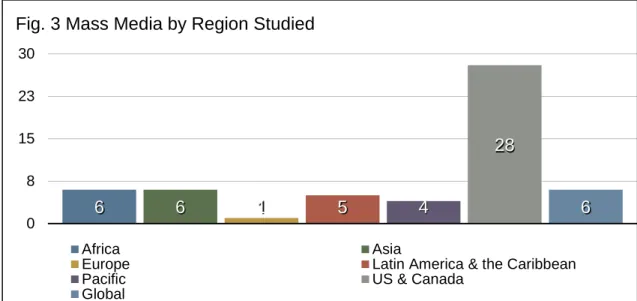
The coverage of ecological levels is much more even within popular literature than in the peer-reviewed/gray literature (see fig. 4). It is interesting to note that mass media & culture are much better represented, since the popular media category includes items that are themselves part of the mass media (such as news stories, personal
narratives, art, etc).
Literature at the individual level provided many examples of storytelling, ranging from women who chose to terminate pregnancies under difficult conditions (https://www.yahoo.com/parenting/what-kind-of-mother-is-8-months-pregnant-and-117104430132.html) to personal explorations of internalized stigma
(http://www.huffingtonpost.com/anna-spargoryan/the-only-person-who-judges-me-for- my-abortion-is-me_b_7266286.html). Storytelling as a topic also comes up in the literature at a more community—or even cultural level—in pieces that tout its
6 6 1 5 4
28
6
0 8 15 23 30
Fig. 3 Mass Media by Region Studied
Africa Asia
Europe Latin America & the Caribbean
Pacific US & Canada
Global
15 13 13 23
30
0 8 15 23 30 38
Fig. 4 Mass Media by Socioecological Level Studied
importance (http://www.psmag.com/health-and-behavior/abortion-storytelling-may-reduce-stigma), defend its necessity (http://rhrealitycheck.org/article/2015/04/20/policy-change-end-goal- abortion-stories/), or point out its limitations
(http://www.thedailybeast.com/articles/2015/04/14/my-abortion-videos-are-moving-but- don-t-change-laws.html). Whatever the result, storytelling has made a mark on the abortion stigma community.
Popular media additionally tends to see more examples of youth involvement; the group Youth Ki Awaaz has been especially impressive with their #Abortthestigma campaign (http://www.youthkiawaaz.com/category/posts/campaigns/abortthestigma/). It also seems that popular media has allowed alternative methods of expressing dissent with abortion stigma, like the creative combination of storytelling with visual art
(http://blog.aclupa.org/2015/04/22/using-artivism-to-combat-abortion-stigma/). The analysis of the popular media also allows for more variation in tone, presenting registers ranging from high-profile news outlets to examples of educational comics about abortion stigma (http://idiva.com/news-iparenting/not-funny-ha-ha-thcomic-book-on-abortion- is-something-every-woman-needs-to-see/1507279).
The difference between the peer-reviewed literature and popular media, then, is seen not only in the breakdown of socioecological representation, but of the modality of the product. Mass media has allowed for more creative products like art and narrative writing, whereas peer-reviewed literature consists primarily of scholarly articles or technical reports.
GAPS AND RECOMMENDATIONS
The research and activity occurring around abortion stigma is exciting, and because of its somewhat inchoate state, still has areas that are ripe for further exploration. Based on the trends and results of the analysis presented in this report, we note some gaps in the current literature and make recommendations for moving forward.
Qualitative evidence from those exploring abortion stigma produces a wide range of exploratory topics. The addition of evidence-based interventions—especially those that take into consideration the context-dependent nature of stigma manifestation—would be
This lack of theoretical framework can complicate attempts to transfer the intervention to another context.
In terms of the distribution of ecological levels, it would be interesting to see more systematic, academically-rigorous examinations of abortion stigma in mass media. Though popular culture is not afraid to address its own strategies for recognizing and dismantling stigma, the peer-reviewed literature has not provided much additional insight into mass media manifestations or interventions around abortion stigma. Greater than the need to diversify the examination of ecological levels, however, is the need to increase
the scope of geographical regions studied in the literature. The peer-reviewed literature shows a heavy preference for the U.S. & Canada and Africa as areas of study. There are a few possible explanations for this pattern; for one, the literature searches were conducted in only English and Spanish, and therefore may have limited the results. Additionally, interest in improving the maternal mortality rates in Africa may have resulted in moredonor resources for research in that region. Expanding future studies to include more regions and languages for publication of documents will provide a more accurate view of the global state of abortion stigma work. Since the Middle East appears to be especially poorly-represented in the literature, increased efforts for research in that area would be welcome.
These gaps in the literature are chances for the community to move forward. In that spirit, we present recommendations for stakeholders, partners, and the inroads network:
• For communications professionals: Explore the ways in which mass media can
be used as a leverage point for reducing abortion stigma; look for opportunities to increase exposure to anti-stigma efforts in the Middle East
• For researchers: Incorporate quantitative research and evaluation in
intervention design; systematically explore the effect of mass media on abortion stigma
• For stakeholders: Seek donors who are interested in expanding beyond the
current funding trends (i.e. in new geographic regions)
• For other members of the stigma community: Remember that attempts to
LITERATURE CITED
Abrams, P. (2013). Abortion Stigma: The Legacy of Casey. Women's Rts. L. Rep., 35, 299.
Astbury-Ward, E. (2015). Abortion 'on the NHS': the National Health Service and abortion stigma. J Fam Plann Reprod Health Care, 0(1-2).
Banerjee, S. K., Andersen, K. L., Buchanan, R. M., & Warvadekar, J. (2012). Woman- centered research on access to safe abortion services and implications for behavioral change communication interventions: a cross-sectional study of women in Bihar and Jharkhand, India. BMC Public Health, 12, 175. doi:10.1186/1471-2458-12-175
Boudewyns, V., Himelboim, I., Hansen, D. L., & Southwell, B. G. (2015). Stigma's Effect on Social Interaction and Social Media Activity. J Health Commun, 1-9. doi:10.1080/10810730.2015.1018604
Cockrill, K., Upadhyay, U. D., Turan, J., & Greene Foster, D. (2013). The stigma of having an abortion: Development of a scale and characteristics of women experiencing abortion stigma. Perspectives on sexual and reproductive health, 45(2), 79-88.
Cook, R. J., & Dickens, B. M. (2014). Reducing stigma in reproductive health. Int J Gynaecol Obstet, 125(1), 89-92. doi:10.1016/j.ijgo.2014.01.002
Cook, R. J., Erdman, J. N., & Dickens, B. M. (2014). Stigmatized Meanings of Criminal Abortion Law. In R. J. Cook (Ed.), Abortion Law in Transnational Perspective: Cases and Controversies (pp. 347-369). Philadelphia: University of Pennsylvania Press.
Corrigan, P. W., Morris, S. B., Michaels, P. J., Rafacz, J. D., & Rüsch, N. (2012). Challenging the public stigma of mental illness: a meta-analysis of outcome studies. Psychiatric Services, 63(10), 963-973.
Crenshaw, K. (1989). Demarginalizing the intersection of race and sex: A black feminist critique of antidiscrimination doctrine, feminist theory and antiracist politics. U. Chi. Legal F., 139.
Gerdts, C., DePiñeres, T., Hajri, S., Harries, J., Hossain, A., Puri, M., Foster, D. G. (2014). Denial of abortion in legal settings. Journal of Family Planning and Reproductive Health Care, jfprhc-2014-100999.
Gipson, J. D., Hirz, A. E., & Avila, J. L. (2011). Perceptions and Practices of Illegal Abortion among Urban Young Adults in the Philippines: A Qualitative Study. Studies in Family Planning, 42(4), 261-272.
Griffith, J. L., & Kohrt, B. A. (2015). Managing Stigma Effectively: What Social Psychology and Social Neuroscience Can Teach Us. Academic Psychiatry, 1-9.
Guttmacher Institute and Likhaan Center for Women's Health. . (2010). Facts on Barriers to Contraceptive Use In the Philippines. Retrieved from
http://www.guttmacher.org/pubs/FB-contraceptives-philippines.pdf
Bellagio Expert Group Meeting. Women & health, 54(7), 617-621.
Hoggart, L. (2015). Abortion Counselling in Britain: Understanding the Controversy. Sociology Compass, 9(5), 365-378.
Hosseini-Chavoshi, M., Abbasi-Shavazi, M. J., Glazebrook, D., & McDonald, P. (2012). Social and psychological consequences of abortion in Iran. International
Journal of Gynecology & Obstetrics, 118, S172-S177.
Hung, S. L. (2010). Access to safe and legal abortion for teenage women from deprived backgrounds in Hong Kong. Reproductive Health Matters, 18(36), 102-110.
Joffe, C. (2013). The politicization of abortion and the evolution of abortion counseling. American journal of public health, 103(1), 57-65.
Kebede, M. T., Hilden, P. K., & Middelthon, A. L. (2012). The tale of the hearts: deciding on abortion in Ethiopia. Cult Health Sex, 14(4), 393-405.
doi:10.1080/13691058.2011.649495
Kumar, A., Hessini, L., & Mitchell, E. M. (2009). Conceptualising abortion stigma. Cul- ture, health & sexuality, 11(6), 625-639.
Levandowski, B. A., Kalilani-Phiri, L., Kachale, F., Awah, P., Kangaude, G., & Mhango, C. (2012). Investigating social consequences of unwanted pregnancy and unsafe abortion in Malawi: The role of stigma. International Journal of Gynecology & Obstetrics, 118, S167-S171.
Link, B. G., & Phelan, J. C. (2001). Conceptualizing Stigma. Annual Review of Sociology, 27, 363-385.
Lithur, N. O. (2004). Destigmatising abortion: Expanding community awareness of abor-tion as a reproductive health issue in Ghana. African Journal of
Reproductive Health, 70-74.
Mahajan, A. P., Sayles, J. N., Patel, V. A., Remien, R. H., Ortiz, D., Szekeres, G., & Coates, T. J. (2008). Stigma in the HIV/AIDS epidemic: a review of the
literature and recommendations for the way forward. AIDS (London, England), 22(Suppl 2), S67.
Martin, L. A., Debbink, M., Hassinger, J., Youatt, E., & Harris, L. H. (2014). Abortion providers, stigma and professional quality of life. Contraception, 90(6), 581-587.
McMurtrie, S. M., García, S. G., Wilson, K. S., Diaz-Olavarrieta, C., & Fawcett, G. M. (2012). Public opinion about abortion-related stigma among Mexican
Catholics and implications for unsafe abortion. International Journal of Gynecology & Obstetrics, 118, S160-S166.
Norris, A., Bessett, D., Steinberg, J. R., Kavanaugh, M. L., De Zordo, S., & Becker, D. (2011). Abortion stigma: a reconceptualization of constituents, causes, and consequences. Women's Health Issues, 21(3), S49-S54.
Pheterson, G., & Azize, Y. (2005). Abortion practice in the northeast
Caribbean:“Just write down stomach pain”. Reproductive Health Matters, 13(26), 44-53.
Purcell, C., Hilton, S., & McDaid, L. (2014). The stigmatisation of abortion: a qualitative analysis of print media in Great Britain in 2010. Cult Health Sex, 16(9), 1141-1155. doi:10.1080/13691058.2014.937463
Rusch, N., Angermeyer, M. C., & Corrigan, P. W. (2005). Mental illness stigma: concepts, consequences, and initiatives to reduce stigma. Eur Psychiatry, 20(8), 529-539. doi:10.1016/j.eurpsy.2005.04.004
Sauer, U., Singh, A., Rubenstein, P., & Pittrof, R. (2013). Do women requesting only contraception find attendance at an integrated sexual health clinic more stigmatizing than attendance at a family planning–only clinic? International journal of women's health, 5, 57.
Shellenberg, K. M., Hessini, L., & Levandowski, B. A. (2014). Developing a scale to measure stigmatizing attitudes and beliefs about women who have abortions: results from Ghana and Zambia. Women & health, 54(7), 599-616.
Shellenberg, K. M., & Tsui, A. O. (2012). Correlates of perceived and internalized stigma among abortion patients in the USA: An exploration by race and Hispanic ethnicity. International Journal of Gynecology & Obstetrics, 118, S152-S159.
Sorhaindo, A. M., Juárez-Ramírez, C., Olavarrieta, C. D., Aldaz, E., Mejía Piñeros, M. C., & Garcia, S. (2014). Qualitative evidence on abortion stigma from Mexico City and five states in Mexico. Women & health, 54(7), 622-640.
Tagoe-Darko, E. (2013). “Fear, Shame and Embarrassment”: The Stigma Factor in Post Abortion Care at Komfo Anokye Teaching Hospital, Kumasi, Ghana. Asian Social Science, 9(10), p134.
Upadhyay, U. D., Cockrill, K., & Freedman, L. R. (2010). Informing abortion
counseling: An examination of evidence-based practices used in emotional care for other stigmatized and sensitive health issues. Patient education and
counseling, 81(3), 415-421.
Weidner, G. (1989). Abortion as a Stigma: In the Eyes of the Beholder. Journal of Research in Personality, 18, 359-371.
World Health Organization. (n.d.). Preventing unsafe abortion. In Sexual and reproductive health. Retrieved November 2, 2015, from