Kristin K. White. Adult Patrons’ Use of Public Libraries to Find Health Information. A Master’s Paper for the M.S. in L.S degree. April, 2010. 43 pages. Advisor: Claudia Gollop
The need for health information is universal, but with limited time to spend with health care professionals and the increasing amount of health information available online, people often have trouble finding quality health information that they can understand. Public libraries are perhaps a solution to this problem, as they provide access to resources and help with searching for information. This study seeks to understand how people use public libraries for finding health information. Patrons from three libraries were
surveyed about their reasons for choosing the public library to find health information, the types of resources they used while there, and their satisfaction level with the information they found. Reference librarians were interviewed about the services they provide and the types of resources available to users. Findings indicate that most users come to the public library to use medical books available there and that many prefer print sources over online sources.
Headings:
by
Kristin K. White
A Master’s paper submitted to the faculty of the School of Information and Library Science of the University of North Carolina at Chapel Hill
in partial fulfillment of the requirements for the degree of Master of Science in
Library Science.
Chapel Hill, North Carolina April 2010
Approved by
Introduction
The need for health information is universal, one which we all face at some point in our lives. But the ways in which people go about finding this necessary information continue to change. This paper examines one of these ways: how people use public libraries to find health information. This topic fits into the larger area of consumer health information, which has become increasingly relevant with the availability of so much information via the Internet as well as the current health care environment. Many, if not most, doctors acknowledge the importance of encouraging patients to participate in their own care (Gillaspy, 2005) which requires health care consumers to educate themselves about medical issues. One way they do this is by seeking health information on the Internet, which has become a more prevalent occurrence in recent years. According to a 2003 report from the Pew Internet Project, 93 million Americans had conducted searches for health information on the Internet (Fox & Fallows, 2003). This number is up from 52 million Americans who used the Internet to make health decisions in 2000 and 73 million who searched for health information online in 2002 (Fox & Rainie, 2002).
important place for users to go to meet their personal information needs even in an age of abundant health information online.
The need for consumer health information presents specific challenges for the general population. Consumers often have limited time to spend with their physician discussing health issues and are confronted with a plethora of information about new drugs and treatments, creating a need for them to understand much of this information on their own (Deering & Harris, 1996; Gillaspy, 2005). At the same time, the amount of consumer health information on the web can be overwhelming, with much of it being of questionable quality, leaving consumers to sort through the good and the bad in order to find information that is relevant to them. Public libraries would seem to be a solution to these problems, as they provide access to information for users who might otherwise be without access and librarians who can help people distinguish between good and bad sources of information. Public libraries have the potential to be, and indeed already are, important portals to vital health information for many people, which is why this is an important topic to study.
• Why do people choose the public library as a source for finding health
information?
• What kinds of sources do people use when looking for health information at the
public library?
• To what extent are users satisfied with the information they obtain at the public
Literature Review
Public libraries have long been a source of information for the communities in which they exist. One of the information needs that people most often use public
libraries for is health information (Wood et al., 2000). Yet with the rise in the amount of consumer health information freely available on the Internet, people now have even more choices of where to turn to find health information. In such an environment, why do they choose to go to the public library for health information, and does this choice lead to a successful search experience? The purpose of this literature review is to identify the research that has been conducted on the types of health-related resources and services provided by public libraries, some of the different populations toward which those services are targeted, and some potential issues raised by the provision of services. This literature review will also demonstrate the gaps that exist in this area and the need to address questions of people’s motivations for using the public library to find health information, what sources they use there, and how successful they are in finding what they need there.
who are most likely to seek health information and who might be the least likely to be able to find it without assistance or be satisfied with what they find. Results of the assessment indicate that there is a strong demand for consumer health information and a variety of sources of information to which people turn. Such sources include medical practitioners, health care facilities, libraries, voluntary health agencies, mass media, federal programs, and employers. One of the significant findings of the assessment was that people usually turn to some type of intermediary as their first source of health information, including physicians and librarians. The reason for this reliance on intermediaries is due, at least in part, to some of the problems related to health
information that the authors identify. These problems include difficulty with interpreting conflicting information, judging the credibility of information, and choosing between many different options.
The significant level of demand for consumer health information, the variety of sources that supply it, and the problems surrounding it all present opportunities for libraries to fill this need. Deering and Harris’s point about people’s preference for an intermediary in finding health information seems to suggest a role for libraries to play in the search for consumer health information. With so many sources that provide
information, libraries can serve as a resource to help people sort through other sources to find the best information and link people to the suppliers that best fit their needs.
Libraries can also assist in selecting reliable information and weighing the appropriateness and credibility of conflicting information. Are libraries actually
the wealth of available health information? Understanding the background of the consumer health information environment, especially several years after this article was written, can give us a point of reference to which we can compare the current state of public library use in the consumer health information milieu.
Once we situate ourselves within this framework, it is useful to consider how this environment might have come to be. One author that provides some possible
explanations is Gillaspy (2005). This article reviews trends in public libraries’ provision of health information from 2000 to 2005 and identifies seven factors that have influenced this area. These include increased access to the Internet, quality of web-based health information, better understanding of the health effects of American lifestyles, progression of the consumer health movement, increased availability of quality print materials,
emphasis on health literacy, and the effects of September 11th. Some of these topics are explored by other research described later in this review. The author goes on to identify several other factors that influence health information provision that have not changed in recent years, including health coverage in the news, the Baby Boomers, lack of time with health care professionals, and alternative and complementary therapies. The author concludes by calling for strong partnerships as well as thoughtfully constructed collections in order to meet the demands of consumers for health information.
of these factors may have changed since 2005, but this article at least provides a
foundation to help us understand some of the reasons behind the current state of affairs. The literature on this topic describes some of the types of health-related resources and services that public libraries provide. One type of service libraries often provide is access to commercial health databases as well as other health-related websites. For example, Picerno (2005) examines the types of online resources to which public libraries provide access. In the article, the author begins by summarizing what is known about the kinds of users who look for health information on the Internet and some of their
information-seeking habits. Most users tend to be younger, with some college
experience, and are somewhat skeptical about the origin of online health information but still do not often evaluate it rigorously. Picerno then conducted a study of various public library websites to see how many provided access to commercial databases of health information, and which databases those were, as well as how many public library
The article concludes with recommendations about how public libraries can better provide health information resources to the public.
Picerno’s study informs the research study at hand by describing some of the types of health-related resources that public libraries provide. Online health information represents a significant portion of the information available to consumers, so knowing the prevalence of health information available on public library websites can give us a clue about patrons’ online searching experience and how it might affect their overall library experience. The kinds of sources available to public library patrons can affect the kinds of sources that they use, but it may also limit the information they are able to access. This article sheds light on a particular service the library offers in providing health information and, in combination with knowledge of how patrons use the resources at the public library, could help identify ways to improve services to users.
The study above raises a significant point in the area of consumer health
information. In contrast to these views, the majority of patients preferred face-to-face verbal interactions with hospital staff as the delivery method for health information.
Although this study was conducted in a hospital setting where patients are likely to have very specific information needs, it may be indicative of the way others prefer to receive health information. With the increase in Internet access and usage in the general population over time, the Internet is likely to remain an important source for health information for some time to come. The results of this study also imply that people still prefer a trusted human intermediary in their search for health information even with the amount of information the Internet affords them. Both of these avenues warrant
attention. What does this mean for the current study? Public libraries are often
considered to be trustworthy sources of information in general, and thus may be looked to as the preferred intermediary for providing health information. The current study will attempt to find out if this is the case and if this is one of the reasons that people choose the public library as a source of health information. It will also attempt to discover the prevalence of online health information seeking among public library users.
Public libraries also provide services in the form of training to teach people how to find health information online. The degree to which this type of training is successful may have implications for how successfully users are later able to find health
their responses to questions about their levels of computer anxiety, interest, and efficacy from before and after the training sessions were compared. The authors found that the majority of participants had positive perceptions of the training and reported reduced levels of computer anxiety and increased interest and efficacy in using computers to find health information after the training. The majority of participants reported using the online resources presented during the training outside of class during the four weeks in which sessions took place, even though most of them were not familiar with these resources before the classes began.
While this study demonstrates the usefulness of computer training for older adults in general, it is also significant in the context of finding health information specifically. The finding that most older adults in the study applied the skills from the training to their lives outside of class implies that finding quality health information is a significant aspect of people’s personal information needs. Additionally, although most participants said they did not expect public libraries to provide this type of training, they also said that public libraries should provide this type of training program. This seems to indicate that the public library is viewed as a place people would like to turn for guidance in finding and selecting health information to fill their personal needs. Why the public library? This is one of the questions that the current study intends to investigate.
and McKenzie (2005). In this study, the researchers interviewed six public library staff members about a total of seventy-four accounts of questions regarding consumer health information. While analyzing these accounts, the authors identified barriers associated with the encounters and divided them into several categories including those that
preceded the user’s visit to the library, those associated with the user’s encounter with the library, and those associated with the library’s response to the user’s question. According to staff accounts, barriers that users faced prior to going to the library included difficulty in finding out about or connecting with health care professionals or other agencies as well as physicians’ lack of time to spend discussing issues with their patients. Barriers
encountered during the library visit were considered to be content-related (missing information on the part of the user or lack of knowledge on the part of the librarian) or relational (interpersonal characteristics of the participants or sensitive nature of the topic). Finally, librarians described some barriers as beyond their personal control and more closely related to the library as a whole. These include factors such as whether the user interacted with a capable staff member; the scope, availability, and organization of the collection; and funding and coordination of local resources.
The authors of this article intended to examine how librarians construct the “story” of the reference transaction and portray their own successes, but it is still very useful in understanding the role of reference services in users’ search for health information at the public library. Analysis of these accounts can help give us a better understanding of the challenges that librarians face in assisting patrons looking for health information as well as challenges that patrons face (at least from the librarians’
library experience to find the help they need. The article also raises some issues
surrounding the search, issues that are related to the nature of the information that people are seeking. People may often be uncomfortable discussing health issues with librarians with whom they are not familiar, and librarians may be afraid to probe too deeply out of respect for patrons’ privacy, making the experience more difficult for both parties. These issues and challenges could very well play into users’ reasons for choosing the public library as a source of health information, whether or not they choose to approach the reference desk with their questions, and how satisfied they are in their ability to find what they need.
As suggested in the previous articles, consumer health information presents a variety of difficulties. One of these is consumers’ ability to understand the information available to them. Burnham (2003) stresses the importance of health information literacy in a review of various initiatives to increase and evaluate levels of literacy. Citing studies that reveal alarmingly low levels of literacy among American adults, the author also presents findings from the Institute of Medicine highlighting problems with the American health care system. One of these findings is that the problem of inequalities in health care is partially due to health literacy issues, especially since this is an issue that affects all types of patients at every stage of life. While there are multiple methods for
players in building health literacy even if other organizations have not yet realized libraries’ potential.
People’s ability to read and understand health information is clearly an issue, and libraries seem to be in a position to address this issue. If libraries do fulfill the role of educating patrons on health literacy issues, it may have an effect on users’ satisfaction with the information they find and their ability to find it. Do consumers recognize the potential of public libraries to assist them in their attempt to make sense of material that is often too difficult for them? The current study intends to take this problem into account in its examination of reasons that people use the public library to find health information and their satisfaction with the information they obtain from the public library.
The previous articles all inform the topic of how people use the public library to find health information in some way, including the kinds of resources and services that public libraries provide, the types of users looking for health information and their
information seeking preferences, or various problems associated with searching for health information. These aspects of the topic can help shed light on the reasons why people choose to use the public library for health information, the types of sources they use once they have chosen to use the public library, and their levels of satisfaction with the
Methodology
The method used for this research was a combination of surveys (questionnaires) and semi-structured interviews. The term “survey” can have multiple meanings in the context of research methods, but according to Groves et al. (2009), “A ‘survey’ is a systematic method for gathering information from (a sample of) entities for the purposes of constructing quantitative descriptors of the attributes of the larger population of which the entities are members” (p. 2). Surveys are used to gather descriptive information about the characteristics, attitudes, opinions, or experiences of a population. They are useful in describing human behavior and its potential causes, but they can also work well for collecting more objective data such as demographic information. Some generally accepted characteristics of surveys are that they collect information by asking people questions which can be administered either through interviews where people are asked questions and an interviewer records their answers or by having people either read or listen to questions and record their answers themselves (Groves et al., 2009).
The other method chosen for this study was the semi-structured interview. With this method, the researcher begins with a set of predetermined questions, but the
researcher can change the order of the questions, leave questions out, or ask additional probing questions during an interview depending on the respondent’s answers.
often choose to use semistructured interviews because they are aware that individuals understand the world in varying ways. They want to elicit information on their research topics from each subject’s perspective” (p. 233). Using this method, two reference librarians from each of the three public libraries in this study who answer questions about health information were interviewed to find out, from their perspectives, what kinds of questions users are asking. The three libraries where the research for this study took place were the Chapel Hill Public Library, the main library in the Durham County Public Library system, and Cameron Village Regional Library in the Wake County Public Library system. Each librarian has unique experiences in this regard, and the semi-structured interview allowed for collection of data that can capture this uniqueness.
Justification
administered in person rather than via the Web or e-mail because one of the assumptions of this study was that some people come to the public library to use the Internet because they do not have access elsewhere. Hence, it would not have made sense to administer a survey to which respondents in the sample did not have access. The survey could have been available on the computers in the public library, but this method might have missed users who only come to the library to look for books and do not use the computers. It also may have been easier for users to ignore the survey if it was administered on the computers, possibly resulting in a smaller sample size.
In addition to the survey for library users, two reference librarians were also interviewed from each library; these librarians were ones who answer questions about health information. The librarians were identified by asking members of the library staff who are the people that handle most health-related questions. These interviews were semi-structured and lasted for a short period of time (thirty minutes or less). The reason for these interviews was to find out from the librarians’ perspective what types of
questions users ask about health information and to compare their answers to those of the patrons themselves. This provided an additional level of detail to complement the data collected in the surveys. Semi-structured interviews were used rather than structured or unstructured because this allowed for differences in the experiences of the various librarians while still gathering consistent types of information.
Population and Sample
complete the survey. Each library was visited for two hours at a time on two occasions over the course of two weeks, varying the days of the week and times in order to reach different groups of users. This procedure was repeated at three local public libraries, including the Chapel Hill Public Library, the main library in the Durham County Public Library system, and the Cameron Village Regional Library in the Wake County Public Library system. These libraries are heavily used and each represents different
communities and demographic groups, which is why they were chosen for sampling. Because of the difficulty of identifying each member of the population (as public library users visiting the library may not necessarily have a library card), this sampling technique was one of convenience and thus is usually referred to as “convenience sampling.”
Data Collection Instruments
dissatisfied. Each of these questions directly relates to one of the research questions: why users choose the public library as a source for health information, what kinds of sources they use while at the library, and whether or not they are satisfied with the information they find there.
Appendix B contains the interview schedule used during the interviews with reference librarians from each library. The first few questions ask about the types of people who use the library as well as the estimated number and percentage of health-related questions librarians receive in a typical week. Other questions included what types of sources the librarians direct users to, how many sources they use in answering a single question, and whether librarians ever direct users to other organizations for more information. The last few questions asked whether librarians are usually able to answer users’ questions and whether users seem satisfied with the information they receive.
Study Procedures
appropriate to interview (who had the most experience answering health information questions). Each selected librarian was interviewed for approximately thirty minutes.
Ethical Issues
This study presents possible ethical issues because it deals with information related to participants’ health. While questions on the survey instrument did not directly ask people about what health conditions they were looking for information about,
participants may have still been uncomfortable answering questions that they felt could indicate the specific conditions in which they were interested. One topic of interest during this study was discovering what types of sources people use, including what types of websites they might be visiting. People might have been unwilling to share the names of specific websites if the website is dedicated to a particular condition, especially if that condition has some type of stigma attached to it (mental health, for example). The survey did not ask for specific websites for this reason, so questions asked about the type of website used such as whether they were government-provided, websites for an
association or nonprofit group, or commercial websites. No names were collected with the surveys so individual responses are not identifiable. This ensured anonymity and protects the identities of the respondents.
Study Limitations
Results and Discussion
One hundred forty-eight people filled out the survey among the three libraries. Of these respondents, 67 were female (45%), 77 were male (52%), and four did not indicate their sex (3%). Ages of the respondents ranged from 18 to 82, with an average age of 46. Most respondents were either white (57%) or African American (32%). The majority also reported having at least some education beyond high school; 28 percent reported a bachelor’s degree as their highest level of education, 24 percent had received a master’s degree, and 7 percent had a doctoral degree. Another 19 percent reported attending some college without earning a degree.
Of the 148 people who completed a survey, 93 responded “yes” to the first question, “Have you ever used the public library to look for health information?” The average age of those who answered yes was 47. Of these, there were 47 females, 44 males, and two who did not indicate their sex. The racial makeup of this group was similar to the makeup of the entire sample, with 56 white respondents (60%) and 29 African American respondents (31%). Education levels were also similar to those of the entire sample. Twenty-eight percent reported a bachelor’s degree as their highest level of education, 24 percent reported receiving a master’s degree, and nine percent reported having a doctoral degree, with another 18 percent reporting attending some college but no degree.
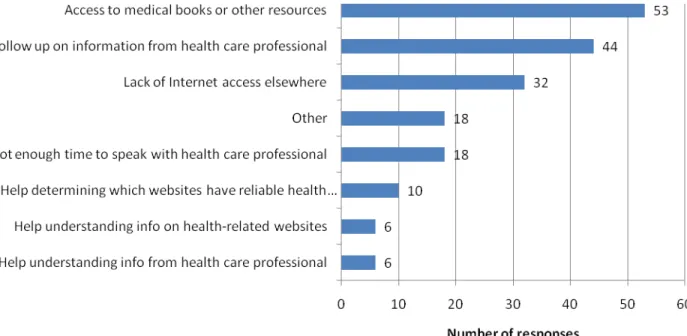
library to find health information. For this question, users could select more than one answer. The survey found that the most common reason users cited was that the library has medical books or other resources that they do not have access to elsewhere, with 57 percent of respondents choosing this reason. Other common reasons included following up on information from a health care professional (47% of respondents) and lack of Internet access elsewhere (34% of respondents). Interestingly, wanting help from a librarian (to determine which websites have reliable health information, to understand information on health-related websites, or to understand information obtained from a health care professional) was the least commonly-cited reason for choosing the public library.
Figure 1: Reasons for choosing the public library as a source for health information (number of responses)
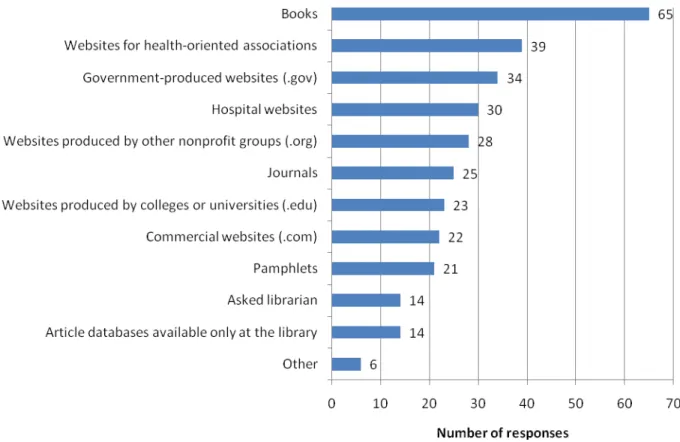
source used was books about medical or health-related information, with 70 percent of respondents choosing this source. Various types of websites were also common sources of information. Overall, online sources ranked as the second most common type of source, with 63 percent of respondents choosing at least one type of online source. These include websites for health-oriented associations, websites produced by other nonprofit groups, government-produced websites, hospital websites, websites produced by colleges or universities, commercial websites, and article databases available only at the library. Asking a librarian ranked as one of the least commonly-used resources, with only 15 percent of respondents choosing this resource. This is consistent with the low number of users who reported “wanting help from a librarian” as one of their reasons for coming to the public library.
The next question on the survey asked users to indicate their level of satisfaction with the health-related information they found at the public library. Figure 3 summarizes their responses. Overall, users were satisfied with the information they were able to find, with 50 percent reporting that they were “Very satisfied” and 42 percent reporting that they were “Somewhat satisfied.” These responses can be further broken down by the libraries at which the users filled out the survey. This breakdown is represented in Figures 4, 5, and 6. Durham had the highest percentage of respondents who were “Very satisfied,” with 25 out of 43 respondents choosing this answer. Cameron Village had 7 out of 14 respondents who reported being “Very satisfied” and Chapel Hill had 14 out of 36.
Figure 4: Satisfaction levels at Durham
Figure 6: Satisfaction levels at Chapel Hill
Out of 148 people who completed the survey, 55 reported that they did not use the public library to look for health-related information. They were then asked their reasons for not doing so using an open-ended question. The most commonly cited reason, with 17 responses, was that the users preferred to use the Internet either at home or somewhere else outside the library. Other common reasons included that they had no need (11 responses), they obtained the information they needed from their doctor or other health care professional (8 responses), and that they had never considered the idea (5 responses). One subject wrote, “I prefer personal interaction.” Another noted, “I find more current information online,” perhaps indicating that she viewed the resources available at the public library as being outdated.
asked how many health-related questions they receive at the reference desk in a typical week, they all reported a very low number, and all estimated that health-related questions accounted for less than 10 percent of all reference questions they receive. This is
consistent with the fact that only a small portion of patrons report asking a librarian for help while looking for health information. One librarian speculated about the reason for this low number, which she said has decreased over the last ten years:
It used to be that older people didn’t know anything about the Internet, and they tended to want health information from the Internet back then, even when I had really great books…they heard the Internet is what you should have, because that’s what everybody told them. ‘Oh, you should go on the Internet and get information,’ and so that’s what they wanted, and they particularly came to the desk to ask for Internet information. And now, I don’t get so much of that particular Internet information request. Still some, because there still are some people who can’t use the Internet or don’t feel comfortable with it, but it’s not so much and I think maybe because a lot of people just are doing it for themselves. I think that’s it. But I’m only guessing.
The librarians mentioned a variety of sources when asked about the types of resources available to users at the library. Five mentioned the library’s print reference collection and specifically named sources such as the Physicians’ Desk Reference, the Mayo Clinic Family Health Book, the Merck Manual, Consumer Reports drug reference guides, and McGill health guides. All of the librarians mentioned the circulating
NC Live specifically. Other online sources included Medline Plus (mentioned by two librarians), NC Health Info (mentioned by two), PubMed, websites for the Mayo Clinic or CDC, and Health Link (each mentioned by one).
In response to the question asking what kinds of sources they direct people to for questions, most of the librarians distinguished between print and online resources and said they usually ask patrons whether they prefer print or online sources before directing them to a particular source. Some noted that certain types of patrons were more
comfortable with print sources (for example, the elderly) while others preferred Internet sources. One librarian noted that currency is also an issue when considering what types of resources to consult: “We try to stay up to date on our books that you can check out, but you know with medicine things are kind of cutting edge so you might have to go to the Internet or go to the journals, academic journals, so it really depends.” Four out of six
also said they ask patrons if they would like a book that they can check out and take home with them as opposed to using reference books. Four librarians also noted that some of these questions come from students doing research for a class assignment, and in some cases students are required to have a certain number of print sources or journal articles.
The number of sources consulted for a single question varied between librarians, and only two respondents gave a concrete number (two to three sources for one
with more sources than the users want; sometimes the users are satisfied with the amount or quality of information found before the librarians are satisfied that they have answered the user’s question.
Four out of the six librarians said that they do, on occasion, have to refer users to other organizations to answer their question if the question cannot be answered with the resources at the public library. These outside organizations were primarily the libraries at local universities and hospitals. Triangle United Way 211 was another agency mentioned for referring people to social services agencies. Overall, though, all of the librarians said that they are usually able to answer users’ questions and that users generally seem to be satisfied with the information the librarians are able to give them in response to their questions. Two librarians mentioned that users are sometimes unhappy when the librarians will not provide medical advice or interpret medical information for them, but this is usually a small number of patrons. All of the librarians said that user surveys were periodically conducted at their libraries to measure customer satisfaction, but none of the surveys ask specifically about health information.
librarian for help. Additionally, the librarians themselves reported that they receive a very small number of health-related reference questions. There could be multiple reasons for this. As one librarian speculated, patrons’ Internet skills have likely become more sophisticated and so they do not need as much help searching for information online as they once did. Perhaps the quality of health information online has improved so that patrons have an easier time finding good information online without help. Also, patrons still often indicate a preference for books or other print materials, and perhaps they are more confident in their ability to find the information they want in these materials without assistance.
master’s degrees. The higher concentration of people with less education within this group is perhaps to be expected, but it is interesting that several people with master’s degrees also fell into this group. The reasons for this are unclear, but perhaps it shows that the world of health information can be complex and sometimes requires professional help to navigate it for people of all educational levels.
Another interesting finding was that users from the three libraries involved in this study still seem to prefer books and other print sources in their search for health
information. With the growth of the Internet and the amount of information available online, it was expected that users would prefer the Internet as a source for health information. But books were the most-used resource consulted at the library, with 65 respondents (70%) using them in contrast to the 59 respondents (63%) who used at least one online source. Interestingly, 19 people reported that books were the only source they used at the public library, and 27 reported using only print sources (books, journals, or pamphlets). In contrast to this, only nine people reported using online sources as the only sources consulted while at the public library. One possible explanation for the small number of people using only online sources, and for the relatively higher number of people using print sources, is that many people have access to the Internet at home or work and thus do not need to look for online information while at the library; they are likely more interested in books or other print sources that they do not have access to at home.
neither satisfied nor dissatisfied, and two (10%) were somewhat dissatisfied. Among the 27 who used only print sources (books, journals, or pamphlets), eleven (41%) were very satisfied, thirteen (48%) were somewhat satisfied, one (4%) was neither satisfied nor dissatisfied, and two (7%) were somewhat dissatisfied. Those who used online sources tended to be a bit more satisfied with the information they were able to find. Of the nine who used only online sources, three (33%) were very satisfied and six (66%) were somewhat satisfied. Among the 59 who used at least one online source, 33 (56%) were very satisfied, 25 (42%) were somewhat satisfied, and one (2%) was neither satisfied nor dissatisfied.
One possible explanation for this difference in satisfaction between those using only print sources and those using online sources is the currency of the information found in the various sources. Several patrons commented that the information available in books is often not the most current available, which in health-related fields can be a serious consideration, and that the library needed to address this issue. One patron wrote, “Unfortunately, for health related issues, information changes so rapidly that books cannot keep up. I think having the most current books available would be the best.” Librarians also expressed this concern, with one librarian mentioning that the library had recently weeded all books that were older than five years. Perhaps the users that
consulted online sources at least in addition to print, if not exclusively, were able to find information that was more recent and thus were happier with what they were able to find.
Directions for Future Research
This study has examined the reasons people use the public library for finding health information, what sources they use while there, and their level of satisfaction with what they find. Some of the findings were that many people come to the public library to use the medical books and other resources there that are not available to them elsewhere, and that they still often prefer print sources to online sources. This suggests that perhaps online information sources are still less familiar to some users than print sources. One possibility for future research is to conduct a similar study in several years to see if there is still a preference for print sources or if the use of online sources in the public library is more prevalent by then. Similarly, this study could be conducted in other regions to investigate the preferences of other communities of users. Another area for research could be to find out in more detail what specific sources people use and how they search for information. This could include observation to see what websites they visit, which could give us a better idea of whether or not they are finding quality sources of
References
Borman, C. B., & McKenzie, P. J. (2005). Trying to help without getting in their faces: Public library staff descriptions of providing consumer health information. Reference & User Services Quarterly, 45(2), 133-136, 140-146.
Burnham, E. (2003). Libraries as partners in health literacy. Journal of Consumer Health on the Internet, 7(4), 7-15.
Colton, D., & Covert, R.W. (2007). Designing and constructing instruments for social
research and evaluation. San Francisco, CA: Jossey-Bass Publishing.
Deering, M. J., & Harris, J. (1996). Consumer health information demand and delivery: Implications for libraries. Bulletin of the Medical Library Association, 84(2), 209-216.
Fox, S., & Fallows, D. (2003). Internet health resources: Health searches and email have become more commonplace, but there is room for improvement in searches and
overall Internet access [Pew Internet and American Life Project Report]. Retrieved
from
to trust when they or their loved ones are sick [Pew Internet and American Life Project Report]. Retrieved from
Gillaspy, M. L. (2005). Factors affecting the provision of consumer health information in public libraries: The last five years. Library Trends, 53(3), 480-495.
Groves, R M., Fowler, F. J., Couper, M. P., Lepkowski, J. M., Singer, E., & Tourangeau, R. (2009). Survey methodology. Hoboken, N.J.: Wiley.
Picerno, P. V. (2005). Health and medical information on and off the Internet: What part can and do public libraries play? Journal of Consumer Health on the Internet, 9(4), 11-25.
Valimaki, M., Nenonen, H., Koivunen, M., & Suhonen, R. (2007). Patients' perceptions of Internet usage and their opportunity to obtain health information. Medical
Informatics and the Internet in Medicine, 32(4), 305-314.
Wildemuth, B. M. (2009). Application of social research methods to questions in
information and library science. Westport, CT: Libraries Unlimited Press.
Appendix A: Survey Instrument
Public Libraries and Health Information Survey
Please answer the questions below to the best of your ability. By answering these questions, you acknowledge that you have read and agree to the information provided in the information sheet, asked all questions you have at this time, and voluntarily agree to participate in this research study.
1. Have you ever used the public library to look for health-related information?
2. If you answered no to question 1, why not?
If you answered no to question 1, please skip ahead to question 6.
3. If you answered yes to question 1, why did you choose the public library as a source for health-related information? (check all that apply)
__lack of Internet access elsewhere
__not enough time to speak with my health care professional __follow up on information from my health care professional
__want help from librarian to understand information from my health care professional
__want help from librarian to determine which websites have reliable health information
__want help from librarian to understand the information on health-related websites
__the library has medical books or other resources that I don’t have access to elsewhere
__other (please specify)
4. If you have used the public library to look for health-related information, what types of sources do you use while there? (check all that apply)
__government-produced websites (.gov)
__websites for medical or health-oriented associations (for example, the American Heart Association)
__websites produced by other nonprofit groups (.org) __commercial websites (.com)
__websites produced by colleges or universities (.edu) __hospital websites
__pamphlets about medical or health-related information __journals about medical or health-related information __asked librarian
__other (please specify)
5. How satisfied were you with the health-related information you found at the public library? (check one)
__Very satisfied __Somewhat satisfied
__Neither satisfied nor dissatisfied __Somewhat dissatisfied
__Very dissatisfied
6. In the future, what could the library do to help you find health information?
7. Age: _______
8. Gender (circle one): Male / Female
9. Race/Ethnicity (check all that apply): __American Indian or Alaska Native __Asian
__Black or African American __Hispanic or Latino
__Native Hawaiian or Other Pacific Islander __White
__Other (please specify)
10. Highest education level (check one) __Not a high school graduate __High school graduate __Some college
Appendix B: Interview Schedule
Please answer these questions to the best of your ability. You may tell me if you wish to skip any question, and you may stop the interview at any time.
1. Please describe the types of users that frequent your library.
2. Approximately how many questions about health information do you receive in a typical week?
3. Please estimate the percentage of all questions you receive that are health-related (0-10%, 10-20%, 20-30%, 30-40%, 40-50%, more than 50%?)
4. What types of health-related resources does your library provide to users? 5. What types of sources do you typically direct users to when they have
health-related questions?
6. About how many sources do you use when responding to a question?
7. Do you ever refer users to other agencies or organizations when responding to a question?
8. If so, can you give an example of some of the agencies or organizations you refer them to?
9. Are you generally able to answer users’ questions?
10. Do users seem satisfied with the information you give them?
11. Are user surveys ever conducted at your library?
12. If so, are questions related to health information included in the survey?