Smart Relay Selection Scheme Based on Fuzzy
Logic with Optimal Power Allocation and Adaptive
Data Rate Assignment
Nayab Taj
1,2, Mohammad Haseeb Zafar
1,3, Shakeel Ahmad Waqas
2, Humaira Rehman
2, Madini O. Alassafi
3and
Imran Khan
11Department of Electrical Engineering, University of Engineering & Technology, Peshawar, Pakistan 2Department of Electrical Engineering, University of Engineering & Technology, Mardan, Pakistan
3Department of Information Technology, King Abdulaziz University, Jeddah, Saudi Arabia
Abstract: In this paper fuzzy logic-based algorithm with improved process of relay selection is presented which not only allocate optimal power for transmission but also help in choosing adaptive data rate. This algorithm utilizes channel gain, cooperative gain and signal to noise ratio with two cases considered in this paper: In case-I nodes do not have their geographical location information while in case-II nodes are having their geographical location information. From Monte Carlo simulations, it can be observed that both cases improve the selection process along with data rate assignment and power allocation, but case-II is the most reliable with almost zero probability of error at the cost of computational complexity which is 10 times more than case-I.
Keywords: Relay Selection, Power Allocation, Fuzzy
Logic, Cooperative Networks, Adaptive Data Rate.
1.
Introduction
In all communication systems reliable exchange of information is the key parameter. In wireless communication the most effective technique is said to be cooperative diversity like in Third Generation, IEEE 802.11s and LTE etc. By considering its importance in most of the wireless communication technologies it is important to analyze and investigate the performance of wireless cooperative networks. Cooperative communication produces spatial diversity due to which it has shown progress and rapid deployment in the previous decades. Multipath fading is the key problem in wireless communication which significantly effect wireless channels. Diversity protocols in cooperative networks overcome these effects in which installation of multiple antennas at transmitter and receiver ends, are no longer needed but its users share their antennas among them. These intermediate nodes are named as relays, and these relays work as an intermediate virtual array of antennas which neither is the source nor the destination [1]. MIMO concept because of its high cost, size and hardware problems is not acceptable especially, when capacity and high data rate along with optimum energy utilization is required. Cooperative networks provide better performance by using relays as forwarders of the information signal between source and destination, manipulating the broadcast nature of wireless networks [2]. Relay forward the received signal to destination, following the designed forwarding protocol like Amplify-and-Forward (AF), Decode-and Forward (DF), Detect-and-Forward (DTF), Compress-and-Forward (CF)
and coded cooperation (CC) etc. [3]–[9]. AF amplify the received signal before forwarding along with the noise while DF first decode and then modulate again before forwarding to destination but require more computational power and system complexity [4]–[7]. Hybrid decode-amplify-forward (HDAF) perform better than AF and DF working alone based on SNR [10]. Besides selecting relaying protocol, selection of best cooperating relay could also significantly improve the performance of cooperative networks. Either the source or destination makes the decision of selecting cooperating relay with better specifications among all the available relays regarding the requirements of the system. Multi-hop transmission using a series of relays increases the range of communication [8]. In [9] the author discusses selection relaying, all-path selection relaying and selection cooperation relaying for multi-hop cooperative networks.
Outage probability can be effectively reduced in both single and multi-relay cooperative systems using optimum relay location. Being one of the most vital aspect of wireless communication, Paper [11] present an algorithm using analytical deduction for optimal relay location with the aim of reducing outage probability. To minimize the outage probability using Hybrid Decode-Amplify-Forward (HDAF) protocol, second or third relay can take part in cooperation in case of the unavailability of the best relay [12]. However, another method for minimizing the average outage probability using AF is discussed in [13], which using channel statistics eliminates unnecessary cooperative relays hence saving resources like battery power, related relay links calculations etc. Outage priority-based fairness scheme is presented in [14] for the improvement of selection fairness among all relays without reducing network lifetime and outage probability gain. Energy harvesting system presented in [15] using DF improves outage probability, by increasing the number of relays between source and destination and utilizing the cochannel interference and information signal for energy harvesting purposes. Optimal outage-based relay selection scheme discussed in [16] first take feedback from the receiver and then decide for relay cooperation to be helpful or not.
for uplink transmissions. An opportunistic relying scheme using decode and forward protocol is presented in [15], which uses rechargeable nodes instead of constant transmission power. The power at the relay is now random and depends on the available energy of the information signal received at the relay. Energy from the cochannel interference signals is also harvested by the energy constrained relays and then the total harvested energy is effectively utilized to forward the decoded signal to the destination. To minimize the overall BER in cooperative networks, a power allocation strategy is discussed in [18], emphasizing on the quality of inter-user links for reliable communication of relayed information. A power efficient algorithm for the power constraint network is proposed in [18], with the aim of overall reduction in outage probability. Based on analytical deduction outage probability gain is calculated. Also, HDAF scheme is used at the relay which select DF to forward the received signal if channel status is good between source and relay. Otherwise, AF is used to forward the signal. Reducing system complexity, outage probability, symbol error rate, bit error rate and maximizing throughput and energy savings etc. are the finest goals of the optimized power allocation in cooperative networks [19], [20].
An opportunistic relaying scheme for the selection of best among all the available relays, using exact channel statistics from source to relay and then to destination are required by the source is discussed in [21]. However, the issues like the probability of having the same channel for data transmission and estimation as well as system delay are not addressed. To reduce computational power local information available at the relay about channel statistics for relay selection is used instead of complete knowledge of all paths [22]. SNR calculated from outdated channel state information CSI is used for best relay selection, which according to authors gives better results but are not suitable for low SNR regions [23]. Relay selection technique using fixed distance and transient channel state information between any two nodes is presented in [24] but this technique is not suitable for dynamic networks and where low computational complexity is the prerequisite.
Using the distances from source to relay and from relay to destination, best relay with minimum SNR is selected in [25], but channel fading, and shadowing effect are the major issues not addressed in the paper which make it unsuitable for real scenario. In [26] a threshold criterion by the destination is used to decide whether relay cooperation is needed or not. The destination send request to relay for cooperation if bit error rate is below certain threshold value. Based on the relay location optimal power is allocated. However, they have considered a single relay network which is unsuitable for a network having more relays between source and destination. The impacts of mobility of different nodes in cooperative networks are investigated in [27], by deriving complex analytical expressions for static and mobile nodes. In [28] the authors presents a mobile-to-mobile system in which both source and destination as well as the intermediate nodes are mobile. By increasing number of mobile relays outage probability improves for a fixed value of SNR.
Fuzzy logic, Unlike modern computers which are based on Boolean logic 0 & 1 that represents two possible states (on/off, true/ false etc.), is based on “degrees of truth” exactly the way human brain works in which there are
various states In between 0 and 1. Fuzzy logic is a many valued logic and has been applied to many fields like control theory, neural networks and artificial intelligence. The fuzzy logic uses Boolean logic (0 & 1) as its extreme cases of truth and in between this 0 & 1the truth values of the variable may be any real number. Hence, the concept of partial truth can be handled by the fuzzy logic much closer to the way of decision making in humans. For example, the temperature of the room may not be too cold or too hot, it can be any value in between so.
The use of natural language and qualitative description makes fuzzy logic more flexible, easy to understand and the place where reasoning really works [29], [30]. Optimal election of cluster head in wireless sensor network consume energy drastically and need to be made energy efficient for enhancement of the network lifetime. In [31] the author have presented a fuzzy logic based system for cluster head selection which takes energy, concentration of the nodes and centrality of a specific node into account. Fuzzy logic based system is proposed for cognitive networks in [32]. The authors have shown that fuzzy logic can be used in cooperative spectrum sensing to further enhance the performance of combining methods. Also, the authors claim that fuzzy logic have the capability of sophisticated and non-predictable decision making which is a requirement of future wireless communication and cognitive networks.
Our focus is primarily on the implementation of a dynamic cooperative system based on fuzzy logic, guaranteeing selection of best cooperating relay among all the available relays. This dynamic cooperative system will promise an enhancement in optimal objectives of a cooperative network. This proposed fuzzy logic-based algorithm will reduce system complexity by avoiding repeated relay selection and will improve the transmission quality. Also, it will reduce power consumption by dynamic power allocation and overall computational complexity of the system. Along with that, our proposed algorithm will also assign optimal data rate to the relay to be used during transmission for best performance. This relay selection scheme is evaluated in terms of Bit Error Rate (BER) with analysis performed on different data rates. For cooperative network’s performance optimization, different relay selection parameters are used by the researchers. However, they are mostly focused on the use of a single parameter. In our work we have considered more than one selection parameters like cooperative gain, channel gain and signal to noise ratio using a Fuzzy Logic system which significantly improve the selection of best cooperating relay. Apart from CSI, using nodes geographical location information can further improve the performance causing zero probability of error in relay selection. In addition to best cooperating relay selection, this work is focusing on optimal power allocation and adaptive data rate selection to reduce power consumption, system complexity and to ensure reliable transmission of information signal. For simplicity we have considered single antenna at each node. Using multiple antennas like in MIMO technology, can improve coverage and data rate but will raise issues like high cost, large size and hardware problems etc.
The major contributions of our work are as follows:
• The selection parameters are Cooperative Gain, Channel Gain and Signal to Noise Ratio.
• Fuzzy logic yields even better BER performance by ensuring 100% accuracy in selection of best cooperating relay when apart from channel state information, nodes geographical location information is also available at the source.
• proposed algorithm reduces power consumption by dynamic optimal power allocation and hence minimizes overall computational complexity of the system.
• Our proposed algorithm also assigns optimal data rate to the relay to be used during transmission for best performance. Our suggested relay selection scheme is evaluated in terms of Bit Error Rate (BER) and analysis is performed using different data rates. The remaining of the document is organized as follows: Section 2 of this paper presents the cooperative system model consisting of single source and destination having AF protocol-based relays in-between. However, our proposed algorithm can work effectively on both DF and AF. Our focus is on the selection of best cooperating relay, based on channel state information and nodes location information (if available) and not on the forwarding protocol used by the relay. The system model is explained in two phases for reliable communication and decision of best relay. Various parameters are also part of this section. Section 3 explains an optimized relay selection criterion for our proposed algorithm, relay selection parameters and considered fuzzy logic system. This section has further two parts based on the availability of geographical location information of relays and destination at source. Simulation model considered in our work is shown in section 4. Section 5 shows simulation results to verify the performance of the proposed relay selection scheme. Conclusions based on analysis and simulation results are provided in section 6 along with future recommendations.
2.
System Model
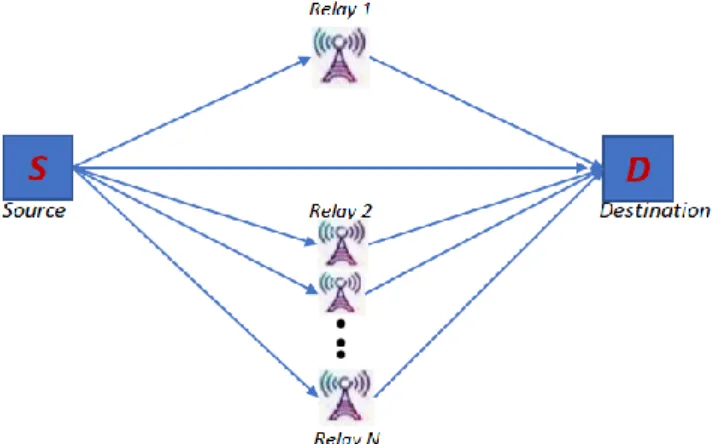
The system model considered for cooperative network as shown in Figure 1 consists of a single source S, a destination D and N number of relays for cooperation. Using AF protocol, relay intensify the received signal and forward it to destination. The information signal is received by the destination from direct as well as cooperative path. MRC technique is used to combine the signals received through these various paths at destination. We consider a dual-hop cooperative network consisting of N relays and each node of the network is having only one antenna. No two relay nodes can communicate directly with each other. Lowest bit rate is used for pilot signaling. Source uses a feedback loop to obtain channel state information of the network.
For the proposed system model, in the first phase source obtain CSI of all paths. For this purpose, a pilot signal is sent to destination through all paths with lowest possible data rate which is then feedback to source to estimate the channel statistics. After comparing the channel statistics obtained, path with minimum BER and channel fading is selected. In the second phase MRC is performed at the destination to combine the amplified copy of the signal transmitted through relay with the signal received through direct path, which gives a strong signal. Results show that for a fixed value of
SNR bit error rate can be significantly reduced with high energy efficiency using proposed system model.
Figure 1. System Model for dual hop cooperative network Let is the signal transmitted by source and is the received signal at destination. is the channel gain from source to destination, while , represents channel gains from source to relay and from relay to destination respectively. , represent additive white gaussian noise at destination and relay. Here the source transmit power is assumed to be 1 for direct path and pilot signal. Average power received at the receiver is related to the distance from the transmitter by the following equation , where is called path loss exponent and it has different
values for different environment as shown in Table-1 [33]. Table-1: Typical values of k [33]
Environment Path Loss exponent
Indoor (line-of-sight) 1.6 - 1.8
Urban Area 2.7 - 3.5
Suburban Area 3 – 5
Free Space 2
The equation for the received signal at destination through direct path is given by:
(1) The distance from source to destination is shown by . while nd represent the distance from source to relay and from relay to destination respectively. represents transmit power of source which initially is considered 1. Using the channel conditions between source, relay and destination the equations for the received signal is given by:
(2)
(3) represents received signal at relay whereas received signal at destination through relay is shown by . In case of AF relaying protocol, is the amplification factor used by the relay to amplify the received signal and to forward it towards destination. While in decode and forward the received signal , is decoded first and then forwarded towards destination as .
3.
Relay Selection Algorithm
3.1 Case I: No Information of Geographical Location
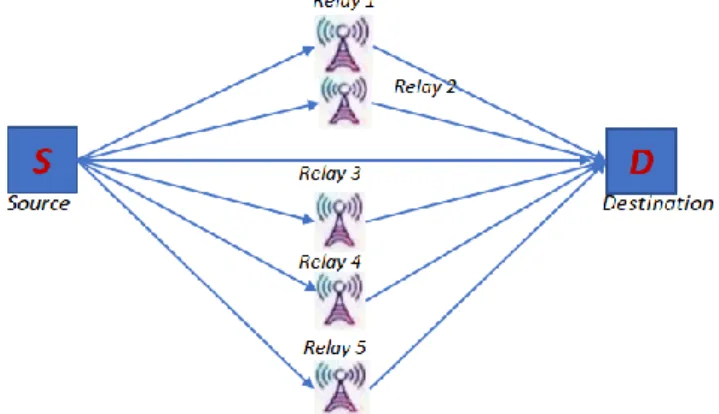
Considering the system model shown in Figure 2, for a dual hop multi-relay cooperative communication system the type and number of relays needed for cooperation depends on the requirement of a specific cooperative network. Channel state information is the basis for relay selection in this part of our proposed algorithm which are collected and analyzed by the fuzzy logic system. Spatial diversity techniques use instantaneous CSI which is a short-term estimation and channel characteristics are estimated at a specific instant [31].
Figure 2. System Model Used for Fuzzy Logic-Based Relay Selection
In number of available relays only one will be selected for cooperation by a fuzzy logic controller, which comprise of several input parameters, a set of fuzzy rules and some output. Fuzzy logic generates acceptable but definite output using levels of possibilities of an input. In the process of fuzzification each linguistic input variable is mapped into a fuzzy set. Each member of this set is a linguistic term which is quantified and graphically represented by a membership function. Next, the inference engine develops a fuzzy inference on inputs using if-then rules. Finally, the results obtained from inference engine, known as output fuzzy set are transformed by the DE-fuzzifier into non-fuzzy crisp output numbers as shown in Figure 3.
The relay selection parameters that are inputs to the fuzzy inference system are:
Cooperative Gain (α) Channel Gain (β) Signal to noise ratio (δ)
While fuzzy gives us three output parameters: Relay selection (ʋ)
Optimum power allocation (p) Adaptive Data rate (γ)
Using Fuzzy logic system for selecting best relay, for each input and output variable (α, β, γ, δ, ʋ, p) a small number of membership functions are defined first and then a static value is assigned to each variable. The number of membership functions for both cooperative and channel Gains are three:
poor, medium and high. Five membership functions for SNR
are very low, low, medium, high and very high. So, for this part of algorithm we have a total of 11 input membership functions. The fuzzy logic controller calculates the degree of relevance of all the input variables according to the strength of rules and membership functions. This calculated degree of relevance of input variables categorize the relays into
selected, considered and ignored output membership functions. The relay having highest degree of relevance, having all desired channel statistics, is marked as best and selected relay. Another important parameter to obtain the objectives of a cooperative network is to efficiently allocate power to the transmission signal at each relay. The membership functions for output variable p are defined as
7,13 and 15dBm. For Data rate four membership functions are defined which are 6,12,24 and 54Mbps [34].
Based on relay performance fuzzy logic system assign optimal power and data rate to each relay under consideration. Depending on the performance of that relay that whether it lies in ignored, considered or selected region, optimal power and adaptive data rate is assigned. If best relay falls in ignored region which simply means that relay will be unable to help source in cooperation, then only direct path will be used. Else, best cooperative relay will be used for cooperation to get less BER at the receiver.
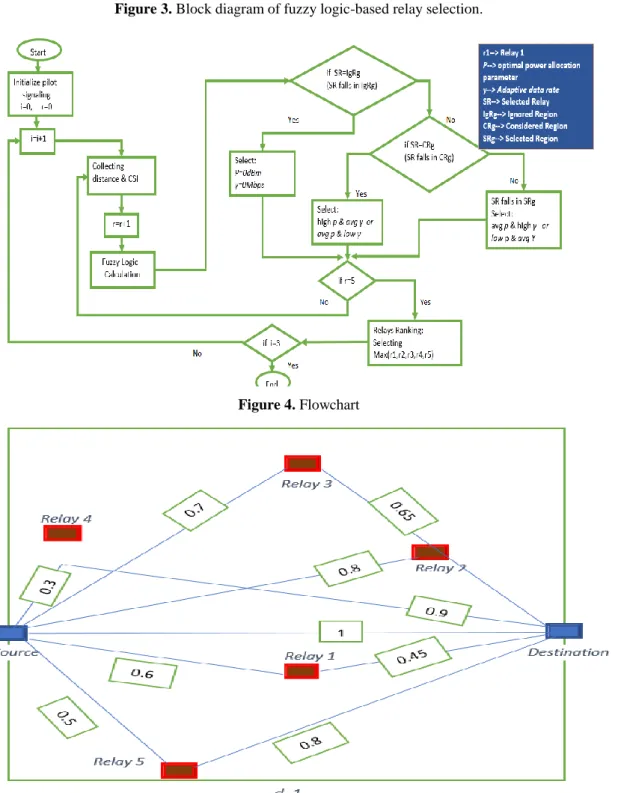
Our proposed algorithm can be further explained by the flowchart shown in Figure 4. There are two phases, In the first phase fuzzy logic system determine the performance of each relay based on channel state information and nodes geographical location information (if available). Then in second testing phase each of these relays is tested with different power levels and data rates based on their performance. For example, if a relay performance lies in
considered region, power versus data rate are assigned in such a way that high power with average data rate and average power with low data rate are tested. While in
selected region average power with high data rate and low power with average data rate are tested. After all fuzzy logic calculations, the relays are ranked and the best among them is selected for cooperation.
3.2 Case II: Nodes Having Information of Geographical Location
System performance can be significantly improved if distance between source, relay and destination is considered as an additional parameter for relay selection with already existing parameters as in case I. Considering a square shaped area, five relays are placed at various locations to select the best available relay as shown in Figure 5. For simplicity each side length d, is normalized to 1 unit which in fact is the distance between source and destination with the assumption that relay positions are fixed, and each node is having information about its geographical location. Considering the position of source, relay and destination as points in the cartesian coordinate system, the distance between any two nodes is calculated using equation:
(4)
In this case distance parameter, the fourth input variable, is the normalized distance which basically is the ratio of distance of a node from source/destination to distance between source and destination. Based on calculated distance parameter three membership functions are defined: near region, mid region and far region, with a total of 15 input membership functions. A relay node positioned in far region
is mostly ignored due to high resource utilization but is considered only if no relay exists in the near or mid region
4.
Simulation Model and Parameters
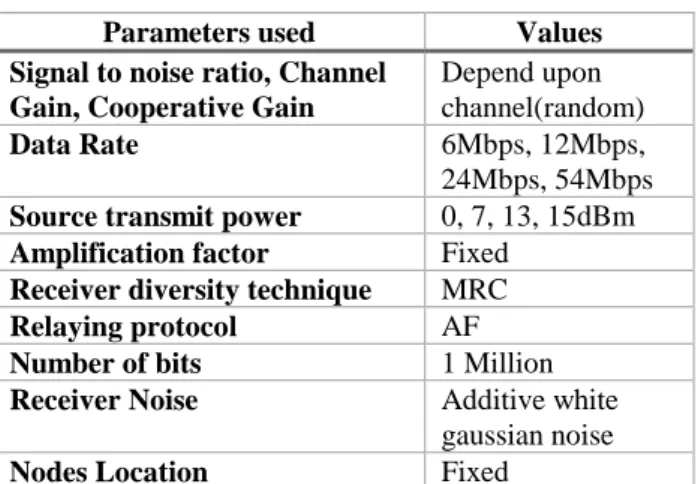
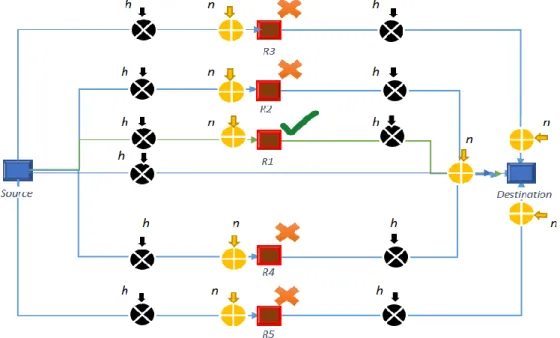
The simulation model for our proposed algorithms comprise of five relays, located between source and destination as shown in Figure 6. The channel gain and additive white gaussian noise are shown along with each link between source, relay and destination. The distance between source to destination, source to relay and relay to destination are assumed to be fixed. The source transmit power is assumed to be 1 for pilot signaling while later optimal power is assigned to source and relay by fuzzy logic system. Similarly, data rate is kept at lowest i.e. 6Mbps for pilot signaling which later-on is updated by fuzzy logic system up to optimal limits. Amplify and Forward relaying protocol is considered for simulation while 1 million bits are transmitted from source to destination during simulation. MRC diversity technique is used at receiver to combine the direct path signal with the signal received through relay. Simulation parameters are summarized in Table -2.
Table-2: Simulation Parameters
In Figure 6 Simulation Model is presented showing all paths from source to destination while in each path i.e. channel the channel parameters modify the transmitted signal by h parameter while noise is added at each receiver. We can simply observe that R1 is selected out of all available 5 relays. These nodes may or may not have the geographical information.
Fuzzy parameters used and their relationship with each other can be observed from the 3D plots shown in Figure 7, each curve represents two inputs and one output parameters and help us to understand the defined rules for the fuzzy logic system. Mamdani type of FIS system is used in these simulations with centroid defuzzification.
Figure 7(a) shows the relation of relay selection parameter with cooperative and channel gain. Relay selection improves with increase in cooperative and channel gain and relay selection is maximum when both input parameters are unity. Similarly, in Figure 7(b) we can observe the relationship of
relay selection with SNR and cooperative gain. Results show higher probability of relay selection when both parameters are at their maximum. In Figure 7(c) relationship of relay selection with distance parameter and cooperative gain
while in Figure 7(d) mapping of distance parameter and channel gain to relay selection can be observed which are following the same trends as in previous graphs.
5.
Simulation Results and Analysis
To validate the proposed algorithm for best relay selection with optimal power allocation and adaptive data rate, the system model shown in Figure 2 is simulated in terms of bit error rate. The simulations are carried out using MATLAB on a Haier Window 10 PC with a processor: Intel(R) Core (TM) M-5Y10c CPU @ 0.80 GHZ 1.00GHZ and 4GB of RAM. Simulation results obtained and their analysis for each case are as follows:
Case I:
The best relay selected by fuzzy logic system shows the most optimal results as compared to other four relays and direct path (DP) as shown in Figure 8. BER is the performance parameter which is plotted with respect to signal to noise ratio (SNR). Comparison of relays in terms of BER is shown in Figure 8(a), where SNR, cooperative gain and channel gain are the input simulation parameters. It is clear from the results that our fuzzy logic-based algorithm is guaranteeing the selection of best cooperating relay among all the available relays.
From Figure 8(a) we can observe different graphs of each relay cooperating source to communicate with destination. The Graph shows the result of BER vs SNR. The Relay 5 has the lowest value of BER at a selected SNR value with respect to all other relays. As we can see for BER value of 10-3 a
gain of more than 10dB when compared with only direct path communication at 6Mbps. But it can be observed that it gives a gain of almost 2dB when compared with Relay 4 which is communicating at 12Mbps. All of this is because of the randomness of the channel in between source, relay and destination. Interestingly we can observe that our fuzzy logic-based algorithm selects the Relay which gives best possible results utilizing optimal resources for best communication. The respective data rates of each relay can be observed in Figure 8(b). Also, it can be observed that this simulation took almost 4.35 seconds for complete transmission and analysis of 1 million bits.
Figure 8(a). BER vs SNR Graph for Performance Analysis using CSI with optimal power allocation and adaptive data
rate assignment.
Case-II:
In this case each node is having information about its geographical location which is fixed. The destination calculates the distance between source to relay X and then from relay X to destination. This calculation is normalized and is fed into the fuzzy logic system as an input parameter along with other. The relay which is having the minimum distance from source and destination and is performing
Parameters used Values
Signal to noise ratio, Channel Gain, Cooperative Gain
Depend upon channel(random)
Data Rate 6Mbps, 12Mbps,
24Mbps, 54Mbps Source transmit power 0, 7, 13, 15dBm
Amplification factor Fixed
Receiver diversity technique MRC
Relaying protocol AF
Number of bits 1 Million
Receiver Noise Additive white
gaussian noise
optimally in term of BER is selected for cooperation. Although we are increasing the computational complexity of the system by introducing location parameter and its respected calculations, but we get more reliable results with zero probability of not selecting the best relay.
Figure 8(b). Adaptive Data Rates and Simulation Time Required
By comparing the results obtained from case-II as shown in Figure 9(a) with the case-I results shown in Figure 8(a), we cannot observe any significant change but by running simulations repeatedly we observed that in the selection process of Case-II the results are more accurate even for very close curves of different relays. It is also observed that time required for case-II is almost 41 seconds which is approximately 10 times larger than that of case-I as shown in Figure 9(b).
Figure 9(a). BER Vs SNR Graph for Performance Analysis using CSI and geographical location information.
Figure 9(b). Adaptive Data Rates assignment and Simulation Time Required
6.
Conclusion and Future Work
The main objective of this work is to improve the received signal quality by adapting the contribution of best cooperative relay. Proposed Fuzzy Logic based relay selection scheme not only select best cooperating relay among all available relays but also allocate optimal power and adaptive data rate. Optimal power allocation and adaptive data rate selection is based on the estimated instantaneous channel state information and nodes location information (if available). Simulation results show that with the selection of the best relay by the proposed scheme has significantly increased the system performance as compared to communication without selecting best cooperating relay. Therefore, the proposed algorithm for optimized relay selection with optimal power allocation and adaptive data rate can be effectively implemented in cooperative networks for improved signal quality, high power efficiency and good bit error rate performance with reduced system complexity. In our work we have considered single antenna at each node. Implementing distributed MIMO system in cooperative communication can provide larger spatial diversity and hence significant increase in data rate can be achieved. Furthermore, cooperative network’s capacity can be increased by implementing Analogue Network Coding (ANC) in it. Basically, ANC is an approach that strategically pick senders to interfere in case of multiple simultaneous transmission, hence reducing number of time slots. Finally, we suggest that with the implementation of multi-hop cooperative networks this work can be extended to wireless sensor networks.
References
[1] A Nosratinia, T. E. Hunter, and a Hedayat, “Cooperative
communication in wireless networks,” Commun. Mag. IEEE, 2004.
[2] J. N. Laneman, D. N. C. Tse, and G. W. Wornell, “Cooperative diversity in wireless networks: Efficient protocols and outage
behavior,” IEEE Trans. Inf. Theory, 2004.
[3] P. K. Kharat and J. D. Gavade, “Cooperative Communication: New
Trend in Wireless Communication,” Int. J. Futur. Gener. Commun.
Netw., 2013.
[4] Y. Zhao, R. Adve, and T. J. Lim, “Symbol error rate of selection
amplify-and-forward relay systems,” IEEE Commun. Lett., 2006.
[5] I. Krikidis, H. A. Suraweera, P. J. Smith, and C. Yuen, “Full-duplex
relay selection for amplify-and-forward cooperative networks,” IEEE
Trans. Wirel. Commun., 2012.
[6] W. S. W. Su, A. K. Sadek, and K. J. R. Liu, “SER performance analysis and optimum power allocation for decode-and-forward
cooperation protocol in wireless networks,” Wirel. Commun. Netw.
Conf. 2005 IEEE, pp. 984–989, 2005.
[7] J. Luo, R. S. Blum, L. J. Cimini, L. J. Greenstein, and A. M. Haimovich, “Decode-and-forward cooperative diversity with power
allocation in wireless networks,” IEEE Trans. Wirel. Commun., vol. 6,
no. 3, 2007.
[8] Imran Khan, “Performance Analysis of 5G Cooperative-NOMA for
IoT Intermittent Communication,” International Journal of
Communucation Networks and Information Securitty, vol. 9, no. 3, pp. 314–322, 2017.
[9] T. X. Vu, P. Duhamel, and M. Di Renzo, “Performance analysis of network coded cooperation with channel coding and adaptive
DF-based relaying in Rayleigh fading channels,” IEEE Signal Process.
Lett., vol. 22, no. 9, pp. 1354–1358, 2015.
[10] K. K. Gurrala and S. Das, “Hybrid decode-amplify-forward (HDAF)
scheme in distributed Alamouti-coded cooperative network,” Int. J.
Electron., vol. 102, no. 5, pp. 725–741, 2015.
[11] J. Bao, J. Wu, C. Liu, B. Jiang, and X. Tang, “Optimized Power Allocation and Relay Location Selection in Cooperative Relay
Networks,” Wirel. Commun. Mob. Comput., vol. 2017, 2017.
decode--amplify--forward protocol with the nth best relay selection,” Wirel. Pers. Commun., vol. 78, no. 2, pp. 1403–1412, 2014.
[13] J. Bao, B. Jiang, C. Liu, X. Jiang, and M. Sun, “Optimized Relay Selection and Power Allocation by an Exclusive Method in
Multi-Relay AF Cooperative Networks.,” KSII Trans. Internet Inf. Syst., vol.
11, no. 7, 2017.
[14] Y. Li, H. Wang, Q. Yin, and M. Luo, “Fair relay selection in
decode-and-forward cooperation based on outage priority,” Sci. China Inf.
Sci., vol. 56, no. 6, pp. 1–10, 2013.
[15] Y. Gu, “Outage Analysis of Energy Harvesting based Opportunistic
Cooperative Communication Systems,” arXiv Prepr.
arXiv1801.06854, 2018.
[16] L. Sun, T. Zhang, L. Lu, and H. Niu, “Cooperative communications
with relay selection in wireless sensor networks,” IEEE Trans.
Consum. Electron., vol. 55, no. 2, pp. 513–517, 2009.
[17] L. Wu, Y. Wang, J. Han, W. Chen, and L. Wang, “Optimal power allocation for wireless uplink transmissions using successive
interference cancellation,” KSII Trans. Internet Inf. Syst., vol. 10, no.
5, pp. 2081–2101, 2016.
[18] J. Adeane, M. R. D. Rodrigues, and I. J. Wassell, “Optimum power
allocation in cooperative networks,” in Proc. Postgraduate Research
Conf. Electronics, Photonics, Commun. Networks, Computing Sci, 2005, pp. 23–24.
[19] J. Bao, D. He, X. Xu, B. Jiang, and M. Sun, “Optimal Relay Selection and Power Allocation in an Improved Low-Order-Bit
Quantize-and-Forward Scheme.,” KSII Trans. Internet Inf. Syst., vol. 10, no. 11,
2016.
[20] B. Zhong, D. Zhang, and Z. Zhang, “Power Allocation for Opportunistic Full-Duplex based Relay Selection in Cooperative
Systems.,” KSII Trans. Internet Inf. Syst., vol. 9, no. 10, 2015.
[21] A. Bletsas, A. Khisti, D. P. Reed, and A. Lippman, “A simple
cooperative diversity method based on network path selection,” IEEE
J. Sel. areas Commun., vol. 24, no. 3, pp. 659–672, 2006.
[22] A. Bletsas, A. Lippnian, and D. P. Reed, “A simple distributed method for relay selection in cooperative diversity wireless networks, based on
reciprocity and channel measurements,” in Vehicular Technology
Conference, 2005. VTC 2005-Spring. 2005 IEEE 61st, 2005, vol. 3, pp. 1484–1488.
[23] L. Fei, Q. Gao, J. Zhang, and Q. Xu, “Relay selection with outdated channel state information in cooperative communication systems,”
IET Commun., vol. 7, no. 14, pp. 1557–1565, 2013.
[24] Z. Lin, E. Erkip, and A. Stefanov, “Cooperative regions and partner
choice in coded cooperative systems,” IEEE Trans. Commun., vol. 54,
no. 7, pp. 1323–1334, 2006.
[25] C.-L. Wang and S.-J. Syue, “A geographic-based approach to relay
selection for wireless ad hoc relay networks,” in Vehicular Technology
Conference, 2009. VTC Spring 2009. IEEE 69th, 2009, pp. 1–5. [26] T. Renk and F. K. Jondral, “Location-dependent performance of
cooperative networks with power allocation,” in Computers and
Communications, 2009. ISCC 2009. IEEE Symposium on, 2009, pp. 399–403.
[27] Y. M. Khattabi and M. M. Matalgah, “Performance analysis of multiple-relay AF cooperative systems over Rayleigh time-selective
fading channels with imperfect channel estimation,” IEEE Trans. Veh.
Technol., vol. 65, no. 1, pp. 427–434, 2016.
[28] L. Xu, H. Zhang, J. Wang, and T. A. Gulliver, “Joint Relay Selection and Power Allocation for AF Relaying M2M Cooperative System,”
Wirel. Pers. Commun., vol. 96, no. 3, pp. 4063–4077, 2017.
[29] G. Klir and B. Yuan, Fuzzy sets and fuzzy logic, vol. 4. Prentice hall
New Jersey, 1995.
[30] J. Yen and R. Langari, Fuzzy logic: intelligence, control, and
information, vol. 1. Prentice Hall Upper Saddle River, NJ, 1999. [31] I. Gupta, D. Riordan, and S. Sampalli, “Cluster-head election using
fuzzy logic for wireless sensor networks,” in Communication
Networks and Services Research Conference, 2005. Proceedings of the 3rd Annual, 2005, pp. 255–260.
[32] M. Matinmikko, T. Rauma, M. Mustonen, I. Harjula, H. Sarvanko, and A. Mammela, “Application of fuzzy logic to cognitive radio
systems,” IEICE Trans. Commun., vol. 92, no. 12, pp. 3572–3580,
2009.
[33] www.utdallas.edu/~torlak/courses/ee4367/lectures/lectureradio.pdf. [34] H. Slimani, B. Escrig, R. Dhaou, and A.-L. Beylot, “Energy and
throughput efficient transmission strategy with Cooperative
Transmission in ad-hoc networks,” in Wireless Communications and
Figure 3. Block diagram of fuzzy logic-based relay selection.
Figure 4. Flowchart
Figure 6. Simulation Model
Figure 7. Fuzzy Parameters Analysis
Fig. 7(a) Mapping Relay Selection Vs cooperative gain and channel gain Fig. 7(b) Mapping Relay Selection Vs SNR and cooperative gain
Fig. 7(c) Mapping Relay Selection Vs distance parameter and
cooperative gain
Fig. 7(d) Mapping Relay Selection Vs distance parameter and