R E S E A R C H
Open Access
Adolescent substance use and peer use: a
multilevel analysis of cross-sectional population
data
Alfgeir Logi Kristjansson
1,2,5*, Inga Dora Sigfusdottir
2,3and John P Allegrante
3,4Abstract
Background:Limited evidence exists concerning the importance of social contexts in adolescent substance use prevention. In addition to the important role schools play in educating young people, they are important ecological platforms for adolescent health, development and behaviors. In this light, school community contexts represent an important, but largely neglected, area of research in adolescent substance use and prevention, particularly with regard to peer influences. This study sought to add to a growing body of literature into peer contexts by testing a model of peer substance use simultaneously on individual and school community levels while taking account of several well established individual level factors.
Method:We analyzed population-based data from the 2009Youth in Icelandschool survey, with 7,084 participants (response rate of 83.5%) nested within 140 schools across Iceland. Multilevel logistic regression models were used to analyze the data.
Results:School-level peer smoking and drunkenness were positively related to adolescent daily smoking and lifetime drunkenness after taking account of individual level peer smoking and drunkenness. These relationships held true for all respondents, irrespective of socio-economic status and other background variables, time spent with parents, academic performance, self-assessed peer respect for smoking and alcohol use, or if they have substance-using friends or not. On the other hand, the same relationships were not found with regard to individual and peer cannabis use.
Conclusions:The school-level findings in this study represent context effects that are over and above individual-level associations. This holds although we accounted for a large number of individual individual-level variables that studies generally have not included. For the purpose of prevention, school communities should be targeted as a whole in substance use prevention programs in addition to reaching to individuals of particular concern.
Keywords:Adolescents, Context, Iceland, Multilevel, Substance use
Introduction
“Although the effects of peer groups on adolescent sub-stance use have been widely documented, much remains to be learned, especially regarding the mechanisms of peer influence”[1]. In a newly published review, this as-sertion signifies the current debate into the processes underlying peer influences in adolescent substance use. Peer substance use has long been shown to be of much
influence in the development of individual use [2,3]. Much of the current literature divides peer influences in merely two categories: socialization and selection. Sim-plified, the former states that adolescents are socialized by the behavior, ideas, and norms of their peers, whereas the latter argues that adolescents select their friends consistent with their interests, seeking out those whom they perceive to behave similar to them and have similar norms and ideas about life [4-6]. Over time researchers have become increasingly convinced that both social-ization and selection are important and that influences from one to the other and across are knitted into a * Correspondence:[email protected]
1West Virginia University, Morgantown, WV, USA
2
Icelandic Centre for Social Research and Analysis, Reykjavik University, Reykjavik, Iceland
Full list of author information is available at the end of the article
complicated web of interrelations where no one factor fully predicts another, and that these components are often bidirectional [7-9]. While many studies have employed longitudinal models to test the development of socialization and selection in adolescent substance use e.g., [10-13], another aspect of peer influences has received much less attention, namely the one due to context.
In order to disentangle the relative associations of in-dividual and contextual relations, a nested data structure is needed where they can be separated in a combined model without jeopardizing important statistical as-sumptions of significance tests [14]. Part of the explan-ation for the scarcity of such studies is the number of responses needed for the analysis to be methodologically possible. For this reason most longitudinal studies with repeated measures and nested data structures do not incorporate measures aggregated to a higher level but focus more on variation in responses within individuals, which is a special class of nested models called growth curve models [15]. Although called for in review studies several years ago [16,17], studying higher level context and individual-level effects jointly is still, to date, rela-tively uncommon in research on adolescent substance use and peer use.
Adolescents spend a great deal of time inside and around their schools where they are directly and indir-ectly affected by school and community norms and cul-ture in addition to the educational aspect of schools. Self-evidently, schools are important platforms in com-munity substance use prevention and health promotion [18-20]. Despite the importance of school communities, not many studies have examined the impact of school community-level rates of peer use on individual use when also including measures for peer use on the indi-vidual level and other important covariates of
adoles-cent substance use. Exceptions are studies by
Leatherdale et al. [6,21] in which the authors found that higher school-level prevalence of smoking among the senior population contributed to an increase in odds for ever smoking in the junior population over schools with lower prevalence rates of senior students smoking. Au-thors also found a cross-level interaction between school-level senior student smoking rates and individual-school-level number of smoking friends. Kuntsche and Jordan [22] also found a strong association between substance using peers and adolescent drunkenness and cannabis use. In a separ-ate study, Kuntche [23] found a contextual relationship between cannabis using peers and student’s cannabis use in classes where students saw others entering schools while cannabis-intoxicated or using cannabis substances on school premises. Also, Ennett et al., [24] found that ad-olescents bound to peer networks with higher smoking prevalence rates are more likely to smoke cigarettes and use marijuana than those with less ties to such networks.
Other studies have examined country characteristics and adolescent substance use and found those to be of importance over and above individual level relationships [25]. These kinds of analyses are exception to the rule but provide important and novel insight into the envir-onmental and cultural relations adolescents are subject to in their communities that are beyond and additive to their individual experiences. In line with such findings, many studies on adolescents conclude that substance use prevention should focus both at individual and group levels e.g., [26,27].
Based on the literature cited above and to further de-velop our understanding of the peer context, we used two-level nested data to test the hypothesis that individual- and school-level measures of peer substance use are positively related to daily smoking, lifetime drunkenness, and lifetime cannabis use among 14 to 16-year-old adolescents, and simultaneously on these two levels, among individuals and within school-communities. In our models we also take account of background factors, demographic and SES variables, parental preventive factors, academic performance, as well as perceived peer respect for substance use. We therefore suggest that aggregated school community level peer use positively associates with the odds of in-dividual level daily smoking, lifetime drunkenness and lifetime cannabis use, suggesting contextual effects that are over and beyond individual-level relationships when controlling for other known risk and protective factors.
Methods Sample
This study utilized population-wide, cross-sectional data from the latest in the series of surveys called Youth in
Iceland, which monitor trends in a wide range of
demo-graphic, behavioral, and health-related variables [18]. Conducted by the Icelandic Centre for Social Research and Analysis (ICSRA), under the auspices of the Ice-landic Ministry of Education, Science, and Culture, the survey on which we report was conducted during Febru-ary of 2009 and included students aged 14 to 16 years who were enrolled in the 9th (14 and 15 years of age) and 10th (15 and 16 years of age) grades in nearly all Icelandic secondary schools. All aspects of data collection, including participant involvement based on passive paren-tal consent, were conducted in accordance with Icelandic guidelines for the protection of research subjects.
They were instructed to complete the entire booklet, but to ask for help if they had any problems or any questions for clarification. Once students completed the question-naires, they were asked to place their completed booklet in an envelope provided for that purpose, and seal the envelope before returning it to the supervising teacher. The total number of responses was 7,514 (50.8% girls) and yielded a response rate of 83.5% of the total national population in these age groups. A background check on the within-school non-response was carried out and re-vealed no particular pattern or bias in responses between schools. Due to item non-response on nominal variables such as gender, school, and moving house during last 12 months, where replacing values with their grand mean is not appropriate, data from 7,084 individuals that are nested within 140 schools were used in the current analysis. A background check concerning the deleted items was carried out and they appeared randomly dis-tributed across the response groups. The missing values in continuous items were in all cases less than 2.4% of the total number of responses for each variable. Given this low frequency in missing information these data were replaced with the respective grand mean on each occasion. The number of valid responses within the 140 schools ranges from 1 to 275, with 23 schools having fewer than 10 participants (16.4%).
Variables and measures
Approximately 90% of the estimated 320,000 inhabitants of Iceland are of Norse-Celtic decent, with 80% of the population belonging to the Lutheran State Church and no other religious institution having more than 3% of the population registered in its services [28]. Because of this homogeneity, exogenous variables such as race and religion, which are often used in research in other coun-tries, were not included in the present analysis. Further-more, enrolment in schools in Iceland is exclusively based on the inhabitants’ geographical area. Although exemptions do occur, the Icelandic school communities are defined by regional areas and town districts. As a re-sult our school level data should contain the specific community characteristics for a given school commu-nity. Generally variables follow a normal distribution with a skew and kurtosis within the range of +/−1.0 ex-cept those explained otherwise. Table 1 shows the de-scriptive statistics for all study variables.
Dependent variables
Daily smoking, lifetime drunkenness, lifetime cannabis use comprised the dependent variables. Daily smoking was assessed with the question “How many cigarettes have you smoked during the last 30 days?”Response cat-egories were 1 = None, 2 = Less than one cigarette per week, 3 = Less than one cigarette per day, 4 = 1–5
cigarettes per day, 5 = 6–10 cigarettes per day, 6 = 11–20 cigarettes per day, and 7 = More than 20 cigarettes per day. The scores were combined to form a dichotomized measure with 0 = None or less than daily, and 1 = daily. The questions forming the lifetime drunkenness and cannabis use were: “How often, if ever, in your lifetime have you a) got drunk and b) smoked hash/marijuana”. Response categories ranged from 1 = Never, 2 = Once, 3 = 2–5 times, 4 = 6–9 times, 5 = 10–19 times, 6 = 20–39 times, and 7 = 40 times or more often. The scores were collapsed to form dichotomized variables with 0 = Never, and 1 = Once or more often.
Independent variables
Academic achievement
Academic achievement is an important marker for ado-lescent development and well-being [29]. It was assessed with four questions about the respondent’s performance in Icelandic, Mathematics, English and Danish (alterna-tively Norwegian or Swedish). These are the so called “unitary subjects” in Iceland and are compulsory for all students [30]. The Icelandic school system operates with a grading system on a 1–10 scale, where 5 or above
Table 1 Descriptive statistics for all study variables (N = 7084)
Categorical variables Min Max n %
Daily smoking 0.00 1.00 470 6.6
Lifetime drunkenness 0.00 1.00 1986 28.0
Lifetime cannabis use 0.00 1.00 544 7.7
Peer cannabis use 0.00 1.00 1785 25.2
Girls 0.00 1.00 3648 51.5
Family structure (other) 0.00 1.00 2107 29.7
Attends school in home neighborhood 0.00 1.00 6139 86.7
Changed schools in last 12 months 0.00 1.00 490 6.9
Residential moving in last 12 months 0.00 1.00 678 9.6
Resides in the capital area 0.00 1.00 4152 58.6
Continuous variables Min Max Mean SD
Academic grades 4.00 32.00 21.59 5.41
Time spent with parents 2.00 10.00 6.46 2.05
Peer smoking 1.00 5.00 1.90 0.99
Peer drunkenness 1.00 5.00 2.00 1.07
Peer respect for smoking 1.00 5.00 1.91 1.05
Peer respect for alcohol use 1.00 5.00 2.30 1.10
Peer respect for cannabis use 1.00 5.00 1.69 1.00
Parental Education −6.24 3.76 .01 2.70
Family financial status 1.00 7.00 3.52 1.05
School level peer smoking 1.00 4.00 1.90 0.30
School level peer drunkenness 1.00 3.33 2.00 0.27
constitutes a pass and below 5 a fail. Response categories ranged from 1 = Less than 4, 2 = About 4, 3 = About 5, 4 = About 6, 5 = About 7, 6 = About 8, 7 = About 9, and 8 = About 10. The scores were summed to form a scale with a range from 4 to 32 (Cronbach’sα= .80).
Time spent with parents
The amount of time adolescents spend with their parents, as opposed to what they actually do with them, has emerged as an important protective factor for substance use initiation and progression [18,19]. Time spent with parents was measured with two questions headed with “How well do the following apply to you: I spend time with my parents a) outside school hours on working days,
and b) during weekends?” Responses range from 1 =
Almost never, 2 = Seldom, 3 = Sometimes, 4 = Often, and 5 = Almost always. The two variables were summed to form a scale ranging from 2 to 10 (Cronbach’sα= .80).
Peer substance use
In line with the dependent variables peer substance use
was measured with three questions headed with “How
many of your friends do the following; a) smoke ciga-rettes, b) become drunk at least once per month, and c) smoke hash or marijuana”. Response categories range from 1 = None, 2 = A few, 3 = Several, 4 = Most, and 5 = Nearly all. Due to heavy positive skew the variable pertaining cannabis use was collapsed to form a dichoto-mized measure with 0 = None and 1 = Some. The vari-ables relating to smoking and drunkenness were used untransformed. These three measures were also aggre-gated to the respective within-school mean in order to form a higher level measure. For the cannabis question this results in the school-level prevalence in knowing anyone that smokes hash or marijuana.
Peer respect for substance use
Peer respect for substance use was measured with three questions with the following heading:“How much do the following matter in order to gain respect in your peer group: a) to smoke cigarettes, b) to drink alcohol, and c) to smoke cannabis substances”. Response categories range from 1 = Decreases respect greatly, 2 = Decreases re-spect somewhat, 3 = Has no effect, 4 = Increases rere-spect somewhat, and 5 = Increases respect greatly.
Gender
Gender was coded 1 for girls (51.5%) and 0 for boys.
Family structure
Family structure was measured with the question “Who lives in your home”: Response categories range from 1 = Both parents, 2 = Mother but not father, 3 = Father but not mother, 4 = Mother and her partner, 5 = Father and
his partner, 6 = I live on my own, 7 = I live equally much but separately with my mother and father, 8 = I live with different arrangements. This variable was collapsed to form a dichotomized measure with 0 = Both parents, and 1 = Other forms.
Parental education
The educational background of parents remains one of the strongest predictors for adolescent well-being and development. Hence, in order to extract other influences it is an important control variable. Parental education was measured with two questions headed with “What is the highest level of education by your a) mother and b) father”. Responses range from 1 = Finished secondary school or less, 2 = Began high school or vocational school but did not graduate, 3 = Graduated from high school or vocational school, 4 = Began college but did not graduate, 5 = College graduate, 6 = Don’t know. These variables were mean-centered and combined to form a scale for parental education.
Family financial status
Family relative financial status is an important marker for substance use risk and adolescent development [31]. We measure family financial status with the question“If you think about the financial position of your family, how is it in comparison to other families in Iceland?” Response categories range from 1 = Much worse, 2 = Considerably worse, 3 = A little worse, 4 = About the same, 5 = A little better, 6 = Considerably better, and 7 = Much better.
School neighborhood
About 13% of the respondents in the study do not at-tend school in their home neighborhood. For analytical purposes we control for this discrepancy.
Residential moving and school change
Moving between neighborhoods/areas and changing schools can be stressful for adolescents and hence is a risk factor for substance use [31]. We control for such environmental change with the following questions: “Have you ever, during the last 12 months: a) changed
schools, and b) moved between neighborhoods.”
Re-sponse categories were 0 = No and 1 = Yes with 6.9% responding to have changed schools and 9.6% moving between neighborhoods during the last 12 months.
Place of residence
study and is coded 1 = Resides in the capital area and 0 = Resides outside the capital area.
Data analyses
Our data analyses were carried out with HLM 7.0 for multilevel logistic regression models with binary data [14,15]. All individual level variables are estimated with random effects and reported as such if statistically sig-nificant. First we ran the “empty” model without any predictor variables to assess the variance in the outcome variable that is attributable to the individual and school-levels and report the mean odds ratio (MOR) and
intraclass correlation coefficients (ICC). We then
proceeded to include the full models with individual level fixed effects and report any significant random ef-fects, or unexplained variance between schools, in the mean odds of the independent variables, both in the intercept and predictor variables. We also report a calculation of explained variance using the formula
outlined by Snijders and Bosker [14], (pp. 225-226) for multilevel logistic models, and significant cross-level interaction relationships for the substance use variables and school level peer use. The method of estimation is restricted penalized quasi-likelihood and all significance tests are based on robust standard errors.
Results
Table 1 depicts the descriptive statistics for all study var-iables. Close to 7% of the study participants reported smoking on a daily bases and 28% had become drunk once or more often in their lifetime. In addition, almost 8% of the study sample admitted to using cannabis sub-stances ever in their lives.
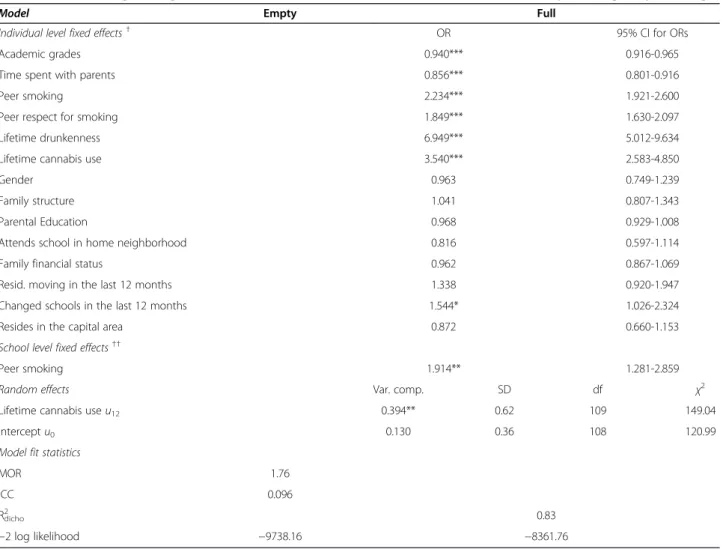
Table 2 shows the results from the multilevel analysis predicting daily smoking. The empty model reveals a lit-tle less than 10% of the variability in smoking being due to differences across school communities. The full model shows that individual level academic grades and time
Table 2 Multilevel logistic regression models with odds ratios and 95% confidence intervals predicting daily smoking
Model Empty Full
Individual level fixed effects† OR 95% CI for ORs
Academic grades 0.940*** 0.916-0.965
Time spent with parents 0.856*** 0.801-0.916
Peer smoking 2.234*** 1.921-2.600
Peer respect for smoking 1.849*** 1.630-2.097
Lifetime drunkenness 6.949*** 5.012-9.634
Lifetime cannabis use 3.540*** 2.583-4.850
Gender 0.963 0.749-1.239
Family structure 1.041 0.807-1.343
Parental Education 0.968 0.929-1.008
Attends school in home neighborhood 0.816 0.597-1.114
Family financial status 0.962 0.867-1.069
Resid. moving in the last 12 months 1.338 0.920-1.947
Changed schools in the last 12 months 1.544* 1.026-2.324
Resides in the capital area 0.872 0.660-1.153
School level fixed effects††
Peer smoking 1.914** 1.281-2.859
Random effects Var. comp. SD df χ2
Lifetime cannabis useu12 0.394** 0.62 109 149.04
Interceptu0 0.130 0.36 108 120.99
Model fit statistics
MOR 1.76
ICC 0.096
R2
dicho 0.83
−2 log likelihood −9738.16 −8361.76
†Based on Wald T and 6,791 df.
spent with parents are the strongest protective factors for smoking used in the study. For every one step in-crease academic grades the odds for daily smoking de-crease by 6%. For every one step inde-crease in time spent with parents the odds for daily smoking decrease by over 14%. As expected, the main risk factors for daily smok-ing are lifetime drunkenness (OR = 6.95) and lifetime cannabis use (OR = 3.54) but peer smoking and peer re-spect for smoking are also of importance. For every one step increase in peer smoking the odds for daily smoking increase over twofold and for every one step increase in peer respect for smoking the odds for daily smoking in-creases by about 85%. Additionally to these risk factors, school level peer smoking increases the odds for daily smoking by over 91% for each one step increase in the peer smoking measure. Only the slope for lifetime
cannabis use differs across schools in the full model as indicated in the random effects.
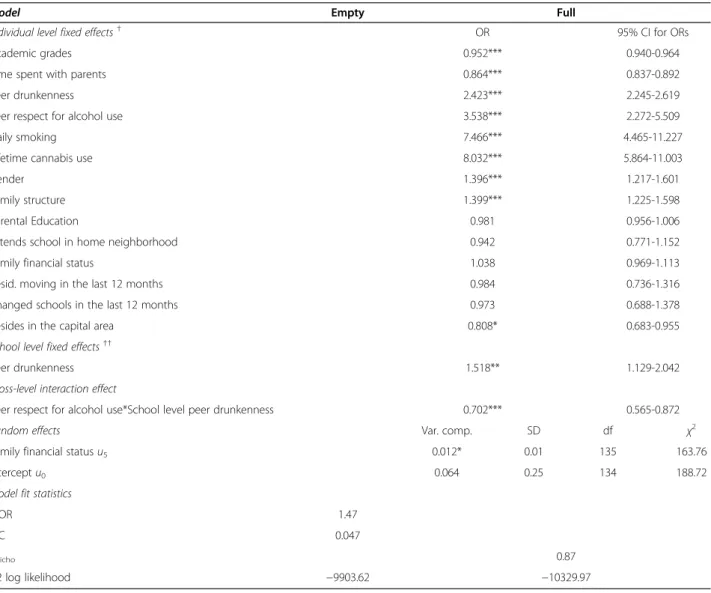
Table 3 shows the results from the multilevel analysis predicting lifetime drunkenness. The empty model re-veals a little less than 5% of the variability in lifetime drunkenness being due to differences across school com-munities. As with smoking the full model shows that in-dividual level academic grades and time spent with parents are the strongest protective factors for lifetime drunkenness included in the model. For every one step increase academic grades the odds for lifetime drunken-ness decrease by 5%. For every one step increase in time spent with parents the odds for lifetime drunkenness de-crease by close to 13%. As in the previous model the main risk factors for lifetime drunkenness are daily smoking (OR = 7.47) and lifetime cannabis use (OR =
Table 3 Multilevel logistic regression models with odds ratios and 95% confidence intervals predicting lifetime drunkenness
Model Empty Full
Individual level fixed effects† OR 95% CI for ORs
Academic grades 0.952*** 0.940-0.964
Time spent with parents 0.864*** 0.837-0.892
Peer drunkenness 2.423*** 2.245-2.619
Peer respect for alcohol use 3.538*** 2.272-5.509
Daily smoking 7.466*** 4.465-11.227
Lifetime cannabis use 8.032*** 5.864-11.003
Gender 1.396*** 1.217-1.601
Family structure 1.399*** 1.225-1.598
Parental Education 0.981 0.956-1.006
Attends school in home neighborhood 0.942 0.771-1.152
Family financial status 1.038 0.969-1.113
Resid. moving in the last 12 months 0.984 0.736-1.316
Changed schools in the last 12 months 0.973 0.688-1.378
Resides in the capital area 0.808* 0.683-0.955
School level fixed effects††
Peer drunkenness 1.518** 1.129-2.042
Cross-level interaction effect
Peer respect for alcohol use*School level peer drunkenness 0.702*** 0.565-0.872
Random effects Var. comp. SD df χ2
Family financial statusu5 0.012* 0.01 135 163.76
Interceptu0 0.064 0.25 134 188.72
Model fit statistics
MOR 1.47
ICC 0.047
R2
dicho 0.87
−2 log likelihood −9903.62 −10329.97
†Based on Wald T and 6,513 df.
8.03) but peer drunkenness and peer respect for alcohol use are also of importance. For every one step increase in peer drunkenness the odds for daily smoking increase by 2.4 and for every one step increase in peer respect for alcohol use the odds for lifetime drunkenness increases by over 3.5. Additionally to these risk factors, school level peer drunkenness increases the odds for lifetime drunkenness by about 52% for each one step increase in the peer drunkenness measure. In addition, the cross level interaction relationship between individual level peer respect for alcohol use and school level peer drunk-enness indicates that the relationship between peer re-spect for alcohol use and risk of drunkenness is less in schools were peer drunkenness is common. Only the slope for family financial status differs across school communities in the full model as indicated in the ran-dom effects.
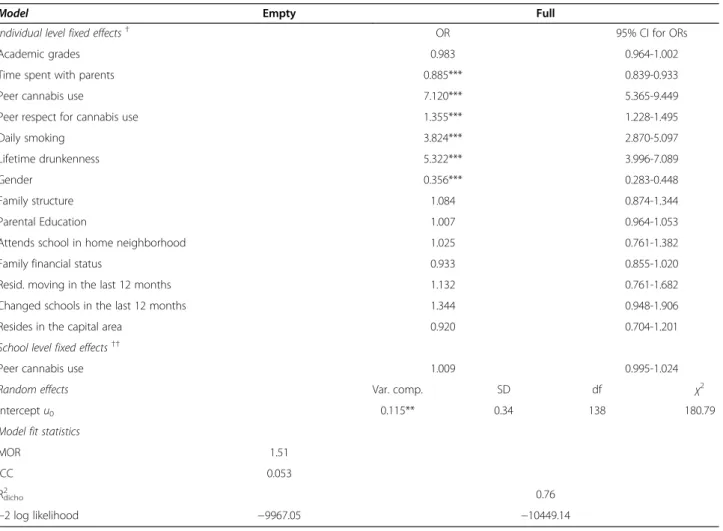
Table 4 shows the results from the multilevel analysis predicting lifetime cannabis use. The empty model
indicates that just over 5% of the variability in lifetime cannabis use is due to differences across school com-munities. The full model shows that being a girl and time spent with parents are the strongest protective factors for lifetime cannabis use in the study. For every one step increase in time spent with parents the odds for lifetime cannabis use decrease by about 11.5%. Also, being a girl is associated with considerably less risk in lifetime cannabis use (OR = 0.36). On the other hand the main risk factors for lifetime cannabis use are peer cannabis use (OR = 7.12), lifetime drunkenness (OR = 5.32), and daily smoking (OR = 3.82) but peer respect for cannabis use is also of importance. Different from the school community aggregate measures for peer smoking and peer drunkenness we do not find a signifi-cant association between school level peer cannabis use and odds of cannabis use. Only the random intercept differs significantly between school communities as shown in the random effects.
Table 4 Multilevel logistic regression models with odds ratios and 95% confidence intervals predicting lifetime cannabis use
Model Empty Full
Individual level fixed effects† OR 95% CI for ORs
Academic grades 0.983 0.964-1.002
Time spent with parents 0.885*** 0.839-0.933
Peer cannabis use 7.120*** 5.365-9.449
Peer respect for cannabis use 1.355*** 1.228-1.495
Daily smoking 3.824*** 2.870-5.097
Lifetime drunkenness 5.322*** 3.996-7.089
Gender 0.356*** 0.283-0.448
Family structure 1.084 0.874-1.344
Parental Education 1.007 0.964-1.053
Attends school in home neighborhood 1.025 0.761-1.382
Family financial status 0.933 0.855-1.020
Resid. moving in the last 12 months 1.132 0.761-1.682
Changed schools in the last 12 months 1.344 0.948-1.906
Resides in the capital area 0.920 0.704-1.201
School level fixed effects††
Peer cannabis use 1.009 0.995-1.024
Random effects Var. comp. SD df χ2
Interceptu0 0.115** 0.34 138 180.79
Model fit statistics
MOR 1.51
ICC 0.053
R2
dicho 0.76
−2 log likelihood −9967.05 −10449.14
†Based on Wald T and 6,791 df.
Discussion
Our findings show that peer smoking and alcohol use are not only related to such use between individuals dur-ing adolescence but also contextually through school communities. Not only do the odds for daily smoking in-crease by 2.2 for every point inin-crease in individual-level peer smoking, they also increase an additional 91% for every point increase in school-level peer smoking. The same applies to lifetime drunkenness. The odds of life-time drunkenness increase by 2.4 for every point in-crease individual-level peer drunkenness and by almost 52% for every point increase in school-level peer drunk-enness. These findings also held for students that re-ceived high grades, spent a lot of time with their parents, belonged to a peer group where respect for sub-stance use was low, and did not have any friends that smoked or became drunk. In contrast to other studies [22,23], we did not find the same contextual effects be-tween individual and school-level peer cannabis use.
These findings provide an important addition to the currently limited evidence that adolescent substance use prevention efforts should target school and school communities directly in addition to individuals [18,19]. Furthermore, in our models we included a number of individual level variables (e.g., academic grades; time spent with parents; peer respect for substance use), that multilevel studies typically do not include. Another sig-nificant finding of our analyses were that the odds of daily smoking and lifetime drunkenness decreased con-tinuously with rising academic achievement; but this relationship was not found for lifetime cannabis use. On a 28 point scale, the odds of daily smoking and life-time drunkenness decreased by 5% and 6% respectively for each additional grade point. The same applies to time spent with parents. More time spent with parents decreased the odds of use for any of the three sub-stances tested by 11-15% respectively. This mirrors our previous findings for time spent with parents [19]. These protective factors have also been found by others [32]. It is also noteworthy that the importance of peer respect for substance use is additional to individual and school level peer use on all three occasions. For every one-point increase in perceived peer respect for smok-ing, the odds for daily smoking increase by 85%. Simi-larly, each point increase in perceived peer respect for alcohol use increases the odds for lifetime drunkenness by over 3.5 times. Additionally, the importance of peer respect for alcohol use is less in schools were peer drunkenness is common, as indicated in the cross-level interaction variable. This is not a surprise as it is con-ceivable that respect for alcohol use should influence such use more if drunkenness is rare rather than if it is general and therefore not particularly daring among students.
The findings of the present study generally align with the prerequisites of the Icelandic model of substance use prevention [18-20]. This long-term approach has been utilized since 1997 and emphasizes community-level col-laboration and dialogue between parental networks, school authorities, policy makers and practitioners. At the center of the approach is a focus on school commu-nities as platforms for health education, collaboration and mutual exchange of knowledge and action, usually through the local schools. Over time this approach has led to a cultural shift in upbringing practices and general emphasis on contextual community effects with the peer group at the center of attention. Contextual relations, as shown in the present study, are associations of cultural aspect because they exert importance over and above in-dividual level associations and, thus, impact on all indi-viduals attending schools with higher prevalence of peer substance use, even though the individuals themselves may not be a part of substance using peer groups. The interpretational problem for such relations, on the other hand, resides, in part, in the current lack of theory that grasps both individual- and contextual effects. As Cook wrote ten years ago [16, p.154]: “Although descriptive [epidemiological] research is usually not highly prized, we consider it to be especially needed where existing theory is weak, as with theories about the joint influence of multiple contexts”.
Generally, in school surveys, between 3% and 7% of the variation in substance use is generated by the school-level with the bulk of the variance being within schools [33]. This does not mean that higher level data are not important; to the contrary, techniques of analysis such as multilevel methods have now allowed us to dis-entangle the potential importance of social contexts such as school-communities by simultaneously controlling for individual level relationships in our models. Research into other higher level contexts has found similar results as we do in the present study. For example, a study by Song et al. [34] suggested that community contexts are important for adolescent alcohol use, and Wright et al. [35] found the relative influences of neighborhoods and families accounted for up to 30% of the total variance in adolescent substance use.
factors, even after taking account of multiple established individual-level components. Second, our analyses relied entirely on self-reports. We are therefore unable to guar-antee responses without foundation to our survey ques-tions. Third, the coding of the dependent variables in our study is somewhat unusual, particularly with regards to “daily smoking during last 30 days”and“lifetime drunken-ness”rather than“any”smoking and alcohol use which is more common. This mismatch in time is particularly problematic in comparison to the peer substance use vari-ables which do not include any reference to time. From an international comparative perspective, the dataset used in this study has rather low prevalence rates [36]. As already reported, school level variance tends to increase with higher prevalence rates [33]. Thus, it is possible that data from other countries would include a greater proportion of the total variance in substance use attributable to differ-ences between schools and may provide additional under-standing in these matters whilst coding the dependent variables in a different way.
Our study also has some strengths. First, we utilized a large and representative sample with high response rates. Second, our data come from a 15 year long line of cross-sectional studies that incorporate the same measures an-nually and have been rigorously tested for reliability and validity. Third, the nature of our statistical modeling en-abled us to directly model the variance in school slopes in-stead of averaging it out as in traditional regression analyses therefore providing further evidence for the added value of higher level information in nested data structures.
Conclusions
Findings of this study indicate that substance use pre-vention approaches among adolescents would benefit from focusing on school-communities as a whole and therefore all their students and not merely the individ-uals that seem likely to become substance users. A focus on ecologic, long-term primary prevention through local community health education and promotion, as success-fully implemented in Iceland for over a decade and a half [18-20], may prove especially effective in reducing the frequency of adolescent substance use.
Competing interests
The authors declare that they have no competing interests.
Authors’contributions
ALK conceived of the study, carried out statistical analyses and drafted multiple versions of the manuscript. IDS conceived of the study, participated in the study design and edited multiple versions of the manuscript. JPA reviewed multiple versions of the manuscript and participated in writing and editing the manuscript in its entirety. All authors read and approved the final manuscript.
Acknowledgement
The authors would like to thank Dr. Lawrence DeCarlo of Teachers College, Columbia University, for helpful comments and advice on the analyses in the paper.
Author details
1
West Virginia University, Morgantown, WV, USA.2Icelandic Centre for Social Research and Analysis, Reykjavik University, Reykjavik, Iceland.3Teachers College, Columbia University, New York, USA.4Mailman School of Public Health, Columbia University, New York, USA.5Department of Social and Behavioral Sciences, West Virginia University, School of Public Health, Robert C. Byrd Health Sciences Center, P.O. Box 9000, Morgantown 26506, WV, USA.
Received: 25 April 2013 Accepted: 29 July 2013 Published: 31 July 2013
References
1. Simons-Morton BG, Farhat T:Recent findings on peer group influences on adolescent smoking.J Prim Prev2010,31:191–208.
2. Bray JH, Adams GJ, Getz JG, McQueen A:Individuation, peers, and adolescent alcohol use: a latent growth analysis.J Consult Clin Psychol 2003,71:553–564.
3. Hill J, Emery RE, Harden KP, Mendle J, Turkheimer E:Alcohol use in adolescent twins and affiliation with substance using peers.J Abnorm Child Psychol2008,36:81–94.
4. Go MH, Green HD, Kennedy DP, Pollard M, Tucker JS:Peer influence and selection effects on adolescent smoking.Drug Alcohol Depend2010,
109:239–242.
5. Hoffman BR, Monge PR, Chou CP, Valente TW:Perceived peer influence and peer selection on adolescent smoking.Addict Behav2007,
32:1546–1554.
6. Leatherdale ST, Cameron R, Brown KS, Jolin MA, Kroeker C:The influence of friends, family, and older peers on smoking among elementary school students: Low-risk students in high-risk schools.Prev Med2006,
42:218–222.
7. Fite PJ, Colder CR, O’Connor RM:Childhood behavior problems and peer selection and socialization: risk for adolescent alcohol use.Addict Behav 2006,31:1454–1459.
8. Curran PJ, Stice E, Chassin L:The relation between adolescent alcohol use and peer alcohol use: a longitudinal random coefficients model.
J Consult Clin Psychol1997,65:130–140.
9. Ennett ST, Bauman KE:The contribution of influence and selection to adolescent peer group homogeneity: the case of adolescent cigarette-smoking.J Pers Soc Psychol1994,67:653–663.
10. Vervaeke HKE, Van Deursen L, Korf DJ:The role of peers in the initiation and continuation of ecstasy use.Subst Use Misuse2008,43:633–646. 11. Hoffman BR, Sussman S, Unger JB, Valente TW:Peer influences on
adolescent cigarette smoking: a theoretical review of the literature.Subst Use Misuse2006,41:103–155.
12. Mason WA, Windle M:Family, religious, school and peer influences on adolescent alcohol use: a longitudinal study.J Stud Alcohol2001,
62:44–53.
13. Nash SG, McQueen A, Bray JH:Pathways to adolescent alcohol use: family environment, peer influence, and parental expectations.J Adolesc Health 2005,37:19–28.
14. Snjiders TA, Bosker RJ:Multilevel analysis: an introduction to basic and advanced multilevel modeling.London: Sage; 1999.
15. Guo G, Zhao H:Multilevel modeling for binary data.Ann Rev Sociol2000,
26:441–462.
16. Cook T:The case for studying multiple contexts simultaneously.Addiction 2003,98:151–155.
17. Kobus K:Peers and adolescent smoking.Addiction2003,98:37–55. 18. Sigfusdottir ID, Thorlindsson T, Kristjansson AL, Roe KM, Allegrante JP:
Substance use prevention for adolescents: the Icelandic model.
Health Promot Int2009,24:16–25.
19. Kristjansson AL, James JE, Allegrante JP, Sigfusdottir ID, Helgason AR:
Adolescent substance use, parental monitoring, and leisure time activities: 12-year outcomes of primary prevention in Iceland.Prev Med 2010,51:168–171.
20. Sigfusdottir ID, Kristjansson AL, Thorlindsson T, Allegrante JP:Trends in prevalence of substance use among Icelandic adolescents, 1995–2006.
Subst Abuse Treatm Prev Policy2008,3:12.
22. Kuntsche E, Jordan MD:Adolescent alcohol and cannabis use in relation to peer and school factors–results of a multilevel analyses.Drug Alcohol Depend2006,84:167–174.
23. Kuntche E:When cannabis is available and visible at school–a multilevel analysis of students’cannabis use.Drugs2010,17:681–688. 24. Ennett ST, Bauman KE, Hussong A, Faris R, Foshee VA, Cai L, DuRant RH:The
peer context of adolescent substance use: findings from social network analysis.J Res Adolesc2006,16:159–186.
25. ter Bogt T, Schmid H, Gabhainn SN, Fotiou A, Vollebergh W:Economic and cultural correlates of cannabis use among mid-adolescents in 31 countries.Addiction2006,101:241–251.
26. Alexander C, Piazza M, Mekos D, Valente T:Peers, schools, and adolescent cigarette smoking.J Adolesc Health2001,2001(29):22–30.
27. Mayberry ML, Espelage DL, Koenig B:Multilevel modeling of direct effects and interaction of peers, parents, school and community influences on adolescent substance Use.J Youth Adolesc2009,38:1038–1049. 28. Statistics Iceland.2011. http://www.statice.is/?PageID=1180&src=/temp_en/
Dialog/varval.asp?ma=MAN10001%26ti=Populations+by+religious+ organizations+1998%2D2011++++%26path=../Database/mannfjoldi/ Trufelog/%26lang=1%26units=Number]
29. Kristjansson AL, Sigfusdottir ID, Allegrante JP, Helgason AR:Social correlates of cigarette smoking among Icelandic adolescents: a population-based cross-sectional study.BMC Public Health2008,8:86.
30. Sigfusdottir ID, Kristjansson AL, Allegrante JP:Health behavior and academic achievement in Icelandic school children.Health Educ Res2007,
22:70–80.
31. Bernburg JG, Thorlindsson T, Sigfusdottir ID:Relative deprivation and adolescent outcomes in Iceland: a multilevel test.Soc Forces2009,
87:1223–1250.
32. Piko BF, Kovacs E:Do parents and school matter? protective factors for adolescent substance use.Addict Behav2010,35:53–56.
33. O’Malley PM, Johnston LD, Bachman JG, Schulenberg JE, Kumar R:How substance Use differs among American secondary schools.Prev Sci2006,
7:409–420.
34. Song EY, Reboussin BA, Foley KL, Kaltenback LA, Wagoner KG, Wolfson M:
Selected community characteristics and underage drinking.Subst Use Misuse2009,44:179–194.
35. Wright DA, Bobashev G, Folsom R:Understanding the relative influence of neighborhood, family, and youth on adolescent drug use.Subst Use Misuse2007,42:2159–2171.
36. Hibell B, Guttormsson U, Ahlström S, Balakireva O, Bjarnason T, Kokkevi A, Kraus L:The 2007 ESPAD report: substance Use among students in 35 European countries.CAN, EMCDDA and the Pompidou Group: Stockholm; 2009.
doi:10.1186/1747-597X-8-27
Cite this article as:Kristjanssonet al.:Adolescent substance use and peer use: a multilevel analysis of cross-sectional population data. Substance Abuse Treatment, Prevention, and Policy20138:27.
Submit your next manuscript to BioMed Central and take full advantage of:
• Convenient online submission
• Thorough peer review
• No space constraints or color figure charges
• Immediate publication on acceptance
• Inclusion in PubMed, CAS, Scopus and Google Scholar
• Research which is freely available for redistribution