International Journal of Communication Networks and Information Security (IJCNIS) Vol. 10, No. 2, August 2018
Resource Allocation using Genetic Algorithm in
Multimedia Wireless Networks
Yaser Khamayseh
1and Rabiah Al-qudah
21
Department of Computer Science, Jordan University of Science and Technology, Jordan 2 Department of Computer Science, Concordia University, Canada
Abstract: Resource allocations in wireless networks is a very challenging task, at one hand wireless networks have scarce resources and suffers from many limitations. At the other hand, typical resource al-location problems requires extensive amount of computations and are usually NP-hard problems. Hence, there is dire need for effective and feasible solutions. Resource allocation problems are concerned in distributing the available network’s resources to all active users in a fair way. Although fairness is hard to define, this work considers the fairness aspects for both, the users and the network operator (service provider). Bio-inspired algorithm are used in many context to provide simple and effective solution to challenging problems. This works employs Genetic Algorithm to provide effective solution to resource allocation problem for multimedia allocation in wireless networks. The performance of the proposed solution is evaluated using simulation. The obtained simulation results show that the proposed solution achieved better performance.
Keywords: Resource allocation, Wireless Networks, Multimedia, Genetic Algorithm.
1.
Introduction
Wireless networks are gaining more and more popularity to provide networking services under normal and harsh circumstances. They have been used to connect vast volume of devices and to provide services to all kind of applications. Traditionally, wireless network were used to provide low data rates communications due to many limitations on its operations such as: interference, noise, security, and high licensing costs. However, modern wireless networks can provide high data rates communications at affordable cost, and can support multimedia streams. Multimedia streams supports all kind of data formats such as text, voice, and video, and requires high bandwidth.
Managing the scarce resource available in wireless networks is a challenging task. Many factors need to be considering while designing a resource allocation suit (algorithms) for wireless networks. AT one hand, we have limited bandwidth, and the other hand, we have an increasing demand for higher data rates. Hence, resource allocation must take advantage of all possible limitations and opportunities. Resource allocation is a suit of algorithm designed to utilize network resources. It consists of many algorithms such as: admission control, scheduling, power management, and time management. Admission control and scheduling are considered the most important algorithms for wireless networks.
The resource allocation problem plays a crucial role for providing QoS for multimedia applications over wireless/mobile networks. Both of Call Admission Control (CAC) and scheduling algorithms work together to ensure
users satisfaction as well as maximizing the system profit. CAC algorithm is responsible of accepting or rejecting new connections. Scheduling algorithm distributes resources among active users. Recent studies show that predicting the system status can improve the system throughput while maintaining users QoS requirements within acceptable limits [8, 4].
The goal of this work is to find a near optimal solution to solve the resource management/allocation problems for wireless networks. Several classical approaches exists to solve optimality problems such as linear programming and dynamic programming. Due to their simplicity, there is an increasing interest in new bio-inspired optimization techniques such as genetic algorithms.
Resource Management for wireless networks traffics is an optimization problem. There are several ways to find the optimal solution for any given problem such as linear programming. Linear programming method is used to find the optimal solution for resource management problems. However, linear programming solutions are time consuming and requires extensive amount of CPU power to run, hence, they are not suitable to the energy-limited wireless networks. Recently there is an interest in new optimization techniques such as genetic algorithm. Using genetic algorithm will enable us to combine most of the scheduling algorithm functionality with the call admission algorithm. The new algorithm will not only decide on accepting or rejecting the new call it also will perform two addition tasks:
1. Assigning power for each user for each upcoming scheduling cycle
2. Deciding which user(s) traffic will be delayed for each upcoming scheduling cycle if necessarily. The scheduling algorithm will be performed at the beginning of each scheduling cycle (Each cycle is equivalent to the frame length FL) and it will use the results obtained by the genetic algorithm.
The rest of this paper is organized as follows: Section 2 provides insights from some related work in this area. Section 3 presents the system model. Section 4 introduces the genetic algorithm and its adaption to solve the given allocation problem. Section 5 presents the simulation environment and the obtained results. Finally, Section 6 concludes the paper and highlights some future works.
2.
Literature Review
International Journal of Communication Networks and Information Security (IJCNIS) Vol. 10, No. 2, August 2018
The authors discussed several aspects of the resource allocation problem: mode switch, power control, link selection and pairing, interference-aware beamforming, and subcarrier assignment. These aspects were discussed in association with four FD networks examples: MIMO, cooperative, cellular (OFDMA), and heterogeneous networks.
The authors in [15] discusses the resource allocation problem in heterogeneous networks that support the usage of multi types of wireless networks to achieve acceptable users’ experience for multimedia applications. The proposed E-PoFANS scheme considers the energy consumption issues and is designed to conserve users’ battery. The work in [6] proposed a secure-aware call admission control (CAC) algorithm for cellular network. The proposed system identifies CAC algorithm as a key component of the resource allocation suite and utilizes fuzzy logic to design new CAC for cellular networks. The performance of the proposed algorithm is evaluated using in-house developed new simulation tool, namely FCACS.
Resource allocation problem was also investigated in [9] for RF-energy harvesting networks (RF-EHNs). This work considered the RF receiver operation policy to maximize throughput while maintaining other QoS requirements. Service differentiation approach was followed to achieve the proposed goal. Other work considered energy efficiency as a main issue in the design of resource allocation algorithms is [14]. In [14], the authors proposed a 2-layer resource allocation algorithm for Heterogeneous network (HetNet). The authors first proved that the given problem is non-convex problem, and hence, they decomposed the problem into multiple optimization problems with single inequality constraint. The investigated problem was considered for a downlink two-tier Heterogeneous network with one macro-cell and multiple pico-macro-cells. Simulation results prove the efficiency of the proposed solution in reducing energy. The resource allocation problem was also considered in cellular network environments, for example, the work in [16] proposed a resource allocation algorithm for cellular network to mitigate the poor quality of service experienced by handoverd (shifted) users to nearby (assisted) cells. The proposed algorithm takes into consideration mobility load balancing (MLB). Its main goal is to distribute resources (users) among cells to avoid uneven load distribution problems. The obtained results show that the proposed solution improved handover failure and call dropping and blocking probabilities.
The authors in [17] review the works done in resource allocation for 4G/LTE networks using game Theory (GT). The work in [17] highlight and emphasize on the importance of resource allocation algorithm to achieve higher network’s performance.
The usage of Genetic algorithm to solve computation problems is widely investigated in the literature, and it had been adopted in many problem domains. Moreover, its applicability in the networking domain is also heavily investigated. Genetic algorithm were adopted by many researcher to provide simple and efficient technique to solve many optimization problems in the networking domain. The work in [1] utilizes Genetic algorithm to construct a
framework for power and channel allocation for cognitive networks. The proposed framework is an opportunistic one that tries to fulfill secondary users with their requirements without interfering with other primary (licensed) users. Other work employed genetic algorithm to obtain optimal (near-optimal) solution(s) is [7]. In [7], the authors proposed two-tier crossover genetic algorithm for cognitive radio networks (CRN). The proposed scheme focuses on the energy efficiency and bandwidth optimization issues. To achieve network synchronization, the authors introduced radio environment map.
Genetic algorithm proved its usefulness and was also used in many other networking context to solve the optimization problems. The authors in [18] used genetic algorithm to find a near optimal scheduler for smart grid networks. The proposed scheduler employed genetic algorithm to select which job (device) to activate next. Genetic algorithm managed to achieve better results than some traditional algorithms.
3.
System Model
For our formulation, we assume a perfect knowledge of the system for the next Twindow slots. Now, we define the following assumptions and notations.
Now, we define the following assumptions and notations.
1. Number of requests/jobs in the given time window is N.
2. Time is slotted (tslot).
3. Each user is assigned one channel per tslot.
4. FDf,i: denotes the number of time slots during which frame f of connection i is delayed.
5. αfd: The maximum allowable delay of frame f of connection i (that is FDf,i ≤ αfd).
6. αQoS: The maximum allowable delay of any connection.
7. TFDRi: The total frame delay ratio for connection i (we need TFDRi ≤ αQoS). TFDRi is defined as the following:
8. For each connection, we assume the following is known: (tstart,i, tduration,i), where, tstart,i is the time when connection i is initiated in the cell or handed in to the cell, and tduration,i is connection i duration while in the cell.
9. QoS requirement: each connection will be able to tolerate a certain level of total frame delay ratio (TFDR). Each frame in the connection is bounded by certain threshold αfd. Otherwise, the connection is dropped.
10. Effective Throughput (Threff): In case of a connection exceeds the TFDR threshold, the connection will be dropped and the user will not be charged for the transmitted traffic. Effective throughput is the throughput excluding the dropped connection. If the system grantees TFDR for all users all the time then the effective throughput will be exactly the same as throughput.
International Journal of Communication Networks and Information Security (IJCNIS) Vol. 10, No. 2, August 2018
Which connection to accept and which to reject.
Which frame should be delayed in case of overloaded tslot.
For systems with fixed capacity, and in addition to the above assumptions and notations, we define the system capacity to be C (measured in channels). Now, we formalize the problem as follows:
Maximize Effective Throughput subject to:
Capacity constraint: System capacity is C channels. For each connection i, the TFDRi≤ αQoS.
For each frame (tslot) in each connection FDf,i ≤ αfd.
This work assumes a simplified notion of system capacity (C), this generalized notion allows a flexible adaptation of this work into various possible networking technologies, in which system capacity can be expressed in terms of energy, time, or frequency.
4.
Genetic Algorithm (GA)
In this section we would like to use the genetic algorithm to find the optimal solution for the resource allocation problem in cellular networks.
GA was developed by John Holland. The idea of GA came from the evolutionary computing introduced by I. Rechenberg in 1969. Holland published his idea of GA in his book “Adaption in Natural and Artificial Systems”. Evolution theory is the main inspiration of the evolutionary computing thus genetic algorithm. The simple idea behind GA is that we start with a feasible solution for the problem this solution produces (evolves) solutions until it get the best solution. GA is being used with different type of problems such as scheduling and stock exchange [11].
A simple GA algorithm consists of three steps [10, 2]. First, GA starts with a set of solutions (chromosomes), these chromosomes forms the population. Secondly, GA keeps producing new population (crossover and mutation) from the previous one. Every time we reproduce a population we are hoping for a better one. Finally, GA tests if the new population satisfy the finishing condition (Reached the optimal solution).
GA can be summarized as the following: 1. Generate an initial population.
2. Evaluate each chromosome based on the evaluation function and sort the chromosomes based on their fitness.
3. Select the best fitted chromosome and put it in the new population.
4. Perform crossover and mutation on the rest of the chromosomes to generate the rest of the new population [3, 13].
5. Check for your termination condition (such as timer or achieving certain fitting value). If it is not satisfied then go to step 2.
By selecting the best fitted chromosome and carry it over to the new population we guarantee that the new population will not diverge from the optimal solution.
There are several commonly used encoding techniques in GA:
1. Binary encoding: This kind of encoding is used mainly with parameter optimization problems.
2.
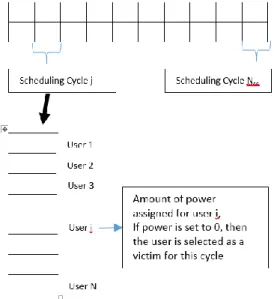
Permutations: Used mainly with scheduling problems. Since our Scheduling/CAC algorithm is responsible of assigning powers for users and selecting victims we need to consider a complex encoding techniques to model our system.Let user i requests a connection at time ti and the clip length is Ti. Our algorithm should assign to model the victims selection process, a vector of zeros and ones will be used to model each scheduling cycle. Zero means that the user is selected as a victim for this scheduling cycle. Another vector of the amount of assigned powers will be used to model the power assignment process. Figure 1 shows the encoding of the scheduling-CAC algorithm.
Figure 1
:
Genetic Algorithm Encoding Model4.1. Genetic Operators (Crossover and Mutation)
Two main genetic operators performed to reproduce a new population are crossover and mutation. In crossover basic form, two individuals are being selected randomly, each individual is then cut at random point to form two heads and two tails segments. The tail segments are then swapped to form a new two individuals. It is possible that some parents will not go through crossover, in this case GA duplicates the parent to produce a new offspring. Mutation is performed in top of the produced offsprings (by crossover). Mutation alters some randomly selected genes. Alteration can be simply done by changing 0 to 1 and vice versa.
4.2.Proposed Genetic Algorithm
The main components of the proposed genetic algorithm are: problem encoding, and evaluation function. For the fixed capacity system we use binary representation. Each job in the time window is represented by a vector of zeros and ones. The vector length is bounded by the time window size (Twindow). Mathematically, Vi = <vi,1, vi,1, . . . , vi,L>, where L = |Twindow|. vi,j is either 0 or 1. If frame j of job i is to be served then vi,j is set to 1, otherwise it is set to 0.
International Journal of Communication Networks and Information Security (IJCNIS) Vol. 10, No. 2, August 2018
the vector Vi is set to zero. Maximum number of combinations (zeros and ones) for connection i is equal to
, li is αQoS in time slots.
At each time slot, a maximum of C connections frames can be set to 1. A second important component of the GA is the evaluation (fitness) function, we define the following:
The initialization step is very important. It is crucial that we choose our start population carefully. The following models can be used to generate initial populations:
1. Distribute the powers among the users fairly.
While selecting a population the following constraints should be considered:
1. Ensure that the same user will not be picked as a victim in Nv consecutive cycles.
2. Satisfy the users’ desired QoS. AQSI ≤ DQSI. 3. The total power assigned to the users for each cycle is
less than the max power available at the base station. PT ≤ Pmax.
As mentioned above, choosing the initial population is very important for GA algorithms. The chosen initial population has to be feasible. Here, we propose different algorithm for selecting the initial population. The first algorithm represent the problem as an interval graph and then uses maximum independent set algorithm to find the initial population. First we define the notation used then we present the proposed algorithm. Assume the set of jobs is represented by graph G(U, E). Now, assume the graph G is undirected. Graph G is an interval graph. Each job ji is mapped to a vertex ui in the set U. ji is described by the start time ai and the completion time ci. Both ai and ci represent the two end points of interval Ii. Two vertices are said to be adjacent if and only if the intersection by the corresponding intervals is not null.
The following algorithm finds the initial population using the maximum independent set algorithm [5].
Algorithm: Initial Population
1. For i = 1 to C
• Find the maximum independent set for graph G assuming that the system capacity is 1.
• Remove the nodes in the solution from the graph G to the set A.
Set A contains the initial population. The maximum independent set algorithm [5] can be found in O(|U|.log|U|). Thus, the above algorithm runs in polynomial time O((C).|U|.log|U|).
5.
Simulation and Results
This section present the simulation environment and obtained results. The performance of the proposed scheme is compared again the performance of a heuristic scheme, in which requests are admitted up to a certain maximum threshold, then, new requests are denied services. The experiments were conducted with system capacity C is set to 100. The network load is measured by Erlangs, in which Erlang (E) is composed of both call arrival rate, λ, and the
average connection time, m, and it is expressed mathematically as: E = λm.
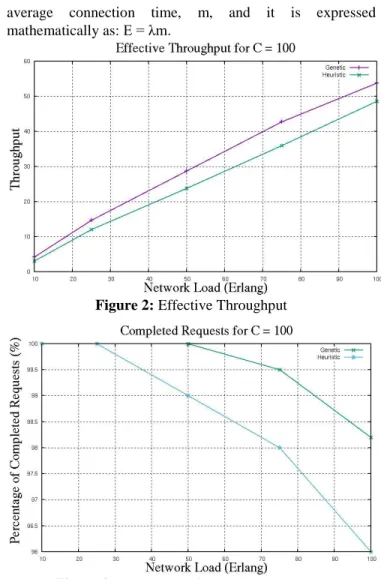
Figure 2: Effective Throughput
Figure 3: Percentage of Completed Requests
The performance metrics used to evaluate the performance of the proposed scheme are: throughput, percentage of successfully completed, aborted, and denied service requests. The obtained results show that the proposed genetic based scheme outperforms the heuristic scheme in terms of throughput, and percentage of completed requests. However, do its original design, the heuristic scheme drop ratio is 0. Once, a request is accepted, it cannot be aborted (non-preemptive behavior). Figure 2 depicts the effective throughput results for both algorithm. The obtained results shows that the proposed system outperform the heuristic one in all cell loads. As expected, increasing the cell load increases the achieved throughput.
International Journal of Communication Networks and Information Security (IJCNIS) Vol. 10, No. 2, August 2018
Figure 4: Percentage of Rejected Requests
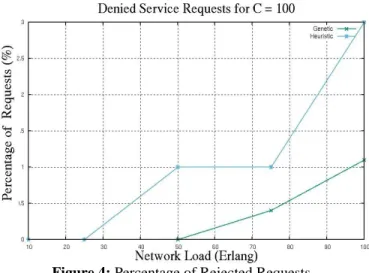
Figure 4 show the percentage of rejected requests by both algorithm, these request were denied service from the beginning. Once a request is made, the system evaluate its current resources and decides whether to accept or reject new requests. The obtained results show that the proposed system managed to block fewer requests than the heuristic one as both systems ran under low cell load, no request were rejected, all request were accepted. As the cell load increases, the rejection probability increases.
Figure 5: Percentage of Preempted Requests
Figure 5 show the percentage of prematurely terminated requests by both algorithm, these request were initially accepted for service, then were terminated by the system. The system may opt to terminate an ongoing request to accommodate new, more important, request. The obtained results show that the proposed system have a lower service termination probability than the heuristic one.
For both algorithms, as shown in Figures 3, 4 and 5, when number of users is low (10 and 25), the system is under loaded and no requests were denied or terminated. As the number of users increases, the system start to get overloaded and hence, some requests starts to be denied service, even in some cases, some requests were terminated from service. For example, when number of users is 100%, the percentages of completed requests (admitted to full completion) is 96% to 98.5%, while the denied service percentages is 1% to 3 %, and the terminated percentage are 0.7% to 1%. In all cases,
the proposed genetic based algorithm outperformed the heuristic algorithm.
6.
Conclusion and Future Work
Resource allocation is a very important task in wireless networks. It assigns partial resources to a particular user based on some criteria. The main goal of resource allocation problem is to distribute these resources in a fair way. This work employs Genetic Algorithm to facilitate the resource allocation problem. It defines the initialization and encoding steps to accommodate the needs for the resource allocation problem. The obtained simulation results shows that the proposed algorithm yield better performance results (i.e., increases the system throughput and number of completed, rejected, preempted requests).
This work consider some important aspects in designing effective resource management algorithms for wireless networks. However, considering other factors may be beneficial to further optimize the resource allocation problem. Recent studies indicate that prediction techniques may help understand the system behavior and hence make more educated decisions on which request to accept or reject. This possible integration of the prediction techniques is to be investigated in the future work. More experiments are required to examine the behavior of the system at different network loads (high number of active users).
References
[1] Salman Ali, Ali Munir, Saad Bin Qaisar, and Junaid Qadir, “A genetic algorithm assisted resource management scheme for reliable multimedia delivery over cognitive networks”, In Beniamino Murgante, Osvaldo Gervasi, Sanjay Misra, Nadia Nedjah, Ana Maria A. C. Rocha, David Taniar, and Bernady O. Apduhan, editors, Computational Science and Its Applications – ICCSA 2012, pp. 352–367, Berlin, Heidelberg, 2012. Springer Berlin Heidelberg.
[2] David Beasley, David R. Bull, and Ralph R. Martin. An overview of genetic algorithms: Part 1, fundamentals. University Computing, vol. 15, No. 2, pp. 58–69, 1993. [3] David Beasley, David R. Bull, and Ralph R. Martin, “An
overview of genetic algorithms: Part 2, research topics”, University Computing, vol. 15, No. 4, pp. 170–181, 1993. [4] E. S. Elmallah and M. Mandal, “Predictive call admission
control for multimedia streaming in CDMA cellular environments”, in Canadian Journal of Electrical and Computer Engineering, vol. 30, No. 2, pp. 115-123, Spring 2005. doi: 10.1109/CJECE.2005.1541733.
[5] U. I. Gupta, D. T. Lee, and J. Y. T. Leung, “Efficient algorithms for interval graphs and circular-arc graphs”, Networks, vol. 12, pp. 459–467, 1982.
[6] Takaaki Inaba, Donald Elmazi, Shinji Sakamoto, Tetsuya Oda, Makoto Ikeda, and Leonard Barolli, “A secure-aware call admission control scheme for wireless cellular networks using fuzzy logic and its performance evaluation”, Journal Mob. Multimed, vol. 11, No. 3-4, pp. 213–222, November 2015. [7] Y. Jiao and I. Joe, “Energy-efficient resource allocation for
heterogeneous cognitive radio network based on two-tier crossover genetic algorithm”, Journal of Communications and Networks, vol. 18, No. 1, pp. 112– 122, Feb 2016.
International Journal of Communication Networks and Information Security (IJCNIS) Vol. 10, No. 2, August 2018
an adaptive framework”, Wireless Networks, vol. 9, pp. 51– 59, 2003.
[9] X. Lu, P. Wang, D. Niyato, and Z. Han, “Resource allocation in wireless networks with RF energy harvesting and transfer”, IEEE Network, vol. 29, no. 6, pp. 68–75, Nov 2015.
[10] M. Mitchell, “An Introduction to Genetic Algorithms”, Cambridge, Massachusetts: MIT Press, 1996.
[11] M. R. Sherif, I. W. Habib, M. Nagshineh and P. Kermani, "Adaptive allocation of resources and call admission control for wireless ATM using genetic algorithms," in IEEE Journal on Selected Areas in Communications, vol. 18, No. 2, pp. 268-282, Feb. 2000. doi: 10.1109/49.824812
[12] L. Song, Y. Li, and Z. Han, “Resource allocation in full-duplex communications for future wireless networks”, IEEE Wireless Communications, vol. 22, No. 4, pp. 88–96, August 2015.
[13]William M. Spears, “Crossover or mutation?”, In L. Darrell Whitley, editor, Foundations of Genetic Algorithms 2, pp. 221–237. Morgan Kaufmann, San Mateo, CA, 1993.
[14]J. Tang, D. K. C. So, E. Alsusa, K. A. Hamdi, and A. Shojaeifard, “Resource allocation for energy efficiency optimization in heterogeneous networks”, IEEE Journal on Selected Areas in Communications, vol. 33, No. 10, pp. 2104–2117, Oct 2015.
[15]R. Trestian, O. Ormond, and G. M. Muntean, “Enhanced power-friendly access network selection strategy for multimedia delivery over heterogeneous wireless networks”, IEEE Transactions on Broad-casting, vol. 60, No. 1, pp. 85– 101, March 2014.
[16]Lexi Xu, Xinzhou Cheng, Yu Liu, Weiwei Chen, Yuting Luan, Kun Chao, Mingqiang Yuan, and Bingyu Xu, “Mobility load balancing aware radio resource allocation scheme for LTE advanced cellular networks”, In 2015 IEEE 16th International Conference on Communication Technology (ICCT), pp. 806– 812, Oct 2015.
[17] SANAA OULAOURF, Abdelfatteh Haidine, Abdelhak Aqqal, Hassan Ouahmane, “Review on Radio Resource Allocation Optimization in LTE/LTE-Advanced using Game Theory”, International Journal of Communication Networks and Information Security (IJCNIS), Vol. 9, No. 1, pp. 117-155, 2017.