DOI 10.1007/s11263-016-0916-3
A Unified Framework for Compositional Fitting
of Active Appearance Models
Joan Alabort-i-Medina1 · Stefanos Zafeiriou1
Received: 5 October 2015 / Accepted: 18 May 2016
© The Author(s) 2016. This article is published with open access at Springerlink.com Abstract Active appearance models (AAMs) are one of
the most popular and well-established techniques for mod-eling deformable objects in computer vision. In this paper, we study the problem of fitting AAMs using compositional gradient descent (CGD) algorithms. We present a unified and complete view of these algorithms and classify them with respect to three main characteristics: (i)cost function; (ii) type ofcomposition; and (iii)optimization method. Fur-thermore, we extend the previous view by: (a)proposing a novel Bayesian cost functionthat can be interpreted as a gen-eral probabilistic formulation of the well-known project-out loss; (b) introducing two new types of composition, asym-metricandbidirectional, that combine the gradients of both image and appearance model to derive better convergent and more robust CGD algorithms; and (c) providing new valu-able insights into existent CGD algorithms by reinterpreting them as direct applications of theSchur complementand the Wiberg method. Finally, in order to encourage open research and facilitate future comparisons with our work, we make the implementation of the algorithms studied in this paper publicly available as part of the Menpo Project (http://www. menpo.org).
Keywords Active appearance models · Non-linear optimization·Compositional gradient descent·Bayesian
Communicated by Sven J. Dickinson.
B
Joan Alabort-i-Medina[email protected] Stefanos Zafeiriou [email protected]
1 Department of Computing, Imperial College London, 180 Queen’s Gate, London SW7 2AZ, UK
inference·Asymmetric and bidirectional composition· Schur complement·Wiberg algorithm
1 Introduction
Active appearance models (AAMs) (Cootes et al. 2001; Matthews and Baker 2004) are one of the most popular and well-established techniques for modeling and segmenting deformable objects in computer vision. AAMs are genera-tive parametric models of shape and appearance that can be fittedto images to recover the set of model parameters that best describe a particular instance of the object being mod-eled.
Fitting AAMs is a non-linear optimization problem that requires the minimization (maximization) of a global error (similarity) measure between the input image and the appear-ance model. Several approaches (Cootes et al. 2001; Hou et al. 2001;Matthews and Baker 2004;Batur and Hayes 2005; Gross et al. 2005;Donner et al. 2006;Papandreou and Mara-gos 2008;Liu 2009;Saragih and Göcke 2009;Amberg et al. 2009;Tresadern et al. 2010;Martins et al. 2010;Sauer et al. 2011;Tzimiropoulos and Pantic 2013;Kossaifi et al. 2014; Antonakos et al. 2014) have been proposed to define and solve the previous optimization problem. Broadly speaking, they can be divided into two different groups:
– Regressionbased (Cootes et al. 2001;Hou et al. 2001; Batur and Hayes 2005;Donner et al. 2006;Saragih and Göcke 2009;Tresadern et al. 2010;Sauer et al. 2011) – Optimizationbased (Matthews and Baker 2004; Gross
et al. 2005; Papandreou and Maragos 2008; Amberg et al. 2009;Martins et al. 2010;Tzimiropoulos and Pantic 2013;Kossaifi et al. 2014)
Regression based techniques attempt to solve the prob-lem by learning a direct function mapping between the error measure and the optimal values of the parameters. Most notable approaches include variations on the original (Cootes et al. 2001) fixed linear regression approach ofHou et al. (2001), Donner et al. (2006), the adaptive linear regres-sion approach ofBatur and Hayes (2005), and the works of Saragih and Göcke (2009) and Tresadern et al. (2010) which considerably improved upon previous techniques by using boosted regression. Also,Cootes and Taylor (2001) andTresadern et al.(2010) showed that the use of non-linear gradient-based and Haar-like appearance representations, respectively, lead to better fitting accuracy in regression based AAMs.
Optimization based methods for fitting AAMs were pro-posed by Matthews and Baker in Matthews and Baker (2004). These techniques are known as compositional gra-dient decent (CGD) algorithms and are based on direct analytical optimization of the error measure. Popular CGD algorithms include the very efficient project-out Inverse Compositional (PIC) algorithm (Matthews and Baker 2004), the accurate but costly Simultaneous Inverse Compositional (SIC) algorithm (Gross et al. 2005), and the more efficient versions of SIC presented inPapandreou and Maragos(2008) andTzimiropoulos and Pantic(2013).Lucey et al. (2013) extended these algorithms to the Fourier domain to efficiently enable convolution with Gabor filters, increasing their robust-ness; and the authors ofAntonakos et al.(2014) showed that optimization based AAMs using non-linear feature based (e.g. SIFT Lowe 1999 and HOG Dalal and Triggs 2005) appearance models were competitive with modern state-of-the-art techniques in non-rigid face alignment (Xiong and De la Torre 2013; Asthana et al. 2013) in terms of fitting accuracy.
AAMs have often been criticized for several reasons: (i) the limited representational power of their linear appearance model; (ii) the difficulty of optimizing shape and appear-ance parameters simultaneously; and (iii) the complexity involved in handling occlusions. However, recent works in this area (Papandreou and Maragos 2008;Saragih and Göcke 2009;Tresadern et al. 2010;Lucey et al. 2013; Tzimiropou-los and Pantic 2013; Antonakos et al. 2014) suggest that these limitations might have been over-stressed in the liter-ature and that AAMs can produce highly accurate results if appropriate training data (Tzimiropoulos and Pantic 2013), appearance representations (Tresadern et al. 2010; Lucey et al. 2013; Antonakos et al. 2014) and fitting strategies (Papandreou and Maragos 2008;Saragih and Göcke 2009; Tresadern et al. 2010; Tzimiropoulos and Pantic 2013) are employed.
In this paper, we study the problem of fitting AAMs using CGD algorithms thoroughly. Summarizing, our main contri-butions are:
– To present a unified and complete overview of the most relevant and recently published CGD algorithms for fit-ting AAMs (Matthews and Baker 2004; Gross et al. 2005; Papandreou and Maragos 2008; Amberg et al. 2009; Martins et al. 2010; Tzimiropoulos et al. 2012; Tzimiropoulos and Pantic 2013; Kossaifi et al. 2014). To this end, we classify CGD algorithms with respect to three main characteristics: (i) thecost function defin-ing the fittdefin-ing problem; (ii) the type ofcompositionused; and (iii) theoptimization methodemployed to solve the non-linear optimization problem.
– To review the probabilistic interpretation of AAMs and propose a novelBayesian formulation1of the fitting prob-lem. We assume a probabilistic model for appearance generation with both Gaussian noise and a Gaussian prior over a latent appearance space. Marginalizing out the latent appearance space, we derive a novel cost func-tion that only depends on shape parameters and that can be interpreted as a valid and more general proba-bilistic formulation of the well-known project-out cost function (Matthews and Baker 2004). Our Bayesian for-mulation is motivated by seminal works on probabilistic component analysis and object tracking (Moghaddam and Pentland 1997; Roweis 1998; Tipping and Bishop 1999).
– To propose the use of two novel types of composition for AAMs: (i)asymmetric; and (ii)bidirectional. These types of composition have been widely used in the related field of parametric image alignment (Malis 2004;Mégret et al. 2008;Autheserre et al. 2009;Mégret et al. 2010) and use the gradients of both image and appearance model to derive better convergent and more robust CGD algo-rithms.
– To provide valuable insights into existent strategies used to derive fast and exact simultaneous algorithms for fit-ting AAMs by reinterprefit-ting them as direct applications of theSchur complement(Boyd and Vandenberghe 2004) and the Wiberg method (Okatani and Deguchi 2006; Strelow 2012).
The remainder of the paper is structured as follows. Sec-tion 2 introduces AAMs and reviews their probabilistic interpretation. Section3constitutes the main section of the paper and contains the discussion and derivations related to the cost functions Sect.3.1; composition types Sect.3.2; and optimization methods Sect.3.3. Implementation details and experimental results are reported in Sect.5. Finally, conclu-sions are drawn in Sect.6.
1 A preliminary version of this work (Alabort-i-Medina and Zafeiriou 2014) was presented at CVPR 2014.
2 Active Appearance Models
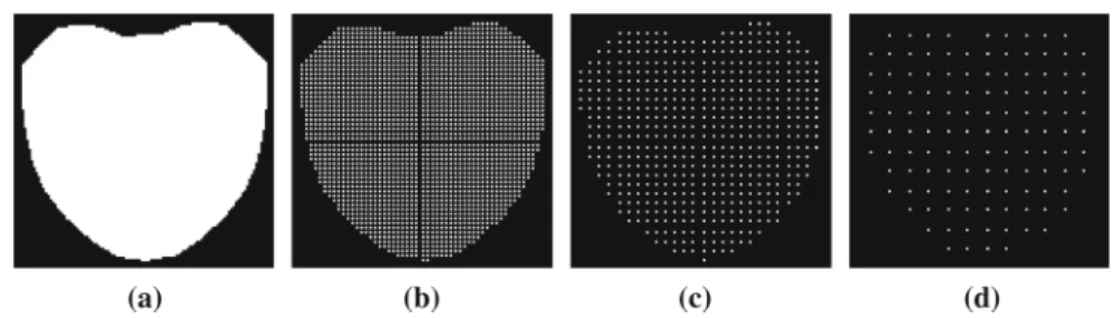
AAMs (Cootes et al. 2001;Matthews and Baker 2004) are generative parametric models that explain visual variations, in terms of shape and appearance, within a particular object class. AAMs are built from a collection of images (Fig.1) for which the spatial position of a sparse set of v land-mark points xi = (xi,yi)T ∈ R2 representing the shape
s=(x1,y1, . . . ,xv,yv)T ∈R2v×1of the object being
mod-eled have been manually defined a priori.
AAMs are themselves composed of three different mod-els: (i) shape model; (ii) appearance model; and (iii) motion model.
The shape model, which is also referred to as Point Distribution Model (PDM), is obtained by typically apply-ing Principal Component Analysis (PCA) to the set of object’s shapes. The resulting shape model is mathematically expressed as: s= ¯s+ n i=1 pisi = ¯s+Sp (1)
wheres¯ ∈ R2v×1 is the mean shape, andS ∈ R2v×n and p ∈ Rn×1 denote the shape bases and shape parameters, respectively. In order to allow a particular shape instances to be arbitrarily positioned in space, the previous model can be augmented with a global similarity transform. Note that this normally requires the initial shapes to be normalized with respect to the same type of transform (typically using Procrustes Analysis (PA)) before PCA is applied. This results in the following expression for each landmark point of the shape model:
xi =sR(x¯i+Xip)+t (2)
wheres,R∈R2×2andt∈R2denote the scale, rotation and translation applied by the global similarity transform, respec-tively. Using the orthonormalization procedure described in Matthews and Baker(2004) the final expression for the shape model can be compactly written as the linear combination of a set of bases: s= ¯s+ 4 i=1 pi∗s∗i + n i=1 pisi = ¯s+Sp (3) where S = (s∗1, . . . ,s∗4,s1, . . . ,sn) ∈ R2v×(4+n) andp =
(p∗1, . . . ,p∗4,p1, . . . ,pn)T ∈R(4+n)×1are redefined as the
concatenation of the similarity basess∗i and similarity para-meters p∗i with the originalSandp, respectively.
The appearance model is obtained by warping the original images onto a common reference frame (typically defined in terms of the mean shape¯s) and applying PCA to the obtained warped images. Mathematically, the appearance model is defined by the following expression:
A(x)= ¯A(x)+
m
i=1
ciAi(x) (4)
where x ∈ Ω denote all pixel positions on the reference frame, and A¯(x),Ai(x)andci denote the mean texture, the
appearance bases and appearance parameters, respectively. Denotinga = vec(A(x))as the vectorized version of the previous appearance instance, Eq.4can be concisely written in vector form as:
a= ¯a+Ac (5)
where a ∈ RF×1is the mean appearance, andA ∈ RF×m andc∈ Rm×1denote the appearance bases and appearance parameters, respectively.
The role of the motion model, denoted by W(x;p), is to extrapolate the position of all pixel positions x ∈ Ω from the reference frame to a particular shape instance s (and vice-versa) based on their relative position with respect to the sparse set of landmarks defining the shape model (for which direct correspondences are always known). Clas-sic motion models for AAMs are PieceWise Affine (PWA) (Cootes and Taylor 2004;Matthews and Baker 2004) and thin plate splines (TPS) (Cootes and Taylor 2004;Papandreou and Maragos 2008) warps.
Given an image I containing the object of interest, its manually annotated ground truth shape s, and a particular
Fig. 1 Exemplar images from the Labelled Faces Parts in-the-Wild (LFPW) dataset (Belhumeur et al. 2011) for which a consistent set of sparse landmarks representing the shape of the object being model (human face) has been manually defined (Sagonas et al. 2013a,b)
motion modelW(x,p); the two main assumptions behind AAMs are:
1. The ground truth shape of the object can be well approx-imated by the shape model
s≈ ¯s+Sp (6)
2. The object’s appearance can be well approximated by the appearance model after the image is warped, using the motion model and the previous shape approximation, onto the reference frame:
i[p] ≈ ¯a+Ac (7)
where i[p] = vec(I(W(x;p)))denotes the vectorized version of the warped image. Note that, the warpW(x;p) which explicitly depends on the shape parameters p, relates the shape and appearance models and is a cen-tral part of the AAMs formulation.
Because of the explicit use of the motion model, the two previous assumptions provide a concise definition of AAMs. At this point, it is worth mentioning that the vector notation of Eqs.6and7will be, in general, the preferred notation in this paper.
2.1 Probabilistic Formulation
A probabilistic interpretation of AAMs can be obtained by rewriting Eqs.6 and7 assuming probabilistic models for shape and appearance generation. In this paper, motivated by seminal works on Probabilistic Component Analysis (PPCA) and object tracking (Tipping and Bishop 1999;Roweis 1998; Moghaddam and Pentland 1997), we will assume probabilis-tic models for shape and appearance generation with both Gaussian noise and Gaussian priors over the latent shape and appearance spaces2: s= ¯s+Sp+ε p∼N(0, ) ε∼N0, ς2I (8) i[p] = ¯a+Ac+ c∼N(0, ) ∼N0, σ2I (9) where the diagonal matrices = diag(λs1, . . . , λsm)and
=diag(λa1, . . . , λam)contain the eigenvalues associated 2This formulation is generic and one could assume other probabilis-tic generative models (van der Maaten and Hendriks 2010;Bach and Jordan 2005;Prince et al. 2012;Nicolaou et al. 2014) to define novel probabilistic versions of AAMs.
to shape and appearance eigenvectors respectively and where ς2 and σ2 denote the estimated shape and image noise3
respectively.
This probabilistic formulation will be used to derive Maximum-Likelihood (ML), Maximum A Posteriori (MAP) and Bayesian cost functions for fitting AAMs in Sects.3.1.1 and3.1.2.
3 Fitting Active Appearance Models
Several techniques have been proposed to fit AAMs to images (Cootes et al. 2001;Hou et al. 2001; Matthews and Baker 2004;Batur and Hayes 2005;Gross et al. 2005;Donner et al. 2006;Papandreou and Maragos 2008;Liu 2009;Saragih and Göcke 2009;Amberg et al. 2009;Tresadern et al. 2010; Mar-tins et al. 2010;Sauer et al. 2011;Tzimiropoulos and Pantic 2013; Kossaifi et al. 2014;Antonakos et al. 2014). In this paper, we will center the discussion around compositional gradient descent (CGD) algorithms (Matthews and Baker 2004; Gross et al. 2005; Papandreou and Maragos 2008; Amberg et al. 2009;Martins et al. 2010;Tzimiropoulos and Pantic 2013;Kossaifi et al. 2014) for fitting AAMs. Conse-quently, we will not review regression based approaches. For more details on these type of methods the interested reader is referred to the existent literature (Cootes et al. 2001;Hou et al. 2001;Batur and Hayes 2005;Donner et al. 2006;Liu 2009;Saragih and Göcke 2009;Tresadern et al. 2010;Sauer et al. 2011.
The following subsections present a unified and complete view of CGD algorithms by classifying them with respect to their three main characteristics: (a)cost function(Sect.3.1); (b) type of composition (Sect. 3.2); and (c) optimization method(Sect.3.3).
3.1 Cost Function
AAM fitting is typically formulated as the (regularized) search over the shape and appearance parameters that mini-mize a global error measure between the vectorized warped image and the appearance model:
p∗,c∗=arg min
p,c R(p,c)+D(i[p],c) (10) whereDis a data term that quantifies the global error measure between the vectorized warped image and the appearance model andRis anoptionalregularization term that penalizes complex shape and appearance deformations.
3 Theoretically, the optimal value forς2andσ2is the average value of the eigenvalues associated to the discarded shape and appearance eigen-vectors respectively i.e.ς2= N1−niN=nλsiandσ
2= 1
M−m
M i=mλai
3.1.1 Sum of Squared Differences
Arguably, the most natural choice for the previous data term is theSum of Squared Differences(SSD) between the vec-torized warped image and the linear appearance model4. Consequently, theclassicAAM fitting problem is defined by the following non-linear optimization problem5:
p∗,c∗=arg min p,c 1 2r T r =arg min p,c 1 2i[p] −(a¯+Ac) 2 D(i[p],c) (11)
On the other hand, considering regularization, the most natural choice forRis the sum of22-norms over the shape
and appearance parameters. In this case, the regularized AAM fitting problem is defined as follows:
p∗,c∗=arg min p,c 1 2||p|| 2+1 2||c|| 2+1 2r T r =arg min p,c 1 2||p|| 2+1 2||c|| 2 R(p,c) +1 2||i[p] −(a¯+Ac)|| 2 D(i[p],c) (12) Probabilistic Formulation
A probabilistic formulation of the previous cost function can be naturally derived using the probabilistic generative models introduced in Sect.2.1. Denoting the models’ parameters as Θ= {¯s,S, ,a¯,A, , σ2}a ML formulation can be derived as follows: p∗,c∗=arg max p,c p(i[p]|p,c, Θ) =arg max p,c lnp(i[p]|p,c, Θ) =arg min p,c 1 2σ2||i[p] −(a¯+Ac)|| 2 D(i[p],c) (13)
and a MAP formulation can be similarly derived by taking into account the prior distributions over the shape and appear-ance parameters:
4This choice ofDis naturally given by second main assumption behind AAMs, Eq.7and by the linear generative model of appearance defined by Eq.9.
5The residualr in Eq.11is linear with respect to the appearance parameterscand non-linear with respect to the shape parametersp
through the warpW(x;p)
p∗,c∗=arg max p,c p(p,c,i[p]|Θ) =arg max p,c p(p|)p(c|)p(i[p]|p,c, Θ) =arg max p,c lnp(p|)+lnp(c|) +lnp(i[p]|p,c, Θ) =arg min p,c 1 2||p|| 2 −1+ 1 2||c|| 2 −1 R(p,c) + 1 2σ2||i[p] −(a¯+Ac)|| 2 D(i[p],c) (14)
where we have assumed the shape and appearance parameters to be independent6.
The previous ML and MAP formulations are weighted version of the optimization problem defined by Eqs. 11 and12. In both cases, the maximization of the conditional probability of the vectorized warped image given the shape, appearance and model parameters leads to the minimization of the data termDand, in the MAP case, the maximization of the prior probability over the shape and appearance para-meters leads to the minimization of the regularization term
R.
3.1.2 Project-Out
Matthews and Baker showed inMatthews and Baker(2004) that one could express the SSD between the vectorized warped image and the linear PCA-based7appearance model as the sum of two different terms:
1 2r T r= 1 2r T AAT +I−AATr = 1 2r T AATr+1 2r T I−AATr = 1 2i[p] −(a¯+Ac) 2 AAT + 1 2i[p] −(a¯+Ac) 2 I−AAT = f1(p,c)+ f2(p,c) (15)
The first term defines the distancewithinthe appearance sub-space and it is always 0 regardless of the value of the shape parametersp:
6 This is a common assumption in CGD algorithms (Matthews and Baker 2004), however, in reality, some degree of dependence between these parameters is to be expected (Cootes et al. 2001).
7 The use of PCA ensures the orthonormality of the appearance bases and, consequently,ATA=I(whereIdenotes the identity matrix). Sim-ilarly, the use of PCA also ensures orthogonality between the appearance mean and the appearance bases and, hence,ATa¯=0.
f1(p,c)= 1 2i[p] −(a¯+Ac) 2 AAT = 1 2 ⎛ ⎜ ⎜ ⎝i[p]TA cT ATi[p] c −2 cT i[p]TA 0 ATa¯ 0 − 2i[p] TA cT I ATA c c + 0T ¯ aTA 0 ATa¯ 0 + 2 0T ¯ aTA I ATA c 0 +cT I ATA cT I ATA c c ⎞ ⎟ ⎟ ⎠ = 1 2(c T c−2cTc+cTc) =0 (16)
The second term measures the distanceto the appearance subspace i.e. the distance within its orthogonal complement. After some algebraic manipulation, one can show that this term reduces to a function that only depends on the shape parametersp: f2(p,c)= 1 2i[p] −(a¯+Ac) 2 ¯ A = 1 2 i[p]TAi¯ [p] −2i[p]TA¯a¯ − 2i[p]T¯ AAc 0 +¯aTA¯¯a + 2a ¯TAAc¯ 0 +c TATAAc¯ 0 ⎞ ⎠ = 1 2(i[p] TAi¯ [p] −2i[p]TA¯a¯+ ¯aTA¯a¯) = 1 2i[p] − ¯a 2 ¯ A (17)
where, for convenience, we have defined the orthogonal com-plement to the appearance subspace asA¯ =I−AAT. Note that, as mentioned above, the previous term does not depend on the appearance parametersc:
f2(p,c)= ˆf2(p)= 1 2i[p] − ¯a 2 ¯ A (18)
Therefore, using the previousproject-out trick, the mini-mization problems defined by Eqs.11and12reduce to:
p∗=arg min p 1 2||i[p] − ¯a|| 2 ¯ A D(i[p]) (19) and p∗=arg min p 1 2||p|| 2 R(p) +1 2||i[p] − ¯a|| 2 ¯ A D(i[p]) (20) respectively. Probabilistic Formulation
Assuming the probabilistic models defined in Sect. 2.1, a Bayesian formulation of the previous project-out data term can be naturally derived by marginalizing over the appearance parameters to obtain the following marginalized density: p(i[p]|p, Θ)= c p(i[p]|p,c, Θ)p(c|)dc =N(a¯,AAT +σ2I) (21)
and applying the Woodbury formula8 Woodbury(1950) to decompose the natural logarithm of the previous density into the sum of two different terms:
lnp(i[p]|p, Θ)=1 2||i[p] − ¯a|| 2 (AAT+σ2I)−1 =1 2||i[p] − ¯a|| 2 AD−1AT + 1 2σ2||i[p] − ¯a|| 2 ¯ A (22) whereD=diag(λa1 +σ 2, . . . , λ am+σ 2).
As depicted by Fig. 2, the previous two terms define respectively: (i) the Mahalanobis distance within the lin-ear applin-earance subspace; and (ii) the Euclidean distance to the linear appearance subspace (i.e. the Euclidean dis-tance within its orthogonal complement) weighted by the inverse of the estimated image noise. Note that when the variance of the prior distribution over the latent appear-ance space increases (and especially as → ∞)cbecomes uniformly distributed and the contribution of the first term
1
2||i[p] − ¯a||2AD−1AT vanishes; in this case, we obtain a 8 Using the Woodbury formula:
(AAT+σ2I)−1= 1 σ2I− 1 σ4A(− 1+ 1 σ2I)− 1 reapply Woodbury AT =σ12I− 1 σ4A(σ 2I−σ4(+σ2I)−1)AT =σ12I− 1 σ4A(σ 2I−σ4D−1)AT =AD−1AT+ 1 σ2(I−AA T)
Fig. 2 The fits AAMs by minimizing two different distances: (i) the Mahalanobis distancewithinthe linear appearance subspace; and (ii) the Euclidean distancetothe linear appearance subspace (i.e. the Euclidean distance within its orthogonal complement) weighted by the inverse of the estimated image noise
weighted version of the project-out data term defined by Eq.19. Hence, given our Bayesian formulation, the project-out loss arises naturally by assuming a uniform prior over the latent appearance space.
The probabilistic formulations of the minimization prob-lems defined by Eqs. 19and20 can be derived, from the previous Bayesian Project-Out (BPO) cost function, as
p∗=arg max p lnp(i[p]|p, Θ) =arg min p 1 2σ2||i[p] − ¯a|| 2 Q D(i[p]) (23) and p∗=arg max p p(p,i[p]|Θ) =arg max p p(p|)p(i[p]|p, Θ) =arg max p lnp(p|)+lnp(i[p]|p, Θ) =arg min p 1 2||p|| 2 −1 R(p) + 1 2σ2||i[p] − ¯a|| 2 Q D(i[p]) (24)
respectively. Where we have defined the BPO operator as Q=I−A(I−σ2D−1)AT.
3.2 Type of Composition
Assuming, for the time being, that the true appearance parametersc∗ are known, the problem defined by Eq. 11 reduces to a non-rigid image alignment problem (Baker and
Matthews 2004;Muñoz et al. 2014) between the particular instance of the object present in the image and its optimal appearance reconstruction by the appearance model:
p∗=arg min p 1 2i[p] −a 2 (25)
wherea= ¯a+Ac∗is obtained by directly evaluating Eq.4 given the true appearance parametersc∗.
CGD algorithms iteratively solve the previous non-linear optimization problem with respect to the shape parametersp by:
1. Introducing an incremental warpW(x;Δp)according to the particular composition scheme being used.
2. Linearizing the previous incremental warp around the identity warpW(x;Δp)=W(x;0)=x.
3. Solving for the parametersΔpof the incremental warp. 4. Updating the current warp estimate by using an
appro-priate compositional update rule.
5. Going back to Step 1 until a particular convergence cri-terion is met.
Existent CGD algorithms for fitting AAMs have intro-duced the incremental warp either on the image or the model sides in what are known asforward andinverse composi-tional frameworks (Matthews and Baker 2004;Gross et al. 2005;Papandreou and Maragos 2008;Amberg et al. 2009; Martins et al. 2010;Tzimiropoulos and Pantic 2013) respec-tively. Inspired by related works in field of image alignment (Malis 2004; Mégret et al. 2008; Autheserre et al. 2009; Mégret et al. 2010), we notice that novel CGD algorithms can be derived by introducing incremental warps on both image and model sides simultaneously. Depending on the exact relationship between these incremental warps we define two novel types of composition:asymmetricandbidirectional.
The following subsections explain how to introduce the incremental warp into the cost function and how to update the current warp estimate for the four types of composi-tion considered in this paper: (i) forward; (ii) inverse; (iii) asymmetric; and (v) bidirectional. These subsections will be derived using the non-regularized expression in Eq.11 and the regularized expression in Eq. 14. Furthermore, to maintain consistency with the vector notation used through out the paper, we will abuse the notation and write the operations of warp composition9W(x;p)◦W(x;Δp)and inversion1.W(x;q)−1as simplyp◦Δpandq−1respectively.
9 Further details regarding composition,p◦Δp, and inversion,Δq−1, of typical AAMs’ motion models such as PWA and TPS warps can be found inMatthews and Baker(2004),Papandreou and Maragos(2008).
3.2.1 Forward
In the forward compositional framework the incremental warpΔp is introduced on the image side at each iteration by composing it with the current warp estimatep. For the non-regularized case in Eq.11this leads to:
Δp∗=arg min Δp 1 2i[p◦Δp] −(a¯+Ac) 2 (26)
Once the optimal values for the parameters of the incre-mental warp are obtained, the current warp estimate is updated according to the following compositional update rule:
p←p◦Δp (27)
On the other hand, using Eq.14, forward composition can be expressed as: Δp∗=arg min Δp 1 2σ2||i[p◦Δp] −(a¯+Ac)|| 2 +1 2||p|| 2 −1 + ||c||2−1 (28)
Because of the inclusion of the prior term over the shape parameters 12||p||2−1, we cannot update the current warp
estimate using the update rule in Eq.27. Instead, as noted by Papandreou and Maragos inPapandreou and Maragos (2008), we need to compute the forward compositionalto forward additive parameter update Jacobian matrix Jp ∈ R(4+n)×(4+n)10. This matrix is used to map the forward
com-positional incrementΔpto itsfirstorder additive equivalent JpΔp. In this case, the current estimate of the warp is com-puted using the following update rule:
p← −1+ JpHJp−1 −1 JpHJp−1p+JpΔp (29)
where Hdenotes the approximate or true Hessiansof the residual||i[p◦Δp] −(a+Ac)||2with respect to the incre-mental parametersΔpandΔpitself is the optimal solution of the non-regularized problem in Eq.26. Note that, in Sect.3.3, 10Note that, Papandreou and Maragos derived the inverse com-positional to forward additive parameter update Jacobian matrix Jq, however, it is straightforward to modify their original
formu-lation to obtain Jp. Further details regarding the computation of
the previous parameter update Jacobian matrices can be found in Papandreou and Maragos(2008), its appendix:http://www.stat.ucla. edu/~gpapan/pubs/confr/PapandreouMaragos_AAM_supmat-cvpr08. pdf and posterior correctionhttp://www.stat.ucla.edu/~gpapan/pubs/ confr/PapandreouMaragos_AAM_typo-cvpr08.pdf
we deriveHfor all the optimization methods studied in this paper.
3.2.2 Inverse
On the other hand, the inverse compositional framework inverts the roles of the image and the model by introduc-ing the incremental warp on the model side. Usintroduc-ing Eq.11:
Δq∗=arg min Δq 1 2||i[p] −(a¯+Ac)[Δq]|| 2 (30) Note that, in this case, the model is the one we seek to deform using the incremental warp.
Because the incremental warp is introduced on the model side, the solutionΔqneeds to be inverted before it is com-posed with the current warp estimate:
p←p◦Δq−1 (31)
Simarly, using the regularized expression in Eq. 14, inverse compositon is expressed as:
Δq∗=arg min Δq 1 2σ2||i[p] −(a¯+Ac)[Δq]|| 2 +1 2||p|| 2 −1+ ||c||2−1 (32)
And the update of the current warp estimate is obtained using: p← −1+ JqHJq−1 −1 JqHJq−1p+JqΔq (33)
where, in this case, Jq denotes the inverse compositional toforward additiveparameter update Jacobian matrixJq ∈ R(4+n)×(4+n)originally derived byPapandreou and Maragos
(2008).
3.2.3 Asymmetric
Asymmetric composition introduces two related incremental warps onto the cost function; one on the image side (forward) and the other on the model side (inverse). Using Eq.11this is expressed as: Δp∗=arg min Δp 1 2||i[p◦αΔp] −(a¯+Ac)[βΔp−1]||2 (34)
Note that the previous two incremental warps are defined to be each others inverse. Consequently, using the first order
approximation to warp inversion for typical AAMs warps Δp−1 = −Δpdefined in Matthews and Baker(2004), we can rewrite the previous asymmetric cost function as:
Δp∗=arg min Δp 1 2||i[p◦αΔp] −(a¯+Ac)[−βΔp||2 (35)
Although this cost function will need to be linearized around both incremental warps, the parametersΔpcontrolling both warps are the same. Also, note that the parametersα∈ [0,1] andβ = (1−α)control the relative contribution of both incremental warps in the computation of the optimal value forΔp.
In this case, the update rule for the current warp esti-mate is obtained by combining the previous forward and inverse compositional update rules into a single composi-tional update rule:
p←p◦αΔp◦βΔp (36)
In this case, using Eq. 14, asymmetric compositon is expressed as: Δp∗=arg min Δq 1 2σ2||i[p◦αΔp] −(a¯+Ac)[−βΔp]||2 +1 2||p|| 2 −1 + ||c|| 2 −1 (37)
And the current warp estimate is updates using:
p← −1+JpHJp−1−1 JpHJp−1p+αJpΔp+βJpΔp (38)
which reduces the forward update rule in Eq. 29because α+β =1.
Note that, the special case in whichα=β =0.5 is also referred to assymmetric composition (Mégret et al. 2008; Autheserre et al. 2009;Mégret et al. 2010) and that the pre-vious forward and inverse compositions can also be obtained from asymmetric composition by settingα=1 ,β =0 and α=0 ,β =1 respectively.
3.2.4 Bidirectional
Similar to the previous asymmetric composition, bidirec-tional composition also introduces incremental warps on both image and model sides. However, in this case, the two incre-mental warps are assumed to be independent from each other. Based on Eq.11: Δp∗, Δq∗=arg min Δp,Δq 1 2||i[p◦Δp] −(a¯+Ac)[Δq]||2 (39)
Consequently, in Step 4, the cost function needs to be lin-earized around both incremental warps and solved with respect to the parameters controlling both warps, Δp and Δq.
Once the optimal value for both sets of parameters is recovered, the current estimate of the warp is updated using:
p←p◦Δp◦Δq−1 (40)
For Eq.14, bidirectional compositon is written as:
Δp∗, Δq∗=arg min Δp,Δq 1 2σ2||i[p◦Δp] −(a¯+Ac)[Δq]||2 +1 2||p|| 2 −1 + ||c||2−1 (41)
And, in this case, the update rule for the current warp estimate is: p← −1+JpHJp+JqHJq−1−1 JpHJp+JqHJq−1p+JpΔp+JqΔq (42)
which reduces the forward update rule in Eq. 29 because α+β=1.
3.3 Optimization Method
Step 2 and 3 in CGD algorithms, i.e. linearizing the cost and solving for the incremental warp respectively, depend on the specific optimization method used by the algorithm. In this paper, we distinguish between three main optimiza-tion methods11: (i)Gauss-Newton(Boyd and Vandenberghe 2004;Matthews and Baker 2004;Gross et al. 2005;Martins et al. 2010; Papandreou and Maragos 2008; Tzimiropou-los and Pantic 2013); (ii)Newton(Boyd and Vandenberghe 2004; Kossaifi et al. 2014); and (iii) Wiberg(Okatani and Deguchi 2006; Strelow 2012; Papandreou and Maragos 2008;Tzimiropoulos and Pantic 2013).
These methods can be used to iteratively solve the non-linear optimization problems defined by Eqs.14and22. The main differences between them are:
11 Amberg et al. proposed the use of theSteepest Descentmethod (Boyd and Vandenberghe 2004) inAmberg et al. (2009). However, their approach requires a special formulation of the motion model and it performs poorly using the standard independent AAM formulation (Matthews and Baker 2004) used in this work.
1. The term being linearized. Gauss-Newton and Wiberg linearize the residualrwhile Newton linearizes the whole data termD.
2. The way in which each method solves for the incremental parametersΔc,ΔpandΔq. Gauss-Newton and Newton can either solve for themsimultaneouslyor in an alter-natedfashion while Wiberg defines its own procedure to solve for different sets of parameters12.
The following subsections thoroughly explain how the previous optimization methods are used in CGD algorithms. In order to simplify their comprehension full derivations will be given for all methods using the SSD data term (Eq.11) with both asymmetric (Sect.3.2.3) and bidirectional (Sect.3.2.4) compositions13while only direct solutions will be given for the Project-Out data term (Eq.19). Note that, in Sect.3.2, we already derived update rules for the regularized expres-sion in Eq.14and, consequently, there is no need to consider regularization throughout this section.14
3.3.1 Gauss-Newton
When asymmetric composition is used, the optimization problem defined by the SSD data term is:
Δc∗, Δp∗=arg min Δc,Δp 1 2r T ara (43)
with the asymmetric residualradefined as:
ra=i[p◦αΔp] −(a¯+A(c+Δc))[βΔp−1] (44)
and where we have introduced the incremental appearance parameters Δc15. The Gauss-Newton method solves the previous optimization problem by performing afirst order Taylor expansion of the residual:
ra(Δ)≈ ˆra(Δ)
≈ra+ ∂
ra
∂ΔΔ
(45)
and solving the following approximation of the original prob-lem:
12Wiberg reduces to Gauss-Newton when only a single set of parame-ters needs to be inferred.
13These represent the most general cases because the derivations for forward, inverse and symmetric compositions can be directly obtained from the asymmetric one and they require solving for both shape and appearance parameters.
14The derivation of regularized solutions with respect to the appearance parametersΔcis straightforward and, hence, omitted throughout this section.
15The value of the current estimate of appearance parameters is updated at each iteration using the following additive update rule:c←c+Δc
Δ∗=arg min Δ 1 2rˆ T arˆa (46)
where, in order to unclutter the notation, we have defined Δ=(ΔcT, ΔpT)Tand the partial derivative of the residual with respect to the previous parameters, i.e. theJacobianof the residual, is defined as:
∂ra ∂Δ = ∂ra ∂Δc, ∂ra ∂Δp = −A,∇t∂W ∂Δp =(−A,Jt) (47) where∇t=(α∇i[p] +β∇(a¯+Ac)).
Whenbidirectionalcomposition is used, the optimization problem is defined as:
Δc∗, Δp∗, Δq∗=arg min Δc,Δp,Δq 1 2r T brb (48)
where the bidirectional residualrbreduces to:
rb=i[p◦Δp] −(a¯+A(c+Δc))[Δq] (49)
The Gauss-Newton method proceeds in exactly the same manner as before, i.e. performing a first order Taylor expan-sion: rb(Δ)≈ ˆrb(Δ) ≈rb+ ∂ rb ∂ΔΔ (50)
and solving the approximated problem:
Δ∗=arg min Δ 1 2rˆ T brˆb (51)
where, in this case,Δ=(ΔcT, ΔpT, ΔqT)T and the Jaco-bian of the residual is defined as:
∂rb ∂Δ = ∂rb ∂Δc, ∂rb ∂Δp, ∂rb ∂Δq =(−A,Ji,−Ja) (52)
whereJi= ∇i[p]∂Δ∂Wp andJa= ∇(a¯+Ac)∂Δ∂Wq. Simultaneous
The optimization problem defined by Eqs. 46 and51 can be solved with respect to all parameters simultaneously by simply equating their derivative to 0:
0=∂ 1 2rˆ Trˆ ∂Δ =∂ 1 2(r+ ∂ r ∂ΔΔ)T(r+∂Δ∂rΔ) ∂Δ = r+ ∂r ∂ΔΔ ∂r ∂Δ T (53)
The solution is given by:
Δ∗= − ∂ r ∂Δ T ∂ r ∂Δ −1 ∂r ∂Δ T r (54) where∂Δ∂rT ∂Δ∂r
is known as the Gauss-Newton approx-imation to theHessianmatrix.
Directly inverting∂Δ∂rT ∂Δ∂r
has complexity16O((n+ m)3)for asymmetric composition andO((2n+m)3)for bidi-rectional composition. However, one can take advantage of the problem structure and derive an algorithm with smaller complexity by using theSchur complement17(Boyd and Van-denberghe 2004).
Forasymmetriccomposition we have:
− ∂ ra ∂Δ T ∂ ra ∂Δ Δ= ∂ ra ∂Δ T r ⎛ ⎝−A T A I ATJt JTtA −JTtJt ⎞ ⎠Δc Δp = −AT JTt ra (55)
Applying the Schur complement, the solution forΔpis given by: −(JTtJt+JTtAATJtT)Δp =JTtr−JTtAATra −JT t (I−AAT)JtΔp =JtT(I−AAT)ra −JT tAJt¯ Δp =J T tAr¯ a Δp∗ = − JtTAJt¯ −1 JtTAr¯ a (56)
16m andndenote the number of shape and appearance parameters respectively whileF denotes the number of pixels on the reference frame.
17Applying the Schur complement to the following system of equa-tions:
Ax+By=a Cx+Dy=b
the solution forxis given by:
(A−BD−1C)x=a−BD−1b
and the solution foryis obtained by substituting the value ofxinto the original system.
and plugging the solution for Δp into Eq.55 the optimal value forΔcis obtained by:
−Δc+ATJtΔp= −ATra
Δc∗=AT(ra+JtΔp)
(57)
Using the above procedure the complexity17of solving each
Gauss-Newton step is reduced to: O(nm F JT tA¯ +n 2F+n3 JTtAJ¯ t−1 ) (58)
Usingbidirectionalcomposition, we can apply the Schur complement either one or two times in order to take advan-tage of the 3×3 block structure of the matrix∂rb
∂Δ T ∂ rb ∂Δ : − ∂ rb ∂Δ T ∂ rb ∂Δ Δ= ∂ rb ∂Δ T rb − ∂ rb ∂Δ T ∂ rb ∂Δ ⎛ ⎝ΔΔcp Δq ⎞ ⎠= ⎛ ⎝−A T JTi −JT a ⎞ ⎠rb (59) where − ∂ rb ∂Δ T ∂ rb ∂Δ = ⎛ ⎜ ⎜ ⎝ −ATA I ATJi −ATJa JiTA −JTi Ji JTi Ja −JT aA JTaJi −JaTJa ⎞ ⎟ ⎟ ⎠ (60)
Applying the Schur complement once, the combined solution for(ΔpT, ΔqT)T is given by:
−JT i AJi¯ JTi AJa¯ JTaAJi¯ −JTaAJa¯ Δp Δq = JTi A¯ −JT aA¯ rb Δp∗ Δq∗ = −JT i AJi¯ JTi AJa¯ JaTAJi¯ −JTaAJa¯ −1 JTi A¯ −JTaA¯ rb (61)
Note that the complexity of inverting this new approxima-tion to the Hessian matrix isO((2n)3).18 Similar to before, plugging the solutions forΔpandΔqinto Eq.60we can infer the optimal value forΔcusing:
Δc∗=AT(rb−JiΔp+JaΔq) (62)
The total complexity per iteration of the previous approach is: O( 2nm F JiTA¯ −JaTA¯ + ( 2n)2F+(2n)3 −JTi AJi¯ JiTAJa¯ JTaAJi¯ −JaTAJa¯ −1 ) (63)
18 This is an important reduction in complexity because usuallym>> nin CGD algorithms.
The Schur complement can be re-applied to Eq.61 to derive a solution forΔqthat only requires inverting a Hessian approximation matrix of sizen×n:
JTaPJa Δq=JaTPrb Δq∗= JTaPJa −1 JaTPrb (64)
where we have defined the projection matrixPas:
P= ¯A− ¯AJi
JTi AJi¯ −1
JTi A¯ (65)
and the solutions forΔpandΔccan be obtained by plugging the solutions forΔqinto Eq.61and the solutions forΔqand Δpinto Eq.60respectively:
Δp∗= − JTi AJi¯ −1 JiTA¯ (rb−JaΔq) Δc∗=AT(rb+JiΔp−JaΔq) (66)
The total complexity per iteration of the previous approach reduces to: O( 2nm F JT aP&JTiA¯ + 2n 2F+2n3 (JT aPJa)−1& JT iAJ¯ i −1 ) (67)
Note that because of their reduced complexity, the solutions defined by Eqs.64and66are preferred over the ones defined by Eqs.61and62.
Finally, the solutions using the Project-Out cost function are:
– Forasymmetriccomposition: Δp∗= −
JTtAJt¯
−1
JTtAr¯ (68)
with complexity19given by Eq.58. – Forbidirectionalcomposition:
Δq∗= JTa¯PJa¯ −1 JTa¯Pr Δp∗= − JiTAJi¯ −1 JTi A¯(r−JaΔq) (69)
with complexity20given by Eq.67. where, in both cases,r=i[p] − ¯a.
19In practice, the solutions for the Project-Out cost function can be computed slightly faster than those for the SSD because they do not need to explicitly solve forΔc. This is specially important in theinverse compositional case because expressions of the form(JTUJ)−1JTUcan be completely precomputed and the computational cost per iteration reduces toO(n F).
Alternated
Another way of solving optimization problems with two or more sets of variables is to use alternated optimization (De la Torre 2012). Hence, instead of solving the previous problem simultaneously with respect to all parameters, we can update one set of parameters at a time while keeping the other sets fixed.
More specifically, usingasymmetriccomposition we can alternate between updatingΔcgiven the previous Δp and then updateΔpgiven the updatedΔcin an alternate manner. Taking advantage of the structure of the problem defined by Eq.55, we can obtain the following system of equations:
−Δc+ATJtΔp= −ATra
JtTAΔc−JtTJtΔp=JTtra
(70)
which we can rewrite as: Δc∗=AT(ra+JtΔp) Δp∗= − JtTJt −1 JtT(ra−AΔc) (71)
in order to obtain the analytical expression for the previous alternated update rules. The complexity at each iteration is dominated by:
O(n 2F+n3 (JTtJt)−1
)
(72)
In the case ofbidirectionalcomposition we can proceed in two different ways: (a) updateΔcgiven the previousΔpand Δqand then update(ΔpT, ΔqT)T from the updatedΔc, or (b) updateΔcgiven the previousΔpandΔq, thenΔpgiven the updatedΔcand the previousΔqand, finally,Δqgiven the updatedΔcandΔp.
From Eq.60, we can derive the following system of equa-tions: −Δc+ATJiΔp−ATJaΔq= −ATrb JTi AΔc−JiTJiΔp+JTi JaΔq=JTi rb −JT aAΔc+JaTJiΔp−JTaJaΔq= −JaTrb (73)
from which we can define the alternated update rules for the first of the previous two options:
Δc∗=AT(rb+JiΔp−JaΔq) Δp∗ Δq∗ = −JT i Ji J T i Ja JTaJi −JaTJa −1 JTi −JT a (rb−AΔc) (74)
with complexity: O( (2n)2F+(2n)3 −JT i Ji JTi Ja JTaJi −JaTJa −1 ) (75)
The rules for the second option are: Δc∗=AT(rb+JiΔp−JaΔq)
Δp∗= −(JTi Ji)−1JTi (rb−AΔc−JaΔq)
Δq∗=(JTaJa)−1JTa(rb−AΔc+JiΔp)
(76)
and their complexity is dominated by: O( 2n 2F+2n3
(JT
i Ji)−1&(JTaJa)−1
)
(77)
On the other hand, the alternated update rules using the Project-Out cost function are:
– For asymmetriccomposition: There is no proper alter-nated rule because the Project-Out cost function only depends on one set of parameters,Δp.
– Forbidirectionalcomposition: Δq∗= JTa¯AJ¯ a¯ −1 JaT¯A¯(r+JiΔp) Δp∗= − JiTAJi¯ −1 JTi A¯(r−JaΔq) (78)
with equivalent complexity to the one given by Eq.58 because, in this case, the termJaT¯AJ¯ a¯
−1
JTa¯A¯ can be completely precomputed.
Note that all previous alternated update rules, Eqs.71,74,76 and107, are similar but slightly different from their simul-taneous counterparts, Eqs.56and57,61and62,64and66, and69.
3.3.2 Newton
The Newton method performs asecondorder Taylor expan-sion of the entire data termD:
D(Δ)≈ ˆD(Δ) ≈D+ ∂D ∂ΔΔ+ 1 2Δ T ∂2D ∂Δ2Δ (79)
and solves the approximate problem: Δ∗=arg min
Δ
ˆ
D (80)
Assuming asymmetric composition, the previous data term is defined as:
Da(Δ)=
1 2r
T
ara (81)
and the matrix containing the first order partial derivatives with respect to the parameters, i.e. the data term’sJacobian, can be written as:
∂Da ∂Δ = ∂D a ∂Δc, ∂Da ∂Δp =−AT ra,JtTra (82)
On the other hand, the matrix ∂2Da
∂Δ2 of the second order
par-tial derivatives, i.e. theHessianof the data term, takes the following form: ∂2D a ∂Δ2 = ⎛ ⎝ ∂ 2D a ∂Δc2 ∂ 2D a ∂Δc∂Δp ∂2D a ∂Δp∂Δc ∂ 2D a ∂Δp2 ⎞ ⎠ = ⎛ ⎝ ∂ 2D a ∂Δc2 ∂ 2D a ∂Δc∂Δp ∂2D a ∂Δc∂Δp T ∂2D a ∂Δp2 ⎞ ⎠ (83)
Note that the Hessian matrix is, by definition, symmetric. The definition of its individual terms is provided in Appen-dix 2(a).
A similar derivation can be obtained for bidirectional composition where, as expected, the data term is defined as:
Db(Δ)=
1 2r
T
brb (84)
In this case, the Jacobian matrix becomes: ∂Db ∂Δ = ∂D b ∂Δc, ∂Db ∂Δp, ∂Db ∂Δq =−AT ra,JiTra,−JTara (85)
and the Hessian matrix takes the following form:
∂2D b ∂Δ2 = ⎛ ⎜ ⎜ ⎜ ⎝ ∂2D b ∂Δc2 ∂ 2D b ∂Δc∂Δp ∂ 2D b ∂Δc∂Δq ∂2D b ∂Δp∂Δc ∂ 2D b ∂Δp2 ∂ 2D b ∂Δp∂Δq ∂2D b ∂Δq∂Δc ∂ 2D b ∂Δq∂Δp ∂ 2D b ∂Δq2 ⎞ ⎟ ⎟ ⎟ ⎠ = ⎛ ⎜ ⎜ ⎜ ⎜ ⎝ ∂2D b ∂Δc2 ∂ 2D b ∂Δc∂Δp ∂ 2D b ∂Δc∂Δq ∂2D b ∂Δc∂Δp T ∂2D b ∂Δp2 ∂ 2D b ∂Δp∂Δq ∂2D b ∂Δc∂Δq T ∂2D b ∂Δp∂Δq T ∂2D b ∂Δq2 ⎞ ⎟ ⎟ ⎟ ⎟ ⎠ (86)
Notice that the previous matrix is again symmetric. The def-inition of its individual terms is provided in Appendix 2(a).
Simultaneous
Using the Newton method we can solve for all parameters simultaneously by equating the partial derivative of Eq.80 to 0: 0= ∂Dˆ ∂Δ =∂ D+ ∂D ∂ΔΔ+12Δ T ∂2D ∂2ΔΔ ∂Δ = ∂D ∂Δ+ ∂2D ∂Δ2Δ (87)
with the solution given by:
Δ∗= −∂Δ∂2D2 −1
∂D
∂Δ (88)
Note that, similar to the Gauss-Newton method, the com-plexity of inverting the Hessian matrix∂Δ∂2D2 isO((n+m)3)
for asymmetric composition andO((2n+m)3)for bidirec-tional composition. As shown byKossaifi et al.(2014)20, we can take advantage of the structure of the Hessian in Eqs.83 and86and apply the Schur complement to obtain more effi-cient solutions.
The solutions forΔpandΔcusingasymmetric composi-tion are given by the following expressions:
Δp∗= ∂2D a ∂Δp2− ∂2D a ∂ΔpΔc ∂2D a ∂ΔcΔp −1 ∂D a ∂Δp − ∂2D a ∂ΔpΔc ∂Da ∂Δc Δc∗= ∂Da ∂Δc− ∂2D a ∂Δc∂ΔpΔp ∗ (89) with complexity: O(nm F ∂2Da ∂Δp∂Δc + n2m ∂2Da ∂Δp∂Δc ∂ 2Da ∂Δc∂Δp +2n 2F ∂2Da ∂Δp2 + n3 H−1 ) (90)
where we have definedH = ∂2D a ∂Δp2 − ∂ 2D a ∂ΔpΔc ∂ 2D a ∂ΔcΔp −1 in order to unclutter the notation.
20In (2014), Kossaifi et al. applied the Schur complement to the New-ton method usingonlyinverse composition while we apply it here using the more generalasymmetric(which includesforward,inverseand sym-metric) andbidirectionalcompositions.
On the other hand, the solutions forbidirectional compo-sition are given either by:
Δp∗ Δq∗ = V WT W U −1 v u Δc∗= ∂Db ∂Δc− ∂2D b ∂Δc∂ΔpΔp− ∂2D b ∂Δc∂ΔqΔq (91) or Δq∗= U−WV−1WT −1 u−WV−1v Δp∗=V−1 v−WTΔq Δc∗= ∂Db ∂Δc− ∂2D b ∂Δc∂ΔpΔp− ∂2D b ∂Δc∂ΔqΔq (92)
where we have defined the following auxiliary matrices
V= ∂ 2D b ∂Δp2− ∂2D b ∂ΔpΔc ∂2D b ∂ΔcΔp W= ∂ 2D b ∂Δq∂Δp− ∂2D b ∂ΔqΔc ∂2D b ∂ΔcΔp U= ∂ 2D b ∂Δq2 − ∂2D b ∂ΔqΔc ∂2D b ∂ΔcΔq (93) and vectors v= ∂Db ∂Δp− ∂2D b ∂ΔpΔc ∂Db ∂Δc u= ∂Db ∂Δq− ∂2D b ∂ΔqΔc ∂Db ∂Δc (94)
The complexity of the previous solutions is of: O(nm F v +2nm F u +4n 2F+2n2m U&V +2n 2F+n2m W + ( 2n)3 V WT W U −1 ) (95) and O(nm F v +2nm F u + 4n2F+2n2m U&V +2n 2F+n2m W + 4n3 V−1&(U−WV−1WT)−1 ) (96) respectively.