
A Case Study of Various Wireless Network
Simulation Tools
V. Venkataramanan
1, S. Lakshmi
21
Research Scholar, School of Electrical and Electronics Engineering, Department of Electronics and Communication Engineering Sathyabama Institute of Science and Technology, India
2
Professor, School of Electrical and Electronics Engineering, Department of Electronics and Communication Engineering Sathyabama Institute of Science and Technology, India
Abstract: 4G is the fastest developing system in the history of mobile communication networks. Network connectivity is paramount for all kinds of big enterprises. 4G not only provides super-fast connectivity to millions of users, but can also act as an enterprise network connectivity enabler and it has inherent advantages such as higher bandwidth, low latency, higher spectrum efficiency along with backward compatibility and future proofing. The design of the 4G based Long Term Evolution physical network provides the required flexibility for optimization during the development phase. In this paper LTE Network related supporting simulation tools is presented to demonstrate the need of Hardware co-simulation of the LTE system. After the feasibility analysis, the importance of the model is to be ported Field Programmable Gate Array platform is examined in survey in detail with the supporting inferences along with the comparison of different wireless network simulators suitable for LTE.
Keywords: Network Simulator, Graphical User Interface, System Generator, Hardware Co simulation, Field Programmable Gate Array, Long Term Evolution.
1.
Introduction
Simulation tools are used to predict, evaluate and verify the mobile wireless network performance. These tools are reliable and it provides a good compromise between accuracy and complexity. Also, Simulation results are easier because it is possible to log the data at critical points which can be used to diagnose network protocols. These tools overcome limitation of various analytical tools, commercial simulation tools and experimentation. Basically, there are three types of simulation like Monte Carlo Simulation, Trace-Driven Simulation and Discrete-Event Simulations. Network Simulators promotes various applications. They are used to understand configuration changes in single and multiple links. Also, they are used to comprehend errors in the network and deploy solutions to the same. In order to predict effects in big scenarios, it is necessary to adapt scalable and reliable tools, namely Network Simulators. These Simulation tools are easily and quickly deployable. In fact, they estimate network performance and functionality prior to deployment. Simulation can be done using software, called as network simulators. These simulators can be classified on the criteria of whether they are commercial or free. Some of the typical examples for commercial network simulators are Optimized Network Evaluation Tool (OPNET) and QualNet. On the other hand, open source or free network simulators have their own advantages and disadvantages. While the disadvantage is that there are no specialized individuals to work with an upgrading version with variations in the documentation, the
advantage is that every individual or organization can work on the network and help finding the errors. Some of the open source network simulators include Network Simulator -2 (NS-2), Network Simulator -3 (NS-3), Objective Modular Network Test bed in C++ (OMNeT++), Scalable Simulation Framework and its extension (SSFNet), Network Simulator and Emulator (NCTUns), and J-Sim (Java based Simulator) [1]. NS-2 is a discrete event network simulator tool which is written in C++ language. It provides simulation of The Transmission Control Protocol (TCP), routing and multi-cast protocols over wired and wireless networks. NS-2 provides excellent documentation and user support. NS-3 is a discrete event computer-simulator for Internet Systems. Operating Systems supported by NS-3 are Linux, Free Berkeley Software Distribution (BSD) and Macintosh Operating System (MacOS) [2]. OMNET++ supports wireless and mobile simulations and is suitable for simulating any system consisting of devices interacting with each other. It is used for educational and commercial purpose. SSFNet Simulators are suitable for very large scale networks and comprises of a layered architecture. This type of simulator focuses on computing as well as modeling scalability [3]. NCTUns is a network simulator capable of simulating both wired and wireless Internet Protocol (IP) [4]. J-Sim is a scalable network simulator which promotes wireless network simulation. It uses a parallel network discrete-event simulation and its network architecture are similar to the Open Systems Interconnection (OSI) seven-layered architecture. Among all aforementioned, OMNET++ and NCTUns possesses Graphical User Interface (GUI) stream, J-Sim with limited GUI feature and NS-2 with no GUI stream. In this paper an attempt has been made to study the various wireless networks and mobile communication simulation tools related to Long Term Evolution (LTE). Section III Provides the detailed information about Network Simulator 3. Section IV describes about OMNET++ and SimuLTE. Section V deals with OPNET Modeller. Section VI explains about system generator and it is importantly related to various signal processing applications and a Section VII emphasis on few LTE related wireless and mobile network communication tools.
2. Related work
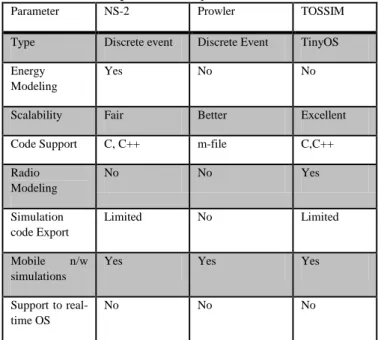
enough results are required for simulation of wireless controlled systems. Thus, this paper investigates five widely used wireless sensor networks reproduction tools namely Prowler, NS-2, Tinyos Mote Simulator (TOSSIM), OMNeT++, and OPNET for high performance network simulation capacity along with planning and verification. The simulators also allow custom extensions allowing seamless and better simulation of all Wireless Sensor Network aspects, battery, ZigBee, mobile nodes, written or downloaded from the internet. Although some of the reviewed simulators do present the incapability of performing high capacity real time simulations thus making it possible that code which runs in a simulation might not run on a real mote, for example if interrupt handlers run too long, a real-world mote may crash but as code in the above mentioned simulators runs instantaneously, no problems will appear in simulation
2.1 NS-2
The library can be written in C and C++ language. The OTCI in NS-2 works as a control language. Simple mobility model ensures seamless simulation, Complex wireless network hardware and model configuration can be imported, NS-2 supports all standard wireless IP networks and ad-hoc protocols are its advantages. NS-2 does not have any capability of for real time operating system, it also lacks application code delay model that is present in other simulators and it is not scalable to larger capacities and wider networks. Along with these, NS-2 also lacks application model for simulating the network are some of its disadvantages.
2.2 Prowler
Prowler is suitable for design establishment which means that it can be very effectively used for transfer of information between sources to destination. The prototyping of application is easily done with the help of prowler, integration of different optimized networks is possible, prowler provides excellent GUI interface with good visualization capabilities, prowler can be easily scalable which sets it apart from other simulators are its improvement towards sensor networks. An official public user-guide is not available for prowler. Fault models are identified in 2 Dimension space, No antenna modelling reference is providing inside the simulator are its drawbacks
2.3. TOSSIM
TOSSIM is a Tinyos Simulator. TOSSIM is more like an emulator rather than a simulator. The developer of TOSSIM had 4 required features that needed to be implemented as Scalability, Completeness, Fidelity and Bridging Thousands of nodes can be connected in a directed graph fashion inside TOSSIM model. Each edge of this graph has probalistic bit error. This enables TOSSIM to capture behavior and interaction at many levels. TOSSIM is an emulator that is based on probalistic values and hence even though it is very efficient and scalable but it cannot be used for low level protocols. TOSSIM is unable to determine the energy consumption for each node in a network are few of its drawbacks.
The paper suggests that NS-2 extensions to be used in wireless sensor networks. Improved attainment is not possible in these simulators without the use of external software. TOSSIM does not support mobile network simulation and dynamic changes in topology and hence it is unsuitable for those application. NS-2 is the least scalable among all the other simulators. Only OPNET provides the 3-D modelling of network [5].
Table 1: Comparative Analysis of Network Tools
Parameter NS-2 Prowler TOSSIM
Type Discrete event Discrete Event TinyOS
Energy Modeling
Yes No No
Scalability Fair Better Excellent
Code Support C, C++ m-file C,C++
Radio Modeling
No No Yes
Simulation code Export
Limited No Limited
Mobile n/w simulations
Yes Yes Yes
Support to real-time OS
No No No
deployment. One of the primary requirements of a good wireless network simulation tool is accuracy, support and the number of publicly available protocols. The paper takes into account the most popular network simulators and compares them, providing a performance evaluation that will benefit researchers in selecting an optimum network simulation tool. Each of the surveyed network simulation tools have their own pros and cons therefore it is essential to have knowledge of their strengths and weaknesses before selecting any one tool based on the particular application [7].
3. NS3
NS-3 is an open source, discrete-event computer simulator which is built using C++ and Python with scripting capabilities [8]. This software can be used to develop simulation models working in real-time, allowing interconnection with the real world and enable real world protocols to be used within the NS-3. It provides models on how packet data networks work and perform and provides user to perform simulation experiments to test the networks. NS-3 core supports both IP and non-IP based networks. The major focus, however, is on wireless fidelity in (Wi-Fi), WiMAX, and LTE physical layer simulations. NS-3 has a set of libraries which can be combined together with external software libraries. It is primarily used on Linux systems and supports for Cygwin, Free BSD (for Windows) is in development [8]. Some of the features of NS-3 include scalability- packets can have a virtual zero byte, for which memory is not allotted. There are node optional features, where one can choose the models and allocate or unallocated memory to the nodes in the network model. Another is Cross-layer features which include packet tags and tracing facility [9]. There are various simulation experiments that have been carried on to test the LTE network, its performance, and to enhance the same remodeling has been also carried out and tested on NS-3. In [10], a new simulation module has been designed for NS-3 aimed at the performance of the LTE networks, with emphasis on the Evolved Universal Terrestrial Radio Access (E-UTRA) designing. The model in this paper uses some part of the previous work of [11], and part of the Physical layer model is being reused. A Medium Access Control (MAC) Scheduler application program interface (API) [12] has been adopted as well. The objective of this module is to become an accepted reference platform for LTE based Self-Organizing Network (SON) systems. Adaptive modulation, coding, test, Round robin method and proportional fair methods for scheduling are used. A comparison with their performance is made as well.
A simple experiment in [13] demonstrates the handover in the 3GPP LTE network environment. Handover is the case when a user equipment (UE) moves away from the serving base station, the services get interrupted. So when it enters the new cell with a new base station, the mobile gets the services from this new station, that is, the connectivity of the UE is handed over from one base station to the other. Seamless connectivity is when the user doesn’t get interruption or call drops when the handover is taking place. This paper shows an experimental setup with two eNodeB located at some distance (500m) from each other. The UE
moves from the serving eNodeB towards the target eNodeB. The handover starts at 250m when the UE is closer to target evolved NodeBs (eNB) than the source eNB. Also, when UE moves 10m/s, the handover may start at 258m whereas for speed 110m/s, it may start at 349m. When the UE travels faster, it communicates with the source for a longer distance. The Reference Signal Received Quality (RSRQ) values have also been plotted. The results show the UE moves to the target close when its speed is faster.
In [14] an application of real-time video streaming over the NS-3 Based simulate LTE networks is described. A video server and video client together with the NS-3 simulated environment are the main parts of this experiment. Several protocols like User Datagram Protocol (UDP), Real-time Transport Protocol (RTP) and Dynamic Adaptive Streaming over HTTP (DASH) are also used. The hardware in the loop (HIL) platform is developed for the simulations. The HIL procedure translates the real packets sent by the server in the format used in NS-3 for easy flow through the simulated environment that has the LTE network. Again, when the packets flow to the client device, they get translated to the real data format. This platform serves multiple clients as well. To verify the platform that has been developed, three test cases, namely video client mobility, streaming video to multiple clients and handover over the HIL platform are considered.
In video client mobility there are two scenarios- first a stationery UE is considered at a certain distance from its eNodeB, and the second where a UE is moving at a certain speed. The network performance here shows the quality of video received by the two clients UE. The stationery UE receives data packets at a constant rate, whereas the mobile UE client has a variant data throughput and also suffers fading losses. In the second test case, as the number of clients streaming the video increases, the bandwidth has to be shared among these clients, as a result of which the end-user performance is affected. The throughput decreases with each new client, which share the same bandwidth. The third case is for handover where one UE moves away from its serving eNodeB towards another eNodeB at some speed. The UE suffers from multipath fading environment simulated using the Extended Vehicular A (EVA) model. As said in this paper, the handover in LTE is hard handover where the connection is broken off at the instance of the handover and so the video suffers some losses. This can be solved using the DASH platform which adapts the bit rate, according to the network conditions. DASH also has a start-up state and a buffer which holds the packets till some threshold value after which it starts the play out state. When packet loss reaches 100% at handover, the client will buffer the video from the stored packets.
4. OMNET++ and SimuLTE
(NED) [15]. SimuLTE is an open source simulation software tool for evaluating the performance of LTE and LTE-Advanced networks for the OMNET++ framework. SimuLTE works on C++ and is customizable with a pluggable interface. SimuLTE allows user to develop new modules incorporating new protocols and algorithms as well. SimuLTE takes the concept of modularity from OMNET++ framework and can also be integrated with other modules. Some of the main features of SimuLTE are – APPs which have VOIP GSM gateway, Real-time gaming, and File Transfer Protocol (FTP). Features like buffering, Protocol Data Unit (PDU) concatenation, and Channel Quality Indicator (CQI) reception are available for designing of the MAC layer. For Physical layer, SimuLTE provides channel feedback computation, transmit diversity with signal-to-interference-plus-noise ratio (SINR) curves and for eNodeB designing there is support for Coordinated Multi Point (CoMP), handover, and scheduling algorithms.
The work described in [16] shows the simulation of LTE and LTE-Advanced networks with concentrate mainly on the MAC layer designing and scheduling algorithms used. The paper introduces the OMNET++ framework whose basic blocks are ‘modules’ which communicate using ‘messages’ sent and received through a ‘connection’ that links the modules’ ‘gates’ acting as interfaces. The implementation and design parameters are coded in C++ whereas the description of gates and connections are coded in Network Description (NED) language. OMNET++ is integrated. SimuLTE which adapts the OMNET++ framework simulates the data plane of the Evolved Packet Core and the Radio Access Network. It also allows the simulation of the LTE networks in Frequency Division Duplex (FDD) mode with heterogeneous eNBs and omnidirectional, anisotropic antennas.
The eNB and the UE are compound modules which are further made up of various other modules and each of these modules has a .ned descriptor file that defines its structure and functionalities. Thus, these compound modules like UE and eNB connect to each other and other nodes to make a network. The protocol stack which consists of TCP, UDP and IP are taken from the Internet networking (INET) package and connect the LTE network with the TCP/IP based applications. Furthermore, the paper gives a detailed description of other modules like Radio Link Control (RLC) module, MAC module and physical layer (PHY) module. When the complete simulation model is designed, validation and verification of the system and the model is carried out followed by performance evaluation. Validation is done by considering reference scenarios and comparing with theoretical results. The throughput is checked for the simulated cases and compared with reference throughput values. The result obtained matches with the reference values. The verification system ensures the correctness of the implemented model which checks for the errors, consistency and interaction of the modules with each other.
The modelling of unicast device to device (D2D) communication where two UEs communicate with each other without interacting with eNB were implemented [17]. Certain changes to the software architecture is made which consist of
developing new classes through inheritance. Example of classes used in the paper is MacUeD2D and MacEnbD2D. Modification is made in the protocol stack of both UE and eNB. Validation is performed by measuring the CQI on the D2D link for two cases. Results show that the channel quality is good for short distances (30m) and degrade as the distance increases to more than 100m. System efficiency, throughput and the scheduling algorithms have also been tested here.
5. OPNET Modeller
using the processor. OPNET network is divided in three parts:
5.1 Network Domain
The network domain consists of networks, sub networks, network topologies and geographical co-ordinates of the network. It provides the overall scope of the system that is to be simulated. Satellite modelling is also present in this domain. Mobility of the nodes can be realized using Mobility trajectory, Mobility vector or Manipulation of node’s co-ordinates. Network Domain contains high level description of objects as well as their physical configuration and location.
5.2 Node Domain
Node means workstations, packet switches, routers, satellite terminals, remote sensors, etc and all of these are specified by node domain. Nodes can be fixed or mobile.
5.3 Process Domain
The process domain in Opnet is designed as the Finite State Machine (FSM) and it contains C and C++ conditional statements inside them. The behavior of processor and queue models are specified in it. It consists of transition states that can be toggled using the code in the processor
6. System Generator
System Generator is a highly advanced tool used for the development of Digital Signal Processing (DSP) and Communication Systems. It is used for developing algorithms very quickly as compared to Register Transfer Level (RTL) Design. Some of the important features are to incorporate of Field Programmable Gate Array (FPGA) s to develop parallel system, help in generating the code automatically and simultaneously model the system using MATLAB developed by Mathworks. In 2003, a technique proposed for implementing applications of DSP based with the help of Xilinx System Generator (XSG) [19]. The technique was aimed at improving the ability to make use complicated systems developed for designing purposes. The most prevalent issue in the electronics field, especially in the wireless domain consisted of intelligent networks based on the sensor being shared by systems, which was identified in 2006 [20]. Planning, Modeling and error correction of the entire system was of crucial importance in several situations. Thus the authors used the Spartan-IIE XC2S200E to design a platform incorporating both MATLAB and the System Generator.
In 2009 proposed a technique to enhance how efficiently the design of a complex system is verified using XSG [21]. Further a model was developed for conversion between different colors spaces essentially used for video processing based on XSG. The comparison of the results with other methods was done, and successful verification was obtained as the transformed image was obtained without any perpetual errors. The method in which XSG could be used to develop and design an Infinite Impulse Response (IIR) filter on the FPGA Platform, was shown in 2012 [22]. Parameters such as overflow and quantization effects had to be taken into account to stabilize the system, further this method also
showed a notable improvement in the rate of computation. The filter was designed for a set of specification, simulated using the Simulink environment in Matlab and finally implemented using Xilinx System Generator. Additionally, in 2014, a method of designing the model for Multiple Input Multiple Output (MIMO), using XSG and Accel DSP was presented [23]. The advantages such as resource reuse, reduction in the time taken for designing were highlighted and the merit of FPGA over DSPs as platforms was reviewed
Figure 1. System Generator Design Flow [24]
7. Other Software
7.1 LTE SIM
LTE SIM is referred to as Long Time Evolution Subscriber Identity Module. It is exactly similar to the 2nd Generation (2G) and 2.5 Generation (2.5G) Subscriber Identity Module (SIM) Card which additional features incorporated. It is referred to as the UE. It mainly comprises of Mobile Termination, Terminal Equipment and Universal Integrated Circuit Card. Mobile Termination- it mainly handles the functions related to the communication. Terminal Equipment- it is mainly used to terminate the streams of data. Universal Integrated Circuit card- It is also referred to as the SIM card for the LTE devices. Application used for its operation is called as User Subscriber Identity Module (USIM). This USIM has complete detailed information about the subscriber who is using the LTE device. It mainly contains details like Phone number of the subscriber, home network identity and security keys etc. LTE SIM incorporates the several aspects of LTE networks that are Evolved Universal Mobile Telecommunications System Terrestrial Radio Access Network (EUTRAN) and Evolved Packet Core (EPC). It also provides different kinds of services such as Supporting single cell and multi-cell environments, Incorporating Frequency Reuse Concepts and
Xilinx DSP Block Set
Xilinx Core Generation
Xilinx Implementation
flow
Download to FPGA
RTL Verification Develop
Executable Spec in Simulimk
Test bench Generation
Automatic RTL Generator
finally it also ensures appropriate mobility of the user as well as ensures perfect handovers thus preventing the call drop [25].
7.2 Agilent System Vue
System Vue is basically a software which by specifically designed for automation in the field of Electronic designing environment incorporating the design of the system-level electronics component. This software also allows all the software designers and developers to appropriately and effectively modify the physical layer of the wireless and security systems thus ensuring the unique value of the FPGA, DSP and Radio Frequency (RF). This software is the perfect and the most dedicated platform for the designing of Electronic System Level (ESL) and appropriate realization of the signal processing block. System Vue software replaces all the common based environments for the digital, math and analog parts. The System Vue software breaks the Physical development and the time required for the verification into half and it automatically gets connected to our flow of mainstream Electronic design automation (EDA). This software has many tremendous features such as data flow with very excellent performance, synthesis of the digital filter, verification and improvement of hardware components, developed interface for the Custom C++ model and a developed core environment to meet the user demands [26].
7.3 IT++
IT++ is mainly the library used for performing mathematical functions, signal processing functions and for all the associated communication functions. IT++ is basically a library associated with C++. Objective of using this IT++ is mainly for simulation of the communication systems so as to enhance and improve the working and performance in the field of communication systems. IT++ technology mainly originated from the Chalmers University of Technology, Gothenburg, Sweden. Just because this library is associated with the C++ library, IT++ appears to be an excellent name. IT++ was developed as a part of the European Network body for the wireless Communication systems related to LTE Networks. IT++ is extensively used nowadays taken into consideration the fact that is has a very high speed, accuracy and better functionality. IT++ is an open source library which can freely be installed. IT++ works almost on every operating system such as Windows, LINUX, Sun Solaris and MAC OS operating systems. IT++ can also work without the libraries such as Automatically Tuned Linear Algebra Software (ATLAS), The AMD Core Math Library (ACML) and Math Kernel Library (MKL), but its performance and functionality would be degraded. [27]
7.4 GNS 3
GNS 3 is referred to as the Graphical Network Simulator 3 software. This software functions exactly similar to the Cisco packet Tracer software. Just like the Cisco packet tracer software GNS 3 is also used specifically for simulation of the network. It basically involves testing of the network by pinging all the devices, it also checks whether packets can successfully be send from one Personal Computer (PC) to
another PC and it also helps in detecting any sort of faults which occur in the network. Network designers before designing the actual network first test the network on software such as GNS 3. Once the network is successfully implemented on the GNS 3 only after that the hardware implementation of the network is done. The biggest drawback associated with the Cisco Packet tracer software is that it does not support various protocols such as Border gateway protocol and Multi-Protocol Label Switching (MPLS). These drawbacks associated with Cisco packet Tracer are solved using the GNS 3 software. GNS 3 is nowadays widely used in various companies for network simulation as well. GNS 3 software also allows the researchers to perfectly emulate the complex networks which incorporate both the actual devices also with the virtual devices and minimal support is feasible for LTE [28].
7.5 Open WNS
Open WNS is the software which was specifically developed for the simulation for the wireless cum multi-cellular networks which were mainly used for the Mobile Communication Systems. In short is basically provides a platform for simulation for wireless mobile communication systems. Open WNS is mainly an Open source system level platform for simulation, evaluation and performance of the multi-cellular mobile communication systems. This simulation platform mainly provides detailed analysis and ensures highly efficient performance of the protocol stack along with detailed analysis and steps to eliminate any sort of the interference which has crept into the network. This software also includes models for the mobility, generators for traffic loading and methods incorporating statistical evaluation and models used for detailed channels. Open WNS generally uses the plugin architecture which allows all the developers so as to extend the simulation as per the requirements. This software also results in its own evaluation and supports channel estimation, scheduling algorithms used in LTE based on 3rd Generation Partnership Program (3GPP) releases. In such scenario this common simulation platform has a great potential for cost reduction and also improve the network performance [29].
7.6 Vienna LTE A
as well as the secondary users and appropriately changing/varying the channel conditions and relative position
of the receiver where chances of interference are considerably high [30].
7.7 Hurricane II
Hurricane II is mainly the software which is used for the network simulation as well as the emulation of the Wide Area Networks (WAN). Certain features of this software are- extremely simple and easy to use GUI, including any sort of faults which occur in the network, perfect generations of the data, incorporating multiple interfaces as per the user requirements and providing the interfaces which support a very high data rates of up to 1Giga bits per second (Gbps)[31]. This software performs the simulation of the network taking into consideration all the required settings made by the researchers. This network simulation is designed taking into consideration various impairments such as –
Delay, Jitter, Decimate and Relay of the frames. In this software the generation of the data can easily be achieved without using much of the resources which are associated with the network. This software is widely used in many applications such as – Enterprises which require continuous maintenance of the network on the daily basis, it is also used for quality testing of various devices which are used in the network and it is also used by the manufactures when the devices have been manufactured. This software is widely used in today’s modern technology as it has the capability to provide information about both the Impair IP as well as non-IP traffic [32].
Table 2.
Comparison of different wireless network simulation tools [33] [34]Advantage Disadvantage Limitation
NS-3 real time implementation simplified view of complex Interactions credibility and validation
OMNeT++ Simulation model for IP Networks available portability It doesn’t have overall single solution
OPNET It supports parallel simulations, technologies
and different Protocols result accuracy is limited requires more memory for model
SimuLTE fully customizable with a simple pluggable
interface needs to be identified
upgradations based on LTE Networks
LTE Sim supports Uplink Downlink Scheduling Strategies
ongoing communication at Drillsim affects the path loss
connectivity and coverage is affected to path loss
Agilent System
Vue Modification of physical layer is allowed. linearization technique
to implement multi antenna configuration it has to be replaced with own algorithm
IT++ It will enhance the performance of
communication system It won’t support the Parallelism
library modules based Implementations
GNS 3 fault identification is easier It won’t support various protocol and slow
throughput minimal support for LTE
Open WNS efficient performance of the protocol stack needs to be identified own evaluation leads to low throughput
Vienna LTE A It supports multiuser MIMO in LTE A handover in video streaming It is not a modular core
Hurricane II easy to use the graphical user interface general purpose emulator Supports up to 1Gbps
8. Conclusions and Future Scope
The detailed information’s and importance of wireless and mobile network tools are presented in this paper. The road map is also identified to carry out the research in Hardware Cosimulation domain using System generator and MATLAB/SIMULINK. Model based design, parallelism, the tool which supports MATLAB to analyse the performance analysis of LTE, LTE A, LTE Pro networks are identified. System generator integrated with MATLAB provides hardware expansion and mapping with FPGA devices, the need of hardware Cosimulation and hardware in loop are also observed. System generator utilizes the Very Large Scale Integration (VLSI) core libraries and possible FPGA implementation resources. This paper will be useful for the researchers to determine which simulator is required for different domain. The Importance of JTAG Programming with FPGA and Generated system Data transfer of can be analyzed in future with System Generator.
9. Acknowledgment
The Authors are thankful to the management and staff of Sathyabama Institute of Science and Technology for their wonderful support towards the completion of the paper.
References
[1] The Network Simulator - ns-2. http://www.isi.edu/nsnam/ns/. [2] L. Begg, W. Liu, K. Pawlikowski, S. Perera, and H. Sirisena.
“Survey of Simulators of Next Generation Networks for Studying Service Avail ability and Resilience. pp. 1-76. 2006. [3] S.Y. Wang, C.L. Chou, C.H. Huang, C.C. Hwang, Z.M. Yang, C.C. Chiou, and C.C. Lin “The Design and Implementation of the NCTUns 1.0 Network Simulator” Computer Networks, Volume 42,Issue 2,pp175-19,2003. [4] L. Bajaj, M. Takai, R. Ahuja, K. Tang, R. Bagrodia, and M.
Gerla. "GloMoSim: A Scalable Network Simulation Environment", UCLA Computer Science Department Technical Report 990027, pp1-12, 1999.
[5] Marko Korkalainen, Mikko Sallinen, Niilo Kärkkäinen, Pirkka Tukeva "Survey of Wireless Sensor Networks Simulation Tools for Demanding Applications " Fifth International Conference on Networking and Services, Spain. [6] Hsin-Hung Hsieh, Bih-Hwang Lee, Huai-Kuei Wu, Wen-Pin
Hsu and Hung-Chi Chien, "A Wireless Network Simulator Based on Design Patterns for WiMAX and LTE" Proceedings of the 2017 IEEE International Conference on Applied System Innovation, Japan.
Of Computer Networks, Volume (2), Issue (5), pp 249-265, 2011.
[8] ns-3 Manual, Release ns-3.25, ns-3 project, 2016.
[9] Pallavi S. Katkar, Dr. Vijay R. Ghorpade “Comparative Study of Network Simulator: NS2 and NS3” International Journal of Advanced Research in Computer Science and Software Engineering, Volume 6, Issue 3,pp 608-612,2016.
[10] Nicola Baldo, Marco Miozzo, Manuel Requena-Esteso, Jaume Nin-Guerrero “An open source product-oriented LTE network simulator based on ns-3” Proceedings of the 14th ACM international conference on Modelling, analysis and simulation of wireless and mobile systems, pp 293-298, 2011,USA.
[11] G. Piro, N. Baldo, and M. Miozzo, “An LTE module for the ns-3 network simulator,” in Proc. of the Workshop on NS-3 2011, Spain.
[12] FemtoForum, “LTE MAC Scheduler Interface Specification v1.11,” 2010
[13] Hojin Heo, Woosik Lee, Hanbin Kim, Byoung-Dai Lee, Byungjin Jeong, Namgi Kim, “Analysis of 3GPP LTE Handover using NS-3 Simulator ” Annual Int'l Conference on Intelligent Computing, Thailand, pp 24-25, 2016.
[14] Abdurrahman Fouda, Ahmed N. Ragab, Ali Esswie, Ahmed S Ibrahim, “Real-Time Video Streaming over NS3-based Emulated LTE Networks” International Journal of Electronics Communication and Computer Technology, Volume 4 Issue 3 , pp 659,2014.
[15] Simulation Manual, OMNeT++ version 5.2,2015.
[16] Antonio Virdis, Giovanni Stea, Giovanni Nardini “Simulating LTE/LTE-Advanced networks with SimuLTE”, Advances in Intelligent Systems and Computing, Springer Vol 402, pp. 83-105, 2016.
[17] Antonio Virdis, Giovanni Nardini, Giovanni Stea “Modeling unicast device-to-device communications with SimuLTE”, IWSLS ‘16, Vienna.
[18] Zafer Albayrak, Cumhur Torun, “Recent LTE Simulation Tools,” International Conference on Engineering and Natural Sciences, 2016, Sarajevo.
[19] Mohamed Hassan Babiker, Hala Eldaw Idris Neelain “Video steaming Throughput Performance Analysis over LTE,” IOSR Journal of Electronics and Communication Engineering Volume 11, Issue 1, Ver. I. pp 24-32,2016.
[20] Ownby, M.; Mahmoud, W.H. “A Design Methodology for Implementing DSP with Xilinx System Generator for Matlab", in IEEE International Symposium on System Theory, pp. 404- 408, 2003, USA.
[21] G.E. Martinez-Torres J.M. Luna-Rivera R ,R.E. Balderas-Navarro, “FPGA –Based Educational Platform for Wireless Transmission using System Generator”, IEEE International Conference on Reconfigurable Computing and FPGA’s, pp1-9, 2006,USA.
[22] T. Saidani, D. Dia, W. Elhamzi, M. Atri and R. Tourki, “Hardware Co-simulation for Video Processing Using Xilinx System Generator” Proceedings of the World Congress on Engineering, Vol I, 2009.
[23] Harish V. Dixit , Dr. Vikas Gupta, “IIR filters using Xilinx System Generator for FPGA Implementation” International Journal of Engineering Research and Applications Vol. 2, Issue 5, pp.303-307 2012.
[24] Sparsh Mittal, Saket Gupta, and S. Dasgupta “System Generator: The State-of-art FPGA Design tool for DSP Applications”, 2014.
[25] Vilas S. Bagad, Mobile Communication and Computing, Technical Publications, 2016
[26] Keysight Technologies, “Keysight EEsof EDA SystemVue”, Technical Overview, pp 1-9, 2016.
[27] http://itpp.sourceforge.net/4.3.1/
[28] Hassine J., Hamou-Lhadj A, “Toward a UCM-Based Approach for Recovering System Availability Requirements from Execution Traces.”. Springer International Publishing, pp.48-63, 2014.
[29] Bültmann D., Mühleisen M., Max S. “Modeling and Tools for Network Simulation”. Springer, Berlin.
[30] Julian Wilson, “Problem Description Primary receiver Secondary receiver eNodeB Aim: Reception of MIMO signals by a secondary receiver Parameterize design of secondary." Presentation transcript, 2017.
[31] Razvan Beuran," Introduction to Network Emulation “Taylor & Francis Group, 2012.
[32] Packet Storm, “IP Network emulator”, Datasheet, 2016. [33] Mansoor Ebrahim, Chai Wai Chong "A Comprehensive
Review of Distributed Coding Algorithms for Visual Sensor Network (VSN)"International Journal of Communication Networks and Information Security, Vol 6, No 2,pp104-116,2014.
![Figure 1. System Generator Design Flow [24]](https://thumb-us.123doks.com/thumbv2/123dok_us/8123337.2154566/5.892.469.816.254.663/figure-system-generator-design-flow.webp)
![Table 2. Comparison of different wireless network simulation tools [33] [34]](https://thumb-us.123doks.com/thumbv2/123dok_us/8123337.2154566/7.892.70.842.400.745/table-comparison-different-wireless-network-simulation-tools.webp)
