Ymchwil gymdeithasol Social research
Number: 38/2013
Understanding who commits
hate crime and why they do it
AUTHORS
Dr Colin Roberts, Cardiff University
Prof Martin Innes, Cardiff University
Dr Matthew Williams, Cardiff University
Dr Jasmin Tregidga, Cardiff University
Prof David Gadd, University of Manchester
Views expressed in this report are those of the researchers and not necessarily those of the Welsh Government
For further information please contact: Name: Nathan Cook
Department: Local Government and Communities Welsh Government
Rhydycar Business Park Merthyr Tydfil
CF48 1UZ
Tel: 0300 062 8119
Email: [email protected]
Welsh Government Social Research, 2013 ISBN 978-0-7504-9639-1
Table of contents
Page No
Summary………. 2
1. Introduction ………....10
1.1. How the research is structured………..…12
2. Structured literature review……….14
2.1. The idea of hate crime………..14
2.2. Structured literature review method……… 17
2.3. Who commits hate crimes?...18
2.4. What acts are committed as hate crimes?...….24
2.5. Where do hate crimes occur?...27
2.6. When do hate crimes occur?...29
2.7. Why do perpetrators commit hate crime?...30
2.8. How do hate crime perpetrators acquire their attitudes and account for hate crime?...37
2.9. Assessing the quality and strength of research evidence……….38
3. Empirical data on hate crime in Wales ……….……...40
4. Conclusions and recommendations……….………...54
Appendix 1………59
Executive Summary
This study was commissioned by the Welsh Government to explore and assess what is known about the perpetrators of hate crimes and their
motivations. By providing a critical analysis of the existing research evidence-base in this area, the study contributes to a more comprehensive and
informed understanding of this kind of offending in order to improve policy and practice responses to it.
Based upon a detailed review of the literature in terms of what is known about hate crime offenders and offending nationally and internationally, it is intended that the findings should frame and steer subsequent more detailed empirical analysis of hate crime data.
The available data shows that of the 43,748 hate crimes recorded by the police in England and Wales in 2011/12:
• 35,816 (82%) were race hate crimes;
• 1,621 (4%) were religious/belief hate crimes;
• 4,252 (10%) were sexual orientation hate crimes;
• 1,744 (4%) were disability hate crimes; and
• 315 (1%) were transgender hate crimes.
In that year, there were 1,809 hate crimes recorded in Wales with a broadly similar pattern of offences:
• 1,368 (76%) were race hate crimes; • 54 (3%) were religious/belief hate crimes; • 244 (13%) were sexual orientation hate crimes; • 122 (8%) were disability hate crimes; and • 21 (1%) were transgender hate crimes.
Reflecting the harm associated with crimes of this type over the past two decades or so, there has been a rapid growth in the amount of policy and research attention paid to it as an issue. A significant proportion of this work has focused upon victims and victim perspectives. Far less research has been conducted into those responsible for causing harm to the victims.
The research design
The study was organised around three key phases of activity:
1) A structured review of published academic and policy-related research to enhance understanding of what is known about the characteristics of people who engage in hate crimes and their motivations for doing so. This phase also sought to identify any key knowledge ‘gaps’.
2) Employing emerging empirical findings from on-going research in relation to hate crime to explore the extent to which findings derived from the review of the wider literature are relevant to the unique and diverse characteristics of the communities across Wales.
3) Identifying what works in reducing the harm of hate crime, what looks promising in this respect, and where future activity should be focused.
Key findings
The findings from the review of the literature were organised around six key ‘who’, ‘what’, ‘where’, ‘why’, ‘when’, and ‘how’ questions:
• Who are the perpetrators of hate crimes, in terms of social relationships and identities, and their socio-demographic and socio-economic
profiles?
o One study on hate crime offenders identified four broad categories of offender – ‘thrill seekers’, ‘area or territory defenders’, ‘retaliatory offenders’ and ‘mission offenders’. o The socio-demographic profiles of hate crime offenders tend to
match the demographics of the population of a given area. o The majority of hate crime offenders in the UK are white, male
and under 25.
o Hate crime offenders convicted of more serious and violent offences tend to be older.
o Contrary to classic portrayals of hate crimes, very few are committed by strangers.
o A small proportion of hate crime offenders appear to ‘specialise’ only in hate crime.
• What kinds of acts are involved in hate crimes? Are there patterns in the use of verbal harassment and abuse, and different kinds of violence in respect of certain kinds of offender and victim? Relatedly, do
individuals ‘specialise’ in hate crimes, or are they part of a broader pattern of offending?
o Approximately 84% of all hate crime is racially motivated.
o Perpetrators of racial and religious hate crimes and homophobic and transphobic hate crimes, are somewhat more likely than those who commit disability hate crime to commit public order offences and offences against the person.
o Those who commit disability hate crime are more likely than the perpetrators of other types of hate crime to commit sexual offences, theft and handling, and robbery.
• Where do hate crimes take place? Is there any patterning in terms of the geographic locations that can be identified where such offending occurs (i.e. public spaces, or in particular neighbourhoods)?
o ‘Place’ is an important yet neglected consideration in relation to hate crime offending.
o Emerging evidence suggests that there may be identifiable hate crime ‘hotspots’.
• Why do individuals commit hate crimes of different kinds and against particular victims?
o There are a wide variety of accounts engaging with the question of ‘why hate crime offenders commit their acts?’
o Disciplinary backdrops shape these accounts, which in turn shape what issues are held to be important in explaining participation in hate crime.
o Few attempts have been made either by researchers or policy makers to consciously monitor the ‘engineered narratives’ of extremist groups and the realistic threats contained and exploited within them.
o Personal insecurity concerning sexuality and identity are important drivers of hate crime.
• When do perpetrators engage in different kinds of ‘hate’-motivated offending? For example, are particular types of ‘disinhibitor’ involved, or are there specific behavioural/emotional triggers that can be identified?
o Understanding how hate crimes might be connected to previous events and reactions to them (including interventions applied to offenders) appears a promising line for future research.
o To date, the ‘when do they occur’ issue has been relatively neglected in terms of the research evidence-base.
• How do perpetrators acquire their prejudiced attitudes and behaviours, and account for these?
o The incubation of racist attitudes and views in young people is particularly strong where this is ‘normalised’ as a result of the public expression of such views by older community members. o There are three distinct groups around which interventions can
be crafted: perpetrators; potential perpetrators; and the perpetrator community.
o The identification and active resistance to dehumanising language circulating in communities and media reports, may have a positive impact on polarisation and stereotyping. Applying a conceptual schema such as this affords an opportunity to look across the available literature in a systematic way, without being beholden to any existing framings or interpretations that the original authors may have placed upon their data.
Following on from this assessment, the analysis draws together some empirical data derived from other studies to establish whether the findings from the review of the literature are coherent with what we know about hate crime perpetration in Wales, and to a lesser extent England.
Assessment of the literature
As part of the study, the research team undertook an overarching assessment of the quality and quantity of research evidence relating to hate crime
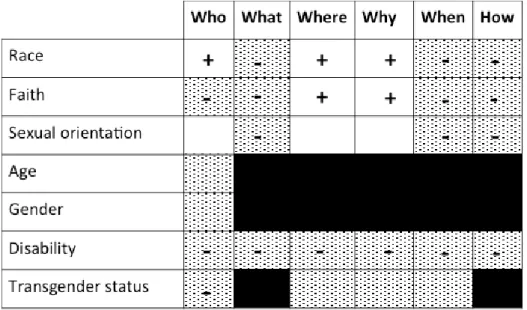
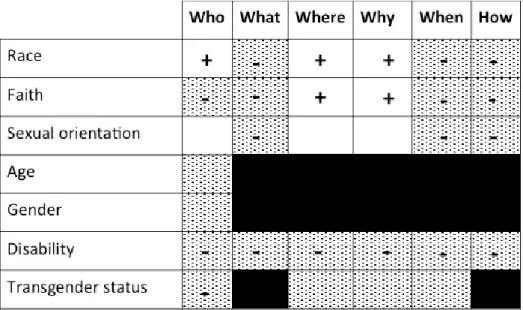
offending. The results of which are provided in Table 1 below. The blocked out cells indicate where little or no substantive quality evidence about this issue has been identified. A dotted hatched cell denotes where there is some evidence on this issue, albeit of limited quality and quantity. Typically this is where there is one (or several) small-scale, fairly focused study that has been conducted on a specific type of hate crime. Finally, the white cells are used to identify where the research evidence is of a relatively robust standard, both in terms of the research designs used and the total number of studies that have been conducted. ‘Plus signs’, indicate a substantial body of research in this area, while negative signs indicates a concern about the lack/weakness of studies.
Table 1: Summary of strength and depth of hate crime literature
The summary clearly conveys some evident patterns in terms of the structure of the knowledge base about the different types of hate crime. The quality and quantity of research evidence is best in relation to racist hate crimes. There is also reasonable strength and depth about crimes committed against people because of their sexual orientation and faith/belief. The latter in particular gravitates around the growth in anti-Islamic sentiments post-9/11. For the other protected characteristics, there is much less reliable published evidence about the perpetration of these kinds of activities. What little evidence there is suggests that the profile of perpetrators and their motivations may differ markedly.
The purpose of these analyses has been to clarify what is known about who commits hate crimes and why, and also to locate any key gaps in our
knowledge about such issues. On the basis of the work conducted to date, a number of important questions can be identified that still cannot be answered:
• Are there a small, concentrated number of hate crime offenders
responsible for a significant proportion of all incidents, or is this kind of activity more widespread?
• What role, if any, is played by organised extremist groups who espouse oppositional agendas to groups with protected characteristics?
Empirical data on hate crime in Wales
There is very little available data specifically concerned with hate crime
perpetration in Wales. Accordingly, the British Crime Survey has been used to identify a number of broad patterns in respect of hate crime perpetration:
• Where victims are targeted because of their race or sexual orientation, it is likely to involve more than one offender. In contrast, incidents based upon gender and disability are more often committed by individuals.
• The gender of hate crime offenders is overwhelmingly male, albeit participation in hate offences motivated by sexual orientation, age and disability, involves female participation in around 18% of cases.
• For most types of hate crime roughly one-third of offenders are aged under 24. The exception to this is hate crime on the basis of sexual orientation, where 77% of offenders were aged over 25.
• There are some interesting trends in relation to offender ethnicity. The BCS suggests that just under one-third (31%) of offenders involved in racially motivated hate crime, were themselves from a visible ethnic minority background (VEM). A similar level of VEM involvement was found for hate crime offences motivated by gender.
The analysis of the British Crime Survey (BCS) has been supplemented by inclusion of material from The All Wales Hate Crime Survey (AWHC), which was established to develop a more comprehensive picture of the experience and impact of hate crime across Wales. Based upon a survey of 1,810 respondents, 564 of whom were victims, some limited data about hate crime perpetrator characteristics in Wales can be extracted1.
Of particular note when compared with the BCS data for England and Wales, is the higher participations of women in race hate crime in Wales (28%) versus England and Wales (15%). Similarly, there is higher female
participation in hate crimes on the basis of: age – 40% in Wales compared with 18% in England and Wales; and disability (29% in Wales - 17% in England and Wales). In summary, it appears that women in Wales are more likely to be involved in several types of hate crime offences when compared with BCS data for England and Wales.
It is important to acknowledge that the sampling strategy adopted for the AWHC survey differed from that of the British Crime Survey, and therefore the differences reported here should be interpreted with a degree of caution. To confirm these differences, a random probability sample survey (with
appropriate stratification and clustering) needs to be conducted within Wales to compare to the BCS.
1
The AWHC survey adopted a quota sampling strategy which oversampled the recognised equality strands and victims of hate crime/incidents. As a result, the sample is not a reliable basis for ‘hard’ measures such as prevalence. It does however provide a sound basis for ‘soft’ measures such as perceptions, attitudes and feelings. Any reference to prevalence should therefore be interpreted with a degree of caution.
Conclusions
In moving forward, the analysis concludes it is particularly important given the complexities associated with defining and measuring levels of hate crime, that any new contribution be conceptually robust and precise in terms of what it is seeking to contribute. In the initial overview of the literature reported herein, the tendency to over-extend the relevance of findings was noted. For
example, a number of studies of racist hate crimes rapidly move on to talk about the findings as providing insights into ‘hate crime’ in general, rather than a specific type of crime.
It would seem that in terms of a future agenda for research into why hate crimes happen in Wales, it would be important to look at all such crimes in detail to discover which are influenced by extreme narratives, and which are not; those that are retaliatory and those that are not; and those that are planned and those that are spontaneous.
Recommendations
The following recommendations are made within the context provided by the Welsh Government’s, Tackling Hate Crimes and Incidents: A Framework for Action:
1. Welsh Government and criminal justice agencies should commission further research using police data from across Wales to better
understand what kinds of acts are committed against different groups, in order to identify specific protective measures individual groups may need to reduce victimisation.
2. It is essential that a continuous process is adopted across government and all partners in the criminal justice sector to drive up reporting of all hate crimes, while removing inconsistencies in the recognition and prosecution of different types of hate crime. This is particularly vital in relation to disability hate crime. The increase in reported hate crime reporting should be publicly acknowledged as a measure of success. 3. To confirm key differences in patterns of perpetration of hate crimes
between Wales and England, a random probability sample survey of sufficient size (with appropriate stratification and clustering) needs to be conducted within Wales to compare to the Crime Survey for England and Wales.
4. Welsh Government should instigate with its partners in the police, Crown Prosecution Service (CPS) and National Offender Management
Service (NOMS), a study of criminal careers of hate crime offenders in Wales, particularly those that use violence, to understand:
a. Whether there is an escalation in violent offending over time. b. The extent to which hate crime offences are retaliatory,
situational, or territorial in nature.
c. If some hate crime offenders specialise only in hate crime and if so why.
d. To what extent hate offending is organised.
e. The relationships between hate crime offending, particularly the commissioning of serious violent offences and the link to
extremist groups.
f. The key narratives of extremist groups linked to offending. g. The role of drug and alcohol intoxication in hate crime offending
behaviour.
h. The geographic relationship and proximity of offenders to their victims.
5. Welsh Government should instigate a geographical analysis of all hate crime offences to establish where in Wales ‘hotspots’ for hate crime offending exist, and then to instigate place-based studies of selected hotspots in order to develop a more ‘thickly’ descriptive account of what is happening in these areas.
6. Based on Recommendation 3 above, to develop from this study a set of monitored interventions appropriate to different hate crime
categories, to de-escalate hate offending, the harm caused by it, and improve reporting of it in priority areas.
7. Welsh Government and the four Welsh police forces should explore the use of restorative justice interventions for less violent/serious hate crime offenders as a possible way of preventing progression in hate crime careers and reducing victim impact.
8. Welsh Government and its partners should seek to establish ‘wider and deeper’ third-party hate crime reporting mechanisms, particularly with regard to disability hate crime and other minority hate crime sectors, coupled with appropriate publicity, training and awareness campaigns. 9. Related to Recommendations 4 and 5 above, Welsh Government and
partners should assess how the police and other official bodies interface with ‘groups’ rather than individuals acting in this area, in order to strengthen local targeted action and opposition to hate crime in areas of most concern in Wales. It is particularly important that
partnership delivery is focused on the essential ‘bridging’ activities that bring people together from different communities in a meaningful way, in order to demystify narratives of difference.
1 Introduction
This document reports findings from a study designed to explore and assess what is known about the perpetrators of hate crimes and their motivations. It is intended that, by providing a critical analysis of the existing research
evidence-base in this area, the study should contribute to the development of a more comprehensive and informed understanding of this kind of offending in order to improve responses to it.
This report provides a detailed review of the literature in terms of what is known about hate crime offenders and offending nationally and internationally. It is intended that this should frame and steer subsequent more detailed
empirical analysis of hate crime data supplied by the four police forces in Wales.
Defining hate crime
An agreed national definition of hate crime for England, Wales and Northern Ireland was first introduced in 2007 by the Association of Chief Police Officers (ACPO) and the Crown Prosecution Service (CPS). According to this
definition, ‘hate crimes’ are where the perpetrator's hostility or prejudice against an identifiable group of people is a factor in determining who is victimised. This is a broad and inclusive definition. A victim does not have to be a member of the group2. In fact, anyone could be a victim of a hate crime3. Commensurate with this definition, police and CPS collect data for the
following five ‘monitored’ categories of hate crimes:
• disability;
• race;
• religion or belief;
• sexual orientation; and
• transgender identity.
Transgender hate crime/hate incidents were the last to be added to the list of monitored categories in April 2009. Consequently, meaningful analysis of all recorded ‘monitored hate crime’ and incident types only became possible from April 2010.
2
Hate crime thus for example could include the scenario where a man was attacked because he was thought to be gay by an offender (although he wasn’t).
3
Within official data, a distinction is routinely made between ‘hate incidents’ and ‘hate crimes’, with the latter recordable and reportable under the National Crime Recording Standards. Hate crimes have two key components. The first involves the infraction of criminal law, and the second the recognition of the presence of an aggravating factor aligned to any of the five monitored categories associated with the commissioning of the crime. This element is then flagged up through the criminal justice process and may attract a higher sentencing tariff at court.
The precise definition of what acts are classified as ‘hate crimes’ has been refined and altered through several pieces of legislation. The Crime and Disorder Act (1998) established a number of specific offences of racially aggravated crime. This was amended by the Anti-Terrorism Crime and Security Act 2001, which extended the scope of the previous legislation by creating new religiously aggravated offences and applying the same sentencing duty to all other offences where there is evidence of religious aggravation. Further amendments were introduced via the Protection of Freedoms Act 2012, which identified new specific offences of stalking and racially and religiously aggravated versions of these offences.
These legislative manoeuvres have sought to build upon the basic framework of protected characteristics established by the Equality Act (2010). This recognises that people can be discriminated against on the grounds of disability, race, religion or belief, sexual orientation or gender reassignment, age, marital status and civil partnerships, maternity and gender. What the level of legislative activity described above tends to show is just how
important hate crime has become as a public policy issue, and how complex an arena it is in terms of understanding the prevalence and distribution of the problem.
Recorded Hate Crime
One view of hate crime can be obtained by examining police recorded crime figures. In overview, there were 43,748 hate crimes recorded by the police in 2011/124 for England and Wales. This figure relates to the monitored
categories of hate crime listed above, but is not a definitive count of crime as more than one form of hate crime can be assigned to an offence. The Home Office suggest that less than 5% of hate crime offences have more than one monitored strand assigned to them (this ranged between 1% and 7% of
offences for the 17 Welsh and English police forces whose data was reviewed by the Home Office).
4
http://www.homeoffice.gov.uk/publications/science-research-statistics/research-statistics/crime-research/hate-crimes-1112/
Of the 43,748 hate crimes recorded by the police in England and Wales in 2011/12:
• 35,816 (82%) were race hate crimes;
• 1,621 (4%) were religious/belief hate crimes;
• 4,252 (10%) were sexual orientation hate crimes;
• 1,744 (4%) were disability hate crimes; and
• 315 (1%) were transgender hate crimes.
Disaggregating the combined total above, there were 1,809 hate crimes recorded in Wales in the same period:
• 1,368 (76%) were race hate crimes; • 54 (3%) were religious/belief hate crimes; • 244 (13%) were sexual orientation hate crimes; • 122 (8%) were disability hate crimes; and • 21 (1%) were transgender hate crimes.
Although there are some differences evident when comparing like for like categories for England and Wales, for example disability hate crime, where the percentage is double that of England, we should nevertheless be cautious of drawing any firm conclusion from this because of the low number of crimes recorded.
As can be seen from the data above, race hate crime is by far the most common type reported to and recorded by police in England and in Wales. This is supported by the most recent analysis of the British Crime Survey, which suggests that each year about 0.5% of the total adult population for England and Wales are victims of hate crime, with the greatest proportion of victims believing they were targeted because of their race (Smith et al, 2012). Although there are relatively few victims of hate crime proportionate to the entire population, it is clear that it is a type of offending that can cause profound harm to those who experience it. The same Home Office study recorded that 92% of hate crime victims stated they had been emotionally affected by their experiences.
1.1 How the research is structured
Reflecting the harm associated with such victimisation over the past two decades or so, there has been a rapid growth in the amount of policy and research attention paid to this issue. A significant proportion of this work has focused upon victims and victim perspectives. Far less research has been conducted into those responsible for causing harm to the victims. Set against this backdrop, the current study was commissioned by the Welsh Government
to establish a comprehensive picture of what is and is not known about who commits hate crimes and why they do it.
The research design for the study was organised around three key phases of activity:
1. A structured review of published academic and policy-related research to enhance understanding of what is known about the characteristics of people who engage in hate crimes and their motivations for doing so. This phase also sought to identify any key knowledge ‘gaps’.
2. Employing emerging empirical findings from on-going research in relation to hate crime to explore the extent to which findings derived from the review of the wider literature, are relevant to the unique and diverse characteristics of the communities across Wales.
3. Identifying what works in reducing the harm of hate crime, what looks promising in this respect, and where future activity should be focused. Reflecting this structure, the current report is organised around three principal sections. The first sets out the concepts and methods that underpin the study in order to position it in a broader context. The findings from the review of the literature are then analysed, organised around six key questions:
• Who are the perpetrators of hate crimes, in terms of social
relationships and identities, and their demographic and socio-economic profiles?
• What kinds of acts are involved in hate crimes? Are there patterns in the use of verbal harassment and abuse, and different kinds of violence in respect of certain kinds of offender and victim? Relatedly, do individuals ‘specialise’ in hate crimes, or are they part of a broader pattern of offending?
• Where do hate crimes take place? Is there any patterning in terms of the geographic locations that can be identified where such offending occurs (i.e. public spaces, or in particular neighbourhoods)?
• Why do individuals commit hate crimes of different kinds and against particular victims?
• When do perpetrators engage in different kinds of ‘hate’-motivated offending? For example, are particular types of ‘disinhibitor’ involved, or are there specific behavioural/emotional triggers that can be identified?
• How do perpetrators acquire their prejudiced attitudes and behaviours, and account for these?
Applying a conceptual schema such as this affords an opportunity to look across the available literature in a systematic way without being beholden to any existing framings or interpretations that the original authors may have placed upon their data.
Following on from this assessment, the report then seeks to draw together some empirical data derived from other studies to establish whether the findings from the review of the literature are coherent with what we know about hate crime perpetration in Wales, and to a lesser extent England. The final section of the report seeks to use the analysis to map out the implications for policy and practice, including a number of specific recommendations.
2 Structured Literature Review
This section positions the present study in relation to the wider literature, in order that readers should be able to understand how the view that is set out in subsequent sections has been arrived at. Specifically, it describes the key concepts and methods that have been used to orient the analysis.
2.1 The idea of ‘hate crime’
Hate crime as a concept first came to prominence in the United States in the 1970s and has acquired increasing importance in the UK over the past decade. Despite growing academic and policy interest, it remains the case that most of the research emanates from the United States. More recently, significant emerging contributions to the literature have started to come out of Australia, Canada and South Africa.
In terms of disciplinary orientations, as the hate crime literature has developed, it has attracted contributions from a variety of academic disciplines. The most notable contributions emanating from perspectives could be broadly labelled as psychological, social-psychological, sociological and criminological (Iganski, 2008). Tracing these intellectual genealogies is important inasmuch as they subtly shape the questions that researchers ask, and the interpretative explanations that they proffer. For example,
psychologists tend to focus more on individuals, social psychologists on small group dynamics, sociologists on the impact of social forces, and criminologists on illegal acts.
These roots are important also in terms of disaggregating certain concepts and ideas that are deployed. In particular, there is a sense that hate crime scholarship might benefit from being treated less in isolation as something of a ‘special interest’ issue, and connecting to mainstream traditions. For
example, Green, McFalls and Smith (2001) suggest that when looking across the extensive literature, those seeking to understand the nature and origins of bigoted violence are likely to be ‘disappointed by extant scholarship on
prejudice, racism and discrimination’.
It may take the better part of a lifetime to read the prodigious research literature on prejudice…. Yet scarcely any of this research examines directly and systematically the question of why prejudice erupts into violence. (p.2)
This view was echoed by Ardley (2005) who further states, “Little empirical data or analysis of specifically targeted acts exists in the United Kingdom”. Accepting these constraints, Green, McFalls and Smith’s (2001) review found a number of additional problems with the available literature that should be taken into account when attempting, as we are here, to build a theoretical synthesis as to ‘why’ people commit hate crimes. These problems include: the small scale of many studies; poor methodology; and highly partisan and selective renderings, often the product of pressure and campaign groups. Most problematic they found, was that researchers did not always state their theoretical premises explicitly, frequently combining perspectives into ‘multi-causal narrative accounts’.
A second key identifiable pattern in the hate crime literature is the
pre-eminence of a victim perspective. Much of the work that has been undertaken has been focused upon victim perceptions and experiences. The volume of victim-oriented work significantly outstrips consideration of the perpetrators of hate crime. Moreover, and as will be discussed in more detail, research focusing upon perpetrator characteristics and motivation is largely
preoccupied with racism and racially motivated crime. Understanding of the causes of crimes and incidents motivated by hostility towards sexual
orientation, gender, disability, religion and transgender status/gender identity is relatively limited. Importantly for the current study, many of these accounts are themselves based upon data collected from victims and their
interpretations of perpetrator motivation. This is self-evidently problematic as it fails to interrogate in depth the individual offender perspective on their own motivations and the socio-economic and psycho-social dynamics of
perpetration.
Arguably more critical though, are the definitional problems with the notion of hate crime itself. These, as discussed above, have profound effects and
implications for police and criminal justice recording practices. To unpack this further, it is clear that there are a range of offensive and harmful behaviours that are routinely labelled as ‘hate crimes’, including verbal harassment and abuse, vandalism and criminal damage of property and buildings, physical assaults through to extreme forms of personal violence. As such, some of the issues routinely categorised as ‘hate crimes’ do not strictly speaking, involve criminal conduct as defined in law, but are nevertheless classed as ‘hate incidents’ by police.
Further, acts of discrimination defined in the Equality Act 2010 - including direct, indirect, perceptive, associative, harassment, harassment by a third- party and victimisation - while essentially confined to employer/employee relations in civil law, could also in some circumstances be regarded as hate crimes in criminal law. This depends on where they occur, how they are reported and to whom. Reflecting such complexities, some analysts have proposed adopting alternative conceptual framings. However, we do not propose to introduce a new concept, or to adopt some of these alternative framings that have been proposed. For the purposes of this study, we will refer to ‘hate crimes’ meaning ‘monitored hate crimes’ within the ACPO definition, whilst acknowledging and being aware of some of the conceptual problems that attend this notion.
These conceptual matters are particularly salient to this report inasmuch as they alert us to the importance of assessing the aggregate quality and strength of the research evidence on hate crime offenders. Most empirical studies of hate crime tend to be focused upon investigating particular
behaviours/incidents involving certain kinds of victim. However, the findings are then either explicitly or implicitly held to be generalisable to other forms of supposedly related conduct. A prime example of this is Sibbitt’s (1997) study in London for the Home Office entitled “The Perpetrators of Racial
Harassment and Racial Violence’.
A key empirical finding of Sibbitt’s (1997) approach was that racist attitudes and behaviours can be found across all age ranges. A particular focus of the analysis was upon developing a model of inter-generational transmission, in that the attitudes of younger offenders were found to be strongly influenced by older family members or community representatives. Although presented as identifying a series of dynamic risk factors, implicit in her account, was the notion that there is some form of career progression from using racist language at a very young age, through to offensive anti-social behaviour during teenage years, before participating in more serious forms of hate violence in adulthood.
This is a career path that may well apply for some violent offenders, but equally, many who may be willing to engage in verbal abuse will never escalate their conduct to directly engaging in violence. We should be mindful of the dangers of thinking that we can read across from verbal threats of violence as some reliable indicator of actual willingness to use violent conduct. For as empirical studies of different kinds of violence have shown, the move from verbal conflict to physical action happens comparatively rarely. As Collins (2008) documents from a diverse range of empirical materials, ‘competent’ and ‘calculating’ violence is quite hard to do. There may be a lot of posturing and threats, but most of these do not translate into violent
actions. And when violence does manifest, it is more usually in the context of a ‘hot’ emotionally-charged interaction, than a deliberative and calculated act. Collins (2008) helps us understand that group acts such as marches and demonstrations may serve to lower the threshold for engaging in violent conduct to an extent, making violence more likely for some. However, most hate crimes do not occur in these rather specialised environments, but in the more mundane day-to-day world of inter-personal interaction.
A related but distinct concern is whether the socio-demographic profile and motivations underpinning differently focused forms of hate crime are shared or unique. That is, how much in common is there between those who engage in racially motivated crimes and for example, those who abuse or assault people with disabilities. This is an issue that appears to have been relatively
neglected to date. This is perhaps indicative of the more general tendency, noted above, for hate crime to be something of a ‘special interest’ subject and somewhat disconnected from other kinds of acts defined as crimes. As a consequence of which there are a series of questions about whether the profile of those who commit hate crimes are similar to other criminals that are deserving of consideration.
2.2 Structured literature review method
To address the series of questions set out above (who, what, where, why, when and how) a structured review of the published research literature was undertaken. This involved a process of identifying possible key words and then searching across key library databases for references to these terms. Given the diversity of conceptual approaches to the area outlined above, a wide-ranging set of search terms were initially identified (listed in the Appendix). These terms were used to search the following databases:
• PsycInfo; Equalities and Human Rights Commission’s Databases; Campbell Collaboration; Home Office website; International
Criminal Justice Reference Services Abstracts; National Institute of Justice; Oxford Scholarship Online (Political Science); Science Direct; Sociological Abstracts; Westlaw UK.
As potential sources were identified, a process of ‘concept mapping’ was employed whereby new ideas and terms were added to the list refining the initial search criteria. During the process of the research, this led to a
widening of the search strategy in terms of incorporating the names of authors who had penned significant studies of some aspect of hate crime. At the same time, a fairly focused effort was made to check academic journals where
significant pieces on the topic in question had been published. Reflecting the wide conceptual base of the hate crime literature that is a
product of the variety of underpinning disciplinary backgrounds, a relatively large number of potentially relevant studies and papers were identified. Accordingly, an interim assessment stage was introduced whereby members of the research team were tasked to ‘scan read’ the abstracts from all
materials located, and provisionally grade them in terms of their relevance to the focus of this study. The grades used were as follows:
1) Clearly in scope for the focus of this project. Output is focused upon hate crime motivations/perpetrators and includes new empirical data. 2) Possibly in scope for the project. Title or abstract indicates potential
relevance to the project’s focus upon hate crime perpetrator motivations, but this is not confirmed.
3) Unclear relevance for the study. The study may contain data/comment on hate crime perpetrator motivations, but this is not the main focus, or a minority interest in terms of what is reported.
4) Not directly relevant to the focus of the study, but nevertheless makes a significant contribution to understanding of hate crime.
5) Not relevant.
An overview of how these assessments were used to filter and focus the literature is provided in the Appendix.
2.3 Who commits hate crimes?
In presenting the results of the literature review we will start by addressing the question of ‘who the perpetrators of hate crimes are in the UK?’ In overview, McDevitt, Levin and Bennett’s (2002) study identifies four broad categories of hate crime offenders:
1. thrill offenders - those who commit their crimes for the excitement or the thrill;
2. defensive offenders - those who view themselves as defending their ‘turf’;
3. mission offenders - those whose life’s mission is to rid the world of groups they consider evil or inferior; and
4. retaliatory offenders - those who engage in retaliatory violence in the belief that by doing so, just desserts is served (McDevitt et al: 2002). However, McDevitt, Levin and Bennett’s research is limited by being based on secondary analysis of police case files (in Boston, USA). The police
interviewers did not seem to have asked the young offenders, who went outside their area in gangs to assault gays and ethnic minority groups, why they chose this way to get their excitement or thrill.
As Chakraborti and Garland (2009) point out:
“There is therefore more to these attacks than bored youths simply seeking “thrills”, as they reveal the existence of negative attitudes and stereotypes about marginalised groups that somehow render their pain meaningless”. (Chakraborti, N. & Garland, J. (2009), Hate Crime. Impact, Causes and Responses, Sage, London, p. 27).
“Defensive offenders”, in McDevitt, Levin and Bennett’s (2002) study, were those who conducted attacks against ethnic minorities when they moved into an all White area.
McDevitt et al’s categorisation is useful in clarifying that hate crime offenders are not a single homogenous category. In fact, categories 1, 2 and 4 would hold true for a wide range of violent crime. Looking in more detail at hate crime offenders, Iganski and Smith (2011) report that the majority tend to be young males who are ‘versatile’ in their offending in that they tend to be involved in other types of crime. However, the so called “thrill offenders , who attacked gays in Levin and McDevitt’s 1993 study, were said to be typically “average” young men without criminal records. (Levin, J. & McDevitt, J. (1993) Hate Crimes: The rising tide of bigotry and bloodshed, Plenum Press, NY). What Iganski and Smith are less clear on is whether such offenders, when committing hate crimes, tend to focus upon one type of victim or target people with a range of different protected characteristics.
Similar profiles are evident from analysis of the British Crime Survey (reported in Sibbitt, 1997), where for hate crimes against African Caribbean victims:
• 75% male; and;
• 36% aged between 16-25.
For Asian victims where a perceived racial motivation was recorded: • 82% of offenders were white;
• 87% male; and • 53% aged 16-25.
International data tends to support these broad patterns. In Canada, 38% of all those accused of hate crime in 2006 were aged 12-17 (Dauvergne, Scrim and Brennan, 2008), and in Sweden, 40% of those suspected of involvement in hate crimes were aged under 20 (Bra, 2009).
Focusing in particular upon racist hate crime, Iganski and Smith (2011) report empirical data from Lancashire Police, the Police Service of Northern Ireland and the Metropolitan Police Service on the ethnicity of perpetrators of
homophobic and racially aggravated crimes. These data suggest that between 8-9% of homophobic attacks were committed by people of Asian backgrounds. It is also of note that although the majority of racially motivated offences were committed by white offenders, a proportion of these were resulting from the actions of individuals who themselves are drawn from BME backgrounds. A 2008 Joseph Rowntree report5 on young people and
territoriality in British cities, indicates that territoriality and gang violence is likely to be implicated in the statistics above and can be considered as an additional ‘exacerbating factor’. The latter is important in terms of pointing to the presence of a complex web of inter-community tensions that are
associated with some aspects of hate crime offending.
Examining the available data from the Crown Prosecution Service (CPS (2012) 2010- 2011 data) about the make-up of those hate crime offenders categorised as ‘defendants’ (i.e. those offenders charged and prosecuted), a broadly similar pattern can be seen to the BCS data reported. Thus, in the CPS (2012) report (the first to report transphobic data): 83.3% of all hate crime defendants across all monitored strands of hate crime were men; 73.7% were categorised as ‘white British’; and 26.3% were from a category other than white. As such, these findings broadly concur with the earlier findings provided by Sibbitt (1997), suggesting the broad pattern observed is enduring.
5Young People and Territoriality in British Cities (2008)
The age of defendants in the CPS data differs however from the studies reported above. Amongst hate crime defendants, 51% were aged between 25 and 59, and 29% between the ages of 18 and 24. Thus the age of the subset of offenders that commit crime serious enough to be referred for prosecution is substantially older and differs from the international data. However, this may be reflecting differences in national proportions of the populations in each age range. Nevertheless, it is important to note that the disaggregated
demographic data of defendants by monitored category shows no significant differences in offender gender, ethnicity or age profile across ALL victim groups.
The ‘classic’ portrayal of the hate crime offender is a person motivated by some individual level of hostility to a victim’s social group, or ‘animus’, who attacks strangers perceived to represent that animus in some form. This is, as has been shown above, a rather narrow portrayal encompassing only one of the four motivations discussed. Whilst the motivation may hold true in some cases, the reality painted by the literature is that the ‘violent stranger’ attack is not the modal form. As Gail Mason (2005) points out in her detailed analysis of racist and homophobic hate crime data from the Metropolitan Police Service (MPS), there is now a small, but well established body of research that actively challenges the ‘stranger-danger’ image, by arguing that
perpetrators are likely to be known to the victim (see also Von Schulthess 1992; Bowling 1993; Mason 1997; Sibbitt 1997; Maynard and Read 1997; Stanko 1990; Tomsen and Mason 2001). Mason reports that only 10.2% of racist incidents were perpetrated by a stranger to a victim and for homophobic incidents, only 15% were classified as stranger perpetrators. Local youths made up the largest proportion of offenders at 28%, followed by neighbours accounting for 21%. This led Stanko (2001:323) to the conclusion that the very ‘logic of the stranger obscures our ability to understand the ordinariness of hate crime’. This observation is underscored by Mason’s (2005:851) analysis of MPS data which showed that in 83% of hate crime incidents, the victim knew or believed the suspect to be a neighbour or someone local to their residential area.
However, the references to perpetrators “likely to be known to the “victim”, “neighbours” and “colleagues and customers”, may give the false impression that these were people the victim knew, or had some social relationship with, rather than simply recognised. Sibbitt (1997) found that common assaults were often carried out by groups of white youths or adult males against people they did not know. On the other hand, acts of intimidation, including verbal abuse and damage to property, were carried out by children and adults against those who lived near them (cited by Chakraborti and Garland (2009), p. 131). Mason’s (2005) study of homophobic and racist harassment cases reported to the police, found that 90% occurred at or near the victim’s home.
Mason argues, however, that those living in proximity to each other can be known, but still be strangers (cited by Chakraborti and Garland (2009), p. 132) In positioning these findings, it is worth emphasising that they are derived from reported hate crime data, and as the British Crime Survey (BCS) indicates, there are known to be significant levels of under reporting and recording. The potential consequences of this were illuminated by data from the BCS (2000) where 54% of racially motivated offenders were unknown to their victims, whereas homophobic victimisation studies indicate at least 60% of offenders were not known to their victims (Berrill 1990; Comstock 1991). Nevertheless, the MPS data starts to paint a picture of the ‘localised’ nature of day-to-day hate crime incidents, which will be developed further in the section on ‘where’ hate crime happens below.
The Demographics of Hate Crime Perpetrators
Moving on to look at the demographics of hate crime perpetrators, work from the United States indicates that proportionately perpetrators tend to match the demographics of the area where the hate crime occurred. As areas show demographic change, so the make up of hate crime perpetrators tends to reconfigure to match the shift in area level demography. This shift has been observed in a particularly distinct way in the United States where areas have changed rapidly from white and black areas, to ones where large scale Hispanic immigration is now evident. Where this has occurred the number of Hispanic hate crime offenders has risen sharply, but remains consistent with the proportion of the total population that are Hispanic (Stacy, Carbone-Lopez and Rosenfield 2011).
In terms of gender, Mason (2005) indicates that hate crime perpetrators are twice as likely to be male than female. This finding is challenged by results from large scale offender population studies in the United Sates, where male offenders outweighed female offenders 6 to 1 (Dunbar, Quinones and
Crevecoeur, 2005). However, this may be an attribute of persons convicted of serious hate crime offences, versus the wider spectrum of reported hate crimes. The available research suggests that the more serious the category of offence, particularly with regard to racially aggravated offences against the person, the more masculine the sample becomes.
In the MPS studies described above, the age of suspects was found to be poorly recorded, and was only available in 27.5% of MPS records. Within the total sample of hate crime assailants, 22.5% of suspects were under 20 years of age and 5% between 31-40. The Dunbar, Quinones and Crevecoeur (2005) study found the mean age for offenders to be 32.7 years, with 84% of the
offender sample classified as adults at the time when their crimes were committed.
Data from Northern Ireland and London suggests that the socio-economic profile of hate crime offenders is a further relevant consideration with over-representation of those who are unemployed or economically inactive. Of those accused of sectarian offences in Northern Ireland, 25% were unemployed, and 60% of those accused of homophobic hate crimes in London were similarly out of work (Iganski and Smith, 2011).
A further relevant consideration in terms of engaging with the question of ‘who are the perpetrators?’ is their membership of far right extremist groups. The work on this issue is very sparse in the context of UK-based studies, and most in the United States involves offenders in prison. The general conclusion is that most hate crime offenders are not members of formal groups. However, the previously mentioned Dunbar et al study (2005) based upon a painstaking analysis of crime reports, concluded that in their sample 16% of the identified offenders were members of hate-orientated criminal gangs or groups. This is a significant finding and one that would benefit from further research in the UK context, and should form a substantial component of future research enquiry. There is also the issue of the extent to which more loosely coupled forms of ‘perpetrator community’ (such as those who are motivated by animus who associate through social media or in social settings, but are not part of recognised or organised groups) may function as ‘incubators’ for abuse and violence (Sibbitt, 1997).
Drawing aspects of these findings together, several psychological studies intimate that stranger-related incidents may be more often associated with serious violent hate crime offenders, particularly those who are members of extreme far right/white supremacists gangs, or those that have adopted that ideology (Dunbar 2003, Dunbar, Quinones and Crevecoeur 2005). In these studies, it was found that 56% of hate crime offenders had prior criminal convictions. This suggests that at least a significant proportion of hate crime perpetrators ‘specialise’ in hate crime offending. For these individuals and groups, the motivation for engaging in hate crimes, may be about ‘sending a message’ to the wider community, rather than just the violence itself (Perry and Alvi 2012).
Developing this insight, one study found that the number of prior arrests and criminal convictions were significantly higher for those offenders who targeted racial minorities. In addition, offenders who targeted racial minorities had significantly more serious histories of violence than offenders who committed crimes due to religious or sexual orientation bias (Dunbar et al 2005:11). Offenders belonging to ‘bias-orientated’ groups had far more extensive and
violent criminal histories, committed more severe hate crimes, and engaged in significantly more violent forms of aggression in the commissioning of hate crimes. They concluded that this small group of individuals reflects the popular image of the violent hate crime offender as a ‘highly dissocial and aggressive individual’, yet these offenders constitute a very small percentage of all individuals who commit hate crimes (p13).
Section summary
• One study on hate crime offenders identified four broad categories of offender – ‘thrill seekers’, ‘area or territory defenders’, ‘retaliatory offenders’ and ‘mission offenders’.
• The demographics of hate crime offenders tend to match the demographic proportions of the population of any given area. • The majority of hate crime offenders in the UK are white, male and
under 25.
• Hate crime offenders convicted of more serious and violent offences tend to be older.
• Contrary to classic portrayals of hate crimes, very few are committed by strangers.
• A small proportion of hate crime offenders appear to ‘specialise’ only in hate crime.
2.4 What acts are committed as hate crimes?
Analysis as to what acts are committed as hate crimes is surprisingly sparse. It is clear that hate crimes range from verbal abuse, through criminal damage of buildings and property, and on to ‘minor’ and ‘serious’ forms of violence. The latter being the exception rather than the rule. As Iganski (2008)
describes it, most hate crime, most of the time, is possessed of an “everyday normality”.
In the process of conducting this review, we have not been able to identify a comprehensive breakdown of the make-up of hate crimes in England and Wales. However, in terms of those hate crimes reported to the police, the Association of Chief Police Officers (ACPO) published data on what the
proportion of hate crimes by monitored category were in 2009. These data are represented below:
FIGURE 1: Hate Crimes Reported to the Police in 2009, England, Wales and Northern Ireland
A total of 51,920 incidents were reported in 2009. This figure was not
disaggregated to distinguish between crime and non-crime incidents, and the vast majority of reports were defined by victims as racially motivated.
Some indication of the kinds of act that are committed against different groups, can be gleaned from Crown Prosecution Service data on hate crime prosecutions for the year 2010-11 (Crown Prosecution Service, 2012). Such data obviously do not provide a comprehensive picture of all kinds of hate crimes, as they are biased towards those types of act where prosecutions were undertaken. These limitations notwithstanding, they are useful in illuminating how different types of hate crime involve different acts.
FIGURE 2: CPS Prosecution Data for 2010-11
These data show that the most common types of offence for all categories of hate crime victim, are offences against the person, and public order offences, However, people with a disability are more likely than other victim groups to suffer from sexual offences, and crimes motivated by financial gain (Theft and Handling, Robbery, Burglary and Fraud and Forgery.
A rather different approach to answering the question of what acts are committed as hate crimes can be derived from Hall (2005). Synthesising the work of Perry (2001) and others, he suggests hate crimes typically have both symbolic and instrumental qualities in that, through their enactment, they are designed to send a ‘message’. For Perry (2001) this is pivotal to
understanding the ontology of the variety of acts that collectively tend to be labelled as hate crimes. For what they share is an intent to intimidate and subordinate a group of people, of whom the victim is merely a selected representative. Hate crime is designed to send a message to the victimised community “that they are somehow “different” and “don’t belong”. Perry stresses the role of hate crime in maintaining social hierarchies in society:
“Hate crime…involves acts of violence and intimidation, usually directed towards already stigmatised groups. As such it is a mechanism of power and oppression, intended to reaffirm the precarious hierarchies that characterise a given social order. It attempts to recreate simultaneously the threatened (real or imagined) hegemony of the perpetrator’s group and the “appropriate” subordinate identity of the victim’s group”. (Perry (2001) p.10)
From this perspective, hate crime perpetrators can be seen as acting out the hostility felt by a wider community to a subordinate group.
That such acts are designed to send a message should not be taken to imply that hate crimes are in some sense extra ordinary. The preponderance of research evidence tends to suggest that the majority of hate crime incidents are not highly violent. Tracing this across to offenders, Sampson and Philips’ (1992) intensive work on a single housing estate identified 31 repeat
offenders responsible for 111 racial incidents. This is important in terms of suggesting at least the potential for a relatively small number of offenders committing a disproportionate amount of crime.
Section Summary
• Approximately 84% of all hate crime is racially motivated.
• Perpetrators of racial and religious hate crimes and homophobic and transphobic hate crimes are somewhat more likely than those who commit disability hate crime to commit public order and offences against the person.
• Those who commit disability hate crime are more likely than the perpetrators of other types of hate crime to commit sexual offences, theft and handling, and robbery.
2.5 Where do hate crimes occur?
Compared with questions of who commits hate crime and why, the issue of where such incidents occur has received less attention. There are though several studies that have engaged with this issue in different ways. For instance, 25% of the cases in McDevitt et al.’s (2002) study were what they labelled as ‘defensive’. That is, the offender(s) committed their acts against outsiders that they perceived as intruding into their ‘territory’. In contrast though, in the same study, the authors remarked that just under two-thirds of
cases were motivated by pursuit of a ‘thrill’. Here, the perpetrators left their neighbourhood to commit the offence, actively searching for a target. Analysis of Metropolitan Police data found that when examining racial and homophobic incidents, a very high proportion occur at or near a victim’s home address. One in three racial incidents occurred at or near home, as did about one-half of homophobic incidents. In both types, what might be termed
‘residential localisation’ was strongly evident. Drawing from the same source, about a third of racial incidents occur in ‘work/school’ and around a quarter were categorised as occurring in the ‘street’. If the racial or homophobic incident is not a one-off and forms a ‘course of conduct’ amounting to harassment, then the localisation factor rises further, with 90% of incidents taking place at or near the victim’s home. The remaining 10% occurring at or near the victim’s place of work (Mason 2005:849). One study from the United States also suggest that homophobic crimes are more likely to occur in schools than racial crimes (Stacey 2011:3025), but it is not known if this is reflected in the context of schools in England and Wales.
Iganski et al. (undated) provide important refinements to our understandings of the importance of place. They report that in London, one-third of anti-Semitic incidents are recorded as occurring in the London Borough of
Barnet – an area with a large Jewish population. Relatedly, they also note that the majority of incidents occur either at identifiably Jewish locations (such as places of worship and schools) or in public locations where victims are identifiably Jewish. As such, this connects our consideration of ‘where’ hate crimes occur with the previously examined issue of ‘what’ acts are used to send hate-inspired messages.
Drawing upon wider developments in Environmental Criminology, the idea of ‘hotspot’ locations for certain types of hate crime is addressed by Disha, Cavendish and King (2011) examining post-9/11 attacks on Muslims/Arabs. They report that levels of hate crime have tended to rise in areas with Muslim residential communities in the aftermath of Islamist extremist terrorist events. As such, this is a finding that also speaks to the question of ‘when’ hate crimes occur. But the broader point is that the presence of identifiable hate crime hotspots has practical relevance in terms of making it possible for agencies to predict when and where future incidents are likely to occur. The results above stress the importance of ‘place’, a finding echoed by Croall and Wall (2003) who concluded that hate crime incidents must be seen in the context of ‘where’ they take place. As will be developed in due course, this has important implications for the further study of police-recorded hate crime data using geo-spatial mapping techniques.
The more general point to be made about reliance upon police hate crime data though, is that it is in many ways a better reflection of police activity than the actual prevalence and distribution of the problem. So in areas where police actively seek to ‘do something’ about hate crime, and public confidence reflects this, then there will be higher hate crime levels because people are reporting and the police recording more. At a national level, this is
underscored by European comparative data provided by Garland and
Chakraborti (2012). For example, in 2009 in England and Wales 52,102 hate crimes were recorded by police. This compares with: 4,583 in Germany; in France 3,960 (in 2008); Italy – 142; and in Spain 23. Such data also tend to underscore the point made in the opening sections about how official
definitions shape the scale and scope of the problem that is to be solved. Section summary
• ‘Place’ is an important yet neglected consideration in relation to hate crime offending.
• Emerging evidence suggests that there may be identifiable hate crime ‘hotspots’.
2.6 When do hate crimes occur?
In raising the question of ‘when do hate crimes occur?’ we are interested in the temporal dimension, as well as whether there are any patterns evident in terms of other factors triggering such incidents. For example, it seems entirely plausible that, in areas where there are escalated levels of community
tension, incidents might occur in ‘chains’ or sequences as processes of action and reaction link together specific events over time.
In one of the few studies to engage explicitly with the question of ‘when hate crimes occur?’, Mason (2005) reports that over two-thirds of recorded
incidents happened between midday and midnight. This pattern is similar to the temporal profile for recoded crime in general.
McDevitt et al (2002) identify that, when some people are bored or seeking excitement, then they are more likely to initiate or participate in hate crimes. Based upon an analysis of 169 police cases in Boston they concluded that in around 66% of these, offenders were motivated by the ‘thrill’ of their act and the need to enhance their own feelings of power and importance. Again this replicates the commissioning of crimes in general as Katz (1988) showed. Bowling (1999) identifies that from a victim’s perspective, whilst the authorities tend to treat racist offences as discrete crimes, they are often experienced as part of a process of multiple victimisations. From this, we might extrapolate
that if an offender commits a crime against a victim and there is no consequential intervention, then it raises the likelihood that they will do
something similar again because they know they are likely to get away with it. This has parallels with Robinson and Howarth’s (2012) research on domestic violence pointing up the need for early intervention as a key interdicting strategy.
It is well documented that rates of hate crime offending increase when there are escalated community tensions. Recent scholarship on the interactive social dynamics of violence more generally might usefully be imported into debates on this issue to start to unpack causal associations. Most notably, Collins’ (2008) work shows that the introduction of violence into a social conflict or tense situation tends to arise when there is an imbalance in the power between the parties. That is, where those involved are equally strong (or weak) they tend to neutralise each other. Violence is more likely where one party thinks they can use it to ‘win’ the conflict. The potential insight this offers to hate crime scholarship, is the extent to which motivated hate crime perpetrators might select victims who they perceive as ‘vulnerable’ in some sense.
More recently, Collins (2012) has sought to develop the role of time in the escalation and de-escalation of violent conflicts. He contends that violent events provide the ‘ammunition’ that can promote polarisation between
groups over time. Violent events can promote greater internal group solidarity between victims and those who share the targeted identity characteristics, and then separately perpetrators and those who share similar attitudes and beliefs. This effect amplifies, as events from each side are committed. This perspective is useful to analysis of hate crime perpetration in several key ways. First, it starts to show how the occurrence of particular incidents might shape the sequencing in terms of when other hate crimes or ‘retaliatory’ acts occur. It might also start to answer some of the ‘how’ issues, in terms of people acquiring a willingness to engage in such behaviours.
Section summary
• Understanding how hate crimes might be connected to previous events and reactions to them including interventions applied to them, appears a promising line for future research.
2.7 Why do perpetrators commit hate crimes?
For understandable reasons, the question ‘why do individuals and groups commit hate crimes?’ has received perhaps the most attention of all those we will consider in this section. Green, McFalls and Smith (2001) provide a useful overarching typology of the key orienting perspectives that have been used to engage with the ‘why?’ question:
A. psychological;
B. social-psychological;
C. historical-cultural (not discussed as not enough quality material was identified through the literature search);
D. sociological; and E. economic and political. Psychological
Psychological explanations tend to start from an assumption of some ‘animus’ - an individual level of hostility to a victim’s social group. Such individual-level accounts limit themselves to the analysis of the ‘cognitive and affective’ processes by which perpetrators identify their victims, generate hostility and engage in aggression and violence. Key works defining and explaining hate crime as an extreme or disproportionate form of prejudice include Kleg (1983) and Roberts (1995). These and other similar studies invariably draw, either explicitly or implicitly, on Gordon Allport’s (1954) seminal ‘The Nature of Prejudice’. Allport argued that stereotyping coupled with ‘affective disorders’ of frustration, guilt avoidance, projection and
paranoia, pushes individuals to acts of discrimination, including hate speech, avoidance, and various forms of interpersonal violence. The latter ranging from low-level physical assault, through to homicide and even genocide of whole groups.
Approaches based on prejudice are limited because they do not answer the question why the prejudices were acquired and are maintained. In the view of Simpson and Yinger (1985) cited in Brown (2011), “prejudice exists because someone gains by it” (Brown R. (2011) Prejudice: its Social Psychology) p. 12.
Theories of authoritarian personality (Adorno et al 1950; Altmeyer 1981) elaborate this model of hate crime by characterising the psychological
attributes of individuals most likely to resort to prejudiced violence (see Mazz 1991, Heitmeyer 1992, Hopf et al. 1995, Modena 1997 and Pfeiffer in Sharma