International Specification
for Orienteering Maps
INTERNATIONAL ORIENTEERING FEDERATION 2000
Radiokatu 20, FI-00093 SLU, Finland – http://www.orienteering.org
MAP COMMITTEE
MAP COMMITTEE:
Björn Persson (chairman), Andreas Dresen, Søren Nielsen, Christopher Shaw, László Zentai ISOM2000 Project Team and Reference Group:
Jorma Ake, Pat Dunlavey, Lennart Karlsson, Flemming Nørgaard, Hans Steinegger, Knut-Olav Sunde, Alex Tarr, Håvard Tveite.
Editor: László Zentai
Orienteering is a sport in which the orienteer completes a course of control points in the shortest possible time, aided only by map and compass. As in all forms of sport, it is necessary to ensure that the conditions of competi-tion are the same for all competitors. The more accurate the map, the better this can be done, and the greater the opportunity for the course planner to set a good and fair course.
From the competitors' point of view, an accurate and legible map is a reliable guide for choice of route, and it enables them to navigate along a route chosen to suit their navigational skill and physical ability. However, skill in route choice loses all meaning if the map is not a true picture of the ground—if it is inaccurate, out-of-date or of poor legibility.
Anything which bars progress is essential information: cliffs, water, dense thickets. The path and track network shows where the going and navigation is easiest. A detailed classification of the degrees of hindrance or good going helps the competitor to make the right decisions. Orienteering is first of all to navigate by map reading. An accurate map is therefore necessary for a good and effective route choice. In the ideal case no competitor should gain an advantage or suffer a disadvantage because of faults on the map.
The aim of the course planner is a course where the deciding factor in the results will be navigational skill. This can be achieved only if the map is sufficiently accurate, complete and reliable, and is also clear and legible under competition conditions. The better the map the course planner has, the greater the chance he has of setting good, fair courses, whether for the elite or for the novice.
Controls are the most important building blocks of a course. Choice of sites, placing of the markers, checking their positions, and locating controls in competition, all put definite demands on the map. The map must give a complete, accurate and detailed picture of the terrain. For an international event, it must be up-to-date in all parts which could affect the end result of the competition. If it is not up-to-date it must be improved.
For the mapper, the task is knowing which features to map and how to represent them. A continuing involvement in the sport is important for a basic understanding of the requirements for the orienteering map: its content, the need for accuracy, the level of detail and above all the need for legibility.
Orienteering is a worldwide sport. A common approach to the interpretation and drawing of orienteering maps is essential for fair competition and for the future growth of the sport.
These specifications should be read in conjunction with the rules for International Orienteering Federation (IOF) orienteering events. For IOF events deviations are permissable only with the sanction of the IOF Map Committee (IOF MC). For other events such sanction must be given by the national federation. In addition, there are supplementary specifications for other orienteering disciplines on the basis of the specification for foot orienteering maps.
It is the aim of the International Specification for Orienteering Maps (ISOM) to provide a map specification which can accomodate the many different types of terrain around the world and the many ways of doing orienteering.
International Specification
for Orienteering Maps
International Specification
for Orienteering Maps
1 INTRODUCTION
2 GENERAL REQUIREMENTS
2.1 Orienteering and the mapAn orienteering map is a detailed topographic map. The map must contain the features which are obvious on the ground to a competitor at speed. It must show every feature which could influence map reading or route choice: land forms, rock features, ground surface, rate of progress through the vegetation (known in foot-o as runnability), main land uses, hydrography, settlements and individual buildings, the path and track network, other lines of communication and features useful from the point of view of navigation.
The shape of the ground is one of the most important aspects of an orienteering map. The correct use of contours to show a three dimensional picture of the ground—shape and height difference—cannot be overem-phasized.
The degree to which a feature is recognizable, the openness of the forest and runnability of the terrain should be taken into consideration at the survey stage.
Boundaries between different types of ground surface provide valuable reference points for the map reader. It is important that the map shows these.
An orienteer´s speed and choice of route through the terrain is affected by many factors. Information on all of these factors must therefore be shown on the map by classifying paths and tracks, by indicating whether marshes, water features, rock faces and vegetation are passable, and by showing the characteristics of the ground surface and the presence of open areas. Clearly visible vegetation boundaries should also appear since they are useful for map reading.
The map must show the features which are obvious on the ground and which are of value from the point of view of map reading. An attempt must be made when surveying to maintain the clarity and legibility of the map, i.e. the minimum dimensions designed for normal sight must not be forgotten when choosing the degree of generaliza-tion.
The map must contain magnetic north lines and may additionally contain some place names and peripheral text to help the competitor to orientate the map to north. This text should be written from west to east. Text within the map should be placed to avoid obscuring important features and the style of lettering should be simple. The sides of the map should be parallel to the magnetic north lines. Arrowheads may be used to show magnetic north.
The general rule should be that competitors shall not perceive any inaccuracy in the map. The accuracy of the map as a whole depends upon the accuracy of measurement (position, height and shape) and the accuracy of drawing. Accuracy of position on an orienteering map must be consistent with that obtained by compass and pacing. A feature must be positioned with sufficient accuracy to ensure that a competitor using compass and pacing will perceive no discrepancy between map and ground. In general if the distance between neighbouring features deviates less than 5% this will satisfy accuracy requirements.
Absolute height accuracy is of little significance on an orienteering map. On the other hand, it is important that the map shows as correctly as possible the relative height difference between neighbouring features.
Accurate representation of shape is of great importance for the orienteer, because a correct, detailed and sometimes exaggerated picture of the land form is an essential precondition for map reading. However, the inclusion of a lot of small detail must not disguise the overall shapes. Drawing accuracy is of primary importance to any map user because it is closely connected with the reliability of the final map.
Absolute accuracy is important if an orienteering map is to be used with a positioning system or together with geographical data sets from other sources. In such cases it must also be possible to transform the map to a well known geographical reference system.
2.2 Content
Good orienteering terrain contains a large number and a great variety of features. Those which are most essential for the runner in competition must be selected and presented on the orienteering map. To achieve this, in such a way that the map is legible and easy to interpret, cartographic generalization must be employed. There are two phases of generalization—selective generalization and graphic generalization.
Selective generalization is the decision as to which details and features should be presented on the map. Two important considerations contribute to this decision—the importance of the feature from the runners' point of view and its influence on the legibility of the map. These two considerations will sometimes be incompatible, but the demand for legibility must never be relaxed in order to present an excess of small details and features on the map. Therefore it will be necessary at the survey stage to adopt minimum sizes for many types of detail. These minimum sizes may vary somewhat from one map to another according to the amount of detail in question. However, consistency is one of the most important qualities of the orienteering map.
Graphic generalization can greatly affect the clarity of the map. Simplification, displacement and exaggeration are used to this end.
Legibility requires that the size of symbols, line thicknesses and spacing between lines be based on the percep-tion of normal sight in daylight. In devising symbols, all factors except the distance between neighbouring symbols are considered.
The size of the smallest feature which will appear on the map depends partly on the graphic qualities of the symbol (shape, format and colour) and partly on the position of neighbouring symbols. With immediately neighbouring features, which take up more space on the map than on the ground, it is essential that the correct relationships between these and other nearby features are also maintained.
The scale for an orienteering map is 1:15 000. Terrain that cannot be fieldworked at a scale of 1:7 500 and legibly presented at a scale of 1:15 000, is not suitable for international foot-orienteering.
The scale 1:10 000 is recom-mended for older age groups (age classes 45 and above) where reading fine lines and small symbols may cause problems or for (age classes 16 and below) where the capacity of reading complex maps is not fully developed.
Where practical the same dot screens as used at 1:15 000 will give the most legible map and are therefore to be preferred.
In education there is usually a progression of scales from 1:2 500 to 1:5 000 to 1:10 000. Maps at very large scales such as 1:2 500 will clearly contain additional detail such as playground equipment. Line dimensions for these maps should also be enlarged by 50%.
Other scales may be produced for other forms of orienteering.
For practical reasons a map should not be larger than is necessary for the orienteering competition. Maps larger than A3 should be avoided.
Maps at 1:10 000 may be produced for relay and short distance competitions. younger age groups
Maps at 1:10 000 must be drawn with lines, line screens and symbol dimensions 50% greater than those used for 1:15 000 maps.
2.4 Generalization and legibility
3 MAP SPECIFICATION FOR FOOT-ORIENTEERING
3.1 Scale
The contour interval for an orienteering map is 5 m. In flat terrain a contour interval of 2.5 m may be used. It is not permissable to use different intervals on the same map.
No deviations from the given dimensions within these specifications are permitted. It is however accepted that due to limitations in printing technology the final map symbol dimensions may vary up to +/- 5%.
All line widths and symbol dimensions must be kept strictly to their specified value. Certain minimum dimensions must also be observed. These are based on both printing technology and the need for legibility.
MINIMUM DIMENSIONS of 1:15 000
All features smaller than the dimensions above must be either exaggerated or omitted, depending on whether or not they are of significance to the orienteer. When a feature is enlarged, neighbouring features must be dis-placed so that the correct relative positions are maintained.
SCREENS
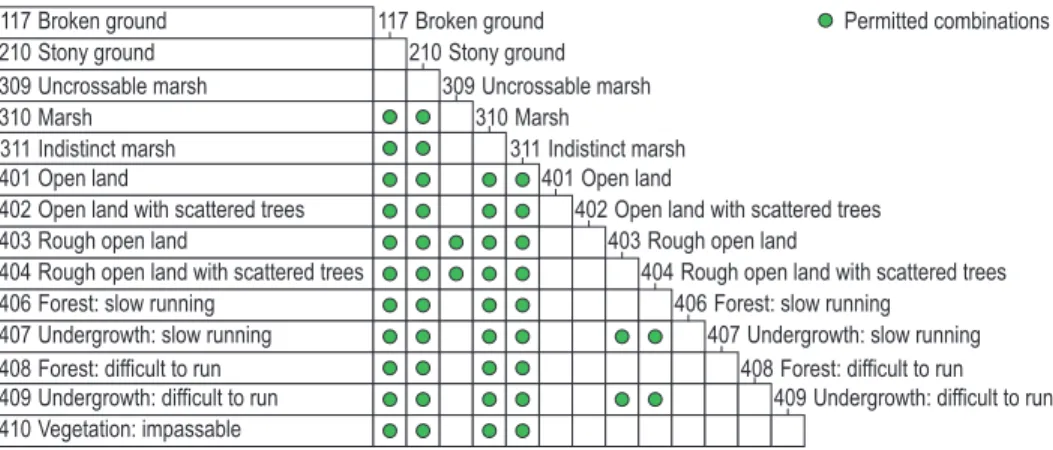
Vegetation, open areas, marshes, etc. are shown with dot or line screens. The following table lists the permissi-ble combinations of screens.
Dimensions in this book are given at the printed scale of 1:15 000.
• The gap between two fine lines of the same colour, in brown or black: 0.15 mm • The smallest gap between two blue lines: 0.25 mm
• Shortest dotted line: at least two dots • Shortest dashed line: at least two dashes
• Smallest area enclosed by a dotted line: 1.5 mm (diameter) with 5 dots • Smallest area of colour
Blue, green, grey or yellow full colour: 0.5 mm Black dot screen: 0.5 mm
Blue, green or yellow dot screen: 1.0 mm
2 2
2
117 Broken ground 117 Broken ground Permitted combinations 210 Stony ground 210 Stony ground
309 Uncrossable marsh 309 Uncrossable marsh
401 Open land 401 Open land
402 Open land with scattered trees 402 Open land with scattered trees 403 Rough open land 403 Rough open land
404 Rough open land with scattered trees 404 Rough open land with scattered trees 406 Forest: slow running 406 Forest: slow running
407 Undergrowth: slow running 407 Undergrowth: slow running 408 Forest: difficult to run 408 Forest: difficult to run 409 Undergrowth: difficult to run 409 Undergrowth: difficult to run 410 Vegetation: impassable
310 Marsh 310 Marsh
311 Indistinct marsh 311 Indistinct marsh
3.2 Contour interval
Where a map is enlarged to a scale of 1:10 000 or greater, all lines and symbols must be enlarged by 150%. Area screens made with fine dot percentage tints should not be enlarged wherever possible, i.e. screens at 60 l/cm.
An orienteering map must be printed on good, possibly water resistant, paper (weight 80-120 g/m ).
Spot colour printing is recommended for IOF events. Other printing methods may be used, if colours and line width have the same quality as printing with spot colours.
Legibility depends on the correct choice of colours.
2
Four-colour printing is the traditional way of printing most colour work, maps have been one of the main excep-tions due to the fine line requirements.
The four colour printing method uses the three basic colours of the additive colour model: cyan, magenta and yellow. In theory a mix of 100% of cyan, magenta and yellow produces black colour, but in reality it will be more of a dark brown. Therefore black is normally printed as a separate colour. After these four colours the model is often referred to as CMYK.
Although four-colour printing requires fewer and standardized inks, the main advantage of using this process is that it allows the inclusion of colour photographs and full colour advertisements at no extra cost.
The use of digital techniques to produce four colour separations has now made it possible to make high quality orienteering maps using four colour printing. This is not the suggested method of printing orienteering maps, it is an alternative. This method will only be acceptable when line quality, legibility and colour appearance are of the same quality as the traditional spot colour printed map.
However, the mapmaker has to take into consideration the limitations and potential errors of this method. The reproduction of very thin lines (contours) requires special attention.
Spot colour printing uses pure colour inks. Each spot colour ink is made by mixing a number of stock inks in specific proportions to produce the desired colour. The colours specified for use for orienteering maps are defined by the Pantone Matching System (PMS).
The map may be in up to 6 colours (excluding overprinting).
The following recommendations for spot colours are intended to standardize maps as much as possible: Colour PMS number
Black Brown Yellow Blue Green Grey Violet
Process black 471
136 299 361 428 Purple
The appearance of colours is dependent on the printing order. In spot colour printing, order should always be:
1. yellow 2. green 3. grey 4. brown 5. blue 6. black 7. purple
3.4 Enlargement of maps
3.5 Printing
3.5.1 Spot colour printing
3.5.2 Four colour offset printing
Screens
Screen frequency Angles
The colour mixture can be done either with traditional printing screens or special printing screens with randomly distributed dots called stochastic screens. The latter screens will improve legibility and make fine lines such as contours more readable, and is therefore highly recommended.
Traditional screens should have a screen frequency of at least 60 lines/cm. For stochastic screens the frequency will vary randomly.
To avoid the unwanted moiré effects with traditional printing screens 4-color orienteering maps should always use the recommended angle set. In proper stochastic screens the dots are placed randomly,
nwanted moiré effects will not appear. so angles are irrelevant and u
Colours
The following table lists the CMYK combinations for the equivalent PMS colours recommended for orienteering maps:
Colour Angle Cyan
Magenta Yellow Black
15° 75° 0° 45°
Printing order
The appearance of colours is dependent on the printing order. In 4-colour orienteering map offset printing the printing order should always be:
1. Yellow 2. Cyan 3. Magenta 4. Black
Colour Cyan Magenta Yellow Black
Black Brown Yellow Blue Green Grey Violet
Process black PMS 471 PMS 136 PMS 299 PMS 361 PMS 428 Purple
87% 76%
56% 27% 18% 100%
100% 79% 91%
100% 18%
23%
moiré effect (false angles)
PMS colour
Colour copiers, printers and other digital printing equipment are not yet suitable for printing orienteering maps for high level competitions. It is very difficult to achieve the line quality, legibility and colour appearance of traditional spot colour printed maps using this kind of equipment.
It is expected that the continuing development of computer technology will lead to the possibility of using alternative printing methods with quality suitable for large competitions.
Most printing devices use a 4-color technique (CMYK). For such devices the same colour settings as recom-mended for 4-color offset printing may be suitable, but the colour appearance will vary slightly from one device to another and from one paper quality to another.
Extensive experimentation with different colour and halftone settings, different paper qualities and other variables will be necessary to achieve a quality as close to offset printing as possible. Such experimentation has to be done for a whole range of devices. This specification can therefore not give any general recommendations for the use of such alternative printing methods.
3.5.3 Alternative printing methods
Overprinting
With traditional spot colour printing inks are physically printed on top of each other. It is possible to simulate the same with four-colour printing technique, and this optimises legibility and gives a colour appearance as close to traditional spot colour printing as possible. To achieve this effect in four-colour offset printing, information underlying (in the spot colour printing order described in 3.5.1) a specific spot colour should not be blocked out (erased / printed white) completely, but should be blended in to produce a new colour for printing.
The use of overprinting effect with 4-color offset printing is recommended for the following solid colors: • 100 % Violet
• 100 % Black • 100 % Brown • 100 % Blue • 100 % Green
Illustration: Contours in dense vegetation printed in 4-colours. Overprinting effect in the right illustration.
Definitions of map features and specifications for the drawing of symbols are given in the following sections. Symbols are classified into 7 categories:
(brown) (black+grey) (blue) (green+yellow) (black) (black+blue) (purple) Land forms
Rock and boulders Water and marsh Vegetation Man-made features Technical symbols Course symbols
The shape of land is shown by means of very detailed contours, aided by the special symbols for small knolls, depressions, etc. This is complemented in black by the symbols for rock and cliffs. Orienteering terrain is nor-mally best represented with a 5 m contour interval.
Excessive use of form lines should be avoided as this will complicate the map and give a wrong impression of height differences. If the representation of an area needs a large number of form lines, a smaller contour interval provides a more legible alternative.
The relative height difference between neighbouring features must be represented on the map as accurately as possible. Absolute height accuracy is of less importance. It is permissible to alter the height of a contour slightly if this will improve the representation of a feature. This deviation should not exceed 25% of the contour interval and attention must be paid to neighbouring features.
101 Contour
102 Index contour
103 Form line
104 Slope line
A line joining points of equal height. The standard vertical interval between contours is 5 metres. The smallest bend in a contour is 0.25 mm from centre to centre of the lines.
Colour: brown.
Every fifth contour shall be drawn with a thicker line. This is an aid to the quick assessment of height difference and the overall shape of the terrain surface. Where an index contour coincides with an area of much detail, it may be shown with a normal contour line.
Colour: brown.
An intermediate contour line. Form lines are used where more information can be given about the shape of the ground. They are used only where representation is not possible with ordinary contours. Only one form line may be used between neighbour-ing contours.
Colour: brown.
Slope lines may be drawn on the lower side of a contour line, e.g. along the line of a re-entrant or in a depression. They are used only where it is necessary to clarify the direction of slope.
Colour: brown.
Note: dimensions are specified in mm at the scale of 1:15 000. All drawings are at 1:7 500 for clarity only.
gap or infill between two lines line thickness
distance from centre to centre or length of line
diameter
symbol orientated to north
4 EXPLANATION OF SYMBOLS (FOOT-O)
4.1 Land forms
0.14
0.14 1.25 0.25
0.25
0.14 0.5
105 Contour value
106 Earth bank
107 Earth wall 108 Small earth wall
109 Erosion gully
Contour values may be included to aid assessment of large height differences. They are inserted in the index contours in positions where other detail is not obscured. The figures should be orientated so that the top of the figure is on the higher side of the contour.
Colour: brown.
A steep earth bank is an abrupt change in ground level which can be clearly distin-guished from its surroundings, e.g. gravel or sand pits, road and railway cuttings or embankments. The tags should show the full extent of the slope, but may be omitted if two banks are close together. Impassable banks should be drawn with symbol 201 (impassable cliff). The line width of 0.25 mm.
Colour: brown.
Distinct earth wall. Minimum height is 1 m. Colour: brown.
Colour: brown.
An erosion gully or trench which is too small to be shown by symbol 106 is shown by a single line. The line width reflects the size of the gully. Minimum depth 1 m. The end of the line is pointed.
very high earth banks may be
A small or partly ruined earth wall shall be shown with a dashed line. Minimum height is 0.5 m.
Colour: brown.
A small erosion gully or trench. Minimum depth 0.5 m. Colour: brown.
Knolls are shown with contour lines. A prominent knoll falling between contour lines may still be represented by a contour line if the deviation from the actual contour level is less than 25%. Smaller or flatter knolls should be shown with form lines.
Colour: brown.
A small obvious mound or rocky knoll which cannot be drawn to scale with a contour (diameter of mound less than ca. 5 m). The height of the knoll should be a minimum of 1 m from the surrounding ground. The symbol may not touch a contour line. Colour: brown.
A small obvious elongated knoll which cannot be drawn to scale with a contour (length less than 12 m and width less than 4 m). The height of the knoll should be a minimum of 1 m from the surrounding ground. Knolls larger than this must be shown by contours. The symbol may not be drawn in free form or such that two elongated knoll symbols overlap. The symbol may not touch a contour line.
Colour: brown. 110 Small erosion gully 111 Knoll
112 Small knoll
113 Elongated knoll
ø0.25
ø0.5 0.5 0.14
0.14
0.14
max. 0.25 0.5
0.5
2.5 0.25
ø0.4
ø0.4
0.8 0.4 0.18
(0.25)
225
0.18 min. 0.6
1.5
114 Depression
115 Small depression
116 Pit
117 Broken ground
118 Special land form feature
Depressions are shown with contours or form lines and slope lines. Prominent depressions falling between contour lines may be represented by a contour line if the deviation from the actual contour level is less than 25%. Smaller or shallower depressions should be shown by form lines.
Colour: brown.
Small shallow natural depressions and hollows (minimum diameter 2 m) which cannot be shown to scale by contours are represented by a semicircle. Minimum depth from the surrounding ground should be 1 m. Location is the centre of gravity of the symbol, which is orientated to north. Symbol 116 is used for man-made pits. Colour: brown.
Pits and holes with distinct steep sides which cannot be shown to scale by symbol 106 (minimum diameter 2 m). Minimum depth from the surrounding ground should be 1 m. Location is the centre of gravity of the symbol which is orientated to north. Colour: brown.
An area of pits or knolls which is too intricate to be shown in detail. The density of dots may vary according to the detail on the ground.
Colour: brown.
This symbol can be used for a special small land form feature. The definition of the symbol must be given in the map legend.
Colour: brown. randomly placed
Rock is a special category of land form. The inclusion of rock gives useful information about danger and runnability, as well as providing features for map reading and control points. Rock is shown in black to distinguish it from other land forms features. Care must be taken to make sure that rock features such as cliffs agree with the shape and fall of the ground shown by contours or form lines.
An impassable cliff, quarry or earth bank (see 106) is shown with a 0.35 mm line and downward tags showing its full extent from the top line to the foot. For vertical rock faces the tags may be omitted if space is short, e.g. narrow passages between cliffs (the passage should be drawn with a width of at least 0.3 mm). The tags may extend over an area symbol representing detail immediately below the rock face. When a rock face drops straight into water making it impossible to pass under the cliff along the water’s edge, the bank line is omitted or the tags should clearly extend over the bank line.
Colour: black. 201 Impassable cliff Note: dimensions are
specified in mm at the scale of 1:15 000. All drawings are at 1:7 500 for clarity only.
4.2 Rock and boulders
ø0.18 - 0.250.18
0.18 0.8
0.7 0.8
0.8
0.18
min. 0.5 0.5 0.35
0.6 0.12
202 Rock pillars/cliffs
203 Passable rock face
204 Rocky pit
205 Cave
206 Boulder
207 Large boulder
208 Boulder field
209 Boulder cluster
In the case of unusual features such as rock pillars or massive cliffs or gigantic boulders, the rocks shall be shown in plan shape without tags.
Colour: black.
A small vertical rock face (minimum height 1 m) may be shown without tags. If the direction of fall of the rock face is not apparent from the contours or to improve legibility, short tags should be drawn in the direction of the fall. For passable rock faces shown without tags the ends of the line may be rounded to improve legibility. Colour: black.
Rocky pits, holes or mineshafts which may constitute a danger to the runner. Location is the centre of gravity of the symbol, which is orientated to north.
Colour: black.
A cave is represented by the same symbol as a rocky pit. In this case the symbol should be orientated to point up the slope as indicated opposite. The centre of gravity of the symbol marks the opening.
Colour: black.
A small distinct boulder (minimum height 1 m). Every boulder marked on the map should be immediately identifiable on the ground. To be able to show the distinction between boulders with significant difference in size it is permitted to enlarge this symbol by 20% (diameter 0.5 mm).
Colour: black.
A particularly large and distinct boulder. For gigantic boulders symbol 202 should be used.
Colour: black.
An area which is covered with so many blocks of stone that they cannot be marked individually is shown with randomly orientated solid triangles with sides of ratio 8:6:5. A minimum of two triangles should be used. The going is indicated by the density of the triangles. To be able to show the distinction between boulder fields with a significant difference in boulder size it is permitted to enlarge the triangles by 20%. Colour: black.
A small distinct group of boulders so closely clustered together that they cannot be marked individually. The symbol is an equilateral triangle orientated to the north. To be able to show the distinction between boulder clusters with significant difference in size it is permitted to enlarge this symbol by 25% (1.0 mm).
Colour: black.
ø0.6 ø0.4
( 0.5)ø 0.25 0.18
0.16
0.16 min. 0.6 0.5 0.5
0.12
0.7
0.7 0.8
0.8
0.5 - 1.0
0.8 (1.0)
210 Stony ground
211 Open sandy ground
212 Bare rock
Stony or rocky ground which affects going should be shown on the map. The dots should be randomly distributed with density according to the amount of rock. A minimum of three dots should be used.
Colour: black.
An area of soft sandy ground or gravel with no vegetation and where running is slow. Where an area of sandy ground is open but running is good, it is shown as open land (401/402).
Colour: black 12.5% (22 lines/cm) and yellow 50% (see 403).
A runnable area of rock without earth or vegetation is shown as bare rock. An area of rock covered with grass, moss or other low vegetation is shown as open land (401/402).
Colour: black 30% (60 lines/cm) or grey.
This group includes both open water and special types of vegetation caused by the presence of water (marsh). The classification is important because it indicates the degree of hindrance to the runner and provide features for map reading and control points. A black line around a water feature indicates that it cannot be crossed under normal weather conditions. In dry areas the features listed in this section may only contain water in some seasons.
Large areas of water are shown with dot screen. Small areas of water should be shown with full colour. A black bank line indicates that the feature cannot be crossed. Colour: blue 50% (60 lines/cm), black.
Where the lake or pond is smaller than 1mm on the printed map, the bank line is omitted.
Colour: blue.
A water-filled pit or an area of water which is too small to be shown to scale. Location is the centre of gravity of the symbol, which is orientated to north.
Colour: blue.
An uncrossable river or canal is drawn with black bank lines. The bank lines are broken at a ford.
Colour: blue 50% (60 lines/cm), black.
A crossable watercourse, minimum 2 m wide. The width of watercourses over 5 m wide should be shown to scale.
Colour: blue. 301 Lake
302 Pond
303 Waterhole
304 Uncrossable river
305 Crossable watercourse
2
Note: dimensions are specified in mm at the scale of 1:15 000. All drawings are at 1:7 500 for clarity only.
4.3 Water and marsh
0.45YELLOW BLACK ø0.18
(30 %) ø0.16 - 0.2
0.18
0.18 0.7
0.8
0.18
min. 0.2
min. 0.25
306 Crossable small watercourse
307 Minor water channel
308 Narrow marsh
309 Uncrossable marsh
310 Marsh
311 Indistinct marsh
312 Well 313 Spring
314 Special water feature
A crossable watercourse (including a major drainage ditch) less than 2 m wide. For better legibility a ditch in a marsh should be drawn as a crossable watercourse (305). Colour: blue.
A natural or man-made minor water channel which may contain water only intermit-tently.
Colour: blue.
A marsh or trickle of water which is too narrow to be shown with symbol 310 (less than ca. 5 m wide).
Colour: blue.
A marsh which is uncrossable or dangerous for the runner. A black line surrounds the symbol.
Colour: blue, black.
A crossable marsh, usually with a distinct edge.
Where a small marsh area should be combined with either 403/404 it is permitted to use 401/402 to improve legibility.
Colour: blue.
Colour: blue.
Wells and captive springs, which are clearly visible on the ground. Colour: blue.
The source of a stream with a distinct outflow. The symbol is orientated to open downstream.
Colour: blue.
A special small water feature. The definition of the symbol must always be given in the map legend.
Colour: blue.
The symbol should be combined with vegetation symbols to show runnability and openness.
An indistinct or seasonal marsh or area of gradual transition from marsh to firm ground, which is crossable. The edge is generally indistinct and the vegetation similar to that of the surrounding ground. The symbol should be combined with vegetation symbols to show runnability and openness.
ø0.25
0.18
0.1
0.3 0.1
0.9 0.25
0.5
0.3 0.25
0.2 0.25
0.14 1.25
0.5 0.25
0.18
0.18 0.8
0.8
0.18 0.8
min. 0.5
min.
0.14 The representation of vegetation is important to the orienteer because it affects runnability and visibility and it
also provides features for map reading. COLOUR
The basic principle is as follows: - represents runnable forest,
- represents open areas divided into several categories,
-RUNNABILITY.
The runnability depends on the nature of the forest (density of trees/brushwood and undergrowth—bracken, brambles, nettles, etc.) but does not take account of marshes, stony ground etc. which are shown by separate symbols.
white yellow
green represents the density of the forest and undergrowth according to its runnability and is divided into several categories.
Runnability in forest is divided into 4 categories according to running speed. If speed through typically open runnable forest is, for example, 5 min/km, the following ratios apply:
open forest slow running difficult to run very difficult to run
80-100% 60-80% 20-60% 0-20%
6:15 min/km 8:20 min/km 25:00 min/km 25:00 min/km 5
6:15 8:20 ->
401 Open land
402 Open land with scattered trees
403 Rough open land
Cultivated land, fields, meadows, grassland, etc. without trees, offering easy running. If yellow coloured areas becomes dominant, a screen (75%) instead of full yellow may be used.
Colour: yellow.
Colour: yellow (20 lines/cm).
Heath, moorland, felled areas, newly planted areas (trees lower than ca. 1 m) or other generally open land with rough ground vegetation, heather or tall grass. Symbol 403 may be combined with symbols 407 and 409 to show reduced runnability.
Colour: yellow 50% (60 lines/cm).
Meadows with scattered trees or bushes, with grass or similar ground cover offering easy running. Areas smaller than 10 mm at the maps scale are shown as open land (401). Individual trees may be added (418, 419, 420). If yellow coloured areas becomes dominant, a screen (75%) instead of full yellow may be used.
2
4.4 Vegetation
Note: dimensions are specified in mm at the scale of 1:15 000. All drawings are at 1:7 500 for clarity only.
speed in typically open forest
20
200 600 800 1000 m 60
80 100
100%
50% 0.5 ø0.4
50%
runnabilty
(%)
0.12
0.12
0.4 30% (36%)
60%
1.5
0.84 0.72
0.30 0.42
min. 0.25 0.7 ø0.55
ø 0.45 0.8
1.3 0.6 0.2 0.85 YELLOW GREEN
404 Rough open land with scattered trees
405 Forest: easy running
406 Forest: slow running
407 Undergrowth: slow running
408 Forest: difficult to run
409 Undergrowth: difficult to run
410 Vegetation: very difficult to run, impassable
411 Forest runnable in one direction
412 Orchard
413 Vineyard
Where there are scattered trees in rough open land, areas of white (or green) should appear in the tone. Such an area may be generalised by using a regular pattern of large white dots in the yellow screen. Areas smaller than 16 mm in the maps scale are shown as rough open land (403). Individual trees may be added (418, 419, 420). Typically open runnable forest for the particular type of terrain. If no part of the forest is runnable then no white should appear on the map.
If yellow coloured areas becomes dominant, a screen (75%) instead of full yellow may be used.
If yellow coloured areas becomes dominant, a screen (75%) instead of full yellow may be used.
yellow
2
Colour: yellow 70% (60 lines/cm), white 48.5% (14.3 lines/cm).
Colour: white.
An area with dense trees (low visibility) which reduces running to ca. 60-80% of normal speed.
Colour: green 30% (60 lines/cm).
An area of dense undergrowth but otherwise good visibility (brambles, heather, low bushes, and including cut branches) which reduces running to ca. 60-80% of normal speed. This symbol may not be combined with 406 or 408.
Colour: green 14.3% (11.9 lines/cm).
An area with dense trees or thicket (low visibility) which reduce running to ca. 20-60% of normal speed.
Colour: green 60% (60 lines/cm).
An area of dense undergrowth but otherwise good visibility (brambles, heather, low bushes, and including cut branches) which reduces running to ca. 20-60% of normal speed. This symbol may not be combined with 406 or 408.
Colour: green 28.6% (23.8 lines/cm).
An area of dense vegetation (trees or undergrowth) which is barely passable. Running reduced to ca. 0-20% of normal speed.
Colour: green 100%.
When an area of forest provides good running in one direction but less good in others, white stripes are left in the screen symbol to show the direction of good running. Colour: green, white.
Land planted with fruit trees or bushes. The dot lines may be orientated to show the direction of planting.
Colour: yellow and green 25% (12.5 lines/cm).
The green lines may be orientated to show the direction of planting. Colour: and green.
The track network provides important information for the runner and the classification must be clearly recognisable on the map. Particularly important for the competitor is the classification of smaller paths. Account must be taken not only of the width, but also of how obvious the path is to the runner.
Other man-made features are also important both for map reading and as control points.
A road with two carriageways. The width of the symbol should be drawn to scale but not smaller than the minimum width. The outer boundary lines may be replaced with symbols 519, 521, 522 or 524 if a fence or wall is so close to the motorway edge that it cannot practically be shown as a separate symbol. The space between the black lines must be filled with brown (50%).
Colour: black and brown 50% (60 lines/cm).
Colour: black and brown 50% (60 lines/cm). 501 Motorway
502 Major road
A road under construction may be shown with broken lines.
Road wider than 5m. The width of the symbol should be drawn to scale but not smaller than the minimum width. The outer boundary lines may be replaced with symbols 519, 521, 522 or 524 if a fence or wall is so close to the motorway edge that it cannot practically be shown as a separate symbol. The space between the black lines must be filled with brown (50%). A road under construction may be shown with broken lines.
Note: dimensions are specified in mm at the scale of 1:15 000. All drawings are at 1:7 500 for clarity only.
4.5 Man-made features
0.12ø 0.22 0.5
414 Distinct cultivation boundary
415 Cultivated land
416 Distinct vegetation boundary 417 Indistinct vegetation boundary 418, 419, 420 Special vegetation features
The boundary of cultivated land when not shown with other symbols (fence, wall, path, etc.) is shown with a black line. A permanent boundary between different types of cultivated land is also shown with this symbol.
Colour: black.
Cultivated land which is seasonally out-of-bounds due to growing crops may be shown with a black dot screen.
Colour: yellow 100%, black 5% (12.5 lines/cm).
A distinct forest edge or very distinct vegetation boundary within the forest. Colour: black.
Indistinct boundaries between areas of green, yellow or white are shown without a line. The edge of the area is shown only by the change in colour or dot screen. Symbols 418, 419 and 420 can be used for special small vegetation features. The definition of the symbol must be given in each case in the map legend.
Colour: green.
100%
ø 0.2
ø 0.5 0.8
YELLOW BLACK
0.18 0.8
0.18
0.18 min. 0.3
0.25
0.25 3.0
3.0 min. 0.5
503 Minor road
504 Road 505 Vehicle track
506 Footpath 507 Small path
508 Less distinct small path 509 Narrow ride
510 Visible path junction
512 Footbridge
513 Crossing point with bridge 514 Crossing point without bridge
Road 3-5 m wide. The space between the black lines must be filled with brown (50%). Colour: black and brown 50% (60 lines/cm).
A maintained road suitable for motor vehicles in all weather. Width less than 3 m. Colour: black.
A track or poorly maintained road suitable for vehicles only when travelling slowly. Width less than 3 m.
Colour: black.
A large path, or old vehicle track, which is distinct on the ground. Colour: black.
A small path or (temporary) forest extraction track which can be followed at competi-tion speed.
Colour: black.
A less distinct small path or forestry extraction track. Colour: black.
A distinct ride, less than ca. 5 m wide. A ride is a linear break in the forest (usually plantation) which does not have a distinct path along it. Where there is a path along a ride, symbols 507 or 508 should be used in place of symbol 509.
Colour: black.
When a junction or intersection of paths or tracks is visible, the dashes of the symbols are joined at the junction.
Colour: black.
A footbridge with no path leading to it. Colour: black.
A path or track crossing a river, stream or ditch by a bridge. A path or track crossing a river, stream or ditch without a bridge. Colour: black.
A road under construction may be shown with broken lines.
When a junction or intersection of paths or tracks is not clear, the dashes of the symbols are not joined.
Colour: black.
Colour: black. 511 Indistinct junction
0.35
0.25
0.18
0.18
0.14 0.25
0.25
0.25
0.25
0.5 3.0
2.0
1.0
3.0 1.0
0.5 0.25
0.35 0.18
0.25 3.0
0.3 515 Railway
516 Power line 517 Major power line
518 Tunnel
519 Stone wall 520 Ruined stone wall 521 High stone wall 522 Fence 523 Ruined fence
524 High fence
525 Crossing point
526 Building
A railway or other kind of railed track (tramway, truckway, etc.). Colour: black.
Power line, cableway or skilift. The bars indicate the exact location of the pylons. Colour: black.
Major power lines should be drawn with a double line. The gap between the lines may indicate the extent of the powerline.
Colour: black.
A way under roads, railways, etc. which may be used by the runner. This symbol is used whether or not the tunnel has a track leading to it.
Colour: black.
A stone wall or stone-faced bank. Colour: black.
A ruined stone wall may be shown by a dashed line. Colour: black.
A stone wall higher than ca 1.5 m, not crossable to the average orienteer. Colour: black.
A wooden or wire fence less than ca. 1.5 m high. Colour: black.
A ruined fence may be shown with a dashed line. Colour: black.
A boarded or wire fence higher than ca 1.5 m, not crossable to the average orienteer, eg. deer fence.
Colour: black.
All ways through or over high fences or walls must be indicated. The symbol may also be used for a gate through or stile over a stone wall (519) or a fence (522) or a pipeline (534).
Colour: black.
A building is shown with its ground plan so far as the scale permits. Colour: black.
0.35 0.35
0.35 3.0
0.14 0.3
0.14 0.3
0.18 0.6
60º
0.14
0.18
0.18 0.14
0.14 0.14 ø 0.4
ø 0.5 ø 0.4 2.5
2.5 0.7 0.25
2.5
60º
0.25 2.5
2.5
2.5 0.6
0.5
0.5
0.5 0.14
0.14 0.6 0.18
min. 0.5 x 0.5
527 Settlement
528 Permanently out of bounds
529 Paved area 530 Ruin
531 Firing range
532 Grave
533 Crossable pipeline
534 Uncrossable pipeline 535 High tower
536 Small tower
Houses and gardens and other built up areas. Roads, buildings and other significant features within a settlement must be shown. If all buildings cannot be shown, an alternative symbol (black line screen) may be used.
Colour: green 50% (60 l/cm) and yellow 100% or alternatively black . Areas which are permanently forbidden to the runner are shown as out of bounds. The screen is superimposed on the normal map detail. A bounding line may be drawn if there is no natural boundary (see 709).
Colour: black or purple 33.3% (13.3 lines/cm).
An area of hard standing used for parking or other purposes. Colour: black and brown 50% (60 lines/cm).
The ground plan of a ruin is shown to scale, down to the minimum size shown opposite. Very small ruins may be drawn with a solid line.
Colour: black.
A firing range is shown with a special symbol to indicate the need for caution. Associated buildings are individually marked.
Colour: black.
A distinct grave marked by a stone or shrine. Location is at the centre of gravity of the symbol, which is orientated to north. A cemetery is shown by using grave symbols as space permits.
Colour: black.
A pipeline (gas, water, oil, etc.) above ground level which can be crossed over or under.
Colour: black.
A pipeline which cannot be crossed. Colour: black.
A high tower or large pylon, standing above the level of the surrounding forest. Location is at the centre of gravity of the symbol.
Colour: black.
An obvious shooting platform or seat, or small tower. Location is at the centre of gravity of the symbol.
Colour: black.
32.5% (27 l/cm)
0.25
0.35 0.5
0.12
0.14
0.14
0.18 0.5
0.5 2.5
2.5 0.6
0.3 50% min. 0.8 x 0.8 0.16
0.35
0.16
0.16
0.16 0.3 0.7 1.0
1.0 1.0 0.25
2.0 1.4
0.25
45º
45º
ø 0.8 0.25
0.12
100% 50%
YELLOW alternative BLACK
GREEN
Technical symbols are such symbols which are essential on all kinds of topographic maps and not only on orienteering maps.
Magnetic north lines are lines placed on the map pointing to magnetic north. Their spacing on the map should be 33.33 mm which represents 500 m on the ground at the scale of 1:15 000. For maps with other scales lines placing should be at intervals which represents a round number of meters (e.g. 50 m, 100 m, 250 m, 500 m) and the spacing should be between 20 mm and 40 mm on the map. North lines may be broken where they obscure small features such as boulders, knolls, cliffs, stream junctions, path ends, etc. In areas with very few water features, blue lines may be used. Colour: black (blue).
At least three registration marks must be placed within the frame of a map in a non-symmetrical position. In addition, a colour check should also be possible.
Colour: all printed colours.
Spot heights are used for the rough assessment of height differences. The height is given to the nearest metre. The figures are orientated to the north. Water levels are given without the dot.
Colour: black.
601 Magnetic north line
602 Registration marks
603 Spot height 537 Cairn
538 Fodder rack
539, 540 Special man-made features
Cairn, memorial stone or boundary stone (or a trigonometric point in some countries) more than 0.5 m high.
Colour: black.
A fodder rack which is free standing or built on to a tree. Location is at the centre of gravity of the symbol. For land access reasons these may be omitted.
Colour: black.
Special man-made features are shown with these symbols. The definition of the symbols must be given in each case in the map legend.
Colour: black.
Note: dimensions are specified in mm at the scale of 1:15 000. All drawings are at 1:7 500 for clarity only.
4.6 Technical symbols
0.160.16
0.18
1.5 min.
4 mm 0.1
0.14
0.16
1.0 0.8
1.0 60º
ø 0.3 ø 0.14
0.8 0.8
321
54
Courses should be overprinted at least for elite classes. For other classes they can be drawn by hand.
The size of overprinting symbols is given for 1:15 000 maps. The size of these symbols for 1:10 000 maps should be the same as for 1:15 000 maps. However, for multi-age competitions in which both 1:10 000 and 1:15 000 maps are used, the size of the symbols on the 1:10 000 maps may be 150% greater than on the 1:15 000 maps.
701 Start
702 Control point
703 Control number
704 Line
705 Marked route 706 Finish
707 Uncrossable boundary 708 Crossing point
The start or map issue point (if not at the start) is shown by an equilateral triangle which points in the direction of the first control. The centre of the triangle shows the precise position of the start point.
Colour: purple.
The control points are shown with circles. The centre of the circle shows the precise position of the feature. Sections of circles should be omitted to leave important detail showing.
Colour: purple.
The number of the control is placed close to the control point circle in such a way that it does not obscure important detail. The numbers are orientated to north.
Colour: purple.
Where controls are to be visited in order, the start, control points and finish are joined together by straight lines. Sections of lines should be omitted to leave important detail showing.
Colour: purple.
A marked route is shown on the map with a dashed line. Colour: purple.
The finish is shown by two concentric circles. Colour: purple.
A boundary which it is not permitted to cross. Colour: purple.
A crossing point through or over a wall or fence, or across a road or railway or through a tunnel or an of-bounds area is drawn on the map with two lines curving out-wards.
Colour: purple.
4.7 Overprinting symbols
7.0
ø 6.0
ø 5.0 ø 7.0
0.35
0.35
0.35
0.35
0.35 0.35
0.35 0.6
2.0 0.5
4.0
3.0
0.7
1
8
9
Note: dimensions are specified in mm at the the printed scale of 1:15 000. Drawings in this section are at 1:15 000 also.
709 Out-of-bounds area
710 Dangerous area
711 Forbidden route 712 First aid post 713 Refreshment point
An out-of-bounds area, see also symbol 528, is shown with vertical stripes. A bounding line may be drawn if there is no natural boundary, as follows:
- a solid line indicates that the boundary is marked continuously (tapes, etc.) on the ground,
- a dashed line indicates intermittent marking on the ground, - no line indicates no marking on the ground.
Colour: purple.
An area presenting danger to the competitor is shown with cross-hatched diagonal lines.
Colour: purple.
A route which is out-of-bounds is shown with crosses.. Colour: purple.
The location of a first aid post. Colour: purple.
The location of a refreshment point which is not at a control. Colour: purple.
0.5 0.6
0.6
3.0 0.35
1.0 3.0
3.0 3.0
0.25 0.25
3.0
0.25
Maps for ski orienteering are based on the specifications for foot-orienteering maps. However in order to meet the specific requirements put on the map by the nature of ski orienteering, certain deviations and additions to the foot-orienteering map specification is needed. These special rules and symbols are described in this chapter. Deviations from the specifications are permissible only with the sanction of the national Ski-O Committee. For international events, sanction must be given by the IOF Ski-O Committee.
Complete foot-orienteering maps may be used in ski-o competitions at all levels, if the dark green (symbol 410) is replaced by light green (symbol 406). For international events, permission from the IOF Ski-O Committee is required.
Ski orienteering is a sport in which the ski-orienteer uses the map to navigate a track and route network in order to visit a number of control points. In ski-o the competitor's skiing and navigation skills shall be tested in such way that the navigation skill becomes the decisive element.
Ski orienteering takes place in the track network, and involves as a basic element complex route choice prob-lems, including the estimating of height differences. It is obvious that the map must concentrate on clearly depicting these features. The map must also be legible when skiing at high speed. This means that the map should omit a large part of details in “free“ terrain in order to exaggerate the track network and to simplify the presentation of the shape of the ground. Only details that impact a) route choice and b) navigation and position-ing, need be shown on the map.
In order to accomplish fairness in route choice, additional symbols need to be introduced. These symbols describe the quality and width of the tracks.
The maps scale shall be 1:15 000 or 1:10 000. A different scale may be used, but permission shall be obtained from the IOF Ski-O Committee at IOF ski-o events and from the national Ski-O Committee for other events. The magnification in scale has made it possible to build a more dense and easily legible track network. Furthermore, the error probability has decreased, as the shapes of the junctions and the departure angles of the tracks can be drawn correctly on the map.
The contour interval is 5 m. A different interval (2.5 m or 10 m) may be used, but permission shall be obtained from the IOF Ski-O Committee at IOF ski-o events and from the national Ski-O Committee for other events.
Ski-orienteering maps are often updated very close to a competition. The track network may be revised only a few days before an event. Therefore new printing methods, like digital offset, colour copying etc. is well suited for
5 MAP SPECIFICATION FOR SKI-ORIENTEERING
5.1 General
5.2 Content
5.3 Scale
5.4 Contour interval
5.5 Printing and reproduction
5.6.1 Use of foot-o symbols
ski-orienteering maps. However, for IOF events such as World Championships and World Cup, spot colour offset is still the recommended method.
When using alternative printing methods, it is important to make sure that the overprint effect between green and black is maintained. The rule is that when overprinting a green track on a black path, the path must be visible through the green, and not totally cleared out. When printing offset, green is the last colour ("overprint") and this effect is automatically achieved, but when using digital methods this effect must be controlled through the software.
Please refer also to section 3.4 Printing, in this publication.
The following symbols from the foot-orienteering map specification are recommended for the ski orienteering map.
The shape of land is shown by means of contours. In order to maintain legibility of the map when skiing at high speed the contour lines may be more generalised in comparison to foot-o maps. Form lines shall be omitted. 101 Contour, 102 Index contour, 104 Slope line, 105 Contour value, 106 Earth bank, 109 Erosion gully, 111 Knoll, 114 Depression.
Rocks and boulders are not likely to affect route choices, but in its prominent forms they can serve as valuable object for navigation and positioning. The map may show these features when they are visible to the competitor when the terrain is covered with snow.
201 Impassable cliff, 202 Rock pillars/cliffs, 206 Boulder, 207 Large boulder, 208 Boulder field, 209 Boulder cluster.
Besides navigation and positioning, this group is important to the competitor as it facilitates the interpretation of height (what is up" and what is down") in maps with complex contouring.
301 Lake, 304 Uncrossable river, 305 Crossable watercourse, 306 Crossable small watercourse, 309 Uncross-able marsh, 310 Marsh.
The representation of vegetation is of importance to the competitor mainly for navigational purposes, but could be used for route choices in cases where the competitor chooses to try shortcuts in free terrain. In order not to destroy legibility of the green tracks,
401 Open land, 402 Open land with scattered trees, 403 Rough open land, 404 Rough open land with scattered trees, 405 Open forest, 406 Forest: slow running, 412 Orchard, 413 Vineyard, 414 Distinct cultivation boundary 416 Distinct vegetation boundary, 418, 419 Special vegetation features.
501 Motorway, 502 Major road, 503 Minor road, 504 Road, 505 Vehicle track, 506 Footpath, 507 Small path (not to be seen when covered with snow), 509 Narrow ride, 515 Railway, 516 Power line, 517 Major power line, 518 Tunnel, 519 Stone wall, 521 High stone wall, 522 Fence, 524 High fence, 525 Crossing point, 526 Building, 527 Settlement, 529 Paved area, 532 Firing range, 534 uncrossable pipeline, 536 High tower, 540,541 Special man-made features.
Land forms
Rock and boulders
Water and marsh
Open land and vegetation
all vegetation screens must be drawn with the symbol 406 Forest: Slow running.
Man-made features
" "
5.6.2 Discipline-specific symbols
The following symbols are introduced for ski orienteering maps.
The track network is indicated by green symbols for track width. When a track follows a path, the green is superimposed on the path. The symbols are drawn with a compact and clearly visible shade of green (PMS 354 is recommended). Opened skiable dirt roads are shown only with black. (Roads that are cleared from snow but still skiable are only shown with black.)
Track overprint
If a road printed in black is not open, but has tracks on it, a track must be printed in green beside the road.
A route or road which is out-of-bounds is shown by the general symbol 711 Forbidden route, printed in purple.
All junctions and crossings must be drawn solid in order to clarify the exact position of the junction or crossing. This is valid also for dotted tracks.
Note: dimensions are specified in mm at the scale of 1:15 000. All drawings are at 1:7 500 for clarity only.
801 Track >2 m
802 Track 1-2 m
803 Track 0.8-1 m
804 Road covered with snow
805 Sanded or snowless road
806 Prepared areas Track wider than 2.0 m. Colour: green.
The thinner line can be used in areas with very dense track network. Track 1-2 m wide.
Colour: green.
Narrow, soft, winding track with 0.8-1 m width. The symbols is also used for difficult slopes.
Colour: green.
The smaller dots can be used in areas with very dense track network.
A road on the map covered with snow during the competition. The symbol is a cross line across the road. The symbol can also be used on green track symbols to show that the track is not opened.
Colour: green.
A road on the map which is sanded or snowless during the competition is shown by a chain of V-symbols across the road.
Colour: green.
Prepared slalom slopes and similar areas. Colour: green.
The thinner line can be used in areas with very dense track network.
ø0.5
0.5 4.0 0.5
0.9 0.5 (0.35)
0.5 3.0
0.5 0.5
0.5 (0.35)
0.5 (0.35)
5.0 60°
0.18 2.0
Maps for mountain bike orienteering are based on the specifications for foot-orienteering maps. However in order to meet the specific requirements put on the map by the nature of mountain bike orienteering, certain deviations and additions to the foot-orienteering map specification are needed. These special rules and symbols are described in this chapter.
Mountain bike orienteering is a sport in which the bike-orienteer uses the map to navigate a track and path network in order to visit a number of control points. The competitor must always stay on the track and paths and is not allowed to cycle freely in the terrain. This rule is important for the requirements of the map.
Mountain bike orienteering takes place on the track and path network and involves as a basic element complex route choice problems, including the estimating of height differences. It is obvious that the map must concentrate on clearly depicting these features. The map must also be legible when cycling at high speed. This means that the map should omit a large number of details in "free" terrain in order to exaggerate the track and path network and to simplify the presentation of the shape of the ground. Only details that impact a) route choice and b) navigation and positioning, need be shown on the map.
In order to accomplish fairness in route choice, additional symbols need to be introduced. These symbols describe the quality and width of the tracks and paths.
The scale for mountain bike orienteering maps range from 1:10 000 to 1:30 000. Maps at 1:10 000 may be produced for the shorter distances while 1:30 000 is suitable for the long distances. The size of the map sheet must not exceed 300 mm by 300 mm.
Independent of scale, maps should be drawn with lines, line screens and symbol sizes as specified for the 1:15 000 maps. This is especially important since the line widths for tracks and paths present information about the classification.
The contour interval for mountain bike orienteering maps is 5 m. In very hilly terrain an interval of 10 m may be used. Note: The same interval must be used all over the map!
Even though new printing methods, like digital offset, colour copying etc. is developing rapidly, traditional offset is still superior in quality when printing detailed maps. For IOF events such as World Championships and World Cup this is the recommended method. However, if alternative methods produces maps with the same quality as traditional spot colour offset printing, they will be accepted.
6 MAP SPECIFICATION FOR MOUNTAIN BIKE ORIENTEERING
6.1 General
6.2 Content
6.3 Scale and map size
6.4 Contour interval
For smaller competitions, maps are likely to be reproduced in relatively small quantities and for this the new and cheaper printing methods are well suited.
Please refer also to section 3.4 Printing, in this publication.
The following symbols from the foot-orienteering map specification are recommended for the mountain bike orienteering map.
The shape of land is shown by means of contours. In order to maintain legibility of the map with scales down to 1:30 000, when cycling at high speed the contour lines may be more generalised in comparison to foot-o maps. Form lines shall be omitted.
101 Contour, 102 Index contour, 104 Slope line, 105 Contour value, 106 Earth bank, 109 Erosion gully, 111 Knoll, 114 Depression.
Rocks and boulders are not likely to affect route choice, but where prominent they can serve as valuable features for navigation and positioning. The map may show these features when they are visible to the competitor. 201 Impassable cliff, 202 Rock pillars/cliffs, 207 Large boulder, 208 Boulder field, 209 Boulder cluster, 211 Open sandy ground, 212 Bare rock.
Besides navigation and positioning, this group is important to the competitor as it facilitates the interpretation of height (what is "up" and what is "down") in maps with complex contouring.
301 Lake, 304 Uncrossable river, 305 Crossable watercourse, 306 Crossable small watercourse, 307 Minor water channel, 309 Uncrossable marsh, 310 Marsh, 314 Special water feature.
The representation of vegetation is of importance to the competitor only for navigational purposes, not for route choices. If for example the forest is dense on one side of the path and sparse on the other, this presents naviga-tion and posinaviga-tioning informanaviga-tion. It is not necessary to grade the forest for "speed" purposes unlike maps for foot-orienteering, only for visibility. In order to meet the demands for highest possible legibility, the 30% green colour used for 406 Forest slow running has been judged optimal.
It should also be noted that the symbols 414 and 416 (cultivation boundaries) should be omitted since they may cause confusion with some of the symbols used for tracks and paths.
401 Open land, 402 Open land with scattered trees, 403 Rough open land, 404 Rough open land with scattered trees, 405 Open forest, 406 Forest: slow running, 412 Orchard, 413 Vineyard, 415 Cultivated land, 418, 419,420 Special vegetation features.
As stated above, the track and path network provides information fundamental to the competitor. Since a new set of symbols for detailed classification of this network is introduced, the corresponding symbols used in foot-orienteering maps are omitted.
501 Motorway, 502 Major road, 503 Minor road, 515 Railway, 516 Power line, 517 Major power line, 518 Tunnel, 521 High stone wall, 524 High fence, 525 Crossing point, 526 Building, 527 Settlement, 529 Paved area, 531 Firing range, 534 Uncrossable pipeline, 536 High tower, 540,541 Special man-made features.
Land forms
Rock and boulders
Water and marsh
Open land and vegetation
Man-made features
6.6.1 Use of foot-o symbols
6.6 Recommended symbols
The following symbols are introduced for mountain bike orienteering maps.
Mountain bike orienteering requires two classifications for tracks and paths: a. speed (or "riding") and b. width. Three classes of speed and two classes of width, given in all six combinations, is optimal.
Road and track classification
"Riding" classification Width classification
Three levels of classification is proposed: EASY, SLOW, DIFFICULT. Two levels of width is proposed:
MORE THAN 1.5 m WIDE (termed "TRACK") vehicle track
can be used by four wheeled vehicles, cars, tractors, forestry always possible to pass or cross other bikers
LESS THAN 1.5 m WIDE (termed "PATH") too narrow for a four wheeled vehicle hiking path
811 Track: easy riding
812 Path: easy riding
813 Track: slow riding
814 Path: slow riding
815 Track: difficult to ride
816 Path: difficult to ride
A track with stabilised surface at least 1.5 m wide. Forest road or well maintained track with no obstacles.
Colour: black.
Well maintained path narrower than 1.5 m. Smooth, clean path with no erosion or obstacles.
Colour: black.
A track at least 1.5 m wide. Infrequently used, with ruts, grassy, wet, muddy or sandy. Possibility of rocky surfaces. Pedalling is more difficult, riding is slowed.
Colour: black.
Path narrower than 1.5 m, through difficult terrain, with rocky or banked surface. Other characteristics as in 813.
Colour: black.
Rarely used track at least 1.5 m wide, with obstacles such as roots or rocky steps. Many obstacles, stones, rocks, erosion, mud, lad slides or sand. Very slow or impossible riding. Could necessitate to carry bike.
Colour: black.
Path narrower than 1.5 m, through very difficult terrain. Mountain paths with many obstacles. Other characteristics as in 815.
Colour: black. Note: dimensions are
specified in mm at the scale of 1:15 000. All drawings are at 1:7 500 for clarity only.
6.6.2 Discipline-specific symbols
0.6
0.35
0.5 3.0
0.6
0.5
0.35
0.5 1.5
0.6 3.0
0.5 1.5
Maps for international trail orienteering are based on foot orienteering mapping specifications and are usually amended versions of sections of foot orienteering maps. Although important, the number and extent of the amendments are generally not large.
Trail orienteering requires map and terrain interpretation by competitors on tracks, paths and marked routes (referred to as 'trails'). Competitors are not permitted to enter the terrain off the trails and this has a number of consequences for trail-O mapping.
The competition area is that adjacent to the trails, generally within 50 m. Concentrating on this greatly reduced area, compared with foot orienteering, leads to a more detailed terrain representation and an enlarged map scale.
The map must fairly represent the terrain as seen from the trails. Features which cannot be seen may be omitted, particularly if their inclusion would distort the representation of visible features.
The concept of runnability cannot apply to trail orienteering. Those symbols and descriptions in foot orienteering which refer to passability and runnability of terrain features off the trails are amended to refer to appearance and visibility.
Trail orienteering provides competition for disabled entrants. There is a need to represent on the map stepped sections of the trails which present difficulties to competitors with impaired mobility. Special symbols are introduced for this purpose.
The map committee wishes to thank Brian Parker, GBR for his valuable comments and cooperation in compiling this section of the ISOM.
With the exception of the variations given in the following paragraphs, the specification for international trail orienteering maps is that for foot orienteering maps.
The scale for an international trail orienteering map is 1:5 000.
The dimensions of symbols, lines and line screens are 100% greater than those used for 1:15 000 foot orienteer-ing maps.
The contour interval for trail orienteering maps follows the same rules as for foot-orienteering maps.
7 MAP SPECIFICATION FOR TRAIL ORIENTEERING
7.1 General
7.2 Content
7.3 Scale
7.4 Contour interval
Maps for trail-orienteering are likely to be reproduced in relatively small quantities. Since trail-o maps uses symbols enlarged by 100%, the new and cheaper 4-colour printing methods, such as digital colour printing, colour copying and digital offset are well suited.
Please refer also to section 3.4 Printing, in this publication.
The symbols for 1:15 000 foot orienteering maps, scaled to 1:5 000 and enlarged by 100% apply, with the following amendments.
Symbols 406 and 407 are deleted, symbols 405 and 408-410 are re-described:
Typically open forest with good visibility of terrain features from the trails.
Areas with denser trees giving significantly reduced visibility and preventing more distant terrain features from being used as control sites.
Areas with denser and taller undergrowth giving significantly reduced visibility and preventing lower terrain features from being used as control sites.
Areas of very dense trees or undergrowth giving severely reduced visibility.
The following are re-described foot orienteering map symbols indicating appearance and not runnability: Major amendments
405 Forest: good visibility
408 Forest: reduced visibility
409 Undergrowth: reduced visibility
410 Vegetation: severely reduced visibility
Minor amendments
201 Major cliff 203 Minor rock face 208 Distinct boulderfield 210 Distinct stony ground 212 Distinct bare rock