207
Ms. Jyoti M More, Ms.Urmila BiradarEnforcing Secure and Privacy-Preserving Information
Brokering with Dynamic Load Balancing in Distributed
Information Sharing
.
Ms. Jyoti M More, Ms.Urmila Biradar1
M.E. Computer Engineering Department GHRCEM, Wagholi, Pune. [email protected]
2
Department of Computer, GHRCEM, Wagholi, Pune, India University Of Pune
Abstract
This paper describes concept of privacy preserving and dynamic load balancing. To preserve sensitive information Privacy Preserving is used. Information sharing through on-demand access has been increased in organizations (e.g. libraries, enterprise). Information sharing among large scale loosely unified data sources are connected via peer-to-peer overlay network by Information Brokering System (IBS). Information Brokering System (IBS) is distributed system providing data access through set of brokers. The set of brokers are used to make decisions to locate data sources for client queries. A solution in Information Brokering process of multiple stakeholders is Privacy Preserving Information Brokering (PPIB) to preserve privacy. To integrate security with query routing has been achieved by automaton segmentation and query segment encryption. The attacker could infer the privacy by two attacks named as correlation attack and inference attack. I also focus on concept of Load Balancing. Load balancing has important impact on performance. In distributed system, load balancing is applied among nodes for redistributing the
workload. Load balancing improves resource utilization and response time for implementing this concept; I focus on Dynamic Load Balancing Algorithm.
Keywords—Privacy, PPIB,
Automaton segmentation, query segment encryption, Load Balancing, distributed system.
1. Introduction
There is increasing need for information sharing in recent years, in different organization. In designing distributed information sharing system, there is need for peer autonomy. The existing system work on 1) Query Answering model, 2) Distributed database system [2]. In Query Answering model, peers are fully autonomous but no system-wide communication. In Distributed database system, all participates don’t have autonomy and they are managed by centralized DBMs.Both of the spectrum are not suitable for newly application. The centralized DBMs is not suitable for sensitive and autonomous data provider. For this problem, the solution is Data Centric overlay. The
208
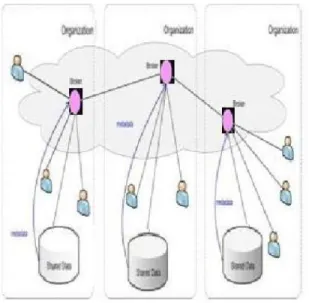
Ms. Jyoti M More, Ms.Urmila Biradar system consisting of data sources and brokers. Brokers are helping to make routing decision for queries. In earlier study, distributed system providing data access through set of brokers.IBS system providing scalability, on-demand data access with transparency and server autonomy. The problem with IBS infrastructure is brokers are not fully trustedFigure 1. Overview of the IBS infrastructure.
To overcome this problem, Privacy Preserving Information Brokering (PPIB) introduced. In this paper, it introduced the implementation of Dynamic Load Balancing concept. Dynamic load balancing improves system performance. Load Balancing means redistribute workload among the nodes of distribute system to improve resource utilization and response time [6].
2. Background
In order to provide privacy and security Privacy Preserving Information
Brokering (PPIB) introduced. PPIB has two types of brokering component 1) Brokers and 2) Co-ordinator [1][2]. The user authentication and query forwarding is done by brokers. Access control and query routing is done by co-ordinator.
In this paper, two attacks have been discussed and also provide solution to overcome those attacks for security purpose. In this paper, it introduced concept of dynamic load balancing. For improving system performance dynamic load balancing is implemented.
3. The Problem
In the Information brokering system, there are mainly three types of stakeholder data owner, data provider and data requester. The information is may be different from one another. The main problem has been created by attacker. Attacker could infer privacy of data owner, data provider and data requester. Also introduce problem of system performance.
There are two types of attacks as follows 1).Inference attack 2).Attribute-correlation attack[1][2].
Inference attack
This attack is totally based on the guessing the query. If the guess is matches, the query will be inferred.
Attribute-correlation attack
This attack is depends on predicates. Attacker prevents query, which contain
209
Ms. Jyoti M More, Ms.Urmila Biradar predicates. To infer sensitive information, the attacker correlate attributesNeed for improving Performance Solution:
PPIB has been provided for overcome these attacks. In this way, privacy is preserved. And also Dynamic load balancing algorithm is implemented for improving performance of system.
4. Privacy Preserving Information
Brokering (PPIB)
4.1 Architecture of PPIB:
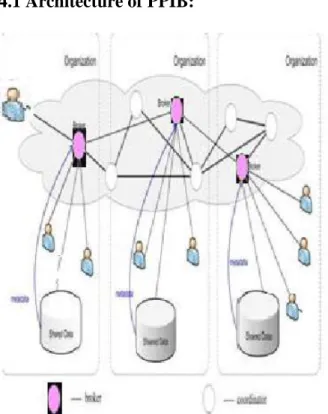
Figure 1. Architecture of PPIB.
PPIB has mainly three types of brokering components: (a) Brokers (b) Coordinators and (c) Central authority (CA) [2].
Brokers: Brokers are attached through coordinators. The main function of brokers is for user authentication and query forwarding.
Coordinator: Coordinator is responsible for access control and content based query routing.
Central Authority: Central
Authority is responsible for metadata maintenance and key management.
4.2 Two Novel Schemes: A. Automata Segmentation
The data is share between multiple organizations. Organizations have their own ideas and goals. Global components are divided locally and forwarded to the coordinators. The query must be partitioned into multiple parts and parts are forwarded to the local coordinators. Automata Segmentation includes deployment, segmentation and replication [1][2].
B. Query Segment Encryption
In Query Segment Encryption phase, segmented query is encrypted by the coordinator. It consists of post-encryption and pre-encryption modules. Coordinator uses the key to encrypt the query segment. The encrypted query has been send to the next coordinator. Until it reaches its data server, query must be prevented. Query has been forwarded to destination [1][2].
210
Ms. Jyoti M More, Ms.Urmila Biradar Fig 3. 4-Phases of PPIB.Phase 1: To join the system user needs to authenticate to local broker. The user submits encrypted segment with XML query by unique session key Ks and public level keys, data servers encrypted with the public key, to return data.
Phase 2: The task of metadata preparation is done by broker. 1. It extracts the role of the user authenticated and attaches it to the encrypted XML query; 2. For each query it makes a unique ID, and attaches QID with its own address to the query. Data server can directly return the data.
Phase 3: The query receives by the root of the coordinator tree and its metadata from a local the query within the coordinator tree, until it reaches a leaf coordinator, which broker, it follows schemes i.e. the automata segmentation scheme for segment the XML query and to perform access control the query segment encryption scheme and to route sends the query to related data servers. Phase 4: In this phase, the data server gets a safe query in an encrypted form. The data server evaluates the query and after decryption returns the data, encrypted by Ks, to the broker of the query [2].
5. Conclusion
This system gives different ways for privacy and security issues. We studied how the privacy and security is maintained. Attacker could infer privacy of data owner, data provider and data requester. Also introduce problem of system performance. There are two types of attacks: inference attack and Attribute-correlation attack are studied. In this paper, we studied PPIB architecture, two novel scheme, and phases of PPIB. This system proposes a new approach for Dynamic load Balancing concept.
6. References
[1] “Enforcing Secure and Privacy-Preserving Information Brokering in Distributed Information Sharing”, by Bo Luo, Chao-Hsien Chu, Peng Liu Dongwon Lee, Fengjun Li, IEEE
TRANSCATIONS ON
INFORMATION FORENSICS AND SECURITY, 2013.
[2] Ms. Pradnya Kamble, Mr. Mukesh Kawatghare,”Review on Enforcing Secure And Privacy Preserving Information Brokering In Distributed Information Sharing”.
[3] “In-broker access control: Towards efficient end-to-end performance of information brokerage systems”, by F. Li, P. Liu, D. Lee, B. Luo, W. Lee, and P. Mitra, C. Chu, in Proc. IEEE SUTC, 2006.
[4] A. Banu Prabha “Security Enforcement with query routing Information Brokering in Distributed Information Sharing” IOSR-JCE,Issue 2, Vol 16,Ver.XI Mar-Apr 2014
211
Ms. Jyoti M More, Ms.Urmila Biradar [5] Noe Elisa, K. Suresh Babu“SURVEY ON PROTECTING
PRIVACY ANDSECURITY IN XML
INFORMATION BROKERING”
IJCSMC, Vol.3, Issue.4 April 2014.
[6] “EXECUTION ANALYSIS OF
LOAD BALANCING ALGORITHMS
IN CLOUD COMPUTING
ENVIRONMENT “Ajanta De
Sarkar,Soumya Ray. IJCCSA, Vol.2, No.5, October 2012.
[7] S.S.Apte,Abhijit A. Rajguru,,“A Comparative Performance Analysis of Load Balancing Algorithms in Distributed System using Qualitative Parameters” Volume-1,Issue-3,August-2012.
[8] Rima Lingawar,Milind
Srode,Mangesh Ghonge,”Survey on Load-Balancing Techniques in Cloud Computing”IJARCE,Vol.1,No.3,May 2014.
AUTHORS
First Author – Ms. Jyoti M.More, ME (Computer Engineering), GHRCEM, Wagholi Pune.
email : [email protected] Second Author – Ms. Urmila Biradar, ME(CE),GHRCEM,Wagholi pune.