P ho to : M ic ha el B et ts /G et ty I m ag es ; F la m es : © is to ck p ho to .c om /S ela ha ttin B ay ra m
T
he British Virgin Islands in the Caribbean – an international hub for hot money – has negligible trade with faraway China but in the first five months of this year poured an astonishing US$7.9 billion into the booming Asian powerhouse.Not surprisingly, wealthy Hong Kong is also putting money into the mainland, with the value of its foreign direct investment rising 95 percent in the first half of 2008, compared with the same period last year. But while the amount has jumped, the number of projects actually has dropped, raising fears that the unaccounted for investment may be “hot money” entering mainland China on the back of its stunning economic rise.
The phenomenon, hidden in the financial world’s jargon and
complications, is a simple story of lust for quick and easy profit. Lured by the yuan’s constant appreciation, which has risen nearly 7 percent this year against the U.S. dollar and China’s relative high interest rates, speculators are gambling huge amounts of portfolio funds in money markets and similar investments.
The amount of speculative money flowing in and out of China is anybody’s guess. In the first six months of 2008, economists place the estimate at US$200 billion. Zhang Ming, an economist with the Institute of World Economics and Politics at the Chinese Academy of Social Sciences, says total speculative funds entering China since 2003 stand at around US$1.74 trillion.
If Zhang were correct, China’s financial markets would suffer havoc if the speculators suddenly pulled out.
Another Asian crisis?
Yu Xuejun, branch head of the China Banking Regulatory Commission in Jiangsu province, warned in a July conference in Beijing that in about two years, a financial crisis could hit China that would send shock waves throughout Asia, similar to Thailand’s baht debacle that triggered the 1997 Asian financial meltdown.
He should know the problem well, having formally headed the banking regulator’s office in Shenzhen, the place the central government fears is one of the main conduits of hot money entering China.
Yu’s prognosis is that the crisis will be triggered by a reversal in the yuan’s value. “By that time, international capital will flow out instead of come in and the yuan will face depreciation
A surge of speculative funds complicates China’s
monetary policies, reports
Cookie Micaller
instead of appreciation pressure. China will face a liquidity shortage and fi nancial crisis will therefore follow,” Yu wrote in his report cited by Quamnet.
Some economists, however, disagree, citing China’s massive foreign exchange reserves (the largest in the world at approximately US$1.83 trillion), its stable fi nancial system and strict capital controls.
Stephen Green, head of research in China at Standard Chartered, says the People’s Bank of China has much liquidity locked up on its own balance sheet, so the domestic fi nancial system will be able to withstand large outfl ows of foreign exchange.
“In short, as far as hot money goes, don’t panic,” Green wrote in his 8 August research notes.
David O’Rear, chief economist at the Hong Kong General Chamber of Commerce, agrees the possibility of China plunging into a fi nancial crisis is unlikely. China, he says, does not have excessive short-term foreign debts or a shortage of foreign exchange reserves, factors that complicated the problems of East Asian economies during the 1997-98 crisis.
“Post-reform China has not yet had a fi nancial crisis, which every rapidly developing economy gets eventually, but hot money is not likely the cause,” O’Rear explains. “Crises are caused by a loss of faith that banks will have enough money to pay back depositors, or that the currency will hold its value.”
Too hot to handle
China’s foreign exchange reserves are continuing to accumulate at a
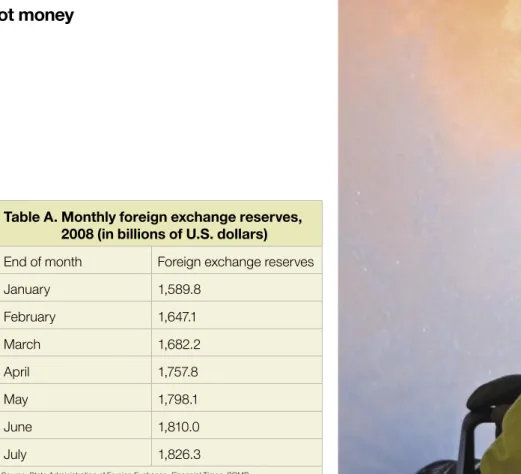
rapid pace. Th e total increase in the fi rst seven months of 2008 came to approximately US$298.1 billion. Figures from the People’s Bank of China, quoted by the Financial Times, showed a record increase of US$75.6 billion in April and a rise of US$40.3 billion in May, but the numbers slowed to US$11.9 billion in June (see table A). Economists explain the slowdown could be due to a change in the way foreign exchange reserves are accounted for, rather than a decrease in cash infl ows. Th e latest statistics by the central bank, according to the
South China Morning Post, showed the numbers picked up again in July, with fund infl ows of US$16.3 billion.
“I don’t believe money is leaving China at all at this point,” says Michael Pettis, a fi nance professor with Guanghua School of Management at Peking University. “You still have this huge amount of unexplained money.”
Slowing down or not, the money infl ux has alarmed Beijing offi cials.
Since the beginning of the year, Chinese leaders have acted quickly to halt the surge of speculative money, using measures such as cracking down on illicit money transfers through underground banks, capping daily yuan deposits and withdrawals, requiring banks to submit monthly reports on deposits held by foreign individuals and organizations, and ordering exporters to park their revenues in special accounts while documentary evidence of genuine trade is verifi ed.
“I think the authorities are making a heroic eff ort but they are unlikely to succeed except for short periods of time,” says Pettis.
“Th e root of the problem is the perception that the yuan is seriously undervalued, and with productivity having grown faster than the increase in the real value of the yuan, this
Hot money
Table A. Monthly foreign exchange reserves, 2008 (in billions of U.S. dollars)
End of month Foreign exchange reserves January 1,589.8 February 1,647.1 March 1,682.2 April 1,757.8 May 1,798.1 June 1,810.0 July 1,826.3
ha
un L
ow
e
undervaluation has increased over the years. Until this problem is addressed, the incentives for capital and trade infl ows are too high,” he says.
So how exactly do speculative funds bypass China’s strict capital controls and sneak into the money system of the giant Asian nation?
Researchers and economists point to the usual routes: foreign direct investments, under-invoicing imports or over-invoicing exports and illicit money transfers using illegal money shops.
Th e reason skeptics suspect foreign direct investment is that there has been a surge in investment but a decline in projects. From January to July this year, the Chinese Ministry of Commerce approved 22.15 percent fewer overseas-funded projects compared to the same period last year. But the overall amount of actual FDI used rose 44.54 percent to US$60.72 billion.
Th is means, according to offi cials, the value of FDI used per project has on average increased substantially. But the explanation is not enough to quell observers’ doubts.
“In comparison with other channels, it is much easier for speculative funds [to enter] the mainland in the form of direct investment,” Xinhua quoted Ding Zhijie, a professor with the University of International Business and Economics in Beijing. Th e decline in the number of projects,
bolstered by the closures of various foreign-funded enterprises in the Pearl River Delta, meant foreign direct investment should fall but it rose instead, highlighting suspicions that some of the investments might be speculative money, Ding said.
Green of Standard Chartered says based on his estimate, actual foreign direct investment surged in the fi rst half of 2008, owing to the commerce ministry’s new calculation method that now considers fi nancial acquisitions as FDI. “It is likely that companies Th is means, according to offi cials,
I don’t believe money is leaving
China at all at this point. You
still have this huge amount of
unexplained money.
are front-loading or exaggerating their investments in order to bring in funds and gain exposure to the yuan,” he says.
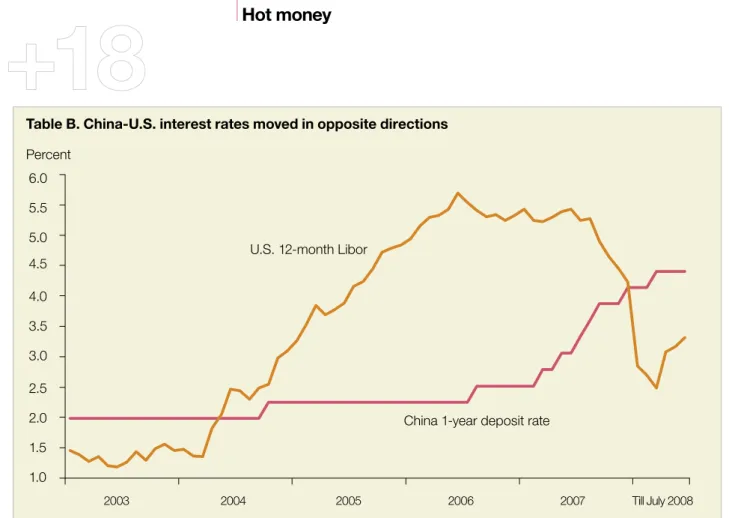
According to Zhang of the Chinese Academy of Social Sciences, hot money may also sit in the bank as ordinary deposits. With a relatively high interest rate of more than 4 percent on yuan deposits compared to the 2 percent for U.S. dollar deposits, plus the projected appreciation of the yuan, he estimates that investors can gain at least 12 percent in annual returns. Not bad for a risk-free investment amid a gloomy global economy. (See table B for interest rates movements)
Wang Tao, chief China economist at UBS in Beijing, says it is rational for foreign direct investors to hoard money in China now for any planned future expansion to hedge against the yuan’s appreciation risk. Th e resulting rise in
Clear and present danger
As Chinese economy watchers debate the actual amount of speculative funds circulating in the mainland, Beijing is battling against a more pressing concern: infl ation.
Th e consumer price index eased to 7.1 percent in June after reaching a 12-year high of 8.7 percent in February on rising fuel costs and a global food crisis. With infl ation at such a high level, controlling capital infl ows is all the more important for the Chinese leadership.
“Th e recent surge in hot money infl ows adds complications to China’s macro and especially monetary policy decision,” Wang says. “Th e concerns of speculative infl ows have made the authorities reluctant to use interest rate tools to combat infl ation, and have led to the slowing of exchange rate adjustment. Th is means that the hot
China’s interest rates are below its infl ation rate, which makes it diffi cult for the banking regulator to hike interest rates for fear of attracting more hot money that will worsen infl ation.
One solution analysts are putting forward is a one-off 10 percent to 20 percent appreciation of the yuan to curb speculation. Beijing offi cials, however, are likely to be cautious with the exchange rate policy, especially when global demands for exports have dramatically declined.
Whether reports about hot money are misplaced or exaggerated, Wang says China should be concerned at the speed speculative funds are fl owing into the mainland economy and the rapid accumulation of foreign exchange reserves.
“We think that the continued generation of liquidity would be like 6.0 5.5 5.0 4.5 4.0 3.5 3.0 2.5 2.0 1.5 1.0 Percent
U.S. 12-month Libor
China 1-year deposit rate
Source: CEIC, Reuters
Table B. China-U.S. interest rates moved in opposite directions