J
OURNAL OF
C
LINICAL
O
NCOLOGY
O R I G I N A L R E P O R TAuthor affiliations appear at the end of this article.
Published online ahead of print at www.jco.orgon June 6, 2016.
Support information appears at the end of this article.
Authors’disclosures of potential conflicts of interest are found in the article online at www.jco.org. Author contributions are found at the end of this article.
Corresponding author: Michael D. Taylor, MD, PhD, FRCSC, Division of Neurosurgery, 555 University Ave, Toronto, Ontario M5G 1X8, Canada; e-mail: [email protected].
© 2016 by American Society of Clinical Oncology
0732-183X/16/3421w-2468w/$20.00
DOI: 10.1200/JCO.2015.65.7825
Therapeutic Impact of Cytoreductive Surgery and Irradiation
of Posterior Fossa Ependymoma in the Molecular Era: A
Retrospective Multicohort Analysis
Vijay Ramaswamy, Thomas Hielscher, Stephen C. Mack, Alvaro Lassaletta, Tong Lin, Kristian W. Pajtler, David T.W. Jones, Betty Luu, Florence M.G. Cavalli, Kenneth Aldape, Marc Remke, Martin Mynarek, Stefan Rutkowski, Sridharan Gururangan, Roger E. McLendon, Eric S. Lipp, Christopher Dunham, Juliette Hukin, David D. Eisenstat, Dorcas Fulton, Frank K.H. van Landeghem, Mariarita Santi, Marie-Lise C. van Veelen, Erwin G. Van Meir, Satoru Osuka, Xing Fan, Karin M. Muraszko, Daniela P.C. Tirapelli, Sueli M. Oba-Shinjo, Suely K.N. Marie, Carlos G. Carlotti, Ji Yeoun Lee, Amulya A. Nageswara Rao, Caterina Giannini,
Claudia C. Faria, Sofia Nunes, Jaume Mora, Ronald L. Hamilton, Peter Hauser, Nada Jabado, Kevin Petrecca, Shin Jung, Luca Massimi, Massimo Zollo, Giuseppe Cinalli, L´aszl´o Bogn´ar, Almos Klekner, Tibor Hortob´agyi, Sarah Leary, Ralph P. Ermoian, James M. Olson, Jeffrey R. Leonard, Corrine Gardner, Wieslawa A. Grajkowska, Lola B. Chambless, Jason Cain, Charles G. Eberhart, Sama Ahsan, Maura Massimino, Felice Giangaspero, Francesca R. Buttarelli, Roger J. Packer, Lyndsey Emery, William H. Yong, Horacio Soto, Linda M. Liau, Richard Everson, Andrew Grossbach, Tarek Shalaby, Michael Grotzer, Matthias A. Karajannis, David Zagzag, Helen Wheeler, Katja von Hoff, Marta M. Alonso, Teresa Tuñon, Ulrich Sch¨uller, Karel Zitterbart, Jaroslav Sterba, Jennifer A. Chan, Miguel Guzman, Samer K. Elbabaa, Howard Colman, Girish Dhall, Paul G. Fisher, Maryam Fouladi, Amar Gajjar, Stewart Goldman, Eugene Hwang, Marcel Kool, Harshad Ladha,
Elizabeth Vera-Bolanos, Khalida Wani, Frank Lieberman, Tom Mikkelsen, Antonio M. Omuro, Ian F. Pollack, Michael Prados, H. Ian Robins, Riccardo Soffietti, Jing Wu, Phillipe Metellus, Uri Tabori, Ute Bartels, Eric Bouffet, Cynthia E. Hawkins, James T. Rutka, Peter Dirks, Stefan M. Pfister, Thomas E. Merchant, Mark R. Gilbert, Terri S. Armstrong, Andrey Korshunov, David W. Ellison, and Michael D. Taylor
A B S T R A C T
Purpose
Posterior fossa ependymoma comprises two distinct molecular variants termed EPN_PFA and EPN_PFB that have a distinct biology and natural history. The therapeutic value of cytoreductive surgery and radiation therapy for posterior fossa ependymoma after accounting for molecular subgroup is not known.
Methods
Four independent nonoverlapping retrospective cohorts of posterior fossa ependymomas (n = 820) were profiled using genome-wide methylation arrays. Risk stratification models were designed based on known clinical and newly described molecular biomarkers identified by multivariable Cox proportional hazards analyses.
Results
Molecular subgroup is a powerful independent predictor of outcome even when accounting for age or treatment regimen. Incompletely resected EPN_PFA ependymomas have a dismal prognosis, with a 5-year progression-free survival ranging from 26.1% to 56.8% across all four cohorts. Al-thoughfirst-line (adjuvant) radiation is clearly beneficial for completely resected EPN_PFA, a sub-stantial proportion of patients with EPN_PFB can be cured with surgery alone, and patients with relapsed EPN_PFB can often be treated successfully with delayed external-beam irradiation.
Conclusion
The most impactful biomarker for posterior fossa ependymoma is molecular subgroup affiliation, independent of other demographic or treatment variables. However, both EPN_PFA and EPN_PFB still benefit from increased extent of resection, with the survival rates being particularly poor for subtotally resected EPN_PFA, even with adjuvant radiation therapy. Patients with EPN_PFB who undergo gross total resection are at lower risk for relapse and should be considered for inclusion in a randomized clinical trial of observation alone with radiation reserved for those who experience recurrence.
INTRODUCTION
Ependymoma is the third most common posterior fossa tumor of childhood and a major cause of morbidity and mortality in pe-diatric oncology, occurring across the entire age spectrum.1-16 Current therapy for posterior fossa ependymoma in children is aggressive surgical resection followed by involved-field radiation, resulting in 7-year event free-survival of 65%.12,15Despite the high mortality rate, trials of cytotoxic chemotherapy have failed to reveal a clear survival benefit for chemotherapy over surgery and radiation alone, although definitive pediatric randomized trials of maintenance chemotherapy are still recruiting through cooperative groups (ClinicalTrials.govidentifiers: NCT01096368 and NCT02265770).1,5,17
In adults, posterior fossa ependymoma is frequently treated with surgery alone.18
Numerous publications have suggested that the most powerful prognostic factor for posterior fossa ependymoma is the extent of surgical resection or, more appropriately, the amount of residual tumor after surgery. This has entailed an aggressive surgical approach, with some oncologists and surgeons tolerating serious neurologic deficits, including the need for tracheostomies and gastrostomy tubes, as an inevitable cost in the attempt to achieve tumor-free survival, including potentially morbid second-look surgery.
Because the majority of ependymomas within the neuroaxis are histologically similar, historically they had been thought to compose one disease, but they were subsequently recognized to be biologically distinct in the supratentorial, posterior fossa, and spinal compartments of the CNS.19More recently, integrated genomic approaches have clearly shown the existence of the fol-lowing three distinct molecular variants of posterior fossa epen-dymoma: EPN_PFA, EPN_PFB, and subependymoma. EPN_PFA occurs primarily in infants and young children, whereas EPN_PFB occurs primarily in older children and adults.20-23Subependymomas are grade 1 tumors with an excellent prognosis restricted to older adults. Patients with EPN_PFB have an excellent outcome, with survival rates in excess of 90%, whereas patients with EPN_PFA have a poor outcome. Curiously, neither EPN_PFA nor EPN_PFB has any recurrent somatic single nucleotide variants, and both demonstrate a low rate of mutation across the genome.21The complete lack of recurrent somatic single nucleotide variants implies that targeted therapy using small molecules directed against recurrent mutations is unlikely to be a successful strategy for patients with posterior fossa ependymoma. EPN_PFA is characterized by relatively increased DNA methylation compared with EPN_PFB, and preclinical studies suggest that epigenetic modulating agents might be beneficial for patients with EPN_PFA.21
All prior studies of the therapeutic value of cytoreductive surgery and external-beam radiation done in the premolecular era have not accounted for subgroup affiliation and might therefore be confounded by clinical differences in response to therapy between EPN_PFA and EPN_PFB. In addition to extent of resection and provision of radiotherapy, age at presentation was a strong pos-terior fossa ependymoma risk factor in the premolecular era lit-erature. It is unclear whether younger age is an independent risk factor or is merely a reflection of the enrichment of patients with EPN_PFA in younger cohorts. Thus, it is unclear whether older patients with EPN_PFA will do well, whereas younger patients with
EPN_PFB will do poorly. Previous studies from our group and others have suggested that the two posterior fossa ependymoma subgroups may have disparate responses to therapy.20,21 To de-termine the true value of extent of resection, radiation therapy, and age at presentation as biomarkers in the molecular era, we present the largest retrospective cohort of posterior fossa ependymomas ever assembled and determine the validity and strength of known biomarkers after accounting for molecular subgroup.
METHODS
Three hundredfive posterior fossa ependymomas were obtained from the Hospital for Sick Children and from collaborating centers from around the world through the Global Ependymoma Network of Excellence (GENE) consortium from 1990 to 2014. Samples were all collected in accordance with the approval of the Hospital for Sick Children Research Ethics Board and local institutional research ethics boards. To account for unobserved variables, three independent nonoverlapping validation cohorts were as-sembled from the prospective St Jude Children’s Research Hospital (n = 112, RT1 cohort), the Collaborative Ependymoma Research Network (n = 121, CERN cohort), and the German Cancer Research Center/ Burdenko Neurosurgical Institute (n = 261, Burdenko cohort). Full details of the cohorts, sample processing, collection of clinical annotations, and statistical analysis are found in the Appendix (online only).
RESULTS
Demographics of Posterior Fossa Ependymoma Cohorts
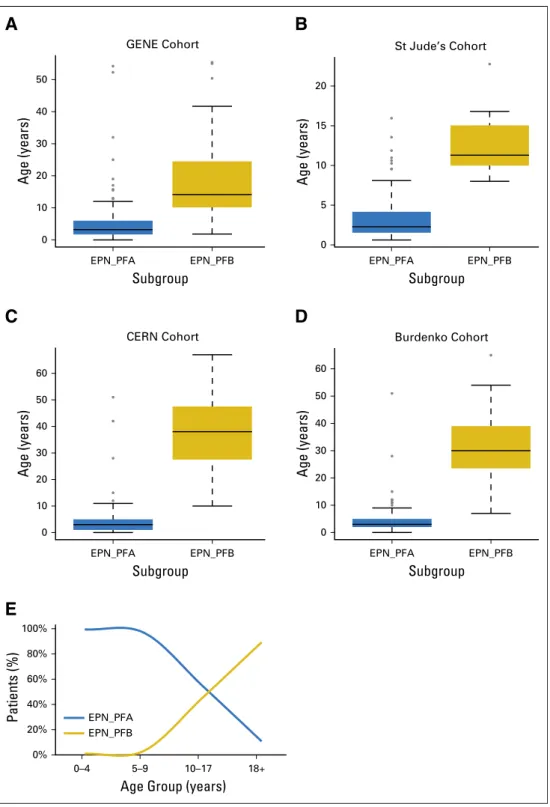
Posterior fossa ependymomas from all four cohorts had mo-lecular subgroup determined using unsupervised hierarchical clus-tering of genome-wide methylation arrays, as recently described.23In total, we analyzed 820 posterior fossa ependymomas, which were subsequently found to include 678 EPN_PFAs and 142 EPN_PFBs, with EPN_PFBs more highly enriched in the CERN and Burdenko cohorts, as reflected by the median age (Table 1). Demographics and treatment details of each of the four cohorts are listed inTable 1. Grade was not included as a variable because a previous reanalysis of several prospective cohort studies showed the existing WHO histologic classification to be unreliable as a result of profound intraobserver variability, confounding its utility in clinical risk stratification.24The median age of patients with EPN_PFA was almost identical across all four cohorts, with a combined median age of 3 years (AppendixFig A1, online only; overall age range, 0 to 77 years; GENE: median, 3.6 years; range, 0 to 72 years; St Jude RT1: median, 2.38 years; range, 0.62 to 22.76 years; CERN: median, 4 years; range, 0 to 67 years; Burdenko: median, 4 years; range, 0 to 65 years). Children younger than age 5 years almost exclusively had EPN_PFA (three EPN_PFB tumors in patients,5 years old); however, 45% of pediatric patients age 10 to 17 years had EPN_PFB tumors. Adults largely had EPN_PFB, although 11% of adults had EPN_PFA tumors. Overall, 236 deaths and 420 progression events were observed, and median follow-up time of the entire cohort was 6.7 years (95% CI, 6.0 to 7.2 years).
Subgroup Affiliation Is the Most Powerful Prognostic Marker for Posterior Fossa Ependymoma
all four cohorts incorporating age, extent of surgical resection, adjuvant external-beam irradiation, subgroup, and cohort stratifi -cation (Table 2, AppendixTables A1-A3, online only). No significant predictor-cohort interaction was identified for any of these variables with the exception of adjuvant radiation, which had a stronger effect in the GENE cohort; thus, we proceeded to pool all four cohorts in a multivariable analysis (AppendixTable A4, online only). After accounting for treatment variables, subgroup affiliation remained a highly significant predictor of progression-free survival (PFS; hazard ratio [HR], 2.14; 95% CI, 1.31 to 3.49;P= .002,Table 2; AppendixTables A1andA3report each cohort individually) and overall survival (OS; HR, 4.30; 95% CI, 1.88 to 9.87;P,.001; Table 2; AppendixTables A1andA3report each cohort individually). Administrative censoring at 10 years did not significantly alter the multivariable analysis (AppendixTables A2 andA3). The HR for subgroup affiliation (HR, 4.30) was the highest of the examined biomarkers. Extent of resection, adjuvant external-beam irradiation, and male sex were also significant independent predictors of PFS and OS, whereas age at diagnosis and delivery of chemotherapy were not. We then evaluated the survival of patients with EPN_PFA versus EPN_PFB in each cohort individually. Across the four cohorts, EPN_PFA had significantly worse PFS and OS compared with
EPN_PFB (Table 2; Appendix Fig A2, online only; Appendix Tables A1andA2).
EPN_PFA Carries a Poor Prognosis Independent of Age at Diagnosis
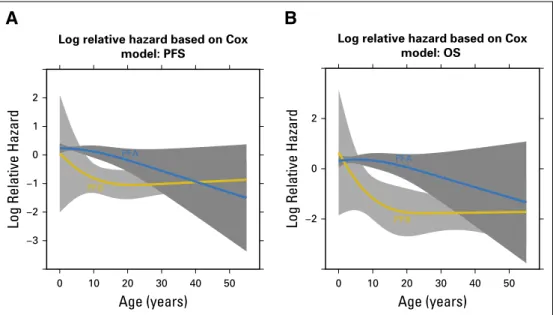
In the premolecular era, age was an important prognostic factor for patients with posterior fossa ependymoma. We assessed the relative hazard for EPN_PFA and EPN_PFB depending on age and found that the relative risk of an EPN_PFA tumor is relatively constant across all age groups with a slight decrease for adults and is consistently higher than for EPN_PFB across the entire age spectrum (AppendixFig A3, online only). We restricted our survival analysis to patients older than age 10 years, and EPN_PFA remained a signif-icant predictor of poor outcome for both 10-year PFS (P= .001) and 10-year OS (P,.001; AppendixFig A4and AppendixTable A5, online only). Finally, to determine whether older children with EPN_PFA have a poor outcome, we stratified age as less than or greater than 10 years and found no significant difference in either PFS or OS, confirming that the poor prognosis attributed to EPN_PFA is not solely a result of the young age of the cohort (Fig 1). A similar analysis was done for EPN_PFB, where survival was stratified as greater than or less than 18 years with no significant difference in survival, further reaffirming that EPN_PFB is a favorable-risk group independent of age at diagnosis (Fig 1). As such, we conclude that the poor prognosis of EPN_PFA and the excellent prognosis of EPN_PFB are independent of age at diagnosis, confirming the results of the multivariable Cox re-gression analysis.
Surgical Cytoreduction of EPN_PFA Is Prognostic Independent of Subgroup
Extent of resection is identified in multiple publications as the single most important predictor of outcome for patients with posterior fossa ependymoma. However, poor-prognosis EPN_PFA tumors are a difficult surgical challenge as a result of their lateral location and occurrence in small infants who have a small blood volume, whereas good-prognosis EPN_PFB tumors are compar-atively straightforward to resect as a result of their midline location and occurrence in an older age group. We hypothesized that the
Table 1. Demographic and Treatment Characteristics of All Four Cohorts
Characteristic
No. of Patients (%)
GENE (n = 326) St Jude’s RT1 (n = 112) CERN (n = 121) Burdenko (n = 261)
Median age, years (interquartile range) 3.6 (1.87-7.45) 2.38 (1.57-4.99) 4 (2-25.5) 4 (2-8.5)
Male sex 175 (53.6) 61 (54.5) 63 (52.1) 152 (58.2)
GTR 221 (68.9) 92 (82.1) 68 (56.7) 138 (53.3)
Adjuvantfirst-line radiation 250 (78.6) 112 (100) 72 (59) 196 (75.1)
Adjuvant chemotherapy 138 (44.5) 0 42 (34.7) 164 (62.8)
Disease progression 148 (45.7) 40 (35.7) 72 (59.5) 146 (55.9)
Dead 104 (31.9) 41 (33.9) 28 (25) 63 (24.2)
Subgroup
EPN_PFA 275 (84.4) 104 (92.9) 86 (71.1) 213 (81.6)
EPN_PFB 51 (15.6) 8 (7.1) 35 (28.9) 48 (18.4)
NOTE. Data were missing for the following: GTR: GENE, n = 4; CERN, n = 1; Burdenko, n = 2; adjuvantfirst-line radiation: GENE, n = 8; adjuvant chemotherapy: GENE, n = 16; disease progression: GENE, n = 2; and sex: Burdenko, n = 16.
Abbreviations: CERN, Collaborative Ependymoma Research Network; GENE, Global Ependymoma Network of Excellence; GTR, gross total resection (,5 mm residual disease).
Table 2.Multivariable Cox Proportional Hazards Regression Model of Progression-Free and Overall Survival
Variable Hazard Ratio 95% CI P
Progression-free survival (n = 777)
Age 0.99 0.98 to 1.00 .13
Male 1.25 1.02 to 1.54 .03
Incomplete resection 1.84 1.49 to 2.28 ,.001 Adjuvantfirst-line radiation 0.63 0.49 to 0.79 ,.001
Chemotherapy 1.04 0.81 to 1.34 .76
EPN_PFA subgroup 2.14 1.31 to 3.49 .002 Overall survival (n = 778)
Age 0.98 0.96 to 1.00 .12
Male 1.41 1.97 to 1.85 .01
Incomplete resection 2.13 1.60 to 2.82 ,.001 Adjuvantfirst-line radiation 0.52 0.38 to 0.72 ,.001
Chemotherapy 0.90 0.65 to 1.26 .54
previously observed therapeutic value for surgical cytoreduction was confounded by the poor natural history of EPN_PFA tumors, which are difficult to resect, compared with the benign natural history of EPN_PFB tumors, which are less difficult to resect.
To determine the relationship between subgroup and extent of resection after accounting for molecular subgroup, we compared PFS and OS in each subgroup individually stratified by extent of resection. When comparing subtotal resection (STR) versus gross total resection (GTR) in EPN_PFA, STR was highly predictive of a dismal PFS and OS (Fig 2and AppendixTable A6, online only). In a multivariable Cox proportional hazards model that included adjuvant chemotherapy and radiation, survival remained dismal for STR EPN_PFA (Appendix Tables A7 and A8, online only). Although we observed some variability in the effect of extent of
resection across the four cohorts, we did not observe a statistically significant difference in or heterogeneity of the effect of extent of resection in EPN_PFA across cohorts (interactionP= .80 for PFS,
P= .53 for OS). Male sex was a significant independent predictor of poor outcome across all four cohorts in GTR in a multivariable analysis restricted to EPN_PFA, although STR is a high-risk group in both male and female patients (AppendixFig A5, online only, and AppendixTable A7). Within EPN_PFA, female patients with a GTR had a 5-year PFS of 0.652 (95% CI, 0.581 to 0.732), whereas male patients with a GTR had a 5-year PFS of 0.455 (95% CI, 0.393 to 0.527).
The value offirst-line (adjuvant post-surgical) radiotherapy could only be compared with no radiation in the GENE, CERN, and Burdenko cohorts, because all patients in the prospective
P = .53 0.25
0.50 0.75 1.00
0 1 2 3 4 5 6 7 8 9 10
Time Since Diagnosis (years)
OS (probability)
Age < 10 years
Age > 10 years Age < 10 years
Age > 10 years
624 545 473 388 327 277 224 184 143 116 93 54 51 42 38 33 29 28 24 21 16 10 Age < 10
Age > 10 No. at risk
P = .21 0.25
0.50 0.75 1.00
0 1 2 3 4 5 6 7 8 9 10
Time Since Diagnosis (years)
PFS (probability)
623 479 363 283 232 203 162 133 103 83 71 54 48 36 30 25 23 23 20 17 13 7 Age < 10
Age > 10 No. at risk
A
B
C
D
P = .73 0.25
0.50 0.75 1.00
0 1 2 3 4 5 6 7 8 9 10
Time Since Diagnosis (years)
PFS (probability)
47 40 35 31 23 20 15 10 9 6 5 94 84 75 65 56 51 45 38 30 22 17 Age < 18
Age > 18 No. at risk
Age < 18 years
Age > 18 years
P = .26 0.25
0.50 0.75 1.00
0 1 2 3 4 5 6 7 8 9 10
Time Since Diagnosis (years)
OS (probability)
48 45 43 38 29 24 18 11 10 7 6 93 85 78 69 60 55 49 43 34 25 18 Age < 18
Age > 18 No. at risk
Age < 18 years
Age > 18 years
A
GENE Cohort
PFS
P = .02
0.25 0.50 0.75 1.00
0 1 2 3 4 5 6 7 8 9 10
Time Since Diagnosis (years) Time Since Diagnosis (years)
PFS (probability) GTR STR
175 128 89 70 54 48 40 34 25 18 15 87 50 36 23 16 13 10 8 7 6 4
GTR STR
No. at risk
St Jude’s Cohort
P = .007
0.25 0.50 0.75 1.00
0 1 2 3 4 5 6 7 8 9 10
Time Since Diagnosis (years)
PFS (probability)
84 82 70 59 58 56 51 43 40 36 33 20 17 13 11 10 9 7 7 6 3 2
GTR STR
No. at risk GTR STR
C
OS
P < .001
0.25 0.50 0.75 1.00
0 1 2 3 4 5 6 7 8 9 10
OS (probability)
176 148 123 101 79 67 54 48 39 29 22 87 58 50 38 34 22 17 13 11 9 7
STR GTR
No. at risk GTR STR
B
P = .003
0.25 0.50 0.75 1.00
0 1 2 3 4 5 6 7 8 9 10
Time Since Diagnosis (years)
OS (probability)
84 84 80 75 73 71 65 55 51 44 39 20 19 19 15 12 11 10 10 9 6 4
GTR STR
No. at risk
GTR STR
D
F
P = .2
0.25 0.50 0.75 1.00
0 1 2 3 4 5 6 7 8 9 10
Time Since Diagnosis (years)
OS (probability)
49 48 43 39 33 31 24 19 13 9 7 37 35 30 27 24 21 17 12 9 7 6
GTR STR
No. at risk GTR STR
E
CERN Cohort
P = .06
0.25 0.50 0.75 1.00
0 1 2 3 4 5 6 7 8 9 10
Time Since Diagnosis (years)
PFS (probability)
49 48 43 39 33 31 24 19 13 9 7 37 35 30 27 24 21 17 12 9 7 6
GTR STR
No. at risk
GTR STR
H
P = .01
0.25 0.50 0.75 1.00
0 1 2 3 4 5 6 7 8 9 10
Time Since Diagnosis (years)
OS (probability)
114 105 88 71 59 49 40 35 19 16 11 97 88 73 54 41 29 20 11 8 7 5
GTR STR
No. at risk
GTR STR
G
Burdenko Cohort
P < .001
0.25 0.50 0.75 1.00
0 1 2 3 4 5 6 7 8 9 10
Time Since Diagnosis (years)
PFS (probability)
114 92 68 51 42 32 26 22 12 10 7 98 67 46 29 17 13 7 5 5 5 4
GTR STR
No. at risk GTR STR
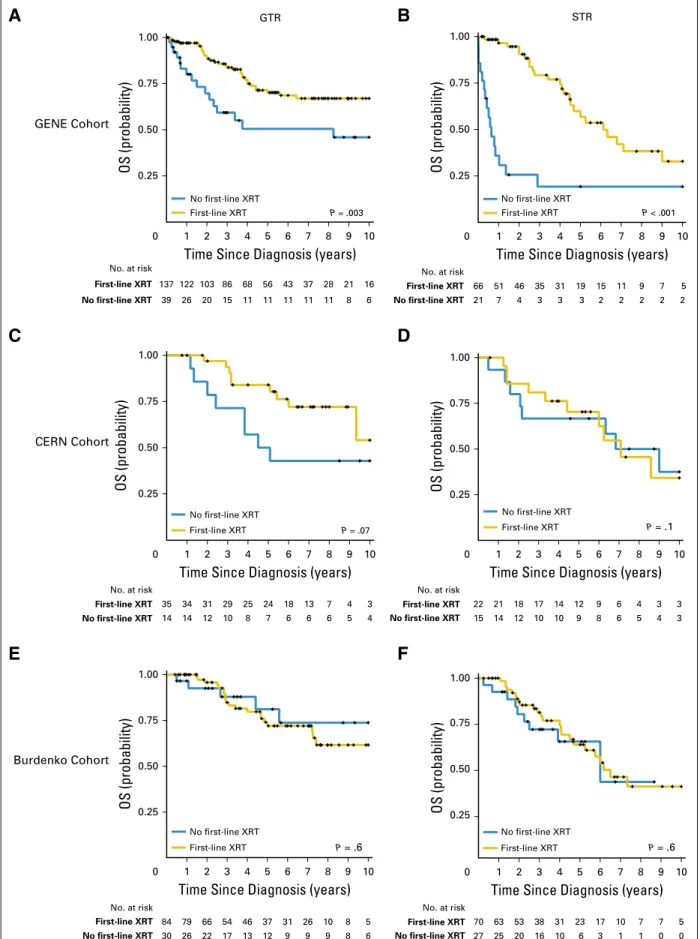
St Jude RT1 cohort received adjuvant postoperative radiation. Strikingly, survival for STR EPN_PFA was not different between those who received first-line external-beam radiation and those who did not in the CERN and Burdenko cohorts (AppendixFig A6, online only). In the GENE cohort, there was a statistically sig-nificant difference by a univariable analysis in patients who did not receive radiation; however, survival remains poor even in patients with subtotal resections who received external-beam irradiation. These data suggest that the benefit of post-surgical first-line adjuvant external-beam irradiation for patients with EPN_PFA is limited in the face of a subtotal resection and that these patients should be prioritized for clinical trials of novel therapy.
Patients With GTR EPN_PFB Have an Excellent Prognosis
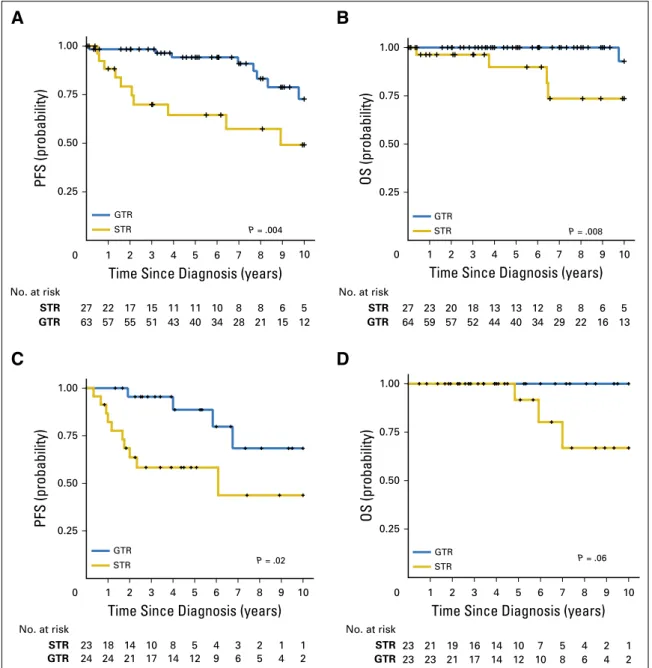
As a result of limited patient numbers, we combined patients with EPN_PFB from the GENE, St Jude RT1, and CERN cohorts and demonstrated that STR results in a high risk of relapse (10-year PFS for GTR, 0.740; 95% CI, 0.550 to 0.859; 10-year PFS for STR, 0.50; 95% CI, 0.271 to 0.692). Thesefindings were confirmed in a cohort of patients with EPN_PFB treated at the Burdenko In-stitute (Fig 3). As a result of the similar behavior of the two cohorts and the relatively small number of patients with EPN_PFB in each cohort, we combined all patients in our subsequent multivariable analysis. In a multivariable analysis restricted to EPN_PFB, a similar
P= .4 0.25
0.50 0.75 1.00
0 1 2 3 4 5 6 7 8 9 10
Time Since Diagnosis (years)
OS (probability)
No first-line XRT
First-line XRT
29 27 26 25 21 19 18 14 11 8 5 61 56 52 46 38 36 30 25 21 16 14
No first-line XRT First-line XRT
No. at risk
P= .1 0.25
0.50 0.75 1.00
0 1 2 3 4 5 6 7 8 9 10
Time Since Diagnosis (years)
PFS (probability)
29 26 25 24 20 18 17 14 11 8 5 61 55 49 44 36 35 29 24 20 14 13
No first-line XRT
No first-line XRT First-line XRT
No. at risk
B
A
P = .6 0.25
0.50 0.75 1.00
0 1 2 3 4 5 6 7 8 9 10
Time Since Diagnosis (years)
PFS (probability)
No first-line XRT First-line XRT
7 6 6 6 5 4 4 3 2 1 1
40 36 29 21 17 13 9 6 5 4 2
First-line XRT
No first-line XRT First-line XRT
No. at risk
P = .3 0.25
0.50 0.75 1.00
0 1 2 3 4 5 6 7 8 9 10
Time Since Diagnosis (years)
OS (probability)
7 7 6 6 5 4 4 4 2 1 1
39 37 34 27 23 18 13 9 8 5 2 No. at risk
D
C
No first-line XRT First-line XRT No first-line XRT
First-line XRT
pattern emerges, where an incomplete resection is an independent predictor of both PFS and OS (AppendixTables A9andA10, online only). However, OS for patients with GTR EPN_PFB is extremely favorable, with a 10-year OS of 0.961 (95% CI, 0.753 to 0.994), compared with patients with STR EPN_PFB, who had a 10-year OS of 0.667 (95% CI, 0.308 to 0.870; AppendixFig A7, online only). Interestingly, the PFS for patients with EPN_PFB who did not receive external-beam irradiation was 0.451 (95% CI, 0.216 to 0.661); however, the OS was 0.823 (95% CI, 0.519 to 0.943). These
data suggest that a subset of patients with EPN_PFB can be cured by surgery alone after GTR (Fig 3). Of the three nonirradiated patients with EPN_PFB who died, two had an STR and one had a GTR. A substantial portion of patients with EPN_PFB who experience re-currence after initially withholding radiation can potentially be successfully treated by repeat surgery and delayed delivery of ra-diation (Fig 3). Indeed, the effect of a GTR versus an STR in EPN_PFB was significant for both the three combined cohorts and for the Burdenko cohort (P = .02 in univariable Cox regression
A
Score
0 1 2 3 4 5 6 7 8 9 10
EOR (subgroup = PFB)
GTR
STR
EOR (subgroup = PFA)
GTR
STR
Age
> 18 > 10−18 < 3 3−10
First-line radiation
yes yes
no
Chemotherapy
no
Sex
F
M
Score sum
0 2 4 6 8 10 12 14 16 18 20
5-year PFS probability
0.1 0.2 0.3 0.4 0.5 0.6 0.7 0.8
10-year PFS probability
0.1 0.2 0.3 0.4 0.5 0.6 0.7 0.8
Nomogram for Multivariable Cox Model: PFS
B
Score
0 1 2 3 4 5 6 7 8 9 10
EOR (subgroup = PFB)
GTR
STR
EOR (subgroup = PFA)
GTR
STR
Age
> 18 3−10
< 3 > 10−18
First-line radiation
no
Chemotherapy
yes yes no
Sex
F M
Score sum
0 2 4 6 8 10 12 14 16 18
5-year OS probability
0.1 0.2 0.3 0.4 0.5 0.6 0.7 0.8 0.9
10-year OS probability
0.1 0.2 0.3 0.4 0.5 0.6 0.7 0.8 0.9
Nomogram for Multivariable Cox Model: OS
analysis). Because the long-term effects of radiation for posterior fossa ependymoma in young adults who are cured can be quite severe,25-28 these data provide the necessary clinical equipoise for initiation of a clinical trial of initial radiation avoidance in patients with GTR EPN_PFB ependymoma.
DISCUSSION
We have defined the demographic and prognostic properties of the two subgroups of posterior fossa ependymoma across the largest cohort of posterior fossa ependymoma assembled to date. Al-though three of the cohorts consist of retrospective data, the St Jude RT1 cohort was prospectively followed and homogeneously treated. The cohort is of such a large size that it will not likely be repeated in our lifetime, nor is a prospective clinical trial randomly assigning extent of resection in posterior fossa ependymoma patients likely.
We have shown that although EPN_PFA occurs primarily in infants and EPN_PFB is diagnosed primarily in adults, in children age 10 to 17 years, there is equal representation of both subgroups. Moreover, in adults, approximately 11% of patients have EPN_PFA. Across the entire age spectrum, we show that subgroup is the most powerful predictor of outcome, suggesting that in patients older than age 5 years, there is significant information to be gained in routine subgrouping of patients with posterior fossa ependymoma. Ex-tent of resection, although no longer the most powerful predictor of outcome, remains prognostic in both subgroups. In particular, patients with STR EPN_PFA constitute a high-risk group with a poor outcome. Finally, we have shown that a subset of patients with EPN_PFB can be treated with surgery alone without external-beam irradiation, suggesting a trial of observation alone may be warranted in this subset of patients. Overall, in a prediction model of subgroup, treatment, and extent of resection as depicted in a nomogram, wefind that EPN_PFA is the strongest predictor of poor outcome (Fig 4). Male sex was also an independent predictor of poor outcome in our analysis across all four cohorts, which is consistent with previous reports.12 Interestingly the survival advantage in females is most pronounced in the setting of GTR EPN_PFA. A more comprehensive integrated genomic study will likely be required to clarify this association; however, it is noteworthy that females with a GTR have 10-year survival rates approximately 15% higher than males.
Ourfinding that patients with STR EPN_PFA have a dismal outcome has significant implications to the design of future clinical trials. Although a simple proximate solution would be to suggest GTR in all patients, this is frequently not possible as a result of brainstem invasion. Additionally, this subset of EPN_PFA seems to confer the least benefit from adjuvant external-beam irradiation and could potentially benefit from novel therapies. Previous studies of chemotherapy have shown only limited activity against posterior fossa ependymoma, with high-dose chemotherapy with autolo-gous stem-cell support resulting in 3-year event-free survival of less than 30%, consistent with the survival we observed.29,30The role of adjuvant chemotherapy will require completion and reporting of long-term outcomes in the open studies of both the European Society of Pediatric Oncology (SIOPe) and the Children’s Oncology Group (ACNS0831), where patients are randomly assigned to maintenance chemotherapy. Ourfindings across four independent
cohorts of posterior fossa ependymoma suggest that STR EPN_PFA should be prioritized forfirst-line investigational agents, such as DNA demethylase inhibitors and EZH2 inhibitors, to provide an opportunity to assess activity of these agents prior to radiation.21 Indeed, even patients with GTR EPN_PFA have OS rates of close to 50%, suggesting aggressive surgeries are not curative, and novel approaches would benefit this group as well.
We alsofind that STR confers a significantly poorer prognosis in EPN_PFB. Considering that the 10-year OS for EPN_PFB is greater than 85% with a complete resection, we feel that a GTR should be attempted where possible. The EPN_PFB data are limited by small numbers of STR patients and, as such, warrant some caution in interpretation. Major limitations of our study are a lack of central review of postoperative imaging in the three retrospective cohorts, retrospective design of the study without uniform follow-up imaging to identify progression, and treat-ment heterogeneity. Indeed, nonenhancing residual tumor can be missed even with modern postoperative magnetic resonance imaging. A large prospective radiographic study using modern three-dimensional magnetic resonance imaging volumetrics with a receiver operating curve will be needed to determine precisely how much residual tumor is truly predictive of a poor prognosis.
Finally, ourfinding that EPN_PFB can potentially be cured without external-beam irradiation has profound implications. Across the EPN_PFB cohort, we demonstrate many patients who have not experienced recurrence despite the lack of radiation therapy. Therefore, our data suggest that radiation in EPN_PFB can be initially withheld and that patients who experience recurrence can potentially be treated with salvage reresection and radiation. The ability to successfully treat patients with EPN_PFB with repeat surgery and radiation therapy is demonstrated by the large difference between PFS and OS in this patient population. Considering that the majority of adult posterior fossa epen-dymoma patients are not treated on open protocols, pro-spective evaluation will be crucial to determine the optimal treatment approach. We feel that our data support consider-ation of a prospective clinical trial of observconsider-ation alone for GTR EPN_PFB, which could potentially spare patients the toxic effects of radiation.31The age group in which this could confer the highest benefit would be the older pediatric and adolescent population, in whom radiation has significant effects on learning and memory, and this approach could significantly improve long-term quality of life in this subset of patients.
AUTHORS’DISCLOSURES OF POTENTIAL CONFLICTS OF INTEREST
Disclosures provided by the authors are available with this article at
www.jco.org.
AUTHOR CONTRIBUTIONS
Conception and design:Vijay Ramaswamy, Stephen C. Mack, Terri S. Armstrong, Andrey Korshunov, David W. Ellison, Michael D. Taylor
Provision of study materials or patients:All authors
Gururangan, Roger E. McLendon, Eric S. Lipp, Christopher Dunham, Juliette Hukin, David D. Eisenstat, Dorcas Fulton, Frank K.H. van Landeghem, Mariarita Santi, Marie-Lise C. van Veelen, Erwin G. Van Meir, Satoru Osuka, Xing Fan, Karin M. Muraszko, Daniela P.C. Tirapelli, Sueli M. Oba-Shinjo, Suely K.N. Marie, Carlos G. Carlotti, Ji Yeoun Lee, Amulya A. Nageswara Rao, Caterina Giannini, Claudia C. Faria, Sofia Nunes, Jaume Mora, Ronald L. Hamilton, Peter Hauser, Nada Jabado, Kevin Petrecca, Shin Jung, Luca Massimi, Massimo Zollo, Giuseppe Cinalli, L´aszl ´o Bogn´ar, Almos Klekner, Tibor Hortob´agyi, Sarah Leary, Ralph P. Ermoian, James M. Olson, Jeffrey R. Leonard, Corrine Gardner, Wieslawa A. Grajkowska, Lola B. Chambless, Jason Cain, Charles G. Eberhart, Sama Ahsan, Maura Massimino, Felice Giangaspero, Francesca R. Buttarelli, Roger J. Packer, Lyndsey Emery, William H. Yong, Horacio Soto, Linda M. Liau, Richard Everson, Andrew Grossbach, Tarek Shalaby, Michael Grotzer, Matthias A. Karajannis, David Zagzag, Helen Wheeler, Katja von Hoff, Marta M. Alonso, Teresa Tuñon, Ulrich Sch¨uller, Karel Zitterbart,
Jaroslav Sterba, Jennifer A. Chan, Miguel Guzman, Samer K. Elbabaa, Howard Colman, Girish Dhall, Paul G. Fisher, Maryam Fouladi, Amar Gajjar, Stewart Goldman, Eugene Hwang, Marcel Kool, Harshad Ladha, Elizabeth Vera-Bolanos, Khalida Wani, Frank Lieberman, Tom Mikkelsen, Antonio M. Omuro, Ian F. Pollack, Michael Prados, H. Ian Robins, Riccardo Soffietti, Jing Wu, Phillipe Metellus, Uri Tabori, Ute Bartels, Eric Bouffet, Cynthia E. Hawkins, James T. Rutka, Peter Dirks, Stefan M. Pfister, Thomas E. Merchant, Mark R. Gilbert, Terri S. Armstrong, Andrey Korshunov, David W. Ellison
Data analysis and interpretation:Vijay Ramaswamy, Thomas Hielscher, Alvaro Lassaletta, Tong Lin, David T.W. Jones, Betty Luu, Florence M.G. Cavalli, Kenneth Aldape, Marc Remke, Stefan M. Pfister, Mark R. Gilbert, Terri S. Armstrong, Andrey Korshunov, David W. Ellison, Michael D. Taylor
Manuscript writing:All authors
Final approval of manuscript:All authors
REFERENCES
1. Bouffet E, Tabori U, Huang A, et al: Ependy-moma: Lessons from the past, prospects for the future. Childs Nerv Syst 25:1383-1384, 2009
2. Raybaud C, Ramaswamy V, Taylor MD, et al: Posterior fossa tumors in children: Developmental anatomy and diagnostic imaging. Childs Nerv Syst 31:1661-1676, 2015
3. Thompson YY, Ramaswamy V, Diamandis P, et al: Posterior fossa ependymoma: Current insights. Childs Nerv Syst 31:1699-1706, 2015
4. Mack SC, Taylor MD: The genetic and epi-genetic basis of ependymoma. Childs Nerv Syst 25: 1195-1201, 2009
5. Souweidane MM, Bouffet E, Finlay J: The role of chemotherapy in newly diagnosed ependymoma of childhood. Pediatr Neurosurg 28:273-278, 1998
6. Purdy E, Johnston DL, Bartels U, et al: Ependymoma in children under the age of 3 years: A report from the Canadian Pediatric Brain Tumour Consortium. J Neurooncol 117:359-364, 2014
7. Bouffet E, Tabori U, Bartels U: Paediatric ependymomas: Should we avoid radiotherapy? Lancet Oncol 8:665-666, 2007
8. Yao Y, Mack SC, Taylor MD: Molecular genetics of ependymoma. Chin J Cancer 30:669-681, 2011
9. U-King-Im JM, Taylor MD, Raybaud C: Pos-terior fossa ependymomas: New radiological classi-fication with surgical correlation. Childs Nerv Syst 26: 1765-1772, 2010
10. Dubuc AM, Northcott PA, Mack S, et al: The genetics of pediatric brain tumors. Curr Neurol Neurosci Rep 10:215-223, 2010
11. Koshy M, Rich S, Merchant TE, et al: Post-operative radiation improves survival in children younger than 3 years with intracranial ependymoma. J Neurooncol 105:583-590, 2011
12. Merchant TE, Li C, Xiong X, et al: Conformal radiotherapy after surgery for paediatric ependy-moma: A prospective study. Lancet Oncol 10:258-266, 2009
13. Merchant TE, Boop FA, Kun LE, et al: A ret-rospective study of surgery and reirradiation for re-current ependymoma. Int J Radiat Oncol Biol Phys 71:87-97, 2008
14. Merchant TE, Fouladi M: Ependymoma: New therapeutic approaches including radiation and che-motherapy. J Neurooncol 75:287-299, 2005
15. Merchant TE, Mulhern RK, Krasin MJ, et al: Preliminary results from a phase II trial of conformal radiation therapy and evaluation of radiation-related CNS effects for pediatric patients with localized ependymoma. J Clin Oncol 22:3156-3162, 2004
16. Merchant TE, Zhu Y, Thompson SJ, et al: Preliminary results from a phase II trial of conformal radiation therapy for pediatric patients with localised low-grade astrocytoma and ependymoma. Int J Radiat Oncol Biol Phys 52:325-332, 2002
17. DeWire M, Fouladi M, Turner DC, et al: An open-label, two-stage, phase II study of bevacizumab and lapatinib in children with recurrent or refractory epen-dymoma: A Collaborative Ependymoma Research Network study (CERN). J Neurooncol 123:85-91, 2015 18. Rud `a R, Gilbert M, Soffietti R: Ependymomas of the adult: Molecular biology and treatment. Curr Opin Neurol 21:754-761, 2008
19. Taylor MD, Poppleton H, Fuller C, et al: Radial glia cells are candidate stem cells of ependymoma. Cancer Cell 8:323-335, 2005
20. Witt H, Mack SC, Ryzhova M, et al: De-lineation of two clinically and molecularly distinct subgroups of posterior fossa ependymoma. Cancer Cell 20:143-157, 2011
21. Mack SC, Witt H, Piro RM, et al: Epigenomic alterations define lethal CIMP-positive ependymo-mas of infancy. Nature 506:445-450, 2014
22. Johnson RA, Wright KD, Poppleton H, et al: Cross-species genomics matches driver mutations and cell compartments to model ependymoma. Na-ture 466:632-636, 2010
23. Pajtler KW, Witt H, Sill M, et al: Molecular classification of ependymal tumors across all CNS compartments, histopathological grades, and age groups. Cancer Cell 27:728-743, 2015
24. Ellison DW, Kocak M, Figarella-Branger D, et al: Histopathological grading of pediatric ependy-moma: Reproducibility and clinical relevance in Eu-ropean trial cohorts. J Negat Results Biomed 10:7, 2011
25. Mabbott DJ, Spiegler BJ, Greenberg ML, et al: Serial evaluation of academic and behavioral out-come after treatment with cranial radiation in child-hood. J Clin Oncol 23:2256-2263, 2005
26. Spiegler BJ, Bouffet E, Greenberg ML, et al: Change in neurocognitive functioning after treatment with cranial radiation in childhood. J Clin Oncol 22: 706-713, 2004
27. Merchant TE, Pollack IF, Loeffler JS: Brain tu-mors across the age spectrum: Biology, therapy, and late effects. Semin Radiat Oncol 20:58-66, 2010
28. Mulhern RK, Merchant TE, Gajjar A, et al: Late neurocognitive sequelae in survivors of brain tu-mours in childhood. Lancet Oncol 5:399-408, 2004
29. Venkatramani R, Ji L, Lasky J, et al: Outcome of infants and young children with newly diagnosed ependymoma treated on the “Head Start” III prospective clinical trial. J Neurooncol 113:285-291, 2013
30. Bouffet E, Foreman N: Chemotherapy for in-tracranial ependymomas. Childs Nerv Syst 15:563-570, 1999
31. Lassaletta A, Bouffet E, Mabbott D, et al: Functional and neuropsychological late outcomes in posterior fossa tumors in children. Childs Nerv Syst 31:1877-1890, 2015
Affiliations
Hamburg-Eppendorf, Hamburg; Ulrich Sch¨uller, Ludwig-Maximilians-Universit¨at, Munich, Germany; Stephen C. Mack, Cleveland Clinic Foundation, Cleveland; Maryam Fouladi, University of Cincinnati, Cincinnati Children’s Hospital Medical Center, Cincinnati, OH; Tong Lin, Amar Gajjar, Thomas E. Merchant, and David W. Ellison, St Jude Children’s Research Hospital, Memphis; Lola B. Chambless, Vanderbilt Medical Center, Nashville, TN; Sridharan Gururangan, Roger E. McLendon, and Eric S. Lipp, Duke University, Durham; Jing Wu, University of North Carolina at Chapel Hill, Chapel Hill, NC; Mariarita Santi, Children’s Hospital of Philadelphia; Lyndsey Emery, Hospital of the University of Pennsylvania, Philadelphia; Ronald L. Hamilton and Ian F. Pollack, University of Pittsburgh School of Medicine; Frank Lieberman, University of Pittsburgh Medical Center, Pittsburgh, PA; Erwin G. Van Meir and Satoru Osuka, Emory University, Atlanta, GA; Xing Fan and Karin M. Muraszko, University of Michigan Medical School, Ann Arbor; Tom Mikkelsen, Henry Ford Health System, Detroit, MI; Sarah Leary, Ralph P. Ermoian, and James M. Olson, Seattle Children’s Hospital; Sarah Leary, Ralph P. Ermoian, and James M. Olson, Fred Hutchinson Cancer Research Center; Sarah Leary, Ralph P. Ermoian, and James M. Olson, University of Washington, Seattle, WA; Jeffrey R. Leonard and Corrine Gardner, Washington University School of Medicine and St Louis Children’s Hospital; Miguel Guzman and Samer K. Elbabaa, St Louis University School of Medicine, St Louis, MO; Charles G. Eberhart and Sama Ahsan, John Hopkins University School of Medicine, Baltimore; Mark R. Gilbert, National Cancer Institute, Bethesda, MD; Roger J. Packer and Eugene Hwang, Children’s National Medical Center, Washington, DC; William H. Yong, Horacio Soto, Linda M. Liau, and Richard Everson, David Geffen School of Medicine at University of California, Los Angeles; Girish Dhall, Children’s Hospital Los Angeles, Los Angeles; Paul G. Fisher, Stanford University Medical Center, Stanford; Michael Prados, University of California San Francisco, San Francisco, CA; Andrew Grossbach, University of Iowa Hospitals and Clinics, Iowa City, IA; Matthias A. Karajannis and David Zagzag, New York University Langone Medical Center; Antonio M. Omuro, Memorial Sloan-Kettering Cancer Center, New York, NY; Howard Colman, Huntsman Cancer Institute, University of Utah Health System, Salt Lake City, UT; Amulya A. Nageswara Rao and Caterina Giannini, Mayo Clinic, Rochester, MN; Stewart Goldman, Lurie Children’s Hospital, Chicago, IL; Harshad Ladha, Elizabeth Vera-Bolanos, Khalida Wani, and Mark R. Gilbert, The University of Texas MD Anderson Cancer Center; Terri S. Armstrong, University of Texas Health Science Center, Houston, TX; H. Ian Robins, University of Wisconsin, Madison, WI; Marie-Lise C. van Veelen, Erasmus University Medical Center, Rotterdam, the Netherlands; Daniela P.C. Tirapelli, Sueli M. Oba-Shinjo, Suely K.N. Marie, and Carlos G. Carlotti, University of Sao Paulo, São Paulo, Brazil; Ji Yeoun Lee, Seoul National University College of Medicine, Seoul; Shin Jung, Chonnam National University Research Institute of Medical Sciences, Chonnam National University Hwasun Hospital and Medical School, Hwasun-gun, Chonnam, South Korea; Claudia C. Faria, Centro Hospitalar Lisboa Norte, Hospital de Santa Maria; Sofia Nunes, Instituto Portugues de Oncologia de Lisboaˆ Francisco Gentil, Lisbon, Portugal; Jaume Mora, Hospital Sant Joan de D´eu, Esplugues de Llobregat, Barcelona; Marta M. Alonso, University Hospital of Navarra, Pamplona; Teresa Tuñon, Complejo Hospitalario de Navarra, Pamplona, Navarra, Spain; Peter Hauser, Semmelweis University, Budapest; L´aszl ´o Bogn´ar, Almos Klekner, and Tibor Hortob´agyi, University of Debrecen, Debrecen, Hungary; Luca Massimi, Catholic University Medical School; Francesca R. Buttarelli, Sapienza University of Rome, Rome; Massimo Zollo and Giuseppe Cinalli, University of Naples; Giuseppe Cinalli, Ospedale Santobono-Pausilipon, Naples; Maura Massimino, Fondazione Istituto di Ricovero e Cura a Carattere Scientifico (IRCCS) Istituto Nazionale dei Tumori, Milan; Felice Giangaspero, Sapienza University of Rome–Policlinico Umberto I and IRCCS Neuromed, Pozzilli; Riccardo Soffietti, University of Turin, Turin, Italy; Wieslawa A. Grajkowska, The Children’s Memorial Health Institute, Warsaw, Poland; Jason Cain, The Hudson Institute of Medical Research, Clayton, Victoria; Helen Wheeler, Kolling Institute of Medical Research, The University of Sydney, Sydney, New South Wales, Australia; Tarek Shalaby and Michael Grotzer, University Children’s Hospital of Zurich, Zurich, Switzerland; Karel Zitterbart and Jaroslav Sterba, Masaryk University, Brno, Czech Republic; and Phillipe Metellus, Centre Hospitalier Clairval, Marseille, France.
Support
M.D.T. is supported by funds from the Garron Family Chair in Childhood Cancer Research at the Hospital for Sick Children and the University of Toronto and operating funds from the Pediatric Brain Tumor Foundation, Meagan’s Walk, the Rally Foundation, the National Institutes of Health (NIH; Grants No. R01CA159859 and R01CA148699), and the Canadian Institutes of Health Research (CIHR). V.R. is supported by a CIHR fellowship, an Alberta Innovates-Health Solutions Clinical Fellowship, a Collaborative Ependymoma Research Network (CERN) Foundation fellowship, and an Alex’s Lemonade Stand Young Investigator Award. E.B. and V.R. acknowledge support from b.r.a.i.n.child. S.G., R.E.M., and D.B. are supported by the Pediatric Brain Tumor Foundation. M.R. is supported by a fellowship from the Mildred Scheel Cancer Foundation. S.M.P. is supported by a grant from the Deutsche Kinderkrebsstiftung. M.A.K. and D.Z. are supported by the NYU Langone Human Specimen Resource Center, Laura and Isaac Perlmutter Cancer Center, and Clinical and Translational Science Institute (CTSI), which were partially supported by the Cancer Center Support Grant P30CA016087 and a grant from the National Center for the Advancement of Translational Science (NCATS) (UL 1 TR000038), NIH, and grants from The Making Headway Foundation. A.K. was supported by the Hungarian Brain Research Program (Grant No. KTIA_13_NAP-A-V/3), the T ´AMOP-4.2.2.A-11/1/KONV-2012-0025 project, and J´anos Bolyai Scholarship of the Hungarian Academy of Sciences. K.Z. acknowledges the support of an Institutional Research Project grant to junior researchers from the Faculty of Medicine, Masaryk University. E.V.M. is funded by NIH Grants No. R01 CA163722 and NS096236, St Baldrick’s Foundation, and the Cure Childhood Cancer Foundation. M.D.T., V.R., K.A., T.S.A., and M.R.G. are supported by the CERN Foundation.
AUTHORS’DISCLOSURES OF POTENTIAL CONFLICTS OF INTEREST
Therapeutic Impact of Cytoreductive Surgery and Irradiation of Posterior Fossa Ependymoma in the Molecular Era: A Retrospective Multicohort Analysis
The following represents disclosure information provided by authors of this manuscript. All relationships are considered compensated. Relationships are self-held unless noted. I = Immediate Family Member, Inst = My Institution. Relationships may not relate to the subject matter of this manuscript. For more information about ASCO’s conflict of interest policy, please refer towww.asco.org/rwcorjco.ascopubs.org/site/ifc.
Vijay Ramaswamy
No relationship to disclose
Thomas Hielscher
No relationship to disclose
Stephen C. Mack
No relationship to disclose
Alvaro Lassaletta
Travel, Accommodations, Expenses:Takeda
Tong Lin
No relationship to disclose
Kristian W. Pajtler
No relationship to disclose
David T.W. Jones
No relationship to disclose
Betty Luu
No relationship to disclose
Florence M.G. Cavalli
No relationship to disclose
Kenneth Aldape
Leadership:Celldex, Merck
Marc Remke
No relationship to disclose
Martin Mynarek
Employment:Novartis (I), GlaxoSmithKline (I)
Stefan Rutkowski
Consulting or Advisory Role:Novartis Germany
Sridharan Gururangan Honoraria:Biomarin
Consulting or Advisory Role:Biomarin
Speakers’Bureau:Biomarin
Expert Testimony:MMIC Insurance
Roger E. McLendon
Consulting or Advisory Role:Genetron Health Holding
Patents, Royalties, Other Intellectual Property:Poliovirus receptor detection method–patent applied
Eric S. Lipp
No relationship to disclose
Christopher Dunham
No relationship to disclose
Juliette Hukin
No relationship to disclose
David D. Eisenstat Honoraria:Roche Canada
Travel, Accommodations, Expenses:Roche Canada
Dorcas Fulton
Consulting or Advisory Role:Merck
Travel, Accommodations, Expenses:Merck
Frank K.H. van Landeghem
No relationship to disclose
Mariarita Santi
No relationship to disclose
Marie-Lise C. van Veelen
No relationship to disclose
Erwin G. Van Meir
No relationship to disclose
Satoru Osuka
No relationship to disclose
Xing Fan
No relationship to disclose
Karin M. Muraszko
No relationship to disclose
Daniela P.C. Tirapelli
No relationship to disclose
Sueli M. Oba-Shinjo
No relationship to disclose
Suely K.N. Marie
No relationship to disclose
Carlos G. Carlotti
No relationship to disclose
Ji Yeoun Lee
No relationship to disclose
Amulya A. Nageswara Rao
No relationship to disclose
Caterina Giannini
No relationship to disclose
Claudia C. Faria
No relationship to disclose
Sofia Nunes
No relationship to disclose
Jaume Mora
No relationship to disclose
Ronald L. Hamilton
No relationship to disclose
Peter Hauser
No relationship to disclose
Nada Jabado
No relationship to disclose
Kevin Petrecca
No relationship to disclose
Shin Jung
Luca Massimi
No relationship to disclose
Massimo Zollo
No relationship to disclose
Giuseppe Cinalli
No relationship to disclose
L´aszl ´o Bogn´ar
No relationship to disclose
Almos Klekner
No relationship to disclose
Tibor Hortob´agyi
Stock or Other Ownership:Hortobagyi Med
Research Funding:National Brain Research Program, Hungary
Sarah Leary
No relationship to disclose
Ralph P. Ermoian
Stock or Other Ownership:Several stocks as part of diversified fund: Abbott Laboratories, Abbvie, Agilent Technologies, Allergan, Becton, Dickinson and Company, Boston Scientific Corporation, Biogen Idec, Bristol-Myers Squibb, C. R. Bard, Dyax, Gilead Sciences, Haemonetics Corporation, Hospira, Illumina, McKesson Corporation, Mylan, Myrexis, Novartis AG Shareholder, Novo Nordisk AS, Pfizer, Quest Diagnostics, Quintiles Transnational Holdings, Regeneron Pharmaceuticals, F. Hoffmann-La Roche, St Jude Medical, SanofiGroup, UnitedHealth Group, Vertex Pharmaceuticals, Zimmer Holdings, Zoetis
James M. Olson
Leadership:Blaze Bioscience, Presage Biosciences
Stock or Other Ownership:Blaze Bioscience, Presage Biosciences
Research Funding:Takeda
Patents, Royalties, Other Intellectual Property:Inventor on multiple patents for technologies licensed by Presage Biosciences and Blaze Bioscience. Receive a fraction of the milestone or royalty payments paid to Fred Hutchinson Cancer Research Center by these two companies.
Travel, Accommodations, Expenses:Blaze Bioscience, Presage Biosciences
Jeffrey R. Leonard
No relationship to disclose
Corrine Gardner
No relationship to disclose
Wieslawa A. Grajkowska
No relationship to disclose
Lola B. Chambless
Stock or Other Ownership:Pathfinder Therapeutics (I)
Jason Cain
No relationship to disclose
Charles G. Eberhart
No relationship to disclose
Sama Ahsan
Travel, Accommodations, Expenses:Merck, Merck (I)
Maura Massimino
Consulting or Advisory Role:Genentech, Oncoscience
Felice Giangaspero
No relationship to disclose
Francesca R. Buttarelli
No relationship to disclose
Roger J. Packer
Consulting or Advisory Role:Roche
Lyndsey Emery
No relationship to disclose
William H. Yong
Consulting or Advisory Role:Amgen
Research Funding:Amgen
Horacio Soto
No relationship to disclose
Linda M. Liau
Research Funding:Northwest Biotherapeutics
Richard Everson
No relationship to disclose
Andrew Grossbach
Patents, Royalties, Other Intellectual Property:Medtronic
Tarek Shalaby
No relationship to disclose
Michael Grotzer
No relationship to disclose
Matthias A. Karajannis
Consulting or Advisory Role:MedaCorp
Research Funding:Pfizer (Inst), Novartis (Inst)
David Zagzag
No relationship to disclose
Helen Wheeler
No relationship to disclose
Katja von Hoff
No relationship to disclose
Marta M. Alonso
No relationship to disclose
Teresa Tuñon
No relationship to disclose
Ulrich Sch¨uller
No relationship to disclose
Karel Zitterbart
No relationship to disclose
Jaroslav Sterba
No relationship to disclose
Jennifer A. Chan
No relationship to disclose
Miguel Guzman
No relationship to disclose
Samer K. Elbabaa
Stock or Other Ownership:Pfizer
Howard Colman
Consulting or Advisory Role:Genentech, Upsher-Smith, Roche, Novocure, Oxigene, CytRx Corporation, Omniox
Research Funding:Newlink Genetics, Plexxikon
Girish Dhall
No relationship to disclose
Paul G. Fisher
Other Relationship:Associate Editor,The Journal of Pediatrics
Maryam Fouladi Research Funding:Merck
Amar Gajjar
Research Funding:Genentech (Inst)
Stewart Goldman
No relationship to disclose
Eugene Hwang
Research Funding:Merck Sharp & Dohme
Marcel Kool
No relationship to disclose
Harshad Ladha
No relationship to disclose
Elizabeth Vera-Bolanos Employment:Horizon Health
Khalida Wani
No relationship to disclose
Frank Lieberman
Consulting or Advisory Role:Optune, Genentech, Stemline Therapeutics
Research Funding:Optune, Stemline Therapeutics, Genentech
Travel, Accommodations, Expenses:Optune
Tom Mikkelsen Honoraria:Genentech
Consulting or Advisory Role:Genentech, Orbus Therapeutics
Travel, Accommodations, Expenses:Genentech
Antonio M. Omuro
Consulting or Advisory Role:Stemline Therapeutics, Juno Therapeutics, Bristol-Myers Squibb, Oxigene
Travel, Accommodations, Expenses:Juno Therapeutics, Bristol-Myers Squibb
Ian F. Pollack
No relationship to disclose
Michael Prados Honoraria:Actelion
Consulting or Advisory Role:Actelion
Research Funding:Genentech (Inst), Novartis (Inst), Nativis (Inst)
H. Ian Robins
No relationship to disclose
Riccardo Soffietti
Consulting or Advisory Role:Genentech, Celldex
Jing Wu
No relationship to disclose
Phillipe Metellus
No relationship to disclose
Uri Tabori
No relationship to disclose
Ute Bartels
No relationship to disclose
Eric Bouffet
Research Funding:Genentech
Cynthia E. Hawkins
No relationship to disclose
James T. Rutka
No relationship to disclose
Peter Dirks
No relationship to disclose
Stefan M. Pfister
No relationship to disclose
Thomas E. Merchant
Travel, Accommodations, Expenses:IBA
Mark R. Gilbert
Honoraria:Merck, Genentech, Abbvie, Cell Medica, Heron, Wellcome Trust
Consulting or Advisory Role:Merck/Schering Plough, Genentech, Abbvie, Heron, Cell Medica, Wellcome Trust
Research Funding:GlaxoSmithKline, Merck/Schering Plough, Genentech
Travel, Accommodations, Expenses:Merck/Schering Plough, Genentech, Abbvie
Terri S. Armstrong
Consulting or Advisory Role:Tocagen, ImmunoCellular Therapeutics, Abbvie
Research Funding:Merck/Schering Plough
Andrey Korshunov
No relationship to disclose
David W. Ellison
No relationship to disclose
Michael D. Taylor
Acknowledgment
We thank Narra S. Devi for administrative assistance and Susan Archer for technical writing.
Appendix
Methods
Patient Cohort
All frozen samples were snap frozen and stored at280°C. Both frozen and formalin-fixed paraffin-embedded (FFPE) samples were collected from diagnosis and, in four instances, from relapse. Criteria for inclusion were an institutional histologic diagnosis of grade 2 or greater ependymoma and location within the posterior fossa. FFPE tissue was collected as scrolls or unstained slides. The Global Ependymoma Network of Excellence cohort was deemed the discovery cohort. Samples from three additional cohorts were collected and processed in an identical manner, including central pathologic review by a single pathologist in each of the three cohorts. Patients from the three additional cohorts have been partially reported in other cohort studies.12,23,24Subtotal resection was defined as greater than 5 mm of postoperative residual disease in at least two planes on postoperative magnetic resonance imaging or postoperative contrast-enhanced computed tomography scan as per the guidelines of the Children’s Oncology Group based on institutional radiologic reports. A gross total resection was defined as less than 5 mm of postoperative residual disease on postoperative magnetic resonance imaging or postoperative contrast-enhanced computed tomography based on institutional radiologic reports. Assessment of clinical variables pertaining to treatment and survival were performed at local institutions blinded to the molecular subgrouping. Grading was not included as a variable as a result of previous reports showing the extreme in-terobserver variability of this measure.24
DNA Extraction
Fresh-frozen posterior fossa ependymomas were stored at280°C before processing for extraction of DNA. For frozen samples, DNA extraction was performed using a proteinase K digestion and phenol:chloroform:isoamyl alcohol extraction and ethanol precipitation.25FFPE samples were processed using the Qiagen DNeasy FFPE extraction kit (Qiagen, Hilden, Germany), as per the manufacturer’s instructions.26Samples were quantified using Picogreen (Life Technologies, Waltham, MA).
Genome-Wide DNA Methylation Profiling
All samples were analyzed on the Illumina Infinium HumanMethylation450 BeadChip (Illumina, San Diego, CA) at the Princess Margaret Genomics Centre (Toronto, Ontario, Canada), the St Jude Children’s Research Hospital (Memphis, TN), or the German Cancer Research Center (Heidelberg, Germany) according to the manufacturer’s instructions and as previously described. All analysis was conducted in the R Statistical Environment (v3.1.3;www.r-project.org). Raw datafiles (.idat) were processed as previously described, and ependymoma subgroup affiliation was assigned as per a recently released classifier using unsupervised hierarchical clustering.23 Thirty-five grade 1 ependymomas (myxopapillary and subependymomas) were excluded from the analysis based on this classifier. Eleven samples diagnosed as ependymomas by local institutions did not cluster with posterior fossa ependymoma and were removed from the analysis.
Statistical Analysis
Progression-free survival and overall survival were right censored at 10 years and analyzed using the Kaplan-Meier method, and
age and subgroup interaction and a restricted cubic spline function with three knots for age to allow for a nonlinear relationship. All
Pvalues reported are two-sided. All statistical analyses were performed in the R statistical environment (v3.1.2), using R packages of survival (v2.37-7), rms (4.3-1), Coxphf (v1.1), and ggplot2 (v1.0.0).
EPN_PFA EPN_PFB 0
5 10 15 20
Subgroup
Age (years)
St Jude’s Cohort
B
EPN_PFA EPN_PFB 0
10 20 30 40 50
Subgroup
Age (years)
GENE Cohort
A
EPN_PFA EPN_PFB 0
10 20 30 40 50 60
Subgroup
Age (years)
Burdenko Cohort
D
C
EPN_PFA EPN_PFB
0 10 20 30 40 50 60
Subgroup
Age (years)
Patients (%)
CERN Cohort
E
0% 20% 40% 60% 80% 100%
0–4 5–9 10–17 18+
EPN_PFA EPN_PFB
Age Group (years)
B
0.50 1.0 2.0 4.0 8.0 16.0 32.0
Hazard Ratio [EPN_PFA v EPN_PFB] for OS All GENE CERN St Jude’s Burdenko Univariate
Age adjusted
Multivariable
A
All GENE CERN St Jude’s Burdenko Univariate
Age adjusted
Multivariable
0.50 1.0 2.0 4.0 8.0
Hazard Ratio [EPN_PFA v EPN_PFB] for PFS
Fig A2. Forest plots of EPN_PFA versus EPN_PFB across all cohorts and each cohort individually as a univariate analysis, age-adjusted univariate analysis, and multivariable analysis for (A) progression-free survival (PFS) and (B) overall survival (OS). CERN, Collaborative Ependymoma Research Network; GENE, Global Epen-dymoma Network of Excellence.
A
Log relative hazard based on Cox model: PFS
Log Relative Hazard
−3 −2 −1 0 1 2
0 10 20 30 40 50
PFB PFA
Age (years)
B
Log relative hazard based on Cox model: OS
Age (years) Log Relative Hazard −2
0 2
0 10 20 30 40 50
PFB PFA
P < .001 0.25
0.50 0.75 1.00
0 1 2 3 4 5 6 7 8 9 10
Time Since Diagnosis (years)
OS (probability)
EPN_PFA
EPN_PFB
54 51 42 38 33 29 28 24 21 16 10 EPN_PFA
130 120 111 99 84 76 64 52 43 32 24 EPN_PFB
No. at risk
P = .00141 0.25
0.50 0.75 1.00
0 1 2 3 4 5 6 7 8 9 10
Time Since Diagnosis (years)
PFS (probability)
EPN_PFA
EPN_PFB
54 48 36 30 25 23 23 20 17 13 7 EPN_PFA
130 116 104 91 77 69 58 46 38 28 22 EPN_PFB
No. at risk
A
B
Fig A4. Survival by subgroup in patients with an age at diagnosis of greater than 10 years for (A) progression-free survival (PFS) and (B) overall survival (OS).
A
P < .001 0.25
0.50 0.75 1.00
0 1 2 3 4 5 6 7 8 9 10
PFS (years)
PFS (probability)
176 149 124 105 92 86 68 58 47 37 29 248 204 150 118 97 84 76 63 46 38 33 95 66 51 40 31 28 23 17 13 10 6 140 100 72 50 36 28 18 15 14 11 10
Female/GTR Male/GTR Female/STR Male/STR No. at risk
Female/GTR
Male/GTR
Female/STR
Male/STR
B
P < .001 0.25
0.50 0.75 1.00
0 1 2 3 4 5 6 7 8 9 10
Follow-Up Time (years)
OS (probability)
Female/GTR
Male/GTR
Female/STR
Male/STR
176 162 144 130 113 105 83 73 61 48 37 248 225 194 159 133 116 103 87 64 53 43 95 80 71 58 49 40 30 23 16 11 8 140 118 100 77 63 44 35 24 22 19 14
Female/GTR Male/GTR Female/STR Male/STR No. at risk
P = .07 0.25
0.50 0.75 1.00
0 1 2 3 4 5 6 7 8 9 10
Time Since Diagnosis (years)
OS (probability)
14 14 12 10 8 7 6 6 6 5 4
35 34 31 29 25 24 18 13 7 4 3
No. at risk
CERN Cohort
C
P = .1 0.25
0.50 0.75 1.00
0 1 2 3 4 5 6 7 8 9 10
Time Since Diagnosis (years)
OS (probability)
15 14 12 10 10 9 8 6 5 4 3
22 21 18 17 14 12 9 6 4 3 3
No. at risk
D
P = .6 0.25
0.50 0.75 1.00
0 1 2 3 4 5 6 7 8 9 10
Time Since Diagnosis (years)
OS (probability)
30 26 22 17 13 12 9 9 9 8 6
84 79 66 54 46 37 31 26 10 8 5
No. at risk
Burdenko Cohort
E
P = .6 0.25
0.50 0.75 1.00
0 1 2 3 4 5 6 7 8 9 10
Time Since Diagnosis (years)
OS (probability)
27 25 20 16 10 6 3 1 1 0 0
70 63 53 38 31 23 17 10 7 7 5
No. at risk
F
P = .003
0.25 0.50 0.75 1.00
0 1 2 3 4 5 6 7 8 9 10
Time Since Diagnosis (years)
OS (probability)
No first-line XRT
First-line XRT
No first-line XRT
First-line XRT
No first-line XRT
First-line XRT
No first-line XRT
First-line XRT
No first-line XRT
First-line XRT
39 26 20 15 11 11 11 11 11 8 6
No first-line XRT
137 122 103 86 68 56 43 37 28 21 16
First-line XRT
No. at risk
GENE Cohort
GTR
A
B
P < .001 0.25
0.50 0.75 1.00
0 1 2 3 4 5 6 7 8 9 10
Time Since Diagnosis (years)
OS (probability)
No first-line XRT
First-line XRT
21 7 4 3 3 3 2 2 2 2 2
No first-line XRT
66 51 46 35 31 19 15 11 9 7 5
First-line XRT
No first-line XRT First-line XRT
No first-line XRT First-line XRT
No first-line XRT First-line XRT
No first-line XRT First-line XRT
No. at risk
STR
P = .004 0.25
0.50 0.75 1.00
0 1 2 3 4 5 6 7 8 9 10
Time Since Diagnosis (years)
PFS (probability)
GTR
STR
63 57 55 51 43 40 34 28 21 15 12 27 22 17 15 11 11 10 8 8 6 5
GTR STR
No. at risk
A
P = .008 0.25
0.50 0.75 1.00
0 1 2 3 4 5 6 7 8 9 10
Time Since Diagnosis (years)
OS (probability)
GTR
STR
GTR
STR
GTR
STR
64 59 57 52 44 40 34 29 22 16 13 27 23 20 18 13 13 12 8 8 6 5
GTR STR
No. at risk
B
P = .02 0.25
0.50 0.75 1.00
0 1 2 3 4 5 6 7 8 9 10
Time Since Diagnosis (years)
PFS (probability)
24 24 21 17 14 12 9 6 5 4 2 23 18 14 10 8 5 4 3 2 1 1
GTR STR
No. at risk
C
P = .06 0.25
0.50 0.75 1.00
0 1 2 3 4 5 6 7 8 9 10
Time Since Diagnosis (years)
OS (probability)
23 23 21 17 14 12 10 8 6 4 2 23 21 19 16 14 10 7 5 4 2 1
GTR STR
No. at risk
D
Table A1.Multivariable Cox Proportional Hazards Model of Survival Across All Posterior Fossa Ependymomas
Variable
PFS OS
HR (95% CI) P HR (95% CI) P
GENE cohort (PFS, n = 304; OS, n = 305)
Subgroup EPN_PFA 2.66 (1.14 to 6.23) .02 6.11 (1.38 to 27.01) .02
Age 0.97 (0.95 to 0.99) .008 0.96 (0.93 to 0.99) .02
Incomplete resection 1.87 (1.31 to 2.67) ,.001 2.37 (1.55 to 3.64) ,.001
Adjuvantfirst-line radiation 0.30 (0.21 to 0.44) ,.001 0.29 (0.18 to 0.45) ,.001 Adjuvantfirst-line chemotherapy 1.07 (0.74 to 1.55) .72 0.75 (0.47 to 1.20) .23
Male 1.19 (0.86 to 1.66) .30 1.26 (0.83 to 1.89) .28
CERN cohort (PFS, n = 120; OS, n = 120)
Subgroup EPN_PFA 2.08 (0.65 to 6.66) .22 6.95 (1.13 to 42.71) .04
Age 1.00 (0.97 to 1.03) .89 1.01 (0.97 to 1.05) .73
Incomplete resection 1.59 (0.91 to 2.79) .10 1.79 (0.87 to 3.70) .12
Adjuvantfirst-line radiation 0.70 (0.43 to 1.14) .15 0.62 (0.33 to 1.17) .14 Adjuvantfirst-line chemotherapy 0.95 (0.51 to 1.79) .88 0.79 (0.37 to 1.72) .56
Male 1.17 (0.73 to 1.90) .51 2.12 (1.07 to 4.21) .03
St Jude RT1 cohort (PFS, n = 112; OS, n = 112)
Subgroup EPN_PFA 1.40 (0.25 to 7.96) .70 4.94 (0.43 to 698.63) .23
Age 0.99 (0.89 to 1.10) .87 1.05 (0.91 to 1.17) .51
Incomplete resection 2.75 (1.42 to 5.33) .003 3.27 (1.47 to 6.90) .005
Male 2.16 (1.15 to 4.06) .009 2.72 (1.23 to 6.74) .01
Burdenko cohort (PFS, n = 241; OS, n = 241)
Subgroup EPN_PFA 2.49 (0.98 to 6.35) .06 2.72 (0.51 to 14.67) .24
Age 0.99 (0.96 to 1.02) .61 0.98 (0.93 to 1.04) .49
Incomplete resection 2.03 (1.43 to 2.89) ,.001 2.00 (1.19 to 3.37) .009
Adjuvantfirst-line radiation 1.11 (0.74 to 1.66) .61 1.08 (0.60 to 1.95) .80 Adjuvantfirst-line chemotherapy 0.99 (0.65 to 1.49) .94 1.38 (0.71 to 2.66) .34
Male 1.10 (0.76 to 1.58) .62 0.85 (0.50 to 1.45) .55
Abbreviations: CERN, Collaborative Ependymoma Research Network; GENE, Global Ependymoma Network of Excellence; HR, hazard ratio; OS, overall survival; PFS, progression-free survival.
Table A2. Multivariable Cox Proportional Hazards Regression Model of 10-Year Progression-Free and Overall Survival
Variable Hazard Ratio 95% CI P
Progression-free survival (n = 777)
Age 0.99 0.97 to 1.00 .09
Male 1.25 1.01 to 1.54 .04
Incomplete resection 1.88 1.51 to 2.33 ,.001 Adjuvantfirst-line radiation 0.63 0.50 to 0.81 ,.001 Adjuvantfirst-line chemotherapy 1.02 0.79 to 1.32 .87 EPN_PFA subgroup 2.18 1.31 to 3.62 .003 Overall survival (n = 778)
Age 0.98 0.96 to 1.00 .13
Male 1.40 1.06 to 1.84 .02
Table A3. Multivariable Cox Proportional Hazards Model of 10-Year Survival Across All Posterior Fossa Ependymoma
Variable
PFS OS
HR (95% CI) P HR (95% CI) P
GENE cohort (PFS, n = 304; OS, n =3 05)
Subgroup EPN_PFA 2.61 (1.04 to 6.53) .04 5.26 (1.17 to 23.60) .03
Age 0.96 (0.93 to 0.99) .005 0.96 (0.92 to 1.00) .03
Incomplete resection 1.90 (1.33 to 2.72) ,.001 2.49 (1.61 to 3.87) ,.001
Adjuvantfirst-line radiation 0.29 (0.20 to 0.43) ,.001 0.27 (0.17 to 0.43) ,.001 Adjuvantfirst-line chemotherapy 1.01 (0.69 to 1.47) .96 0.75 (0.47 to 1.22) .25
Male 1.16 (0.83 to 1.61) .40 1.20 (0.79 to 1.82) .40
CERN cohort (PFS, n = 120; OS, n = 120)
Subgroup EPN_PFA 2.08 (0.65 to 6.66) .22 7.52 (1.09 to 51.67) .04
Age 1.00 (0.97 to 1.03) .89 1.00 (0.96 to 1.05) .73
Incomplete resection 1.59 (0.91 to 2.79) .10 1.82 (0.86 to 3.85) .12
Adjuvantfirst-line radiation 0.70 (0.43 to 1.14) .15 0.67 (0.53 to 1.28) .22 Adjuvantfirst-line chemotherapy 0.95 (0.51 to 1.79) .88 0.77 (0.35 to 1.68) .51
Male 1.17 (0.73 to 1.90) .51 2.02 (1.01 to 4.04) .05
St Jude RT1 cohort (PFS, n = 112; OS, n = 112)
Subgroup EPN_PFA 2.87 (0.31 to 26.73) .35 4.68 (0.40 to 662.59) .25
Age 1.00 (0.90 to 1.11) 1.00 1.05 (0.91 to 1.18) .47
Incomplete resection 2.77 (1.42 to 5.38) .003 3.49 (1.56 to 7.45) .003
Male 2.42 (1.25 to 4.67) .009 3.16 (1.38 to 8.30) .006
Burdenko cohort (PFS, n = 241; OS, n = 241)
Subgroup EPN_PFA 2.46 (0.97 to 6.24) .06 2.90 (0.54 to 15.55) .21
Age 0.99 (0.96 to 1.02) .63 0.98 (0.93 to 1.04) .52
Incomplete resection 2.00 (1.40 to 2.84) ,.001 2.01 (1.18 to 3.42) .01
Adjuvantfirst-line radiation 1.09 (0.73 to 1.64) .66 1.10 (0.60 to 2.03) .75 Adjuvantfirst-line chemotherapy 1.01 (0.66 to 1.54) .96 1.31 (0.67 to 2.54) .43
Male 1.10 (0.76 to 1.58) .62 0.84 (0.49 to 1.42) .51
Abbreviations: CERN, Collaborative Ependymoma Research Network; GENE, Global Ependymoma Network of Excellence; HR, hazard ratio; OS, overall survival; PFS, progression-free survival.
Table A4. Predictor-Cohort Interaction Likelihood Ratio Test for Both Progression-Free Survival and Overall Survival
Predictor
P
PFS OS
EPN subgroup .35 .84
Age .09 .68
Extent of resection .79 .49
Sex .37 .14
Adjuvantfirst-line chemotherapy .70 .82
Adjuvantfirst-line radiation ,.001 .009
NOTE. Values represent thePvalues for a likelihood ratio test for predictor-cohort interaction. Abbreviations: OS, overall survival; PFS, progression-free survival.
Table A5. The 5- and 10-Year Survival of Patients With EPN_PFA and EPN_PFB Older Than Age 10 Years
Survival EPN_PFA EPN_PFB
No. of patients 54 128
Median PFS (95% CI)
5-year PFS 0.537 (0.413 to 0.698) 0.828 (0.761 to 0.900)
10-year PFS 0.412 (0.283 to 0.600) 0.622 (0.513 to 0.756)
Median OS (95% CI)
5-year OS 0.705 (0.585 to 0.849) 0.981 (0.955 to 1.000)
10-year OS 0.598 (0.458 to 0.780) 0.868 (0.771 to 0.977)