ISSN Online: 2153-1188 ISSN Print: 2153-117X
DOI: 10.4236/msa.2018.913077 Dec. 24, 2018 1066 Materials Sciences and Applications
Low Temperature Performance Prediction
Model of Cold-Filled SMA-13 Asphalt Mixture
Zhaohui Sun
1, Simeng Wang
2, Shang Ma
3, Shuai Liu
11The Transportation Engineering School, Shenyang Jianzhu University, Shenyang, China
2Yueyang Maritime Bureau of the People’s Republic of China, Yueyang, China 3Liaoning Provincial Transportation Development Center, Shenyang, China
Abstract
Sets of cold-filled SMA-13 asphalt mixture were designed by means of ortho-gonal design method. The bending and low temperature creep tests of the cold-filled SMA-13 asphalt mixture were carried out. The related models of the fractal dimension and the road performance evaluation index including low temperature bending failure strain εB and bending strength RB are estab-lished by using fractal theory. The model can be used to predict the low tem-perature performance of cold-filled SMA-13 asphalt mixture according to the design gradation, which can reduce the test workload and improve the work-ing efficiency, so as to provide the reference for engineerwork-ing design.
Keywords
Low Temperature Performance, Prediction Model, Cold-Filled SMA-13 Asphalt Mixture, Fractal Dimension, Evaluation Index
1. Introduction
The heat compensation method is not suitable for construction in a humid, low temperature environment and pollutes the environment. On the basis of the previous research results at home and abroad, the research group, combined with the characteristics of climate, transportation and materials in Northeast China, independently research and develop cold-filled asphalt mixture suitable for the freezing period and with good road performance. Cold-filled asphalt mixture low-temperature performance is an important component of road per-formance, especially for the northeastern region. If the correlation model be-tween cold-filled asphalt mixture fractal dimension and low temperature per-formance evaluation index can be established, the low temperature perper-formance
How to cite this paper: Sun, Z.H., Wang, S.M., Ma, S. and Liu, S. (2018) Low Tem-perature Performance Prediction Model of Cold-Filled SMA-13 Asphalt Mixture. Materials Sciences and Applications, 9, 1066-1072.
https://doi.org/10.4236/msa.2018.913077
Received: October 25, 2018 Accepted: December 21, 2018 Published: December 24, 2018
Copyright © 2018 by authors and Scientific Research Publishing Inc. This work is licensed under the Creative Commons Attribution International License (CC BY 4.0).
DOI: 10.4236/msa.2018.913077 1067 Materials Sciences and Applications of cold-filled asphalt mixture can be predicted through the gradation fractal di-mension to reduce the amount of test work. Based on the correlation analysis between the fractal dimension and the evaluation index of low temperature per-formance, the low temperature performance prediction model is established and the low temperature performance prediction model of cold-filled SMA-13 as-phalt mixture is recommended through the comparison of multiple models [1].
2. The Raw Material Performance Test
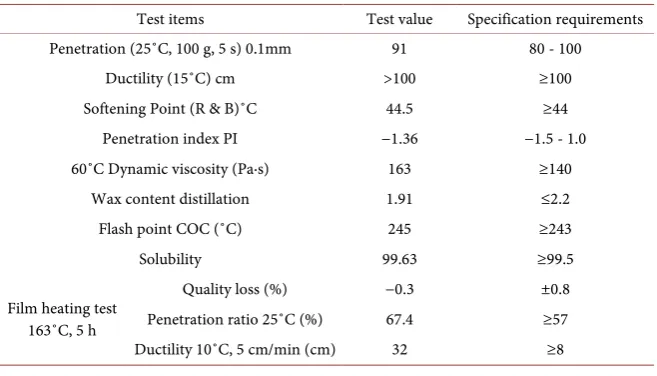
Liaohe petroleum asphalt grade A No. 90, which is widely used in the northeast of China and the basic performance test results are shown in Table 1 [2].
The coarse aggregate of cold-filled SMA-13 asphalt mixture use basalt gravel produced by Jilin Dawan Quarry. The basic performance test results are shown in Table 2 [3].
The fine aggregate should be clean, dry, no weathering, no impurities, and appropriate particle size distribution. Fine aggregate use mechanism sand from limestone produced by Liaoyang Xiaotun Yongli quarries. The basic perfor-mance test results are shown in Table 3.
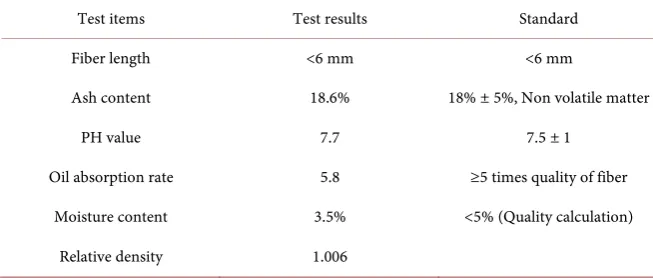
Lignin fiber was used, the basic performance test results are shown in Table 4. The variation coefficient of test data in Tables 1-4 is less than 15%.
24 sets of cold-filled asphalt additive preparation schemes were designed, which were combined with matrix asphalt, thinner and mineral materials to form cold-filled asphalt mixture. The compaction, looseness and low-temperature workability test were tested to select the optimal one. No. 16 cold-filled asphalt liquid was selected [4]. The raw materials used in the test are all in line with the requirements of the road.
3. Cold-Filled Asphalt Mixture Design
[image:2.595.211.540.539.727.2]The aggregate gradation design scheme and the optimum oil-stone ratio of cold-filled SMA-13 asphalt mixture are shown in Table 5 [5].
Table 1. No. 90 Class A asphalt test results.
Test items Test value Specification requirements
Penetration (25˚C, 100 g, 5 s) 0.1mm 91 80 - 100
Ductility (15˚C) cm >100 ≥100
Softening Point (R & B)˚C 44.5 ≥44
Penetration index PI −1.36 −1.5 - 1.0
60˚C Dynamic viscosity (Pa·s) 163 ≥140
Wax content distillation 1.91 ≤2.2
Flash point COC (˚C) 245 ≥243
Solubility 99.63 ≥99.5
Film heating test 163˚C, 5 h
Quality loss (%) −0.3 ±0.8
Penetration ratio 25˚C (%) 67.4 ≥57
DOI: 10.4236/msa.2018.913077 1068 Materials Sciences and Applications
Table 2. Basalt coarse aggregate technical index.
Material specification (mm) 13.2 - 16 9.5 - 13.2 4.75 - 9.5
Technical index Standard value Test value
Crushing value (%) ≤26 12.4 13.2 13.2
Apparent relative density (T/m3) ≥2.6 2.94 2.95 2.96
Water absorption rate (%) ≤2.0 0.50 0.86 1.52
Consistency ≤12 8
Content of needle and sheet granular (%) ≤15 8.2 7.8 6.6
[image:3.595.209.539.277.355.2]<0.075 Particle content (%) ≤1 0.2 0.2 0.2
Table 3. The technical index of limestone fine aggregate.
Material specification (mm) 2.36 - 4.75 1.18 - 2.36 0 - 1.18
Technical index Standard value Test value
Apparent relative density (T/m3) ≥2.5 2.687 2.765 2.734
Content of clay (%) ≤3 0.5 1.5 1.5
Table 4. The technical index of lignin fiber.
Test items Test results Standard
Fiber length <6 mm <6 mm
Ash content 18.6% 18% ± 5%, Non volatile matter
PH value 7.7 7.5 ± 1
Oil absorption rate 5.8 ≥5 times quality of fiber
Moisture content 3.5% <5% (Quality calculation)
Relative density 1.006
Test results
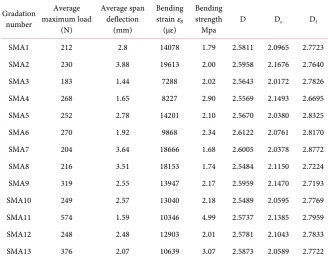
Trabecular bending test at a temperature of −10˚C were done according to the Standard Test Method of Bitumen and Bituminous Mixtures for Highway Engi-neering (JTG E20-2011). The experimental results and the corresponding fractal dimensions of the low temperature stability for cold-filled SMA-13 asphalt mix-ture are summarized in Table 6 [6].
Model building
It can be seen from Table 6 that the range of fractal dimension satisfying the low-temperature bending strain is D = 2.5484 - 2.6122, Dc = 2.0172 - 2.1676, Df = 2.6695 - 2.8772.
[image:3.595.209.536.388.527.2]DOI: 10.4236/msa.2018.913077 1069 Materials Sciences and Applications
Table 5. The scheme of gradation design of cold-filled SMA-13 asphalt mixture.
No. Percentage of quality pass (%)
16 13.2 9.5 4.75 2.36 1.18 0.6 0.3 0.15 0.075 Oil-stone ratio
1 100 95 62.5 27 20.5 19 16 13 12 10 5.03
2 100 95 68.8 30.5 23.3 21.5 18 14.5 13.5 11 5.23
3 100 95 56.3 23.5 17.8 16.5 14 11.5 10.5 9 4.82
4 100 97.5 62.5 27 23.3 21.5 18 11.5 10.5 9 5.04
5 100 97.5 68.8 30.5 17.8 16.5 14 13 12 10 4.92
6 100 97.5 56.3 23.5 20.5 19 16 14.5 13.5 11 5.15
7 100 92.5 62.5 27 17.8 16.5 14 14 13.5 11 5.04
8 100 92.5 68.8 30.5 20.5 19 16 11.5 10.5 9 4.93
9 100 92.5 56.3 23.5 23.3 21.5 18 13 12 10 5.15
10 100 98.1 65.2 25.6 19.8 16.3 13.8 12.4 10.4 8.7 4.93
11 100 97.4 61.1 28.7 22.1 17.8 15.1 13 11.7 10 5.09
12 100 97.7 56.1 26.2 20.9 18.5 15 12.2 11.5 10 5.04
13 100 92.5 67.5 23.5 20 19 16 14 12 10 5.04
Table 6. The fractal dimension of cold-filled SMA-13 asphalt mixture and the low
tem-perature test data.
Gradation number
Average maximum load
(N)
Average span deflection
(mm)
Bending strain εB
(με)
Bending strength
Mpa D Dc Df
SMA1 212 2.8 14078 1.79 2.5811 2.0965 2.7723
SMA2 230 3.88 19613 2.00 2.5958 2.1676 2.7640
SMA3 183 1.44 7288 2.02 2.5643 2.0172 2.7826
SMA4 268 1.65 8227 2.90 2.5569 2.1493 2.6695
SMA5 252 2.78 14201 2.10 2.5670 2.0380 2.8325
SMA6 270 1.92 9868 2.34 2.6122 2.0761 2.8170
SMA7 204 3.64 18666 1.68 2.6005 2.0378 2.8772
SMA8 216 3.51 18153 1.74 2.5484 2.1150 2.7224
SMA9 319 2.55 13947 2.17 2.5959 2.1470 2.7193
SMA10 249 2.57 13040 2.18 2.5489 2.0595 2.7769
SMA11 574 1.59 10346 4.99 2.5737 2.1385 2.7959
SMA12 248 2.48 12903 2.01 2.5781 2.1043 2.7833
SMA13 376 2.07 10639 3.07 2.5873 2.0589 2.7722
Note: The second group of bending strain εB data in the table is subject to further determination. The varia-tion coefficient of test data in the table is less than 15%.
The correlation model of the bending strain and the fractal dimension is es-tablished by the regression analysis, as is shown in Formula (1).
[image:4.595.209.538.381.640.2]DOI: 10.4236/msa.2018.913077 1070 Materials Sciences and Applications Regression coefficient R2 = 0.956.
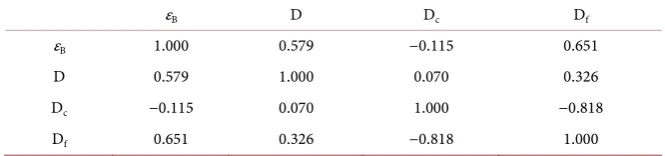
The ternary linear correlation models of bending strain and three fractal di-mensions are established, the correlations of data in Table 6 are analyzed by us-ing SPSS software to obtain the correlation between the bendus-ing strain and frac-tal dimension, as is shown in Table 7.
It can be seen from Table 7, the correlation sequence of low temperature bending strain εB and the fractal dimension D, DC, Df from large to small is Df > D > DC, indicating that the relation between the aggregate fractal dimension and bending strain is relatively large, the correlation between εB and DC is relatively small.
The correlation model of εB and Df is established, as is shown in the formula (2).
εB = −115184 + 46204Df (2) Regression coefficient R2 = 0.790.
The correlation model of εB and D, Df is established, as is shown in the For-mula (3).
εB = −333868 + 104099D + 28508Df (3) Regression coefficient R2 = 0.998.
Similarly, the ternary linear regression models of bending strength is estab-lished, as is shown in the Formula (4).
RB = 59 + 22.55D − 26.96Dc − 21.19Df (4) Regression coefficient R2 = 0.940.
[image:5.595.207.540.520.598.2]For the correlation between the bending failure strength and the fractal di-mension, the data in Table 6 are analyzed by SPSS software. The relationship between the bending failure strength RB and the fractal dimension is shown in Table 8.
Table 7. Correlation between low temperature bending failure strain and fractal
dimen-sion of cold-filled SMA-13 asphalt mixture.
εB D Dc Df
εB 1.000 0.579 −0.115 0.651
D 0.579 1.000 0.070 0.326
Dc −0.115 0.070 1.000 −0.818
[image:5.595.207.540.641.734.2]Df 0.651 0.326 −0.818 1.000
Table 8. Correlation between low temperature bending strength and fractal dimension of
cold-filled SMA-13asphalt mixture.
RB D Dc Df
RB 1 0.021 0.193 −0.413
D 0.021 1 −0.061 0.468
Dc 0.193 −0.061 1 −0.791
DOI: 10.4236/msa.2018.913077 1071 Materials Sciences and Applications
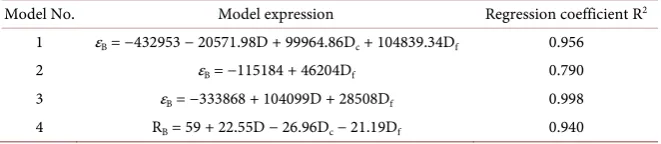
Table 9. The prediction model comparison of bending strain and bending strength for
cold-filled SMA-13 asphalt mixture.
Model No. Model expression Regression coefficient R2
1 εB = −432953 − 20571.98D + 99964.86Dc + 104839.34Df 0.956
2 εB = −115184 + 46204Df 0.790
3 εB = −333868 + 104099D + 28508Df 0.998
4 RB = 59 + 22.55D − 26.96Dc − 21.19Df 0.940
It can be seen from Table 8 that the correlation between the bending strength RB and the fractal dimension DC of the coarse aggregate gradation is relatively large. Therefore, a correlation model between the bending strength and the frac-tal dimension DC can be established. But the regression coefficient is low.
4. Model Selection
As described above, a correlation model of low-temperature bending strain, bending strength and fractal dimension is established, and the results are sum-marized in Table 9.
It can be seen from Table 9 that the prediction accuracy of model 1, 3 and 4 is relatively high, and the model 1 and 3 are recommended as the prediction model of low temperature bending strain and the model 4 is recommended as the pre-diction model of low temperature bending strength through multi-model com-parison.
5. Conclusion
The correlation model recommended between the fractal dimension and the evaluation index of low temperature performance can be used to predict the low temperature performance of cold-filled SMA-13 asphalt mixture according to the design gradation, which can reduce the test workload and improve the working efficiency.
Acknowledgements
This research was financially supported by Liaoning Provincial Expressway Op-eration Management Co., Ltd.
Conflicts of Interest
The authors declare no conflicts of interest regarding the publication of this paper.
References
[1] Sun, Z.H. (2017) Asphalt Mixture Mix Design Method. People’s Communications Publishing Co., Ltd., Beijing.
[2] Standard Test Methods of Bitumen and Bituminous Mixtures for Highway Engi-neering. JTGE20-2011, Occupation Standard of the People’s Republic of China. [3] Test Methods of Aggregate for Highway Engineering. JTGE42-2005, Occupation
[image:6.595.209.540.102.174.2]DOI: 10.4236/msa.2018.913077 1072 Materials Sciences and Applications [4] Li, Q. (2017) Cold-Filled Asphalt Mixture Design Method. Master Thesis, Shenyang
Jianzhu University, Shenyang.
[5] Sun, Z.H., Yu, Q.B., Wang, T.B., Yu, B.Y., Zhu, G.Q. and Ma, J. (2014) The Effect of Asphalt and Aggregate Gradation on the Low-Temperature Performance of Asphalt Mixtures for Intermediate and Underlying Course. Applied Mechanics and Mate-rials, 505-506, 251-254.