SHORT REPORT
Meta-analysis of 49 549 individuals imputed with the
1000 Genomes Project reveals an exonic damaging
variant in
ANGPTL4
determining fasting TG levels
Elisabeth M van Leeuwen,
1Aniko Sabo,
2Joshua C Bis,
3Jennifer E Huffman,
4,5Ani Manichaikul,
6Albert V Smith,
7,8Mary F Feitosa,
9Serkalem Demissie,
10Peter K Joshi,
11Qing Duan,
12Jonathan Marten,
4Jan B van Klinken,
13Ida Surakka,
14Ilja M Nolte,
15Weihua Zhang,
16,17Hamdi Mbarek,
18Ruifang Li-Gao,
19Stella Trompet,
20,21Niek Verweij,
22Evangelos Evangelou,
16,23Leo-Pekka Lyytikäinen,
24,25Bamidele O Tayo,
26Joris Deelen,
27Peter J van der Most,
15Sander W van der Laan,
28Dan E Arking,
29Alanna Morrison,
30Abbas Dehghan,
1Oscar H Franco,
1Albert Hofman,
1Fernando Rivadeneira,
31Eric J Sijbrands,
31Andre G Uitterlinden,
1,31Josyf C Mychaleckyj,
6Archie Campbell,
32Lynne J Hocking,
33Sandosh Padmanabhan,
34Jennifer A Brody,
3Kenneth M Rice,
35Charles C White,
36Tamara Harris,
37Aaron Isaacs,
1Harry Campbell,
11Leslie A Lange,
12Igor Rudan,
38Ivana Kolcic,
39Pau Navarro,
4Tatijana Zemunik,
39Veikko Salomaa,
40The LifeLines
Cohort Study Angad S Kooner,
41Jaspal S Kooner,
17,41,42Benjamin Lehne,
16William R Scott,
16,17Sian-Tsung Tan,
41Eco J de Geus,
18Yuri Milaneschi,
43Brenda W J H Penninx,
43Gonneke Willemsen,
18Renée de Mutsert,
19Ian Ford,
44Ron T Gansevoort,
45Marcelo P Segura-Lepe,
16Olli T Raitakari,
46,47Jorma S Viikari,
48,49Kjell Nikus,
50,51Terrence Forrester,
52Colin A McKenzie,
52Anton J M de Craen,
21Hester M de Ruijter,
28CHARGE Lipids Working Group
Gerard Pasterkamp,
28,53Harold Snieder,
15Albertine J Oldehinkel,
54P Eline Slagboom,
27Richard S Cooper,
26Mika Kähönen,
55,56Terho Lehtimäki,
24,25Paul Elliott,
57Pim van der Harst,
22,58J Wouter Jukema,
20Dennis O Mook-Kanamori,
19,59,60Dorret I Boomsma,
18John C Chambers,
16,17,42Morris Swertz,
58,61Samuli Ripatti,
14,62,63Ko Willems van Dijk,
13,64Veronique Vitart,
4Ozren Polasek,
39Caroline Hayward,
4James G Wilson,
65James F Wilson,
4,11Vilmundur Gudnason,
7,8Stephen S Rich,
6Bruce M Psaty,
3,66,67,68Ingrid B Borecki,
9Eric Boerwinkle,
2,30Jerome I Rotter,
69,70,71L Adrienne Cupples,
5,9Cornelia M van Duijn
1▸ Additional material is published online only. To view thisfile please visit the journal online (http://dx.doi.org/10. 1136/jmedgenet-2015-103439)
For numbered affiliations see end of article.
Correspondence to Professor Cornelia M van Duijn, Genetic Epidemiology Unit, Department of Epidemiology, Erasmus Medical Center, Postbus 2040, Rotterdam 3000 CA, The Netherlands; [email protected]
Received 4 August 2015 Revised 19 November 2015 Accepted 23 November 2015 Published Online First 1 April 2016
To cite:van Leeuwen EM, Sabo A, Bis JC,et al.J Med Genet2016;53:441–449.
ABSTRACT
Background
So far, more than 170 loci have been
associated with circulating lipid levels through
genome-wide association studies (GWAS). These associations are
largely driven by common variants, their function is often
not known, and many are likely to be markers for the
causal variants. In this study we aimed to identify more
new rare and low-frequency functional variants
associated with circulating lipid levels.
Methods
We used the 1000 Genomes Project as a
reference panel for the imputations of GWAS data from
∼
60 000 individuals in the discovery stage and
∼
90 000
samples in the replication stage.
Results
Our study resulted in the identi
fi
cation of
fi
ve
new associations with circulating lipid levels at four loci.
All four loci are within genes that can be linked
biologically to lipid metabolism. One of the variants,
rs116843064, is a damaging missense variant within
the
ANGPTL4
gene.
Conclusions
This study illustrates that GWAS with
high-scale imputation may still help us unravel the
biological mechanism behind circulating lipid levels.
INTRODUCTION
Genome-wide association studies (GWAS) for
circu-lating lipid levels (high-density lipoprotein
choles-terol (HDL-C), low-density lipoprotein cholescholes-terol
(LDL-C), total cholesterol (TC) and triglycerides
(TG)) have identi
fi
ed over 170 loci.
1–3These
Open AccessScan to access more free content
studies have been based on imputations to the HapMap
refer-ence panel
2or primary versions of the 1000 Genomes Project
(1kG)
1or genotyping on the Illumina Exome Chip.
3None has
used imputations with the Phase 1 integrated release v3 of the
1kG which allows the imputation of rare and low-frequency
functional variants and structural variations with more
preci-sion. Evidence of rare and low-frequency functional variants
associated with circulating lipid levels comes from recent studies
in which exome sequencing of the
NPC1L1
gene identi
fi
ed rare
variants associated with reduced LDL-C levels and reduced risk
of coronary heart disease.
4Moreover, exome sequencing of
LDLR
and
APOA5
identi
fi
ed rare variants associated with an
increased LDL-C and increased TG levels
5and exome
sequen-cing of
APOC3
identi
fi
ed rare variants associated with reduced
TG levels and reduced risk of coronary heart disease.
6Our goal in this study was to identify rare and low-frequency
functional variants associated with circulating lipid levels in a
larger sample size compared with the exome sequencing of
can-didate gene approach. To this end, we imputed genotypes for
study samples participating in the cohorts of the Cohorts for
Heart
and
Aging
Research
in
Genomic
Epidemiology
(CHARGE) consortium using the Phase 1 integrated release V. 3
of the 1kG and conducted a meta-analysis of about
approxi-mately 60 000 individuals, followed by a replication in an
inde-pendent set of 90 000 individuals.
METHODS
Please see online supplementary methods for complete
descrip-tions of the methods. In summary, for the discovery stage of this
project, we used the data from 20 cohorts of the CHARGE
con-sortium (see online supplementary methods). All cohorts were
imputed with reference to the 1kG reference panel (version
Phase 1 integrated release V.3). The total number of individuals
in the discovery stage was 59 409 for HDL-C, 48 780 for
LDL-C, 60 024 for TC and 49 549 for TG. Online
supplemen-tary tables S1 and S2 contain the baseline characteristics per
cohort and more details about SNP genotyping and genotype
imputations
.
Within each cohort, each variant was tested for
association with each of the lipid traits, assuming an additive
genetic model. The association results of all cohorts for all
var-iants were combined using inverse variance weighting. We used
the following
fi
lters for the variants: 0.3<R
2(measurement for
the imputation quality)
≤
1.0 and expected minor allele count
(expMAC=2×MAF (minor allele frequency)×R
2×sample size)
>10 prior to meta-analysis. After meta-analysis of all available
variants, we excluded the variants that were not present in at
least four cohorts, to prevent false positive
fi
ndings. In order to
select only variants that were independently associated with
each of the lipid traits, we used the genome-wide complex trait
analysis (GCTA)
7tool, V.1.13. To identify novel loci we selected
from the list of variants identi
fi
ed by GCTA, those variants
located more than 0.5 Mb away from previously identi
fi
ed
loci of the corresponding trait
2 3and which were signi
fi
cant
( p value<5×10
−8) in the initial discovery stage. To prevent the
identi
fi
cation of false positive loci, we added a second
replica-tion stage within 23 independent cohorts. The experiment-wide
signi
fi
cance threshold required to keep type I error rate within
the replication stage at 5% is 2.63×10
−3(Bonferroni correction
based on 19 variants). We also meta-analysed the individuals of
the discovery and replication stage together and per ethnicity
using a
fi
xed-effect approach. We also repeated this analysis
with genome-wide association meta analysis (GWAMA) (V.2.0.5)
using a random effect approach as the individuals in discovery
and replication stages come from multiple ethnicities.
RESULTS
The association of all variants with HDL-C, LDL-C, TC and
TG was tested in all discovery cohorts (see online
supplemen-tary
fi
gures S1 and S2). The association results of all discovery
cohorts for all variants were combined in a
fi
xed-effect
meta-analysis using METAL (see online supplementary
fi
gures
S3 and S4). We signi
fi
cantly replicated 88.1% of the loci
described by Teslovich
et al
2despite a sample size of about 80%
(see online supplementary
fi
gure S5 and supplementary table
S3). We also signi
fi
cantly replicated 43.4% of the loci described
by the Global Lipids Genetics Consortium (GLGC)
3despite a
sample size of about 30% (see online supplementary
fi
gure S6
and supplementary table S4).
A conditional and joint analysis using GCTA identi
fi
ed 185
independent variants for HDL-C, 174 for LDL-C, 214 for TC
and 119 for TG. Next, we excluded all variants that were not
genome-wide signi
fi
cant ( p value<5×10
−8) in the initial
discov-ery stage, which resulted in 56 variants for HDL-C, 50 for
LDL-C, 66 for TC and 37 for TG. And we excluded all variants
which are within 0.5 Mb of a loci previously published by
Teslovich
et al
2or GLGC,
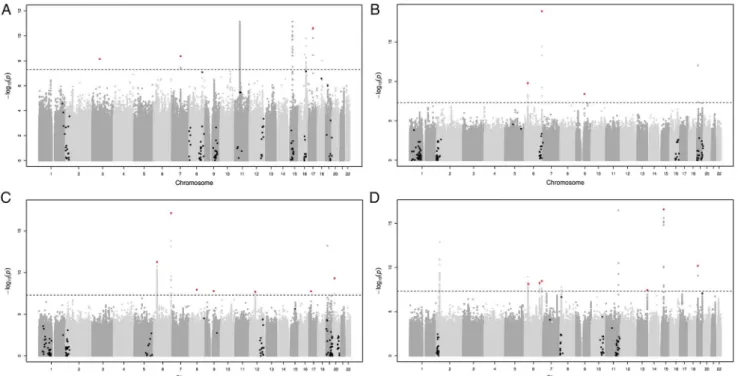
3which resulted in three variants for
HDL-C, three for LDL-C, seven for TC and six for TG. These
variants are located at 17 different loci and include one deletion
(
fi
gure 1
and
table 1
).
These 19 variants were selected for replication. The total
number of individuals in the replication stage was 84 598,
72 486, 83 739 and 73 519 for HDL-C, LDL-C, TC and TG,
respectively (see online supplementary tables S1 and S2 for
baseline characteristics and information about SNP genotyping
and imputation details)
.
The sample size in the replication stage
was larger than the initial discovery sample for 17 out of the 19
variants. The frequencies of the variants were similar between
the discovery and replication cohorts. The directions of effect
were the same in the discovery and replication cohorts for 16
out of the 19 variants (see online supplementary
fi
gure S7).
We used a Bonferroni corrected threshold for signi
fi
cance
( p value<2.63×10
−3). Five out of the 19 variants were
signi
fi
cantly replicated (
table 1
): rs6457374 (TC), rs186696265
(LDL-C and TC), rs77697917 (HDL-C) and rs116843064 (TG).
The frequency of these variants ranged between 0.012 and 0.249
within the discovery sample. Online supplementary table S5
shows the heterogeneity for the 19 variants after the meta-analysis
of all discovery cohorts and of all replication cohorts. We also
meta-analysed all variants in the individuals of the discovery
cohorts and replication cohorts combined (
table 1
and see online
supplementary tables S5 and S6) and per ethnicity (see online
supplementary table S6) using a
fi
xed-effect meta-analysis
approach. We found that the
fi
ve signi
fi
cantly replicated variants
we identi
fi
ed in this study are only signi
fi
cant within the
European samples, thereby noticing that there are much more
European samples in this study, compared with the African and
Asian samples. When using a random-effect meta-analysis to
account for the multiple ethnicities in our sample (see online
sup-plementary table S7), we found that of the
fi
ve replicated variants,
one attained genome-wide signi
fi
cance ( p value<5×10
−8) and
the other four nominal signi
fi
cance ( p value<0.05).
DISCUSSION
reference panel. The meta-analysis, followed by GCTA analysis
revealed 19 associations with MAF ranging from 0.01 to 0.48.
Of the 19 associations, we were able to replicate
fi
ve in an
inde-pendent sample of approximately 90 000 individuals.
One of the
fi
ve associations we identi
fi
ed is between TG and
rs116843064, an exonic variant in the
ANGPTL4
gene on
chromosome 19 (
fi
gure 2
C). This missense variant changes the
amino acid glutamic acid into lysine (Glu40Lys) and is predicted
to be damaging for the structure and function of the protein by
Polyphen2,
8MutationTaster
9and likelihood ratio test (LRT).
10ANGPTL4
is signi
fi
cantly associated with the Kyoto Encyclopedia
of Genes and Genomes (KEGG) term fatty acid metabolism, the
GO process lipid storage and the gene ontology (GO) cellular
component lipid particle ( p value of 1.10×10
−6, 1.31×10
−10and 2.87×10
−18, respectively, genenetwork.nl).
ANGPTL4
has
been associated with HDL-C before using the GWAS approach
2and with TG before using an exome sequencing approach
11and
more recently using the GWAS approach.
1We therefore do not
claim this
fi
nding as novel, though this is the smallest study in
which this variant was genome-wide signi
fi
cantly associated with
TG and replicated in an independent sample.
The second new
fi
nding we identi
fi
ed is the association
between TC and rs6457374, an intergenic variant located
on chromosome 6 between the genes
HLA-C
and
HLA-B
(
fi
gure 2
A). Both genes are associated with the KEGG term ATP
binding cassette (ABC) transporters ( p value of 4.29×10
−5and
3.84×10
−5for
HLA-C
and
HLA-B,
respectively, genenetwork.
nl) which is in line with, among others, a previously published
association between TC and an exonic variant in the
ABCA6
gene which is also an ABC transporter.
12ABC transporters
transport a wide variety of substrates across extracellular and
intracellular membranes, including lipids.
13The third
fi
nding of this study is the association between
HDL-C and rs77697917, an intergenic variant on chromosome
17 between the genes
SOST
and
DUSP3
(
fi
gure 2
B).
DUSP3
is
associated
with
the
regulation
and
function
of
carbohydrate-responsive element-binding protein (ChREBP) in
the liver ( p value=3.03×10
−5, genenetwork.nl). ChREBP
med-iates the activation of several regulatory enzymes involved in
lipogenesis.
14–18This variant is in high linkage disequilibrium
(D
0=0.936) in the 1 kG with rs72836561, an exonic variant in
the gene
CD300LG
(MAF=0.027,
β
=
−
2.437, se
β=0.381, p
value=1.51×10
−10in the discovery stage). This missense
variant
changes
the
amino
acid
arginine
into
cysteine
(Arg82Cys) and is predicted to be damaging for the structure
and function of the protein by Polyphen2,
8MutationTaster
9and LRT.
10This amino acid polymorphism has been associated
with HDL-C in exome-wide association studies
19and TG in
GWAS
1before.
The fourth variant we identi
fi
ed is rs186696265, which is
located on chromosome 6 and associated with LDL-C and TC
(
fi
gure 2
D, E). This intergenic variant is between the
LPA
(Lipoprotein, Lp(A)) gene and the
PLG
(Plasminogen) gene.
The
LPA
gene has been associated before with LDL-C and TC
before.
2The reported lead SNP was rs1564348, which in the
newer human genome versions is annotated to the
SLC22A1
(Solute Carrier Family 22 (Organic Cation Transporter),
Member 1) gene instead of the
LPA
gene. This explains why we
again identi
fi
ed a locus near the
LPA
gene, which has been
iden-ti
fi
ed by others as well.
1Fourteen out of the 19 variants were not replicated despite
similar sample sizes and similar frequencies within the
replica-tion stage as compared with the discovery stage. Of those 14
variants, 11 exhibited effect sizes in the same direction in both
stages. A possible explanation might be that the replication
sample size is much larger compared with that of the discovery
sample size. Two variants might have lacked signi
fi
cant
replica-tion due to small sample size, rs60839105 and rs151198427.
Figure 1
Manhattan plots for HDL-C (A), LDL-C (B), TC (C) and TG (D) after the meta-analysis of all discovery cohorts. Variants that were present
in at least four cohorts and that are not within 0.5 Mb of a previously published loci
2 3were included. The black line indicates the genome-wide
signi
fi
cant line (5×10
−8), the black and red dots the variants identi
fi
ed by GCTA which are not genome-wide signi
fi
cant and which are
genome-wide signi
fi
cant, respectively. HDL-C, high-density lipoprotein cholesterol; LDL-C, low-density lipoprotein cholesterol; TC, total cholesterol;
TG, triglycerides.
Table 1
The results for the 19 variants after the meta-analysis of all discovery cohorts, all replication cohorts and all cohorts combined
Discovery cohorts Replication cohorts All cohorts combined
Trait Chr:Position rs identifier nearest gene A1/A2 Freq N β SEβ p Value Freq N β SEβ p Value Freq β SEβ p Value
HDL-C 3:72 067 255 rs75909755 PROL2-EIF4E3 T/C 0.03 62 607 1.593 0.275 7.27E-09 0.03 86 252 −0.019 0.031 5.45E-01 0.03 0.002 0.031 9.57E-01
TC 6:31 272 261 rs6457374 HLA-B T/C 0.75 46 839 2.339 0.339 5.32E-12 0.81 74 417 0.057 0.016 4.23E-04 0.81 0.062 0.016 1.18E-04
LDL-C 6:31 325 323 rs9266229 HLA-B C/G 0.53 37 981 −2.201 0.344 1.62E-10 0.41 61 582 −0.025 0.014 7.37E-02 0.41 −0.029 0.014 4.04E-02
TG 6:36 648 275 – CDKN1A CAG/C 0.45 53 425 −0.019 0.003 7.63E-09 0.49 59 018 −0.003 0.004 5.20E-01 0.46 −0.013 0.003 5.93E-07
TG 6:13 983 949 8 rs608736 – C/G 0.48 53 425 −0.019 0.003 5.67E-09 0.49 73 512 −0.008 0.003 2.67E-02 0.48 −0.013 0.002 9.10E-09
TG 6:16 085 176 6 rs376563 SLC22A3 T/C 0.46 47 036 −0.02 0.003 3.37E-09 0.46 73 512 −0.001 0.003 8.22E-01 0.46 −0.010 0.002 1.36E-05 LDL-C 6:16 111 170 0 rs186696265 LPA-PLG T/C 0.01 49 221 11.247 1.241 1.31E-19 0.01 59 497 0.263 0.076 5.42E-04 0.01 0.304 0.076 6.17E-05 TC 6:16 111 170 0 rs186696265 LPA-PLG T/C 0.01 59 859 10.004 1.162 7.20E-18 0.01 75 821 0.238 0.075 1.46E-03 0.01 0.278 0.075 1.93E-04
HDL-C 7:80 492 357 rs60839105 SEMA3C T/C 0.07 7882 3.355 0.571 4.26E-09 0.08 4971 1.067 1.228 3.85E-01 0.07 2.948 0.518 1.25E-08
TC 8:68 351 787 rs151198427 CPA6 A/G 0.11 17 361 6.552 1.147 1.12E-08 0.13 1419 −2.858 2.396 2.33E-01 0.11 4.797 1.035 3.56E-06
LDL-C 9:78 728 065 rs146369471 PCSK5 T/C 0.99 43 398 8.529 1.449 3.99E-09 0.99 51 367 0.068 0.103 5.11E-01 0.99 0.110 0.103 2.84E-01
TC 9:78 728 065 rs146369471 PCSK5 T/C 0.99 53 787 7.978 1.413 1.64E-08 0.99 70 241 0.015 0.103 8.84E-01 0.99 0.057 0.103 5.79E-01
TC 12:51 207 704 rs829112 ATF1 A/G 0.68 56 924 1.448 0.258 2.02E-08 0.73 87 659 0.009 0.012 4.63E-01 0.73 0.012 0.012 3.18E-01
TG 13:11 454 402 4 rs7140110 GAS6 T/C 0.71 48 221 −0.021 0.004 3.65E-08 0.72 60 437 −0.006 0.005 2.68E-01 0.72 −0.015 0.003 5.13E-07 TG 15:43 726 625 rs150844304 TP53BP1 A/C 0.97 52 720 −0.083 0.01 2.52E-17 0.95 63 884 −0.026 0.015 8.85E-02 0.96 −0.066 0.008 9.52E-16 TC 17:18 046 290 rs8065026 MYO15A T/C 0.79 56 924 −1.644 0.292 1.76E-08 0.81 76 913 −0.026 0.013 4.93E-02 0.81 −0.029 0.013 2.66E-02 HDL-C 17:41 840 849 rs77697917 SOST-DUSP3 T/C 0.02 45 052 −2.717 0.407 2.38E-11 0.03 67 843 −0.222 0.036 4.27E-10 0.03 −0.241 0.035 1.04E-11 TG 19:8 429 323 rs116843064 ANGPTL4 A/G 0.03 35 643 −0.101 0.016 6.46E-11 0.03 44 194 −0.065 0.019 4.53E-04 0.03 −0.087 0.012 3.83E-13 TC 20:17 844 684 rs2618566 BANF2-SNX5 T/G 0.65 63 300 −1.566 0.251 4.68E-10 0.60 88 946 −0.024 0.011 2.83E-02 0.60 −0.027 0.011 1.38E-02
The variants in bold are the significantly replicated variants.
A1 is allele 1 and A2 is allele 2, Freq is the frequency of A1,βis the effect of A1.
HDL-C, high-density lipoprotein cholesterol; LDL-C, low-density lipoprotein cholesterol; TC, total cholesterol; TG, triglycerides.
444
van
Leeuw
en
EM,
et
al
.
J
Med
Genet
2016;
53
:441
–
449.
doi:10.1136/jm
edgenet-20
15-103439
Genome-wide
Both variants only pass quality control in the cohorts in the
discovery stage that contain individuals of African ancestry
(see online supplementary
fi
gure S7). Although there are several
cohorts with individuals of African ancestry in the replication
stage, both variants did not pass quality control in most cohorts
which leads to the conclusion that these variants might be
population-speci
fi
c. This is also suggested by the 1 kG data
(Phase 3) as the frequency of the C-allele is 92% in African
samples and 100% in the European samples for rs60839105
and the frequency of the G-allele is 86% in the African samples
and 100% in the European samples for rs151198427.
Imputations of cohorts with individuals of African ancestry
with the African Genome Variation Project
20might con
fi
rm
the association of rs60839105 with HDL-C and rs151198427
with TC.
To our knowledge, this is the
fi
rst GWAS of circulating lipid
levels using the Phase 1 integrated release V.3 of the 1 kG,
there-fore we cannot compare the positive replication rate with other
studies. However, we did replicate 88.1% of the
fi
ndings of
Teslovich
et al
2and 43.4% of the
fi
ndings of GLGC
3despite
our smaller sample. A high replication rate is expected based on
the high overlap of our samples with the samples of Teslovich
et al
2and with the samples of GLGC
3though it indicates that
when using the 1000 Genomes instead of the HapMap
refer-ence panel, we can achieve a high replication rate using a
smaller sample size. We also tried to replicate
fi
ndings from
Figure 2
The regional association results of the initial meta-analysis of all discovery cohorts for (A) TC on chromosome 6, (B) HDL-C on
chromosome 17, (C) TG on chromosome 19, (D) LDL-C on chromosome 6 and (E) TC on chromosome 6. HDL-C, high-density lipoprotein cholesterol;
LDL-C, low-density lipoprotein cholesterol; TC, total cholesterol; TG, triglycerides.
exome sequencing of candidate genes. The p.Arg406X mutation
in the
NPC1L1
gene (rs145297799), which was reported to be
associated with reduced LDL-C levels and reduced risk of
cor-onary heart disease,
4is not available in the 1kG reference panel
and, therefore, we were not able to replicate this
fi
nding. Do
et al
5described the exome sequencing of the genes
LDLR
and
APOA5
and identi
fi
ed rare variants associated with an increased
risk of myocardial infarction, increased LDL-C and TG levels.
Of those rare variants, only two in the
LDLR
gene and seven in
the
APOA5
gene
exist
in
our
discovery
meta-analysis.
Both
LDLR
variants
are
associated
with
TG
in
our
discovery meta-analysis (rs34282181,
β
=
−
0.093, SE
β=0.023,
p value=4.827×10
−5and rs2075291,
β
=0.219, SE
β=0.046,
p value=2.092×10
−6), but not signi
fi
cantly associated with
LDL-C (rs34282181,
β
=
−
3.939, SE
β=1.861, p value=0.034
and rs2075291,
β
=
−
2.316, SE
β=3.001, p value=0.440). None
of the seven
APOA5
variants were signi
fi
cantly associated with
TG or LDL-C in our discovery meta-analysis (lowest p value is
for LDL-C with rs72658860,
β
=
−
18.430, SE
β=7.140, p
value=9.848×10
−3). The third published
fi
nding we tried to
replicate, was the association between
APOC3
and TG levels.
6Of the seven variants reported, only one existed in our
discov-ery meta-analysis (chromosome 11, position 116 701 354),
which is associated with TG (
β
=
−
0.343, SE
β=0.113, p
value=2.311×10
−3). Those authors also reported an association
between an
APOA5
variant (rs3135506) and TG as the most
sig-ni
fi
cant
fi
nding. This variant was also signi
fi
cantly associated
with TG in our discovery meta-analysis (
β
=0.129, SE
β=0.007,
p value=1.099×10
−87). These replication efforts demonstrate
that many of the published results of exome sequencing can be
replicated through the use of 1 kG imputations.
In conclusion, we identi
fi
ed and replicated
fi
ve variants
asso-ciated with circulating lipid levels. These variants are in genes
that can be linked biologically to lipid metabolism. Although
there were a large number of variants that did not replicate at
the accepted genome-wide signi
fi
cance threshold, the low-cost,
hypothesis-free approach that we applied uncovered
fi
ve
var-iants. This study, therefore, illustrates that GWAS may still help
us unravel the biological mechanisms behind circulating lipid
levels.
Author affiliations 1
Department of Epidemiology, Erasmus Medical Center, Rotterdam, The Netherlands 2Human Genome Sequencing Center, Baylor College of Medicine, Houston, USA 3
Department of Medicine, University of Washington, Seattle, USA
4Medical Research Council Human Genetics Unit, Institute of Genetics and Molecular
Medicine, University of Edinburgh, Edinburgh, UK
5The Framingham Heart Study, NHLBI Cardiovascular Epidemiology and Human
Genomics Branch, Framingham, USA
6Center for Public Health Genomics, University of Virginia, Charlottesville, USA 7
Icelandic Heart Association, Kopavogur, Iceland
8Faculty of Medicine, University of Iceland, Reykjavik, Iceland 9
Department of Genetics, Washington University School of Medicine, St Louis, USA 10Department of Biostatistics, Boston University School of Public Health, Boston,
USA
11Usher Institute for Population Health Sciences and Informatics, University of
Edinburgh, Edinburgh, UK
12Department of Genetics, University of North Carolina, Chapel Hill, USA 13
Department of Human Genetics, Leiden University Medical Center, Leiden, The Netherlands
14
Human Genomics Unit, Institute for Molecular Medicine, University of Helsinki, Helsinki, Finland
15
Department of Epidemiology, University of Groningen, University Medical Center Groningen, Groningen, The Netherlands
16
Department of Epidemiology and Biostatistics, School of Public Health, Imperial College London, London, UK
17
Department of Cardiology, Ealing Hospital NHS Trust, Middlesex, UK 18Department of Biological Psychology, VU University Amsterdam and EMGO+
Institute for Health and Care Research, Amsterdam, The Netherlands
19Department of Clinical Epidemiology, Leiden University Medical Center, Leiden,
The Netherlands
20Department of Cardiology, Leiden University Medical Center, Leiden, The
Netherlands
21Department of Gerontology and Geriatrics, Leiden University Medical Center,
Leiden, The Netherlands
22Department of Cardiology, University Medical Center Groningen, University of
Groningen, Groningen, The Netherlands
23Department of Hygiene and Epidemiology, University of Ioannina Medical School,
Ioannina, Greece
24Department of Clinical Chemistry, Fimlab Laboratories, Tampere, Finland 25
Department of Clinical Chemistry, University of Tampere School of Medicine, Tampere, Finland
26
Public Health Sciences, Loyola University Chicago Stritch School of Medicine, Maywood, USA
27
Department of Molecular Epidemiology, Leiden University Medical Center, Leiden, The Netherlands
28
Laboratory of Experimental Cardiology, University Medical Center Utrecht, Utrecht, The Netherlands
29
McKusick-Nathans Institute of Genetic Medicine, Johns Hopkins University School of Medicine, Baltimore, USA
30
Human Genetics Center, The University of Texas School of Public Health, Houston, USA
31
Department of Internal Medicine, Erasmus Medical Center, Rotterdam, The Netherlands
32
Generation Scotland, Centre for Genomic and Experimental Medicine, Institute of Genetics and Molecular Medicine, University of Edinburgh, Edinburgh, UK
33Musculoskeletal Research Programme, Division of Applied Medicine, University of
Aberdeen, Aberdeen, UK
34British Heart Foundation Glasgow Cardiovascular Research Centre, Institute of
Cardiovascular and Medical Sciences, College of Medical, Veterinary and Life Sciences, University of Glasgow, Glasgow, UK
35
Department of Biostatistics, University of Washington, Seattle, USA 36Brigham and Women’s Hospital, Boston, USA
37
Laboratory of Epidemiology and Population Sciences, National Institute on Aging, National Institutes of Health, Bethesda, USA
38
Centre for Population Health Sciences, University of Edinburgh, Edinburgh, UK 39Faculty of Medicine, University of Split, Split, Croatia
40
Department of Health, National Institute for Health and Welfare, Helsinki, Finland 41Cardiovascular Science, National Heart and Lung Institute, Imperial College
London, London, UK
42Imperial College Healthcare NHS Trus, Imperial College London, London, UK 43
Department of Psychiatry, VU University Medical Center Amsterdam/GGZinGeest and EMGO+ Institute for Health and Care Research and Neuroscience Campus Amsterdam, Amsterdam, The Netherlands
44Robertson Center for Biostatistics, University of Glasgow, Glasgow, UK 45
Department of Nephrology, University of Groningen, University Medical Center Groningen, Groningen, The Netherlands
46
Department of Clinical Physiology, Turku University Hospital, Turku, Finland 47Research Centre of Applied and Preventive Cardiovascular Medicine, University of
Turku, Turku, Finland
48Division of Medicine, Turku University Hospital, Turku, Finland 49
Department of Medicine, University of Turku, Turku, Finland
50Department of Cardiology, Heart Hospital, Tampere University Hospital, Tampere,
Finland
51School of Medicine, University of Tampere, Tampere, Finland 52
Tropical Metabolism Research Unit, Tropical Medicine Research Institute, University of the West Indies, Mona, Jamaica
53
Laboratory of Clinical Chemistry and Hematology, University Medical Center Utrecht, Utrecht, The Netherlands
54
Department of Psychiatry, University of Groningen, University Medical Center Groningen, Groningen, The Netherlands
55
Department of Clinical Physiology, Tampere University Hospital, Tampere, Finland 56Department of Clinical Physiology, University of Tampere School of Medicine,
Tampere, Finland
57Department of Epidemiology and Biostatistics, MRC-PHE Centre for Environment
and Health, School of Public Health, Imperial College London, London, UK 58Department of Genetics, University of Groningen, University Medical Center
Groningen, Groningen, The Netherlands
59Department of Public Health and Primary Care, Leiden University Medical Center,
Leiden, The Netherlands
60Epidemiology Section, Department of BESC, King Faisal Medical Hospital and
Research Centre, Riyadh, Saudi Arabia
61Genomics Coordination Center, University of Groningen, University Medical Center
Groningen, Groningen, The Netherlands
62Public Health, University of Helsinki, Helsinki, Finland 63
64Department of General Internal Medicine, Leiden University Medical Center,
Leiden, The Netherlands
65Physiology and Biophysics, University of Mississippi Medical Center, Jackson, USA 66
Department of Epidemiology, University of Washington, Seattle, USA 67Department of Health Services, University of Washington, Seattle, USA 68
Group Health Cooperative, Group Health Research Institute, Seattle, USA 69Institute for Translational Genomics and Population Sciences, Los Angeles
BioMedical Research Institute at Harbor-UCLA Medical Center, Torrance, USA 70Division of Genomic Outcomes, Department of Pediatrics, Harbor-UCLA Medical
Center, Torrance, USA
71Departments of Pediatrics, Medicine, and Human Genetics, UCLA, Los Angeles,
USA
Acknowledgements The authors especially thank all volunteers who participated in the study.
The authors thank the staff and participants of the ARIC study for their important contributions. Infrastructure was partly supported by Grant Number UL1RR025005, a component of the National Institutes of Health and NIH Roadmap for Medical Research.
We are grateful to all study participants and their relatives, general practitioners and neurologists for their contributions to the ERF study and to P Veraart for her help in genealogy, J Vergeer for the supervision of the laboratory work and P Snijders for his help in data collection.
The authors thank Behrooz Alizadeh, Annemieke Boesjes, Marcel Bruinenberg, Noortje Festen, Pim van der Harst, Ilja Nolte, Lude Franke, Mitra Valimohammadi for their help in creating the GWAS database, and Rob Bieringa, Joost Keers, René Oostergo, Rosalie Visser, Judith Vonk for their work related to data collection and validation. The authors are grateful to the study participants, the staff from the LifeLines Cohort Study and the contributing research centres delivering data to LifeLines and the participating general practitioners and pharmacists.
MESA and the MESA SHARe project are conducted and supported by contracts N01-HC-95159, N01-HC-95160, N01-HC-95161, N01-HC-95162, N01-HC-95163, N01-HC-95164, N01-HC-95165, N01-HC-95166, N01-HC-95167, N01-HC-95168, N01-HC-95169, UL1-TR-001079 and UL1-TR-000040 from the National Heart, Lung, and Blood Institute (NHLBI). Funding for MESA SHARe genotyping was provided by NHLBI Contract N02-HL6-4278. The provision of genotyping data was supported in part by the National Center for Advancing Translational Sciences, CTSI grant UL1TR000124, and the National Institute of Diabetes and Digestive and Kidney Disease Diabetes Research Center (DRC) grant DK063491 to the Southern California Diabetes Endocrinology Research Center. This publication was developed under a STAR research assistance agreement, No. RD831697 (MESA Air), awarded by the U.S Environmental protection Agency. It has not been formally reviewed by the EPA. The views expressed in this document are solely those of the authors and the EPA does not endorse any products or commercial services mentioned in this publication.
The authors of the NEO study thank all individuals who participated in the Netherlands Epidemiology in Obesity study, all participating general practitioners for inviting eligible participants and all research nurses for collection of the data. The authors thank the NEO study group, Petra Noordijk, Pat van Beelen and Ingeborg de Jonge for the coordination, lab and data management of the NEO study. The genotyping in the NEO study was performed at the Centre National de Génotypage (Paris, France), headed by Jean-Francois Deleuze.
The authors of the ORCADES study would like to acknowledge the invaluable contributions of Lorraine Anderson and the research nurses in Orkney, the administrative team in Edinburgh and the people of Orkney.
On behalf of the Rotterdam Study, the authors thank Pascal Arp, Mila Jhamai, Marijn Verkerk, Lizbeth Herrera and Marjolein Peters for their help in creating the GWAS database, and Karol Estrada and Maksim V. Struchalin for their support in creation and analysis of imputed data. The authors are grateful to the study participants, the staff from the Rotterdam Study and the participating general practitioners and pharmacists.
Collaborators The LifeLines Cohort Study: see online supplementary appendix 1. CHARGE Lipids Working Group: see online supplementary appendix 2.
Contributors EMvL organised the study and designed the study with substantial input of AI, LAC and CMvD. EMvL drafted the manuscript with substantial input from CMvD. All authors had the opportunity to comment on the manuscript. Data collection, GWAS and statistical analysis was done by SWvdL, HMdR, GP (AEGS); AVS, VG, TBH (AGES); EE, MPS, PE (Airwave); AS, DEA, ACM, EB (ARIC); JCB, JAB, KMC, BMP (CHS); AI, EMvL, CMvD (ERF); MFF, IBB (FamHS); LPL, KN, MK (FINCAVAS); IS, VS, SR (FINRISK); SD, CCW, LAC (FHS); JEH, AC, LJH, SP (GS); QD, LAL, JGW ( JHS); JEH, IK, PN, OP (CROATIA Korcula); IMN, MS (Lifelines); JD, AJMdC, PES (LLS); WZ, JSK, BL, WRS, STT, JCC (LOLIPOP); BOT, TF, CAM, RSC (Loyola); AM, JCM, SSR, JIR (MESA); RLG, RdM, DOMK (NEO); HM, EJdG, YM, BWJHP, GW, DIB (NTR-NESDA); PKJ, HC, JFW (ORCADES); NV, RTG, PvdH (PREVEND); ST, IF, JWJ (PROSPER); EMvL, AD, OHF, AH, FR, EJS, AGU, CMvD (RS); JEH, TZ, VV (CROATIA Split); PJvdM, AJO, HS (TRAILS); JEH, JM, CH, IR (CROATIA
Vis); JSV, OTR, TL (YFS). EMvL performed the meta-analysis and all follow-up steps. Biological association of loci and bioinformatics were carried out by EMvL, JBvK, KWvD and CMvD.
Funding The AGES Study has been funded by NIH contracts N01-AG-1-2100 and HHSN271201200022C, the NIA Intramural Research Program, Hjartavernd (the Icelandic Heart Association), and the Althingi (the Icelandic Parliament).
The Airwave Study is funded by the Home Office (grant number 780-TETRA) with additional support from the National Institute for Health Research (NIHR) Imperial College Healthcare NHS Trust (ICHNT) and Imperial College Biomedical Research Centre (BRC). PE is an NIHR Senior Investigator and is supported by the ICHNT and Imperial College BRC, the MRC-PHE Centre for Environment and Health and the NIHR Health Protection Research Unit on Health Impact of Environmental Hazards.
The ARIC Study is carried out as a collaborative study supported by National Heart, Lung, and Blood Institute (NHLBI) contracts (HHSN268201100005C, HHSN268201100006C, HHSN268201100007C, HHSN268201100008C, HHSN268201100009C, HHSN268201100010C, HHSN268201100011C, and HHSN268201100012C), R01HL087641, R01HL59367 and R01HL086694; National Human Genome Research Institute contract U01HG004402; and National Institutes of Health contract HHSN268200625226C.
Cardiovascular Health Study: This CHS research was supported by NHLBI contracts HHSN268201200036C, HHSN268200800007C, N01HC55222, N01HC85079, N01HC85080, N01HC85081, N01HC85082, N01HC85083, N01HC85086; and NHLBI grants U01HL080295, R01HL087652, R01HL105756, R01HL103612, and R01HL120393 with additional contribution from the National Institute of
Neurological Disorders and Stroke (NINDS). Additional support was provided through R01AG023629 from the National Institute on Aging (NIA). A full list of principal CHS investigators and institutions can be found at CHS-NHLBI.org. The provision of genotyping data was supported in part by the National Center for Advancing Translational Sciences, CTSI grant UL1TR000124, and the National Institute of Diabetes and Digestive and Kidney Disease Diabetes Research Center (DRC) grant DK063491 to the Southern California Diabetes Endocrinology Research Center. The content is solely the responsibility of the authors and does not necessarily represent the official views of the National Institutes of Health.
CROATIA-Korcula, CROATIA-Split and CROATIA-Vis (CR-Korcula, CR-Split, CR-Vis) were funded by the Medical Research Council UK, The Croatian Ministry of Science, Education and Sports (grant 216-1080315-0302), the European Union framework program 6 EUROSPAN project (contract no. LSHG-CT-2006-018947) and the Croatian Science Foundation (grant 8875).
The ERF study as a part of EUROSPAN (European Special Populations Research Network) was supported by European Commission FP6 STRP grant number 018947 (LSHG-CT-2006-01947) and also received funding from the European Community’s Seventh Framework Programme (FP7/2007-2013)/grant agreement
HEALTH-F4-2007-201413 by the European Commission under the programme “Quality of Life and Management of the Living Resources”of 5th Framework Programme (no. QLG2-CT-2002-01254). The ERF study was further supported by ENGAGE consortium and CMSB. High-throughput analysis of the ERF data was supported by joint grant from Netherlands Organisation for Scientific Research and the Russian Foundation for Basic Research (NWO-RFBR 047.017.043). Exome sequencing in ERF was supported by the ZonMw grant ( project 91111025).
The Family Heart Study was supported by the by grants R01-HL-087700, R01-HL-088215 and R01-HL-117078 from the National Heart, Lung, and Blood Institute.
Generation Scotland received core funding from the Chief Scientist Office of the Scottish Government Health Directorate CZD/16/6 and the Scottish Funding Council HR03006. Genotyping of the GS:SFHS samples was carried out by the Genetics Core Laboratory at the Wellcome Trust Clinical Research Facility, Edinburgh, Scotland and was funded by the UK’s Medical Research Council.
The LifeLines Cohort Study, and generation and management of GWAS genotype data for the LifeLines Cohort Study is supported by the Netherlands Organization of Scientific Research NWO (grant 175.010.2007.006), the Economic Structure Enhancing Fund (FES) of the Dutch government, the Ministry of Economic Affairs, the Ministry of Education, Culture and Science, the Ministry for Health, Welfare and Sports, the Northern Netherlands Collaboration of Provinces (SNN), the Province of Groningen, University Medical Center Groningen, the University of Groningen, Dutch Kidney Foundation and Dutch Diabetes Research Foundation.
The Leiden Longevity Study (LLS) has received funding from the European Union’s Seventh Framework Programme (FP7/2007–2011) under grant agreement no 259679. This study was supported by a grant from the Innovation-Oriented Research Program on Genomics (SenterNovem IGE05007), the Centre for Medical Systems Biology, and the Netherlands Consortium for Healthy Ageing (grant 050-060-810), all in the framework of the Netherlands Genomics Initiative, Netherlands Organization for Scientific Research (NWO), UnileverColworth and by BBMRI-NL, a Research Infrastructurefinanced by the Dutch government (NWO 184.021.007).
The LOLIPOP study is supported by the National Institute for Health Research (NIHR) Comprehensive Biomedical Research Centre Imperial College Healthcare NHS Trust, the British Heart Foundation (SP/04/002), the Medical Research Council (G0601966,G0700931), the Wellcome Trust (084723/Z/08/Z) the NIHR
(RP-PG-0407-10371),European Union FP7 (EpiMigrant, 279143) and Action on Hearing Loss (G51). The work was carried out in part at the NIHR/Wellcome Trust Imperial Clinical Research Facility.
The NEO study is supported by the participating Departments, the Division and the Board of Directors of the Leiden University Medical Center, and by the Leiden University, Research Profile Area‘Vascular and Regenerative Medicine’. Dennis Mook-Kanamori is supported by Dutch Science Organization (ZonMW-VENI Grant 916.14.023).
ORCADES was supported by the Chief Scientist Office of the Scottish Government, the Royal Society, the MRC Human Genetics Unit, Arthritis Research UK and the European Union framework program 6 EUROSPAN project (contract no. LSHG-CT-2006-018947). DNA extractions were performed at the Wellcome Trust Clinical Research Facility in Edinburgh.
The PROSPER study was supported by an investigator initiated grant obtained from Bristol-Myers Squibb. JWJ is an Established Clinical Investigator of the Netherlands Heart Foundation (grant 2001 D 032). Support for genotyping was provided by the seventh framework program of the European commission (grant 223004) and by the Netherlands Genomics Initiative (Netherlands Consortium for Healthy Aging grant 050-060-810).
The generation and management of GWAS genotype data for the Rotterdam Study is supported by the Netherlands Organisation of Scientific Research NWO Investments (nr. 175.010.2005.011, 911-03-012). This study is funded by the Research Institute for Diseases in the Elderly (014-93-015; RIDE2), the Netherlands Genomics Initiative (NGI)/Netherlands Organisation for Scientific Research (NWO) project nr. 050-060-810. The Rotterdam Study is funded by Erasmus Medical Center and Erasmus University, Rotterdam, Netherlands Organization for the Health Research and Development (ZonMw), the Research Institute for Diseases in the Elderly (RIDE), the Ministry of Education, Culture and Science, the Ministry for Health, Welfare and Sports, the European Commission (DG XII), and the Municipality of Rotterdam.
Participating centres of TRAILS include the University Medical Center and University of Groningen, the Erasmus University Medical Center Rotterdam, the University of Utrecht, the Radboud Medical Center Nijmegen, and the Parnassia Bavo group, all in the Netherlands. TRAILS has beenfinancially supported by various grants from the Netherlands Organization for Scientific Research NWO (Medical Research Council program grant GB-MW 940-38-011; ZonMW Brainpower grant 100-001-004; ZonMw Risk Behavior and Dependence grants 60-60600-97-118; ZonMw Culture and Health grant 261-98-710; Social Sciences Council medium-sized investment grants GB-MaGW 480-01-006 and GB-MaGW 480-07-001; Social Sciences Council project grants GB-MaGW 452-04-314 and GB-MaGW 452-06-004; NWO large-sized investment grant 175.010.2003.005; NWO Longitudinal Survey and Panel Funding 481-08-013 and 481-11-001), the Dutch Ministry of Justice (WODC), the European Science Foundation (EuroSTRESS project FP-006), Biobanking and Biomolecular Resources Research Infrastructure BBMRI-NL (CP 32), and the participating universities.
Competing interests BMP serves on the DSMB of a clinical trial of a device funded by the manufacturer (Zoll LifeCor) and on the Steering Committee of the Yale Open Data Access Project funded by Johnson & Johnson. OHF works in ErasmusAGE, a centre for aging research across the life course funded by Nestlé Nutrition (Nestec); Metagenics; and AXA. Nestlé Nutrition (Nestec); Metagenics; and AXA had no role in design and conduct of the study; collection, management, analysis, and interpretation of the data; and preparation, review or approval of the manuscript.
Patient consent Obtained.
Ethics approval All studies were performed with the approval of the Local Medical Ethics Committees.
Provenance and peer reviewNot commissioned; externally peer reviewed. Data sharing statement All meta-analysis results and the results of the follow-up analysis of this project are available.
Open Access This is an Open Access article distributed in accordance with the Creative Commons Attribution Non Commercial (CC BY-NC 4.0) license, which permits others to distribute, remix, adapt, build upon this work non-commercially, and license their derivative works on different terms, provided the original work is properly cited and the use is non-commercial. See: http://creativecommons.org/ licenses/by-nc/4.0/
REFERENCES
1 Surakka I, Horikoshi M, Mägi R, Sarin AP, Mahajan A, Lagou V, Marullo L, Ferreira T, Miraglio B, Timonen S, Kettunen J, Pirinen M, Karjalainen J, Thorleifsson G, Hägg S, Hottenga JJ, Isaacs A, Ladenvall C, Beekman M, Esko T, Ried JS, Nelson CP, Willenborg C, Gustafsson S, Westra HJ, Blades M, de Craen AJ, de Geus EJ, Deelen J, Grallert H, Hamsten A, Havulinna AS, Hengstenberg C,
Houwing-Duistermaat JJ, Hyppönen E, Karssen LC, Lehtimäki T, Lyssenko V, Magnusson PK, Mihailov E, Müller-Nurasyid M, Mpindi JP, Pedersen NL, Penninx
BW, Perola M, Pers TH, Peters A, Rung J, Smit JH, Steinthorsdottir V, Tobin MD, Tsernikova N, van Leeuwen EM, Viikari JS, Willems SM, Willemsen G, Schunkert H, Erdmann J, Samani NJ, Kaprio J, Lind L, Gieger C, Metspalu A, Slagboom PE, Groop L, van Duijn CM, Eriksson JG, Jula A, Salomaa V, Boomsma DI, Power C, Raitakari OT, Ingelsson E, Järvelin MR, Thorsteinsdottir U, Franke L, Ikonen E, Kallioniemi O, Pietiäinen V, Lindgren CM, Stefansson K, Palotie A, McCarthy MI, Morris AP, Prokopenko I, Ripatti S, ENGAGE Consortium. The impact of low-frequency and rare variants on lipid levels.Nat Genet2015;47:589–97. 2 Teslovich TM, Musunuru K, Smith AV, Edmondson AC, Stylianou IM, Koseki M,
Pirruccello JP, Ripatti S, Chasman DI, Willer CJ, Johansen CT, Fouchier SW, Isaacs A, Peloso GM, Barbalic M, Ricketts SL, Bis JC, Aulchenko YS, Thorleifsson G, Feitosa MF, Chambers J, Orho-Melander M, Melander O, Johnson T, Li X, Guo X, Li M, Shin Cho Y, Jin Go M, Jin Kim Y, Lee JY, Park T, Kim K, Sim X, Twee-Hee Ong R, Croteau-Chonka DC, Lange LA, Smith JD, Song K, Hua Zhao J, Yuan X, Luan J, Lamina C, Ziegler A, Zhang W, Zee RY, Wright AF, Witteman JC, Wilson JF, Willemsen G, Wichmann HE, Whitfield JB, Waterworth DM, Wareham NJ, Waeber G, Vollenweider P, Voight BF, Vitart V, Uitterlinden AG, Uda M, Tuomilehto J, Thompson JR, Tanaka T, Surakka I, Stringham HM, Spector TD, Soranzo N, Smit JH, Sinisalo J, Silander K, Sijbrands EJ, Scuteri A, Scott J, Schlessinger D, Sanna S, Salomaa V, Saharinen J, Sabatti C, Ruokonen A, Rudan I, Rose LM, Roberts R, Rieder M, Psaty BM, Pramstaller PP, Pichler I, Perola M, Penninx BW, Pedersen NL, Pattaro C, Parker AN, Pare G, Oostra BA, O’Donnell CJ, Nieminen MS, Nickerson DA, Montgomery GW, Meitinger T, McPherson R, McCarthy MI, McArdle W, Masson D, Martin NG, Marroni F, Mangino M, Magnusson PK, Lucas G, Luben R, Loos RJ, Lokki ML, Lettre G, Langenberg C, Launer LJ, Lakatta EG, Laaksonen R, Kyvik KO, Kronenberg F, König IR, Khaw KT, Kaprio J, Kaplan LM, Johansson A, Jarvelin MR, Janssens AC, Ingelsson E, Igl W, Kees Hovingh G, Hottenga JJ, Hofman A, Hicks AA, Hengstenberg C, Heid IM, Hayward C, Havulinna AS, Hastie ND, Harris TB, Haritunians T, Hall AS, Gyllensten U, Guiducci C, Groop LC, Gonzalez E, Gieger C, Freimer NB, Ferrucci L, Erdmann J, Elliott P, Ejebe KG, Döring A, Dominiczak AF, Demissie S, Deloukas P, de Geus EJ, de Faire U, Crawford G, Collins FS, Chen YD, Caulfield MJ, Campbell H, Burtt NP, Bonnycastle LL, Boomsma DI, Boekholdt SM, Bergman RN, Barroso I, Bandinelli S, Ballantyne CM, Assimes TL, Quertermous T, Altshuler D, Seielstad M, Wong TY, Tai ES, Feranil AB, Kuzawa CW, Adair LS, Taylor HA Jr, Borecki IB, Gabriel SB, Wilson JG, Holm H, Thorsteinsdottir U, Gudnason V, Krauss RM, Mohlke KL, Ordovas JM, Munroe PB, Kooner JS, Tall AR, Hegele RA, Kastelein JJ, Schadt EE, Rotter JI, Boerwinkle E, Strachan DP, Mooser V, Stefansson K, Reilly MP, Samani NJ, Schunkert H, Cupples LA, Sandhu MS, Ridker PM, Rader DJ, van Duijn CM, Peltonen L, Abecasis GR, Boehnke M, Kathiresan S. Biological, clinical and population relevance of 95 loci for blood lipids.Nature2010;466:707–13.
JM, Boerwinkle E, Palmer CN, Thorsteinsdottir U, Chasman DI, Rotter JI, Franks PW, Ripatti S, Cupples LA, Sandhu MS, Rich SS, Boehnke M, Deloukas P, Kathiresan S, Mohlke KL, Ingelsson E, Abecasis GR. Discovery and refinement of loci associated with lipid levels.Nat Genet2013;45:1274–83.
4 Myocardial Infarction Genetics Consortium Investigators. Stitziel NO, Won HH, Morrison AC, Peloso GM, Do R, Lange LA, Fontanillas P, Gupta N, Duga S, Goel A, Farrall M, Saleheen D, Ferrario P, König I, Asselta R, Merlini PA, Marziliano N, Notarangelo MF, Schick U, Auer P, Assimes TL, Reilly M, Wilensky R, Rader DJ, Hovingh GK, Meitinger T, Kessler T, Kastrati A, Laugwitz KL, Siscovick D, Rotter JI, Hazen SL, Tracy R, Cresci S, Spertus J, Jackson R, Schwartz SM, Natarajan P, Crosby J, Muzny D, Ballantyne C, Rich SS, O’Donnell CJ, Abecasis G, Sunyaev S, Nickerson DA, Buring JE, Ridker PM, Chasman DI, Austin E, Ye Z, Kullo IJ, Weeke PE, Shaffer CM, Bastarache LA, Denny JC, Roden DM, Palmer C, Deloukas P, Lin DY, Tang ZZ, Erdmann J, Schunkert H, Danesh J, Marrugat J, Elosua R, Ardissino D, McPherson R, Watkins H, Reiner AP, Wilson JG, Altshuler D, Gibbs RA, Lander ES, Boerwinkle E, Gabriel S, Kathiresan S. Inactivating mutations in NPC1L1 and protection from coronary heart disease.N Engl J Med
2014;371:2072–82.
5 Do R, Stitziel NO, Won HH, Jørgensen AB, Duga S, Angelica Merlini P, Kiezun A, Farrall M, Goel A, Zuk O, Guella I, Asselta R, Lange LA, Peloso GM, Auer PL; NHLBI Exome Sequencing Project, Girelli D, Martinelli N, Farlow DN, DePristo MA, Roberts R, Stewart AF, Saleheen D, Danesh J, Epstein SE, Sivapalaratnam S, Hovingh GK, Kastelein JJ, Samani NJ, Schunkert H, Erdmann J, Shah SH, Kraus WE, Davies R, Nikpay M, Johansen CT, Wang J, Hegele RA, Hechter E, Marz W, Kleber ME, Huang J, Johnson AD, Li M, Burke GL, Gross M, Liu Y, Assimes TL, Heiss G, Lange EM, Folsom AR, Taylor HA, Olivieri O, Hamsten A, Clarke R, Reilly DF, Yin W, Rivas MA, Donnelly P, Rossouw JE, Psaty BM, Herrington DM, Wilson JG, Rich SS, Bamshad MJ, Tracy RP, Cupples LA, Rader DJ, Reilly MP, Spertus JA, Cresci S, Hartiala J, Tang WH, Hazen SL, Allayee H, Reiner AP, Carlson CS, Kooperberg C, Jackson RD, Boerwinkle E, Lander ES, Schwartz SM, Siscovick DS, McPherson R, Tybjaerg-Hansen A, Abecasis GR, Watkins H, Nickerson DA, Ardissino D, Sunyaev SR, O’Donnell CJ, Altshuler D, Gabriel S, Kathiresan S. Exome sequencing identifies rare LDLR and APOA5 alleles conferring risk for myocardial infarction.Nature 2015;518:102–6.
6 The TG and HDL Working Group of the Exome Sequencing Project, National Heart, Lung, and Blood InstituteCrosby J, Peloso GM, Auer PL, Crosslin DR, Stitziel NO, Lange LA, Lu Y, Tang ZZ, Zhang H, Hindy G, Masca N, Stirrups K, Kanoni S, Do R, Jun G, Hu Y, Kang HM, Xue C, Goel A, Farrall M, Duga S, Merlini PA, Asselta R, Girelli D, Olivieri O, Martinelli N, Yin W, Reilly D, Speliotes E, Fox CS, Hveem K, Holmen OL, Nikpay M, Farlow DN, Assimes TL, Franceschini N, Robinson J, North KE, Martin LW, DePristo M, Gupta N, Escher SA, Jansson JH, Van Zuydam N, Palmer CN, Wareham N, Koch W, Meitinger T, Peters A, Lieb W, Erbel R, Konig IR, Kruppa J, Degenhardt F, Gottesman O, Bottinger EP, O’Donnell CJ, Psaty BM, Ballantyne CM, Abecasis G, Ordovas JM, Melander O, Watkins H, Orho-Melander M, Ardissino D, Loos RJ, McPherson R, Willer CJ, Erdmann J, Hall AS, Samani NJ, Deloukas P, Schunkert H, Wilson JG, Kooperberg C, Rich SS, Tracy RP, Lin DY, Altshuler D, Gabriel S, Nickerson DA, Jarvik GP, Cupples LA, Reiner AP, Boerwinkle E, Kathiresan S. Loss-of-function mutations in APOC3, triglycerides, and coronary disease.N Engl J Med2014;371:22–31.
7 Yang J, Lee SH, Goddard ME, Visscher PM. GCTA: a tool for genome-wide complex trait analysis.Am J Hum Genet2011;88:76–82.
8 Adzhubei IA, Schmidt S, Peshkin L, Ramensky VE, Gerasimova A, Bork P, Kondrashov AS, Sunyaev SR. A method and server for predicting damaging missense mutations.Nat Methods2010;7:248–9.
9 Schwarz JM, Rödelsperger C, Schuelke M, Seelow D. MutationTaster evaluates disease-causing potential of sequence alterations.Nat Methods 2010;7:575–6.
10 Chun S, Fay JC. Identification of deleterious mutations within three human genomes.Genome Res2009;19:1553–61.
11 Romeo S, Pennacchio LA, Fu Y, Boerwinkle E, Tybjaerg-Hansen A, Hobbs HH, Cohen JC. Population-based resequencing of ANGPTL4 uncovers variations that reduce triglycerides and increase HDL.Nat Genet2007;39:513–16.
12 van Leeuwen EM, Karssen LC, Deelen J, Isaacs A, Medina-Gomez C, Mbarek H, Kanterakis A, Trompet S, Postmus I, Verweij N, van Enckevort DJ, Huffman JE, White CC, Feitosa MF, Bartz TM, Manichaikul A, Joshi PK, Peloso GM, Deelen P, van Dijk F, Willemsen G, de Geus EJ, Milaneschi Y, Penninx BW, Francioli LC, Menelaou A, Pulit SL, Rivadeneira F, Hofman A, Oostra BA, Franco OH, Mateo Leach I, Beekman M, , de Craen AJ, Uh HW, Trochet H, Hocking LJ, Porteous DJ, Sattar N, Packard CJ, Buckley BM, Brody JA, Bis JC, Rotter JI, Mychaleckyj JC, Campbell H, Duan Q, Lange LA, Wilson JF, Hayward C, Polasek O, Vitart V, Rudan I, Wright AF, Rich SS, Psaty BM, Borecki IB, Kearney PM, Stott DJ, Adrienne Cupples L; Genome of The Netherlands Consortium, Jukema JW, van der Harst P, Sijbrands EJ, Hottenga JJ, Uitterlinden AG, Swertz MA, van Ommen GJ, de Bakker PI, Eline Slagboom P, Boomsma DI, Wijmenga C, van Duijn CM. Genome of the Netherlands population-specific imputations identify an ABCA6 variant associated with cholesterol levels.Nat Commun2015;6:6065.
13 Jones PM, George AM. The ABC transporter structure and mechanism: perspectives on recent research.Cell Mol Life Sci2004;61:682–99.
14 Towle HC. Glucose as a regulator of eukaryotic gene transcription.Trends Endocrinol Metab2005;16:489–94.
15 Dentin R, Pégorier JP, Benhamed F, Foufelle F, Ferré P, Fauveau V, Magnuson MA, Girard J, Postic C. Hepatic glucokinase is required for the synergistic action of ChREBP and SREBP-1c on glycolytic and lipogenic gene expression.J Biol Chem 2004;279:20314–26.
16 Dentin R, Girard J, Postic C. Carbohydrate responsive element binding protein (ChREBP) and sterol regulatory element binding protein-1c (SREBP-1c): two key regulators of glucose metabolism and lipid synthesis in liver.Biochimie 2005;87:81–6.
17 Ma L, Robinson LN, Towle HC. ChREBP*Mlx is the principal mediator of glucose-induced gene expression in the liver.J Biol Chem2006;281:28721–30. 18 Uyeda K, Repa JJ. Carbohydrate response element binding protein, ChREBP, a
transcription factor coupling hepatic glucose utilization and lipid synthesis.Cell Metab2006;4:107–10.
19 Albrechtsen A, Grarup N, Li Y, Sparsø T, Tian G, Cao H, Jiang T, Kim SY, Korneliussen T, Li Q, Nie C, Wu R, Skotte L, Morris AP, Ladenvall C, Cauchi S, Stančáková A, Andersen G, Astrup A, Banasik K, Bennett AJ, Bolund L, Charpentier G, Chen Y, Dekker JM, Doney AS, Dorkhan M, Forsen T, Frayling TM, Groves CJ, Gui Y, Hallmans G, Hattersley AT, He K, Hitman GA, Holmkvist J, Huang S, Jiang H, Jin X, Justesen JM, Kristiansen K, Kuusisto J, Lajer M, Lantieri O, Li W, Liang H, Liao Q, Liu X, Ma T, Ma X, Manijak MP, Marre M, Mokrosiński J, Morris AD, Mu B, Nielsen AA, Nijpels G, Nilsson P, Palmer CN, Rayner NW, Renström F, Ribel-Madsen R, Robertson N, Rolandsson O, Rossing P, Schwartz TW; D.E.S.I.R. Study Group, Slagboom PE, Sterner M; DIAGRAM Consortium, Tang M, Tarnow L, Tuomi T, van’t Riet E, van Leeuwen N, Varga TV, Vestmar MA, Walker M, Wang B, Wang Y, Wu H, Xi F, Yengo L, Yu C, Zhang X, Zhang J, Zhang Q, Zhang W, Zheng H, Zhou Y, Altshuler D,’t Hart LM, Franks PW, Balkau B, Froguel P, McCarthy MI, Laakso M, Groop L, Christensen C, Brandslund I, Lauritzen T, Witte DR, Linneberg A, Jørgensen T, Hansen T, Wang J, Nielsen R, Pedersen O. Exome sequencing-driven discovery of coding polymorphisms associated with common metabolic phenotypes. Diabetologia2013;56:298–310.
20 Gurdasani D, Carstensen T, Tekola-Ayele F, Pagani L, Tachmazidou I, Hatzikotoulas K, Karthikeyan S, Iles L, Pollard MO, Choudhury A, Ritchie GR, Xue Y, Asimit J, Nsubuga RN, Young EH, Pomilla C, Kivinen K, Rockett K, Kamali A, Doumatey AP, Asiki G, Seeley J, Sisay-Joof F, Jallow M, Tollman S, Mekonnen E, Ekong R, Oljira T, Bradman N, Bojang K, Ramsay M, Adeyemo A, Bekele E, Motala A, Norris SA, Pirie F, Kaleebu P, Kwiatkowski D, Tyler-Smith C, Rotimi C, Zeggini E, Sandhu MS. The African Genome Variation Project shapes medical genetics in Africa.Nature 2015;517:327–32.