Edited by: Martin John McGavin, University of Western Ontario, Canada
Reviewed by: Hongxia Wang, University of Alabama at Birmingham, United States Xiaohui Zhou, University of Connecticut, Storrs, United States
*Correspondence: Youjun Feng [email protected]
†These authors have contributed
equally to this work.
Received:11 October 2017 Accepted:29 November 2017 Published:12 December 2017
Citation: Gao R, Li D, Lin Y, Lin J, Xia X, Wang H, Bi L, Zhu J, Hassan B, Wang S and Feng Y (2017) Structural and Functional Characterization of the FadR Regulatory Protein from Vibrio alginolyticus. Front. Cell. Infect. Microbiol. 7:513. doi: 10.3389/fcimb.2017.00513
Structural and Functional
Characterization of the FadR
Regulatory Protein from
Vibrio
alginolyticus
Rongsui Gao1†, Defeng Li2†, Yuan Lin3†, Jingxia Lin1†, Xiaoyun Xia4, Hui Wang4, Lijun Bi2, Jun Zhu4, 5, Bachar Hassan6, Shihua Wang3and Youjun Feng1*
1Department of Medical Microbiology and Parasitology, Zhejiang University School of Medicine, Hangzhou, China,2Institute
of Biophysics, Chinese Academy of Sciences, Beijing, China,3School of Life Sciences, Fujian Agriculture and Forestry
University, Fuzhou, China,4Department of Microbiology, Nanjing Agricultural University, Nanjing, China,5Department of
Microbiology, Perelman School of Medicine, University of Pennsylvania, Philadelphia, PA, United States,6Department of
Biochemistry and Biophysics, University of North Carolina at Chapel Hill, Chapel Hill, NC, United States
The structure ofVibrio choleraeFadR (VcFadR) complexed with the ligand oleoyl-CoA
suggests an additional ligand-binding site. However, the fatty acid metabolism and its regulation is poorly addressed in Vibrio alginolyticus, a species closely-related to V. cholerae. Here, we show crystal structures of V. alginolyticusFadR (ValFadR) alone
and its complex with the palmitoyl-CoA, a long-chain fatty acyl ligand different from the oleoyl-CoA occupied by VcFadR. Structural comparison indicates that both VcFadR and ValFadR consistently have an additional ligand-binding site (called site 2), which leads to more dramatic conformational-change of DNA-binding domain than that of the
E. coli FadR (EcFadR). Isothermal titration calorimetry (ITC) analyses defines that the
ligand-binding pattern of ValFadR (2:1) is distinct from that of EcFadR (1:1). Together with surface plasmon resonance (SPR), electrophoresis mobility shift assay (EMSA) demonstrates that ValFadR binds fabA, an important gene of unsaturated fatty acid (UFA) synthesis. The removal of fadR from V. cholerae attenuates fabA transcription
and results in the unbalance of UFA/SFA incorporated into membrane phospholipids. Genetic complementation of the mutant version offadR(142, 136-177) lacking site 2
cannot restore the defective phenotypes of1fadRwhile the wild-type fadRgene and
addition of exogenous oleate can restore them. Mice experiments reveals that VcFadR and its site 2 have roles in bacterial colonizing. Together, the results might represent an additional example that illustrates theVibrioFadR-mediated lipid regulation and its role
in pathogenesis.
Keywords: FadR, ligand, fatty acid sensing, virulence,Vibrio alginolyticus
INTRODUCTION
pathogens since they cause severe wound infection and even fatal septicemia. The two major virulence determinants of
Vibrio choleraereferred to toxin-coregulated pilus (TCP) (Taylor et al., 1987) and cholera toxin (CT) (Matson et al., 2007), which are coordinated by two independent activators ToxR, a transmembrane regulatory protein (Miller et al., 1987), and ToxT, a member of AraC family transcription factors (Champion et al., 1997). It seems true that the regulated expression of fatty acid metabolism is implicated intoVibriopathogenicity in that (i) inactivation of fadR impairs virulence ofV. vulnificus
in mice (Brown and Gulig, 2008); (ii) the disruption offadD
gene encoding a long-chain fatty acyl coenzyme A ligase affected production of virulence factors, CtxAB and TcpA (Ray et al., 2011); and (iii) unsaturated fatty acids from bile interfered with bacterial mobility via remodeling bacterial membrane structure (Giles et al., 2011) and inhibited the expression of virulence factors (CtxAB and TcpA) by decreased DNA-binding activity of ToxT in V. cholerae (Brown and Gulig, 2008; Giles et al., 2011; Yang et al., 2013; Kovacikova et al., 2017). More recently,
Kovacikova et al. (2017) proposed that the V. cholerae FadR controls the expression of the virulence cascade by indirect-regulation of ToxT via two different mechanisms (Kovacikova et al., 2017). In contrast to theE. coliFadR paradigm, itsVibrio
homologs with an insert of 40 aa exhibit stronger ability of binding LC acyl-CoA thioesters (Heidelberg et al., 2000; Iram and Cronan, 2005). The structural mechanism of V. cholerae
FadR relies on an additional acyl-CoA ligand binding site formed mainly by the 40-residue insert (Shi et al., 2015).
The paradigmE. coli FadR regulator, belonging to a GntR-type transcription factor, is a dimeric protein that is composed of an N-terminal DNA-binding motif and a C-terminal ligand-interaction domain (van Aalten et al., 2000, 2001; Xu et al., 2001). The E. coliFadR acts as a moderate global regulator in that it negatively regulates more than 12fadgenes [such asfadBA(Iram and Cronan, 2006),fadM(Feng and Cronan, 2009a),fadH(Feng and Cronan, 2010), etc.] and it positively regulates, the two key genes (fabAand fabB) of UFA synthesis (Henry and Cronan, 1992; Campbell and Cronan, 2001). In addition, FadR also activates thefabHDGoperon required for SFA synthesis inE. coli
(My et al., 2013). The physiological ligand of FadR is LC fatty acyl-CoA thioesters. Upon FadR binding of these ligands, FadR is released from all its DNA-binding sites (Henry and Cronan, 1992; Cronan, 1997). This mechanism explains the fatty acid-inducible expression offadregulon (Overath et al., 1969; Klein et al., 1971) plus the fatty acids-mediated repression offabA/fabB
expression (Henry and Cronan, 1991; Campbell and Cronan, 2001). Although the structural basis forE. coliFadR regulation is well understood from the x-ray crystal structures ofE. coliFadR alone (van Aalten et al., 2000), bound DNA (van Aalten et al., 2001; Xu et al., 2001) and in a complex with its ligand myristoyl-CoA (van Aalten et al., 2001), further investigations unexpectedly suggested that FadR orthologs display appreciable functional diversity (Iram and Cronan, 2005) in that FadR proteins from diverseY-proteobacteria showed large differences in the ability to
regulateE. coli fadregulon.
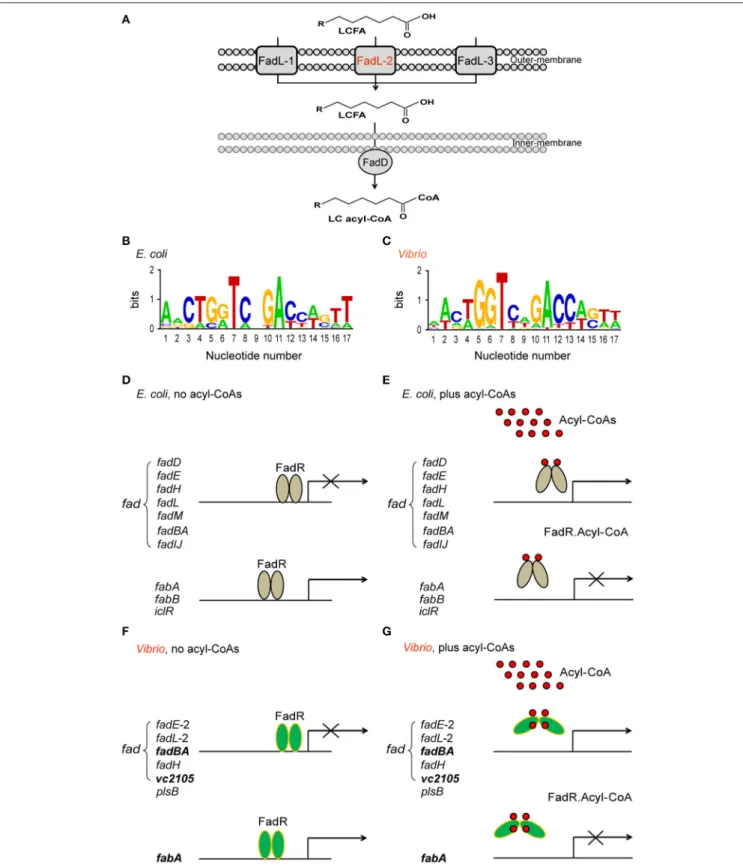
In views of genomic context of lipid metabolism (Figure 1), the Vibrio species, like V. cholerae, seem quite different from
E. coli(andS. enterica) because they have two chromosomes that together encode all the enzymes of fatty acid metabolism. Unlike the paradigm “FadL-FadD” fatty acid transport system inE. coli,
Vibrioencodes threefadLorthologs only one of which has the FadR-binding site recognized byVibrio(Figure 1A) (Heidelberg et al., 2000). This might facilitate more efficient scavenging low level of fatty acids from the dilute marine environment (van den Berg et al., 2004). Relative toE. coliwhich has 12 FadR-regulated genes (Figures 1B–E), the predicted FadR-binding palindrome is detected in only 7Vibriogenes including 5 knownfad/fabgenes, suggesting contraction of fad regulon (Figures 1F,G) (Zhang et al., 2015; Gao et al., 2016). Of note, theVibrio plsBgene is under
FadR control (Figures 1F,G), whereas theE. colicounterpart has no effect on this gene (Feng and Cronan, 2011). In contrast to the FadR of E. coli and S. enterica, all the three Vibrio FadR proteins (ValFadR forV. alginolyticus, VcFadR forV. choleraeand VpFadR forV. parahaemolyticus) consistently have an unusual insert of 40 residues (Figure S1), one of which had already been demonstrated to constitute an additional ligand-binding site in the case of VcFadR (Shi et al., 2015). It explains at least (if not all) whyV. choleraehas potent ability in fatty acid sensing.
Given that knowledge of fatty acid metabolism in
V. alginolyticus is limited, here we report structural and functional characterization of V. alginolyticus FadR. The snapshot of the ValFadR-ligand complex structure also illustrates an additional ligand-binding site. Mice infection experiments suggest that both FadR and the second ligand-binding site might be required for bacterial successful colonization. Together, these results constitute an additional example facilitating us to further understandVibriofatty acid signaling by FadR and its relevance to bacterial virulence. It is rational that development of small molecule inhibitors targeting the FadR-mediated fatty acid sensing might be a promising strategy againstVibrioinfections.
RESULTS
Characterization of the
V. alginolyticus
FadR
We are interested in probing if similar scenarios occur in
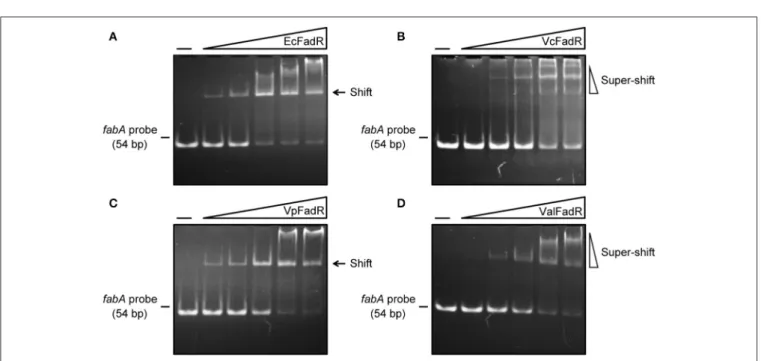
V. alginolyticus. Thus, four types of FadR proteins (namely ValFadR, VcFadR, VpFadR, and EcFadR), were over-expressed and purified with nickel-affinity column, whose purity was judged by SDS-PAGE (Figure S2C). Size exclusion analyses confirmed that all the three Vibrio FadR proteins (ValFadR and VpFadR, in Figure S2A; VcFadR in Figure S2B) can form dimeric structure in solution, which is almost identical to that of EcFadR (Figure S2A). Together with surface plasmon resonance (SPR)-based detection, EMSA experiments were also applied to address binding abilities of the putativeVibrioFadR palindromes (Figures 1C,F,G). A 54 bp of DNA fragment covering the FadR palindrome in the upstream of the Vibrio fabA gene is designated herein as fabA probe. In general agreement with that of EcFadR (Figure 2A), gel shift assays also confirmed that thefabA probe interacts efficiently with ValFadR (Figure 2D). Similar scenarios were also seen with the other two Vibrio
FIGURE 1 |Working model forVibrioFadR-mediated fatty acid sensing and regulation.(A)Schematic representative for uptake and activation of long-chain fatty acids by FadL-FadD system ofV. choleraeN16961. The long-chain fatty acids are transported by FadL membrane protein from the environment into periplasm and then activated by inner-membrane associated protein FadD to give LC acyl-CoA in cytosol. Among three putative FadR homologs encoded byV. choleraeN16961 genome, FadL2 (in red) is only one gene with a predicted FadR-binding site. LCFA is an abbreviation of long chain fatty acid.(B)Sequence logo for FadR-specific palindromes fromE. coliMG1655.(C)Sequence logo for FadR-specific palindromes fromVibriogenus. The sequences of the knownE. coliFadR sites were sampled
FIGURE 1 |fromE. coliK-12 MG1655 (http://regprecise.lbl.gov/RegPrecise/regulon.jsp?regulon_id=10286), and the putativeVibrioFadR sites were collected from 9 Vibriospecies (http://regprecise.lbl.gov/RegPrecise/sites.jsp?regulog_id=1762) (Novichkov et al., 2013).(D)E. coliFadR repressesfadexpression, but activates transcription offabA/BandiclRon the condition without acyl-CoA thioesters.(E)Presence of long chain acyl-CoAs releasesE. coliFadR protein from its cognate targets, resulting in an induction offadexpression and transcriptional inactivation offabA/BandiclR.(F)VibrioFadR represses the expression of limitedfadmembers, whereas only activatesfabAtranscription on the condition with poor acyl-CoA species.(G)The generated long chain acyl-CoAs releasesVibrioFadR protein from its cognate targets, which consequently induces the expression of limitedfadmembers, whereas only inactivatesfabAtranscription. The three representative genes (vc2105,fadBA, andfabA) are highlighted in bold and italic letters, whose ability of binding theVibrioFadR regulator is demonstrated with EMSA (and/or SPR). The gray oval denotesE. coliFadR regulatory protein whereas the green oval denotesVibrioFadR regulator. The small red circle represents the acyl-CoA pool.E. coli FadR has only one ligand-binding site in each monomer, whereasVibrioFadR has two ligand-binding sites in each monomer.
FIGURE 2 |Binding offabAto four types of FadR regulatory proteins.(A)Gel filtration analyses for interaction of EcFadR withfabA.(B)Use of EMSA assays to detect interplay betweenfabAand VcFadR.(C)EMSA-based analyses for interaction offabAwith VpFadR.(D)Physical evidence for binding of ValFadR tofabA.The gel shift experiments were carried out using 9% native PAGE, and a representative result from no less than three independent experiments is given. In each assay (15µl in total), thefabAprobe (5 pmol) is supplemented, and varied level of FadR protein is indicated in the right hand five lanes of each panel (left to right) (2, 5, 10, 15, and 20 pmol). The four types of FadR proteins referred to EcFadR, VcFadR, VpFadR and ValFadR, respectively. The minus sign denotes the absence of FadR protein. FadR protein at high level precipitates easily in the wells of gel or triggers super-shift in the gel shift experiments.
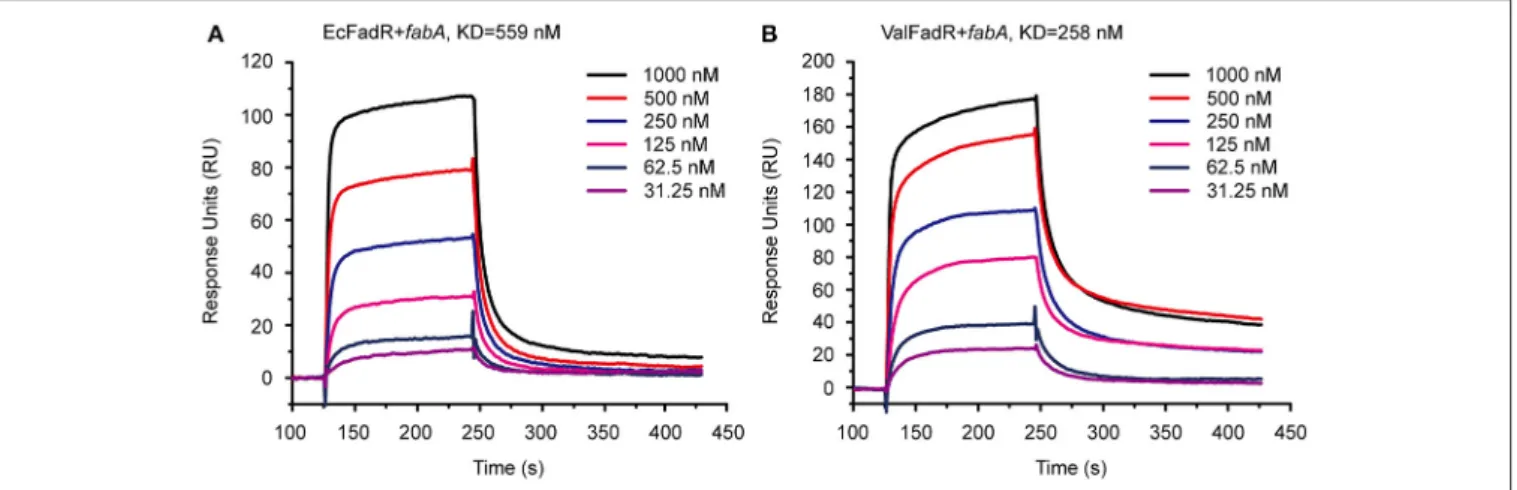
(Figure 2C). Of note, super-shift bands appeared in the cases of VcFadR (Figure 2B) and ValFadR (Figure 2D). In addition, surface plasmon resonance (SPR) results showed clearly that thefabAprobe binds to both EcFadR (Figure 3A) and ValFadR (Figure 3B) in the dose-dependent manner. The binding affinity offabAto EcFadR and ValFadR is estimated to be 5.59×10⁻⁷
M (Figure 3A) and 2.58 × 10⁻⁷ M (Figure 3B), respectively.
Indeed, we recently extendedfadregulon to a newly-identified auxiliaryfadmember,vc2105ofV. cholerae(equivalent tovp0834
of V. parahaemolyticus) (Novichkov et al., 2013; Gao et al., 2016). Therefore, we believed that ValFadR is functional and its regulatory role is relatively-conserved (Figure 1).
Distinct Ligand-Binding Manner of ValFadR
and EcFadR
Consistent with earlier observations with EcFadR (Feng and Cronan, 2010, 2012) and VcFadR (Feng and Cronan, 2011),
in vitro gel shift assays illustrated that only Long-chain fatty
FIGURE 3 |SPR-based assays for binding offabAto the FadR regulator.(A)SPR analysis of theE. coliFadR binding to thefabApromoter.(B)SPR assay for the V. alginolyticusFadR binding to thefabApromoter. SPR assays were conducted to study the affinity and kinetics of FadR proteins and a representative result is given regarding to EcFadR and ValFadR. FadR protein at various concentrations (typically 31.25–1,000 nM) were injected over the immobilized DNA probe covering the FadR palindrome offabAgene. The immobilization level offabAis 34 RU. KD, kd/ka, ka, association constant; kd, disassociation constant; RU, response units.
FIGURE 4 |ITC-based evidence for distinct binding pattern of the palmitoyl-CoA ligand to FadR regulatory protein fromE. coliandVibrio alginolyticus.(A)ITC profile of theE. coliFadR binding its ligand palmitoyl-CoA.(B)The use of ITC to assay interplay between theV. alginolyticusFadR and its ligand palmitoyl-CoA. Ec,E. coli; Val,V. alginolyticus.
pattern was also seen in VcFadR (Figure S4A) and VpFadR (Figure S4B). In addition, the ITC measurements showed that the binding of Vibrio FadRs (VcFadR, VpFadR, and ValFadR) palmitoyl-CoA (Figure 4B, Figure S4) are 4- to 10-fold higher than that of EcFadR (Figure 4A) [the value of Kd1 exhibited appreciably lower (3.17-fold for ValFadR (Figure 4B), 7.07-fold for VcFadR (Figure S4A), and 5.06-7.07-fold for VpFadR
(Figure S4B)]. Obviously, it was consistent with the fact that
VibrioFadR is a much more efficient regulator thanE. coliFadR (Iram and Cronan, 2005). Together, our ITC findings suggested that ligand-binding ofVibrioFadR is in a manner distinct from that of EcFadR (Figure 4, Figure S4), which is consistent with the scenario seen in structure of VcFadR reported by Shiet al.
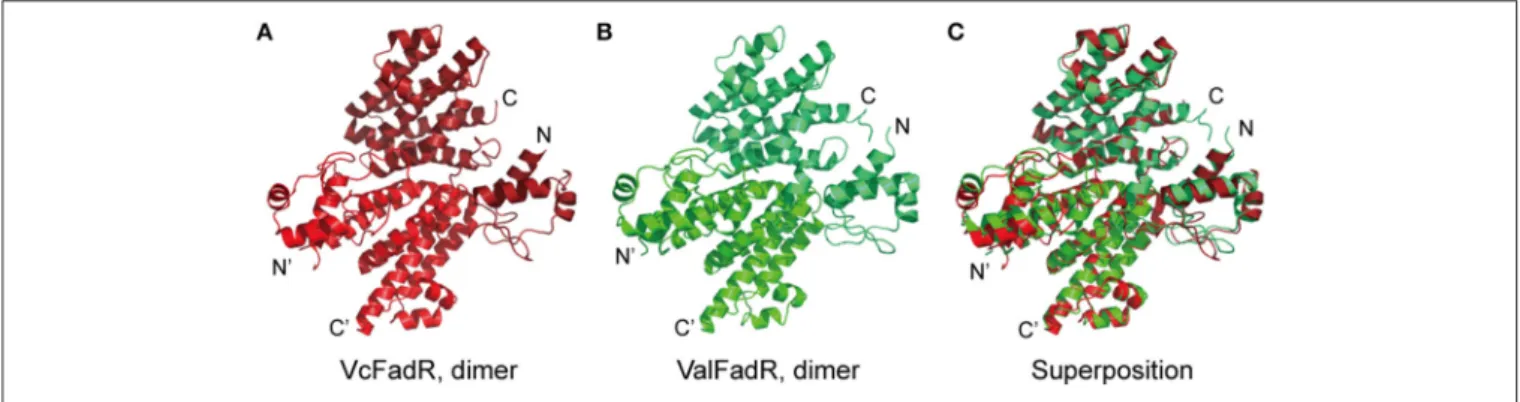
FIGURE 5 |Structural comparison of the FadR proteins ofV. choleraeandV. alginolyticus.(A)Ribbon structure of the dimeric FadR protein ofV. cholerae.(B)X-ray structure of theV. alginolyticusFadR protein in dimer.(C)Structural superposition of the two FadR proteins fromV. alginolyticusandV. cholerae.Vc,V. cholerae;Val, V. alginolyticus.
FIGURE 6 |Chemical structures of the representative FadR ligands and structural comparison of the liganded-ValFadR with the EcFadR-ligand complex structure. (A)Chemical structures of LC fatty acyl-CoAs, the ligands for FadR regulatory proteins. The palmitoyl-CoA ligand that was successfully crystalized into the FadR protein is highlighted in orange, whereas the double bond is indicated in blue.(B)Complex structure of the monomeric form of EcFadR liganded with myristoyl-CoA ligand. The architecture of the EcFadR (PDB: 1H9G) is shown in blue cylinder, whereas the ligand of myristoyl-CoA is given in orange stick.(C)Complex structure of the monomeric form of ValFadR liganded with palmitoyl-CoA ligand (PDB: 5DV5). The protomer form of ValFadR is shown in cyan cylinder, and the extra-40aa insert is given in magenta. The ligands are shown in sticks, one of which is of light green in the binding site 1 and the other one present in site 2 is indicated in red.
Overall Architecture of ValFadR
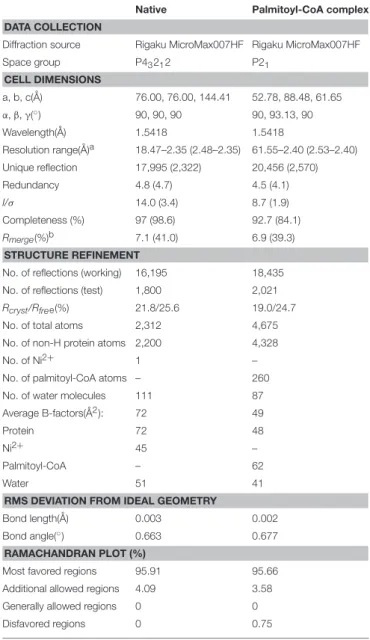
In our pilot trials of protein crystal screening, only the ValFadR amongst the three Vibrio FadR proteins (VcFadR, VpFadR, and ValFadR) is successful. The structure of apo-ValFadR was determined at 2.35 Å (Table 1). In an agreement with those of our gel filtration (Figure S2), ValFadR forms a dimer and belongs to space group of P43212, in which each asymmetric unit
contains one FadR protomer (Table 1,Figures 7A,D). Solution structure of dimer is consistent with the previously-reported EcFadR (van Aalten et al., 2000) and VcFadR (Shi et al., 2015) (Figure 5, Figure S5). The analyses of structural superposition suggested that overall architecture of ValFadR (Figure 5B) can match well that of VcFadR (Figures 5A,C). The protomer is composed of two functional domains, the N-terminal DNA-binding domain, the C-terminal ligand-DNA-binding domain and one linker connecting these two domains (Figure S5). The N-terminal DNA-binding domain adopts a typical wHTH fold motif and includes threeαhelices (α1,α2,α3) and twoβstrands (β1 andβ2) (Figures S1, S5). The C-terminal ligand binding domain forms an α-helix bundle and includes eight helices (Figures S1, S5).
Sequence alignment revealed that ValFadR has more 40 residues (138–177 aa) insertion between helicesα6 andα7 than EcFadR
(Figure S1). The ValFadR structure shows that these 40 residues elongate helicesα7, and form two helices,αA andαB, and some linking loops (Figures S1, S5B,E), which is generally similar to that of VcFadR alone (Figure 5) (Shi et al., 2015). Except the insert of 40 residues, the structure of apo-ValFadR (Figures S5B,E) is highly similar to that of apo-EcFadR (Figures S3A,D) with r.m.s.d over 223 Cα atoms (one protomer) of 1.5 Å (Figures S5C,F).
Structure of ValFadR Liganded with
Palmitoyl-CoA
Unlike the fact that VcFadR was complexed with the ligand oleoyl-CoA (Shi et al., 2015), we obtained the crystal of ValFadR-liganded with palmitoyl-CoA that was diffracted by X-ray to 2.4 Å (Table 1). The asymmetric unit contains one ValFadR dimer and four palmitoyl-CoA molecules, in a 1:2 stoichiometry (Figures 6C, 7B,E) as reported for VcFadR (Shi et al., 2015), whereas EcFadR binds one molecule of ligand (myristoyl-CoA) per monomer (Figures 6A,D). It fully validated the general conclusion from the aforementioned ITC experiments (Figure 4, Figure S4). The two ligand-binding sites in ValFadR are similar to those observed with VcFadR (Figure S6) (Shi et al., 2015). One of the ligand molecules binds to ValFadR in the site that is equivalent to EcFadR ligand-binding site (designated site 1), and the second ligand binds to the pocket derived in part from the 40-residue insertion region. The site 1 is mainly formed by the C-terminal domain (Figures S6A,B), whereas the site 2 is formed by both the N- and C-domains (Figures S6C,D). The electron density of the acyl group in the ligand in site 1 is well defined whereas the phosphorylated adenosine head group is not clear (Figures S6A,B). The phosphorylated adenosine head of the palmitoyl-CoA ligand in one protomer interacts with several residues from the other protomer, including hydrogen bonds between Arg245 and the phosphate group. The
TABLE 1 |Statistics on data collection and structure refinement.
Native Palmitoyl-CoA complex
DATA COLLECTION
Diffraction source Rigaku MicroMax007HF Rigaku MicroMax007HF
Space group P43212 P21
CELL DIMENSIONS
a, b, c(Å) 76.00, 76.00, 144.41 52.78, 88.48, 61.65
α,β,γ(◦) 90, 90, 90 90, 93.13, 90
Wavelength(Å) 1.5418 1.5418
Resolution range(Å)a 18.47–2.35 (2.48–2.35) 61.55–2.40 (2.53–2.40) Unique reflection 17,995 (2,322) 20,456 (2,570)
Redundancy 4.8 (4.7) 4.5 (4.1)
I/σ 14.0 (3.4) 8.7 (1.9)
Completeness (%) 97 (98.6) 92.7 (84.1)
Rmerge(%)b 7.1 (41.0) 6.9 (39.3)
STRUCTURE REFINEMENT
No. of reflections (working) 16,195 18,435 No. of reflections (test) 1,800 2,021 Rcryst/Rfree(%) 21.8/25.6 19.0/24.7
No. of total atoms 2,312 4,675
No. of non-H protein atoms 2,200 4,328
No. of Ni2+ 1 –
No. of palmitoyl-CoA atoms – 260
No. of water molecules 111 87
Average B-factors(Å2): 72 49
Protein 72 48
Ni2+ 45 –
Palmitoyl-CoA – 62
Water 51 41
RMS DEVIATION FROM IDEAL GEOMETRY
Bond length(Å) 0.003 0.002
Bond angle(◦) 0.663 0.677
RAMACHANDRAN PLOT (%)
Most favored regions 95.91 95.66
Additional allowed regions 4.09 3.58
Generally allowed regions 0 0
Disfavored regions 0 0.75
aValues in the parentheses are for the data in the highest resolution shell. bR
merge=P|Ii−Im|/PIi, where Iiis the intensity of the measured reflection, and Imis the
mean intensity of all of the symmetry-related reflections.
pyrophosphate group interacts with residues of both Arg253 and Tyr115 via hydrogen bonds (Figures S6A,B). For the ligand in site 2, the phosphorylated adenosine head group is well defined in electron density while the acyl group lack this ability (Figures S6C,D). The phosphorylated adenosine head group inserts into the pocket derived from the part of the 40-residue insertion region. Among it, the adenosine group stacks with residues Tyr153 and Met187 and forms hydrogen bond with Asn130 and Tyr184. The phosphate group forms hydrogen bond with residue Lys156 and the pyrophosphate forms hydrogen bond with residues Arg126 and Arg191 (Figures S6C,D).
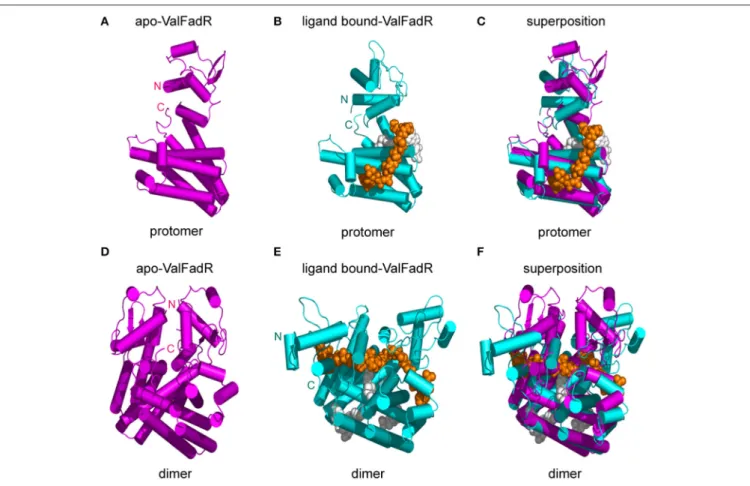
FIGURE 7 |Structural comparison of the apo- and ligand bound-FadR protein fromV. alginolyticus.Monomeric(A)and dimeric(D)structures of apo-ValFadR protein are shown in magenta cylinder (PDB: 5XGF). Protomer(B)and dimeric(E)structures of ligand-bound ValFadR protein are shown in cyan cylinder (PDB: 5DV5). The monomeric(C)and dimeric(F)structures of the apo- and ligand-bound ValFadR protein are superposed via their C-terminal ligand-binding domains. The ligand in binding site 1 is shown in gray spheres and the other one in binding site 2 is indicated with orange spheres. Val,V. alginolyticus; N, N-terminus of the FadR protein; C, C-terminus of the FadR protein.
structure (Figure 6D), which is due to the different stoichiometry of ligand binding, with an r.m.s.d larger than 3 Å over 100 Cα
atoms. In contrast, the N-terminal domain is similar to that of EcFadR with an r.m.s.d 1.0 Å over 70 Cαatoms (Figure 6D).
The major difference between ValFadR and EcFadR lies in the N-domain orientations. The second ligand-binding site involves some residues of the N-terminal domain (Figures S6A,D) and the bound second ligand made the N-domain could not take the similar orientation observed in apo-ValFadR and EcFadR (Figures 6B–D). The large-scale movement of the N-domain leads to distance changes between the two DNA-binding domains of the protein dimer and places the domains in a conformation not suitable for DNA binding. It represents structural basis for ligand-triggered ValFadR-DNA dissociation.
Conformational Alteration of ValFadR by
Ligand Binding
Structure superposition showed that the major difference between apo-ValFadR (Figures 7A,D) and liganded-ValFadR (Figures 7B,E) lies in the varied N-domain orientations
(Figures 7C,F). Similar scenario also occurred between ligand-bound ValFadR and ligand-ligand-bound EcFadR (Figures 6B–D). To illustrate the mechanism whereby ligand-binding leads to the conformational change, both domains of apo-ValFadR and ligand-bound ValFadR are superposed. The N-domains show similar conformations with r.m.s.d 0.9 Å over 65 Cα atoms, so do the C-domains with r.m.s.d 1.3 Å over 173 Cα atoms (Figures 7C,F). These results suggest that the ligand-binding does not alter the overall conformation of both domains but mainly changes the orientation of N-domain (Figures 7C,F). The ligand in the site 1 does not interact with the N-terminal domain and the linker helix, indicating that this ligand-binding does not contribute to the large-scale domain swing. Also, there is no significant domain movement observed in EcFadR upon the ligand-binding (equivalent to site 1 of ValFadR). The ligand in the site 2 interacts with helix α4 of the linker.
the interface of N- and C- domain via its acyl chain tail and alters the orientation of helix α4 as well as the N-domain, which is proposed to be a major reason for the large-scale domain swing upon binding the second ligand. Also, the additional ligand in one protomer interacts with many residues from the other protomer as described above, which definitely affects the dimeric interface and causes slightly relative movements between two protomers.
Physiological Roles of
Vibrio
FadR and the
Additional Ligand-Binding Site 2
Genetic amenability in V. cholerae allowed us to create the
1fadR deletion mutant, using the method of homologous
recombination (Figure S7A). Following PCR-based identification, we harvested the interested 1fadR mutant
(Figure S7B). Given the fact that the ligand-binding site 2 of the
VibrioFadRs is mainly involved in the insertion of 40-residues (138-177aa, Figure S1, Figure 5), we therefore designed a site 2-deficient fadR mutant (142 without 136-177aa) and
engineered it into the1fadRmutant ofV. cholerae. Functional
complementation with the wild-type and/or 142 mutant of fadRgene into the1fadRto probe thein vivorole offadRand
the ligand-binding site 2 in the context of lipid metabolism in
V. cholerae.
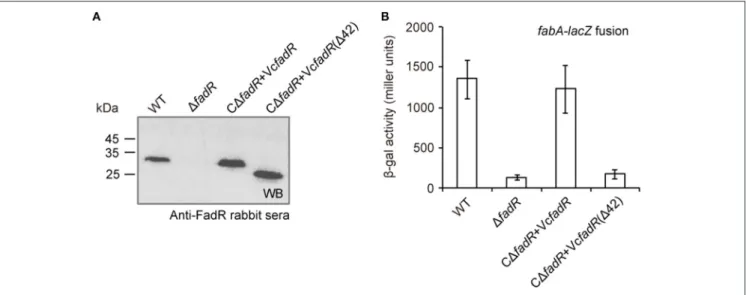
First, western blot analyses with anti-VcFadR rabbit sera as primary antibody showed that the wild-type offadR gene and its derivative [i.e., the fadR(142) mutant] can express well in V. cholerae, whereas not in the1fadRmutant strain ofV. cholerae
(Figure 8A). Subsequently, LacZ-based transcriptional assays revealed that fabAexpression is decreased dramatically in the
1fadRmutant ofV. cholerae, and can be enhanced greatly upon
over-expression of the wild-typeV. cholerae fadR (Figure 8B). This result confirmed that FadR acts as an activator for the
fabAgene of UFA synthesis inVibrio. Of note, thefadR(142,
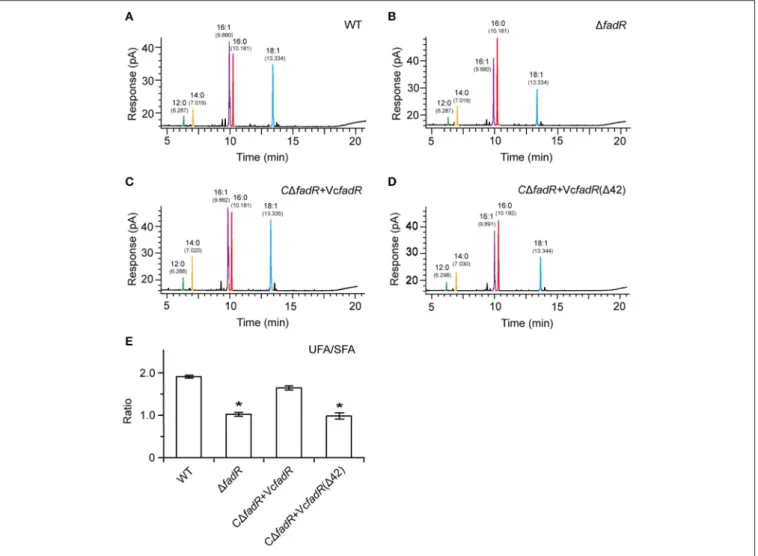
lacking the site 2) mutant gene failed to restorefabAtranscription (Figure 8B), implying the site 2-containing region is critical for VcFadR function. Further analyses of fatty acids composition fromVibriomembrane phospholipids showed that (i) UFA/SFA ratio in the 1fadR mutant (Figures 9B,E) is relatively lower
than that of the wild-type strain (Figures 9A,E), (ii) this ratio can be restored in the complementary strain (C1fadR+VcfadR) (Figures 9C,E); and (iii) the fadR (142) mutant gene without
the site 2 cannot (Figures 8D,E). Therefore, we believed that the Vibrio FadR does control/remodel membrane integrity determined by the ratio of UFA to SFA incorporated into bacterial membrane phospholipids (Figure 9) via its positive regulation of thefabAtranscription (Figure 8).
Roles of
Vibrio
FadR and the
Ligand-Binding Site 2 in Bacterial Virulence
Similar to the phenotype of thefadRinsertional mutant strain ofV. vulnificus(Brown and Gulig, 2008), thefadRdeletion mutant strain ofV. cholerae also displays slower growth in LB liquid media and colony of smaller size on LBA plates than the wild-type strain (Figure S8,Figure 9A). The growth/morphological defects were significantly restored by both plasmid-borne expression of the wild-type VcFadR (Figure S8) and the addition of exogeneous oleate (Figure 10A). However, the expression offadR(142) with
ligand-binding site 2 deleted (Figure 8A) failed to complement the phenotype of defective growth (Figure S8). In light that
fadR(142) mutant neither augments the decreased expression
of fabA, an important gene for UFA synthesis (Figure 8B),
FIGURE 8 |FadR activates expression offabA, an important gene for unsaturated fatty acid synthesis inV. cholerae.(A)Western blot analyses forfadRexpression and its derivatives. The primary antibody used here is rabbit sera againstV. choleraeFadR.(B)The beta-gal activity offabA-lacZtranscription fusion is significantly decreased in the1fadRmutant, and can be restored by the functional complementation of the wild-typefadR[but not VcfadR(142)]. ThefadRdeletion mutant strain referred to1fadR, and the two types of complemented strain of1fadRused corresponded to C1fadR+VcfadRand C1fadR+VcfadR(142), respectively. The
FIGURE 9 |Systematic analyses of fatty acid profile suggests that functional alteration of theVibrioFadR remodels structure of bacterial membrane phospholipids. (A)Analyses for the fatty acid composition isolated from the wild-type strain ofV. cholerae.(B)Alteration in the fatty acid compositions in the1fadRmutant ofV. cholerae.(C)The fatty acid profile in the complemented strain of1fadRmutant with plasmid-borneV. cholerae fadR.(D)Failure to recover the fatty acid composition of theV. cholerae1fadRstrain using plasmid-driven expression of theV. cholerae fadRderivatives that lack the second ligand-binding site [designated as
VcfadR(142)].(E)Effects on UFS/SFA ratio of membrane phospholipids by FadR regulatory protein inV. cholerae.*Studentt-testp<0.01.
nor rescues the dysfunction in fatty acid composition of phospholipids in the 1fadR mutant strain of V. cholerae
(Figures 9D,E), we favored to hypothesize that the activation of fatty acids synthesis by FadR has significant impacts on bacterial growth and the ligand-binding site 2 is critical for FadR function
in vivo.
Given that the opportunistic pathogen V. vulnificus FadR is necessary for bacterial infection in mice (Brown and Gulig, 2008), it is of much interest to test if site 2 has a role in virulence-associated traits as well as infection competency in V. cholerae (Figures 10, 11). Thus, we examined the possible relevance of fadR (and/or the ligand-binding site 2) to bacterial swarming, a virulence-associated trait. As expected, the swarming ability was impaired greatly upon the removal of fadR from V. cholerae (Figure 10B) (Brown and Gulig, 2008). Functional complementation with VcFadR recovered it to that of the parental strain (Figure 10B). Although the
expression of VcFadR (142) (Figure 8A) failed to complement
the loss of swarming ability, supplementation of exogenous oleate rendered them indistinguishable in the swarming assays (Figure 10C). We therefore anticipated that dysfunction of swarming/mobility is related to altered surface architecture of membrane phospholipids. Subsequently, we performed infant mouse colonization competition assays (Gardel and Mekalanos, 1996). To rule out the possible effects of delayed growth of1fadR
mutant, we subjected them to the in vitro colonization trials on LBA plates supplemented with oleate prior to colonization experiments of micein vivo. The result showed that the delayed growth phenotype of the1fadRmutant does not affect greatly the in vitrooutput [i.e., the ratio of colony numbers (WT/1fadR)]
(Figure S10). Thus, we compared the colonization abilities of the wild-type strain with the 1fadR mutant strain and the
complementary strain of fadR mutant (with either wild-type
FIGURE 10 |Oleate can rescue the defection of bacterial growth and swarming caused by the inactivation of FadR.(A)The1fadRmutant exhibited the phenotype of small colony size, and growth defect was restored by an addition of oleate into LB media. The twoV. choleraestrains used here included WT (C6706) and FYJ639 (1fadR). Bacterial cultures in serial 10-fold dilutions were spotted (fromtoptobottom) on plates of LBA solid medium, and kept at 37◦C for 18 h. On the LBA plate without any addition of oleate (Left panel), the single colony size of1fadRis much smaller than that of the wild-type. However, the colonial size of the two strains is comparable upon the supplementation of oleate (Right panel) into the LBA plates. The typical colonies are indicated with red arrows. A representative result is given. (B)The ability of bacterial swarming, a virulence-associated trait, was impaired by the deletion of VcFadR, but rescued by the functional complementation of the wild-typefadR(but notfadR(142)) andin vitrosupplementation of oleate can rescue(C). For the swarming assays, the log-phase culture appropriately diluted (∼10 ul)
is spotted on semi-solid 0.3% agar LB plates and kept overnight at 37◦C.
mutant is profoundly defective in colonization (the competitive index is around 0.004) (Figure 11), suggesting that FadR plays a critical role inV. cholerae virulence. Complementation with the wild-type fadR partially restored colonization of 1fadR,
whereas the plasmid containing fadR (142) failed to recover
the 1fadR colonization (Figure 11). It seems possible that the
site 2-containing region (42-residues long, 136-177aa) is critical for V. cholerae FadR as a functional virulence factor. In fact, we also noted expression of the two major virulence factors
ctxA(Figure S9A) andctpA(Figure S9B) are slightly inhibited
by inactivation of fadR. This control of virulence factors was assigned byKovacikova et al. (2017)to the indirect modulation of ToxT by FadR via two different mechanisms. Hence, our findings might be additional to the linker of bacterial fatty acid metabolism andVibriopathogenesis.
DISCUSSION
FIGURE 11 |Roles ofV. choleraeFadR and the new ligand-binding site 2 in bacterial virulence. Effects exerted byV. choleraeFadR on colonization in the infant mouse model.1fadRmutants containing vector control, VcfadRand VcfadR(142) were co-inoculated into infant mice with wild-type at 1:1 ratio.
After 18-h colonization, the colonized bacteria were enumerated on selective agar plates. Competitive index is calculated as output ratio of mutant to wild-type normalized against input ratio of mutant to wild-type. Horizontal line: mean of CI. **Studentt-testp<0.01; ns, no significance.
energetically-expensive molecules to produce. To date, six bacterial transcription regulators have been identified. Three of them [FapR (Schujman et al., 2003), DesR (Aguilar et al., 2001; Zhu et al., 2006), and FabT (Lu and Rock, 2006)] are found in Gram-positive bacteria, while the other three members [FadR (Henry and Cronan, 1991; Cronan and Subrahmanyam, 1998; Campbell and Cronan, 2001), FabR (McCue et al., 2001; Zhang et al., 2002), and DesT (Zhang et al., 2007)] are derived from Gram-negative bacteria. Unlike the prototypical version of FadR regulatory protein, theE. coli fadRprotein product (van Aalten et al., 2000, 2001; Xu et al., 2001), the description of three
Vibrio FadR homologs (ValFadR, VpFadR, and VcFadR) from our groups and recent report by Shi and coworkers (Shi et al., 2015) defined a unique mechanism for bacterial fatty acid sensing in the genus of Vibrio (Figure 1). Although the Vibrio FadR proteins were derived from different species (V. alginolyticus
from our group andV. choleraefor Kull’s group), the structures we obtained are almost identical, both of which underlined that the insert of 40-residues constitute an extra-domain rich in α-helix (Figures S1, S5, Figure 5). Further dissection for two types ofVibrioFadR-ligand complexes [ValFadR/Palmitoyl-CoA (C16:0) from our group plus VcFadR/Oleoyl-[ValFadR/Palmitoyl-CoA (C18:1) from F. Jon Kull’s group] consistently reveal that the so-called “40-aa insert” of Vibrio FadR regulatory protein constitutes the second ligand-binding site in that it already retained the ligand-binding site 1 that is highly similar to that of E. coli
FadR (Figure 6, Figure S6). This scenario seen with Vibrio
FadR regulator sounds unusual, but not without precedent in that (i) the cAMP-receptor protein (CRP) requires binding of two cAMP molecules each monomer for its function (Passner and Steitz, 1997); (ii) BenM, a LysR-like regulator, has two ligand-binding sites for effector benzoate (Ezezika et al., 2007).
Subsequently, the question raised is what could be a physiological explanation for this unique mechanism. We speculated that unlike the paradigm enteric bacterium E. coli colonizing the digestive tract rich in fatty acids, Vibrio species residing in aquatic environments with low level of fatty acids precipitated on the sediment (Giles et al., 2011) have to evolve a more efficient system for fatty acid uptake, rendering its fatty acid-responsive FadR regulator to select an additional ligand-binding site.
Indeed, complex structures of two types of the ligand/Vibrio
FadR from our group (Figure 4, Figure S5) and report byShi et al. (2015) allow us to better understand the structural/molecular basis for crosstalk/response of Vibrio FadR to effectors. As illustrated inFigure 6and Figure S6, the head of CoA for the second ligand is well fixed and recognized, and the tail of fatty acid chain is inserted between N-terminus and C-terminus of ValFadR and a two-body interface. That is why we hypothesize that fatty acyl-CoA of different lengths might synergistically interfere withVibrioFadR. In the dimeric form ofVibrioFadR protein, the ends of the four lines of fatty acyl chains converge at the same point, which determine the inability of the limited space to hold fatty acyl chains with much longer length. Probably, the acyl chain of both C16 in ValFadR (Figure 6, Figure S6), and C18 in VcFadR (Shi et al., 2015) seemed to be quite close to the its length limit. The fact that extensive ligand-triggered conformation changes seen with two FadR proteins (ValFadR and VcFadR,Shi et al., 2015) more completely impaired the DNA binding than that of E. coliFadR protein, provided structural explanation for our former observation that addition of oleate can result in almost full de-repression ofVibrio fadregulon, like
fadBA(Iram and Cronan, 2005). Not only have we elucidated the contribution of the extra 40-aa insert to the function of
Vibrio FadR protein in the context of lipid metabolism, but also discovered its relevance to bacterial infections (Figures 10, 11). Additionally, the uniqueness of this insert inVibrio might determine that the fatty acid sensing by FadR with double ligand-binding sites is exclusively distributed into the phylum of
VibrionaceaefromÈ-proteobacteria.
MATERIALS AND METHODS
Ethics Statements
Animal care and treatment were conducted in accordance with institutional guidelines and the protocols at Zhejiang University, China. Five-day-old CD1 mice were housed in a temperature-controlled room with proper darkness-light cycles, fed with a regular diet, and maintained under the Experimental Animal Center of Zhejiang University, China. The mouse experimental design and protocols used here were approved by the Ethics Committee of Zhejiang University, China (ZJU20170800).
Bacterial Strains and Growth Conditions
E. coli strains used here are derivatives of the wild-type K-12 strain (Table S1).Vibriostrains used here includedV. cholerae
EI Tor C6706 (Joelsson et al., 2006), V. parahaemolyticus
ATCC 17802 and V. alginolyticus. E. coli SM10 (λ-pir) was used as the donor strain for conjugations with V. cholerae. These strains were routinely maintained in LB medium (Luria-Bertani medium containing 10 g of tryptone, 5 g of yeast extract and 10 g of NaCl per liter) or on LB agar plates (Feng and Cronan, 2011). LB without NaCl and containing 6% (wt/vol) sucrose was used for a selection of the strain with homologous recombination. The growth temperatures used are either 30◦
or 37◦C. When necessary, antibiotics were added as follows
(in µg/ml): tetracycline, 20 for E. coli and 2 for V. cholerae; ampicillin, 100; kanamycin, 50; and streptomycin, 100 (Feng and Cronan, 2009a).
Plasmids and DNA Manipulations
V. cholerae fadRgene was previously cloned pET16b vector (Iram and Cronan, 2005). The twofadRgenes fromV. parahaemolyticus
and V. alginolyticuswere separately amplified with PCR. They were directionally cloned into the pET28 expression vector. The resultant recombinant plasmids were introduced into E. coli
BL21 (DE3) for large-scale production of the FadR protein. As we previously described in the synthesis of the Brucella bioR
gene in vitrowith little change (Feng et al., 2013), overlapping PCR was used to create a mutantfadR gene (fadR(142)) with
the deletion of 42 residues (136-177aa). The pWM91 vector is applied for construction of fadR knock-out plasmid (Metcalf et al., 1996). The expression plasmid pBBR1-MCS3 is used for functional assays of the fadR gene in different versions (VcfadRand the VcfadR mutant142), Table S1) inV. cholerae
(Kovach et al., 1995). All plasmid constructs were validated by PCR detection (Table S2) and direct DNA sequencing (Zhang et al., 2014).
In-Frame Deletion of
V. cholerae fadR
and
Genetic Complementation
V. cholerae El Tor C6706 (Joelsson et al., 2006) was used as the wild-type strain in this study unless otherwise noted. In-frame deletions were constructed by cloning of the upstream (and downstream) regions neighboring the targetfadRgene (vc1900) into the suicide vector pWM91 containing a sacB counter-selectable maker (Metcalf et al., 1996). The upstream (and/or downstream) DNA fragments (of 700 bp long) flankingfadRwere
amplified by PCR using the two pairs of specific primers (L-flank
fadR-5′
/L-flank fadR-3′
and R-flank fadR-5′
/R-flank fadR-3′
) with the high-fidelity Prime STAR DNA Polymerase (Table S2). The flanking DNA sequences in the upstream (and downstream) of thefadRwere overlapped and cloned into the two restriction sites of pWM91 (SacI and BamHI), giving knockout plasmid pWM91-fadRKO. Then the plasmid was introduced into the
V. choleraestrain by conjugation from SM10 (λ-pir) and a single crossover event was selected by resistance to streptomycin and ampicillin. The selection growth in the absence of ampicillin and streptomycin assures that double crossover events occur. Finally, the1fadR mutant was given via sucrose-based screening. The
proper genetic exchange event was confirmed by multiplex-PCR and direct DNA sequencing.
For functional complementation, the wild-type fadR gene of V. cholerae plus its VcfadR mutant (fadR(142)) were
directionally inserted into the pBBR1-MCS3 vector via the two sites (KpnI and XbaI), giving plasmids like pBBR1-MCS3-fadR
(Table S1). The resultant plasmids were transformed intoE. coli
SM10 (λ-pir), and then conjugated into theV. cholerae1fadR
mutant. Tran-conjugants were selected on LB plates containing streptomycin and tetracycline. All the constructs were verified by direct DNA sequencing of PCR products.
Anti-FadR Rabbit Sera and Western Blot
Anti-sera against VcFadR were prepared as previously described (Shao et al., 2011). Pre-immune sera were collected from New Zealand White rabbits (female, 1.5 kg) and then animals were injected subcutaneously at multiple sites with approximately 1 mg/kg of purified FadR recombinant protein emulsified with Freund’s complete adjuvant (1:1). After 2 weeks, each rabbit received the first booster injection with the same antigen concentration emulsified with Freund’s incomplete adjuvant (1:1). One week later, each rabbit received the second booster injection with the same antigen concentration emulsified with Freund’s incomplete adjuvant (1:1). Then, anti-serum samples were collected when the booster injection was administered 7 days later. The sensitivity and specificity of antibody were evaluated routinely by ELISA and Western blot (Feng and Cronan, 2009b). Using the rabbit sera against VcFadR protein as primary antibody, Western blotting analyses were conducted to detect expression of fadR gene (and its derivatives) in the wild-type (or1fadRmutant) strain ofV. cholerae.Growth Phenotypes and Swarming Assays
Growth phenotypes of V. cholerae and its derivatives were examined using both LBA solid plates and measurement of growth curves. To determine effect of colony size by the deletion of fadR, bacterial cultures in series of 10-fold dilution were spotted on solid LBA plates and maintained overnight at 37◦C. Similarly, the cultivation of V. cholerae species in liquid LB media at 37◦C was monitored for plotting the growth curves. For
swarming assays, log-phase cultures were diluted appropriately (10µl each) is spotted on semi-solid 0.3% agar LBA plates and
kept overnight at 37◦
Assays for Competition Colonization in
Infant Mice
Following the protocol established by Davies et al. (2011)with minor modifications, we evaluated the role offadRin bacterial virulence through the competitive colonization experiments in the model of infant mouse. Briefly, the wild-type strain of
V. cholerae (either C6706 or C6706 lac−) and its mutants
were cultivated on LBA plates with streptomycin (100µg/ml) overnight at 37◦C. The wild-type and mutant strains were
mixed together in LB medium. 100µl of competition mixtures (about 1 X 10⁵ CFU) were inoculated into a 5-day-old CD1
infant mouse. Serial dilutions of the competition mixture were plated on LBA plates with streptomycin (100µg/ml) as the selective pressure and enumerated to determine the input ratio of wild-type to the mutant strain. After incubation at 30◦C
for 18 h, the infant mice were sacrificed, and small intestines were removed and homogenized in 5 ml of LB. Serial dilutions were plated on LBA plates containing streptomycin (100µg/ml)
and enumerated to determine the output ratio of wild-type to the appropriate mutant strain. The competitive index for each mutant is defined as the input ratio of mutant/wild-type strain divided by the output ratio of mutant/wild-type strain.
Protein Expression and Purification
Since all the other three FadR proteins of Vibrio origins were tagged with hexa-histidine on the N-terminus, similar to the paradigm E. coli FadR protein stocked in our lab. The recombinant proteins were routinely prepared as we described before (Zhang et al., 2014). Briefly, when the optical density at wavelength of 600 nm (OD600) reached 0.6, the
bacterial culture was induced with 0.2 mM isopropyl-β -D-1-thiogalactopyranoside (IPTG) at 30◦C overnight. Following lysis
by sonication, the cell lysate was clarified by centrifugation and loaded onto a nickel-ion affinity column (Qiagen). After removal of contaminant proteins with washing buffer containing 50 mM imidazole, the 6xHis-tagged FadR protein was eluted in elution buffer containing 150 mM imidazole, concentrated by ultra-filtration (30-kDa cutoff) and exchanged into 20 mM Tris-HCl (pH 7.5) containing 100 mM NaCl. The soluble fractions were further purified by gel filtration with a Superdex 200 10/300 column (GL, GE Healthcare) and the resultant FadR proteins were judged with 12% SDS-PAGE. Protein concentrations were measured using the BCA method with BSA as internal reference (Thermo Scientific).
Electrophoretic Mobility Shift Assays
As we described earlier with minor modifications (Zhang et al., 2014), electrophoretic mobility shift assays (EMSA) were conducted to test the binding of FadR protein to the DNA targets. In this case, FadR protein of E. coli and Vibrio were studied. The FadR-specific DNA probes is fabA probe which is specific to the fatty acid biosynthesisfabA gene. The above double-stranded DNA probe was generated by annealing the two complementary primers in TEN buffer (10 mM Tris-HCl, 1 mM EDTA, 100 mM NaCl; pH 8.0). Generally, the DNA probe was mixed with/without FadR protein in binding buffer and incubated at room temperature. The DNA-protein complexes
were separated with native PAGE gels (Feng and Cronan, 2011, 2012; Tang et al., 2014).
Surface Plasmon Resonance
To further address the interplay between FadR proteins and the DNA target (such asfabA), surface plasmon resonance (SPR) was employed using a Biacore3000 instruments (GE Healthcare) at 25◦C. For immobilization on an SA sensor chip, the biotinylated
DNA probe offabAwas specifically captured by streptavidin on the surface. All the SPR experiments were run in the running buffer (20 mM Tris-HCl, pH7.5, 200 mM NaCl and 0.005% Tween 20) at the flow rate of 30µl/min. A series of dilutions of
protein samples were injected and passed over the chip surface for 2 min. The dissociation phase was followed for 3 min in the same buffer, and the surface was then regenerated with 0.025% SDS for 24 s. Kinetic parameters were analyzed using a global data analysis program (BIA evaluation software), and final graphs were further processed with Origin software.
Isothermal Titration Calorimetry
To study the binding of FadR protein to its effector molecule like palmitoyl-CoA, isothermal titration calorimetry (ITC) was conducted using a MicroCal iTC200 (Malvern) with a cell volume of 200µl. Both FadR samples and the ligand of palmitoyl-CoA were dialyzed against the same buffer (20 mM Tris-HCl pH7.5, 100 mM NaCl) to minimize artifacts due to minor differences of the buffer composition. Prior to titration, the sample of FadR protein was injected into the cell, and the syringe was filled with palmitoyl-CoA. All the ITC experiments were performed at 25◦
C with a reference power of 8 and a stirring speed of 1,000 rpm. The final heat was corrected by subtracting the dilution heat from palmitoyl-CoA titrated to buffer. The raw data was analyzed with the Origin software (note: one set of sites for EcFadR, two sets of sites for VpFadR and ValFadR, and sequential binding sites for VcFadR).
β
-Galactosidase Assays
To measure bacterial β-gal activity, log-phase cultures of V. cholerae carrying the plasmid-borne pTL61T-PfabA-lacZ
transcription fusion grown in LB media (Table S1) were collected by spinning and suspended in Z-buffer (Gao et al., 2016). The data was obtained from three independent assays.
Protein Crystallization and Data Collection
All the apo-FadR homologs of three Vibrio species (ValFadR, VpFadR, and VcFadR) were subjected to initial crystallization trials at protein level of 10 mg/ml, using hanging-drop vapor diffusion method at 16◦C. 1µl of protein solution was mixed
equally with the well solution. Consequently, crystals of apo-ValFadR were observed on the condition containing 200 mM Calcium Acetate, 100 mM Sodium Cacodylate pH 6.5 and 7% PEG8000. After 2–3 days, crystals grew to dimension of 0.1 mm by 0.15 mm by 0.1 mm. To obtain the crystal of ValFadR complex with ligand, a 2-fold molar excess of palmitoyl-CoA was added to 10 mg/ml ValFadR solution, and incubated for 2 h at 16◦C
was transferred to cryo-protecting solution of mother liquor containing 15% glycerol for a few seconds and then quickly flash-cooled in liquid nitrogen and the dataset was collected on a Rigaku R-Axis IV++image plate using Cu Kαradiation (λ=1.5418 Å) at 100 K.
Structure Determination and Refinement
Diffraction data of protein crystals was integrated and processed using MOSFLM and SCALA from the CCP4 program suite (Collaborative Computational Project, 1994). The structure of ValFadR was determined by molecular replacement using EcFadR structure (PDB: 1E2X) as a search model. The model was first built automatically using PHENIX package (Adams et al., 2002) and then manually with COOT (Emsley and Cowtan, 2004) and structure refinement was performed with Phenix. For the structure of ValFadR and palmitoyl-CoA complex, the apo-ValFadR structure was used as a search model and then was built manually with Coot and refined with Phenix. The stereo-chemical quality of the refined structures was verified with PROCHECK (Morris et al., 1992). All structural representations were prepared with PyMol (DeLano Scientific). The two PDBaccession numbers are listed as follows: 5XGF for ValFadR alone and 5DV5 for ligand-bound ValFadR protein.
AUTHOR CONTRIBUTIONS
YF designed this project; YF, YL, RG, XX, JL, and DL performed experiments and analyzed the data; LB, JZ, HW, BH, and SW contributed reagents and tools; YF, DL, YL, JZ, and SW wrote this manuscript.
ACKNOWLEDGMENTS
This work was supported by National Key R&D Program of China [2017YFD0500202 (YF)], the National Natural Science Foundation of China under Grant No. 31570027 & 81772142 (YF), Zhejiang Provincial Natural Science Foundation of China under Grant No. LR15H190001 (YF) and National Key Basic Research Program of China [2013CB127802 (SW), 2016YFC1200100 (YF)]. YF is a recipient of the “Young 1000 Talents” Award. We would like to thank Prof. John E. Cronan and Mr. Saif Ullah for critical reading of this manuscript.
REFERENCES
Adams, P. D., Grosse-Kunstleve, R. W., Hung, L. W., Ioerger, T. R., McCoy, A. J., Moriarty, N. W., et al. (2002). PHENIX: building new software for automated crystallographic structure determination.Acta Crystallogr. D Biol. Crystallogr.
58, 1948–1954. doi: 10.1107/S0907444902016657
Aguilar, P. S., Hernandez-Arriaga, A. M., Cybulski, L. E., Erazo, A. C., and de Mendoza, D. (2001). Molecular basis of thermosensing: a two-component signal transduction thermometer inBacillus subtilis.EMBO J.20, 1681–1691. doi: 10.1093/emboj/20.7.1681
Brown, R. N., and Gulig, P. A. (2008). Regulation of fatty acid metabolism by FadR is essential forVibrio vulnificusto cause infection of mice.J. Bacteriol.190, 7633–7644. doi: 10.1128/JB.01016-08
Campbell, J. W., and Cronan, J. E. Jr. (2001).Escherichia coliFadR positively regulates transcription of thefabBfatty acid biosynthetic gene.J. Bacteriol.183, 5982–5990. doi: 10.1128/JB.183.20.5982-5990.2001
Champion, G. A., Neely, M. N., Brennan, M. A., and DiRita, V. J. (1997). A branch in the ToxR regulatory cascade of Vibrio cholerae revealed by characterization of toxT mutant strains. Mol. Microbiol. 23, 323–331. doi: 10.1046/j.1365-2958.1997.2191585.x
Collaborative Computational Project, N. (1994). The CCP4 suite: programs for protein crystallography. Acta Crystallogr. D Biol. Crystallogr. 50, 760–763. doi: 10.1107/S0907444994003112
Cronan, J. E. Jr. (1997).In vivoevidence that acyl coenzyme A regulates DNA binding by theEscherichia coliFadR global transcription factor.J. Bacteriol.
179, 1819–1823. doi: 10.1128/jb.179.5.1819-1823.1997
Cronan, J. E. Jr., and Subrahmanyam, S. (1998). FadR, transcriptional co-ordination of metabolic expediency. Mol. Microbiol. 29, 937–943. doi: 10.1046/j.1365-2958.1998.00917.x
Davies, B. W., Bogard, R. W., Dupes, N. M., Gerstenfeld, T. A., Simmons, L. A., and Mekalanos, J. J. (2011). DNA damage and reactive nitrogen species are barriers toVibrio choleraecolonization of the infant mouse intestine.PLoS Pathog.7:e1001295. doi: 10.1371/journal.ppat.1001295
Emsley, P., and Cowtan, K. (2004). Coot: model-building tools for molecular graphics. Acta Crystallogr. D Biol. Crystallogr. 60, 2126–2132. doi: 10.1107/S0907444904019158
Ezezika, O. C., Haddad, S., Clark, T. J., Neidle, E. L., and Momany, C. (2007). Distinct effector-binding sites enable synergistic transcriptional activation by BenM, a LysR-type regulator. J. Mol. Biol. 367, 616–629. doi: 10.1016/j.jmb.2006.09.090
Feng, Y., and Cronan, J. E. (2009a). A new member of the Escherichia coli fad regulon: transcriptional regulation offadM (ybaW). J. Bacteriol. 191, 6320–6328. doi: 10.1128/JB.00835-09
Feng, Y., and Cronan, J. E. (2009b). Escherichia coli unsaturated fatty acid synthesis: complex transcription of thefabAgene andin vivoidentification of the essential reaction catalyzed by FabB.J. Biol. Chem.284, 29526–29535. doi: 10.1074/jbc.M109.023440
Feng, Y., and Cronan, J. E. (2010). Overlapping repressor binding sites result in additive regulation ofEscherichia coliFadH by FadR and ArcA.J. Bacteriol.192, 4289–4299. doi: 10.1128/JB.00516-10
Feng, Y., and Cronan, J. E. (2011). TheVibrio choleraefatty acid regulatory protein, FadR, represses transcription ofplsB, the gene encoding the first enzyme of membrane phospholipid biosynthesis. Mol. Microbiol. 81, 1020–1033. doi: 10.1111/j.1365-2958.2011.07748.x
Feng, Y., and Cronan, J. E. (2012). Crosstalk ofEscherichia coliFadR with global regulators in expression of fatty acid transport genes.PLoS ONE 7:e46275. doi: 10.1371/journal.pone.0046275
Feng, Y., Xu, J., Zhang, H., Chen, Z., and Srinivas, S. (2013).BrucellaBioR regulator defines a complex regulatory mechanism for bacterial biotin metabolism.J. Bacteriol.195, 3451–3467. doi: 10.1128/JB.00378-13
Gao, R., Lin, J., Zhang, H., and Feng, Y. (2016). Transcriptional repression of the VC2105 protein byVibrioFadR suggests that it is a new auxiliary member of the fad regulon. Appl. Environ. Microbiol. 82, 2819–2832. doi: 10.1128/AEM.00293-16
Gardel, C. L., and Mekalanos, J. J. (1996). Alterations inVibrio choleraemotility phenotypes correlate with changes in virulence factor expression. Infect. Immun.64, 2246–2255.
Giles, D. K., Hankins, J. V., Guan, Z., and Trent, M. S. (2011). Remodelling of the Vibrio cholerae membrane by incorporation of exogenous fatty acids from host and aquatic environments. Mol. Microbiol. 79, 716–728. doi: 10.1111/j.1365-2958.2010.07476.x
Heidelberg, J. F., Eisen, J. A., Nelson, W. C., Clayton, R. A., Gwinn, M. L., Dodson, R. J., et al. (2000). DNA sequence of both chromosomes of the cholera pathogen
Vibrio cholerae.Nature406, 477–483. doi: 10.1038/35020000
Henry, M. F., and Cronan, J. E. Jr. (1991).Escherichia colitranscription factor that both activates fatty acid synthesis and represses fatty acid degradation.J. Mol. Biol.222, 843–849. doi: 10.1016/0022-2836(91)90574-P
Iram, S. H., and Cronan, J. E. (2005). Unexpected functional diversity among FadR fatty acid transcriptional regulatory proteins.J. Biol. Chem.280, 32148–32156. doi: 10.1074/jbc.M504054200
Iram, S. H., and Cronan, J. E. (2006). The beta-oxidation systems ofEscherichia coliandSalmonella entericaare not functionally equivalent.J. Bacteriol.188, 599–608. doi: 10.1128/JB.188.2.599-608.2006
Joelsson, A., Liu, Z., and Zhu, J. (2006). Genetic and phenotypic diversity of quorum-sensing systems in clinical and environmental isolates of Vibrio cholerae.Infect. Immun.74, 1141–1147. doi: 10.1128/IAI.74.2.1141-1147.2006 Klein, K., Steinberg, R., Fiethen, B., and Overath, P. (1971). Fatty acid degradation
in Escherichia coli. An inducible system for the uptake of fatty acids and further characterization of old mutants.Eur. J. Biochem.19, 442–450. doi: 10.1111/j.1432-1033.1971.tb01334.x
Kovach, M. E., Elzer, P. H., Hill, D. S., Robertson, G. T., Farris, M. A., Roop, R. M., et al. (1995). Four new derivatives of the broad-host-range cloning vector pBBR1MCS, carrying different antibiotic-resistance cassettes.Gene166, 175–176. doi: 10.1016/0378-1119(95)00584-1
Kovacikova, G., Lin, W., Taylor, R. K., and Skorupski, K. (2017). The fatty acid regulator FadR influences the expression of the virulence cascade in the El Tor biotype ofVibrio choleraeby modulating the levels of ToxT via two different mechanisms.J. Bacteriol.199:e00762-16. doi: 10.1128/JB.00762-16
Lu, Y. J., and Rock, C. O. (2006). Transcriptional regulation of fatty acid biosynthesis in Streptococcus pneumoniae. Mol. Microbiol. 59, 551–566. doi: 10.1111/j.1365-2958.2005.04951.x
Marrakchi, H., Zhang, Y. M., and Rock, C. O. (2002). Mechanistic diversity and regulation of Type II fatty acid synthesis.Biochem. Soc. Trans.30, 1050–1055. doi: 10.1042/bst0301050
Matson, J. S., Withey, J. H., and DiRita, V. J. (2007). Regulatory networks controlling Vibrio cholerae virulence gene expression. Infect. Immun. 75, 5542–5549. doi: 10.1128/IAI.01094-07
McCue, L., Thompson, W., Carmack, C., Ryan, M. P., Liu, J. S., Derbyshire, V., et al. (2001). Phylogenetic footprinting of transcription factor binding sites in proteobacterial genomes.Nucleic Acids Res. 29, 774–782. doi: 10.1093/nar/29.3.774
Metcalf, W. W., Jiang, W., Daniels, L. L., Kim, S. K., Haldimann, A., and Wanner, B. L. (1996). Conditionally replicative and conjugative plasmids carryinglacZ
alpha for cloning, mutagenesis, and allele replacement in bacteria.Plasmid35, 1–13. doi: 10.1006/plas.1996.0001
Miller, V. L., Taylor, R. K., and Mekalanos, J. J. (1987). Cholera toxin transcriptional activator toxR is a transmembrane DNA binding protein.Cell48, 271–279. doi: 10.1016/0092-8674(87)90430-2
Morris, A. L., MacArthur, M. W., Hutchinson, E. G., and Thornton, J. M. (1992). Stereochemical quality of protein structure coordinates.Proteins12, 345–364. doi: 10.1002/prot.340120407
My, L., Rekoske, B., Lemke, J. J., Viala, J. P., Gourse, R. L., and Bouveret, E. (2013). Transcription of theEscherichia colifatty acid synthesis operonfabHDGis directly activated by FadR and inhibited by ppGpp.J. Bacteriol.195, 3784–3795. doi: 10.1128/JB.00384-13
Novichkov, P. S., Kazakov, A. E., Ravcheev, D. A., Leyn, S. A., Kovaleva, G. Y., Sutormin, R. A., et al. (2013). RegPrecise 3.0–a resource for genome-scale exploration of transcriptional regulation in bacteria.BMC Genomics14:745. doi: 10.1186/1471-2164-14-745
Overath, P., Pauli, G., and Schairer, H. U. (1969). Fatty acid degradation in
Escherichia coli. An inducible acyl-CoA synthetase, the mapping of old-mutations, and the isolation of regulatory mutants.Eur. J. Biochem.7, 559–574. doi: 10.1111/j.1432-1033.1969.tb19644.x
Passner, J. M., and Steitz, T. A. (1997). The structure of a CAP-DNA complex having two cAMP molecules bound to each monomer.Proc. Natl. Acad. Sci. U.S.A.94, 2843–2847. doi: 10.1073/pnas.94.7.2843
Ray, S., Chatterjee, E., Chatterjee, A., Paul, K., and Chowdhury, R. (2011). AfadD
mutant ofVibrio choleraeis impaired in the production of virulence factors and membrane localization of the virulence regulatory protein TcpP.Infect. Immun.
79, 258–266. doi: 10.1128/IAI.00663-10
Schujman, G. E., Paoletti, L., Grossman, A. D., and de Mendoza, D. (2003). FapR, a bacterial transcription factor involved in global regulation of membrane lipid biosynthesis. Dev. Cell 4, 663–672. doi: 10.1016/S1534-5807(03) 00123-0
Shao, Z., Pan, X., Li, X., Liu, W., Han, M., Wang, C., et al. (2011). HtpS, a novel immunogenic cell surface-exposed protein of Streptococcus suis, confers protection in mice. FEMS Microbiol. Lett. 314, 174–182. doi: 10.1111/j.1574-6968.2010.02162.x
Shi, W., Kovacikova, G., Lin, W., Taylor, R. K., Skorupski, K., and Kull, F. J. (2015). The 40-residue insertion in Vibrio cholerae FadR facilitates binding of an additional fatty acyl-CoA ligand. Nat. Commun. 6:6032. doi: 10.1038/ncomms7032
Tang, Q., Li, X., Zou, T., Zhang, H., Wang, Y., Gao, R., et al. (2014).Mycobacterium smegmatisBioQ defines a new regulatory network for biotin metabolism.Mol. Microbiol.94, 1006–1023. doi: 10.1111/mmi.12817
Taylor, R. K., Miller, V. L., Furlong, D. B., and Mekalanos, J. J. (1987). Use ofphoA gene fusions to identify a pilus colonization factor coordinately regulated with cholera toxin.Proc. Natl. Acad. Sci. U.S.A. 84, 2833–2837. doi: 10.1073/pnas.84.9.2833
Thompson, F. L., Gevers, D., Thompson, C. C., Dawyndt, P., Naser, S., Hoste, B., et al. (2005). Phylogeny and molecular identification ofVibrioson the basis of multilocus sequence analysis.Appl. Environ. Microbiol.71, 5107–5115. doi: 10.1128/AEM.71.9.5107-5115.2005
van Aalten, D. M., DiRusso, C. C., and Knudsen, J. (2001). The structural basis of acyl coenzyme A-dependent regulation of the transcription factor FadR.EMBO J.20, 2041–2050. doi: 10.1093/emboj/20.8.2041
van Aalten, D. M., DiRusso, C. C., Knudsen, J., and Wierenga, R. K. (2000). Crystal structure of FadR, a fatty acid-responsive transcription factor with a novel acyl coenzyme A-binding fold. EMBO J. 19, 5167–5177. doi: 10.1093/emboj/19.19.5167
van den Berg, B., Black, P. N., Clemons, W. M. Jr., and Rapoport, T. A. (2004). Crystal structure of the long-chain fatty acid transporter FadL.Science304, 1506–1509. doi: 10.1126/science.1097524
Xu, Y., Heath, R. J., Li, Z., Rock, C. O., and White, S. W. (2001). The FadR.DNA complex. Transcriptional control of fatty acid metabolism inEscherichia coli.J. Biol. Chem.276, 17373–17379. doi: 10.1074/jbc.M100195200
Yang, M., Liu, Z., Hughes, C., Stern, A. M., Wang, H., Zhong, Z., et al. (2013). Bile salt-induced intermolecular disulfide bond formation activates
Vibrio cholerae virulence. Proc. Natl. Acad. Sci. U.S.A. 110, 2348–2353. doi: 10.1073/pnas.1218039110
Zhang, H., Zheng, B., Gao, R., and Feng, Y. (2015). Binding ofShewanellaFadR to thefabAfatty acid biosynthetic gene: implications for contraction of thefad
regulon.Protein Cell6, 667–679. doi: 10.1007/s13238-015-0172-2
Zhang, Y., Gao, R., Ye, H., Wang, Q., and Feng, Y. (2014). A new glimpse of FadR-DNA crosstalk revealed by deep dissection of theE. coli
FadR regulatory protein.Protein Cell5, 928–939. doi: 10.1007/s13238-014-0107-3
Zhang, Y. M., Marrakchi, H., and Rock, C. O. (2002). The FabR (YijC) transcription factor regulates unsaturated fatty acid biosynthesis inEscherichia coli.J. Biol. Chem.277, 15558–15565. doi: 10.1074/jbc.M201399200
Zhang, Y. M., and Rock, C. O. (2009). Transcriptional regulation in bacterial membrane lipid synthesis. J. Lipid Res. 50(Suppl.), S115–S119. doi: 10.1194/jlr.R800046-JLR200
Zhang, Y. M., Zhu, K., Frank, M. W., and Rock, C. O. (2007). APseudomonas aeruginosatranscription factor that senses fatty acid structure.Mol. Microbiol.
66, 622–632. doi: 10.1111/j.1365-2958.2007.05934.x
Zhu, K., Choi, K. H., Schweizer, H. P., Rock, C. O., and Zhang, Y. M. (2006). Two aerobic pathways for the formation of unsaturated fatty acids inPseudomonas aeruginosa.Mol. Microbiol.60, 260–273. doi: 10.1111/j.1365-2958.2006.05088.x
Conflict of Interest Statement: The authors declare that the research was conducted in the absence of any commercial or financial relationships that could be construed as a potential conflict of interest.