Original Contribution
Associations of Premenopausal Hysterectomy and Oophorectomy With Breast
Cancer Among Black and White Women: The Carolina Breast Cancer Study,
1993
–
2001
Whitney R. Robinson*, Hazel B. Nichols, Chiu Kit Tse, Andrew F. Olshan, and Melissa A. Troester
*Correspondence to Dr. Whitney R. Robinson, Department of Epidemiology, UNC Gillings School of Global Public Health, University of North Carolina at Chapel Hill, CB #7435, McGavran-Greenberg, Chapel Hill, NC 27599-7435 (e-mail: [email protected]).
Initially submitted September 19, 2015; accepted for publication December 18, 2015.
Black women experience higher rates of hysterectomy than other women in the United States. Although research indicates that premenopausal hysterectomy with bilateral oophorectomy decreases the risk of breast cancer in black women, it remains unclear how hysterectomy without ovary removal affects risk, whether menopausal hormone therapy use attenuates inverse associations, and whether associations vary by cancer subtype. In the population-based, case-control Carolina Breast Cancer Study of invasive breast cancer in 1,391 black (725 cases, 666 controls) and 1,727 white (939 cases, 788 controls) women in North Carolina (1993–2001), we investigated the associations of premenopausal hysterectomy and oophorectomy with breast cancer risk. Compared with no history of premeno-pausal surgery, bilateral oophorectomy and hysterectomy without oophorectomy were associated with lower odds of breast cancer (for bilateral oophorectomy, multivariable-adjusted odds ratios = 0.60, 95% confidence interval: 0.47, 0.77; for hysterectomy without oophorectomy, multivariable-adjusted odds ratios = 0.68, 95% confidence interval: 0.55, 0.84). Estimates did not vary by race and were similar for hormone receptor–positive and hormone receptor–negative cancers. Use of estrogen-only menopausal hormone therapy did not attenuate the associations. Premenopausal hysterectomy, even without ovary removal, may reduce the long-term risk of hormone receptor– positive and hormone receptor–negative breast cancers. Varying rates of hysterectomy are a potentially important contributor to differences in breast cancer incidence among racial/ethnic groups.
African Americans; breast cancer; case-control studies; gynecologic surgical procedures; hysterectomy; minority health and health disparities; oophorectomy; postmenopausal hormone replacement therapy
Abbreviations: CI, confidence interval; ER+, estrogen receptor–positive; ER−, estrogen receptor–negative; HR+, hormone receptor–positive; HR−, hormone receptor–negative; MHT, menopausal hormone therapy; PR+, progesterone receptor–positive; PR−, progesterone receptor–negative.
Compared with other racial/ethnic groups, black women ex-perience higher rates of hysterectomy, or surgical removal of the uterus, particularly at younger ages (1–3). In 2004–2005, a woman’s cumulative risk of hysterectomy by age 44 years was 18% (4). No nationally representative data have been published for black women in the United States, but results from studies have suggested that prevalence among black women is much greater than among white women (66%–250% greater) (1,3).
Hysterectomy is most commonly performed to treat noncan-cerous conditions such asfibroids, excessive uterine bleeding, or endometriosis (5). Approximately half of hysterectomies
also involve bilateral oophorectomy, or removal of both ova-ries (6). Premenopausal hysterectomy with concomitant oo-phorectomy is associated with higher risks of stroke and higher all-cause mortality rates (7,8). However, the surgeries may also have unintended protective effects: In some studies, premenopausal hysterectomy with oophorectomy was asso-ciated with a decreased breast cancer risk (9–11) and lower breast cancer–specific mortality rates (8,12). Therefore, dis-proportionately high hysterectomy rates may be an important contributor to patterns of breast cancer incidence in black women.
Between 2002 and 2010, inpatient hysterectomy rates de-creased in the United States, with estimates of the decrease as high as 40% (13,14). Rapid declines in the use of a clinical exposure may primarily affect groups in whom prevalence was historically greatest, as demonstrated by the decline in menopausal hormone therapy use after publication of the Women’s Health Initiative study results (15). Because of his-torically high rates of hysterectomy among black women, de-clining rates of surgical menopause may have the unintended consequence of disproportionately increasing the incidence of breast cancer among black women (9).
Unfortunately, the magnitude of surgery effects on cancer risk remains unclear, as do racial differences in these effects. For instance, although inverse associations between hysterec-tomy without oophorechysterec-tomy and breast cancer risk have been reported in some studies (11,16,17), no association was found in others (9,18). In addition, there have been few stud-ies (19) in which the important clinical question of whether use of menopausal hormone therapy (MHT) might mitigate any protective effects of premenopausal surgery on breast cancer risk has been investigated. Likewise, it is important to investigate whether surgery differentially affects risks of hormone receptor–positive (HR+) and hormone receptor– negative (HR−) cancers. Racial differences in these cancer subtypes are important drivers of inequalities in rates of mor-tality due to breast cancer (20). Finally, these relationships have been studied among black women in few studies (8,10). In the present study, our objective was to assess the asso-ciation between premenopausal gynecologic surgeries and risk of breast cancer in a population-representative sample of black and white women living in the US South, a region in which hysterectomy rates are particularly high (1,13,21). We examined whether associations differed by race, breast cancer hormone-receptor status, or use of MHT.
METHODS
Study population
The Carolina Breast Cancer Study (CBCS) is a population-based, case-control study of breast cancer (22). The study was conducted in 2 phases (1993–1996 and 1996–2001). Study procedures were similar in both phases, but phase 2 included cases of in situ cancer in addition to invasive cancer. The pre-sent analysis was restricted to invasive cancer cases. Women were eligible to participate as case patients if they had an in-cident diagnosis of breast cancer recorded in the North Caro-lina Cancer Registry between the ages of 20 and 74 years during the period between 1993 and 2000 and were living in a 24-county area of central and eastern North Carolina (22). Using randomized recruitment, black case patients and young case patients (20–49 years of age) were over-sampled according to predetermined sampling probabilities (22,23). For instance, researchers recruited 100% of black case patients younger than 50 years of age but only 20% of nonblack cancer case patients who were 50 years of age or older (22).
Control patients with no history of breast cancer were se-lected from the same geographic area as cases. We used rec-ords from the North Carolina Division of Motor Vehicles to
identify women younger than 65 years of age and from the US Health Care Financing Administration, which oversees Medi-care, to identify control women 65–74 years of age. Controls were sampled to ensure approximate frequency-matching to cases by race and 5-year age group (23,24).
Exclusions
The following were excluded from analyses: women who were unsure about whether they had undergone a premeno-pausal surgery or what organs were removed ( for black women,n= 15; for white women,n= 9); women who stopped menstruating because of chemotherapy or radiation (for black women,n= 9; for white women,n= 18); and women who re-ported a premenopausal hysterectomy and use of progestin-estrogen combination MHT ( for black women, n= 5; for white women, n= 4). For women without a uterus, estro-gen-only MHT rather than combination therapy is indicated. The progesterone in combination therapy, which opposes the endometrial proliferative effects of estrogen, is unnecessary after hysterectomy because the risk of endometrial cancer is minimal. Therefore, women who had the co-exposure of hys-terectomy and MHT combination therapy were rare, and it was not feasible to study this group. Thus, 759 black case pa-tients and 964 white case papa-tients were eligible to be included in the present analyses. In multivariable models, women with missing values for covariates were dropped from the model (34 black cases and 25 white cases). Therefore, the sample size for cases in the main multivariable-adjusted model was 725 black and 939 white women.
Like cases, controls were excluded from this analysis if they were unsure about whether they had undergone a pre-menopausal surgery or what organs were removed (for black women,n= 9; for white women,n= 6); if they had stopped menstruating because of chemotherapy or radiation ( for black women, n= 3; for white women,n= 2); or if they re-ported a premenopausal hysterectomy and use of progestin-estrogen combination MHT ( for black women, n= 2; for white women, n= 2). Thus, 704 black control women and 808 white control women were eligible to be included in the present analysis. In multivariable-adjusted models, controls with missing values for covariates were dropped from the model (38 black controls and 20 white controls). Therefore, the sample size for controls in the main multivariable-adjusted model was 666 black and 788 white women.
Data collection
Exposure variables
In the present analysis, we examined history of premeno-pausal hysterectomy and oophorectomy. Case and control
women were asked a series of questions to determine meno-pausal status. First, women were asked if they were“still hav-ing menstrual periods.”If a woman had stopped menstruating before the diagnosis date or reference date, she was asked
Table 1. Characteristics of Control Patientsaby Premenopausal Gynecologic Surgery Status, Carolina Breast Cancer Study Phases 1 and 2, 1993–2001
Characteristic
All (n= 1,512)
No Surgery (n= 1,026)
Bilateral Oophorectomy
(n= 190)
Hysterectomyb (n= 326)
No. Weighted % No. Weighted % No. Weighted % No. Weighted %
Age, years
20–39 192 42.7 177 52.0 5 10.1 10 11.8
40–44 240 13.5 193 14.2 17 12.2 30 10.2
45–49 332 12.1 226 11.0 37 16.3 69 15.6
50–54 164 9.6 95 7.3 29 18.3 40 17.0
55–59 159 7.4 71 4.3 31 14.0 57 19.8
60–74 425 14.8 234 11.2 71 29.0 120 25.6
Race
Black 704 20.7 438 20.0 104 25.7 162 21.7
White 808 79.3 558 80.0 86 74.3 164 78.3
Menopausal status
Premenopausal 701 64.5 592 76.3 0 0.0 109 37.6
Postmenopausal 811 35.5 404 23.7 190 100 217 62.4
Family history breast cancerc
No 1,294 82.2 857 80.4 164 90.3 273 86.9
Yes 173 17.8 109 19.6 20 9.7 44 13.1
Missing 45 30 6 9
Educational levelc
Some high school or less 279 10.0 155 8.0 48 17.9 76 16.5
High school graduate or some college 842 60.1 527 58.1 116 64.6 199 68.0
College graduate or higher 390 29.8 313 33.9 26 17.5 51 15.5
Missing 1 1 0 0
Lifetime alcohol consumptionc
<12 drinks 487 25.7 285 21.7 83 42.9 119 37.7
≥12 drinks 1,024 74.3 711 78.3 107 57.1 206 62.3
Missing 1 0 0 1
Smoking history
Current 318 20.9 206 20.8 49 26.8 63 18.0
Former 381 31.4 246 33.1 48 24.3 87 25.9
Never 813 47.8 544 46.0 93 49.0 176 56.1
Age at menarche, yearsc
≤11 292 17.3 191 17.5 40 17.5 61 15.9
12–13 811 52.4 545 50.7 100 59.5 166 57.7
>13 401 30.3 256 31.8 48 23.0 97 26.4
Missing 8 4 2 2
No. of full-term pregnancies
0 169 22.8 128 27.8 17 7.3 24 5.4
1–2 756 49.8 514 49.5 90 57.4 152 47.2
≥3 587 27.4 354 22.8 83 35.3 150 47.3
whether her periods had stopped“by themselves because of menopause (change of life)”;“because of an operation (re-moval of uterus or ovaries)”;“because of chemotherapy or radiation treatment”; or for “some other reason.”Women
who were still menstruating were asked whether they were taking“female hormones other than birth control pills.” Self-reported hysterectomy has a high positive-predictive value (25,26). In contrast, among women treated with bilateral
Table 1. Continued
Characteristic
All (n= 1,512)
No Surgery (n= 1,026)
Bilateral Oophorectomy
(n= 190)
Hysterectomyb (n= 326)
No. Weighted % No. Weighted % No. Weighted % No. Weighted %
Age of first full-term pregnancy, yearsc
Nulliparous 169 22.8 128 27.8 17 7.3 24 5.4
≤24 959 50.3 568 43.2 143 72.8 248 74.9
25–29 249 18.1 182 18.6 24 18.1 43 15.2
≥30 132 8.8 115 10.4 6 1.9 11 4.4
Missing 3 3 0 0
Breast feeding
Nulliparous 169 22.8 128 27.8 17 7.3 24 5.4
Parous, never 757 41.9 471 36.5 105 58.1 181 60.8
Parous, ever 586 35.3 397 35.7 68 34.6 121 33.8
Age at menstrual cessation, yearsc,d
Premenopausal or on MHT 609 60.6 609 78.5 0 0.0 0 0.0
≤39 270 13.7 35 3.3 86 51.7 149 47.6
40–44 177 7.5 56 3.2 41 18.8 80 24.0
45–49 234 10.0 134 7.5 40 19.6 60 18.4
50–54 160 6.5 120 6.2 15 7.2 25 7.9
55–59 44 1.5 29 1.4 6 2.1 9 1.7
60–74 3 0.1 0 0.0 1 0.6 2 0.4
Missing 15 13 1 1
Hormone replacement therapy use
Ever 467 23.0 175 12.2 148 85.0 144 46.1
Never 1,045 77.0 821 87.8 42 15.0 182 53.9
Duration of MHT use, yearsc
Never 1,045 77.1 821 87.8 42 15.0 182 54.2
<5 241 11.8 121 8.6 56 32.9 64 17.2
5–10 103 5.4 34 2.3 33 20.8 36 13.6
>10 121 5.8 20 1.4 59 31.3 42 15.1
Missing 2 0 0 2
MHT type
None MHT 1,045 77.0 821 87.8 42 15.0 182 53.9
Unopposed estrogen only 300 13.6 41 2.1 123 69.5 136 43.7
Progestin-estrogen combination 90 5.2 90 6.8 0 0.0 0 0.0
Progestin sometimes with estrogen 49 2.6 25 1.9 20 11.8 4 1.6
Progestin only 22 1.2 18 1.4 1 0.3 3 0.5
Estrogen and progestin never simultaneously 6 0.4 1 0.1 4 3.4 1 0.4
Abbreviation: MHT, menopausal hormone therapy. a
Restricted to black and white women. We excluded women whose surgery status or specific surgery type was unknown. We also excluded women who reported premenopausal hysterectomy and use of progestin-estrogen combination therapy.
b
Includes hysterectomies with ovarian conservation (76.4%) and those with unilateral oophorectomy (23.6%). c
Women for whom data were missing were not included in the denominator. d
oophorectomy and hysterectomy, many (36% in 1 valida-tion study (26)) failed to report that both ovaries were also removed during surgery. In the present analysis, 4 categories of premenopausal surgery were examined: no premeno-pausal surgery; bilateral oophorectomy, most of which were accompanied by hysterectomy; hysterectomy with uni-lateral oophorectomy; and hysterectomy only, with ovaries left intact.
Statistical analysis and covariates
Univariate distributions of characteristics among controls were calculated using sampling weights. The sampling weights, defined as the inverse of the controls’sampling probabilities, allowed us to estimate prevalences in the source population from which the sample was drawn (22,23). For instance, breast cancer is much more common among older women. Therefore, selecting controls to produce an age distribution similar to that among cases can result in a control series that is older than the general population. Incorporating weights accounts for the sam-pling design.
Unconditional logistic regression was used to estimate odds ratios and 95% confidence intervals for the associations between premenopausal gynecologic surgery and the risk of invasive breast cancer. To enable inference to the source pop-ulation, offset terms were incorporated into each regression model. Offset terms were defined for each race-age group as the natural log of the ratio of the sampling probability of cases from that race-age group to the sampling probability of controls from that same race-age group. Incorporating these offset terms into the model accounted for the study’s oversampling of black and young case patients and selection of control patients to reflect the distribution of race and age among the case patients (23). All analyses were tested for ra-cial differences using a Wald interaction test with a liberal cutpoint of 0.20 to compensate for the low statistical power of tests for modification (27,28).
All models were adjusted for race (unless stratified by race) and the age (in years) at which women were selected into the study modeled as a continuous variable and a quadratic term (29,30). The quadratic term was statistically significant (P≤ 0.05) in preliminary analyses. Multivariable-adjusted models also included the following variables, which were identified a priori as potential confounders based on the fact that they are known risk factors for breast cancer that might may also be related to the probability of hysterectomy: educational level (some high school or less, high school graduate, or college graduate),first-degree family history of breast cancer (yes or no), age at menarche (≤11, 12–13, or >13 years), lactation history (had breastfed vs. never breastfed), a composite of parity and age atfirst full-term pregnancy (nulliparous; 1 child and age≤25 years; 1 child and age >25 years;≥2 chil-dren and age≤25 years; and≥2 children and age >25 years), smoking history (current, former, or never), and alcohol in-take of at least 12 drinks in one’s lifetime (yes or no). We did not adjust for menopausal status at the time of selection into the study. Accelerating the timing of menopause is a key mechanism by which surgery may affect breast cancer risk; therefore, menopausal status is an intermediary on the hy-pothesized causal pathway.
Two sets of secondary analyses were conducted. First, we examined joint associations of surgery and MHT with breast cancer risk by creating a 7-level composite variable. This var-iable defined combinations of surgery (no surgery, hysterec-tomy without oophorechysterec-tomy, or oophorechysterec-tomy) with use of MHT (no MHT, progestin-estrogen combination therapy, or estrogen only). As described above, surgery-MHT combinations involving progestin-estrogen therapy and hysterectomy (with or without oophorectomy) were excluded from analysis. Sec-ond, we investigated risks of HR+ cancers (estrogen receptor– positive (ER+) or progesterone receptor–positive (PR+) cancers) and HR−cancers (estrogen receptor–negative (ER−) and pro-gesterone receptor–negative (PR−) cancers).
RESULTS
Descriptive characteristics
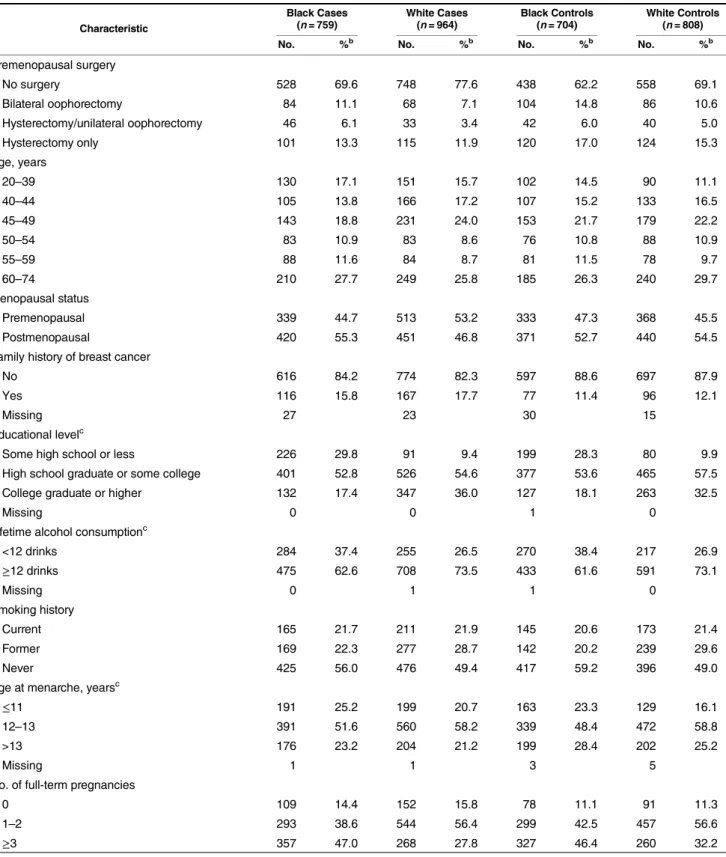
Using control data, we calculated weighted percentages for the population-representative distributions of selected char-acteristics (Table 1). Black control women appeared more likely to have had premenopausal surgeries, especially those involving bilateral oophorectomy; they represented 20.7% of the control population but 25.7% of those with a history of bilateral oophorectomy. Childbearing history was associated with premenopausal surgery: The prevalence of surgery was lower among nulliparous women, whereas women with 3 or more children or those who had theirfirst full-term pregnancy before age 25 years were more likely to have had surgery. Women who had premenopausal surgeries were more likely to have used MHT than were women who did not have surgery (85.0% of women with bilateral oopho-rectomies and 46.1% of women with hysteoopho-rectomies without oophorectomy versus 12.2% of women who did not undergo surgery). The majority of MHT users with surgeries used un-opposed estrogen, whereas the majority of women with no surgery history used a combination of progestin and estrogen. Appendix Table 1 presents characteristics by race and case-control status.
Overall breast cancer
Premenopausal gynecologic surgery was associated with reduced odds of invasive breast cancer (Table 2). Odds ratio estimates did not vary by black/white race (Wald test for interaction,P= 0.60). Overall, the multivariable-adjusted odds ratios were similar for hysterectomies involving bilateral oophorectomy, unilateral oophorectomy, or conservation of both ovaries: The multivariable-adjusted odds ratios were 0.60 (95% confidence interval (CI): 0.47, 0.77), 0.74 (95% CI: 0.53, 1.03), and 0.68 (95% CI: 0.55, 0.84), respectively.
Stratification by estrogen- and progesterone-receptor status
odds ratios were 0.69 and 0.68, respectively. Tests for in-teraction by black/white race were not significant ( for ER+ and PR+ cancers, WaldP= 0.7; for ER−and PR−cancers, WaldP= 0.9).
Joint associations with MHT
Table4lists joint associations for surgeries and hormone therapy use. Again, results did not vary significantly by race.
Table 2. History of Gynecologic Surgery and Invasive Breast Cancer Among Study Participants, Carolina Breast Cancer Study, 1993–2001
Gynecologic Surgery
Overalla Black Women White Women
No. of Cases (n= 1,664)
No. of Controls (n= 1,454)
Multivariable
Adjustedb CasesNo. of (n= 725)
No. of Controls (n= 666)
Multivariable
Adjustedb No. of Cases (n= 939)
No. of Controls (n= 788)
Multivariable Adjustedb
OR 95% CI OR 95% CI OR 95% CI
No surgery 1,236 958 1.00 Referent 505 412 1.00 Referent 731 546 1.00 Referent
Hysterectomy only 207 234 0.68 0.55, 0.84 95 113 0.65 0.48, 0.90 112 121 0.72 0.54, 0.97
Hysterectomy/ unilateral oophorectomy
77 80 0.74 0.53, 1.03 46 41 0.90 0.57, 1.42 31 39 0.59 0.36, 0.98
Bilateral oophorectomy
144 182 0.60 0.47, 0.77 79 100 0.60 0.42, 0.84 65 82 0.62 0.44, 0.89
Abbreviations: CI, confidence interval; OR, odds ratio. a
Wald test for interaction between race and gynecologic surgery:P= 0.6. b
Adjusted for age, squared age, race (when appropriate), family history of breast cancer, alcohol consumption, age at menarche, parity and age at first pregnancy composite, lactation history (ever vs. never breastfed), educational level, and smoking. Complete-case analysis was restricted to those with nonmissing values for these covariates.
Table 3. History of Gynecologic Surgery and Invasive Breast Cancer by Subtype Among Study Participants, Carolina Breast Cancer Study, 1993–2001
Cancer Subtype and Gynecologic Surgery
Overalla Black Women White Women
No. of Cases
No. of Controls
Multivariable Adjustedb No.
Cases No. Controls
Multivariable Adjustedb No.
Cases No. Controls
Multivariable Adjustedb
OR 95% CI OR 95% CI OR 95% CI
Hormone receptor– positive cancer
Total 1,005 1,454 370 666 635 788
No surgery 743 958 1.00 Referent 255 412 1.00 Referent 488 546 1.00 Referent
Hysterectomy only 129 234 0.69 0.54, 0.88 50 113 0.63 0.42, 0.93 79 121 0.74 0.53, 1.02
Hysterectomy/ unilateral oophorectomy
47 80 0.71 0.48, 1.04 23 41 0.78 0.44, 1.38 24 39 0.66 0.38, 1.13
Bilateral oophorectomy
86 182 0.58 0.43, 0.77 42 100 0.57 0.38, 0.86 44 82 0.61 0.41, 0.90
Hormone receptor– negative cancer
Total 540 1,454 302 666 238 788
No surgery 407 958 1.00 Referent 216 412 1.00 Referent 191 546 1.00 Referent
Hysterectomy only 64 234 0.68 0.50, 0.94 38 113 0.68 0.44, 1.05 26 121 0.70 0.43, 1.14
Hysterectomy/ unilateral oophorectomy
24 80 0.74 0.45, 1.22 18 41 0.90 0.49, 1.64 6 39 0.51 0.20, 1.25
Bilateral oophorectomy
45 182 0.60 0.42, 0.87 30 100 0.61 0.38, 0.98 15 82 0.60 0.33, 1.10
Abbreviations: CI, confidence interval; OR, odds ratio. a
Wald test for interaction between race and gynecologic surgery: for estrogen receptor–positive and progesterone receptor–positive cancer, P= 0.7; for estrogen receptor–negative or progesterone receptor–negative cancer,P= 0.9.
b
Pronounced inverse associations were observed for surgery with and without use of estrogen-only MHT. The multivariable-adjusted odds ratios for hysterectomy only and bilateral oopho-rectomy with estrogen-only MHT were 0.56 (95% CI: 0.42, 0.75) and 0.63 (95% CI: 0.47, 0.84), respectively. There was also the suggestion of an inverse association among those women who reported bilateral oophorectomy without MHT (odds ratio = 0.61, 95% CI: 0.36, 1.01). There was a less pro-nounced inverse association among those women who reported hysterectomy only with no MHT use (odds ratio = 0.78, 95% CI: 0.61, 0.99). In contrast, combination progestin-estrogen MHT in the absence of surgery showed a weakly elevated asso-ciation with breast cancer risk (odds ratio = 1.17, 95% CI: 0.86, 1.60). The remaining group, estrogen-only MHT use in the ab-sence of surgery, had relatively imprecise estimates and there was no strong association with cancer risk.
Stratifying by HR+ versus HR−cancers did not substantially alter the joint associations of surgery and MHT (data not shown). For both HR+ and HR−cancers, inverse associations were observed for 1) hysterectomy only with estrogen-only MHT use and 2) bilateral oophorectomy with estrogen-only MHT use. Moreover, as with overall cancer, although results were relatively imprecise, hysterectomy-only with no MHT use and bilateral oophorectomy with no MHT use showed sug-gestions of inverse associations with both HR+ and HR− cancers.
DISCUSSION
In a population-representative sample of women from North Carolina with high rates of premenopausal surgery,
we found inverse associations between premenopausal gyneco-logic surgery and the risk of breast cancer. These associations were similar for both black and white women. Additionally, we found no evidence that use of estrogen-only MHT attenuated these inverse associations. Finally, in our sample, the protective associations appeared to be of similar magnitude for HR+ and HR−breast cancers.
It is especially important to investigate this question among black women because their premenopausal hysterectomy rates have historically been high (1–3). In the only study besides ours in which whites and blacks were compared, investigators observed that black women experienced a 35% greater preva-lence of hysterectomy without oophorectomy (44.6% vs. 33.4%) and a 20% greater prevalence of bilateral oophorec-tomy (23.8% vs. 19.8%) than did white women (11). Further, among control women in our study who had ceased menstru-ating, nearly half (47%) of nonmenstruating black women had ceased menstruating before 40 years of age versus only one-third (31%) of white women. This low age at menstrual cessa-tion reflects the high rates of premenopausal gynecologic surgery among black women in the US South (1). For instance, the prevalence of premenopausal hysterectomy among women aged 21–69 years in the Black Women’s Health Study in 1995 was 20.5% (9). The prevalence among black women in our sample was greater (25.3%).
In the United States, the relatively high rates of hysterec-tomy among black women are partially due to the greater prevalence and severity of uterinefibroids, the most common indication for hysterectomy (5). Also, most black women live in the South (31), where hysterectomy rates are up to 2.5 times as common as in other parts of the United States (1). However,
Table 4. History of Gynecologic Surgery With Hormone Therapy Use and Invasive Breast Cancer Among Study Participants, Carolina Breast Cancer Study, 1993–2001
Gynecologic Surgery and Hormone Therapy
Use
Overalla Black Women White Women
No. of Cases (n= 1,581)
No. of Controls (n= 1,384)
Multivariable
Adjustedb No. of Cases (n= 714)
No. of Controls (n= 649)
Multivariable
Adjustedb No. of Cases (n= 867)
No. of Controls (n= 735)
Multivariable Adjustedb
OR 95% CI OR 95% CI OR 95% CI
No surgery
No MHT 1,008 788 1.00 Referent 457 371 1.00 Referent 551 417 1.00 Referent
Estrogen-only MHT 39 41 0.80 0.50, 1.27 16 19 0.63 0.32, 1.27 23 22 0.93 0.50, 1.74
Progestin-estrogen MHT
129 88 1.17 0.86, 1.60 25 14 1.14 0.57, 2.29 104 74 1.12 0.79, 1.59
Hysterectomy onlyc
No MHT 177 173 0.78 0.61, 0.99 108 105 0.79 0.58, 1.09 69 68 0.79 0.54, 1.14
Estrogen-only MHT 97 135 0.56 0.42, 0.75 32 48 0.48 0.29, 0.78 65 87 0.59 0.41, 0.86
Bilateral
oophorectomyc
No MHT 30 37 0.61 0.36, 1.01 25 28 0.66 0.37, 1.18 5 9 0.48 0.16, 1.48
Estrogen-only MHT 101 122 0.63 0.47, 0.84 51 64 0.58 0.38, 0.87 50 58 0.68 0.45, 1.03
Abbreviations: CI, confidence interval; MHT, menopausal hormone therapy; OR, odds ratio. a
Wald test for interaction between race and gynecologic surgery with MHT:P= 0.8. b
Adjusted for age, squared age, race (when appropriate), family history of breast cancer, alcohol consumption, age at menarche, parity and age at first pregnancy composite, lactation history (ever vs. never breastfed), educational level, and smoking. Complete-case analysis was restricted to those with nonmissing values for these covariates.
c
racial disparities persist even when controlling forfibroids prevalence, geography, and other hysterectomy risk factors (1,3).
Additionally, this research is of importance because gyne-cologic surgery rates are decreasing (32). The historically greater prevalence of premenopausal gynecologic surgeries among US black women may have contributed to the histor-ically lower overall incidence of breast cancer in this popula-tion. Therefore, the decline in the rate of premenopausal gynecologic surgeries (13) may be a novel contributor to ris-ing rates of breast cancer among black women. In 2012, the incidence of invasive breast cancer converged for US black and white women (132.2 and 131.9 per 100,000 women, re-spectively) as the incidence declined among white women and rose among black women (33). Rising breast cancer in-cidence among black women could contribute to widening racial disparities in breast cancer mortality rates (34).
Our study is one of thefirst in which researchers examined how specific formulations of MHT may interact with gyneco-logic surgery to influence breast cancer risk. In most previous studies of the associations of hysterectomy and oophorectomy with breast cancer risk, investigators adjusted for hormone therapy use without specifically examining the joint effects (9,11,16,17,35). In a study in which MHT use was exam-ined, Nichols et al. (19) found that use of unopposed estrogen after 45 years of age somewhat attenuated the protective ef-fects of premenopausal oophorectomy on postmenopausal breast cancer. Our results may differ from those of Nichols et al. because in our population, the majority of premenopausal oophorectomies were performed before age 40 years, and es-trogen use likely commenced before age 45 years.
Another unique aspect of our analyses was the evaluation of the effects of surgery on risks of different breast cancer sub-types. We found no evidence that bilateral oophorectomy or hysterectomy without oophorectomy affected risk of breast cancer differentially by hormone-receptor status. In 1 other study, investigators also found no differences in the associa-tions of surgery with ER+/PR+ versus ER−/PR−breast can-cers (35). However, our results differ fromfindings from the Black Women’s Health Study and the Women’s Contraceptive and Reproductive Experiences (Women’s CARE) case-control study (9,11). Results from these studies indicated that premenopausal bilateral oophorectomy was more strongly associated with a decreased risk of ER+/PR+ cancers versus ER−/PR−cancers. In the Black Women’s Health Study, the multivariable-adjusted hazard ratios for bilateral oophorec-tomy in women younger than 40 years of age were 0.67 (95% CI: 0.39, 1.15) for ER+ breast cancer and 1.00 (95% CI: 0.53, 1.15) for ER−breast cancer (9). In the Women’s Contraceptive and Reproductive Experiences Study, investiga-tors found a multivariable-adjusted odds ratio for bilateral oo-phorectomy and ER+/PR+ breast cancer of 0.55 (95% CI: 0.45, 0.68) versus a suggestively protective odds ratio of 0.82 (95% CI: 0.63, 1.07) for ER−/PR−breast cancer (11).
A surprisingfinding was the inverse association of breast cancer risk with hysterectomy only and no MHT use. Hyster-ectomy without oophorHyster-ectomy among younger women (i.e., <45 years of age) has been associated with a decreased breast cancer risk in some studies (11,16,17), whereas there was no association in others (9,18). Although the inverse association
we observed could be attributable to exposure misclassifi ca-tion bias (the hysterectomy–no MHT subgroup may include women who inaccurately reported hysterectomy only instead of hysterectomy with bilateral oophorectomy (26)), there is biological evidence that suggests that hysterectomy without oophorectomy may alter breast cancer risk. Studies have demonstrated earlier ovarian failure among premenopausal women who have hysterectomy without oophorectomy (5), possibly because of altered circulatory functioning in con-served ovaries after hysterectomy.
The present study was limited by several factors. As dis-cussed above, exposure assessment relied on self-reported data, which may have biased the hysterectomy-only results downward. Additionally, we did not have information on clin-ical indication for the surgery, which is a potential confounder. However, previous research has suggested that indication is not a cause of appreciable confounding bias when examining the association between premenopausal surgery and breast cancer risk (10). Finally, our analysis of cancer subtypes re-sulted in some imprecise estimates, and we did not examine the full intrinsic subtype profile. Surgery may be more strongly associated with etiologic intrinsic subtypes than hormone re-ceptor status. A larger study is needed to evaluate relationships for morefinely resolved etiologic subtypes.
This work has unique strengths. With our population-based sample of white and black women, we had the unique ability to examine how racial differences in hysterectomy rates may affect racial inequalities in breast cancer risk. Additionally, be-cause the Carolina Breast Cancer Study is conducted in the US South, the region in which the majority (55%) of black Amer-icans live (31) and in which hysterectomy rates are the highest (36), we were able to make inferences to a target population highly affected by the exposure. Moreover, in this analysis, we comprehensively studied gynecologic premenopausal sur-gery and breast cancer risk, stratifying by type of sursur-gery and use of MHT and examining associations by cancer subtypes. Another major strength is that the population-based design al-lowed us to better document the racial differences in surgery rates, including the higher prevalence of premenopausal bilat-eral oophorectomy among black women in this population. Finally, the CBCS Study used a rapid case ascertainment sys-tem to contact and interview 95% of breast cancer case patients within 12 months of diagnosis, limiting potential selection bias from differential mortality rates from those with and without gynecologic surgery.
ACKNOWLEDGMENTS
Author affiliations: Epidemiology Department, UNC Gillings School of Global Public Health, University of North Carolina at Chapel Hill, Chapel Hill, North Carolina (Whitney R. Robinson, Hazel B. Nichols, Chiu Kit Tse, Andrew F. Olshan, Melissa A. Troester); Lineberger Comprehensive Cancer Center, University of North Carolina at Chapel Hill, Chapel Hill, North Carolina (Whitney R. Robinson, Hazel B. Nichols, Andrew F. Olshan, Melissa A. Troester); and Caro-lina Population Center, University of North CaroCaro-lina at Chapel Hill, Chapel Hill, North Carolina (Whitney R. Robinson).
This research was funded in part by the University Cancer Research Fund of North Carolina and the National Cancer In-stitute Specialized Program of Research Excellence (SPORE) in Breast Cancer (National Institutes of Health/National Can-cer Institute grant P50-CA58223). W.R.R. was supported by the National Cancer Institute (grant K01-CA172717). H.B. N. was supported by the National Center for Advancing Translational Sciences (grant KL2-TR001109). M.A.T. was supported by the following grants from the National Institutes of Health: U01 CA179715, U01 ES019472, and P50 CA058223. The Carolina Population Center was supported by grant R24 HD050924.
We thank the staff of the Carolina Breast Cancer Study and the Carolina Population Center. We thank Dr. Steve Cole for his helpful comments on the analysis plan. We also thank University of North Carolina at Chapel Hill Epidemiology doctoral students Marc Emerson and Nathaniel DeBono for assistance with literature review and formatting.
Conflict of interest: none declared.
REFERENCES
1. Bower JK, Schreiner PJ, Sternfeld B, et al. Black-white differences in hysterectomy prevalence: the CARDIA study. Am J Public Health. 2009;99(2):300–307.
2. Jacoby VL, Fujimoto VY, Giudice LC, et al. Racial and ethnic disparities in benign gynecologic conditions and associated surgeries.Am J Obstet Gynecol. 2010;202(6):514–521. 3. Powell LH, Meyer P, Weiss G, et al. Ethnic differences in past
hysterectomy for benign conditions.Womens Health Issues. 2005;15(4):179–186.
4. Merrill RM. Hysterectomy surveillance in the United States, 1997 through 2005.Med Sci Monit. 2008;14(1):Cr24–Cr31. 5. Moorman PG, Myers ER, Schildkraut JM, et al. Effect of
hysterectomy with ovarian preservation on ovarian function. Obstet Gynecol. 2011;118(6):1271–1279.
6. Jacoby VL, Vittinghoff E, Nakagawa S, et al. Factors associated with undergoing bilateral salpingo-oophorectomy at the time of hysterectomy for benign conditions.Obstet Gynecol. 2009; 113(6):1259–1267.
7. American College of Obstetricians and Gynecologists. ACOG Practice Bulletin No. 89. Elective and risk-reducing Salpingo-oophorectomy.Obstet Gynecol. 2008;111(1): 231–241.
8. Parker WH, Broder MS, Chang E, et al. Ovarian conservation at the time of hysterectomy and long-term health outcomes in the Nurses’Health Study.Obstet Gynecol. 2009;113(5):
1027–1037.
9. Boggs DA, Palmer JR, Rosenberg L. Bilateral oophorectomy and risk of cancer in African American women.Cancer Causes Control. 2014;25(4):507–513.
10. Nichols HB, Visvanathan K, Newcomb PA, et al. Bilateral oophorectomy in relation to risk of postmenopausal breast cancer: confounding by nonmalignant indications for surgery? Am J Epidemiol. 2011;173(10):1111–1120.
11. Press DJ, Sullivan-Halley J, Ursin G, et al. Breast cancer risk and ovariectomy, hysterectomy, and tubal sterilization in the Women’s Contraceptive and Reproductive Experiences Study. Am J Epidemiol. 2011;173(1):38–47.
12. Nichols HB, Trentham-Dietz A, Newcomb PA, et al. Pre-diagnosis oophorectomy, estrogen therapy and mortality in a cohort of women diagnosed with breast cancer.Breast Cancer Res. 2013;15(5):R99.
13. Wright JD, Herzog TJ, Tsui J, et al. Nationwide trends in the performance of inpatient hysterectomy in the United States. Obstet Gynecol. 2013;122(2 Pt 1):233–241.
14. Lowder JL, Oliphant SS, Ghetti C, et al. Prophylactic bilateral oophorectomy or removal of remaining ovary at the time of hysterectomy in the United States, 1979–2004.Am J Obstet Gynecol. 2010;202(6):538.e1–538.e9.
15. Krieger N, Chen JT, Waterman PD. Temporal trends in the black/white breast cancer case ratio for estrogen receptor status: disparities are historically contingent, not innate.Cancer Causes Control. 2011;22(3):511–514.
16. Gaudet MM, Gapstur SM, Sun J, et al. Oophorectomy and hysterectomy and cancer incidence in the Cancer Prevention Study-II Nutrition Cohort.Obstet Gynecol. 2014;123(6): 1247–1255.
17. Parazzini F, Braga C, La Vecchia C, et al. Hysterectomy, oophorectomy in premenopause, and risk of breast cancer. Obstet Gynecol. 1997;90(3):453–456.
18. Woolcott CG, Maskarinec G, Pike MC, et al. Breast cancer risk and hysterectomy status: the Multiethnic Cohort Study.Cancer Causes Control. 2009;20(5):539–547.
19. Nichols HB, Trentham-Dietz A, Newcomb PA, et al. Postoophorectomy estrogen use and breast cancer risk.Obstet Gynecol. 2012;120(1):27–36.
20. Carey LA, Perou CM, Livasy CA, et al. Race, breast cancer subtypes, and survival in the Carolina Breast Cancer Study. JAMA. 2006;295(21):2492–2502.
21. Merrill RM, Layman AB, Oderda G, et al. Risk estimates of hysterectomy and selected conditions commonly treated with hysterectomy.Ann Epidemiol. 2008;18(3):253–260. 22. Newman B, Moorman PG, Millikan R, et al. The Carolina
Breast Cancer Study: integrating population-based
epidemiology and molecular biology.Breast Cancer Res Treat. 1995;35(1):51–60.
23. Weinberg CR, Sandler DP. Randomized recruitment in case-control studies.Am J Epidemiol. 1991;134(4):421–432. 24. Weinberg CR, Wacholder S. The design and analysis of
case-control studies with biased sampling.Biometrics. 1990; 46(4):963–975.
25. Colditz GA, Stampfer MJ, Willett WC, et al. Reproducibility and validity of self-reported menopausal status in a prospective cohort study.Am J Epidemiol. 1987;126(2):319–325. 26. Phipps AI, Buist DS. Validation of self-reported history of
hysterectomy and oophorectomy among women in an integrated group practice setting.Menopause. 2009;16(3): 576–581.
27. Selvin S. A note on the power to detect interaction effects. In: Statistical Analysis of Epidemiologic Data. 2nd ed. New York, NY: Oxford University Press; 1996:213–214.
29. Rothman KJ, Greenland S, Lash TL. Matching in case-control studies. In: Rothman KJ, Greenland S, Lash TL, eds.Modern Epidemiology. 3rd ed. Philadelphia, PA: Lippincott, Williams & Wilkins; 2008:175–179.
30. Greenland S. Analysis of data from matched studies. In: Rothman KJ, Greenland S, Lash TL, eds.Modern
Epidemiology. 3rd ed. Philadelphia, PA: Lippincott, Williams & Wilkins; 2008:283–284.
31. Rastogi S, Johnson TD, Hoeffel EM, et al.The Black Population: 2010. Washington, DC: U.S. Department of Commerce, US Census Bureau; 2011.https://www.census.gov/prod/cen2010/ briefs/c2010br-06.pdf. Accessed August 2, 2016.
32. Asante A, Whiteman MK, Kulkarni A, et al. Elective oophorectomy in the United States: trends and in-hospital complications, 1998–2006.Obstet Gynecol. 2010;116(5): 1088–1095.
33. Howlader N, Noone AM, Krapcho M, et al, eds.SEER Cancer Statistics Review, 1975–2012. Bethesda, MD: National Cancer Institute; 2015.http://seer.cancer.gov/archive/csr/1975_2012/. Accessed August 2, 2016.
34. Sighoko D, Fackenthal JD, Hainaut P. Changes in the pattern of breast cancer burden among African American women: evidence based on 29 states and District of Columbia during 1998 to 2010.Ann Epidemiol. 2015;25(1):15.e10–25.e10. 35. Cui Y, Deming-Halverson SL, Beeghly-Fadiel A, et al.
Interactions of hormone replacement therapy, body weight, and bilateral oophorectomy in breast cancer risk.Clin Cancer Res. 2014;20(5):1169–1178.
36. Wu JM, Wechter ME, Geller EJ, et al. Hysterectomy rates in the United States, 2003.Obstet Gynecol. 2007;110(5):1091–1095. 37. DeSantis C, Ma J, Bryan L, et al. Breast cancer statistics, 2013.
CA Cancer J Clin. 2014;64(1):52–62.
Appendix Table 1. Characteristics of Case and Control Patients by Racea, Carolina Breast Cancer Study Phases 1 and 2, 1993
–2001
Characteristic
Black Cases (n= 759)
White Cases (n= 964)
Black Controls (n= 704)
White Controls (n= 808)
No. %b No. %b No. %b No. %b
Premenopausal surgery
No surgery 528 69.6 748 77.6 438 62.2 558 69.1
Bilateral oophorectomy 84 11.1 68 7.1 104 14.8 86 10.6
Hysterectomy/unilateral oophorectomy 46 6.1 33 3.4 42 6.0 40 5.0
Hysterectomy only 101 13.3 115 11.9 120 17.0 124 15.3
Age, years
20–39 130 17.1 151 15.7 102 14.5 90 11.1
40–44 105 13.8 166 17.2 107 15.2 133 16.5
45–49 143 18.8 231 24.0 153 21.7 179 22.2
50–54 83 10.9 83 8.6 76 10.8 88 10.9
55–59 88 11.6 84 8.7 81 11.5 78 9.7
60–74 210 27.7 249 25.8 185 26.3 240 29.7
Menopausal status
Premenopausal 339 44.7 513 53.2 333 47.3 368 45.5
Postmenopausal 420 55.3 451 46.8 371 52.7 440 54.5
Family history of breast cancer
No 616 84.2 774 82.3 597 88.6 697 87.9
Yes 116 15.8 167 17.7 77 11.4 96 12.1
Missing 27 23 30 15
Educational levelc
Some high school or less 226 29.8 91 9.4 199 28.3 80 9.9
High school graduate or some college 401 52.8 526 54.6 377 53.6 465 57.5
College graduate or higher 132 17.4 347 36.0 127 18.1 263 32.5
Missing 0 0 1 0
Lifetime alcohol consumptionc
<12 drinks 284 37.4 255 26.5 270 38.4 217 26.9
≥12 drinks 475 62.6 708 73.5 433 61.6 591 73.1
Missing 0 1 1 0
Smoking history
Current 165 21.7 211 21.9 145 20.6 173 21.4
Former 169 22.3 277 28.7 142 20.2 239 29.6
Never 425 56.0 476 49.4 417 59.2 396 49.0
Age at menarche, yearsc
≤11 191 25.2 199 20.7 163 23.3 129 16.1
12–13 391 51.6 560 58.2 339 48.4 472 58.8
>13 176 23.2 204 21.2 199 28.4 202 25.2
Missing 1 1 3 5
No. of full-term pregnancies
0 109 14.4 152 15.8 78 11.1 91 11.3
1–2 293 38.6 544 56.4 299 42.5 457 56.6
≥3 357 47.0 268 27.8 327 46.4 260 32.2
Appendix Table 1. Continued
Characteristic
Black Cases (n= 759)
White Cases (n= 964)
Black Controls (n= 704)
White Controls (n= 808)
No. %b No. %b No. %b No. %b
Age at first full-term pregnancy, yearsc
Nulliparous 109 14.5 152 15.8 78 11.1 91 11.3
≤24 520 69.1 479 49.7 503 71.8 456 56.4
25–29 78 10.4 211 21.9 72 10.3 177 21.9
≥30 46 6.1 122 12.7 48 6.8 84 10.4
Missing 6 0 3 0
Breast feeding
Nulliparous 109 14.4 152 15.8 78 11.1 91 11.3
Parous, never 431 56.8 432 44.8 377 53.6 380 47.0
Parous, ever 219 28.9 380 39.4 249 35.4 337 41.7
Age at menstrual cessation, yearsc,d
Premenopausal or on MHT 286 38.2 450 46.9 272 39.1 337 42.0
≤39 133 17.8 104 10.8 150 21.6 120 15.0
40–44 79 10.6 100 10.4 80 11.5 97 12.1
45–49 114 15.2 160 16.7 99 14.2 135 16.8
50–54 101 13.5 117 12.2 71 10.2 89 11.1
55–59 30 4.0 25 2.6 22 3.2 22 2.7
60–74 5 0.7 4 0.4 1 0.1 2 0.2
Missing 11 4 9 6
MHT use
Ever 144 19.0 323 33.5 165 23.4 302 37.4
Never 615 81.0 641 66.5 539 76.6 506 62.6
Duration of MHT use, yearsc
Never 615 81.2 641 66.9 539 76.7 506 62.7
<5 87 11.5 157 16.4 97 13.8 144 17.8
5–10 38 5.0 85 8.9 36 5.1 67 8.3
>10 17 2.2 75 7.8 31 4.4 90 11.2
Missing 2 6 1 1
MHT type
None 615 81.0 641 66.5 539 76.6 506 62.6
Unopposed estrogen only 104 13.7 145 15.0 131 18.6 169 20.9
Progestin-estrogen combination 28 3.7 106 11.0 15 2.1 75 9.3
Progestin sometimes with estrogen 7 0.9 41 4.3 10 1.4 39 4.8
Progestin only 4 0.5 21 2.2 9 1.3 13 1.6
Estrogen and progestin never simultaneously 1 0.1 10 1.0 0 0 6 0.7
Abbreviation: MHT, menopausal hormone therapy. a
Restricted to black and white women. We excluded women whose surgery status or specific surgery type was unknown. We also excluded women who reported premenopausal hysterectomy and use of progestin-estrogen combination therapy.
b
Percentages are not weighted. c
Women for whom data were missing were not included in the denominator. d