Global analysis of genomic instability caused by DNA
replication stress in
Saccharomyces cerevisiae
Dao-Qiong Zhenga,b,1, Ke Zhangc,1, Xue-Chang Wuc, Piotr A. Mieczkowskid, and Thomas D. Petesb,2
aInstitute of Marine Biology, Ocean College, Zhejiang University, Zhoushan 316021, China;bDepartment of Molecular Genetics and Microbiology, Duke
University School of Medicine, Durham, NC 27710;cInstitute of Microbiology, College of Life Science, Zhejiang University, Hangzhou 310058, China;
anddDepartment of Genetics, University of North Carolina, Chapel Hill, NC 27599
Contributed by Thomas D. Petes, November 1, 2016 (sent for review September 15, 2016; reviewed by Victoria Lundblad and Jasper Rine)
DNA replication stress (DRS)-induced genomic instability is an important factor driving cancer development. To understand the mechanisms of DRS-associated genomic instability, we measured the rates of genomic alterations throughout the genome in a yeast strain with lowered expression of the replicative DNA polymerase δ. By a genetic test, we showed that most recombinogenic DNA lesions were introduced during S or G2 phase, presumably as a consequence of broken replication forks. We observed a high rate of chromosome loss, likely reflecting a reduced capacity of the low-polymerase strains to repair double-stranded DNA breaks (DSBs). We also observed a high frequency of deletion events within tandemly repeated genes such as the ribosomal RNA genes. By whole-genome sequencing, we found that low levels of DNA polymeraseδelevated mutation rates, both single-base mutations and small insertions/ deletions. Finally, we showed that cells with low levels of DNA po-lymerase δtended to accumulate small promoter mutations that increased the expression of this polymerase. These deletions con-ferred a selective growth advantage to cells, demonstrating that DRS can be one factor driving phenotypic evolution.
DNA replication stress
|
DNA polymerase|
genome instabilityI
n normal rapidly dividing cells, DNA replication is rapid and accurate, preventing the accumulation of genomic alterations. Stalling of replication forks or inappropriate initiation of repli-cation origins can result in DNA replirepli-cation stress (DRS) that can contribute to cancer development (1). It has been proposed that mutations in oncogenes and tumor suppressor genes drive cell proliferation and induce DRS. In turn, DRS generates ge-nome instability, allowing cells with various types of genetic varia-tions (mutavaria-tions, duplicavaria-tions, translocavaria-tions) to escape cellular senescence and apoptosis (2). However, the mechanisms by which oncogenes induce DRS and the precise nature of DRS-associated DNA lesions have not been clearly defined.Exposure of mammalian cells in culture to conditions that perturb DNA synthesis result in“fragile sites,”gaps or constrictions detected by light microscopy in metaphase chromosomes (3). Aphidicolin, a drug that inhibits DNA polymerase, is one agent that induces fragile sites. The break points of chromosome rearrangements that occur in tumor cells often colocalize with fragile sites (3, 4), establishing another link between DRS and cancer. In addition to inducing chromosome breaks in cultured cells, aphidicolin induces high frequencies of duplications and deletions similar to those observed in tumor cells (5).
As a model for mammalian fragile sites, we previously con-structed yeast strains in which the transcription of the replicative DNA polymerases α (encoded by POL1) or δ (encoded by POL3) was regulated by theGAL1promoter (6–8). Under low-galactose growth conditions, which reduced the levels of DNA polymerasesαorδabout 10-fold, these strains had elevated rates of chromosome loss and rearrangements on chromosome III.
We also studied genome stability in diploid strains heterozygous for many (>50,000) single-nucleotide polymorphisms (SNPs) by using SNP-specific microarrays to detect loss of heterozygosity (LOH) and other genomic alterations (9). We applied this method
to map events associated with low DNA polymerase α, and showed that LOH events were often associated with chromosome elements [such as quadruplex motifs, termination (ter) sequences, and long-terminal repeats (LTRs)] that slow replication forks (10). In addition to the LOH and chromosomal rearrangements, single-base mutations and small insertions/deletions (in/dels) are also prevalent in some solid tumors (11). In our previous study (6), we found low levels of DNA polymerase-δ–induced muta-tions in theCAN1gene. However, the global mutagenic effects of reduced expression of DNA polymeraseδare unknown.
In the current study, by a combination of microarray analysis and whole-genome sequencing, we examine the effects of low levels of DNA polymeraseδon the rates of mitotic recombina-tion, large (>1-kb) deletions and duplications, aneuploidy, single-base mutations, and small in/dels throughout the genome. We show that some of the observed alterations alleviate DRS. Our findings are relevant to the mechanism by which DRS drives ge-nome instability, and the mechanism by which genetic alterations allow cells to escape DRS.
Results
As described below, we characterized genetic instability induced by low levels of DNA polymeraseδby two methods: SNP-specific
Significance
One important source of genomic instability associated with tumor cells is DNA replication stress. In the current study, replication stress was induced in yeast by a 10-fold reduction in the level of the replicative DNA polymeraseδ. By DNA micro-array analysis and high-throughput DNA sequencing, we showed that this stress resulted in very high rates of both large (aneuploidy, mitotic recombination, deletions and duplications, and translocations) and small (point mutations and small in-sertion/deletions) genetic alterations. Some of these changes resulted in a selective growth advantage of the cells, demon-strating the role of elevated genetic instability in the rapid evolution of cells in challenging growth conditions.
Author contributions: D.-Q.Z. and T.D.P. designed research; D.-Q.Z., K.Z., and P.A.M. per-formed research; X.-C.W. and P.A.M. contributed new reagents/analytic tools; D.-Q.Z., K.Z., X.-C.W., P.A.M., and T.D.P. analyzed data; and D.-Q.Z., K.Z., and T.D.P. wrote the paper.
Reviewers: V.L., Salk Institute for Biological Studies; and J.R., University of California, Berkeley.
The authors declare no conflict of interest.
Freely available online through the PNAS open access option.
Data deposition: The microarray data reported in this paper have been deposited in the Gene Expression Omnibus (GEO) database,www.ncbi.nlm.nih.gov/geo(accession no. GSE78856). The sequencing data reported in this paper have been deposited in the Na-tional Center for Biotechnology Information Sequence Read Archive (SRA) (accession no. SRP071648).
1D.-Q.Z. and K.Z. contributed equally to this work.
2To whom correspondence should be addressed. Email: [email protected].
microarrays (allowing the mapping of mitotic crossovers, large de-letions/duplications, and ploidy alterations) and DNA sequencing (allowing the detection of point mutations, small deletions/dupli-cations, and changes in the copy number of repeated genes). Cer-tain features of the instability are similar to those observed in strains with low levels of DNA polymeraseα(for example, the association between recombination break points and hard-to-replicate genomic sequences), whereas others are quite different (for example, the ratio of ploidy alterations to mitotic recombination events, and el-evated levels of point mutations).
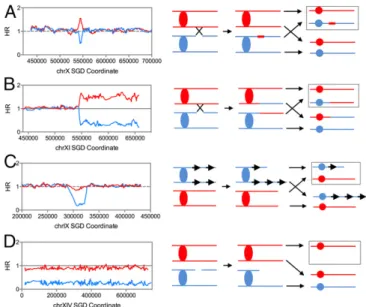
System for Detecting Genomic Alterations by SNP-Specific Microarrays. We mapped LOH events and other chromosome alterations using SNP-specific microarrays as described previously (9). The diploid used in our experiment (DZ12) was constructed by crossing haploid strains of two sequence-diverged backgrounds, one isogenic with W303-1A (12) and one isogenic with YJM789 (13). These resulting diploid is heterozygous for about 55,000 SNPs. In DZ12, LOH events or ploidy alterations can be detected using SNP-specific microarrays. We designed arrays with 25-base oligonucleotides distributed throughout the genome that allow us to detect LOH at 13,000 positions. Each position is represented by four oligonucle-otides, two with the Watson and Crick sequences of the W303-1A– specific allele and two with the Watson and Crick sequences of the YJM789-specific allele. By measuring the hybridization levels to each of these oligonucleotides (Supporting Information), we can detect LOH events and other alterations. Among the alterations detected in our experiments are gene conversion events (interstitial LOH events in which sequences from one homolog are duplicated and sequences from the other homolog are lost; Fig. 1A), crossovers
(terminal LOH events in which sequences from one homolog are duplicated and sequences from the other are lost; Fig. 1B), large deletions (Fig. 1C) or duplications, and ploidy changes (Fig. 1D).
The DZ12 strain was also homozygous for an insertion of the GAL1 promoter upstream of the coding sequence of POL3. When this strain was grown in low-galactose medium, the strain grew slowly and had an elongated S phase (Fig. S1). Under these conditions, the level of DNA polymeraseδis approximately 10-fold less than the level observed in a wild-type strain (6). When the strain is grown in high-galactose medium, the strain grew at approximately the same rate as a wild-type strain (Fig. S1B) and had a level of DNA polymeraseδthat is about 7-fold higher than wild type (6). Last, we deleted theMATαlocus from the diploid to prevent sporulation and to allow synchronization of the dip-loid using theαpheromone.
Characterization of LOH Events in DZ12.Single cells of strain DZ12 were allowed to form colonies on solid low-galactose medium. Because such colonies are likely to contain subpopulations of cells with different genotypes, we restreaked cells from 35 in-dependent colonies to high-galactose medium in which the cells have much reduced rates of instability (6). Single colonies from the high-galactose plates derived from each of the original 35 colonies grown on low-galactose plates were subsequently ana-lyzed by SNP-specific microarrays to detect LOH events and other chromosome alterations. Among the 35 isolates, we de-tected a total of 21 interstitial LOH events (gene conversions) and 69 terminal LOH events. There are two alternative mecha-nisms for generating terminal LOH events, crossovers and break-induced replication (BIR) events. In BIR events, a broken chromatid invades the other homolog and copies sequences from the point of invasion to the end of the chromosome (14). In wild-type diploid cells, DSBs are more frequently repaired by crossing over than BIR (15). Because the distinction between crossovers and BIR requires the recovery of both daughter cells, terminal LOH events in which sequences from one homolog are lost and sequences from the other homolog are duplicated will be de-scribed as“crossover/BIR”events.
The locations [SaccharomycesGenome Database (SGD) co-ordinates] of break points of LOH events are inDataset S1. All LOH events were assigned a class (depicted in Dataset S2) depending on whether the event was a terminal or interstitial event, and which chromatid was the recipient of information. From previous studies of recombination (16), the chromosome with the recombinogenic DNA lesion acts as the recipient of sequences from the intact donor. In Fig. 1A, for example, we infer that the initiating DNA break was on the YJM789-derived homolog.
We also identified large interstitial deletions and duplications (Datasets S3.1andS4). In these isolates, the hybridization signal for one homolog is reduced (deletion) or elevated (duplication), whereas the signal for the other homolog is unchanged. In Fig. 1C, we show a heterozygous deletion in which sequences were lost from the W303-1A–derived copy of chromosome IX in isolate DZ12-7. Of the 41 interstitial deletion/duplications de-tected in the 35 colonies, 21 were within the tandem cluster of CUP1 genes, 10 involved homologous recombination between nonallelic Ty transposons, and 4 were between solo LTRs in-cluding the event shown in Fig. 1C. Six events were deletions between tandemly repeated HXTgenes. In summary, the main source of large interstitial deletions and duplications is homol-ogous recombination between ectopic repeats rather than non-homologous end joining. Interstitial deletions outnumbered interstitial duplications 37 to 4.
Dataset S3.2 lists 6 terminal duplications and 10 terminal deletions. We found most (12 of 16) terminal alterations were paired events: a terminal duplication and a terminal deletion within one strain with break points that involved Ty elements
Fig. 1. Examples of LOH and other genomic rearrangements detected by microarray. (A) Microarray analysis of a gene conversion event on chromo-some X in isolate DZ12-3. Theyaxis shows the normalized hybridization ratio between W303-1A–specific SNPs (red) and YJM789-specific SNPs (blue); thex axis shows SGD coordinates numbered from the left telomere. A moving window that includes the hybridization values of nine SNPs is shown. On the right side of the figure, the chromatids are shown as horizontal lines connected by ovals (centromeres). The daughter cell with the chromosomes represented by the microarray is outlined. (B) Microarray analysis of a crossover (or break-induced replication event) on chromosome XI in isolate DZ12-2. (C) A heterozygous deletion on chromosome IX in isolate DZ12-7. Because the break points of the deletion occur at repetitiveδelements (indicated as arrows on the right side of the figure), one possible mechanism of deletion formation is unequal crossing over. (D) Microarray analysis of an isolate monosomic for chromosome XIV (DZ12-2).
GENET
ICS
PNAS
chromosome IV was duplicated (Fig. S2A) and a region of chromosome VI was deleted (Fig. S2B). We previously found that a break in or near a Ty element on one chromosome could be repaired by break-induced replication using an ectopic Ty element on a nonhomologous chromosome as a template (Fig. S2C). The expected size of the translocated chromosome is about 655 kb, and a chromosome of this size was detected (Fig. S2D). The locations of the LOH events, and internal and ter-minal deletions/duplications are in Fig. 2A.
Analysis of Aneuploidy in DZ12.The same 35 colonies examined for LOH events had many changes in chromosome number. We observed 97 monosomic chromosomes and 8 trisomic chromosomes (Table S1). We also observed 11 uniparental disomy (UPD) events in which the diploid has two copies of the homolog, but both copies are derived from one of the two parental homologs. Two-way hi-erarchical clustering analysis of these aneuploidy events was per-formed using the R package“pheatmap.”By aχ2test, monosomy for chromosomes V and XIV is significant (P < 0.05), elevated compared with the other homologs.
inDataset S5. A small number of additional changes that were detected only by DNA sequencing are described below and in Dataset S6. Although we previously found elevated rates of LOH and ploidy changes in strains with low levels of DNA polymerase α(10), strains with low levels of DNA polymeraseδhad a rel-atively higher ratio of ploidy alterations (Fig. S3).
One cycle of growth in low-galactose medium resulted in an average of 14 alterations/isolate and 8 alterations/isolate for the strains with low levels of DNA polymeraseαandδ, respectively. Because it takes about 25 divisions to form a colony from a single cell, the rates of alterations per cell division in the strains with low levels of DNA polymeraseα andδare about 0.6 and 0.3, respectively. By a similar calculation using the data of O’Connell et al. (17), the rate of genetic alterations in wild-type cells is about 2.4×10⁻³ per division. Thus, low levels of either DNA polymeraseαor δelevate genomic instability by about two or-ders of magnitude. We also examined six isolates of DZ12 that were grown from a single cell to a colony on high-galactose medium. These isolates had an average of less than one genomic alteration per isolate. In summary, replication stress imposed by
low levels of two different components of the replisome result in similar levels of genomic instability.
Association of LOH Events with Elements of Chromosome Sequence or Structure. In yeast, certain motifs/sequences, including tRNA genes, Ty elements, LTRs, centromeres, DNA replication ori-gins/terminations, G4 motifs, highly transcribed genes, and pause sites for Rrm3p are associated with slow-moving replication forks (Supporting Information). Longer pausing of replication forks increases the risk of fork collapse and DSBs. Phosphory-lation of histone H2AX is an early response to DNA damage in eukaryotes, and regions of accumulatedγ-H2AX were mapped as indicators of genomic fragile sites (18). Using aχ2analysis, we examined whether certain chromosomal elements were signifi-cantly overrepresented or underrepresented at the break points of genomic rearrangements.
We found four types of elements that were significantly overrepresented at recombination break points (Table S2): G4-/quadruplex-motifs, Ty elements, autonomously replicating sequence (ARS) elements, andγ-H2AX–enriched regions. The G4 motifs and theγ-H2AX–enriched regions are associated with slow-moving replication forks in wild-type cells, and the G4 motifs were overrepresented in our analysis of rearrangements induced by low polymerase α (10). In addition, several of the motifs that were significant in the low–polymerase-α dataset, such as replication-termination sequences, were nearly signifi-cant [uncorrected probability (P) value of 0.03] in strains with low polymeraseδ. As an alternative method of comparing the two sets of data, we compared the ratio of observed events/ expected events for the various classes of motifs (Fig. S4). The correlation coefficient was 0.75 and thePvalue was 0.002, con-firming that replication stresses induced by low levels of two different DNA polymerases have shared properties.
Induction of Reciprocal Crossovers by Replication Stress.We pre-viously developed a genetic system that allowed detection and mapping of reciprocal crossovers on the right arm of chromo-some IV (19). Diploids for this purpose are homozygous for the ochre-suppressible ade2-1 allele, and heterozygous for an in-sertion of the ochre-suppressing tRNA SUP4-o near the right telomere of chromosome IV. Strains with zero, one, and two copies
of SUP4-oresult in colonies that are red, pink, and white, re-spectively. A reciprocal crossover produces a red/white sectored colony (Fig. S5). To induce replication stress, we incubated DZ12 in medium with no galactose for 6 h, and then plated the culture in medium with high galactose. The frequency of red/white sectored colonies was 1.4×10⁻²(0.8–2.2×10⁻²; 95% confidence limits). The frequency of sectored colonies in an isogenic wild-type strain is 3.1×10⁻⁵. Thus, replication stress stimulates reciprocal cross-overs about 500-fold.
Using SNP-specific microarrays, we mapped the transitions between heterozygous SNPs and homozygous ones. In addition to allowing us to map LOH associated with crossovers, the microarray analysis allows us to examine nonreciprocal LOH events (gene conversions) that are often associated with cross-overs. From previous studies of spontaneous crossovers on chromosome IV, two classes of conversion are observed, those in which only one sister chromatid has a region of nonreciprocal LOH (Fig. S5A) and those in which two chromatids have such regions (Fig. S5B). The first class of event (3:1 conversions) is likely to reflect the repair of a single chromatid broken in S or G2, whereas the second class (4:0 conversions) is likely to reflect the repair of two sister chromatids, resulting from replication of a chromosome broken in G1. About two-thirds of the sponta-neous crossovers in wild-type cells involve the repair of two sister chromatids (19).
The positions of the crossovers (SGD coordinates) in 34 red/ white sectored colonies are inDataset S7. Out of the 30 single-crossover events, 11 had no detected conversion tract (class A1, Dataset S8) and 19 have 3:1 conversion events (classes B1 and B2); 4 had two independent exchanges (class C). No 4:0 con-version tracts were observed. These results demonstrate that low levels of polymerase δgenerate high levels of S/G2-associated DNA lesions, as expected for cells experiencing replicative stress. Similar events were observed in cells with low levels of poly-meraseα(10). The median length of conversion tracts associated with crossovers in DZ12 was 7.1 kb (95% confidence limits of 5.1–19.8 kb), similar to spontaneous conversions (10.6 kb) and conversions induced by low polymeraseα(6.3 kb).
St. Charles and Petes (19) previously identified several hot spots (HS1–HS7) for spontaneous crossovers on the right arm of chromosome IV (Fig. 3A). This distribution is clearly different from that induced by low levels of polymeraseδ(Fig. 3B). The strong HS3 and HS4 spontaneous recombination hot spots were not prominent under replication stress. In contrast, the HS5 hot spot is enriched for recombination events in DZ12 (P<0.001, by Fisher exact test). This region contains three closely linked re-peated genes:HXT7,HXT6, andHXT3(Fig. 3B). In addition to the crossovers that map to this region, we observed six internal deletions betweenHXT7andHXT6within the sectored colonies (Dataset S9).
To examine what sequences/elements contribute to the HS5 hot-spot activity, we constructed diploid strains heterozygous for URA3andHIS3insertions flanking the hot spot (Fig. S6A). Five related diploids were generated: DZ67 (wild-type HS5 hot spot), DZ67d7 (deletion ofHXT7withhphMX4), DZdA (deletion of ARS432), DZ67d6 (deletion ofHXT6), and DZ67d3 (deletion of HXT3) (Fig. S6B). For all five strains, a crossover betweenHIS3 andURA3will produce a cell that is 5-FOARHis+. As shown in Fig. S6C, deletion of either HXT7 or HXT3resulted in a sig-nificant loss of hot-spot activity, whereas deletion ofARS432or HXT6led to small increases in recombination activity.
Genomic DNA Sequencing to Identify Small (<1-kb) Genomic Alterations in DZ12 Strains.To find alterations (point mutations and small in/dels) that would be undetectable by microarrays, we sequenced 15 out of the 35 DZ12-derived colonies grown on plates with low levels of galactose. We used Illumina paired-end high-throughput sequencing. All recombination events in the
Fig. 3. Spontaneous recombination events and events induced by low levels of DNA polymeraseδ on the right arm of chromosome IV. These plots summarize the number of times a SNP is included in conversion tracts as-sociated with a crossover on chromosome IV. (A) Conversion tract distribu-tion of spontaneous events (19). The labels HS1–HS7 are hot spots for crossovers. (B) Conversion tracts associated with low levels of DNA poly-meraseδin DZ12. The highest peak contains the tandem array of the closely relatedHXT7/6/3genes.
GENET
ICS
PNAS
15 mutants previously detected by the microarray were confirmed by sequencing. Some findings obtained from the sequencing data are described below.
New LOH events.Although there are about 55,000 SNPs that dis-tinguish the homologs of the hybrid strain, only about one-fourth of these SNPs (about 13,000) can be detected by microarray analysis (9). In our current analysis, in the 15 sequenced mutants, we detected 22 gene conversion events, of which 6 were already detected by microarray and 16 were new (Dataset S6). Most of the newly discovered conversion events had short tracts (median value of 1.7 kb; Dataset S6) compared with those detected by microarrays (Fig. S7). DNA sequencing also revealed that some conversion tracts were more complex than was evident from the microarray analysis (Fig. S8). In summary, although no addi-tional crossovers or large (>5-kb) deletions or duplications were detected by sequencing, microarrays detected only about 30% of the gene conversion events.
Copy number variations in genomic regions with tandem repeats. Tan-demly repeated genes represent about 10% of Saccharomyces cerevisiaegenome (SGD:www.yeastgenome.org). Most of these repeated genes are not represented on our microarrays. By cal-culating the coverage of DNA sequencing reads from these re-gions, however, we were able to determine copy number changes for both the W303-1A–and YJM789-derived repeated genes.
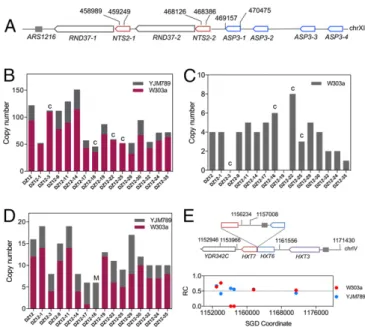
The 9-kb ribosomal RNA genes form a cluster of about 150 tandem repeats on chromosome XII (20). In our analysis, we used four SNPs that distinguish the ribosomal DNA (rDNA) repeats of W303-1A from those of YJM789 (Fig. 4A). Coverage
repeated genes to the average number of reads for single-copy sequences (details inSupporting Information). The copy number of rDNA repeats in the starting DZ12 strain was about 122, of which 94 were derived from W303-1A and 28 were from YJM789 (Fig. 4B). The number of rDNA repeats per strain varied be-tween 46 and 151 with a significant bias toward fewer repeats than the control strain. Because most of the isolates with altered numbers of repeats were not associated with a crossover between homologs, it is likely that the variation in copy number is a consequence of intrachromatid or sister chromatid recombination as will be discussed further below.
In some yeast strains, the centromere-distal end of the rDNA is adjacent to 3.6-kb repeats, each containing one copy ofASP3 and a variant 5S rRNA gene (Fig. 4A, SGD website). From our analysis, we calculate that there are four copies of this repeat in the genome of W303-1A, but none in the YJM789 genome. Seven of the 15 isolates had an alteration in the number of re-peats (Fig. 4C).
In a survey of 100 differentS. cerevisiae strains, about two-thirds have tandem arrays ofCUP1repeats (21, 22). Strain DZ12 has about 16 copies ofCUP1, with 12 copies on the W303-1A– derived homolog and 4 on the YJM789 homolog (Fig. 4D). As observed for the rDNA, arrays in the 15 isolates were very fre-quently altered in size, and deletions outnumbered duplications. TheHXT3,HXT6, andHXT7genes are clustered as a tandem array on chromosome IV.HXT6andHXT7are almost identical (99.8% identity), whereasHXT3is 85% identical toHXT6/7. In the sectored colonies resulting from crossovers on chromosome IV, this cluster is a hot spot for LOH events (HS5 in Fig. 3B; Dataset S7) and for deletions that were associated with cross-overs (Dataset S9). In addition, we found that 6 of the 35 unsec-tored colonies had deletions betweenHXT6andHXT7, resulting in a fusion of these two genes and loss of the intergenic region (Fig. 4E).
Fig. 4. CNV of repeated genes in strains with low levels of DNA polymerase δ. The copy numbers of each class of repeat were determined by DNA se-quencing, using the number of “reads”for each repeat relative to the number of reads for single-copy sequences. (A) Depictions of ribosomal RNA andASP3genes on chromosome XII; only 2 of the 150 copies of the rRNA genes are shown. The indicated SNPs in the nontranscribed spacer region were used to measure the copy numbers of W303-1A–and YJM789-derived rRNA genes. (B) Numbers of rRNA genes in 15 sequenced isolates compared with the parental strain DZ12. The gray and purple colors indicate YJM789-and W303-1A–derived repeats, respectively. In isolates labeled“C,”there was a crossover within the rDNA. (C) The number ofASP3repeats in DZ12 and 15 isolates; this repeat is found only in the W303-1A–derived homolog. (D) The numbers ofCUP1repeats. In the strain labeled“M,”chromosome VIII (which contains theCUP1array) became monosomic. (E) An example of deletion between theHXT7andHXT6genes. This deletion was detected by a reduction in the sequencing coverage of the SNPs located at 1,156,234 and 1,157,008.
Fig. 5. DNA replication stress drives phenotypic changes in DZ12-derived isolates. (A) Comparison of the growth rates of a wild-type diploid (DZ3), DZ12, and 35 DZ12-derived isolates grown on medium containing low ga-lactose. Approximately equal numbers of cells were placed on medium containing high [0.05% galactose, 3% (grams/100 milliliters) raffinose], low [0.005% galactose, 3% (grams/100 milliliters) raffinose], and YPD [2% (grams/100 milliliters) glucose, no galactose]. Numbers 1–35 represent the 35 DZ12-derived isolates (DZ12-1 to DZ12-35). (B) Deletions within theGAL1
Single-base mutations and in/dels.Our microarrays do not detect single-base changes or most in/dels that are<1 kb. Among the 15 sequenced isolates, we found 71 single-base mutations (Dataset S10) and 11 in/dels (Dataset S11). Based on these numbers, the number of isolates, the number of cell divisions/isolate (about 25), and the diploid genome size, we calculated mutation rates for single-base mutations and in/dels as 8×10⁻⁹and 1.3×10⁻⁹ per base per cell division, respectively. These rates are about 30-fold elevated for single-base mutations and about 500-30-fold ele-vated for in/dels compared with wild-type diploid strains (23, 24). A comparison of the point mutations with those observed in a wild-type strain is inFig. S9. Most in/dels generated in DZ12-derivated isolates were deletions that ranged from 50 to 700 bp in length. One distinguishing characteristic of these deletions is the presence of two direct repeats (3–9 bp) flanking the deletion (Dataset S11).
Functional Consequences of Alterations Induced by Low Levels of DNA Polymeraseδ.The genomes of solid metastatic tumors have many alterations (25), and, for the most part, it is unclear which of these alterations contribute to tumorigenicity. However, we found that some strains had alterations that allowed them to grow better under conditions of replication stress. As shown in Fig. 5A, DZ12-9, -12, -13, and -14 grew better than the starting DZ12 diploid on media containing low or no galactose (YPD). By sequencing DZ12-19, we identified a deletion in theGAL-POL3promoter (Fig. 5B). We used the primers P2 and P3 to examine the promoters of the other DZ12-derived colonies, and found two other isolates that grew well on YPD plates had deletions within the promoter; all three deletions were flanked by short repeats (Fig. 5B).
To verify the phenotypic effect of these three mutated pro-moters, we amplified thekanMX6-PGAL-3HAcassette from the strain without the promoter deletion and from the three deleted strains. These fragments were inserted into wild-type haploid derivatives of the W303-1A and YJM789. All transformants with the mutatedGAL1promoters grew approximately as fast as the wild-type strains on low-galactose and YPD plates, whereas the strains with the unmutated promoter upstream ofPOL3cassette grew very slowly (Fig. S10).
In strains grown in the presence of galactose, transcription from theGAL1promoter is positively regulated by Gal4 (26) and, in the presence of glucose, is negatively regulated by Mig1 (27). The approximate locations of the Gal4 and Mig1 binding sites within the promoter are shown inFig. S11. All three of the deletions that allow theGAL1promoter to function in medium containing glucose and lacking galactose remove the binding site for the Mig1 repressor. Although it is clear that removal of this region that negatively regulates transcription is important for the increased expression of POL3, the sequences/activators that positively influence expression are less clear. Two of the dele-tions partially or completely remove most of the sequences that define the GAL1 promoter (Fig. S11). We note, however, a number of binding sites for Rtg1 and Gcr1 (transcriptional ac-tivators in the presence of glucose) located adjacent to theGAL1 promoter (Fig. S11) that may positively influence transcription. In Fig. 2B, we show that four of eight trisomy events involved chromosome IV, the chromosome encodingPOL3. We also ob-served one large duplication event on the left arm of this chro-mosome that includes thePOL3 gene (DZ12-11). To determine whether an extra copy ofPOL3 in these strains increases their ability to grow on low-galactose or YPD plates, we constructed derivatives of two of the trisomic strains (DZ12-10 and DZ12-30) in which we deleted one of the threeGAL-POL3genes. We also deleted one of theGAL-POL3genes in the strain with a chro-mosome-borne duplication ofPOL3(DZ12-11). Strains with three GAL-POL3genes grew better than the derivatives with two copies (Fig. S12). Thus, strains that are trisomic for chromosome IV likely have a selective advantage when the cells are grown under
low-galactose conditions, presumably because of increased levels of DNA polymeraseδ.
Discussion
Using SNP-specific microarrays and genome sequencing, we found that low levels of DNA polymeraseδgreatly elevate nu-merous types of genomic instability including LOH events, an-euploidy, copy number variation (CNV), in/dels, and single-base changes. The level of instability in strains with low levels of DNA polymerase δ was similar to that observed in strains with low levels of DNA polymerase α, demonstrating that replication stress caused by deficiencies in two different components of the replisome can have similar quantitative effects. In addition, the genomic changes in strains with low levels of either DNA poly-merase occurred preferentially in genomic regions that are as-sociated with slow-moving replication forks. Last, we show that some of the genetic changes that occur in strains with low levels of polymerase δrelieve DNA replication stress. Below, we dis-cuss the implications of these findings.
LOH and Aneuploidy.Strains with low DNA polymerase δhave rates of LOH that are about two orders of magnitude greater than observed in wild-type strains. Our mapping of crossovers on chromosome IV shows the location of the events is different in wild-type and low–polymerase-δstrains. The hot spots HS3 and HS4, each of which contains two closely linked inverted Ty ele-ments (19), are absent in the low–polymerase-δstrain. In con-trast, the HS5 hot spot that contains the tandemly repeated HXT7, HXT6, and HXT3 genes is a preferred site for mi-totic recombination in wild-type, low–polymerase-α and low– polymerase-δstrains. The same region had an elevated rate of interstitial deletions. One interpretation of this result is that template switching occurs between theHXTgenes during DNA replication, forming secondary structures that can be resolved as DSBs resulting in either interhomolog crossovers or deletions. Alternatively, interstitial deletions could be formed by unequal crossovers or“pop-out”recombination (Fig. S13). Møller et al.
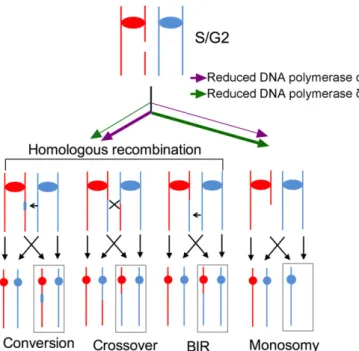
Fig. 6. Different patterns of chromosomal alterations caused by lowered expression ofPOL1andPOL3. Both types of polymerase-depleted strains have elevated rates of DSBs during S and/or G2. We suggest that these
breaks are efficiently repaired in strains with low levels of DNA polymerase α, but inefficiently repaired in strains with low levels of DNA polymeraseδ.
GENET
ICS
PNAS
chromosomal circular DNAs, presumably resulting from unequal intrachromatid crossovers between the repeats.
The DNA lesions that result in LOH in strains with low po-lymeraseδare different from those that induce LOH in wild-type strains in another important way. From the patterns of gene conversion associated with crossovers on chromosome IV (Fig. S5), we previously concluded that about two-thirds of the LOH events were initiated by DSBs induced in unreplicated chromo-somes (19), whereas all of the conversion tracts observed in the present study reflect DSBs on only one chromatid. This result argues that the DNA breaks in strains with low levels of DNA polymeraseδoccur in replicating/replicated DNA, likely as a con-sequence of a broken replication fork; similar results were observed in strains with low levels of DNA polymeraseα (29). Our obser-vation that LOH break points are enriched for hard-to-replicate sequence motifs is also consistent with this conclusion.
The rate of aneuploidy in strains with low levels of DNA po-lymerase δ was elevated more than two orders of magnitude compared with the wild-type strain. In addition, the ratio of aneuploid to LOH events is higher in strains with low levels of DNA polymeraseδthan in strains with low levels of DNA po-lymerase α. One interpretation of this result is that DSBs in strains with low levels of DNA polymerase α are efficiently repaired (leading to more LOH events than chromosome loss events) relative to the efficiency of repair in strains with low levels of DNA polymerase δ (Fig. 6). This interpretation is consistent with the observations of Wang et al. (30), suggesting a greater requirement for DNA polymeraseδthanαfor the repair of HO-induced DSBs.
CNV. High rates of CNVs were observed in our experiments. Most of the interstitial deletions and duplications resulted from recombination between the HXT genes or nonallelic Ty ele-ments, demonstrating that low levels of DNA polymerase greatly elevate the frequency of nonallelic homologous recombination events. Such events are associated with a large number of human diseases (31).
We also detected very frequent deletions in the rDNA and CUP1 tandem arrays (Fig. 4). The frequent deletions can be interpreted in two ways. First, it is possible that the recombi-nogenic lesions that occur in the low-polymerase strains are channeled into a repair pathway (such as single-strand anneal-ing) that preferentially produces deletions. Alternatively, strains with shorter arrays of rDNA and CUP1 may have a selective growth advantage during replication stress. Previously, Kwan et al. (32) showed that the decreased use of rDNA replication origins resulted in elevated initiation activity for weak yeast or-igins. Thus, a reduction in the level of rDNA repeats (each of which contains an origin) may alleviate the replication stress imposed by the low level of DNA polymerase. It should also be noted that many of the rDNA origins are silenced during normal replication (33). Thus, under conditions of replication stress, if origin use is further compromised or if the rate of DNA fork movement is slowed, it is possible that strains with long arrays will have a selective disadvantage.
Small In/Dels and Single-Base Mutations.We previously found that strains with low polymerase δhad elevated rates of small dele-tions at theCAN1locus, and most of the deletions were flanked by short repeats (6). Similar mutations were observed in the current study (Dataset S11). Such mutations likely reflect DNA polymerase slippage (6). The alternative possibility that the dele-tions are a consequence of microhomology-mediated end joining is unlikely, because this class of events usually involve 8- to 10-bp flanking repeats (34).
We also found a 30-fold elevation in the rate of base substi-tutions. Northam et al. (35) showed a strong mutator phenotype
were dependent on the error-prone DNA polymerase ζ. From these and other data, Northam et al. suggested that disruption of the normal replisome results in recruitment of DNA polymerase ζeven in the absence of DNA damage. One diagnostic type of mutation introduced by DNA polymerase ζis a GC-to-CG al-teration. In our analysis, this class of mutation was significantly (P<0.001 by Fisher exact test) elevated in the low–polymerase-δ strain relative to wild type (Fig. S9). In summary, it is likely that the elevated rates of small in/dels and base substitutions in the low–DNA polymerase-δ strains reflect two different mecha-nisms: increased DNA polymerase slippage and recruitment of DNA polymeraseζto slow-moving or stalled replication forks. It should be noted that DNA polymeraseζdoes not increase the rate of in/dels involving short repeats (35). In addition, low levels of DNA polymeraseαresult in a very small (twofold) elevation in mutation rates (7).
Genetic Alterations That Relieve Replication Stress. The elevated rate of genomic alterations in strains with low DNA polymerase increases the likelihood of creating a strain with a genetic variant that could relieve replication stress. We found several examples of such variants. Three independent deletions within the pro-moter of the kanMX6-GAL1-3xHA-POL3 cassette resulted in strains that grew better than the progenitor strain in low-galactose medium (Fig. 5). Second, we found that strains with an extra copy of the kanMX6-GAL1-3xHA-POL3 cassette (acquired by chromosome nondisjunction or an intrachromosomal duplica-tion) grew better on low-galactose medium. Last, we found that 23 of the 35 isolates examined by microarrays were monosomic for chromosome XIV. One possible explanation of this striking observation is that loss of one copy of XIV, which contains the genes encoding the catalytic subunits of DNA polymerasesαand e, helps preserve the stoichiometry of replication proteins in strains with low levels of DNA polymeraseδ.
There is increased evidence that replication stress of various types can contribute to tumorigenesis (1). In our study, the stress induced by low levels of DNA polymeraseδ results in greatly increased rates of multiple types of genetic alterations. It has been suggested that one approach to cancer therapy might be to apply additional conditions that further elevate stress, resulting in an intolerably high level of instability (36). In considering this approach, it is important to note how readily yeast strains with low levels of DNA polymeraseδproduced variants that escaped replication stress.
Chromosome Instability Tumors.With the exception of tumors that have mutations in mismatch repair genes or the proofreading domains of DNA polymerases, most tumors do not have elevated rates of single-base or microsatellite mutations (11). Elevated rates of chromosomal changes (aneuploidy, CNV, LOH, and translocations), however, are common. Our current study and previous analysis of strains with low levels of DNA polymeraseα (10) demonstrate that many features of this instability can be mimicked in yeast. Because null mutations in replicative DNA polymerases result in cell death, we suggest that hypomorphic alleles or epigenetic reductions in the levels of DNA polymerase or polymerase cofactors could be the initiating genetic alteration in a subset of chromosome instability tumors.
Experimental Procedures
Strains and Genetic Methods.The genotypes of yeast strains were given in
Genome Sequencing and Analysis.Whole-genome sequencing of yeast strains was performed on the Illumina HiSeq 2500 sequencer using a 2×100-bp paired-end indexing protocol. The BWA software was used to align the high-quality reads to yeast genomic sequences (37). CNVs of tandem repeats (for ex-ample, rDNA) were determined by sequencing coverage. SNPs and small in/dels (<10-bp) detection were detected using Samtools (38) and VarScan (39). Deletions and duplications that are larger than 10 bp were detected by Lumpy (40).
Statistical Analysis.Most of the statistical tests followed the methods de-scribed in our previous studies (10, 41). Briefly,χ2tests were performed using
VassarStat (vassarstats.net) or the chisq.test functions in Excel. Corrections of
Pvalues for multiple comparisons were performed as described by Hochberg and Benjamini (42). Fisher exact tests with two-tailPvalues and Pearson’s correlation analysis were done using the software GraphPad Prism 6.
ACKNOWLEDGMENTS.We thank Y. Yin, J. Gerton, B. Brewer, J. Haber, P. Shcherbakova, and A. Bedalov for suggestions. The research was supported by NIH Grants GM24110, GM52319, and R35GM118020 (to T.D.P.), and NIH Grant GM52319 (to P.A.M.). D.-Q.Z., K.Z., and X.-C.W. were supported by National Natural Science Foundation of China Grants 31370132 and 31401058.
1. Gaillard H, García-Muse T, Aguilera A (2015) Replication stress and cancer.Nat Rev Cancer15(5):276–289.
2. Macheret M, Halazonetis TD (2015) DNA replication stress as a hallmark of cancer.
Annu Rev Pathol10:425–448.
3. Durkin SG, Glover TW (2007) Chromosome fragile sites.Annu Rev Genet41:169–192. 4. Arlt MF, Durkin SG, Ragland RL, Glover TW (2006) Common fragile sites as targets for
chromosome rearrangements.DNA Repair (Amst)5(9-10):1126–1135.
5. Arlt MF, et al. (2009) Replication stress induces genome-wide copy number changes in human cells that resemble polymorphic and pathogenic variants.Am J Hum Genet
84(3):339–350.
6. Kokoska RJ, Stefanovic L, DeMai J, Petes TD (2000) Increased rates of genomic dele-tions generated by mutadele-tions in the yeast gene encoding DNA polymerase delta or by decreases in the cellular levels of DNA polymerase delta.Mol Cell Biol20(20): 7490–7504.
7. Lemoine FJ, Degtyareva NP, Lobachev K, Petes TD (2005) Chromosomal translocations in yeast induced by low levels of DNA polymerase a model for chromosome fragile sites.Cell120(5):587–598.
8. Lemoine FJ, Degtyareva NP, Kokoska RJ, Petes TD (2008) Reduced levels of DNA po-lymerase delta induce chromosome fragile site instability in yeast.Mol Cell Biol
28(17):5359–5368.
9. St. Charles J, et al. (2012) High-resolution genome-wide analysis of irradiated (UV and
γ-rays) diploid yeast cells reveals a high frequency of genomic loss of heterozygosity (LOH) events.Genetics190(4):1267–1284.
10. Song W, Dominska M, Greenwell PW, Petes TD (2014) Genome-wide high-resolution mapping of chromosome fragile sites inSaccharomyces cerevisiae.Proc Natl Acad Sci USA111(21):E2210–E2218.
11. Vogelstein B, et al. (2013) Cancer genome landscapes.Science339(6127):1546–1558. 12. Thomas BJ, Rothstein R (1989) Elevated recombination rates in transcriptionally active
DNA.Cell56(4):619–630.
13. Wei W, et al. (2007) Genome sequencing and comparative analysis ofSaccharomyces cerevisiaestrain YJM789.Proc Natl Acad Sci USA104(31):12825–12830.
14. Llorente B, Smith CE, Symington LS (2008) Break-induced replication: What is it and what is it for?Cell Cycle7(7):859–864.
15. Ho CK, Mazón G, Lam AF, Symington LS (2010) Mus81 and Yen1 promote reciprocal exchange during mitotic recombination to maintain genome integrity in budding yeast.Mol Cell40(6):988–1000.
16. Symington LS, Rothstein R, Lisby M (2014) Mechanisms and regulation of mitotic recombination inSaccharomyces cerevisiae.Genetics198(3):795–835.
17. O’Connell K, Jinks-Robertson S, Petes TD (2015) Elevated genome-wide instability in yeast mutants lacking RNase H activity.Genetics201(3):963–975.
18. Szilard RK, et al. (2010) Systematic identification of fragile sites via genome-wide location analysis of gamma-H2AX.Nat Struct Mol Biol17(3):299–305.
19. St. Charles J, Petes TD (2013) High-resolution mapping of spontaneous mitotic recombination hotspots on the 1.1 Mb arm of yeast chromosome IV.PLoS Genet9(4):e1003434. 20. Petes TD (1979) Yeast ribosomal DNA genes are located on chromosome XII.Proc Natl
Acad Sci USA76(1):410–414.
21. Strope PK, et al. (2015) The 100-genomes strains, anS. cerevisiaeresource that illu-minates its natural phenotypic and genotypic variation and emergence as an op-portunistic pathogen.Genome Res25(5):762–774.
22. Zhao Y, et al. (2014) Structures of naturally evolvedCUP1tandem arrays in yeast indicate that these arrays are generated by unequal nonhomologous recombination.
G3 (Bethesda)4(11):2259–2269.
23. Nishant KT, et al. (2010) The baker’s yeast diploid genome is remarkably stable in vegetative growth and meiosis.PLoS Genet6(9):e1001109.
24. Zhu YO, Siegal ML, Hall DW, Petrov DA (2014) Precise estimates of mutation rate and spectrum in yeast.Proc Natl Acad Sci USA111(22):E2310–E2318.
25. Colnaghi R, Carpenter G, Volker M, O’Driscoll M (2011) The consequences of struc-tural genomic alterations in humans: Genomic disorders, genomic instability and cancer.Semin Cell Dev Biol22(8):875–885.
26. Ma J, Ptashne M (1987) The carboxy-terminal 30 amino acids ofGAL4are recognized byGAL80.Cell50(1):137–142.
27. Nehlin JO, Carlberg M, Ronne H (1991) Control of yeastGALgenes byMIG1repressor: A transcriptional cascade in the glucose response.EMBO J10(11):3373–3377.
28. Møller HD, Parsons L, Jørgensen TS, Botstein D, Regenberg B (2015) Extrachromosomal circular DNA is common in yeast.Proc Natl Acad Sci USA112(24):E3114–E3122. 29. Song W, Petes TD (2012) Haploidization inSaccharomyces cerevisiaeinduced by a
deficiency in homologous recombination.Genetics191(1):279–284.
30. Wang X, et al. (2004) Role of DNA replication proteins in double-strand break-induced recombination inSaccharomyces cerevisiae.Mol Cell Biol24(16):6891–6899.
31. Liu P, Carvalho CM, Hastings PJ, Lupski JR (2012) Mechanisms for recurrent and complex human genomic rearrangements.Curr Opin Genet Dev22(3):211–220. 32. Kwan EX, et al. (2013) A natural polymorphism in rDNA replication origins links origin
activation with calorie restriction and lifespan.PLoS Genet9(3):e1003329. 33. Pasero P, Bensimon A, Schwob E (2002) Single-molecule analysis reveals clustering and
epigenetic regulation of replication origins at the yeast rDNA locus.Genes Dev16(19): 2479–2484.
34. Ma JL, Kim EM, Haber JE, Lee SE (2003) Yeast Mre11 and Rad1 proteins define a Ku-independent mechanism to repair double-strand breaks lacking overlapping end sequences.Mol Cell Biol23(23):8820–8828.
35. Northam MR, Robinson HA, Kochenova OV, Shcherbakova PV (2010) Participation of DNA polymerase zeta in replication of undamaged DNA inSaccharomyces cerevisiae.
Genetics184(1):27–42.
36. Dobbelstein M, Sørensen CS (2015) Exploiting replicative stress to treat cancer.Nat Rev Drug Discov14(6):405–423.
37. Li H, Durbin R (2009) Fast and accurate short read alignment with Burrows-Wheeler transform.Bioinformatics25(14):1754–1760.
38. Li H, et al.; 1000 Genome Project Data Processing Subgroup (2009) The sequence alignment/map format and SAMtools.Bioinformatics25(16):2078–2079.
39. Koboldt DC, et al. (2012) VarScan 2: Somatic mutation and copy number alteration discovery in cancer by exome sequencing.Genome Res22(3):568–576.
40. Layer RM, Chiang C, Quinlan AR, Hall IM (2014) LUMPY: A probabilistic framework for structural variant discovery.Genome Biol15(6):R84.
41. Yin Y, Petes TD (2013) Genome-wide high-resolution mapping of UV-induced mitotic recombination events inSaccharomyces cerevisiae.PLoS Genet9(10):e1003894. 42. Hochberg Y, Benjamini Y (1990) More powerful procedures for multiple significance
testing.Stat Med9(7):811–818.
43. Jensen RE, Herskowitz I (1984) Directionality and regulation of cassette substitution in yeast.Cold Spring Harb Symp Quant Biol49:97–104.
44. Sikorski RS, Hieter P (1989) A system of shuttle vectors and yeast host strains designed for efficient manipulation of DNA inSaccharomyces cerevisiae.Genetics122(1):19–27. 45. Güldener U, Heck S, Fielder T, Beinhauer J, Hegemann JH (1996) A new efficient gene disruption cassette for repeated use in budding yeast.Nucleic Acids Res24(13): 2519–2524.
46. Goldstein AL, McCusker JH (1999) Three new dominant drug resistance cassettes for gene disruption inSaccharomyces cerevisiae.Yeast15(14):1541–1553.
47. Gueldener U, Heinisch J, Koehler GJ, Voss D, Hegemann JH (2002) A second set of loxP marker cassettes for Cre-mediated multiple gene knockouts in budding yeast.Nucleic Acids Res30(6):e23.
48. Lea DE, Coulson CA (1949) The distribution of the numbers of mutants in bacterial populations.J Genet49(3):264–285.
49. Faust GG, Hall IM (2014) SAMBLASTER: Fast duplicate marking and structural variant read extraction.Bioinformatics30(17):2503–2505.
50. Lisnic B, Svetec IK, Saric H, Nikolic I, Zgaga Z (2005) Palindrome content of the yeast
Saccharomyces cerevisiaegenome.Curr Genet47(5):289–297.
51. Capra JA, Paeschke K, Singh M, Zakian VA (2010) G-quadruplex DNA sequences are evolutionarily conserved and associated with distinct genomic features in Saccharo-myces cerevisiae.PLoS Comput Biol6(7):e1000861.
52. Nagalakshmi U, et al. (2008) The transcriptional landscape of the yeast genome de-fined by RNA sequencing.Science320(5881):1344–1349.
53. Azvolinsky A, Giresi PG, Lieb JD, Zakian VA (2009) Highly transcribed RNA polymerase II genes are impediments to replication fork progression inSaccharomyces cerevisiae.
Mol Cell34(6):722–734.
54. Fachinetti D, et al. (2010) Replication termination at eukaryotic chromosomes is mediated by Top2 and occurs at genomic loci containing pausing elements.Mol Cell
39(4):595–605.
GENET
ICS
PNAS