Symptom burden and life challenges reported by adult chordoma
patients and their caregivers
Paula H. Song1 · Hadi Beyhaghi1 · Josh Sommer2 · Antonia V. Bennett1
Accepted: 3 March 2017 / Published online: 17 March 2017
© The Author(s) 2017. This article is published with open access at Springerlink.com
patients, the most commonly reported challenges included delayed care (37%), long-term disability (33%), and confu-sion or unanswered questions about chordoma (28%). For caregivers, grief (55%), delayed diagnosis (47%), and diffi-culty helping the patient cope with his or her disease (45%) were most common.
Conclusions Our study findings suggest a high symp-tom burden and life challenges among chordoma patients and their caregivers. This study provides preliminary, lim-ited estimates of the prevalence of a wide range of self-reported symptoms and challenges that will inform the assessment of patient-reported outcomes in future clinical trials and help clinicians better manage chordoma patients’ symptoms.
Keywords Chordoma · Symptom burden · Patient-reported outcomes · Quality of life
Introduction
Chordoma is a rare bone cancer that accounts for 1–4% of all bone malignancies [1]. Chordoma is a highly morbid and potentially fatal disease that involves complex medi-cal decisions, and the low incidence of chordoma creates challenges for tailoring care. Chordoma tumors are thought to be derived from notochord remnants that may persist anywhere along the axial skeleton [1, 2]. Chordomas are generally slow growing, chemotherapy-, and radiotherapy-resistant tumors that are locally invasive [1].
Population-based studies using the Surveillance, Epide-miology, and End Results (SEER) database estimate the age-adjusted incidence of all chordoma cases to be 0·08 to 0.089 per 100,000. Chordoma is more common in men and the incidence is highest among 50–60 years of age [1–4]. Abstract
Purpose This study aims to characterize the symptom burden and life challenges that chordoma patients and their caregivers experience.
Methods In this cross-sectional study, we analyzed data from the Chordoma Foundation online community survey conducted in 2014. Frequency counts and percentages were calculated to determine the prevalence of self-reported symptoms and life challenges in the sample. We used Fish-er’s exact test to compare self-reported symptoms among subgroups with different disease status, tumor locations, and treatments received.
Results Among the survey participants, 358 identified themselves as chordoma patients and 202 as caregivers. The majority of the patients were over 45 years (72%), male (56%), educated beyond high school degree (87%), and from North America (77%). Skull base was the most preva-lent tumor location (40%). Chronic pain (35%) was the most commonly reported symptom followed by depression or severe anxiety (32%) and chronic fatigue (31%). Among
Parts of this paper were presented in an abstract and poster forms at the 2016 International Chordoma Research Workshop on July 2016, in Boston.
Electronic supplementary material The online version of this article (doi:10.1007/s11136-017-1544-2) contains supplementary material, which is available to authorized users.
* Paula H. Song [email protected]
1 Department of Health Policy and Management, The University of North Carolina at Chapel Hill, 1105A McGavran-Greenberg Hall, CB #7411, Chapel Hill, NC 27599-7411, USA
Chordoma is less frequent among patients younger than 40 years and rarely affects children and adolescents (less than 5% of all chordoma cases) [1]. The anatomic distribution of chordomas is almost equal among the skull base (32%), mobile spine (33%), and sacrum (29%) [1] Chordoma accounts for over 50% of primary sacral tumors [1] and less than 1% of all intracranial neoplasms [2].
Most studies estimate the survival of chordoma patients using data from the SEER database, showing a median overall survival of 7.8 years [4]. Surgery plus radiation therapy is estimated to increase the overall median sur-vival time to 9.2 years. Age and treatment modality are significant determinants of patients’ survival [3]. Younger patients (aged <40 years) survive longer compared with older patients (10-year relative survival of 68% vs. 43%) [4]. Specifically, age >50 years is associated with an increase in mortality rate. The estimated age-standardized 5-year, 10-year, and 20-year survival rates for patients diagnosed between 1973 and 2009 are 72, 48, and 31%, respectively [4]. Improved survival is seen over time with 5-year survival rates of 48, 73, and 81% for the 1975–1984, 1985–1994, and 1995–2004 cohorts, respectively [3]. Primary tumor site has not shown to influence chordoma patients’ survival [5, 6].
As chordoma patients survive longer, the importance of identifying determinants of health-related quality of life (HRQOL) in guiding comprehensive patient care increases [2]. Chordoma progresses slowly but continuously, affect-ing multiple vital functions, which results in disability and death. As chordoma progresses, it affects patients’ physi-cal, social, and mental wellbeing and increases the need for caregiver support [2]. However, symptom burden and other determinants of HRQOL remain poorly defined in patients with chordoma [2]. Improving HRQOL during and after treatment is a primary endpoint underlying clinical decision-making and the development of optimal treatment regimens for patients with chordoma [7]. A better under-standing of the symptom burden and main challenges that chordoma patients and caregivers face will help clinicians and palliative care providers improve the quality of care for chordoma patients.
The number of clinical trials testing different interven-tions for treating chordoma has significantly increased over the past few years [8]. Currently, three Phase 1, two Phase 2, and one Phase 3 randomized clinical trials are in pro-gress that assess the efficacy and safety of surgery, radio-therapy, and medical therapy in treating chordoma patients [8]. Patient-reported outcomes (PROs), especially symp-tom burden and functional status, are increasingly assessed in oncology clinical trials for approval and reimburse-ment purposes [9]. Although challenges exist for assessing PROs for rare conditions like chordoma, many of the barri-ers are inherent to studying rare diseases rather than PRO
measurement itself, and the common barriers and solutions have been documented [10]. Information about the preva-lence of the symptoms and other determinants of HRQOL in patients undergoing treatment for chordoma is essential for planning PRO assessment in a clinical trial. This infor-mation supports the identification of the most relevant PRO endpoints and provides preliminary support of the content validity of PRO instruments [11].
This study aims to characterize the symptom burden and challenges to quality of life that chordoma patients and their caregivers experience.
Methods
Study design and setting
In this cross-sectional study, we analyzed data from a sur-vey of the chordoma community conducted by the Chor-doma Foundation to determine the prevalence of self-reported symptoms experienced by chordoma patients and the chordoma-related life challenges that patients and their caregivers experience. The Chordoma Foundation (CF) is a global non-profit organization whose mission is to improve the lives of those affected by chordoma and lead the search for a cure. In 2014, the CF conducted an internet-based sur-vey of the chordoma community to better define the needs and range of experiences of its constituents. At the time of the survey, the CF’s contact database included 950 self-identified chordoma patients and 3,276 individuals iden-tified as family members or friends of patients. In March 2014, a link to the survey was emailed to all members of the foundation’s database, including both patients and car-egivers. The survey was open to respondents until the end of June 2014.
Survey instrument
Statistical analysis
Due to a very small sample size of children respondents, the study analyses focus on respondents who were 18 years and older. Caregivers were defined as parents, spouse, or family members providing care to a patient with chordoma. The analysis of self-reported symptoms was limited to patient respondents because patients are the most reliable source of information regarding their symptoms [12]. The analysis of chordoma-related life challenges included data from both patient and caregiver respondents. Two sepa-rate questions with slightly different response options were included in the survey for patients and caregivers about their experience with challenges that they face as a result of chordoma (patients) and caring for a patient with chordoma (caregivers).
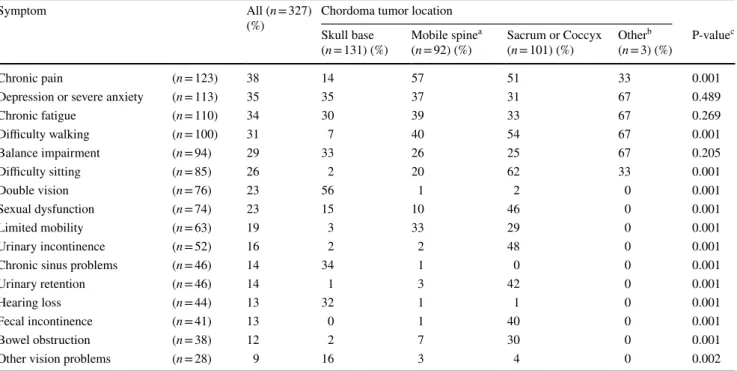
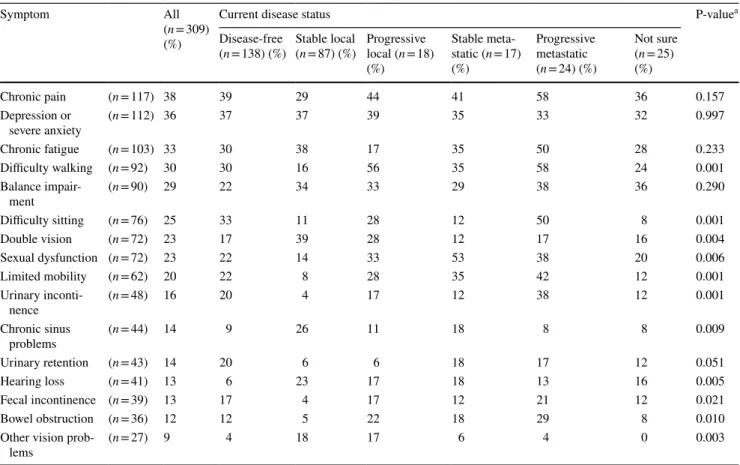
Frequency counts and percentages were calculated to determine the prevalence of self-reported symptoms in the sample. Fisher’s exact test was used to compare the preva-lence of a wide range of symptoms (Tables 3, 4, 5) in dif-ferent subgroups. Associations were calculated between the most common symptoms reported and the following clini-cal characteristics: location of tumor, disease status, and type of treatment received. The prevalence of chordoma-related symptoms among subgroups with different tumor locations, disease status, and type of treatment received was tabulated. Data were analyzed using Stata software version 12 (StataCorp, College Station, TX), and p < 0.05 was considered statistically significant.
Results
Study population
Between March and June 2014, 709 participants including chordoma patients (358), their family members (294), and friends and others (57) responded to the online CF commu-nity survey (Table 1). Among family members, i.e., parents (31%), spouses (36%), and other family members (33%), 202 participants identified themselves as a caregiver to a chordoma patient. The majority of the patient respondents were over 45 years (72%), male (56%), educated beyond high school degree (87%), and from North America (77%). Caregivers were predominantly over 45 years (62%), female (66%), educated beyond high school degree (86%), and from North America (74%). The skull base was the most common tumor location in our patient sample (40%) fol-lowed by sacrococcygeal tumors (31%) and mobile spine, i.e., neck, mid back, and lower back (27%). The majority of patients reported either disease-free status, i.e., no evidence of tumor (41%) or stable local disease (28%). The major-ity of patients reported receiving multiple therapies, i.e., a
Table 1 Demographic characteristics of the chordoma patients and caregivers
Not reported: age (patient: 1, caregiver: 1); gender (p: 2, c: 1); educa-tion (p: 1, c: 2); tumor locaeduca-tion (p: 2, c: 5); current status of disease (p: 21, c: 67); treatment received (p: 28, c: 18)
a Reflects caregivers’ demographic characteristics (age, gender, edu-cation, and region) and patients’ tumor loedu-cation, current status of the disease, and treatment received reported by their caregiver
b Includes extra-axial, multifocal, or unknown
Age Patients
(n = 358) Caregivers (n = 202)a
No % No %
18–24 16 4 12 6
25–34 31 9 27 13
35–44 54 15 36 18
45–54 84 23 41 20
55–64 105 29 52 26
65–74 52 15 26 13
74 or older 15 4 7 3
Gender
Male 199 56 68 34
Female 157 44 133 66
Education
Some high school or less 8 2 8 4
High school graduate or GED 36 10 19 9
Vocational college or some college 99 28 35 17
College degree 111 31 73 36
Professional or graduate degree 103 29 65 32 Region
North America 275 77 149 74
Europe 59 16 32 16
South America 7 2 5 3
Asia 8 2 9 5
Australia and New Zealand 6 2 5 3
Africa 3 1 2 1.0
Tumor location
Skull base 144 40 97 48
Mobile spine 97 27 58 29
Sacrum or Coccyx 111 31 42 21
Othersb 4 1 5 2
Current status of disease
Disease-free (no evidence of tumor) 145 41 38 19
Stable local disease 101 28 43 21
Progressive local disease 21 6 23 11
Stable metastatic disease 17 5 7 3
Progressive metastatic disease 25 7 17 8
Not sure 28 8 7 3
Treatment received
Surgery only 89 25 25 12
Radiotherapy only 24 7 8 4
Medical therapy only 3 1 0 0
Multiple treatments 204 57 146 72
combination of surgery, radiotherapy, or medical therapy (57%) followed by surgery only (25%) and radiotherapy only (7%). Table 2 shows the distribution of treatment types based on the anatomic site of chordoma tumor reported by chordoma patients.
Patient‑reported symptoms
The most common symptoms that chordoma patients reported include chronic pain (35%), depression or severe anxiety (32%), chronic fatigue (31%), difficulty walking
(28%), and balance impairment (26%). The majority of patients in our sample reported experiencing at least one symptom (93%), while more than 36% experience 5 or more symptoms as a result of suffering from chordoma. Thirty patients (8%) did not respond to the question about symptoms.
The majority of self-reported symptoms were signifi-cantly associated with the location of tumor (Table 3, last column). Among patients with skull base tumors (40%), the three most common symptoms were double vision (50%), depression or severe anxiety (32%), and chronic sinus
Table 2 Distribution of treatment types based on the anatomic site of chordoma tumor reported by chordoma patients (n = 329)
Fisher’s exact test p = 0.004
a At least two treatment types from surgery, radiotherapy, or medical treatment categories
Tumor location All Treatment type
Surgery only (n = 88) Radiotherapy
only (n = 24) Medical treatment only (n = 3) No treatment (n = 10) Multiple treatmentsa (n = 204)
Skull base 134 (56%) 22 (16%) 11 (8%) 0 (0%) 6 (4%) 95 (71%)
Mobile spine 91 (28%) 22 (24%) 7 (8%) 1 (1%) 2 (2%) 59 (65%)
Sacrum or Coccyx 100 (30%) 42 (42%) 6 (6%) 2 (2%) 2 (2%) 48 (48%)
Other 4 (1%) 2 (50%) 0 (0%) 0 (0%) 0 (0%) 2 (50%)
Table 3 Distribution of the patient-reported symptoms associated with chordoma by tumor location
Symptoms were asked using the following survey question: “Which of the following health effects have you ever suffered as a result of chor-doma?”
a Includes neck, mid back, and lower back b Includes extra-axial, multifocal, or unknown c P-values were calculated using Fisher’s exact test
Symptom All (n = 327)
(%) Chordoma tumor locationSkull base (n = 131) (%) Mobile spine
a
(n = 92) (%) Sacrum or Coccyx (n = 101) (%) Other b
(n = 3) (%) P-value c
Chronic pain (n = 123) 38 14 57 51 33 0.001
Depression or severe anxiety (n = 113) 35 35 37 31 67 0.489
Chronic fatigue (n = 110) 34 30 39 33 67 0.269
Difficulty walking (n = 100) 31 7 40 54 67 0.001
Balance impairment (n = 94) 29 33 26 25 67 0.205
Difficulty sitting (n = 85) 26 2 20 62 33 0.001
Double vision (n = 76) 23 56 1 2 0 0.001
Sexual dysfunction (n = 74) 23 15 10 46 0 0.001
Limited mobility (n = 63) 19 3 33 29 0 0.001
Urinary incontinence (n = 52) 16 2 2 48 0 0.001
Chronic sinus problems (n = 46) 14 34 1 0 0 0.001
Urinary retention (n = 46) 14 1 3 42 0 0.001
Hearing loss (n = 44) 13 32 1 1 0 0.001
Fecal incontinence (n = 41) 13 0 1 40 0 0.001
Bowel obstruction (n = 38) 12 2 7 30 0 0.001
problems (31%). Among patients with sacral tumors (20%), difficulty sitting (55%), difficulty walking (53%), and sex-ual dysfunction (49%) were the most common, and among patients with lower back tumor (11%), the most common symptoms were chronic pain (54%), difficulty walking (49%), and limited mobility (41%). Several common symp-toms were significantly different in their prevalence across different types of treatment received and disease status (Tables 4, 5).
Challenges experienced by chordoma patients and caregivers
Table 6 reports the prevalence of challenges that patients and caregivers experienced as a result of chordoma in the following domains: emotional health and coping; employ-ment and finances, access to care and information; and quality of care. Eight patients (2%) and four caregivers (2%) did not respond to the question about challenges faced as a result of suffering from chordoma. The most common challenges reported by patients were delayed care (37%), long-term disability (33%), confusion or unanswered ques-tions about chordoma (28%), difficulty finding experienced physicians or treatment centers (27%), misdiagnosis (24%), and short-term disability (24%). Among caregivers, the most frequently reported challenges included grief (55%),
delayed care (47%), difficulty helping the patient cope with his/her illness (45%), confusion or unanswered questions about chordoma (45%), difficulty finding experienced phy-sicians or treatment centers (43%), and misdiagnosis of the patient (28%).
Discussion
Although several studies of chordoma symptoms and qual-ity of life exist, they focus on a small number of cases, lim-ited list of symptoms, or a specific tumor location or treat-ment modality [2, 7, 13, 14]. This study adds to the existing literature by investigating self-reported symptom burden and life challenges among a large group of chordoma patients and caregivers across different tumor characteris-tics. Our study data suggest high symptom burden among chordoma patients that varies based on the location of the tumor, disease status, and type of treatment received. In addition, our findings show that the chordoma patients and caregivers face many medical, emotional, and healthcare challenges. Receiving inappropriate care including but not limited to delayed diagnosis or misdiagnosis and difficulty finding experienced physicians or medical centers were among the most commonly cited challenges. Our study results provide a better understanding of the challenges
Table 4 Distribution of the patient-reported symptoms associated with chordoma by treatment received
Symptoms were asked using the following survey question: “Which of the following health effects have you (the patient) ever suffered as a result of chordoma?”
a P-values were calculated using Fisher’s exact test
Symptom All
(n = 322) (%)
Treatment received P-valuea
Surgery only
(n = 87) (%) Radiotherapy only (n = 22) (%)
Medical therapy
only (n = 3) (%) No treat-ment (n = 8) (%)
Multiple ther-apy (n = 202) (%)
Chronic pain (n = 122) 38 49 27 33 38 34 0.107
Depression or severe anxiety (n = 111) 34 38 27 67 38 33 0.632
Chronic fatigue (n = 106) 33 29 18 33 38 36 0.375
Difficulty walking (n = 97) 30 34 27 33 50 28 0.502
Balance impairment (n = 92) 29 22 23 33 38 32 0.394
Difficulty sitting (n = 82) 25 44 18 33 50 17 0.001
Double vision (n = 75) 23 13 32 33 25 27 0.046
Sexual dysfunction (n = 72) 22 26 27 33 13 20 0.607
Limited mobility (n = 62) 19 26 5 67 25 17 0.020
Urinary incontinence (n = 49) 15 15 9 67 38 14 0.059
Urinary retention (n = 46) 14 16 0 33 38 14 0.040
Chronic sinus problems (n = 45) 14 5 18 0 13 18 0.022
Hearing loss (n = 44) 14 6 18 33 13 16 0.050
Fecal incontinence (n = 40) 12 18 14 33 13 9 0.128
Bowel obstruction (n = 38) 12 15 9 67 13 10 0.075
associated with chordoma, with the aim of helping improve the quality of care provided to chordoma patients.
Our study also provides prevalence data for a com-prehensive list of patient-reported symptoms as well as patient- and caregiver-reported life challenges associated with chordoma. These findings can inform the design of clinical trials and guide the development of chordoma-specific PRO instruments or selection of existing generic instruments. Information about the prevalence of symptoms and life challenges is necessary for identifying which con-cepts should be assessed. For detailed information about symptoms and life challenges specific to sacral chordoma patients and an example of using existing generic (non-disease specific) PRO instruments to develop a compre-hensive questionnaire, see van Wulfften Palthe et al. (2016) [14]. Because of the nature of the chordoma—in that the impact of the disease varies by the location of the tumor(s), instruments for specific types of chordoma may be war-ranted, depending on the goals of the study. This could be operationalized as a series of independent tumor site-spe-cific instruments or one instrument with tumor site-spesite-spe-cific modules and branching logic. Further, our findings can
be directly utilized in clinical practice. Information about prevalent symptoms and challenges faced by patients and caregivers may help improve patient–provider communica-tion, inform decision-making, healthcare management, and ultimately improve health outcomes.
The major strengths of this study include its relatively large sample size of both chordoma patients and caregiv-ers. Given the incidence and average survival of chordoma patients, the estimated prevalence is approximately 6 per million, or roughly 2,000 patients in the United States. Thus, the survey sample included more than 10% of the estimated United States chordoma patient population. In addition, the construction of the survey was patient-cen-tered, and approximately 90% of respondents completed the entire questionnaire. However, we acknowledge the limitations associated with the online questionnaire admin-istration. Our study sample included a high proportion of respondents with a university degree (65%), and was lim-ited to those who have access to a computer, can read in English, and have the mental and physical capacity to com-plete the online questionnaire. In addition, because patients and their caregivers had access to the survey questionnaire,
Table 5 Distribution of the patient-reported symptoms associated with chordoma by disease status (n = 309)
Symptoms were asked using the following survey question: “Which of the following health effects have you (the patient) ever suffered as a result of chordoma?”
a P-values were calculated using Fisher’s exact test
Symptom All
(n = 309) (%)
Current disease status P-valuea
Disease-free
(n = 138) (%) Stable local (n = 87) (%) Progressive local (n = 18) (%)
Stable meta-static (n = 17) (%)
Progressive metastatic (n = 24) (%)
Not sure (n = 25) (%)
Chronic pain (n = 117) 38 39 29 44 41 58 36 0.157
Depression or
severe anxiety (n = 112) 36 37 37 39 35 33 32 0.997
Chronic fatigue (n = 103) 33 30 38 17 35 50 28 0.233
Difficulty walking (n = 92) 30 30 16 56 35 58 24 0.001
Balance
impair-ment (n = 90) 29 22 34 33 29 38 36 0.290
Difficulty sitting (n = 76) 25 33 11 28 12 50 8 0.001
Double vision (n = 72) 23 17 39 28 12 17 16 0.004
Sexual dysfunction (n = 72) 23 22 14 33 53 38 20 0.006
Limited mobility (n = 62) 20 22 8 28 35 42 12 0.001
Urinary
inconti-nence (n = 48) 16 20 4 17 12 38 12 0.001
Chronic sinus
problems (n = 44) 14 9 26 11 18 8 8 0.009
Urinary retention (n = 43) 14 20 6 6 18 17 12 0.051
Hearing loss (n = 41) 13 6 23 17 18 13 16 0.005
Fecal incontinence (n = 39) 13 17 4 17 12 21 12 0.021
Bowel obstruction (n = 36) 12 12 5 22 18 29 8 0.010
Other vision
for questions that could be answered both by patients and caregivers, it is possible that some responses are counted both from a patient and his or her caregiver. Nonetheless, the distribution of age and tumor location in our sample is similar to that reported in the literature from the repre-sentative population-based estimates [1–3]. Although this survey included a large proportion (10%) of the US chor-doma patient population, because of the sampling scheme that was employed in this study, the denominator is not clearly defined and the sample underrepresents population subgroups who may experience the challenges of chordoma differently. Therefore, the results of this study are limited preliminary estimates intended to be hypothesis generating and to inform future research.
Previous studies have estimated quality of life in specific subgroups of chordoma patients using validated, non-dis-ease specific instruments, such as the 36-Item Short Form
Health Survey (SF-36) and the European Organization for Research and Treatment of Cancer Quality of Life Core 30 (EORTC QLQ-C30) [2, 13]. However, the intent of the CF survey was not to estimate the quality of life scores for the study sample. Instead, the survey questionnaire was designed to document the prevalence of a wide range of symptoms and challenges experienced by chordoma patients and caregivers. The content was determined based on input from members of the chordoma patient commu-nity, the moderators of the chordoma survivors Facebook group, and physicians who treat chordoma patients, and the questionnaire included open-ended response fields for each response option of “other” to elicit any additional symptoms and issues. The CF survey was able to capture symptoms and challenges specific to chordoma that were not reflected in the more general quality of life measures used previously.
Table 6 Challenges that patients/caregivers face as a result of having/caring for a patient with chordoma
The challenges were asked in the following questions in the survey: “Which of the following challenges have you faced as a result of your experience with chordoma?” and “Which of the following challenges have you faced in caring for someone with chordoma?”
a Response option only available to respondents who identify themselves as caregivers of chordoma patients
b Response option only available to respondents who identify themselves as patients Patients
(n = 358) Caregivers (n = 202) No. Percent No. Percent Emotional health and coping
Feelings of loneliness or isolation 104 29 87 43
Difficulty coping/helping the patient cope with his/her illness 93 26 91 45
Griefa – – 111 55
Family conflict 34 10 46 23
Difficulty helping children or other family members cope 47 13 67 33 Difficulty talking about chordoma and how it has affected my life 64 18 43 21 Employment and finances
Change in career or reduced ability to work 118 33 63 31
Short-term disabilityb 84 24 – –
Long-term disabilityb 119 33 – –
Loss of employment 74 21 20 10
Financial distress (including bankruptcy or foreclosure) 59 17 39 19 Access to care and information
Denial of insurance coverage for the patient’s recommended treatment 45 13 34 17
Loss of health insuranceb 20 6 – –
Inability to pay for the patient’s recommended treatment 28 8 20 10 Inability to pay for travel, lodging, or other treatment-related expenses 45 13 28 14 Confusion or unanswered questions about chordoma 101 28 90 45 Difficulty finding experienced physicians or treatment centers 96 27 86 43 Quality of care
Delayed diagnosis of patient 134 37 95 47
Misdiagnosis of patient 85 24 56 28
Difficulty dealing with physicians or medical staff 77 22 50 25
Conclusion
Our study findings suggest a high symptom burden among patients with chordoma. In addition, many patients and caregivers are facing challenges related to access and qual-ity of care and psychological health. This study provides preliminary, limited estimates of the prevalence of a wide range of self-reported symptoms and challenges that will inform the assessment of patient-reported outcomes in future clinical trials and will help clinicians and palliative care providers better understand and manage symptoms of chordoma patients.
Compliance with ethical standards
Conflict of interest Paula H. Song serves on the board of the doma Foundation. Josh Sommer is the executive director of the Chor-doma Foundation. Hadi Beyhaghi has no conflict of interest relevant to this manuscript. Antonia V. Bennett has no conflict of interest relevant to this manuscript.
Ethical approval This article does not contain any studies with human participants performed by any of the authors. The authors ana-lyzed data from the Chordoma Foundation community survey. The authors also sought IRB approval early on, and the study was deter-mined to be exempt.
Open Access This article is distributed under the terms of the Creative Commons Attribution 4.0 International License (http:// creativecommons.org/licenses/by/4.0/), which permits unrestricted use, distribution, and reproduction in any medium, provided you give appropriate credit to the original author(s) and the source, provide a link to the Creative Commons license, and indicate if changes were made.
References
1. Walcott, B. P., Nahed, B. V., Mohyeldin, A., Coumans, J. V., Kahle, K. T., & Ferreira, M. J. (2012). Chordoma: Current con-cepts, management, and future directions. The Lancet Oncology, 13(2), e69–e76.
2. Diaz, R. J., Maggacis, N., Zhang, S., & Cusimano, M. D. (2014). Determinants of quality of life in patients with skull base
chordoma: Clinical article. Journal of Neurosurgery, 120(2), 528–537.
3. Chambers, K. J., Lin, D. T., Meier, J., Remenschneider, A., Herr, M., & Gray, S. T. (2014). Incidence and survival patterns of cra-nial chordoma in the United States. The Laryngoscope, 124(5), 1097–1102.
4. Smoll, N. R., Gautschi, O. P., Radovanovic, I., Schaller, K., & Weber, D. C. (2013). Incidence and relative survival of chordo-mas. Cancer, 119(11), 2029–2037.
5. McMaster, M. L., Goldstein, A. M., Bromley, C. M., Ishibe, N., & Parry, D. M. (2001). Chordoma: Incidence and survival pat-terns in the United States, 1973–1995. Cancer Causes & Con-trol, 12(1), 1–11.
6. Lee, J., Bhatia, N. N., Hoang, B. H., Ziogas, A., & Zell, J. A. (2012). Analysis of prognostic factors for patients with chor-doma with use of the California Cancer Registry. The Journal of Bone and Joint Surgery. American volume, 94(4), 356–363. 7. Gil, Z., & Fliss, D. M. (2010). Quality of life in patients with
skull base tumors: current status and future challenges. Skull Base, 20(01), 011–018.
8. Stacchiotti, S., & Sommer, J. (2015). Building a global consen-sus approach to chordoma: A position paper from the medical and patient community. The Lancet Oncology, 16(2), e71–e83. 9. Gnanasakthy, A., DeMuro, C., Clark, M., Haydysch, E., Ma, E.,
& Bonthapally, V. (2016). patient-reported outcomes labeling for products approved by the Office of Hematology and Oncology Products of the US Food and Drug Administration (2010–2014). Journal of Clinical Oncology, 34, 1928–1934.
10. Basch, E., & Bennett, A. V. (2014). Patient-reported outcomes in clinical trials of rare diseases. Journal of General Internal Medi-cine, 29(3), 801–803.
11. Food and Drug Administration (2009). Guidance for indus-try: patient-reported outcome measures: use in medical product development to support labeling claims. Federal Register, 74, 65132–65133.
12. Sneeuw, K. C., Sprangers, M. A., & Aaronson, N. K. (2002). The role of health care providers and significant others in evalu-ating the quality of life of patients with chronic disease. Journal of Clinical Epidemiology, 55(11), 1130–1143.
13. Srivastava, A., Vischioni, B., Fiore, M. R., Vitolo, V., Fossati, P., Iannalfi, A., ... & Orecchia, R. (2013). Quality of life in patients with chordomas/chondrosarcomas during treatment with pro-ton beam therapy. Journal of Radiation Research, 54(suppl 1), i43–i48.