Open Forum Infectious Diseases
Open Forum Infectious Diseases®
A Prospective Observational Study of the Epidemiology,
Management, and Outcomes of Skin and Soft
Tissue Infections Due to Carbapenem-Resistant
Enterobacteriaceae
Oryan Henig,1 Eric Cober,2 Sandra S. Richter,3 Federico Perez,4,5 Robert A. Salata,5 Robert C. Kalayjian,6 Richard R. Watkins,7,8
Steve Marshall,4 Susan D. Rudin,4,9 T. Nicholas Domitrovic,4,9 Andrea M. Hujer,4,9 Kristine M. Hujer,4,9 Yohei Doi,14 Scott Evans,15
Vance G. Fowler Jr.,16,17 Robert A. Bonomo,4,5,9,10,11,12,13 David van Duin,18 and Keith S. Kaye,1; for the Antibacterial Resistance Leadership Group 1Department of Medicine, University of Michigan, Ann Arbor; Departments of 2Infectious Diseases and 3Laboratory Medicine, Cleveland Clinic, Ohio; 4Research Service, Louis Stokes Cleveland
Department of Veterans Affairs Medical Center, Ohio; 5Division of Infectious Diseases and HIV Medicine, Department of Medicine, Case Western Reserve University School of Medicine, Cleveland,
Ohio; 6Department of Medicine, MetroHealth Medical Center, Cleveland, Ohio; 7Department of Internal Medicine, Northeast Ohio Medical University, Rootstown; 8Division of Infectious Diseases,
Akron General Medical Center, Ohio; Departments of 9Medicine, 10Pharmacology, 11Molecular Biology and Microbiology, 12Biochemistry, and 13Proteomics and Bioinformatics, Case Western
Reserve University School of Medicine, Cleveland, Ohio; 14Division of Infectious Diseases, University of Pittsburgh School of Medicine, Pennsylvania; 15Department of Biostatistics and the Center
for Biostatistics in AIDS Research, Harvard School of Public Health, Boston, Massachusetts; 16Division of Infectious Diseases and 17Duke Clinical Research Institute, Duke University, Durham, North
Carolina; 18Division of Infectious Diseases, University of North Carolina, Chapel Hill
Background. This study was performed to characterize the epidemiology, management, and outcomes of skin and soft tissue infection (SSTI) and colonization due to carbapenem-resistant Enterobacteriaceae (CRE).
Methods. Patients from the Consortium on Resistance Against Carbapenem in Klebsiella and Other Enterobacteriaceae (CRACKLE-1) from December 24, 2011 to October 1, 2014 with wound cultures positive for CRE were included in the study. Predictors of surgical intervention were analyzed. Molecular typing of isolates was performed using repetitive extragenic palindro-mic polymerase chain reaction (PCR). Carbapenemase genes were detected using PCR.
Results. One hundred forty-two patients were included: 62 had SSTI (44%) and 56% were colonized. Mean age was 61 years, and 48% were male: median Charlson score was 3 (interquartile range, 1–5). Forty-eight percent of patients were admitted from long-term care facilities (LTCFs), and 31% were from the community. Two strain types (ST258A and ST258B) were identified (73% of 45 tested). Carbapenemase genes were detected in 40 of 45 isolates (blaKPC-3 [47%], blaKPC-2 [42%]). Sixty-eight patients (48%) underwent surgical intervention, 63% of whom had SSTI. Patients admitted from LTCFs were less likely to undergo surgical intervention (odds ratio [OR], 0.36; 95% confidence interval [CI], 0.18–0.71). In multivariable analysis, among patients with SSTI, those admitted from LTCFs were less likely to undergo debridement (OR, 0.18; 95% CI, 0.04–0.93).
Conclusions. Patients admitted from LTCFs with CRE SSTI were less likely to undergo surgical intervention. Sixteen percent of the patients died, and approximately 50% of survivors required more intensive care upon discharge. These findings suggest a unique, impactful syndrome within the CRE infection spectrum. Further studies are needed to assess the role of surgical debridement in management of CRE-SSTI, particularly among LTCF residents.
Keywords. carbapenem-resistant Enterobacteriaceae; Klebsiella pneumoniae; ST258; surgical site infections; wound infection.
The management of wounds may be associated with acquisi-tion or emergence of resistance among bacteria that infect or colonize these wounds [1–3]. Often, chronic wounds occur in patients who are already at increased risk for carriage of mul-tidrug-resistant organisms (MDROs), due to the presence of
comorbid conditions as well as frequent exposures to healthcare systems and antimicrobials [1]. Furthermore, chronic wounds can foster the emergence and persistence of MDROs due to poor vascular supply and biofilm production, which limits the ability of antimicrobials to achieve therapeutic concentrations within the wound microbiome [3–5].
Carbapenem-resistant Enterobacteriaceae (CRE) are recog-nized by the US Centers for Diseases Control and Prevention (CDC) to be an urgent public health threat [6]. Carbapenem-resistant Enterobacteriaceae are reported to be important path-ogens in wound infection in several regions including in the Middle East, Asia, and South and North America [7–10]. In addition to fostering the growth of bacteria and emergence of resistance, bacterial wound infection itself impedes the heal-ing process [2, 11]. Given the limited antimicrobial options for
M A J O R A R T I C L E
© The Author 2017. Published by Oxford University Press on behalf of Infectious Diseases Society of America. This is an Open Access article distributed under the terms of the Creative Commons Attribution-NonCommercial-NoDerivs licence (http://creativecommons.org/licenses/ by-nc-nd/4.0/), which permits non-commercial reproduction and distribution of the work, in any medium, provided the original work is not altered or transformed in any way, and that the work is properly cited. For commercial re-use, please contact [email protected]. DOI: 10.1093/ofid/ofx157
Received 24 March 2017; editorial decision 17 July 2017; accepted 26 July 2017. Presented in part: IDWeek, October 29, 2016, New Orleans, LA.
treatment of CRE, wound infections caused by CRE may be particularly challenging to manage.
Surgical debridement has an important role in the thera-peutic management of infected wounds. Debridement involves removing necrotic tissue and improving vascular supply, as well as lowering the burden of pathogens and their associated biofilm [12]. Wound debridement has been shown to improve wound healing [1, 12–15], and it might be particularly crucial for the treatment of soft tissue infections (SSTIs) due to CRE, where medical treatment options are limited. To date, the impact of surgical intervention is not yet described in patients with complex SSTIs due to CRE.
The objectives of this study were to characterize the epide-miology and management of patients with SSTI and/or colo-nization due to CRE in a US clinical consortium. In addition, predictors of outcome, surgical intervention, and debridement were assessed. Our analyses in this chronically ill and debili-tated population uncovered unexpected findings regarding sur-gical interventions and outcomes.
METHODS
Study Design, Setting, and Variables
The Consortium on Resistance Against Carbapenem in Klebsiella pneumoniae and Other Enterobacteriaceae (CRACKLE) is a prospective multicenter consortium that includes the partic-ipation of 18 hospitals that are part of 8 healthcare systems predominantly located in the Great Lakes region of the United States [16]. Initially, the consortium included patients with only carbapenem-resistant K pneumoniae (CRKP). Since October 2014, other CRE species were also included.
This study evaluated a nested cohort within the CRACKLE-1 consortium cohort. All hospitalized patients between December 2011 and February 2016 who had skin or soft tissue (wound) cultures growing CRE were included. Each patient was included once at the time of their first CRE-positive wound culture. Patients were evaluated for the presence of SSTI. One type of SSTI was surgical site infection (SSI). Cultures derived from surgical wounds were defined as a SSI when they met CDC/ National Healthcare Safety Network criteria [17]. The other type of SSTI was infection present in nonsurgical wounds, which was determined to be present when there was a positive wound cul-ture, documentation of infection by the treating physician, as well as an evidence of inflammation on the day of positive cul-ture (defined as an abnormal white blood cell count [>10 000 or <4000 cells/µL] and/or abnormal body temperature [>99.5°F or <96°F]). Surgical and nonsurgical wound cultures that did not meet criteria for infection were categorized as colonizers.
Data pertaining to patients’ demographics and comorbid conditions, including Charlson’s score index [18], admission source, discharge disposition, as well as antimicrobial treat-ment, antimicrobial susceptibilities of CRE, Pitt bacteremia score at the day of positive culture (which has been previously
been validated as a predictor of mortality in patients with CRKP infections) [16, 19, 20], and surgical interventions were pro-spectively collected. Number of effective antimicrobial agents administered was captured. Ceftazidime-avibactam, tigecy-cline, and colistin were assumed to be effective when in vitro susceptibility was not available. Long-term care facility (LTCF) included both long-term acute care (LTAC) and skilled nursing home (SNF). Clinical outcomes that were collected included in-hospital mortality, duration of hospitalization, and discharge disposition categorized as “worsened”. Worsened discharge dis-position was defined as surviving patients who were discharged to a location that was associated with requiring “more intensive care” compared with their admission source (eg, home to an LTCF, home to other hospital, LTCF to hospital, SNF to LTAC). The Institutional Review Boards of all of the healthcare systems involved approved this study.
Microbiology
Carbapenem-resistant Enterobacteriaceae was defined, accord-ing to the Clinical and Laboratory Standard Institute (CLSI) guidelines [21], as Enterobacteriaceae resistant to 1 or more of the following carbapenems: imipenem, meropenem, or ertape-nem. Bacterial identification and routine antimicrobial suscep-tibilities were performed using MicroScan (Siemens Healthcare Diagnostics) or Vitek 2 (bioMérieux) supplemented by a GN4F Sensititre tray (Thermo Fisher Scientific) to confirm carbape-nem susceptibility results.
Detection of Carbapenemase Genes in Carbapenem-Resistant Enterobacteriaceae and Strain Typing
Carbapenem-resistant Enterobacteriaceae-associated carbap-enemase genes were detected by polymerase chain reaction (PCR) amplification of blaKPC, blaNDM,blaVIM, blaIMP, and blaOXA-48 genes using established primers as previously described [22]. For molecular typing of CRE, repetitive extragenic palindro-mic PCR (rep-PCR) were used to identify similarities among isolates. In brief, rep-PCR was conducted using the DiversiLab strain typing system (Bacterial BarCodes; bioMérieux, Athens, GA) isolates. Similarity of 95% or greater were considered to be of the same rep-PCR type [23, 24]. Multilocus sequence typing was performed on CRKP isolates from the predominant rep-PCR types, as previously described [25].
Data Analysis
Risk Factor Analysis.
Risk factor analyses were conducted, including comparing patients who underwent surgical intervention with patients who did not require surgical intervention during the study period, using the Wilcoxon rank-sum test or Student’s t test for contin-uous variables and Fisher’s exact test or χ2 test for dichotomous
To assess the independent effect of admission from an LTCF on the likelihood of undergoing surgical intervention, a pro-pensity score predicting the likelihood of admission from an LTCF was computed by comparing patients admitted from LTCFs with those not admitted from LTCFs. A multivariable logistic regression was built, and a propensity score was devel-oped by summing together the β-coefficients of variables in the model. To determine the independent impact of admission from an LTCF on surgical intervention, a multivariable logistic regression model predicting the likelihood of surgical interven-tion was constructed, and the propensity score and admission from an LTCF were analyzed as independent variables.
Outcomes Analysis.
Bivariable outcomes analyses were performed to evaluate the impact of surgical intervention on in-hospital mortality and worsened disposition using the statistical tests described above. For the latter outcome, only patients who survived were included in the analysis. In addition, predictors of in-hospital mortality were assessed, and associations between SSTI and outcomes (compared with colonization) were assessed in bivar-iable analysis.
Multivariable Modeling
For all multivariate analyses, variables with P < .2 in bivariable analysis were evaluated for inclusion in multivariable models. The final models included variables with P < .05. Confounding variables were defined as variables that changed the β-coeffi-cient of one of the variables in the final model by 10% or more. Variables were evaluated for confounding and, if identified as confounders, were retained in the final model, regardless of their P value. Multivariable analyses of in-hospital mortality and wors-ened disposition were performed using logistic regression; mul-tivariable analysis of duration of hospitalization was performed using linear regression, after log transformation of this outcome variable. For multivariable predictors of log duration of hospitali-zation, the inverse natural log of the β-coefficients was calculated for variables in the final regression model and was referred to as the multiplicative effect (ME) [26]. P < .05 was considered to be statistically significant, and all P values were 2-sided.
RESULTS
Overall Cohort Description
One hundred forty-two patients were identified with positive soft tissue cultures for CRE (Table 1), 138 (97%) of which were CRKP, 3 were carbapenem-resistant (CR) Enterobacter spp, and 1 was CR Citrobacter spp. Sixty-two (44%) patients met criteria for a diagnosis of SSTI and 80 (56%) were colonized. Characteristics of colonized and infected patients were similar, except that sig-nificantly more infected patients had postsurgical wounds than did colonized patients (41.9% and 21.3%, respectively; P = .01) (Supplementary Table 1), and that surgical intervention was
more common in infected patients (see below). The mean age of patients was 61 years (±17 years), 48% were male, and 56% were white. The median Charlson’s score was 3 (range, 0–9). Diabetes mellitus was documented in 55% of patients. Seventy-nine (56%) patients were admitted from an LTCF.
The most common wound type was a pressure ulcer (34%) followed by postoperative wound infection (SSI; 30%). Wounds were mostly located in the extremities (27%) followed by the sacrum (24%). The majority of cultures were poly-microbial (66%), and 44 (31%) patients had CRE from other sources, including urine, blood, and respiratory tract. Most of patients received antimicrobial treatment (73.9%), and approximately half of the subjects were treated with at least 1 antibiotic with in vitro efficacy. No significant differences in antibiotic treat-ment between colonized and infected patients were observed (Supplementary Table 1). The median duration of hospitaliza-tion was 2 days (0–9), 22 patients (15.5%) died in-hospital, and 41 (29%) had worsened discharge disposition.
Of the 142 cultures, 45 CRE isolates were available for molec-ular strain typing as well as carbapenemase gene determination. Carbapenemase genes were detected in 40 isolates, 21 (47%) of which had blaKPC-3, and 19 (42%) had blaKPC-2. Among K. pneumo-niae isolates carrying blaKPC, the 2 predominant strain types were ST258B and ST258A (18 [40%] and 15 [33%], respectively) [16, 22].
Surgical Intervention
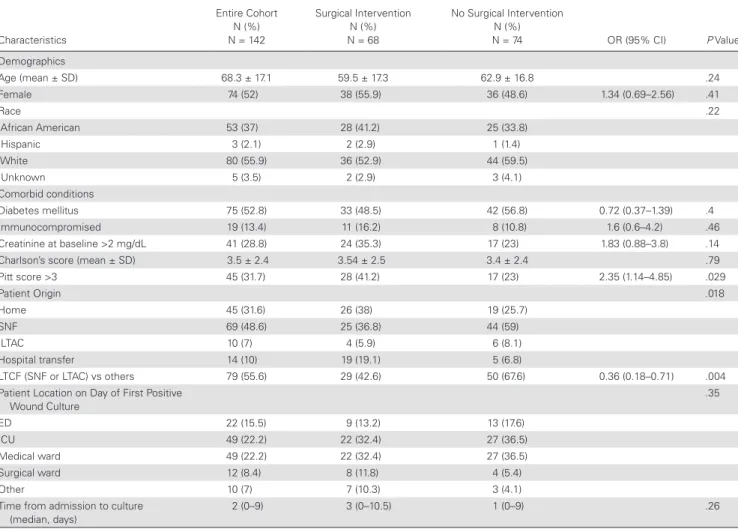
Surgical debridement was performed in 68 patients (48%), half of whom (n = 34) underwent debridement in the operat-ing room (Table 1). Forty-three of 62 infected patients (69.3%) underwent surgical debridement of the wound in comparison to 25 of 80 (31.2%) colonized patients (P < .001).
Predictors of surgical intervention in the bivariable anal-ysis are presented in Tables 1 and 2. In multivariable analy-sis (Table 3), independent predictors of surgical intervention included presence of SSI (odds ratio [OR], 9.60; 95% confi-dence interval [CI], 2.85–32.39) as well as SSTI without SSI (OR, 2.72; 95% CI, 1.13–6.53) (reference group for both was subjects without infection). Undergoing surgical intervention is less likely for those admitted from LTCF than those admitted from other sources (OR, 0.36; 95% CI, 0.18–0.71). This model was controlled for the confounding effects of isolating CRE from extremity wounds. In a subgroup analysis including only patients with SSTI (n = 62), admission from an LTCF remained associated with a decreased likelihood to undergo surgical debridement (OR, 0.18; 95% CI, 0.04–0.93).
Propensity-Adjusted Analysis of the Association Between Admission From a Long-Term Care Facility and Surgical Intervention
included Charlson’s score greater than 2, pressure ulcer wound type, polymicrobial culture, immunosuppression, and presence of SSI. In multivariable analysis controlling for the effects of propensity score, admission from an LTCF was no longer sig-nificantly associated with a decreased likelihood of undergoing surgical intervention (OR, 0.49; 95% CI, 0.22–1.11; P = .09). Outcomes and Surgical Intervention
Mortality and Worsened Discharge Disposition
Twenty-two (15.5%) patients died during hospitalization, and 41 patients (34% of those subjects who survived) required higher level of supportive care when they were discharged, compared with the care they required before admission.
In bivariable analysis, predictors of in hospital mortality included immunosuppression (OR, 8.38; 95% CI, 2.82–24.90), Pitt score greater than 3 (OR, 8.18; 95% CI, 2.93–22.87), and prolonged duration of hospitalization before the first posi-tive culture (median durations of 1 day, interquartile range [IQR] = 0–7 for survivors, and 15 days, IQR = 2–41 for those who died; P < .0001). Patients who were admitted from an LCTF were less likely to die (OR, 0.30; 95% CI, 0.11–0.80).
Associations between surgical intervention and in-hospi-tal morin-hospi-tality and between surgical intervention and worsened disposition at discharge in were not observed (OR = 1.14, 95% CI, 0.46–2.85 and OR = 0.73, 95% CI, 0.34–1.56, respectively in bivariable analyses). In a subgroup analysis of patients with SSTI (N = 62), surgical intervention was not associated with in-hospital mortality (OR, 1.05; 95% CI, 0.28–3.28).
Duration of Hospitalization
The median duration of hospitalization for the subjects in the cohort was 13 days (6.75–25.25). In bivariable analy-sis, surgical intervention was associated with an increased duration of hospitalization (P = .025). In multivariable anal-ysis, the impact of surgical intervention was evaluated, after controlling for the differences between those patients who underwent surgical debridement and those who did not (ie, controlled for admission from LTCF, Pitt score, wound loca-tion, wound type, and SSTI). Surgical intervention was not significantly associated with duration of hospitalization (ME, 1.1; 95% CI, 0.80–1.52).
Table 1. Demographic Characteristics of Cohort and Bivariable Analysis of Predictors of Surgical Intervention
Characteristics
Entire Cohort N (%) N = 142
Surgical Intervention N (%) N = 68
No Surgical Intervention N (%)
N = 74 OR (95% CI) P Value
Demographics
Age (mean ± SD) 68.3 ± 17.1 59.5 ± 17.3 62.9 ± 16.8 .24
Female 74 (52) 38 (55.9) 36 (48.6) 1.34 (0.69–2.56) .41
Race .22
African American 53 (37) 28 (41.2) 25 (33.8)
Hispanic 3 (2.1) 2 (2.9) 1 (1.4)
White 80 (55.9) 36 (52.9) 44 (59.5)
Unknown 5 (3.5) 2 (2.9) 3 (4.1)
Comorbid conditions
Diabetes mellitus 75 (52.8) 33 (48.5) 42 (56.8) 0.72 (0.37–1.39) .4
Immunocompromised 19 (13.4) 11 (16.2) 8 (10.8) 1.6 (0.6–4.2) .46
Creatinine at baseline >2 mg/dL 41 (28.8) 24 (35.3) 17 (23) 1.83 (0.88–3.8) .14
Charlson’s score (mean ± SD) 3.5 ± 2.4 3.54 ± 2.5 3.4 ± 2.4 .79
Pitt score >3 45 (31.7) 28 (41.2) 17 (23) 2.35 (1.14–4.85) .029
Patient Origin .018
Home 45 (31.6) 26 (38) 19 (25.7)
SNF 69 (48.6) 25 (36.8) 44 (59)
LTAC 10 (7) 4 (5.9) 6 (8.1)
Hospital transfer 14 (10) 19 (19.1) 5 (6.8)
LTCF (SNF or LTAC) vs others 79 (55.6) 29 (42.6) 50 (67.6) 0.36 (0.18–0.71) .004
Patient Location on Day of First Positive Wound Culture
.35
ED 22 (15.5) 9 (13.2) 13 (17.6)
ICU 49 (22.2) 22 (32.4) 27 (36.5)
Medical ward 49 (22.2) 22 (32.4) 27 (36.5)
Surgical ward 12 (8.4) 8 (11.8) 4 (5.4)
Other 10 (7) 7 (10.3) 3 (4.1)
Time from admission to culture (median, days)
2 (0–9) 3 (0–10.5) 1 (0–9) .26
Outcomes and Colonization Versus Infection Status
Outcomes were similar in the colonized and infected groups, although patients with infection had a significantly longer median duration of hospitalization than did colonized patients (14 [IQR, 9–41] and 11 [IQR, 6–22.5]; P = .01) (Supplementary Table 2).
DISCUSSION
To our knowledge, this study represents the largest pub-lished cohort of CRE soft tissue infection and/or colonization. Subjects in this cohort possessed a high severity of both chronic and acute illness, which is in line with other published studies Table 2. Clinical Characteristics and Management of Cohort, and Bivariable Analysis of Predictors of Surgical Intervention
Characteristics
Entire Cohort N (%) N = 142
Surgical Intervention N (%) N = 68
No Surgical Intervention N (%)
N = 74 OR (95% CI) P Value
Wound Type .057
Pressure ulcer 48 (33.8) 22 (32.4) 26 (35.1)
Postsurgical 41 (33) 26 (35.1) 21 (28.4)
Traumatic 5 (3.5) 4 (5.9) 1 (1.4)
Diabetic foot ulcers 12 (8.5) 9 (13.2) 3 (4.1)
Other 34 (23.9) 11 (16.2) 23 (31.1)
Wound location .034
Extremities 39 (27.5) 24 (35.3) 15 (20.3)
Sacrum 35 (24.6) 14 (20.6) 21 (28.4)
Abdomen 7 (4.9) 1 (1.5) 6 (8.1)
Other 61 (42.9) 29 (42.6) 32 (43.2)
SSTI, including SSI 62 (43.7) 43 (63.2) 19 (25.7) 4.97 (2.43–10.2) <.001
SSI, excluding other types of SSTIa 26 (24.5) 22 (46.8) 4 (6.8) 12.1 (3.77–38.81) <.001
Poly-microbial wound culture 97 (68.3) 43 (63.2) 54 (73) 0.64 (0.31–1.29) .28
Other sources of CRE in study patients .74
Urine 26 (16.2) 8 (11.8) 15 (20.3)
Respiratory 6 (4.2) 3 (4.4) 3 (4.1)
Blood 13 (9.2) 7 (10.3) 6 (8.1)
Other 2 (1.4) 1 (1.5) 1 (1.4)
Antimicrobial agents receive within 7 days of the positive culture
Tigecycline 58 (40.9) 25 (36.8) 33 (44.6) 0.72 (0.37–1.42) .39
Amikacin 15 (10.6) 6 (8.8) 9 (12.2) 0.70 (0.24–2.08) .59
Gentamicin 13 (9.2) 8 (11.8) 5 (6.8) 1.84 (0.57–5.93) .39
Colistin 13 (9.2) 6 (8.8) 7 (9.5) 0.93 (0.30–2.91) 1.0
TMP-SMZ 11 (7.8) 7 (10.3) 4 (5.4) 2.01 (0.56–7.19) .35
Ceftazidime/ avibactam 5 (3.5) 3 (4.4) 2 (2.7) 1.66 (0.27–10.26) .67
Received any antimicrobial 105 (73.9) 52 (76.5) 53 (71.6) 1.29 (0.61–2.74) .57
Received at least 1 effective antimicrobial 69 (48.6) 34 (50.0) 35 (47.3) 1.11 (0.58–2.15) .87
Received >1 effective antibiotic 17 (12.0) 7 (10.3) 10 (13.5) 0.73 (0.26–2.05) .61
Antimicrobial Resistance Phenotypes
Tigecycline resistance 38 (40.4) 19 (41.3) 19 (39.6) 1.07 (0.47–2.45) 1.0
Amikacin resistance 28 (33.3) 16 (42.1) 12 (26.1) 2.06 (0.82–5.17) .16
Gentamicin resistance 66 (47.8) 30 (45.5) 36 (50) 0.83 (0.43–1.63) .61
Colistin resistance 7 (10.9) 2 (5.4) 5 (18.5) 0.25 (0.04–1.41) .12
TMP-SMZ resistance 91 (65.9) 41 (63.1) 50 (68.5) 0.79 (0.39–1.59) .59
Molecular data (n = 45)
repPCR Clone Type .87
Clone A 15 (33.3) 6 (30) 9 (36)
Clone B 18 (40) 8 (40) 10 (40)
Other clones 12 (26.7) 6 (30) 6 (24)
Carbapenemase Gene .92
blaKPC-2 19 (42.2) 8 (40) 11 (44)
blaKCP-3 21 (46.7) 10 (50) 11 (44)
Negative 5 (11.1) 2 (10) 3 (12)
Abbreviations: CI, confidence interval; CRE, carbapenem-resistant Enterobacteriaceae; OR, odds ratio; PCR, polymerase chain reaction; SSI, surgical-site infection; SSTI, skin and soft tissue infection; TMP-SMZ, trimethoprim-sulfa-methoxazole.
of other types of CRE infection [16, 27]. Of particular interest, the majority of patients arrived from LTCFs, which has been reported in other studies [28, 29] and raises concerns regarding interfacility CRE spread.
It is notable that outcomes of patients with CRE wound infec-tion and/or colonizainfec-tion were generally very poor. Approximately 16% of subjects died during hospitalization, and approximately one half of subjects who survived were discharged to a location where they needed more supportive care compared with the one from which they were admitted. The degree to which these poor outcomes were attributable to CRE as opposed to other compet-ing conditions is not yet apparent. Nevertheless, these outcomes are very serious because the burden suffered from CRE SSTIs is high. Abboud et al [8] described a cohort of 33 patients with postsurgical mediastinitis due to CRE, mainly CRKP. The mor-tality rate was higher in their cohort (33%) probably due to the poor outcomes associated with mediasinits [8].
We observed that approximately one half of subjects under-went surgical debridement. Surgical debridement, which involves the removal of foci of infection and necrotic or nonvi-able tissue, is widely recognized as an important component of the wound healing process [13, 30, 31].
It is interesting to note that subject admitted from an LTCF were significantly less likely to undergo debridement com-pared with subjects admitted from other sites. This association remained statistically significant in subanalysis restricted to subjects with infection, and it trended toward statistical signifi-cance in propensity-adjusted multivariable analysis of the entire study cohort. The reason for this association is not clear, but it might relate in part to an increased likelihood of debridement for SSI compared with other types of SSTIs (patients with SSI were significantly more likely to undergo debridement com-pared with patients with other types of SSTI [OR, 3.93; 95% CI, 1.12–13.78]) and the greater incidence of SSI in the non-LTCF population (28.6%) compared with the non-LTCF population (10.1%). Nevertheless, in multivariable analysis, after controlling for SSI, the LTCF population remained significantly less likely to undergo debridement. Other explanations might be a decreased clinical need for therapeutic debridement in LTCF subjects (pos-sibly due to wound care performed in the LTCF) and/or a bias
by clinicians to avoid surgical intervention in LTCF subjects. Such a bias might be due to a perception by clinicians that LTCF subjects were poor operative candidates and/or that clinical outcomes were poor for this group regardless of them receiv-ing surgical intervention. This bias towards LTCF patients might not have been fully accounted for by other variables in the study (such as Charlson Score and Pitt Bacteremia Score).
Another possibility why LTCF patients might have been less likely to undergo debridement is that there were differences in the virulence of copathogens isolated with CRE from subjects living in an LTCF, SNF, or LTAC compared with community dwellers.
Debridement is an important component of management of both infected and noninfected wounds. Because removal of infected foci of CRE infection has been associated with improved clinical outcomes (such as mortality) [31], it is important that LTCF subjects are objectively and thoroughly evaluated for sur-gical debridement of infected wounds.
Our study has some limitations. As a nested cohort study, the analysis was not designed primarily to evaluate SSTIs and there-fore lacked data pertaining to wound healing and staging. In addition, the retrospective nature of our review precluded the ability to assess patients’ functional status and clinical progress. Moreover, only a minority of study isolates were available for molecular analysis.
CONCLUSIONS
In summary, this study demonstrated that a large proportion of the cohort was admitted from LTCFs, and debridement of wounds occurred at a lower frequency in this population com-pared with the population of patients not admitted from LTCFs. This finding has potential importance from not only a clinical management perspective but also from an infection prevention perspective, because wounds can serve as mobile reservoirs for CRE, facilitating dissemination of CRE across healthcare set-tings. In future studies, prospectively identified and monitored cohorts could provide important information regarding the impact CRE SSTIs and the role of surgical debridement in CRE-SSTI cure, particularly among patients admitted from LTCFs.
Supplementary Data
Supplementary materials are available at Open Forum Infectious Diseases
online. Consisting of data provided by the authors to benefit the reader, the posted materials are not copyedited and are the sole responsibility of the authors, so questions or comments should be addressed to the corre-sponding author.
Acknowledgments
Disclaimer. The content is solely the responsibility of the authors and
does not necessarily represent the official views of the National Institutes of Health.
Financial support. This work was funded in part by the National
Institute of Allergy and Infectious Diseases of the National Institutes of Health under the following award numbers: UM1AI104681 (to V. G. F.); R01AI100560, R01AI063517, R01AI072219 (to R. A. B.); and R21AI114508 (to R. A. B. and D. v. D.). V. G. F. was also funded by the National Institute
Table 3. Multivariable Analysis: Independent Predictors of Surgical Intervention
Predictors Adjusted OR 95% CI P Value
Admission from an LTCF 0.43 0.20–0.95 .036
SSI 9.60 2.84–32.48 <.0001
SSTI without SSIa 2.72 1.13–6.53 .03
Pitt score >3 2.27 0.97–5.26 .058
Extremities 2.19 0.88–5.36 .085
Abbreviations: CI, confidence interval; LTCF, long-term care facility; OR, odds ratio; SSI, surgical-site infection; SSTI, skin and soft tissue infection.
of Health : National Institute of Allergy and Infectious Diseases (NIH, NIAID) K24-AI093969. This study was supported in part by funds and/ or facilities provided by the Cleveland Department of Veterans Affairs ([VA] Award Number 1I01BX001974; to R. A. B.) from the Biomedical Laboratory Research and Development Service of the VA Office of Research and Development and the Geriatric Research Education and Clinical Center VISN 10 (to R. A. B.). K. S. K. was funded by the National Institute of Allergy and Infectious Diseases (DMID Protocol Number: 10-0065 and R01-AI119446-01). S. S. R. received research funding from bioMérieux, BD Diagnostics, Biofire, Opgen, Nanosphere, and Roche.
Potential conflict of interest. All Authors: No reported conflicts of
interest. All authors have submitted the ICMJE Form for Disclosure of Potential Conflicts of Interest. Conflicts that the editors consider relevant to the content of the manuscript have been disclosed.
References
1. Bowler PG, Duerden BI, Armstrong DG. Wound microbiology and associated approaches to wound management. Clin Microbiol Rev 2001; 14:244–69. 2. Halbert AR, Stacey MC, Rohr JB, Jopp-McKay A. The effect of bacterial
coloniza-tion on venous ulcer healing. Australas J Dermatol 1992; 33:75–80.
3. Akers KS, Mende K, Cheatle KA, et al. Biofilms and persistent wound infections in United States military trauma patients: a case-control analysis. BMC Infect Dis
2014; 14:190.
4. Donlan RM, Costerton JW. Biofilms: survival mechanisms of clinically relevant microorganisms. Clin Microbiol Rev 2002; 15:167–93.
5. Vuotto C, Longo F, Balice MP, et al. Antibiotic resistance related to biofilm forma-tion in Klebsiella pneumoniae. Pathogens 2014; 3:743–58.
6. Antibiotic Resistance Threats in the United States, 2013. Available at: https:// www.cdc.gov/drugresistance/threat-report-2013/pdf/ar-threats-2013-508. pdf#page=11. Accessed 24 August 2017.
7. Lerner A, Solter E, Rachi E, et al. Detection and characterization of carbapene-mase-producing Enterobacteriaceae in wounded Syrian patients admitted to hos-pitals in northern Israel. Eur J Clin Microbiol Infect Dis 2016; 35:149–54. 8. Abboud CS, Monteiro J, Stryjewski ME, et al. Post-surgical mediastinitis due to
carbapenem-resistant Enterobacteriaceae: clinical, epidemiological and survival characteristics. Int J Antimicrob Agents 2016; 47:386–90.
9. Rana MM, Sturdevant M, Patel G, Huprikar S. Klebsiella necrotizing soft tissue infections in liver transplant recipients: a case series. Transpl Infect Dis 2013; 15:E157–63.
10. Bhat V, Gupta S, Kelkar R, et al. Bacteriological profile and antibiotic suscepti-bility patterns of clinical isolates in a tertiary care cancer center. Indian J Med Paediatr Oncol 2016; 37:20–4.
11. Renner R, Sticherling M, Rüger R, Simon J. Persistence of bacteria like Pseudomonas aeruginosa in non-healing venous ulcers. Eur J Dermatol 2012; 22:751–7.
12. Johnston BR, Ha AY, Kwan D. Surgical management of chronic wounds. R I Med J (2013) 2016; 99:30–3.
13. Wilcox JR, Carter MJ, Covington S. Frequency of debridements and time to heal: a retrospective cohort study of 312 744 wounds. JAMA Dermatol 2013; 149:1050–8.
14. Wong SY, Manikam R, Muniandy S. Prevalence and antibiotic susceptibility of bacteria from acute and chronic wounds in Malaysian subjects. J Infect Dev Ctries
2015; 9:936–44.
15. Howell-Jones RS, Wilson MJ, Hill KE, et al. A review of the microbiology, anti-biotic usage and resistance in chronic skin wounds. J Antimicrob Chemother
2005; 55:143–9.
16. van Duin D, Perez F, Rudin SD, et al. Surveillance of carbapenem-resistant Klebsiella pneumoniae: tracking molecular epidemiology and outcomes through a regional network. Antimicrob Agents Chemother 2014; 58:4035–41.
17. CDC/NHSN Surveillance Definition of Healthcare-Associated Infection and Criteria for Specific Types of Infections in the Acute Care Setting. Available at: https://www.cdc. gov/nhsn/pdfs/pscmanual/17pscnosinfdef_current.pdf. Accessed 24 August 2017. 18. Charlson ME, Pompei P, Ales KL, MacKenzie CR. A new method of classifying
prognostic comorbidity in longitudinal studies: development and validation. J Chronic Dis 1987; 40:373–83.
19. Neuner EA, Yeh JY, Hall GS, et al. Treatment and outcomes in carbapenem-resistant Klebsiella pneumoniae bloodstream infections. Diagn Microbiol Infect Dis 2011; 69:357–62.
20. Hauck C, Cober E, Richter SS, et al. Spectrum of excess mortality due to car-bapenem-resistant Klebsiella pneumoniae infections. Clin Microbiol Infect 2016; 22:513–9.
21. Chertow DS, Memoli MJ. Bacterial coinfection in influenza: a grand rounds review. JAMA 2013; 309:275–82.
22. Endimiani A, Hujer AM, Perez F, et al. Characterization of blaKPC-containing Klebsiella pneumoniae isolates detected in different institutions in the Eastern USA. J Antimicrob Chemother 2009; 63:427–37.
23. Versalovic J, Koeuth T, Lupski JR. Distribution of repetitive DNA sequences in eubacteria and application to fingerprinting of bacterial genomes. Nucleic Acids Res 1991; 19:6823–31.
24. Zhou T, Zhang X, Guo M, et al. Phenotypic and molecular characteristics of carbapenem-non-susceptible Enterobacteriaceae from a teaching hospital in Wenzhou, southern China. Jpn J Infect Dis 2013; 66:96–102.
25. Diancourt L, Passet V, Verhoef J, et al. Multilocus sequence typing of Klebsiella pneumoniae nosocomial isolates. J Clin Microbiol 2005; 43:4178–82.
26. Kaye KS, Engemann JJ, Mozaffari E, Carmeli Y. Reference group choice and anti-biotic resistance outcomes. Emerg Infect Dis 2004; 10:1125–8.
27. Temkin E, Adler A, Lerner A, Carmeli Y. Carbapenem-resistant Enterobacteriaceae: biology, epidemiology, and management. Ann N Y Acad Sci 2014; 1323:22–42. 28. Marchaim D, Chopra T, Bogan C, et al. The burden of multidrug-resistant
organ-isms on tertiary hospitals posed by patients with recent stays in long-term acute care facilities. Am J Infect Control 2012; 40:760–5.
29. Bhargava A, Hayakawa K, Silverman E, et al. Risk factors for colonization due to carbapenem-resistant Enterobacteriaceae among patients exposed to long-term acute care and acute care facilities. Infect Control Hosp Epidemiol 2014; 35:398–405.
30. Cardinal M, Eisenbud DE, Armstrong DG, et al. Serial surgical debridement: a retrospective study on clinical outcomes in chronic lower extremity wounds. Wound Repair Regen 2009; 17:306–11.